


The study aims to examine the YouTube videos of Malaysia and Indonesia’s education systems to determine what connections exist among curriculum, teacher, accessibility and equity.
Data included YouTube videos about the education system in Malaysia and Indonesia. The most influential YouTube videos about the education systems in Malaysia and Indonesia were first identified through social network analysis. Four videos with the highest betweenness centrality were selected from 100 videos related to the Malaysian education system, whereas the other four videos were selected from 95 videos related to the Indonesian education system, respectively. Transcripts of these videos were qualitatively coded through thematic analysis to study the Malaysian and Indonesian education systems. Epistemic network analysis was then applied to identify the strength of relationships between nodes that emerged from the inductive thematic analysis of the selected YouTube video transcriptions.
Epistemic network analysis revealed that the network model in Malaysia had the greatest connection between equity and curriculum. The network model in Indonesian demonstrated the greatest connection between curriculum and teacher.
The article will contribute to the knowledge about the issues related to Malaysia and Indonesia’s education systems by analyzing the most transcriptions from the most influential YouTube videos and identifying the connections among curriculum, teacher, accessibility and equity.
Introduction
Indonesia and Malaysia, as two neighboring countries in the Association of Southeast Asian Nations (ASEAN) region, have close political, economic, historical and cultural ties. Both experienced the same period of colonization by Europeans, which shaped many similarities in their development. After independence, both countries faced great challenges in nation-building and shaping national identity, including the establishment of national education systems to strengthen identity and develop human resources. Their cultures also have similarities, especially in the influence of religion and traditional values such as kinship, hospitality and gotong royong. This is reflected in the education system, which reflects the values of the people. Intertwined histories and cultures play an important role in shaping education policies in both countries.
Education is one of the most important aspects of a country’s development (Rabindarang et al., 2015; Mustari & Mohamad dan Rahman, 2014). Indonesia and Malaysia, two countries with similar education policies and ASEAN values but different national incomes, face similar challenges in education. Both Indonesia and Malaysia face challenges in access to education due to socioeconomic factors such as poverty, gender inequality and disability, which can limit access to education for certain groups (Rupita, 2019).
Education in Malaysia and Indonesia
Indonesia and Malaysia have similarities in several education policies, as reflected in Law No. 20 of 2003 on the National Education System in Indonesia and the Malaysian Education Development Plan (PPPM) 2013–2025. Both countries aim to provide quality education for all their citizens as a key to achieving national progress and prosperity. Additionally, education in both countries aims to foster a sense of nationalism, literacy and numeracy in students (Chang & Kho, 2017; Susilawati & Sarifuddin, 2021). The main education policy is set by the central government in both countries, and the education structure is similar, starting from primary to senior secondary education (Aslan, 2019; Syakhrani et al., 2022; Wicaksono, 2021). The curricula implemented in both countries also have many similarities, focusing on developing students’ competencies in various fields as well as promoting multilingualism and character education (Mardhiyah, Aldriani, Chitta, & Zulfikar, 2021; Marta, 2015; Osman, Soh, & Arsad, 2010).
Despite their similar educational goals, the education systems in Malaysia and Indonesia have different yet complementary approaches to improving educational quality. Previous research comparing the education systems of these two countries indicates that the essence of education in both Malaysia and Indonesia is quite similar, aiming to enhance students’ knowledge, attitudes and skills. Malaysia focuses more on developing students’ skills with a crucial role for teachers, while in Indonesia, school principals emphasize forming quality improvement teams and creating a comfortable work environment (Afida, Putri, Syahada, Junianti, & Sofiani, 2024; Rizkita et al., 2020).
In a report from the Asian Development Bank (2019) titled “Education in Indonesia/Malaysia: Achievements, Challenges, and Opportunities,” Indonesia and Malaysia also face similar challenges in education access and quality. However, both countries continue to make efforts to improve the quality of education through curriculum changes, improving teacher quality and using technology in learning. Additionally, Indonesia and Malaysia both have an Islamic education system integrated with the national education system (Haryanto, 2015), apply a student-centered approach in learning and use Malay/Indonesian as the main language of instruction in education, with English as a second language (Chusnu, 2018; Gill, 2002; Marisa, 2021; Thirusanku & Melor, 2012). Assessments are also used in both countries to measure student learning achievement and monitor overall educational development.
The two countries, Indonesia and Malaysia, are similar in several aspects based on Hofstede’s ASEAN Value. First, in the power distance dimension, students in both countries tend to respect and trust the authority of teachers (Abdullah, 1996; Asma, 2006; Subiyanto & Susanto, 2021). Second, in the individualism/collectivism dimension, Indonesia is considered a collectivist country, where individuals conform to the group, while Malaysia is more individualistic with highly caring individuals. Third, in terms of uncertainty avoidance, both Indonesia and Malaysia face the challenges of changing education policies, uncertainty about future employment and rapid technological advances (Hofstede, 1984; Oishi, 2010).
Furthermore, in the feminine/masculine dimension, both have a moderate level of dimension, where females tend to have higher learning achievement than males and choose majors related to feminine values, while males tend to choose majors related to masculine values (Charisma, Heldayani, & Tanzimah, 2022; Rosdianti, 2016). Fifth, in the indulgence dimension, both Indonesia and Malaysia have moderate levels of the dimension, where the focus on academic achievement remains high and schools offer various extracurricular activities to develop students’ skills (Pakaya, Posumah, & Dengo, 2021). Lastly, in the time-term orientation dimension, students in both countries are motivated to study and plan their careers to achieve long-term goals while internalizing moral values such as discipline and hard work.
While Indonesia and Malaysia share many similarities in education policies and ASEAN-related values, the stark differences in the 2022 PISA test results highlight the disparity in education quality between the two. The latest data shows that Malaysia consistently recorded higher average scores than Indonesia in all test areas measured. According to the PISA 2022 report shared by DetikEdu, Malaysia outperformed Indonesia in all test areas. In the reading test, Malaysia managed to gain an advantage of 47 points. In math, Malaysia also stood out with a difference of 21 points from Indonesia. While in the science test, Malaysia is even far superior with a difference of 56 points.
The data illustrates a stark gap in educational achievement between the two countries, which then raises the interesting question of what factors cause the difference in the quality of education between Indonesia and Malaysia, despite their many similarities in educational policies and cultural values. To answer this question, further research is needed to identify the main factors that influence the quality of education in both countries.
Methodology
This study involved social network analysis (SNA) approach as a starting point to choose the YouTube videos that represent the Malaysian and Indonesian educational system, followed by epistemic network analysis (ENA) to identify the strength of the relationship between nodes that emerged from the inductive thematic analysis of the selected YouTube video transcriptions.
YouTube allows individuals to share, upload and comment on videos at the same time teachers and educators can make practical and effective use of it to the best, as it is great that students can enjoy benefits or gain profit (Pratama et al., 2020). Users can access a variety of video, including educational videos, news and entertainment content (Dabamona & Yunus, 2022; Pratama et al., 2020). Due to its vast content and easy accessibility, YouTube has proven to be a valuable supplementary tool in educational systems and learning environments. It is useful for enhancing visual and auditory understanding of tangible objects that are otherwise inaccessible in physical settings as well as aiding the comprehension of abstract concepts without a physical form (Moghavvemi, Sulaiman, Jaafar, & Kasem, 2018). The findings of the same study align with participant perspectives, highlighting YouTube’s ability to balance the key elements of storytelling such sound and visuals (Dreon, Kerper, & Landis, 2011). Scholars have also claimed that the platform has been leveraged for research (Hunsinger, Allen, & Klastrup, 2020; Lu, 2023; Sloan & Quan-Haase, 2016). Therefore, it is believed that YouTube serves as an appropriate platform to share information and discuss the education policies (Shoufan & Mohamed, 2022).
SNA is a methodological approach to studying social structures through the use of networks and graph theory. It involves mapping and measuring relationships and flows between people, groups, organizations, computers, URLs and other connected information/knowledge entities. The nodes in the network are the actors (such as individuals or organizations), and the ties or edges represent the relationships or interactions between these actors. In this study, SNA on YouTube video network analysis is done based on the Application Programming Interface (API) YouTube data. Two separate data extraction procedures were done under the keywords “Malaysian Education System” and “Indonesia Education System,” which were translated to the local language to ensure the YouTube videos are being made by local people which represent the voices of Malaysian and Indonesian citizens. Once the API YouTube data have been collected, SNA is done to identify YouTube videos that relatively have higher values of betweenness centrality. Data were extracted with the keyword search, and the results of the video search were filtered based on video only and relevance. Based on the data crawling via SNA, four videos were selected from a pool of 100 videos related to the Malaysian education system, whereas the other four videos were chosen from a pool of 95 videos related to the Indonesian education system, respectively. The selection of the eight videos was made based on their highest betweenness centrality among the rest, with each of the four topping the list of Malaysian and Indonesian education systems. Table 1 displays the eight selected videos with their respective descriptions of content and betweenness centrality value. Those videos are transcribed into the qualitative text format for the preparation of the next method, which is epistemic network analysis (ENA). ENA is a method for identifying and quantifying connections among elements in coded data and representing them in dynamic network models. It allows researchers to compare different networks visually and through summary statistics that reflect the weighted structure of connections. A key feature of ENA is that it enables users to see the original data that contributed to each connection in the network representation. Once possible codes have been identified through inductive thematic analysis, the codes are used as a basis for forming a network model produced by web-based ENA software.
Most influential YouTube videos in Malaysia and Indonesia
| YouTube | Country | Description | Betweenness centrality |
|---|---|---|---|
| Video 1 | Indonesia | This YouTube video discusses the challenges within the Indonesian education system. It suggests that the current educational curriculum is outdated and not in sync with the rapid advancements of the modern world. The video argues that the education system forces students to prepare for jobs that will soon become obsolete and questions the solution to this issue | 305.976 |
| Video 2 | Indonesia | The YouTube video provides an in-depth analysis of the factors contributing to the low quality of education in Indonesia. It appears to be a critical commentary on the Indonesian education system, highlighting systemic issues that hinder educational progress in the country. The content creator encourages viewers to consider these issues as a matter of opinion, possibly suggesting that there are multiple perspectives on the topic. The video seems to be an important contribution to the ongoing discourse on education in Indonesia, aiming to provoke thought and discussion among its audience | 265.577 |
| Video 3 | Indonesia | The YouTube video discusses the challenges faced by the Indonesian education system. It highlights the low ranking of Indonesia’s education on a global scale and explores the root causes of this issue. It seems to be part of a broader conversation about the need for educational reform in Indonesia, encouraging viewers to understand and address the underlying problems within the system | 194.697 |
| Video 4 | Indonesia | The YouTube video presents a discussion on the future roadmap for Indonesia’s education system from 2020 to 2035. It features Indonesian President Joko Widodo and his cabinet conducting a virtual meeting to address the anticipated changes and developments in the educational landscape | 186.250 |
| Video 5 | Malaysia | This YouTube video talks about vernacular schools in Malaysia are educational institutions where non-national languages, such as Mandarin and Tamil, are used as the medium of instruction. These schools play a crucial role in preserving Chinese and Indian cultures within Malaysia’s multicultural society | 297.700 |
| Video 6 | Malaysia | This video is about the seven main pillars that the Malaysian Ministry of Education (Kementerian Pendidikan Malaysia, KPM) focuses on to enhance the country’s education system, which consist effective communication between the ministry and schools, cultivation of good manners, ethics and integrity, issues of multidimensional poverty among students, educational dropout issues as well as literacy and numeracy problems, welfare of teacher, upgrading schools with poor infrastructure, particularly in Sabah and Sarawak and increasing the digital education capabilities | 127.863 |
| Video 7 | Malaysia | This video is about a forum that discuss the use of English language in Malaysian Education system that particularly the use of pushing the English language to teach Science and Mathematics in Malaysian schools is a contentious one, with strong arguments on both sides | 25.733 |
| Video 8 | Malaysia | This video is about how Malaysian education system can be improved based on the best practices of Finland education system | 21.727 |
Source(s): Table by authors
Results and discussion
The results of social network analysis using NodeXL Pro for the Indonesian and Malaysian education system
In this study, the focus of YouTube video analysis is based on the value of betweenness centrality. Betweenness centrality is a measure of how important a node is in a network based on how often it lies on the shortest paths between other nodes. It can be used to identify nodes that act as bridges or brokers between different groups or clusters in a network. Nodes with high betweenness centrality can have more influence, control or access to information than others. Based on this principle, this research listed four YouTube videos which demonstrated relatively high betweenness centrality when the search query is “Indonesian Educational System.” This research also listed four YouTube videos (Table 1) with similar indicators when the search query is “Malaysian Education System.”
Through indicative thematic analysis on the transcription of the selected YouTube videos, the findings discovered four shared themes which served as the codes for building the models, which are (1) accessibility, (2) curriculum, (3) equity and (4) teacher. Based on ENA, the following two models are produced (see Figure 1).
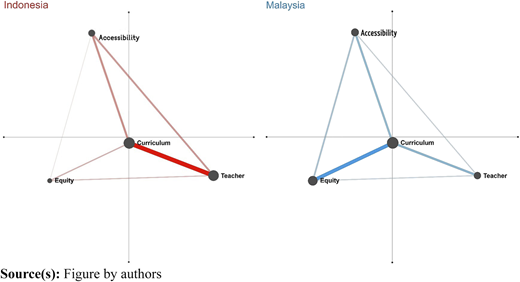
The model for Indonesia indicates a strong connection between curriculum and teacher, followed by a less strong connection between accessibility and teacher and accessibility and curriculum. The strongest connection between curriculum and teacher due to YouTube videos that had the highest betweenness centrality talks about the quality of teachers, teachers salaries and the responsibility of teachers to deliver the curriculum effectively.
The model for Malaysia emphasizes a three-way connection among curriculum, equity, accessibility and teachers. The tripartite connection originated from the four most prominent social media influencers engaging in discussions about educational issues concerning Malaysia’s education system. The topics of discussion from most influential to the least – are on Vernacular Schools, Teaching Mathematics and Science in English, Seven Education Policy in Malaysia and Lessons from Finland for Malaysian education.
The curriculum has the strongest connection with equity in the tripartite connection, followed by equitable relationships with accessibility and teachers. Nevertheless, the interconnection between equity, accessibility and teachers also exists, as shown in the faint connection line. This connection, though subtle, highlights Malaysia’s commitment to delivering a curriculum that aims to offer equitable, accessible and high-quality education to all.
The ENA model comparison, as illustrated in Figure 2 indicated that relatively there is a stronger connection between curriculum and equity for the Malaysia model. Whereas there is a stronger connection between curriculum and equity for the Indonesia model.
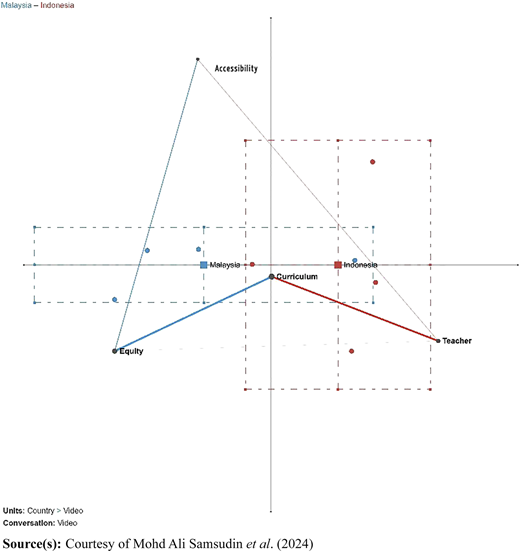
Equity in the Malaysian model education system has been a decade-long issue – thick line between curriculum and equity, indicating that these two aspects/variables. As highlighted in the excerpt from the transcription, the issue of equity emerged from the existence of vernacular schools in the Malaysia education system.
This vernacular school is actually a school that uses language mother tongue as the medium of instruction For example, if we go to school our Malays use the Malay language at school Chinese use Chinese schools Indian schools use Tamil language
The vernacular school system in Malaysia has been controversial, with national integration a focal point (Ong & Chibundu, 2018). The primary issue is the absence of unity within the nation’s multi-ethnic populace caused by limited interaction among students from various socioeconomic, religious and ethnic backgrounds. This hinders the development of mutual understanding, acceptance and appreciation of differences as well as a common set of experiences and goals for Malaysia’s future. The matter has been debated whether vernacular schools should coexist with national schools in Malaysia. It is argued that the use of mother tongue as the medium of instruction in vernacular schools has been seen as an obstacle to the road of unity among Malaysians. Vernacular schools have been perceived as the cause of segregation among ethnic groups in the country.
Vernacular Schools now still exist Mostly, this Vernacular school is always being pushed by the leaders politics or any organization that says This vernacular school is the cause of the groups of Malaysians not united among races. Because, in the Chinese Vernacular School they use the language Chinese In Tamil Vernacular Schools use Tamil and Malay-Malay Jadi, Chinese, Tamils and Malay-Malay Jadi, Chinese, Tamils and Malays they do not interact with each other regularly.
The issues of equity are based on the demand of political leaders from different races to maintain their schools, as each race has their own right to preserve their culture. Although some advocates have called for the abolishment of vernacular schools, such an act will lead to serious repercussions for the local multiracial communities. For example, leaders of Chinese and Indian political parties staunchly oppose the abolition of vernacular schools, citing the need to protect their historical and culturally significant educational institutions. They argue that these schools play a vital role in preserving their respective cultural values and practices.
But, if the Vernacular School is abolished the leaders from the Chinese and even the Indians mostly refused Vernacular schools were abolished because they said their culture this will be eliminated or marginalized and so on And, they also actually ask for them said if it is made into one stream of One Stream School Religious schools don't even need to exist. If we want to fight for a One Stream School that for replacing the Vernacular School we should ensure one answer which remains in safeguarding the interests of the Malays and also does not marginalize the interests of the Chinese and also Indian
Citizens share this concern, fearing that the elimination of vernacular schools would lead to a decline in the appreciation and perpetuation of their cultures and ethnic identities, thereby jeopardizing their societal status. Viewing the issue from an optimistic view (Embong, 2018), one can argue that vernacular schools play a role in promoting equity among different ethnic groups by enabling each primary ethnic group to maintain their culture, language, and traditions. According to Salleh et al. (2014), the 1966 Education Act stipulates that “there shall be no discrimination against any citizen in the education system.” In other words, Malaysia’s national educational policy, as argued by Salleh et al. (2014), focuses on supporting equal education rights and giving equal educational opportunities for all school-age children.
The relationship between curriculum and accessibility, as discussed on social media, involves the importance of language in acquiring knowledge. Scholars have debated whether to use the mother tongue or English as the medium of instruction for learning science and mathematics in countries where English is not the national language, including Malaysia.
There are sentiments and fears when we study science, mathematics and all other subjects in the language English. It seems like it will affect the mastery Malay language.
the teaching of English and learning English in science and mathematics is not accepted by a group of people because it was felt that mastery of science and mathematics more effective in the mother tongue because of the concepts this is a native concept in student knowledge and it is good if it is learned in the mother tongue.
Wildsmith-Cromarty & Gordon (2009) discovered multiple intricacies related to utilizing the native language for conveying scientific and mathematical information. These included unfamiliar terms that raise the issue of standardization, prompting a preference for using English terminology with explanations in the native language. Similar results were observed in Malaysian research when the decision to teach science and mathematics in English (PPSMI) was put into effect from 2002 to 2011. Other issues that emerged from teaching science and mathematics in English are the lack of suitable teaching materials and the competencies of teachers who have long taught science and mathematics in English prior to 2002.
I was surprised when I went to the schools this. They (teachers) teach English using Malay. Not only Bahasa Melayu, using local language, if in Kelantan, how do we want to learn English using Guano Muni. Kelantan language. Kelantan dialect. And also in Chinese schools, also use Mandarin to teach English.
In Malaysia, some parties believed that teaching science and technology in a universal language would enhance the international competitiveness of Malaysian graduates in these fields by promoting familiarity and ease of understanding of scientific terminologies and concepts, particularly at the tertiary level. The use of a universal language such as English in teaching science and mathematics allows students of various races to access knowledge by using the language as the medium of instruction, promoting equity.
If we want to learn maybe in things technology and science, maybe we need to learn languages. So, we should use that language because we are want to gain knowledge in that language.
At the same time, lack of proficiency in the universal language may hinder access to current scientific and technological information.
One of the reasons for this policy or policy of teaching Science and Math in English is rejected is a matter of student's unpreparedness
Therefore, in this scenario, equity acts as a double-edged sword in promoting accessibility.
Next, results from ENA demonstrated a darker line weight between curriculum and teacher in Indonesian model, demonstrating a stronger connection between curriculum and teacher.
Excerpt from the transcription in the videos related to Indonesia education system highlighted the usefulness of lessons in preparation for work. In Indonesia, lessons are still taught without the consideration of needs and trends in the future. As a result, graduates face difficulty when applying for job, as there is a great disparity between what is taught at schools and what is needed at work. Second, the issue of teacher qualification emerged prominently within the network discussions. It was highlighted that the overall quality of teachers in Indonesia remains low. Participants in the discussions expressed concern that inadequately qualified teachers struggle to effectively manage their classrooms and provide high-quality instruction. Consequently, they argued that students pose a considerable challenge due to the perceived insufficiency of competence and preparedness among teachers.
Discussion
YouTube has emerged as a crucial platform for meeting information and educational needs, evidenced by its ability to disseminate educational materials and effectively engage users. With its ease of understanding, reliability and practical benefits, YouTube serves to bridge information gaps and enhance accessibility and comprehension of complex educational issues, making it a valuable tool in academic and global educational discourse (Jusmaniar, Genggong, & Kamil, 2022; Pratama et al., 2023). This study demonstrates that YouTube functions not only as a learning medium but also as a tool to broaden public understanding of the education systems in Malaysia and Indonesia. The research identifies how YouTube videos can facilitate in-depth discussions about educational policies and the challenges faced by the education systems in both countries.
Alongside this role, SNA on YouTube videos can provide deeper insights into the structure and dissemination of information on the platform. The SNA in this study focuses on the concept of centrality in SNA. Centrality measures the importance or influence of a node within the network. The underlying theory that justifies the concept of centrality is structural hole theory introduced by Burt (1995). It refers to a gap between two individuals who have complementary sources of information. Structural hole theory can be applied in YouTube video network analysis by identifying creators or channels that act as bridges between different communities or genres on the platform. These bridging positions are advantageous because they control key information diffusion paths, allowing for the spread of content and ideas across diverse groups. SNA on YouTube videos linked by shared commenters is a method used to understand and visualize the relationships between videos based on the interactions of users who comment on them. Using this data, a co-commenter network is created. This network represents videos as nodes, and the shared commenters between videos are represented as edges connecting these nodes.
Malaysia
The model for Malaysia emphasizes a three-way connection among curriculum, equity, accessibility and teachers. The tripartite connection originated from the four most prominent social media influencers engaging in discussions about educational issues concerning Malaysia’s education system. The topics of discussion from most influential to least are Vernacular Schools, Teaching Mathematics and Science in English, Seven Education Policy in Malaysia and Lessons from Finland for Malaysian education.
The curriculum has the strongest connection with equity in the tripartite connection, followed by equitable relationships with accessibility and teachers. Nevertheless, the interconnection between equity, accessibility and teachers also exists, as shown in the faint connection line. This connection, though subtle, highlights Malaysia’s commitment to delivering a curriculum that aims to offer equitable, accessible and high-quality education to all.
Malaysia is a multicultural country with three main ethnic groups: Malay, Chinese and Indian as well as other minority races. Vernacular schools developed in the 1960s utilize the mother tongue as the primary language of instruction to maintain the culture and heritage of a particular ethnic group, as described in the YouTube – “But, if the Vernacular School is abolished the leaders from the Chinese and even the Indians mostly refused the abolishment of Vernacular schools because they said their culture this will be eliminated or marginalized and so on.”
It is well established that effective delivery of the curriculum depends on the teachers’ competences that have direct impacts on students’ learning. The connection between the curriculum and teachers in social media discussion demonstrates this relationship. The YouTube video analysis suggests that teachers in Malaysia should emulate the practices of Finland education by emphasizing kindness and avoiding harshness. This competency pertains to teacher-student relationships. According to Pennings et al. (2018), teachers need to be trained to become aware of potential (in)effective interaction patterns that could lead to confrontation and possible directions to change may be a first step in improvement. Thus, the development of interpersonal skills among teachers and students should not be left to chance (Majid, 2017). Thus, proficiency in interpersonal skills should be a fundamental competency for both teachers and students, as daily interactions in classrooms form the foundation of teacher–student relationships (Pennings et al., 2018).
Indonesia
Low teacher salary
Teacher welfare should be prioritized to improve teacher performance. Currently, the level of teacher welfare is still relatively low, not commensurate with the service they provide. Salary is the main and most basic aspect of a teacher’s welfare. In addition to salary, teacher welfare also includes smooth promotion, career certainty as a teacher and interpersonal relationships (Zulkifli, Darmawan, & Sutrisno, 2014; Supriyanto, 1997).
Reported from Databoks, “Teacher Salaries in Indonesia are Very Small Compared to Neighboring Countries,” salaries can affect teachers’ concentration and motivation when teaching. If teacher salary increases and welfare improvements occur, then people’s interest in becoming teachers will be high. If people’s interest in becoming teachers is high, there will be competition, which can improve the quality of teachers because prospective teachers will prepare themselves as much as possible to be accepted as teachers (Mansir, 2020).
An example of a case in the field encountered is one of the honorary teachers located in Bengkulu school who complained that the salary he got was only 300,000.00 even though the working hours and tasks carried out were no different from those of teachers who were already civil servants, when they returned from teaching the teachers still had to work in their fields and gardens to meet their daily lives who could not rely on their noble title of teacher to make ends meet, whereas if we want to compare with neighboring countries such as Malaysia there teachers get a maximum basic salary of Rm 6.982 or the equivalent of 22.46 m per month in Indonesia itself is only seven million for teachers who already have certification, seeing this is sad even though the teacher is a person who struggles to build the future of the nation, but his welfare is still questionable (Mansir, 2020).
With low income, many teachers take side jobs to meet their needs because the income from teaching is not enough. As a result, teachers do not focus on their main job so that they cannot implement their competencies as a whole, one of which is in implementing pedagogical competencies, namely the curriculum (Zulkarnaen and Handoyo, 2017).
Teachers are called professionals if they are able to master the curriculum, learning materials, techniques, methods, classroom management skills and commitment and are able to be role models for their students and the surrounding community. This shows how high professional teachers are, but if we look at the abilities, welfare and facilities that exist and get teachers, it seems very difficult for teachers to survive and want to continue their profession (Mansir, 2019).
Teachers are not asked for their jobs due to low salaries in Indonesia because the salaries earned by educators are still low, especially honorary teachers who receive lower salaries than teachers who already have ASN (State Civil Apparatus) status. This shows the very low level of teacher welfare. The salary earned is not proportional to the work they do. So, it is not uncommon for teachers to only be paid hundreds of thousands each month, which is far below the UMR (Minimum Wage Rupiah) standard (Oktafiana, Fathiyani, & Musdalifah, 2020).
Low teachers’ competence
According to Sennen (2017), the problems of Indonesian teachers are caused by (1) low teacher competence; (2) low motivation to strive to develop the quality of teachers; (3) uneven distribution of teachers; (4) low awareness and enthusiasm for sharing knowledge and experience; (5) teacher transfers and placements are associated with political issues; (6) low ability of teachers to write and carry out PTK and (7) many teachers have an easy mentality.
This is in line with Mustofa’s opinion in (Hoesny & Darmayanti, 2021). In Indonesia, teacher professionalism is still considered low. This is in line with the statement about the factors that cause low teacher professionalism in Indonesia, among others:
There are still many teachers who do not pursue their profession. This may be due to the low salaries of teachers, especially honorary teachers.
Teacher training institutions pay little attention to how the output will be produced. So that the education system organized during teacher education does not achieve maximum results.
Lack of motivation for teachers to develop their own quality.
Teacher competence is very influential in curriculum implementation. Teachers must have curriculum insight, the ability to design lesson plans and the ability to understand concepts, design and evaluate. In Government Regulation of the Republic of Indonesia Number 74 of 2008 concerning Teachers article 3 paragraphs 1 and 2, it is explained that “competence is a set of knowledge, skills, and behaviors that must be owned, lived, and mastered by teachers or lecturers in carrying out professional duties. Teacher competencies include pedagogical competence, personality competence, social competence, and professional competence obtained through professional education.”
The low quality of teachers in Indonesia leads to poor curriculum implementation. Teachers’ low mastery of professional competencies reveals that teachers are still weak and insufficiently competent in the following subcompetencies: (1) mastering the material, structure, concepts and scientific mindset that support the subject being taught; (2) mastering the competency standards and basic competencies of the subject/field of study being taught; (3) developing the learning materials being taught creatively; (4) developing professionalism on an ongoing basis by taking reflective action and (5) utilizing information and communication technology to communicate and develop themselves.
Teacher competency standards in Indonesia are still low and uneven at almost all levels of education. Referring to data from the Indonesian Teachers Union (FSGI), the average quality of teachers nationally at all levels of education is still low, with the average score of the national teacher competency test (UKG) results below the standard score of 75. In DKI Jakarta, the average UKG result in 2019 was around 54.6. Although there has been an increase, the condition has not moved far from this figure.
Factors that contribute to the low quality of teachers in Indonesia include:
Teachers lack academic qualifications, many of which are still below the minimum standard of S1 or D4, especially in disadvantaged areas. Based on the Educator Standards in Government Regulation No. 19 of 2005, it is stated that “Educators must have academic qualifications and competencies as learning agents, be physically and mentally healthy, and have the ability to realize the goals of national education,” which includes: (a) Minimum educational academic qualifications of diploma four (D-IV) or bachelor’s degree (S1); (b) Educational background in accordance with the field or subject being taught; (c) Teacher professional certificate (minimum 36 subjects); (d) Teacher professional certificate (minimum 36 subjects) and (e) Teacher professional certificate (minimum 36 subjects). Educational background in accordance with the field or subject being taught; (c) Teacher professional certificate (at least 36 credits above D-IV/S1).
However, the fact is that in underdeveloped areas, teacher qualifications are still low as reported by the lack of training and professional development: Lack of teacher training and professional development, which is still rare, uneven, and inappropriate to the needs of teachers. The fundamental problem of Indonesian education is the lack of teachers in rural areas or the so-called 3T areas (Outermost, Frontier and Disadvantaged). In addition to the lack of teachers, the educational qualifications and competencies of teachers in the 3T areas are also low. On the other hand, there are those who believe that Indonesia has an overabundance of teachers, as the national ratio is around 1 teacher to 17 students. However, it is recognized that the distribution of teachers is uneven (Mustofa, 2016).
In the context of teacher welfare in Indonesia, there are several issues that need attention. One of these is the lack of monitoring and evaluation of teacher performance. Weak, non-objective and non-transparent performance monitoring and evaluation can hinder the improvement of teaching quality. This can have an impact on teachers’ motivation to improve their skills and the quality of their teaching. Therefore, there is a need to improve the system of monitoring and evaluating teacher performance in order to provide constructive feedback and support efforts to improve teacher performance effectively.
Complex curriculum standards
The Merdeka Curriculum is a curriculum with diverse intracurricular learning where content will be optimized so that learners have enough time to explore concepts and strengthen competencies. Teachers have the flexibility to choose various teaching tools so that learning can be tailored to the learning needs and interests of learners. Projects to strengthen the achievement of the Pancasila learner profile are developed based on specific themes set by the government. The project is not directed to achieve specific learning outcome targets, so it is not tied to subject content (Kemendikbudristek, 2022).
The Indonesian curriculum, particularly the Merdeka Curriculum, is designed to provide flexibility and autonomy for schools in tailoring learning to local needs and contexts. However, in the regions, the implementation of this curriculum still faces various challenges and complexities that make it difficult to implement effectively. Here are some of the factors that contribute to this difficulty:
School facilities: Schools in remote areas often lack basic infrastructure such as adequate classrooms, laboratories and internet access. This limits their ability to implement the innovative and project-based learning approaches suggested in the Merdeka Curriculum. In urban areas, there are many schools with complete facilities, qualified teachers and access to the internet and modern learning tools. Meanwhile, in remote rural areas, many schools lack adequate infrastructure, qualified teachers and other supporting facilities such as libraries, laboratories or internet access.
One example of the impact of the lack of education facilities and infrastructure is the low quality of education in some areas in Indonesia. Some schools do not even have proper classrooms, so students have to study under the hot sun or under a leaking roof when it rains. In addition, learning support facilities such as laboratories, libraries and sports facilities are also still minimal in some schools, so students do not get an optimal learning experience (Khikmah, 2020; Yosada, 2017).
Accessibility:
There are inequalities in access to education between urban and rural areas and between islands in Indonesia. Some areas or groups of people in Indonesia still find it difficult to access proper and quality education, so there are inequalities in access to education that result in gaps in development. In addition, some community groups also experience difficulties in accessing education, such as children with special needs, children from poor families, migrant children or children in conflict areas. According to data from the Central Bureau of Statistics (BPS) in 2020, the illiteracy rate in the age group of 15 years and above reached 2.96%, the majority of which were found in communities with low levels of education. This condition makes it difficult for students in remote rural areas to obtain quality education. Many students have to travel long distances to reach the nearest school or even have no access at all due to lack of transportation and difficult roads. This is one of the causes of student dropout in remote rural areas (Nurlaily, Wicaksana, Irmawanto, & Holisin, 2021; Suherdi, 2021).
Teaching staff: The shortage of qualified and trained teachers in the Curriculum Merdeka is also a major obstacle. Many teachers in the regions have not received adequate training to implement new learning approaches and may not have the necessary resources to develop teaching materials that are appropriate to the local context. Based on the results of interviews that have been conducted by researchers, teachers do not really experience difficulties in conducting diagnostic, formative and summative assessments; it is just that they are constrained in determining assessments that are in accordance with the learning objectives to be achieved, determining assessments during project-based learning is confusing for teachers because there are many types or forms of assessments, such as presentations, projects, products, oral, written and so on. The lack of qualified teaching staff in remote rural areas is due to several factors. Firstly, education in remote areas is not always an option for college graduates or professional teachers, as they prefer to work in more promising urban areas. Secondly, wages and incentives for teachers in remote areas are usually lower than those in urban areas, discouraging teachers from working in these areas (Windayanti et al., 2023; Ginting, Ginting, Hasibuan, & Perangin-angin, 2022).
Diverse abilities and needs of students:
In local areas, there is a greater diversity of student abilities and needs than in urban areas. This makes it more difficult for teachers in the regions to implement student-centered learning and meet individual learning needs. Students in the regions may have different learning needs from students in urban areas, such as learning skills that are more relevant to their life context, such as agriculture or fisheries. However, acceptance of students with learning difficulties is still rare, with such students often receiving negative views and a lack of praise. Regular teachers feel a greater burden in dealing with students with learning difficulties, requiring extra time and attention without the expected results. Ignoring the needs of students with learning difficulties can have a detrimental effect on other students, who may learn to be indifferent to “weaker” peers, with a lack of empathy that can continue into adulthood (Lopes, Monteiro, Sil, Rutherford, & Quinn, 2004; Pavri and Luftig, 2000).
Research conducted by Muvid (2022) aims to examine the concept of equitable national education development as an alternative to educational progress in Indonesia. The results indicate that equitable development of national education is one of the alternatives to improve educational progress in Indonesia. Equitable national education must be pursued through the equal allocation of education funds, expanding access to education across all regions of Indonesia, and improving the quality of teaching staff. High-quality teachers require support from equitable access to education as well as the implementation of a relevant and quality curriculum. The close relationship between these three factors is key to improving education quality and ensuring that every student has the opportunity to learn and develop optimally.
This study has significant implications for the education systems in Indonesia and Malaysia. In Indonesia, the strong connection between curriculum and teacher quality suggests that improvements in curriculum design should be accompanied by enhancements in teacher qualifications and support. This integrated approach is crucial to ensuring that educational reforms are effective. In Malaysia, the interconnections between curriculum, equity and accessibility highlight ongoing challenges related to vernacular schools and language of instruction. Addressing these issues requires a balanced policy approach that respects cultural diversity while striving for educational equity. Additionally, the impact of social media on public perceptions of education underscores the need for policymakers to engage in digital discussions to better understand and address public concerns.
Conclusion
The interaction of equity, teachers, curriculum and accessibility remains an important research topic. This study combines qualitative content analysis and ENA (exploratory network analysis) to explore network connections within the education systems of Malaysia and Indonesia. By integrating these methods, the research provides practical applications for enhancing formal education systems in both countries. Further research should include longitudinal studies to assess the long-term effects of curriculum reforms and improvements in teacher quality. Cross-cultural comparisons could also identify effective practices across different education models. Additionally, investigating the impact of media on educational policies and public opinions as well as evaluating teacher training programs, is crucial for developing informed and effective educational strategies.
This paper forms part of a special section “Quantitative ethnography in education research and evaluation in low- and middle-income nations”, guest edited by Drs Eric Hamilton, Danielle Pascual Espino, Seung Lee and Kristina Lux.

