Several terms are interchangeably employed by researchers and practitioners to refer to central bank digital currency (CBDC), resulting in potential mistakes in the CBDC description. This study aims to survey the conceptualization of the CBDC and its utilization context to propose a list of CBDC terminologies.
The research method used is the multivocal literature review, which covers the state-of-the-art with scientific papers and state-of-the-practice with practitioners' reports of the CBDC terminology.
The finding reveals that the terminologies used to mention a digital currency (DC) issued by a central bank are digital money, official DC, DC, centrally banked cryptocurrencies, digital cash, digital central bank money, CBDCs, central bank-issued cryptocurrency, central bank cryptocurrency, digital fiat currency, central bank-issued digital cash and sovereign digital currencies. The authors who proposed CBDC with distributed ledger technology-based infrastructure named it central bank cryptocurrency, and the others who didn’t specify clearly the infrastructure called it CBDC or another synonym of the DC.
We propose a CBDC concept map to clarify the CBDC understanding, which lists all terminologies found in the literature in a logical structure. The proposed CBDC concept map elucidates the linguistic landscape and clarifies the interpretation nuances across different CBDC terminologies, provides a comprehensive blueprint of the multi-conceptualization nature of CBDCs and contributes with an accessible tool for economists, technologists and lawyer researchers.
1. Introduction
Digital currency (DC) is a currency available in digital form, not in physical form (Narayanan, 2020), while electronic currency or money or cash, named e-currency or e-money or e-cash, is an electronic representation of central bank paper currency in the digital platform, for example, WeChat (Brunnermeier et al., 2019). The rise of private DC such as Bitcoin puts the sovereignty of central bank-issued currency at risk, obliging central banks to research how to digitalize their money (Brunnermeier et al., 2019) and distribute it with security, creating central bank digital currency (CBDC) (Furche and Sojli, 2018).
In 2020, the Bank for International Settlements (BIS) published a survey applied to 80% of central banks in the world that are researching CBDC, where they assumed that their purpose in researching CBDC are financial stability, monetary policy implementation, financial inclusion, domestic and cross-border payment efficiency and safety and/or robustness payment system (Auer et al., 2020). In 2020, no central bank had a live CBDC, but the last report [1] published in July 2023 pointed out that 88 central banks are researching retail CBDCs; 35 are researching wholesale CBDCs; 4 live retail CBDCs in the world, namely in Bahamas, Eastern Caribbean, Nigeria, and Jamaica, and several pilots in 37 jurisdictions, covering both wholesale and retail CBDC. These statistical data show the relevance of the CBDC for central banks.
Analyzing the experimentation of the CBDC in countries, the last statistics published by the BIS, in March and April 2024, show that there are 24 jurisdictions researching retail CBDC, 23 jurisdictions researching wholesale CBDC and only 4 live retail CBDCs (Bahamas, Eastern Caribbean, Nigeria and Jamaica). This statistic reveals that the highly developed economies are actively engaged in the piloting phase of CBDC implementation, while the large majority of developing countries have not yet initiated the CBDC experiment.
The term CBDC is currently used to refer to several concepts without a standard agreed definition or framework, which can feel inaccessible and incomprehensible to economists and lawyers who are not familiar with distributed ledger technology (DLT), blockchain or similar terminology (Meaning et al., 2021). Otherwise, we observed that researchers, central banks and other policymakers’ reports are using different terminologies to mention CBDC as DC; consequently, these several dominations can create mistakes in CBDC understanding and make it inaccessible for economists, technologists and lawyer researchers and experts.
Some terminologies such as electronic money, digital cash, DC, digital money, digital fiat money, central bank cryptocurrency and other terminologies are being used by academic and practitioner researchers to mention DC issued by a central bank. The use of multiple terminologies to describe CBDCs often emerges from two drivers: the need for linguistic precision across diverse contexts and the inherent tendency to seek synonyms to avoid repetition in discourse. These motivations are particularly evident in multidisciplinary discussions, where stakeholders from economics, technology and policymaking aim to communicate effectively without diluting the conceptual clarity of CBDCs. However, this strategy also has its drawbacks because the proliferation of terminologies can sometimes lead to confusion, especially among non-specialist audiences.
Regarding the research context, researchers who don’t have expertise in the regulation of financial market infrastructure (FMI) could ignore essential references; if only one terminology is used in a search process, essential reference papers cannot be found or cannot be included. This circumstance reflects the need for precision in discussions.
We searched for related works that mention a list of terminology used to mention CBDC that can be used by a multidisciplinary area to discuss CBDC projects and design choices; as a result, we found one related work entitled “A global perspective on CBDC” (Lee et al., 2021), where the authors discussed the critical considerations of CBDC design to balance benefits and risks, proposing a set of the best practices in CBDC design from a global perspective and a list of CBDC definitions that mention various terminologies. We didn’t find any research paper that lists the terminologies used to mention CBDC.
This research study intends to clarify the CBDC misunderstanding with a list of the terminologies used to mention CBDC and their utilization context, surveying the terminologies used to refer to a DC issued by a central bank. The central banks’ reports aren’t included in this study because their scope is to present the central bank experiment and not discuss the DC issued by a central bank and its impact. The analysis of central bank reports is part of another research study where we studied the CBDC deployment process.
The paper is organized in six sections. Here, in Section 1, we introduce the paper with the research showing the research context, problem, objective and paper structure. In Section 2, we present the research background. In Section 3, we detail the research methodology. In Section 4, we present the results of the research question. In Section 5, we discuss the results. Finally, in Section 6, we made the concluding remarks for Section 5.
2. Research background
The definition of money has been extensively analyzed in the academic literature, but there is no universal agreement on what it is because what has constituted money has varied over time and from place to place (Mcleay et al., 2014).
Money in its evolution history has been represented by many different things, from precious metals, shells, stones, base metal coins or paper (Mcleay et al., 2014), commodity (Velde et al., 2010) electronic records (e-money) (Mellor, 2008) and digital form with CBDC. In the modern economy, money is anything that has three functions: it can serve as a store of value (which means people can save it and use it later), a unit of account (which provides a common base for prices) and a medium of exchange (something that people can use to buy and sell from one another) (Asmundson and Oner, 2012).
According to Velde et al. (2010), a commodity is an object that is intrinsically useful as an input to production or consumption; a medium of exchange is an object that is generally accepted as final payment during or after an exchange transaction; money is the collection of objects that are used as media of exchange and commodity money is a medium of exchange that may become (or be transformed into) a commodity. A wide range of commodities have been reportedly used as money (cowry shells, wampum, salt, furs, cocoa beans, cigarettes, stone, metal and so on) (Velde et al., 2010). According to Mellor (2008), the chosen commodity needed to be valuable, durable, divisible and portable; in this context, precious metals such as gold and silver were obvious choices. When metallic commodities are used, the standardized objects are called coins, and the metals most commonly used have been gold, silver and copper (Velde et al., 2010).
According to Foley (1983), how can gold simultaneously be a concrete commodity and the form of money? This is analyzed by Marx in the theory of the general equivalent commodity, who proposes that in a money commodity system, it is crucial to distinguish the “value of money” as the labor time equivalent of the monetary unit and the “value of the money commodity,” arguing that if the gold exchanges for other commodities in proportion to its labor value, then the value of money will be the value of the amount of gold contained in the standard of price. On the other hand, Smithin (2008) argues that making a coin out of a precious metal confuses the role of money as a measure of value with the value of the coin itself because gold can change value both as a commodity and as a coin in terms of purchasing power (Smithin, 2008). This author argued that gold and silver are therefore valued for themselves but cannot act as a fixed measure of value or secure the value of a currency.
Commodity money is a thing of the past because countries are using fiat money standards, but it is important to understand money evolution (Mellor, 2008). Fiat money is the money that achieves value through authority (legal claim) because it is issued by authorities (government and central banks) that have the political or social capacity to make demands upon others (Mellor, 2008). There are several viewpoints on the definition of money in the economic classic literature that serve as support for the modern definition of money. Leon Walras (Walras) established the idea that money is a “veil ” in the sense that an exchange system works without it (Cirillo, 1986); John Maynard Keynes (Keynes) defined money as that by delivery on which debt contracts and price contracts are discharged and Milton Friedman (Friedman) defined money as that to which we choose to assign a number by specified operations (Dostaler, 1997).
Walras (Cirillo, 1986) refused to accept paper money because it increases the quantity of money in circulation, raises prices, encourages imports, discourages exports and pushes out of the country metallic money. In this scope, Keynes (Dostaler, 1997) proposed the shift from the transaction version of the quantity equation to the cash balances version, emphasizing mechanical aspects of the payment process to the quantities of money as an asset, the role of money as one among many assets and the interest rate as the relevant cost of holding money. Friedman (1971) defended the demand for money as part of capital or wealth theory, concerned with the composition of the balance sheet or portfolio of assets. He argued that the demand for money may be expected to be a function of the following variables: (1) total wealth (divided into various forms of assets) and (2) the division of wealth between human and nonhuman forms in which the major asset is the capacity to convert human into nonhuman wealth or the reverse is subject to narrow limits because of institutional constraints.
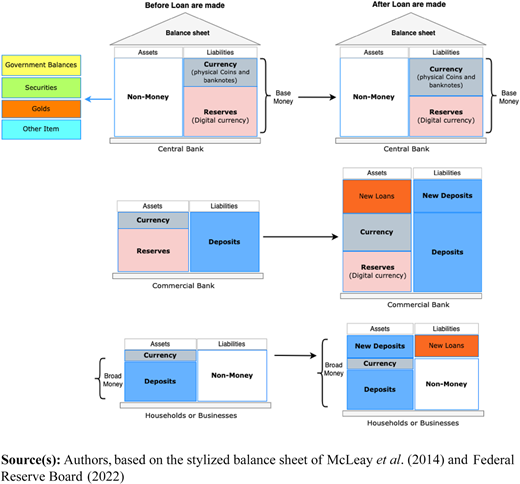
In the modern economy, the quantity of money (named base money) and the money creation are based on a stylized balance sheet (see Figure 1). In the classic literature, Walras’s theory of the quantity of money defended that gold is the only acceptable currency in international payments, arguing that all currency, including banknotes, had to be backed 100% in gold (Cirillo, 1986). In contrast, Friedman defined money as currency, plus demand deposits at commercial banks and time deposits at commercial banks, while Keynes defined money as co-extensive with bank deposits including time deposits (Dostaler, 1997). These visions served as support for the modern economy in terms of base money that is composed of central bank reserves and currency (notes and coins) (Mcleay et al., 2014).
Central bank balance sheets vary across countries, and there is no agreed standard format and breakdown of the bank balance sheet. It is also in central banks, commercial banks and non-banks (payment service providers, households and others) (Rule, 2015). Despite these variations, all central bank balance sheets can be generalized in two parts: assets and liabilities. According to the Bank of England (Federal Reserve Board, 2022), the central bank money (CBM) is the base money, and the broad money is the money created on the households and businesses balance sheets without any change in the amount of central bank “base money.” The amount of money created in the economy ultimately depends on the monetary policy of the central bank.
Figure 1 shows that the money creation is explained by the Central Bank of England (Mcleay et al., 2014; Federal Reserve Board, 2022) as follows: Central banks use reserve money (liability) to give new loans to a commercial bank that is converted into new deposits to the commercial bank. Then, the commercial bank uses this deposit to give new loans to households or businesses, converting a liability into a new financial asset (loan). The households or businesses' new deposits obtained through a commercial bank loan are converted into new liabilities to households or businesses in the form of loans. In this scope, money can be viewed as a liability for the central bank and as a financial asset (or asset) for commercial banks, households and businesses.
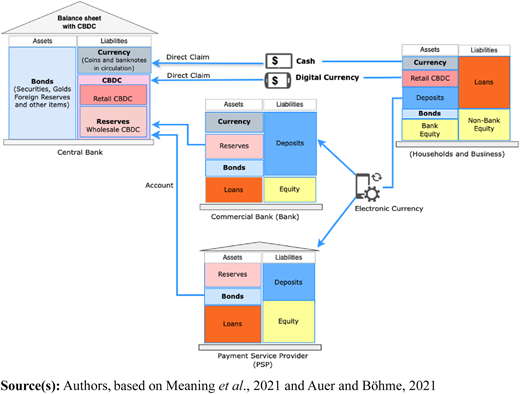
Money is analyzed by Mellor (2008) as a social phenomenon, who argues that money is socially constructed; whatever form it takes, what matters is that people agree to honor the value it represents, and when people trust in money, they are trusting in the organizations, society and authorities that create and circulate it. Analyzing the CBDC (see Figure 2), the new and digital form of CBM means the inclusion of the CBDC in the stylized balance sheet of the central bank, which can be accessed by all sectors of the modern economy: (1) central bank; (2) the regulated institutions (commercial banks and payment service providers) and (3) business and households (Meaning et al., 2021).
Two types of the CBDC are proposed by the Committee on Payments and Market Infrastructures (CPMI) (Bianco, 2020): (1) wholesale CBDC that is limited to regulated financial institutions, such as commercial banks, clearing institutions or other entities that traditionally have access to the central bank reserves (R3, 2019) and non-banked financial institutions (FinTech) (Jin and Xia, 2022) for more efficient interbank payments (Bech and Garratt, 2017; Bianco, 2020; Lannquist, 2019); (2) retail CBDC that is used for general purposes or as a form of “digital currency” or “digital cash” accessible to all (Auer and Böhme, 2021), which means that it has a potentially much larger user base and can involve corporates, small businesses and even individuals (R3, 2019; Lannquist, 2019; Bech and Garratt, 2017; Grothoff and Moser, 2021; Bianco, 2020).
The analysis of central bank reports is part of another research study where we studied the CBDC deployment process. In this research study, we didn’t include and discuss central bank research projects because their scope is to present the central bank experiment, not discuss the DC issued by a central bank. Below we present some projects to show the dynamics of countries' experiments.
Analyzing the countries that issued CBDC, for example, the Eastern Caribbean Central Bank launched Dcash [2] as retail CBDC to modernize the payment system across its member countries (including Antigua and Barbuda, Grenada, Saint Lucia and others) and promote financial inclusion, while Bahamas with Sand Dollar [3], Nigeria with eNaira [4] and Jamaica with Jamaica’s Central Bank Digital Currency (JAM-DEX) [5] launched their CBDC to promote financial inclusion and modernize payments and also to include the unbanked population, as well as businesses and government agencies in the digital payment ecosystem.
The countries that are deploying and testing CBDC are using different strategies. For example, France started its research on DLT-based CBDC, testing the innovative procedures with the creation of the exchange and settlement of tokenized financial assets between financial intermediaries (Central Bank of France, 2021), while China started its research by analyzing the issuance framework, circulation environment, key technologies and the international experience of the CBDC research, establishing its DC Institute to research (People’s Bank of China, 2021).
Several countries created their CBDC research project, but these projects have different aims and collaboration scopes of collaboration; for example, the Atom project is a collaborative research between the Reserve Bank of Australia and financial institutions of Australia (Central Bank of Australia, 2021); Cedar is a project of the New York Innovation Center – part of the Federal Reserve Bank of New York (Federal Reserve Bank of New Youk - New York Innovation Center, 2022); the project e-HKD created by the Hong Kong Monetary Authority (HKMA) (Hong Kong Monetary Authority, 2021); the Project Aurum is a collaboration between the BIS Innovation Hub Hong Kong Center, the HKMA and the Hong Kong Applied Science and Technology Research Institute (Bank for International Settlements, 2022); the eKrona is a project of the Sweden Central Bank (Riksbank, 2017); the Helvetia is a project of the Central Bank of Swiss (Swiss National Bank); Inthanon is a project of the Central Bank of Thailand in collaboration with industry players (Bank of Thailand, 2019); Jasper is a project by the Central Bank of Canada that involved commercial banks (Chapman et al., 2017); Khokha is a project of the South African Reserve Bank in partnership with financial system institutions (South African Reserve Bank, 2018); Aber is collaborative research between the Saudi Central Bank and the Central Bank of the United Arab Emirates (Saudi Central Bank and Central Bank of the U.A.E., 2020) and Ubin is a project of the Monetary Authority of Singapore in collaboration with financial institutions (Monetary Authority of Singapore and Deloitte, 2017).
Several countries are researching CBDC in partnership; for example, Cedar-Ubin (Federal Reserve Bank of New Youk - New York Innovation Center and Monetary Authority of Singapore, 2023), Inthanon-LionRock (Bank of Thailand and Hong Kong Monetary Authority, 2020), renamed mBridge and involved BIS Innovation Hub, Hong Kong Center, the DC Institute of the People’s Bank of China and the Central Bank of the United Arab Emirates (BIS Innovation Hub et al., 2021); Jasper-Ubin (Bank of Canada and Monetary Authority of Singapore, 2019); Jasper-Meridian-Ubin (B. of E. Bank of Canada, 2018); Stella (European Central Bank and Bank of Japan, 2017) and others.
Analyzing the diversities of CBDC and their scope, we observed that each country’s CBDC implementation reflects its unique economic, social, legal and technological context.
3. Research method
In this section, we detail the research methodology.
Several institutions are researching and experimenting with CBDC, but there is confusion over what this new currency is, and discussions often occur without a common understanding of what is actually being proposed (Danezis and Meiklejohn, 2015). This study aims to survey the conceptualization of the CBDC and its utilization context to propose a list of CBDC terminologies, answering the research question: What are the terminologies used to refer to a DC issued by a central bank?
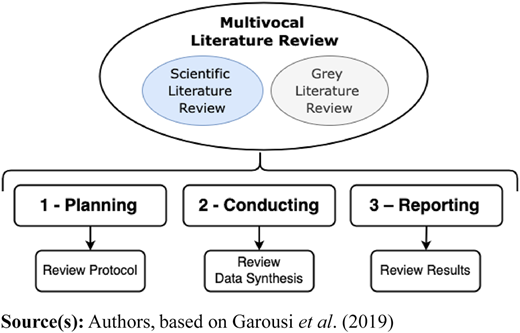
The research method used was the multivocal literature review (MLR), defined by Garousi et al. (2019) as a form of the systematic literature review (SLR) that includes the grey literature (e.g. reports, white papers, discussion papers and others) in addition to the published formal literature (e.g. journal and conference papers). We chose this research method because it provides summaries of academics' and practitioners' viewpoints. The MLR research method is composed of 3 steps: (1) planning, (2) conducting and (3) reporting (see Figure 3).
In the planning step, we made the review protocol, which includes the review needs or motivations, the research goal and questions, the search strategy, selection criteria and quality evaluation. In the conducting step, we synthesized the data with the study’s identification, selection, quality assessment, data extraction of the selected papers, data analysis and data synthesis. Finally, in the reporting step, we presented the results of the research question.
The search was done in August 2022. To find all relevant scientific literature, we adapted the search string in the most critical electronic digital libraries in software engineering: Association for Computing Machinery (ACM), Institute of Electrical and Electronic Engineers (IEEE), Web of Science, Google Scholar, science@Direct, Scopus, Springer Link and Semantic Scholar. To find all relevant grey literature, we search for reports, white papers and discussion papers from policymakers such as central banks, the World Economic Forum, the BIS and technology providers, namely Hyperledger, CORDA R3. Then, we made the screening process by removing duplicates and analyzing the written language, the author identification, the data, the document title and the accessibility.
The study selection was based on the inclusion and exclusion criteria (Kitchenham and Charters, 2007). We excluded studies not written in English, without a date, unidentified author or with a title or abstract not related to the CBDC terminology reports of central banks. We accept studies written in English with content focused on CBDC terminology.
We used the Preferred Reporting Items for Systematic Reviews and Meta-Analyses guidelines (Liberati et al., 2009) to identify and select the study. This guideline is composed of four steps: (1) identification, (2) screening, (3) eligibility and (4) inclusion. First, we identified 97 documents: 73 scientific studies and more than 25 reports from policymakers and practitioners’ organizations. Then, we made the screening process by removing duplicates and analyzing the written language, the author identification, the data, the document title and accessibility. As a result, we screened 62 documents, removing 15 duplicate documents and 20 documents by title. For eligibility analysis, we read all abstracts to analyze each study and if it is focused on the CBDC terminology. As a result, we eliminated 35 studies by abstract and 12 documents by scope, meaning that these documents were unrelated to CBDC terminology, leaving the remaining 15 documents.
We analyze the document quality, according to Kitchenham and Charters (2007) and Kmet et al. (2004), and as a result, we remove six (6) documents by quality, leaving the remaining nine (9) documents for data extraction. After thoroughly reviewing the selected documents, we incorporate seven more documents through the snowballing process (Wohlin, 2014) for data extraction. The extraction was done before a complete reading of selected reports. We extract the year, title, author, keywords, document type, terminologies and requirements.
4. Results
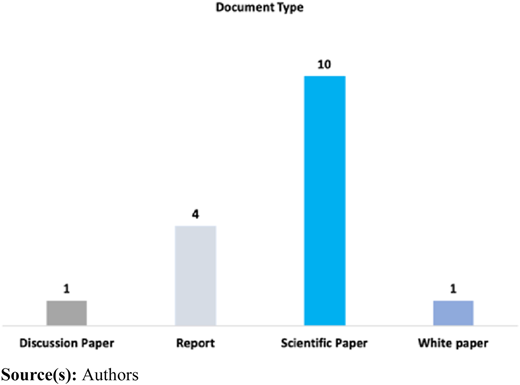
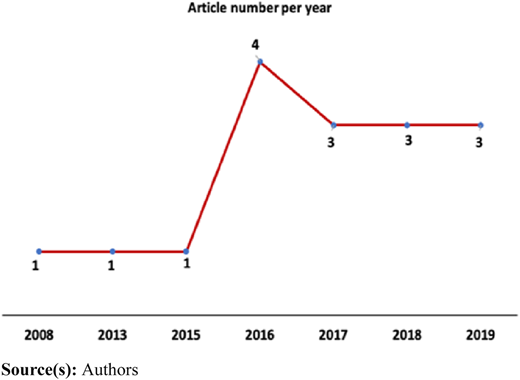
We used the document analysis research method (Bowen, 2009) and qualitative analysis to present the result. We selected 16 papers, including 10 scientific papers and 6 grey documents: 1 discussion paper, 4 reports and 1 white paper (see Figure 4). The years of selected papers vary between 2008 and 2019 (see Figure 5).
The papers selected are ordered by reference (see Table 1). The table information includes title and year of publication.
4.1 CBDC terminologies
We used the International Organization for Standardization (ISO) terminology work ISO 704: 2009 (International Organization for Standardization (ISO) 704: 2009, 2009) to analyze the definition of concepts or terms of the CBDC. This standard defines concepts as an object in the special language of the subject field that can be represented in several forms of human communication: natural language, terms, appellations, definitions or other linguistic forms. In this case, we assumed that CBDC has different terms or appellations.
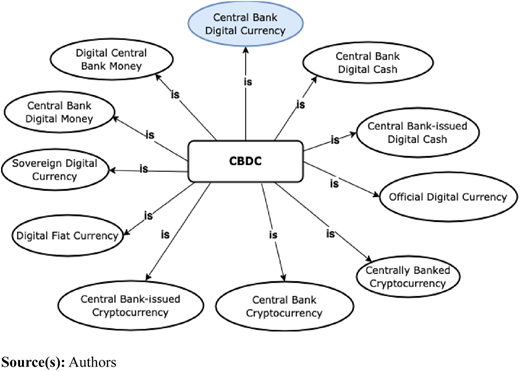
We analyzed the terminologies used in each selected document. The terminologies were organized as a term matrix as proposed by Watson (2002). We identified terminologies in the title, the abstract and the keywords of the selected papers. Table 2 shows 12 different terms used to mention CBDC found in selected papers, organized by year of publication. The result reveals that authors in the same document used several synonyms for the CBDC.
The first terms used are digital money by Pîrjan and Petroşanu (Pîrjan and Petroşanu, n.d) to propose the need for dematerialization of money in digital money that acts as money that will be accepted by most economic agents that verify their authentication against a centralized or distributed authentication database and ensure that it can be exchanged in physical money at different banks. The risks of the paper currency, including counterfeit, printing and transferring costs are analyzed by Shoaib et al. (2013), who propose an official DC issued and controlled by the state and/or central banks of a country that could be used in day-to-day transactions.
DC is used by the BIS (CPMI Committee on Payments and Market Infrastructures, 2018) to discuss three aspects relating to the development of the private digital currencies: (1) the risks of private assets such as bitcoins with monetary characteristics similar to CBM; (2) the transfer mechanism, typically via a built-in distributed ledger, and (3) a variety of third-party institutions such as non-banks. These facts motivated the BIS to consider DC as a potential policy response to the private DC challenge, emphasizing the potential advantage of the distributed ledgers in payment systems and FMIs. Danezis and Meiklejohn (2015) analyzed the benefits of private DC, such as independence from political control and their limitation like as costs and scalability, and proposed RSCoin as a cryptocurrency framework in which central banks maintain complete control over the monetary based on a distributed set of authorities to prevent double-spending. This would create centrally banked cryptocurrencies to ensure a modest degree of centralization using DLT and a consensus mechanism.
Digital cash was used by Dyson and Hodgson (2016) from Positive Money, who analyzed the declining use of cash and the rise of digital currencies such as bitcoin to argue that these issues are strong arguments for central banks to start issuing digital cash. Levin (2018) also use digital cash to argue that digital cash could support the effectiveness of monetary policy via public–private partnerships between the central bank and supervised financial institutions. The Inter-American Development Bank (Saudi Central Bank and Central Bank of the U.A.E., 2020) analyzed the alternative organizational models for the payment system and their implications for the banking industry using the terminology digital CBM to argue that innovations in digital payment technologies are needed to extend access to CBM to firms and individuals. The Bank of Canada (Fung and Halaburda, 2016) used CBDC to discuss the rise of public authorities and central banks around the world that were monitoring the developments in digital currencies and studied their implications for the economy, the financial system and central banks, proposing a framework for assessing why and how to implement CBDC.
The BIS (2018), the CPMI and the Markets Committee published a report of an initial analysis of CBDCs and their potential implications in payment systems, monetary policy implementation and transmission, as well as for the structure and stability of the financial system, emphasizing that CBDC is not a well-defined term and is used to refer to several concepts. The R3 analyzed Bitcoin and proposed the terminology central bank-issued digital to explain Fedcoin as a peer-to-peer electronic cash system based on the original design goal of Bitcoin that reintroduces one central point of control to the monetary system based on the blockchain, allowing the central bank to guarantee equivalence between the digital Fedcoin token and physical notes. Then, in 2018, BIS published a report (BIS, 2018) using the CBDC term to give a high-level overview of CBDC and their implications for payments, monetary policy, financial stability and the inclusion of the CBDC in the central bank balance sheet. The inclusion of the CBDC in the central bank balance sheet is then explained by the Central Bank of England (Grothoff and Moser, 2021).
Bjerg (2017) evaluated three different scenarios for the implementation of CBDC in terms of their monetary policy implications and proposed several CBDC features, namely a DC issued by a central bank, cash, reserve money, universally accessible, bank account money and electronic. In the same year, Bech and Garratt (2017) discussed the problem faced by several central banks in exploring or experimenting DLT to research CBDC, calling attention to confusion over what these new currencies are, proposing a money flower and taxonomy that identifies two types of the CBDC (retail and wholesale), differentiating them from other forms of CBM, such as cash and reserves. Furche and Sojli (2018) investigated the technology options available to implement central bank-issued digital cash, concluding that issuing fiat currency as centrally issued digital certificates is the most likely path to success because digital certificates are the most similar technology to issuing physical cash and allow economic agents to continue their existing roles.
The International Telecommunication Union (ITU) Standardization Sector (ITU-T) - Focus Group DC published a report on money taxonomy written by Reis (ITU-T - Focus Group Digital Currency including Digital Fiat, 2019) from the Central Bank of Brazil, which uses the terminology digital fiat currency to describe the central bank-issued DC. In the same scope, the term sovereign digital currencies was used by Chapman et al. (2017), who analyzed existing forms of currency based on their functional characteristics to propose a taxonomy of sovereign digital currencies.
5. Discussion and limitation
Several terms are interchangeably employed to refer to CBDC by researchers and experts, resulting in potential mistakes in understanding the CBDC. This misunderstanding needs to be clarified with a list of CBDC terminologies that can be used to mention a DC issued by a central bank.
We analyzed the terms used to mention CBDC as a DC issued by a central bank in the literature; as a result, we found 12 terms. We present these terminologies in a CBDC terminology map (see Figure 6) to discuss the results.
We observed three groups of terms in CBDC terminologies: central bank, DC and cryptocurrency. The authors use central bank and DC or synonymous of the DC (digital money, digital cash, digital fiat, digital asset, digital token and digital sovereign) or central bank with cryptocurrency.
Some authors define the term used to elucidate their perspective, while others express their viewpoints without relying on a particular definition. Consequently, we found instances without a corresponding definition.
Digital cash is defined as an electronic version of notes and coins by Dyson and Hodgson (2016), while central bank digital cash is defined as a new form of digital CBM by Furche and Sojli (2018). The reserves money is an electronic version of money; in this scope, Kumhof and Noone (2018) clarify this feature, defining CBDC as an electronic CBM that can be accessed more broadly than reserves, while Fung and Halaburda (2016) clarify the feature of a new form of CBM, defining CBDC as a monetary value stored electronically that is a liability of the central bank that can be used to make payments.
Cryptocurrency is not classified as official currency by central banks. To clarify this fact, Shoaib et al. (2013) use the term official DC to define CBDC as a system-generated sequential number issued by state and/or central banks and replaceable by conventional paper currency, while Daniel Reis (ITU-T - Focus Group Digital Currency including Digital Fiat, 2019) uses the term digital fiat currency to define CBDC as a tokenized (digital token) and digital representation (digital asset) of a sovereign currency.
The central bank cryptocurrency is defined by Bech and Garratt (2017) as an electronic form of CBM. It is complemented by Grothoff and Moser (2021), who used the term central bank-issued cryptocurrency to define CBDC as a government-issued non-tangible currency for public consumption. Cryptocurrency is not controlled by any official entity; in this context, Danezis and Meiklejohn (2015) use the term centrally banked cryptocurrency to define CBDC as a cryptocurrency framework in which central banks maintain complete control over the monetary supply.
CBDC is perceived as an intangible and DC issued by a central bank (Furche and Sojli, 2018), a digital representation of a sovereign currency (ITU-T - Focus Group Digital Currency including Digital Fiat, 2019) that can be exchanged in a decentralized manner (Bech and Garratt, 2017), universally accessible (Bjerg, 2017) and a liability of the central bank (Fung and Halaburda, 2016). The point of convergency of the terminologies found is that all authors mention the central bank as the issuer of the CBDC that can be created by means of DLT named blockchain infrastructure (Danezis and Meiklejohn, 2015) (Koning, 2016) (Bech and Garratt, 2017) or can be created using the traditional centralized ledger technology infrastructure (CPMI Committee on Payments and Market Infrastructures, 2018) (Kumhof and Noone, 2018) (Shoaib et al., 2013). The authors who proposed CBDC with DLT-based infrastructure named it central bank cryptocurrency, and the others who didn’t specify clearly the infrastructure called it CBDC or another synonym of the DC.
The CBDC terminologies arisen from various research challenges, namely the need for currency digitalization or dematerializing (Pîrjan and Petroşanu, n.d), the rise of private digital currencies like Bitcoin the design objectives of these cryptocurrencies, their advantages and limitations, the risks and implications of alternative organizational models for the payment system within the banking industry (Danezis and Meiklejohn, 2015) (Dyson and Hodgson, 2016), the difficulties encountered by central banks in exploring DLT-based CBDC (Bjerg, 2017), the risks associated with paper currency, counterfeit concerns and expenses related to printing and transferring currency (Shoaib et al., 2013).
A concept is defined by ISO 704: 2009 (International Organization for Standardization (ISO) 704: 2009, 2009) as an object in the special language of the subject field and can be represented in the various forms of human communication according to the system used (terms, appellations or other linguistic forms). The concept map is being used as a research tool to help the research team construct a global blueprint for their research efforts (Iuli and Helldén, 2004), enable the creation of a schematic representation of domain knowledge, synthesize the literature review, summarize the information obtained from an individual source and synthesize information obtained from the different sources (dos Santos et al., 2017). Concept maps have been applied in different research areas, including computer science (dos Santos et al., 2017) and education (Akinsanya and Williams, 2004).
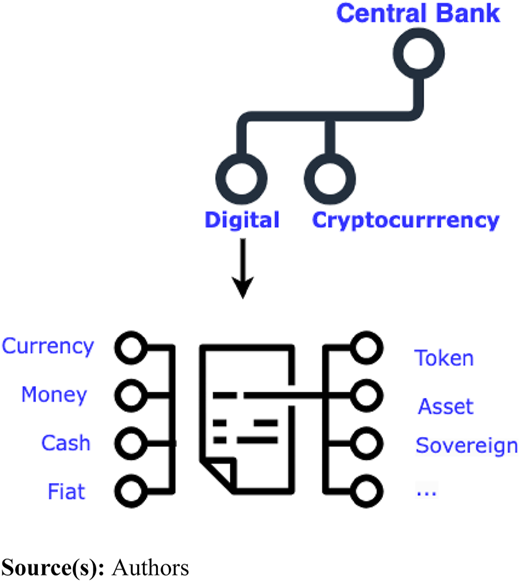
We propose a CBDC concept map to clarify the misunderstandings about the CBDC conceptualization (see Figure 7). The concept map proposed lists all terminologies found in the literature in a logical structure. At the top appears the Central Bank as an issuer; in the middle structure appears cryptocurrency and digital and at the bottom level appear several denominations of digital money.
CBDC doesn’t have a standardized terminology or concept because the currency has a set of synonyms such as money, cash and cryptocurrency; consequently, the DC has a set of synonyms as digital money, digital cash, digital fiat, digital asset, digital token and digital sovereign currency. CBDC, as DC issued by a central bank, is named cryptocurrency if it is issued using DLT of blockchain or digital when the infrastructure is not explicit.
This comprehensive CBDC Concept Map elucidates the linguistic landscape and clarifies the interpretation nuances across different CBDC terminologies. Such granularity clarifies the distinct denomination of the CBDC, provides a comprehensive blueprint of the multi-conceptualization nature of CBDCs, improves the CBDC conceptual understanding and contributes with an accessible tool for economists, technologists and lawyer researchers and experts that can be used by a multidisciplinary area to discuss CBDC projects and design choices.
We used the map of threats to the validity of SLRs in software engineering (Zhou et al., 2016) to analyze the limitations of this research. We identified three limitations that may threaten the validity of the presented results.
The first limitation is the lack of standard language and terminology of CBDC. Several terminologies are being used to introduce the theme of DC issued by a central bank, instigating chaos in the research process. The strategy used to overcome this limitation was to use “central bank DC” and a “decentralized application” to do a search because CBDC is a decentralized application that can be developed in a centralized or distributed infrastructure.
The second limitation is the number of selected studies (16 papers) and the fact that they were published some years ago; the last paper was in 2019. The strategy used to overcome this limitation was to search for other new terminologies from 2019 to 2024 in digital libraries and central bank-published reports; as a result, we didn’t find any study published with new terminology.
The third limitation is the exclusion of central banks' experiment reports. To overcome this limitation, we analyzed the content of these reports; as a result, we observed that the content information of these reports was focused on specific experiments, not on a discussion of a new terminology. In this scope, we think that the exclusion of reports not focused on CBDC terminology will not change the findings of this study because these reports use the term CBDC.
6. Conclusion and future work
CBDC is mentioned by several terminologies, creating mistakes about this type of DC. This study analyzed the several denominations used, surveying the most common terminologies used using the MLR.
The terminologies used to mention a DC issued by a central bank are digital money, official DC, DC, centrally banked cryptocurrencies, digital cash, digital CBM, CBDCs, central bank-issued cryptocurrency, central bank cryptocurrency, digital fiat currency, central bank-issued digital cash and sovereign digital currencies.
We conclude that CBDC doesn’t have a standardized terminology because the currency has a set of synonyms such as money, cash and cryptocurrency; consequently, digital money issued by a central bank is called CBDC, central bank digital cash, central bank digital money and central bank cryptocurrency.
This research proposes a CBDC concept map that can be used for further CBDC research and understanding to clarify the ambiguity surrounding CBDCs in academic and practitioner discourse to simplify dialog in a CBDC research project. We will use the findings of this research study to analyze the CBDC characteristics as intangible money.
The research work reported in this publication was funded by the Foundation for Science and Technology of Portugal (No: SFRH/BD/151432/2021 [Carvalho Silva, 2021]) and supported by Systems and Computer Engineering Innovation INESC-INOV Lab Research Center.
Notes
Rise of CBDC updated in July 2023 - https://www.bis.org/publ/work880.htm
Dcash - https://www.dcashec.com/
SandDollar - https://www.sanddollar.bs/
eNaira - https://enaira.gov.ng/