This research examines the challenges of teaching a research-based capstone unit in Master of International Business (MIB) programmes, focusing on coursework students with limited research training. It explores how a curriculum redesign, informed by backward design and advance organizers, can enhance learning clarity, coursework integration and engagement. To further support the collaborative requirements of the unit, this study introduces a group work contract designed to clarify task allocation prior to collaboration and encourage active participation. This research aims to equip educators with a holistic set of actionable strategies for improving capstone units in MIB and similar professionally oriented programmes, boosting graduate employability while providing tools to manage group dynamics effectively.
Adopting an autoethnographic qualitative approach, this study leverages the first author’s dual role as a former student and current teaching assistant. The research applies backward design to structure the research-based capstone curriculum and uses advance organizers to develop teaching materials, while also implementing the group work contract. Through iterative reflections, student evaluation surveys, analysis of past student correspondence and observed outcomes, the research evaluates how these strategies align learning objectives with assessments and group management. This practitioner-informed model emphasizes dual scaffolding, covering both academic and collaborative aspects, to bridge gaps in research comprehension and application.
Student evaluations of teaching and unit results indicate higher satisfaction with the upgraded research-based MIB capstone curriculum compared to the previous taught-based model. Survey results confirm that capstone objectives were met, with a majority of students believing the skills developed will support their future careers, which represents a significant improvement over the previous taught-based curriculum. Regarding the collaborative scaffolding, the implementation of group work contracts increased motivation by clearly defining responsibilities, thereby reducing free-rider conflicts. The contract served as a constructive tool for guiding students and offering a proactive alternative to peer evaluation forms.
This research uniquely combines backward design and advance organizers in the redesign of the MIB capstone unit by offering a dual learner-instructor perspective. It provides actionable and student-centred strategies rarely addressed in the literature on research-based capstones. In addition, this study offers practical implications for managing group assignment conflicts through the strategic use of group work contracts.
1. Introduction
The Master of International Business (MIB) programme is offered by numerous universities worldwide. It is designed to equip students with effective management skills tailored to the international business environment. Reflecting the interdisciplinary nature of international business, the programme typically includes courses across functional areas such as accounting, marketing and law, disciplines which operate within the global market. Although specific course offerings vary between institutions, a typical MIB programme structure includes foundation or advanced preparatory units for students without a business background, followed by core and elective units, and concluding with a capstone unit. For example, the University of Melbourne offers core units such as Cross-Cultural Management and Teamwork, and Strategic Management. In contrast, the University of New South Wales (UNSW) includes Global Business Environment and Responsible Business and Sustainability among its core units. Despite differences in individual course offerings, one common element across MIB programmes is the capstone unit. This unit serves as a key component of the MIB curriculum and is the focus of discussion in this paper.
The term “capstone” was initially used to refer to the topmost stone in an architectural structure, gradually evolving to describe the cumulative experience in an academic programme (Fleming and Kowalsky, 2022). In this context, the capstone unit is often described as a “rite of passage” within a degree programme (Durel, 1993). Unlike advanced preparatory units that build foundational knowledge for students without a business background, or core units that deliver essential concepts in international business, the capstone unit offers more than direct instruction. It provides students with the opportunity to synthesize what they have learned across various units and to demonstrate their readiness for graduation (Lee and Loton, 2019). In line with this role, we conceptualize the capstone unit in the MIB programme not merely as a remedial process of revisiting previously learned knowledge, but as a developmental experience that cultivates students’ ability to integrate that knowledge and apply it in real-world contexts, such as working as business consultants for multinational enterprises (MNEs). Accordingly, MIB capstone units often focus on strategy-related topics, preparing students for consulting roles. For example, the University of Melbourne offers a unit on Global Strategy, UNSW includes an International Business Consulting Practicum and Monash University provides a course in International Business Strategy. As Schermer and Gray (2012) note, the intended purpose of the capstone unit, as perceived by faculty, can explain differences in style, scope and scale across programmes, which in turn affects student learning experiences and outcomes (Lee and Loton, 2019). In other words, the design and structure of capstone units are shaped by the perspectives of the instructors. This paper is based on the reflective insights of a former MIB graduate who now serves as a teaching assistant, focusing on the redesign of a research-based capstone unit in the MIB programme.
The MIB is a typical master’s by coursework programme, which excludes the traditional research thesis that once defined academic achievement (McInnis et al., 1995). Master’s by coursework degrees are often designed for professionals to “update and upgrade their knowledge base”, thereby enhancing their competitiveness in the labour market (Beattie and James, 1997; Kiley and Cumming, 2015). Accordingly, the MIB programme emphasizes problem-based learning as a way to ensure practical application in professional and vocational contexts, helping graduates advance their careers. However, problem-based learning alone may no longer sufficiently build the competencies needed by MIB graduates in today’s labour market. With the rise of artificial intelligence (AI), tasks such as generating business plans for MNEs or explaining complex business models to non-specialists can now be done within seconds. As such, MIB students are increasingly expected to develop research skills that allow them to critically analyse problems and create novel insights in a digitized world. Changes in technology, market conditions and the skills and knowledge demanded by the job market (McKinney et al., 2024) highlight the need to transform the MIB capstone unit from a taught model to a research-based model.
Curriculum change through the integration of a research component to enhance student engagement in an MIB capstone unit is the central focus of this paper. A review of the literature reveals several gaps that this study seeks to address. Firstly, while instructors widely recognize the importance of developing students’ research skills, traditional research method instruction often poses challenges for students enrolled in coursework-based master’s programmes. Previous studies emphasize the value of integrating research findings into teaching, as this increases students’ awareness of research validity and improves their research skills, thereby preparing future managers to apply research evidence in their professional careers (Burke and Rau, 2010). However, passive knowledge transmission by academic staff is insufficient for fully developing research competence. Learner-centred approaches, in contrast, encourage students to actively discover and construct knowledge independently (Davidovitch, 2013; Rogoff, 1994). Consequently, scholars argue that higher levels of student engagement in research require a shift from learning about faculty research output to actively conducting their own research projects as part of coursework, enabling both learning about research and the generation of new knowledge (Brew, 2002; Burke and Rau, 2010). Nevertheless, coursework-based programmes face inherent tension between traditional academic goals (e.g. completing a research thesis) and professional or vocational objectives (e.g. applied problem-solving) (McInnis et al., 1995). In professionally oriented programmes such as the MIB, students are often insufficiently prepared to undertake research projects, as these projects differ from those in research-oriented programmes, which aim to contribute directly to the academic body of knowledge (Marel et al., 2022). Accordingly, this study addresses this gap by providing a detailed account of curriculum change in an MIB capstone unit, demonstrating how students can leverage prior learning to conduct research that enhances professional competence and supports complex problem-solving in real-world business contexts.
Secondly, passive approaches to teaching research methods are ineffective for coursework-based students and often hinder their ability to apply knowledge acquired in previous semesters to a research project. Learners are central participants in the educational process (Ornstein and Hunkins, 2009), and effective curricula play a critical role in fostering student engagement and learning (McKinney et al., 2024). This underscores the need for curriculum design that places students at the centre of the learning experience. Prior research on curriculum change generally falls into two streams (McKee and Botsford Morgan, 2025). One stream focuses on detailing curriculum revision processes in higher education institutions but lacks a theoretical framework to support systemic and large-scale change (e.g. Barr et al. (2020). The other stream applies theory to inform curriculum design but does not address comprehensive curriculum revision (e.g. Allen and Simpson (2019). To address this gap, the present study adopts a case study approach to examine the revision of an MIB research-based capstone unit underpinned by backward design theory. Additionally, the study employs advance organizers to illustrate how students are guided to connect knowledge acquired from core MIB units with newly introduced research skills, enabling them to actively conduct research projects with support from the teaching team.
Thirdly, given the constraint of a single semester to complete a comprehensive research report, assignments in this unit are designed as group-based tasks. However, this collaborative structure introduces the issue of “free riding”, which has been extensively identified in the pedagogical literature (Abernethy and Lett, 2005; El Massah, 2018; Harding, 2018). This reflects the phenomenon of social loafing, defined as “a decrease in individual effort due to the social presence of other[s]” (Latané et al., 1979, p. 823). Scholars argue that when individual contributions are difficult to identify (Price et al., 2006), students may become free riders, expecting others to carry the workload (Karau and Williams, 1993) or believing their own contribution is dispensable (Price et al., 2006; Weldon and Mustari, 1988). While periodic peer evaluations are a widely adopted solution for sanctioning free riders (Aggarwal and O'Brien, 2008; Druskat and Wolff, 1999), they often fail to genuinely foster student engagement. Practical observation suggests that traditional peer evaluation can be misused; for example, existing friendship cliques may falsely accuse a member of making zero contribution, even when that student can provide evidence of their work. Furthermore, punitive evaluation forms can negatively impact student mental health without serving as a positive tool for engagement. Additionally, I have observed that some students identified as underperformers argue they were simply unaware of their specific task allocations. Consequently, this research introduces a “group work contract” to manage group assignments within our research-based capstone unit.
Therefore, instructors of research-based capstone units face the pedagogical challenge of supporting students in balancing research skill development with the integration of knowledge acquired from previous coursework, while also preparing them to become full members of the professional community (Marel et al., 2022). This study demonstrates how backward design and the use of advance organizers can be employed to redesign the MIB capstone unit and support students in engaging with new research-based content. The paper contributes to the scholarship of teaching and learning in international business by offering a pedagogical framework that bridges the gap between theoretical curriculum design and practical classroom management. It provides instructors with actionable strategies for conveying complex research processes through accessible tools and materials, enabling MIB students to actively engage in research by leveraging their prior learning. Given that the MIB is a widely offered programme globally, this study also serves as a transferable case example for other business schools and professionally oriented master’s programmes that aim to foster academic and social engagement without a standalone research methods unit or a thesis or dissertation component. Furthermore, scholars acknowledged that teaching capstone units is a very time-consuming task (Brown and Benson, 2005). Our paper introduces the concept of a “group work contract” to enable students to self-manage their group issues and individually assigned tasks, allowing educators to focus on high-impact teaching and supervision activities rather than administrative mediation.
2. Research context
Since the early 1990s, the master’s by coursework has been the most rapidly growing qualification in Australian universities (McInnis et al., 1995). Driven by the trend of globalization, universities have established international branch campuses in foreign countries. The internationalization of universities is considered a typical example of international business practice itself. As such, the MIB programme is commonly delivered both at home institutions and their overseas campuses.
This study examines the MIB programme at the international campus of an Australian university in Malaysia as a case to explore how a research-based capstone unit is designed and delivered. This specific international campus environment presents distinct challenges for educators, who must balance managing large international student numbers with providing quality learning experiences for students from diverse cultural and linguistic backgrounds (Markey et al., 2023; Miller et al., 2021). Therefore, educators need to take greater care in pedagogical planning and curriculum design.
The first author brings a unique dual perspective, having completed the programme as a student and now serving as a teaching assistant for the capstone unit. Initially, the capstone was a closed-book examination based on an Ivey Business School case, which was used as a standardized assessment to measure the atomized knowledge acquired during the semester (Villarroel et al., 2018). Over time, it evolved into an authentic assessment model, which addresses criticisms that students often struggle to apply knowledge acquired across different academic contexts in higher education and feel unprepared for employment (Andrews and Higson, 2014; Ellström and Ellström, 2014; Villarroel et al., 2018). In this phase, students took on the role of business consultants tasked with developing internationalization plans for real companies, using models such as Porter’s Diamond, SWOT analysis and the OLI framework. Implementing authentic assessment in the capstone unit has been shown to positively impact the quality and depth of learning achieved by students (Dochy and McDowell, 1997; Villarroel et al., 2018).
However, the most recent shift to a research-based format has introduced new challenges, particularly as students often struggle to develop the research skills required to write a comprehensive research report within a single semester. Drawing on both learning and teaching experience, the first author contributes not only to student support but also to curriculum design and the development of learning materials, helping to enhance the overall delivery of the unit.
The capstone unit examined in this research is titled International Business Strategy (IBS). It is delivered over 12 sessions, each lasting 2 hours (Table 1). Students are required to have completed the equivalent of two semesters of study prior to enrolling in this unit. Before taking the capstone, they are advised to complete core units, such as International Business Theory and Practice, which provide a foundation in key internationalization theories and their practical applications to global firms. These enrolment requirements are designed to ensure that students possess the necessary disciplinary knowledge before undertaking the IBS unit. The table below outlines the weekly topics of both the previous version (taught-based) and the current, upgraded research-based version of the capstone.
MIB capstone unit weekly topics
| Session | Taught-based capstone unit | Research-based capstone unit |
|---|---|---|
| 1 | Introduction to international business strategy | Introduction to the international business strategy research project |
| 2 | Environments of international business and firm-specific advantages (FSAs) | Research topic selection |
| 3 | Strategy and international business theories | Developing research proposal (1) − Synthesizing research literature relevant to the Problem |
| 4 | Global strategic orientations | Developing research proposal (2) − Understanding the Context (Case Company and Industry) |
| 5 | Compatibility analysis – CAGE framework | Pitching the research proposal |
| 6 | Understanding global value chains | Research proposal development − workshop |
| 7 | Market entry modes | Submission of research proposal and start work on developing research report |
| 8 | Sustainability and ESGs for international business expansion | Case data collection for developing solution (1) |
| 9 | Organization structures for international business | Case data collection for developing solution (2) |
| 10 | HR and operations for international business | Case analysis |
| 11 | Revision and prepare for final presentations | Developing and providing solutions |
| 12 | Final presentations | Finalizing research report |
3. Conceptual framework
In the curriculum design process, Richards (2013) identifies input (e.g. course content), process (e.g. learning activities) and outcome (e.g. learning outcomes) as the three key dimensions. However, the sequence in which these three factors are considered represents different approaches to curriculum development. Richards (2013) reviewed three curriculum approaches, each based on a different sequence of these dimensions.
Firstly, forward design process is a linear approach that starts with content, then considers the process, and finally the outcomes. In this approach, the learning content is determined before the educator decides how to teach or what the objectives should be. Secondly, central design approach begins with the selection of teaching activities and techniques, prior to elaborating detailed learning outcomes and the syllabus. This approach is typically adopted by educators who view exercises and activities as essential tools for achieving successful learning outcomes, with activities serving as the initial focus. Thirdly, backward design, the approach adopted in this study, emphasizes that learning outcomes are the basis for developing instructional processes and determining content.
The rationale for upgrading the MIB capstone unit to a research-based format has been established in previous sections. In today’s increasingly digital and AI-driven world, merely understanding how to apply business tools and frameworks is no longer sufficient. Research skills play a critical role in enhancing MIB graduates’ competitiveness in the labour market. In this context, having students deliver a research report is the key distinctive outcome distinguishing this unit from the previous taught capstone unit, which only required a business report. Therefore, the learning outcomes are a central focus in our curriculum design process. Accordingly, designing the curriculum by starting from the final or desired outcomes and then aligning the appropriate teaching activities and content is crucial (Richards, 2013).
Although there is no single best approach to curriculum design (Richards, 2013), backward design proved particularly suitable for our context. Practically, at the time of upgrading the research-based capstone unit, our sole certainty was that the final outcome was for students to deliver a research report for a real company. Since this was a newly upgraded unit, there was no prior course content (e.g. slides) for us to reference, and the teaching activities had not yet been designed because we first needed to determine what students needed to learn to achieve the final outcome. Figure 1 illustrates how backward design is suited to our circumstances.
 The diagram presents three design approaches. The Forward Design Approach shows Content leading to Process, then to Outcome in a linear sequence. The Central Design Approach places Process first, with arrows pointing from Process to both Content and Outcome. The Backward Design Approach begins with Outcome, with arrows pointing from Outcome to Content and Process. Each approach highlights a different starting point and direction of planning among Content, Process, and Outcome.
Curriculum development approaches
Source: Adopted from Richards (2013)
The diagram presents three design approaches. The Forward Design Approach shows Content leading to Process, then to Outcome in a linear sequence. The Central Design Approach places Process first, with arrows pointing from Process to both Content and Outcome. The Backward Design Approach begins with Outcome, with arrows pointing from Outcome to Content and Process. Each approach highlights a different starting point and direction of planning among Content, Process, and Outcome.Curriculum development approaches
Source: Adopted from Richards (2013)
In this section, we adopt the backward design approach to explain how the curriculum is structured and use the advance organizer model to illustrate how teaching and supervision are delivered.
3.1 Backward design
Unlike undergraduate units, where the curriculum is typically derived directly from textbooks, the MIB capstone unit emphasizes the attainment of higher-order knowledge and critical analysis, rather than the introduction of a significant amount of new content (Durel, 1993; Lee and Loton, 2019). As Wiggins and McTighe (2005) noted, curriculum design often prioritizes activities and instruction over the intended learning outcomes. This suggests that instructors tend to focus more on teaching delivery and less on how students actually learn (Bowen, 2017), which can result in poorly designed curricula that do not effectively support student learning.
To design an effective curriculum for a research-based capstone unit, it is essential to begin with the desired outcomes in mind (Bowen, 2017). This principle underpins the backward design approach, which starts by asking: If there is a task to be accomplished, how do we get there? (Wiggins and McTighe, 1998). According to Wiggins and McTighe, backward design involves three key stages: (1) identifying desired results (i.e. learning goals), (2) determining acceptable evidence of learning and (3) planning instructional activities and learning experiences. These stages help establish a clear purpose and ensure that all elements of the curriculum are aligned with the intended outcomes (Bowen, 2017).
While this model provides a logical structure for instructors, it does not always align with how students perceive or engage with the curriculum. Learning goals, particularly when presented abstractly on digital platforms, are often overlooked by students. As a result, the effort educators invest in curriculum planning may not be fully appreciated or effectively used. To address this disconnect, it is important to adopt a student-centred perspective and consider how learners understand and interact with course structure and objectives. In other words, educators must “wear the students’ shoes” to better anticipate their needs and support their learning process.
To explore students’ academic motivations, Van Etten et al. (1998) conducted an interview-based study that offers empirical insights into students’ actual perspectives rather than assumptions. The findings, supported by Lin et al. (2003), revealed that the primary motivation for many students is achieving good grades. This extrinsic motivation often drives their engagement, suggesting that clearly understanding what is expected in assignments can enhance their learning experience.
From this perspective, backward design can be even more effective when paired with transparent and scaffolded assessment structures. Curriculum designers should break down major assessment tasks into smaller, manageable components aligned with weekly topics, and establish milestone checkpoints throughout the semester. This not only clarifies expectations but also supports continuous student engagement and achievement:
P1. The backward design of a research-based capstone curriculum in the MIB programme should be developed from a student-centred perspective to enhance engagement and learning effectiveness.
3.2 Advance organizer
Designing the curriculum for a capstone unit presents more challenges than for other units. This is because the capstone is typically the final unit students undertake, and they often assume they have already acquired the necessary disciplinary knowledge through prior coursework. As a result, they may perceive no need to “review” familiar content.
For example, when tasked with writing a research report on a firm’s international expansion, students often assume they already understand key concepts such as internationalization theory and institutional frameworks. Consequently, they tend to dive into the assignment based solely on prior knowledge, showing reluctance to engage with new class content or revisit foundational theories.
From an instructional standpoint, we recognize that acquiring research skills in the capstone unit is more important than simply completing the assignment. Students are therefore advised not to begin their assessment tasks until they have understood the research skills presented each week. This raises a key pedagogical challenge: how can we balance students’ assignment-oriented mindset with the need to develop research capabilities, especially when students perceive research as difficult, irrelevant to their future careers and not worth engaging with deeply?
To address this issue, the curriculum design of the research-based capstone unit can incorporate advance organizer theory, originally proposed by Ausubel (1960). An advance organizer is a teaching tool that helps students connect their existing knowledge to new information (Denham, 2018). This approach is particularly relevant in a research-based capstone unit, which requires students not only to synthesize knowledge acquired in previous units but also to acquire and retain new skills, specifically, research skills.
According to Relan (1991, p. 214), learning is enhanced by “establishing a hierarchical framework to anchor new, incoming information. Memory traces resulting from such learning would be firm and enduring, ensuring effective transfer into long-term memory” (see also Denham, 2018).
There are two types of advance organizers: expository and comparative (Ausubel, 1978). Both are applicable in delivering a research-based capstone unit. The expository advance organizer is useful when the content is entirely unfamiliar to students. It helps instructors relate new information to students’ existing cognitive structures. In the context of this study, research-related skills represent the unfamiliar content for master’s students in a coursework-based programme.
On the other hand, the comparative advance organizer is used when new material is somewhat familiar and helps learners distinguish it from previously learned content (Ausubel, 1978, p. 253). In this capstone unit, it is employed to help students integrate and apply knowledge from previous units, transitioning from theoretical understanding to practical application in real business contexts:
P2. The use of expository (and comparative) advance organizers in the research-based capstone teaching of the MIB programme supports students in understanding new research-related knowledge (and applying previously acquired theoretical concepts to real business cases).
3.3 Integrated framework
By reviewing two distinct approaches, namely, backward design for curriculum development and the advance organizer as an effective teaching strategy, we integrated these two frameworks as the foundation for the MIB research-based capstone unit. Given that the first author is both a recent graduate of the MIB programme and currently a teaching assistant, the curriculum design process was adapted from the student’s perspective, “wearing their shoes”. This student-centred approach to backward design is particularly effective for engaging coursework students who may lack research knowledge from previous studies.
The adapted backward design framework helps curriculum designers to focus on students’ needs, beginning with the assignment rather than the learning objectives. In this model, milestones are set throughout the semester to track students’ progress, as the research report is a long-term project. Weekly topics are then designed around manageable tasks, such as focusing on case study methodology in one week, corresponding to specific components of the research report.
Once the curriculum design is finalized, teaching materials and activities are shaped using the advance organizer approach. This is particularly useful in the research-based capstone unit, where students are required to integrate research-related skills (which are unfamiliar to coursework students) with knowledge they have already acquired in previous units. The expository and comparative advance organizers help balance the teaching of research skills with the application of prior learning, ensuring that both aspects of the capstone − research and practical application − are effectively addressed. The framework illustrating the integration of backward design and advance organizers in the MIB research-based capstone unit is shown in the following Figure 2:
 The diagram presents a Research-Based Capstone Unit Design and Teaching Framework with three connected sections. The left section titled Curriculum development lists Clarify Assignment Expectations, Milestone check-up points, and Planning weekly topic in sequence. The centre section titled Research-Based Capstone Unit includes Research skill development plus Integration of prior knowledge. The right section titled Effective teaching strategy lists Expository advance organizer plus Comparative advance organizer. Arrows show two-way links between curriculum development and the capstone unit, and between the capstone unit and teaching strategy.
Conceptual framework of research-based capstone unit
Source: Authors’ own work
The diagram presents a Research-Based Capstone Unit Design and Teaching Framework with three connected sections. The left section titled Curriculum development lists Clarify Assignment Expectations, Milestone check-up points, and Planning weekly topic in sequence. The centre section titled Research-Based Capstone Unit includes Research skill development plus Integration of prior knowledge. The right section titled Effective teaching strategy lists Expository advance organizer plus Comparative advance organizer. Arrows show two-way links between curriculum development and the capstone unit, and between the capstone unit and teaching strategy.Conceptual framework of research-based capstone unit
Source: Authors’ own work
P3. In the research-based capstone unit of the MIB programme, backward design serves as the foundation for curriculum development, while advance organizers function as a teaching strategy to help students bridge prior knowledge with new research skills, fostering a cohesive alignment between curriculum goals and instructional delivery.
4. Methodology
The conceptual framework outlined above provides guidance for transforming the MIB capstone unit from a purely taught-based one to a research-based approach; however, the new curriculum design and teaching materials have not yet been finalized. Accordingly, this study adopts an analytic autoethnography approach, a qualitative research method that uses personal experience to describe and interpret practices and experiences (Adams et al., 2017). Following this approach, the first author narrates his past experience as an MIB student at the same university, where he took the capstone unit that he now teaches as a teaching assistant and for which he helped prepare the new curriculum and teaching materials.
Few studies have explored curriculum design and teaching in research-based MIB capstone units, especially when students do not take a separate research methods course and are required to integrate knowledge from core international business courses to carry out a research project for a real company. Therefore, autoethnography is an appropriate research method to leverage personal experience to complement and address gaps in the existing literature (Adams et al., 2017).
The data for this study were generated through triangulation from three primary sources:
Reflective memories: The author’s experiences as an MIB student (2020–2022) and as a teaching assistant (2024–2025).
Archival correspondence: Analysis of past emails sent to students, specifically weekly summaries of frequently asked questions (FAQs) and iterative revisions of teaching materials (slides, briefing videos and exemplars) prepared two weeks in advance of delivery.
Secondary quantitative data: As detailed in Section 5.5, Student Evaluation of Teaching and Units (SETU) collected by the university were analysed to validate student satisfaction.
4.1 Reflections as a former student
When I was an MIB student in 2020, we could choose either to enrol in the coursework stream as an elective or to pursue the research pathway. Students who enrolled in the coursework stream could take electives such as Global Supply Chain Management, Asian Business Systems or Innovation and Entrepreneurship. I chose the research pathway, which was designed for students interested in higher-degree research and had an enrolment requirement of an average mark above distinction.
The research pathway consisted of three sequential units: Introductory Management Research Methods, Research Report (Introduction) and Research Report. Students could enrol in only one research pathway unit each semester. In practice, few classmates were interested in research.
I still recall that when I first attempted to enrol in the research pathway, I was the only student registered for the first unit. I was informed that the unit would be cancelled due to low enrolment. I contacted my classmates to see if anyone would join me, but they all thought research was too difficult and preferred to take coursework-based electives, merely attending tutorials and submitting assignments. As expected, after two weeks, the unit was cancelled, and I had to change my enrolment. In the second semester, I insisted on enrolling in the same unit, which this time had six students enrolled. Fortunately, the Deputy Head of School (Education) approved the offering despite the low number of students. I asked a few classmates whether they would consider completing the full research pathway and writing a master’s thesis after completing the research methods unit. However, they said that they were not interested in research. They enrolled in the first research unit only because other elective units' timeslots conflicted with their core units, leaving the research unit as the only available option. From this experience, I realized that most students were not interested in research and perceived research methods as significantly more difficult than other taught electives.
Eventually, I managed to undertake the research methods unit. In this unit, I learned about the research process, quantitative research methods (e.g. experiments and surveys) and qualitative research methods (e.g. documentation and observation, semi-structured interviews and content analysis). The topics were delivered over twelve two-hour sessions. Covering both quantitative and qualitative methods in a single semester was challenging for me, especially since I had no prior research training. Although I attended the lectures, I often struggled to immediately see how the content applied to my own research. At times, I found the material confusing and difficult to understand. For example, I only fully understood the concepts of reliability and validity when I conducted my final thesis. Before that, I remembered that the lecturer emphasized their importance, but the ideas did not make much sense to me.
After successfully completing the first research pathway unit with an average mark above distinction, I was eligible to continue with the next units: Research Report (Introduction) and Research Report, which involved preparing a research proposal and completing a full thesis respectively. Because I had been unable to enrol in the first research unit earlier due to low enrolment, I had to complete both the research proposal and the full research report within a single semester, even though the pathway was originally designed to be completed over two sequential semesters.
It was my first time conducting research independently, and I felt both pressure and difficulty. Completing both the research proposal and final thesis within 12 weeks was challenging, especially compared to other students who could complete the work over two semesters.
In addition to the research pathway, I also attended the MIB capstone unit as a student. I found that the unit was not well designed, as some weekly topics overlapped with content from other core MIB units. For example, market entry modes covered in the previously taught-based capstone unit had already been taught in International Marketing and International Business Theory and Practice. Similarly, topics on the international business environment, such as institutions, were covered in International Management and International Marketing. As a result, I did not pay much attention to the capstone unit as a student, relying on what I had learned in other units to complete assignments with good marks. Although the IBS capstone tutorials provided in-class activities each week, I found them isolated and difficult to integrate. Consequently, I did not feel confident in my ability to act as a consultant and propose business strategies for MNEs. In the next section, I narrate how my experiences helped the chief examiner to integrate a research approach into the IBS capstone unit.
4.2 Inspiration as a current teaching assistant
Starting in 2023, I began my PhD in International Business at the same university. After one year, I became a teaching assistant for the MIB capstone unit, which at that time was still taught. From the first class, I began observing whether students approached the capstone unit differently than I had as a student. I initially assumed that students would engage with the unit in a different way for two main reasons. Firstly, the core units had undergone changes in teaching staff, meaning students may have learned different content compared to previous cohorts. Secondly, the final assessment had changed. During my time as a student, the assessment was an open-book exam based on an Ivey case study. During my teaching assistantship, it had been replaced by an authentic assessment in which students acted as consultants for a real company that visited the class and presented its business context.
However, most students did not attend classes regularly. Many explained that they had already learned similar topics in other units. Furthermore, they completed the final assignment quickly, often before the midpoint of the semester. Observing this, I reflected that if I were in their position today, I might have behaved similarly by paying little attention in class and focusing on completing the assignment as quickly as possible. Relearning similar or repetitive content felt unengaging, and this led me to question the purpose of the capstone unit in its existing form.
At the end of 2024, I was informed by the Chief Examiner of IBS that the capstone unit would be transformed into a research-based unit starting in 2025. This change presented significant challenges for the teaching team. Firstly, the MIB research pathway had been officially cancelled in 2023, and no research methods units or thesis options were available. As a result, most MIB students had little or no understanding of the basic research process. Secondly, more than 100 students were enrolled in the capstone unit each semester, while the teaching team consisted of only one Chief Examiner and two teaching assistants, making it difficult to supervise individual research projects.
This situation prompted me to reflect on my own experience as an MIB student. I had completed a research methods unit before writing my research proposal and thesis, and even with that preparation, I found the research process challenging and stressful within a limited timeframe. This raised an important question: how could current MIB capstone students, without prior research training, learn research methods while also integrating their previously acquired international business knowledge to complete a research report within 12 teaching weeks? Consequently, I began to consider how a research-based capstone unit could be designed for students with limited research experience, and how clear and accessible teaching materials could be developed to support them in completing a research report by the end of the semester.
5. Design process
To design the MIB research-based capstone unit, we first developed the curriculum, followed by the teaching strategy, both through a student-centred lens. In the curriculum design phase, we adapted the backward design approach, beginning with the final assessment task as the starting point. From there, we established milestone checkpoints throughout the semester to monitor student progress, and subsequently determined the weekly topics based on the skills and knowledge required to complete the assignment.
Once the curriculum was finalized, we prepared the teaching and learning materials using the advance organizer approach, particularly the expository advance organizer, as the unit focuses on introducing new and unfamiliar content. This includes research-related skills and concepts, which are often not covered in previous coursework and therefore require structured instructional support for MIB students.
5.1 Step 1: Assignment design
According to our adapted backward design approach, we began curriculum development from a student-centred perspective, starting with the design of the final assignment. In the research-based capstone unit, the primary output is a group research report, which assesses both students’ research skills and their ability to apply knowledge gained from core or discipline-specific units.
This final group research report requires five to six students to collaboratively produce a paper of approximately 10,000–12,000 words. The report must adopt a case study approach using a real company selected by the instructor. This method enables students to apply research skills in a practical context. The assignment requires students to collect secondary qualitative data, such as company reports, official websites, industry standards and national policies. This approach avoids the need for advanced statistical skills required for quantitative data analysis, such as survey design or panel data interpretation, which may be beyond the scope of coursework students. Additionally, primary data collection can be impractical and may raise ethical concerns. Furthermore, in many cases, the case company may not find statistical outputs particularly useful or relevant. Thus, using secondary qualitative data allows students to complete the assignment within the 14-week semester (12 teaching weeks plus 2 self-study weeks), while also aligning with ethical standards.
The structure of the research report mirrors that of a traditional research thesis, comprising an abstract and five chapters: introduction, literature review, methodology, results and discussion and conclusion. Given the scale of this task, it presents a significant workload for coursework students, many of whom are also enrolled in other core or elective units during the same semester. This raises two key concerns:
How can we structure additional assessments when a single large assignment is insufficient to support student learning and progress throughout the semester?
How can we ensure students remain on track, particularly when they may not have previously completed a separate research methods unit?
To address these challenges, we applied our adapted backward design framework by establishing milestone checkpoints aligned with the final assignment. Since the expected output − the group research report (or thesis) − is clearly defined, the curriculum was structured to provide ongoing guidance and monitor student progress effectively.
5.2 Step 2: Milestone check-points
In the research-based capstone unit, milestones play a critical role in keeping students on track and breaking down the final research task into smaller, manageable components. This approach not only supports progress but also helps reduce students’ anxiety by making the assignment process less overwhelming. Given the already demanding course load of MIB coursework students, it is not feasible to introduce numerous additional assessments. Therefore, we designed two intermediate assignments, a 3-min research pitch and a 4,000-word research proposal, to serve as structured milestone check-points. Together with the final research report, the capstone unit includes three key assignments with the following weightings: 10% (research pitch), 30% (research proposal) and 60% (research report).
This sequence and weighting structure are pedagogically sound. The first assignment, the research pitch, introduces students, most of whom have never conducted research, to the process in an accessible way. Students present their research topic, background, problem statement, and research question in a 3-min oral presentation with a one-slide visual. The 10% weighting encourages students to engage without feeling overwhelmed. Importantly, the presentation format allows for immediate instructor and peer feedback, promoting reflection and improvement for future assignments.
The second assignment, the research proposal (30%), represents the first substantial research task for most students. It includes four core sections: introduction, literature review, methodology and expected results. Developing the proposal not only enhances research skills but also helps students synthesize knowledge from previous units. For example, students often revisit internationalization theories learned in core MIB courses and apply them in the literature review. Additionally, the proposal can be viewed as a form of business proposal, giving MIB students a practical, real-world experience in scoping and planning a project. This stage builds confidence and gives students a clearer sense of what a full research report entails.
The final assignment is the 60% weighted group research report, previously described. By the time students reach this stage, they have a solid foundation in research design, methodology and academic writing. The earlier tasks support their readiness to complete the report within the semester timeline.
While having multiple assignments supports skill development, it may initially seem overwhelming, especially for students encountering research for the first time. Despite the interconnection among the three tasks, students without prior experience may struggle to see how each assignment builds upon the previous one. From their perspective, the three tasks may appear as unrelated and difficult research assessments.
To address this, we created a visual metaphor using bricks to illustrate the relationship between the three assignments (Figure 3). The research pitch serves as the foundational layer (the ground of the house), the research proposal represents the structural framework (the skeleton or frame of the house), and the final research report is the completed structure (roof and details). This visualization helps students understand that content developed in earlier assignments can be refined and reused in later stages. By clarifying the logical flow between tasks, students are better able to grasp the curriculum design and reduce anxiety related to the research process.
 The diagram shows three stages of a research project with increasing weightage. Research pitch Assignment 1 is 10 percent and includes the project title, research background, research problem, and research question. Research proposal Assignment 2 is 30 percent and contains Chapter 1 Introduction with research problem, background, objectives, and research questions, followed by Chapter 2 Literature review, Chapter 3 Research methodology, and Chapter 4 Expected outcomes and implications. Research report Assignment 3 is 60 percent and includes Chapter 1 Introduction, Chapter 2 Literature review, Chapter 3 Research methodology, Chapter 4 Actual Results, and Chapter 5 Discussion and Conclusions. Arrows indicate progression from pitch to proposal to report.
Research-based capstone unit assignment design logic
Source: Authors’ own work
The diagram shows three stages of a research project with increasing weightage. Research pitch Assignment 1 is 10 percent and includes the project title, research background, research problem, and research question. Research proposal Assignment 2 is 30 percent and contains Chapter 1 Introduction with research problem, background, objectives, and research questions, followed by Chapter 2 Literature review, Chapter 3 Research methodology, and Chapter 4 Expected outcomes and implications. Research report Assignment 3 is 60 percent and includes Chapter 1 Introduction, Chapter 2 Literature review, Chapter 3 Research methodology, Chapter 4 Actual Results, and Chapter 5 Discussion and Conclusions. Arrows indicate progression from pitch to proposal to report.Research-based capstone unit assignment design logic
Source: Authors’ own work
In this way, the assignment design and sequencing are aligned with the backward design approach, ensuring that the curriculum is structured around the final learning goal while providing meaningful support along the way.
5.3 Step 3: Weekly topic planning
According to our adapted backward design approach, the weekly topics were derived from students’ needs in completing the final assignment − specifically, the components of the research process and the structure of the research report. These topics follow the logical sequence required to complete the report. For example, the first week introduces the overall research process to provide students with a broad understanding. Week 2 then focuses on selecting a research topic, followed by sessions on planning the literature review, designing the methodology, conducting case analysis, coding the secondary qualitative data using content analysis and finally comparing and contrasting findings with the literature to support the discussion chapter.
This sequencing not only aligns with the structure of the final assignment but also enables students to apply what they learn immediately. Each week’s topic directly supports progress on the research report, allowing students to practice new concepts in real time. This practical application enhances engagement, particularly with research-related content, which students often perceive as abstract or uninteresting when not clearly linked to their assignments.
5.4 Teaching with expository advance organizers
Given that research-related content is often unfamiliar to most coursework students, teaching it using professional jargon and advanced terminology can lead to confusion. To address this, we adopted the expository advance organizer teaching strategy, which connects new information, specifically research knowledge, to students’ existing cognitive frameworks. Individual cognition is influenced by various factors, including culture, which is especially relevant in the MIB programme, where students come from diverse international backgrounds. Consequently, we designed teaching strategies using general, relatable examples to ensure accessibility and inclusivity.
In this study, we highlight two teaching strategies that proved effective in our research-based capstone unit. The first involves linking real-life examples to the research process, thereby making abstract concepts more concrete. The second strategy is the consistent use of a single example across all chapters of the research report. This continuity helps students understand how different report components interconnect, avoiding the confusion that may arise from using unrelated examples.
5.4.1 Analogy: The research process as solving a math problem.
At the beginning of the semester, we introduce the research process to provide students with a holistic view of what research entails. Because the research process is inherently rigorous and follows a standard structure similar to that in other research methods units, it cannot be oversimplified, even for coursework students. As a result, many students struggle with both the structure and terminology. Typically, the process begins with identifying a research topic, followed by developing a research problem based on a literature review and then conducting data analysis to generate findings. While this sequence is intuitive to experienced researchers, it can be confusing for coursework students with no prior research exposure. For instance, students often ask why the research problem must be derived from the literature, which are seemingly basic questions that are, in fact, quite common.
To help students better understand the research process, we use a real-life analogy. Firstly, we present a flowchart of the research steps and walk students through it. However, we find that even visual aids can remain abstract. Consequently, we decided to use an example that universally understood. International branch campuses often host a student population from a wider range of countries compared to local universities. As reviewed by Darling-Hammond and Snyder (2000) in their study on teaching diverse learners effectively, educators need to consider differences in students’ prior experiences and knowledge, as well as cultural and linguistic backgrounds. As such, we relate the process to solving a math problem, which is a more familiar and accessible example for most students (Figure 4).
 The visual presents a mathematics question about travel time and compares problem-solving in mathematics with a research process. The question states that Driver Jack travels 120 kilometres at 60 kilometres per hour and asks how long the trip takes. The brainstorm explains identifying key numbers, focusing on speed and distance, ignoring irrelevant details, and calculating time. Below, a flow shows known patterns leading to the mathematics question, key numbers, calculation, and expected answer. Beneath it, a parallel simplified research process shows literature, research problem, data collection, data analysis, and research findings. Arrows indicate forward research steps and backward mathematical reasoning.
Exploring the research process via backward reasoning in math problems
Source: Authors’ own work
The visual presents a mathematics question about travel time and compares problem-solving in mathematics with a research process. The question states that Driver Jack travels 120 kilometres at 60 kilometres per hour and asks how long the trip takes. The brainstorm explains identifying key numbers, focusing on speed and distance, ignoring irrelevant details, and calculating time. Below, a flow shows known patterns leading to the mathematics question, key numbers, calculation, and expected answer. Beneath it, a parallel simplified research process shows literature, research problem, data collection, data analysis, and research findings. Arrows indicate forward research steps and backward mathematical reasoning.Exploring the research process via backward reasoning in math problems
Source: Authors’ own work
For example, we explain that the final solution in a math problem is analogous to the research findings. Without a solution, previous calculations lose their value; similarly, research findings give meaning to the entire process. We then ask: how does one arrive at the solution? In mathematics, it is through calculation; in research, this corresponds to data analysis. Before analysing data, however, one must collect it, just as solving a math problem requires identifying key information, such as speed and distance, to calculate time. The math problem itself is analogous to the research problem. Importantly, we emphasize that a research problem should not be based on personal assumptions but must be grounded in literature, much like how math problems are derived from established patterns. To illustrate this, a typical math question asks students to calculate speed using distance and time, not irrelevant variables like the driver’s age, because prior knowledge confirms the relevance of those specific factors. Similarly, in research, the problem statement must emerge from the literature, not from conjecture. Through this analogy, students gain a clearer understanding of the research process and learn why grounding their problem statements in existing literature is essential.
5.4.2 Consistency: the “Banana sales” case study.
Beyond explaining the research process on paper, we move to hands-on guidance by using a single example consistently across the main components of the research report. For this purpose, we designed a teaching case titled “Sales of Bananas”. The scenario centres on banana sales in the Chinese market, aiming to explore how sales can be increased. The proposed research title, “Exploring the Sales of Bananas in the Chinese Market”, provides a clear indication of the research topic before students begin writing their report. In the literature review section, a problem statement is developed to explain why banana sales in China are significant, encouraging students to pursue this line of inquiry. Since our capstone unit uses the case study method, the corresponding research question in the example is: “How does the company increase banana sales?” This framework provides students with a solid foundation to complete Assignment 1 – the research pitch.
To support Assignment 2 – the research proposal – we continue using the same example. The literature review is the most critical section of this assignment. Key elements from the research pitch, such as the problem statement, research question and research background, can be reused and refined in the proposal. We guide students through the literature search by suggesting keywords like “banana sales” in library databases. Then, we introduce the literature review matrix template to help them organize key findings. To promote deeper understanding, we encourage students to create a mind map that identifies relationships among journal articles, helping them build a logical structure for their writing.
Unsurprisingly, some students questioned why they needed to fill in a literature matrix instead of simply highlighting key points in the journal articles themselves. Others were unsure why synthesizing the literature was necessary, rather than copying or paraphrasing sentences directly. To address these concerns, we returned to the banana sales example to illustrate how and why to use the matrix, create a mind map and draw a conceptual framework.
The figure below (Figure 5) illustrates the example we used to help students better understand abstract research concepts through practical and relatable means, enabling them to transfer these insights to their own research projects.
 The image presents five steps of a literature review process using banana sales as an example. Step 1 shows a literature search with the keywords banana sales. Step 2 shows a review matrix listing authors Jack, Amy, Tom, Frank, Jessie, and Lucy with findings on size, color, taste, shape, and no requirement. Step 3 displays a mind map linking size, taste, shape, color, and no requirement to banana sales with cited studies and years. Step 4 shows a sample review writing summarising cited findings. Step 5 presents a conceptual framework where size, color, taste, and shape point to banana sales.
Illustration of hands-on guidance for literature review
Source: Authors’ own work
The image presents five steps of a literature review process using banana sales as an example. Step 1 shows a literature search with the keywords banana sales. Step 2 shows a review matrix listing authors Jack, Amy, Tom, Frank, Jessie, and Lucy with findings on size, color, taste, shape, and no requirement. Step 3 displays a mind map linking size, taste, shape, color, and no requirement to banana sales with cited studies and years. Step 4 shows a sample review writing summarising cited findings. Step 5 presents a conceptual framework where size, color, taste, and shape point to banana sales.Illustration of hands-on guidance for literature review
Source: Authors’ own work
Since students are expected to revise and expand on their research proposals when developing the final research report, we continue using the same example to help them better understand how to conduct content analysis and connect their research findings with relevant literature. During classroom observations, we noticed that many students were confused by the term “coding”. Initially, several associated it with computer programming. Although some began to recognize coding as a method for analysing data, they remained uncertain about how to apply it to textual data, specifically the secondary qualitative data required in this unit.
To support their understanding, we first introduced the general steps of content analysis, and then applied them using the ongoing banana sales case. Because this example had already been used in previous assignment guidance, its continued use helped reinforce learning and reduce confusion. Moreover, the banana sales topic is simple, relatable and easy to understand, especially compared to more complex or unfamiliar topics that might be difficult for students to grasp. Figure 6 illustrates the example we used to help students better understand the content analysis process and compare and contrast their findings with literature.
 The image outlines six steps of content analysis. Step 1 involves reading all transcriptions to gain an overall sense. Step 2 asks what the document is about and focuses on the underlying meaning. Step 3 clusters resources by topic with a table listing number, title, source, and topic, including the China Banana report, the Case company annual report, and the Chinese preference report on bananas. Step 4 shows coding with example data on taste, size, and season, followed by a table linking code, example quote, and description. Step 5 summarises the meaning unit, code, category, and theme. Step 6 presents discussion scenarios comparing findings with the literature and noting consistency or inconsistency.
Illustration of hands-on guidance for content analysis
Source(s): Authors’ own work
The image outlines six steps of content analysis. Step 1 involves reading all transcriptions to gain an overall sense. Step 2 asks what the document is about and focuses on the underlying meaning. Step 3 clusters resources by topic with a table listing number, title, source, and topic, including the China Banana report, the Case company annual report, and the Chinese preference report on bananas. Step 4 shows coding with example data on taste, size, and season, followed by a table linking code, example quote, and description. Step 5 summarises the meaning unit, code, category, and theme. Step 6 presents discussion scenarios comparing findings with the literature and noting consistency or inconsistency.Illustration of hands-on guidance for content analysis
Source(s): Authors’ own work
5.5 The student evaluation of teaching and units (SETU)
At the end of each semester, the university collected data from students regarding their evaluation of our teaching and the design of the unit. In the first offering of upgraded research-based capstone unit, a total of 63.37% of students participated in the five-point Likert survey. Of these, 92.19% agreed or strongly agreed that the assessment tasks helped them develop the knowledge and skills required for this unit. In other words, students acknowledged that the step-by-step guidance provided in our three assignments helped them understand research methods and improve their research skills when producing their research reports.
In addition, only 1.56% of students disagreed that the various topics were related to each other. Furthermore, 93.66% agreed or strongly agreed that the unit contained a good mix of theory and application. This suggests that students were able to leverage the international business theories they learned in other units during previous semesters to conduct a real research project involving a case study for a real company.
To further evaluate the impact of the redesign, we compared the student engagement metrics between the research-based capstone and the previous semester’s taught-based capstone. For the survey question “I was encouraged to actively participate in this unit”, 95.31% of students in the research-based capstone agreed or strongly agreed, whereas the result from the previous semester was only 91.30%. The 4% increase highlights that our curriculum and teaching material redesign positively impacted student engagement levels.
The most significant difference was observed in the survey question “I attempted to engage in this unit to the best of my ability”. In the research-based capstone unit, 98.44% of students agreed or strongly agreed, whereas in the previous taught-based semester, the ratio was only 92.75%. This substantial increase indicates that student engagement is higher than before.
Similarly, upon reviewing the student evaluation results for both iterations, the research-based capstone unit had 95.24% of students agree or strongly agree that “I have developed skills which help me in my career”. In contrast, the previous taught-based capstone only had 89.71% agreement. This indicates that we achieved the primary purpose of the capstone unit: preparing students for life after graduation (Fleming and Kowalsky, 2022; Lee and Loton, 2019). The significant increase in this ratio suggests that acquiring research skills makes students more confident in their future career prospects.
Moreover, students were asked if “the feedback helped me achieve the learning outcomes for the unit”. In the research-based capstone period, 93.75% of students agreed or strongly agreed, compared to only 89.86% in the previous taught-based period. This indicates that three interrelated assignments (i.e. pitch, proposal, final report) are more effective than designing three separated assignments, which students often feel are irrelevant. It also highlights that the weekly in-class supervision provided in the research-based capstone was helpful and useful for students in achieving their learning outcomes.
In addition, 90.63% of research-based capstone students agreed or strongly agreed that the activities helped them to achieve the learning outcomes for the unit, whereas the taught-based capstone unit only received 88.41%. This signals that our teaching material (e.g. the math problem analogy and banana sales case) played an important role in helping students understand the research process and implement their own research report.
We acknowledge that the student cohort may affect the survey results; however, we attempted to minimize this effect. Firstly, the taught-based capstone had 70 students participate in the survey, and the research-based capstone unit has 64 students participate, providing comparable sample sizes. Secondly, the teaching team remained the same for both semesters, consisting of one academic staff member (Chief Examiner/Lecturer) and two teaching assistants. Each student group was assigned to one member of the teaching team for guidance in class. As such, the feedback and support given to students came from the same teaching team. Therefore, by comparing the survey results with the previous taught-based capstone unit while controlling for these variables, these quantitative results can be seen as evidence that our upgraded research-based capstone unit was successfully delivered.
6. Discussion
To effectively deliver a research-based capstone unit, designing the curriculum and teaching materials alone is insufficient. This is because the unit requires students to engage in collaborative group work, preparing them for future team-based projects in professional settings. Group collaboration, however, presents a significant challenge for the teaching team, especially in our context, where more than half of the enrolled students are international. This culturally diverse cohort often faces issues such as free-riding, miscommunication and uneven workload distribution. These problems were exacerbated by tight timelines, particularly between the research pitch and proposal stages, leaving little room to resolve conflicts. Early feedback highlighted students’ frustration, with multiple requests to switch groups, indicating the mental strain caused by unresolved tensions.
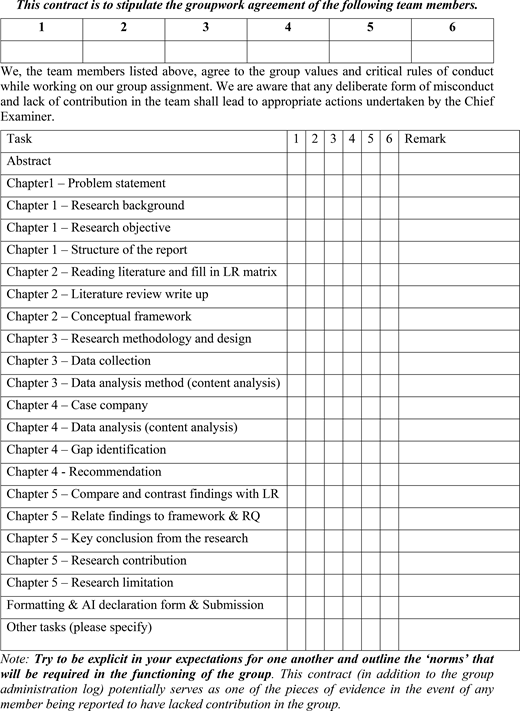
In the past, we attempted to manage group conflict through peer evaluation forms. This is a common approach in many units, where students who contribute less, as rated by their peers, receive lower marks than the group. While this method may appear fair in theory, our past experiences revealed its flaws. In one case, a student received a 0% contribution rating despite providing evidence of completed work, demonstrating how peer assessments can be biased or misused as retaliation. This highlighted a critical issue: rather than promoting accountability, peer evaluations sometimes deepened conflicts and discouraged honest communication. We also realized that peer evaluation should not serve as a punitive tool but as a motivator for inclusive participation. To better manage group dynamics and encourage engagement, we introduced a proactive solution—structured group work contracts ( Appendix).
The group contract began with students listing their names, with each number corresponding to a group member. The task column listed standard components of the research report, along with space for additional group-defined tasks. Students were asked to assign tasks by marking their responsibilities under their assigned number. For example, if Student 1 was responsible for writing the abstract, they would tick the corresponding box. Tasks could also be shared; for instance, multiple students could collaborate on the data analysis section.
Task assignments were encouraged based on individual strengths; for instance, analytical students tackled data analysis, while strong writers worked on the discussion, to ensure each member felt valued.
To evaluate student engagement in our unit assignments, we used the signed group work contract forms to determine how many students collaborated on the same tasks with their group peers. For example, if two students were assigned to the “abstract” section, we counted both towards the total number of group members completing that task and calculated the corresponding percentage.
In our latest cohort, 89% of groups adopted overlapping responsibilities such as co-authoring and peer-editing, fostering integration and cohesion over fragmented work. At the individual level, 78.2% of students (79 out of 101) were assigned to at least one task in collaboration with another member. The contract also served as a neutral point of reference during conflicts, guiding discussions based on pre-agreed terms rather than personal disagreements.
This framework allowed students to clearly express expectations and responsibilities within their teams. Compared to traditional peer evaluations, which often function as punitive tools administered after the fact, the group work contract encouraged active participation from the outset.
During the contract signing process, students, particularly those with prior negative group experiences, expressed satisfaction with the structure. Many reported feeling more optimistic about collaboration, noting fewer frustrations than in previous assignments. Complaints about unequal workload decreased, and students praised the process for setting “clearer expectations” and leading to “fewer arguments”. The structured negotiation also helped bridge cultural communication gaps. For example, students from high-context cultures emphasized the importance of “detailed pre-discussions”, which facilitated mutual understanding. Collaborative tasks, such as joint literature reviews not only improved output quality by incorporating diverse viewpoints but also reinforced accountability. Moreover, students reported gains in intercultural communication and conflict resolution, skills that are directly transferable to global work environments.
7. Conclusion
This study presents a case analysis of the research-based capstone unit in the MIB programme, highlighting the challenges and strategies involved in its curriculum design and delivery. One key challenge was that many coursework students possessed limited prior exposure to research methods. Additionally, the capstone unit required students to synthesize previously learned disciplinary knowledge, which increased to their cognitive load. Standard curriculum and teaching approaches often proved inadequate in meeting these specific needs.
To address this, the first author, who is both a recent MIB graduate and a current teaching assistant, approached curriculum design from a student-centred perspective, identifying common difficulties and concerns. By integrating an adapted backward design approach, we structured the curriculum starting from the final assessment and worked backward to establish learning milestones and weekly topics. For teaching materials, we adopted the expository advance organizer strategy to bridge new research-related content with students’ existing knowledge. Practical examples were central to this approach: we used the analogy of solving a math problem to explain the research process and applied a simple, relatable teaching case on banana sales in China to illustrate literature reviews, content analysis and the process of linking findings back to existing research.
Beyond curriculum and teaching design, this research also emphasizes the importance of student management, especially in group work. We introduced a group work contract to replace the traditional peer evaluation model, which often served as a punitive measure and negatively impacted student mental health and group dynamics. The contract promoted clarity, accountability and collaboration by explicitly setting expectations among group members from the beginning.
The insights from this study can inform the design of research-based capstone units in other coursework-based programmes, especially where students lack prior research experience but are required to apply their disciplinary knowledge in a research context. We also recommend exploring intensive delivery modes for future iterations of such units − for example, offering a three-day intensive workshop early in the semester to provide students with a comprehensive overview of the research process. This can help build a strong conceptual foundation and improve the continuity between research skills and weekly learning.
This study has several limitations. Firstly, as this research is based on a single case, the findings may not fully represent the broader population of MIB students. Different universities offering the same degree may structure their programmes differently − for example, by including a standalone research methods unit. In such cases, our proposed curriculum design may overlap with existing content and require adjustments.
Secondly, the research-based capstone unit was implemented and evaluated over a single semester. Longer-term observation across multiple semesters is needed to assess the sustainability and effectiveness of the approach.
Thirdly, the current curriculum was designed for weekly delivery. Its effectiveness may differ in an intensive teaching format, where the content is condensed into a shorter period. If the unit is delivered in intensive mode, the design may need to be adapted based on student feedback and learning outcomes.
While this study uses secondary university evaluation data to gauge general satisfaction, future research should aim to incorporate more granular quantitative measures. For example, post-completion surveys assessing specific skill acquisition could provide deeper empirical validation of student engagement. Furthermore, future studies could explore the transferability of this integrative model to research-based capstone units in other professional master’s disciplines, particularly those where research methods are not taught as a standalone unit, yet students are required to develop the research competencies necessary for professional practice.
References
Appendix. Group work contract