


High-involvement human resource practices (HIHRP) and i-deals are effective independently; however, in most cases, organizations implement them in combination. Using optimal distinctiveness theory, this study examines how employees respond to the joint implementation of HIHRP and i-deals.
The regression analyses were conducted to examine data gathered from a sample of 397 full-time employees across Eastern Asian countries, specifically Japan, Indonesia, Singapore, Thailand and Vietnam, through an online survey.
The results reveal that when individualistic values are strong, greater implementation of HIHRP strengthens the positive relationship between i-deals and affective commitment. Conversely, when collectivist values are strong, greater HIHRP implementation strengthens the negative relationship between i-deals and affective commitment. These findings suggest that combined human resources practices may send mixed signals depending on employees’ value orientations.
Managers should consider employees’ cultural values when combining HIHRP and i-deals, particularly in collectivist contexts.
This study offers two key theoretical insights. First, although i-deals are generally expected to be beneficial, their interaction with other human resources practices may lead to negative employee reactions. This result highlights the need for horizontal alignment within human resources systems. Second, the impact of i-deals and commitment-oriented HR practices varies by employees’ cultural values, particularly individualism. This notion highlights the importance of considering both individual and country-level cultural factors in similar future research.
1. Introduction
There has been a shared understanding, both in academia and in practice, that employees are a key asset to an organization and that investing in them significantly impacts organizational performance. Strategic human resource management (SHRM) scholars advocate for high-involvement human resource practices (HIHRP) as a means to drive effectiveness (Lawler, 1986; Dyer and Reeves, 1995; Wright et al., 2001). Unlike bureaucratic models emphasizing hierarchical control, HIHRP fosters flatter employment relationships by delegating knowledge, information, and authority to employees to encourage active participation and commitment. These models emphasize horizontal integration across HR practices, assuming employee participation enhances motivation, satisfaction, and performance. It is believed that providing such HR practices to the entire workforce, rather than specific individuals or departments, can strengthen commitment and drive greater performance (Delery and Doty, 1996; Huselid, 1995; Kehoe and Wright, 2013).
On the other hand, the importance of retaining exceptional performers through tailored development opportunities and preferential treatment has increasingly drawn the attention of organizational behavior scholars (Oldroyd and Morris, 2012; Aguinis and O’Boyle, 2014). Organizations identify, recruit and retain high-skilled employees by offering nonstandard arrangements known as idiosyncratic deals (i-deals), which are “voluntary, personalized arrangements of a nonstandard nature negotiated between individual employees and their employers regarding terms that benefit each party” (Rousseau et al., 2006). Empirical studies have confirmed that ideals foster employees’ commitment and positive behaviors (Liao et al., 2016).
While both HIHRP and i-deals are effective, real organizations use them in combination, making it crucial to understand their interaction. HIHRP fosters commitment through uniform treatment, whereas i-deals create differentiation by granting selected individuals access to exclusive resources and benefits. This contrast can lead to unintended consequences, which may potentially cancel out each other’s effects. Individualistic employees, driven by personal interests, may actively seek i-deals when engaged in HIHRP environments, while collectivistic employees may resist differentiation and prefer uniform treatment. In such cases, i-deals may be perceived negatively rather than as a valued opportunity. Despite i-deals being an HR practice, their interaction with other HRM elements remains underexplored.
This study empirically examines how employees perceive and respond to HIHRP and i-deals when these practices are implemented together. Previous research suggests that both practices foster commitment through a social exchange process (Lawler, 1986; Liao et al., 2016). However, this assumption overlooks how cultural values shape employees’ reactions. Using optimal distinctiveness theory, this study aims to explore how individualism and collectivism influence the interplay between HIHRP and i-deals.
This study makes two key contributions. First, it investigates the horizontal integration of HIHRP and i-deals by addressing a critical gap in the research. While prior studies on SHRM have extensively examined the internal alignment of standardized HR practices (e.g. recruitment, training and appraisal), little attention has been given to how more personalized and discretionary practices like i-deals fit within structured HR systems such as HIHRP. This study contributes to the SHRM literature by exploring how such alignment is not only technical or procedural but also contingent on employees’ value orientations, especially the extent to which they adhere to collectivist or individualist logics. Second, it highlights that i-deals are not universally beneficial in such a way that under certain conditions, they may have negative or neutral effects, which in turn challenges the predominant focus on their positive impacts.
The remainder of this paper is structured as follows. Section 2 reviews the literature on HIHRP and i-deals by highlighting their theoretical foundations and empirical findings. Section 3 presents the research methodology, including data collection, sample characteristics and measurement of key variables. Section 4 demonstrates the results of regression analyses, which examine the moderating role of individualistic values in the relationship between HIHRP, i-deals and affective commitment. Finally, Sections 5 and 6 provide theoretical and practical implications, acknowledge limitations, conclude and suggest directions for future research.
2. Literature review
2.1 High involvement HR practice
SHRM is a theoretical perspective for examining how HRM systems affect company performance in relation to other organizational factors, especially other HRM practices. While SHRM lacks a definitive definition, many scholars agree it takes a macro-level view, contrasting with traditional HRM theories focusing on individual practices and emphasizing integration with the strategic management process. It also stresses coordination among HR practices (horizontal/internal fit) and recognizes HRM’s impact on company performance (Wright and McMahan, 1992; Huselid, 1995). SHRM comprises multiple theoretical strands, among which HIHRP is prominent (Lawler, 1986, 1992; Lawler et al., 1995). Unlike the bureaucratic model (Beer et al., 1984), which relies on hierarchical authority to manage employees, HIHRP distributes resources (rewards, knowledge, authority, information) to all organizational levels, enhancing participation and voluntary contributions. It aims to cultivate a motivated, high-quality workforce. Remuneration practices include group or company-linked salaries and skill-based allowances. Knowledge practices involve training for skill development; authority practices include declaration systems, self-managed teams, and employee committees; and information practices involve performance and skills sharing. Empirical studies consistently show that HIHRP improves organizational performance. A meta-analysis by Combs et al. (2006) covering 92 studies confirmed that HIHRP has a stronger effect when implemented systemically. Renkema et al. (2021) found that HIHRP promotes employee innovation via autonomy and affective commitment. Jia et al. (2023) showed that HIHRP fosters psychological ownership, encouraging bootlegging behaviors.
2.2 I-deals as an HR practice
Independent of research on HIHRP, i-deals have attracted attention since 2005. Employment relationships in contemporary organizations are increasingly individualized (Bal and Lub, 2015; Bal and Hornung, 2019). Labor market deregulation encourages employees to actively bargain for their interests and opportunities (Rousseau, 2005). Employees pursue their needs through nonstandard, customized employment modes (Rousseau, 2005; Bal and Dóci, 2018; Bal and Hornung, 2019). For instance, knowledge workers with distinctive competencies negotiate terms like high pay and flexible hours. In response to this and broader social and technological changes, and the strategic need to retain qualified talent, organizations have adopted nonstandard employment arrangements (NSEA). Rousseau (2005) termed such arrangements idiosyncratic deals (I-deals), defined as voluntary, personalized agreements of a nonstandard nature that benefit both employees and employers (Rousseau, 2005). I-deals have several features. First, they are individually negotiated and, initiated by either party. Second, they are heterogeneous, offering terms not granted to others in similar roles. Third, they must benefit both the focal employee and the organization. Finally, they vary in scope: some involve broad conditions (e.g. flexibility in location, scheduling and incentives), while others involve a single aspect (e.g. location only). I-deals were initially theorized and studied in Western contexts (Marescaux et al., 2019; Mughal et al., 2022), though a few studies have extended the research to Asia (Hornung et al., 2008). For example, Hattori et al. (2021) explored how i-deals are interpreted and integrated differently in Asian organizational contexts, shaped by cultural dynamics.
2.3 Co-existence of HIHRP and i-deals
It is important to note that real organizations often use HIHRP and i-deals together, and that these practices can convey different messages to employees, sometimes even cancelling out each other’s effects. HIHRP targets most employees, offering uniformly distributed resources such as training and development opportunities to foster strong organizational commitment. In contrast, i-deals are granted selectively to specific individuals to elicit deep commitment by tailoring benefits or conditions to personal needs. When the former dominates, employees are assimilated into a shared experience of organizational support; when the latter prevails, differentiation arises as only some employees receive privileged access to organizational resources.
This tension raises a critical and underexplored question: what happens when HIHRP and i-deals coexist within the same organizational system? While SHRM theorists have investigated the internal consistency among the practices that constitute HIHRP, they have not examined how HIHRP interacts with practices like i-deals that operate on different principles. From the perspective of i-deals research, a similar gap exists: although early studies largely assumed that i-deals benefit their recipients, more recent work has revealed negative effects on coworkers (Ng and Feldman, 2015; Marescaux et al., 2019; Kong et al., 2020; Mughal et al., 2022). Still, little attention has been given to how the organizational context, such as the presence of HIHRP, shapes the impact of i-deals on both recipients and observers. While HIHRP and i-deals may appear conceptually distinct, HIHRP represents standardized, collective practices and i-deals reflect individualized, negotiable arrangements, which are not necessarily incompatible. Both aim to enhance employee motivation and organizational performance through different mechanisms. Prior research has rarely examined how these two logics can be integrated within a coherent HR practice. This study positions itself at this intersection, seeking to clarify whether HIHRP and i-deals can co-exist and, under what conditions their alignment supports or undermines relational cohesion in the workplace.
2.4 Hypothesis development
This study focuses on affective commitment as the primary outcome. First, HIHRP and i-deals shape the nature of employment relationships, whereas organizational commitment reflects employees’ responses to these relationships (Allen and Meyer, 1990). Second, previous research has consistently shown that organizational commitment serves as a key determinant of various job attitudes and behaviors (Allen and Meyer, 1990; Mathieu and Zajac, 1990), making it a crucial factor in understanding how HR practices influence diverse workplace outcomes.
This study is built on an integrated framework that combines social exchange theory (Blau, 1964; Cropanzano and Mitchell, 2005) and optimal distinctiveness theory (Brewer, 1991). Social exchange theory explains how resource provision from organizations through HIHRP and i-deals positively influences employees’ attitudes. On the other hand, optimal distinctiveness theory suggests that employees seek both a sense of inclusion within the organization and differentiation from others, explaining how cultural values (individualism and collectivism) shape the effects of HR practices. While social identity and organizational justice theory provide important insights into group belonging and fairness perceptions, optimal distinctiveness theory offers a more integrative framework for understanding how employees navigate competing identity pressures from simultaneous exposure to collective and individualized HR practices.
According to the social exchange theory, HIHRP and i-deals independently generate positive employee responses. HIHRP introduces measures that support employee autonomy and self-management (Lawler, 1992), reinforcing a sense of reciprocal obligation between the organization and its employees. According to social exchange theory, when employees perceive investment via training, participation and empowerment, they reciprocate with greater affective commitment. In contrast, bureaucratic HR systems, which emphasize hierarchical control, low skill development and limited participation, minimize employees’ sense of contribution and exchange with the organization (Lawler, 1992). HIHRP, by contrast, enhances employees’ perceived value to the organization and increases their commitment by fostering a mutual investment relationship.
Arthur (1994) argues that in high-involvement workplaces, employees’ organizational centrality tends to increase, and their skills and tenure become more critical for organizational performance. Thus, greater organizational investment raises switching costs, deepening attachment to the organization (Becker and Gerhart, 1996). Empirical research also supports that HIHRP enhances employee innovation and commitment through increased autonomy (Renkema et al., 2021). From this theoretical foundation, the following hypothesis is proposed:
HIHRP increases affective commitment to the organization
Existing literature has consistently found a positive relationship between received i-deals and affective commitment, suggesting that employees who receive customized work arrangements feel a stronger attachment to their organization. Social exchange theory (Blau, 1964; Cropanzano and Mitchell, 2005) provides a theoretical foundation for this relationship, as i-deals represent personalized investments by the organization, fostering a sense of reciprocity and commitment among employees.
Ng and Feldman (2010) demonstrated that received i-deals, including salary, promotion, training, and career development, enhance affective commitment. Similarly, Rosen et al. (2013) found that certain i-deal dimensions, particularly task and job responsibilities, positively influence employees’ organizational attachment. Liu et al. (2013) further showed that flexibility and developmental i-deals strengthen commitment through increased perceived organizational support and self-esteem. The above evidence has reinforced the reciprocal nature of i-deals.
In addition, a meta-analysis by Liao et al. (2016) confirms that i-deals positively affect perceived organizational support, job satisfaction, affective commitment and leader-member exchange across different cultural contexts. While cultural contexts may moderate the strength of effects, the core mechanism holds. Theoretically (Bal and Lub, 2015; Rousseau, 2005) and empirically (Hornung et al., 2008; Liao et al., 2016; Ng and Feldman, 2015), i-deals have been shown to enhance affective commitment regardless of national culture or i-deal type (Hornung et al., 2008; Ng and Feldman, 2010; Hattori et al., 2021; Wasti et al., 2022). Based on these insights and grounded in social exchange theory, this study investigates the following hypothesis:
Received i-deals increase affective commitment to the organization
Both types of practices can explain the relationship between personnel practices and employees’ positive attitudes and behavior from the perspective of social exchange. I-deals lead to high emotional commitment because employees feel valued by the organization. Similarly, the same mechanism can explain why HIHRP leads to employees’ high emotional commitment. Therefore, simply applying social exchange theory to the combination of the two practices, it can be hypothesized that there is a positive interaction between HIHRP and i-deals as follows.
The degree of HIHRP moderates the relationship between i-deals and affective commitment. Specifically, the higher the degree of HIHRP, the stronger the positive influence of perceived i-deals on affective commitment.
From the simple social exchange theory perspective, both HIHRP and i-deals reflect an organization valuing its employees. However, this view overlooks how they may differently affect relationships among employees. HIHRP emphasizes group inclusion rather than individual recognition. As its implementation strengthens, employees are likely to feel valued by the organization and increasingly assimilated into the broader workforce. In contrast, i-deals distinguish focal employees from others. As i-deals increase, recipients may feel valued, yet differentiated from those who are not granted the same treatment.
Combining these practices may thus create a more complex employee experience than simply “being valued”. Optimal distinctiveness theory explains the psychological effects of inclusion and differentiation in groups and organizations (Brewer, 1991). According to this theory, individuals seek both assimilation and differentiation, though these needs inherently conflict. Being overly assimilated or overly isolated both deviate from an optimal psychological state, prompting efforts to restore balance. Specifically, as inclusion increases, the need for assimilation is satisfied, but the desire for differentiation strengthens. Conversely, as inclusion decreases, the need for differentiation declines, while the need for assimilation intensifies. These counteracting tendencies inhibit one another, maintaining a dynamic balance. The optimal point lies where desires for inclusion and differentiation intersect, creating psychological comfort. This theory is supported by experimental studies (Brewer and Roccas, 2001).
Triandis (1995) relates optimal distinctiveness theory to cultural values. In collectivist cultures, the optimal point is closer to high inclusiveness, whereas in individualist cultures, it lies nearer low inclusiveness. It follows that individuals high in individualism have stronger tendencies to seek differentiation, while those high in collectivism show less inclination. If this reasoning holds, individualists who feel included in the group will increasingly seek differentiation. In the context of i-deals, the more individualistic employees feel organizational inclusion, the more they desire distinct treatment. In contrast, when feeling included, collectivists are more inclined to maintain group conformity and avoid special treatment. Thus, the extent to which a person welcomes i-deals depends on their perceived inclusion in the organization or group. Base on this reasoning, the following hypothesis is proposed.
The strength of individualistic values moderates the impact of HIHRP and i-deals on affective commitment. Specifically, when individualistic values are strong, the stronger the degree to which HIHRP is implemented, the stronger the positive relationship between i-deals and affective commitment; conversely, when individualistic values are weak (collectivist values are strong), the stronger the degree to which HIHRP is implemented, the stronger the negative relationship between i-deals and affective commitment becomes stronger.
H3 and H4 reflect competing theoretical predictions. H3, grounded in social exchange theory, posits that HIHRP and i-deals both signal organizational appreciation, thus jointly enhancing affective commitment. In contrast, H4, based on optimal distinctiveness theory, offers an alternative view. While HIHRP targets broad employee commitment through uniform practices, i-deals provide tailored benefits to select individuals, reinforcing their distinct value. The former promotes assimilation, the latter, differentiation. The perceived balance between these opposing dynamics likely depends on the individual’s level of individualism. The validity of these competing predictions is examined below.
3. Research method
3.1 Data collection and samples
This study collected data from full-time employees in five Eastern Asian countries, including Japan, Indonesia, Singapore, Thailand and Vietnam. The primary objective of this study is to examine how cultural values, particularly individualism and collectivism, influence the effects of HR practices in organizational settings. To ensure broader generalizability, data were collected from multiple countries with diverse cultural backgrounds. Specifically, five countries from the East and Southeast Asian regions were selected, which exhibit varying degrees of individualism and collectivism. This approach enables us to capture cross-cultural differences and assess the robustness of the study’s theoretical framework.
An online survey platform was employed to collect the data. Prior research comparing traditional paper-based and online surveys has demonstrated no significant differences in response biases between the two methods (Mehta and Sivadas, 1995). Participants were recruited via GMO Research Inc., a research firm with a substantial database of individuals willing to engage in online surveys. In each country, respondents were randomly selected by GMO Research Inc. from their national participant pool, thereby approximating a random sampling strategy rather than a pure convenience sample. By selecting employees across various organizations and industries rather than restricting the sample to specific sectors or companies, this study ensures a broader assessment of how the distribution of HIHRP and i-deals influences affective commitment.
In each country, GMO Research Inc. distributed the survey link (URL) via email to full-time white-collar employees. Participants were clearly informed that their responses would remain confidential and be used only for academic purposes, and that their employer would not have access to any data. The anonymity of participants was strictly maintained across all countries. No monetary or other incentives were provided to reduce social desirability pressure. Each participant completed two surveys that were administered about 30 days apart to mitigate common method bias (MacKenzie and Podsakoff, 2012). At time 1 (1st November 2022), those who volunteered to participate were given access to a secure website where they completed the survey. A total of 450 responses were recorded. The survey was continued until 90 respondents were reached in each country to align the sample size by country. The survey was terminated when 90 respondents were reached for each country. Then, at time 2 (1st December 2022), after eliminating invalid samples by performing a Satisfice check, the data collection ended up with 397 valid samples. Prior to the start of the survey, participants were informed of the purpose/objectives of the study and their right to refuse participation or withdraw from the survey at any time. The authors confirm that this study complies with relevant ethical guidelines for human subjects and guarantee that the anonymity and confidentiality of participants will be maintained throughout the study. The procedures of this study were reviewed and approved by the university’s ethics review committee.
The survey results included valid data from 83 Japanese, 79 Vietnamese, 82 Singaporeans, 79 Thai, and 74 Indonesians. Forty-five percent (45%) of valid samples were female. The ages of the samples ranged between 23 and 65, with a mean of 34.89. The average age of the samples was 40.73 for Japan, 30 for Vietnam, 34.11 for Singapore, 35.42 for Thailand and 33.07 for Indonesia. The average tenure of participants was 12.56 years in Japan, 5.68 years in Vietnam, 4.68 years in Singapore, 5.11 years in Thailand and 7.07 years in Indonesia. The high value for the Japanese sample is particularly noticeable, but overall, the results reflect the average age and length of service of workers in each country. Participants were employed from a wide variety of industries, most of which were manufacturing (20.3%), banking/finance (11.2%), retail (16.0%), service (15.2%) and consulting (8.3%). The sample also included employees from companies of various sizes, ranging from small firms to large corporations. This diversity in industry and organizational size ensures that the findings are not biased toward a specific sector or company type. There were some cross-national differences regarding gender and tenure, but these variables are not significantly associated with the measures used in this study.
The survey questionnaire was initially developed in English and then translated into Japanese, Thai and Vietnamese using Brislin’s (1986) back-translation procedure. All translators were blind to the study’s hypotheses. All translators were bilingual professionals blind to the study’s hypotheses, and translations were reviewed by independent native-speaking proofreaders. To further ensure cross-language comparability, small-scale pre-tests (one or two people per country) were conducted with native speakers in each country to assess whether the translated items were conceptually and culturally interpreted as intended. These pre-tests did not indicate systematic misunderstanding, lending support to the conceptual equivalence of the instruments.
There may be differences between countries in the extent to which high-involvement HR practices and i-deals are implemented and the relationship between these and effective commitment. To confirm this point, this study compared the mean values of these variables in each country and calculated correlation coefficients for the three variables. As a result, no country-specific differences were detected. This result indicates that it is reasonable to analyze the data of the citizens of the five countries at the same time.
3.2 Measures
At time 1, HIHRP and i-deals were measured in addition to some demographic variables. At time 2, participants’ organizational commitment was measured.
3.2.1 High involvement HR practice
For HIHRP, this study used Chuang and Liao’s (2010) scale to measure. Seven items related to the involvement and participation dimension were extracted from this scale, and the rest were excluded. Sample items include “If a decision made might affect employees, your company asks them for opinions in advance,” “Employees are often asked to participate in work-related decisions,” “The organization does not share information with employees” and “Employees are allowed to make necessary changes in the way they perform their work.” Their reliability coefficient alpha is 0.85.
3.2.2 Received i-deals
Received i-deals were measured using eight items from Rosen et al. (2013). Their original scale included six items for task and work responsibilities, three for schedule flexibility, two for location flexibility and five for financial incentives. To address this imbalance, the two items with the highest factor loadings from each category were selected. Sample items include: “I have successfully asked for extra responsibilities that take advantage of the skills that I bring to the job” (task/work responsibilities); “My supervisor considers my personal needs when making my work schedule” (schedule flexibility); “Because of my individual needs, I have negotiated a unique arrangement with my supervisor that allows me to complete a portion of my work outside of the office” (location flexibility); “My supervisor has ensured that my compensation arrangement (e.g. hourly vs. salaried) meets my individual needs” (financial incentives). Confirmatory factor analysis (CFA) showed good fit for the one-factor model: root-mean-square error of approximation (RMSEA) value of 0.073; comparative fit index (CFI) value of 0.95; Tucker-Lewis Index (TLI) value of 0.939. In contrast, the four-factor model showed poor fit:
with RMSEA value of 0.21; CFA value of 0.72; TLI value of 0.56, and performed worse than the one-factor model. The Cronbach’s Alpha value of the overall scale was 0.92.
3.2.3 Individualism
The study used three items developed by Dorfman and Howell (1988) to measure individualism. Two sample items are: “Group welfare is more important than individual rewards” (reverse score) and “Individuals may be expected to give up their goals to benefit group success” (reverse score). The Cronbach’s Alpha value of the individualism scale was 0.87.
3.2.4 Affective commitment
Affective commitment was measured using six items developed by Allen and Meyer (1990). Sample items are “I enjoy discussing my organization with people outside it” and “I really feel as if this organization’s problems are my own”. The Cronbach’s Alpha value of the affective commitment scale was 0.80.
3.2.5 Demographics
Participants reported their gender (1 = female, 0 = male), age, organizational tenure, company size, respondents’ nationality and managerial position (1 = manager, 0 = others) at time 1.
The study confirmed that all factor loadings for variables measured using a Likert scale were above 0.5. Additionally, the square root of the AVE for each construct was confirmed to be greater than its correlations with other variables.
3.3 Analytic approach
In a three-factor interaction, the effect of the independent variable X on the dependent variable Y depends on the two adjustment variables, Z and W. As in a normal interaction, the dependent variable Y is regressed from the independent variables X, Z and W, the combination of two variables XZ, XW and ZW, and the combination of three variables XZW. This article follows Dawson and Richter’s (2006) procedures and analyses three-factor interactions.
4. Results
Table 1 shows the descriptive statistics and correlation matrix for the various variables (excluding dummy variables) that are input into the regression analysis. No differences between countries were found for these variables. According to Table 1, both HIHRP and received i-deals are statistically significantly correlated with affective commitment, consistent with H1 and H2.
Means, standard deviations and correlation for variables in all data
| Variables | Mean | S.D. | 1 | 2 | 3 | 4 | 5 | |
|---|---|---|---|---|---|---|---|---|
| 1 | Age | 35.982 | 10.123 | 1 | ||||
| 2 | Tenure | 7.055 | 7.409 | 0.592*** | 1 | |||
| 3 | Received ideal | 3.403 | 0.793 | −0.202*** | −0.076 | 1 | ||
| 4 | HIHRP | 3.480 | 0.783 | −0.247*** | −0.134*** | 0.598*** | 1 | |
| 5 | Individualism | 3.417 | 0.659 | −0.155*** | −0.049 | 0.367*** | 0.348*** | 1 |
| 6 | Affective commitment | 3.176 | 0.729 | −0.103** | 0.029 | 0.189*** | 0.246*** | −0.278*** |
Note(s): ** and *** denote statistical significance at 5% and 1%, respectively
Regarding Table 2, Model (1) is the main model excluding the control variables, Model (2) is the model with the control variables and variables other than the interaction term and Model (3) is the full model with all variables. When comparing these models, Model (3) has a significantly higher explanatory power than Models (1) and (2). The results of the main variables detected in all models are robust. This suggests that the model is statistically stable. In addition, we assessed multicollinearity using the Variance Inflation Factor (VIF) for all regression models. All VIF values were below the commonly accepted threshold of 5, indicating that multicollinearity is not a concern. According to Model (3), HIHRP was positively related to affective commitment. In addition, received i-deals were positively related to affective commitment. Thus, Hypotheses 1 and 2 are supported. To test the interactive effect of received ideals and high HIHRP, the study calculated the product of received i-deals and HIHRP and this result was put into the model. As indicated in Table 2, HIHRP does not moderate the relationship between received i-deals and affective commitment; thus, hypothesis H3 is rejected.
Estimated result of regression analysis
| Hypothesis | Model 1 | Model 2 | Model 3 | |
|---|---|---|---|---|
| β | Β | β | ||
| Intercept | 3.233*** | 3.314*** | 3.228*** | |
| Japan dummy | 0.009 | −0.059 | ||
| Vietnam dummy | 0.135 | 0.090 | ||
| Singapore dummy | −0.137 | −0.119 | ||
| Thailand dummy | 0.120 | 0.152 | ||
| Age | −0.009* | −0.007* | ||
| Female dummy | 0.245*** | 0.244*** | ||
| Manager dummy | 0.006 | −0.005 | ||
| Size over1000 dummy | 0.242*** | 0.272*** | ||
| Tenure | 0.015*** | 0.014*** | ||
| Received ideal | H1 | 0.150*** | 0.185*** | 0.175*** |
| HIHRP | H2 | 0.244*** | 0.259*** | 0.237*** |
| Individualism | −0.507*** | −0.471*** | −0.475*** | |
| Received i-deals by HIHRP | H3 | −0.071 | −0.051 | |
| Received i-deals by individualism | 0.046 | 0.041 | ||
| HIHRP by individualism | −0.265*** | −0.261*** | ||
| Received i-deals by HIHRP by individualism | H4 | 0.149** | 0.204** | |
| Adjust R2 | 0.280 | 0.297 | 0.340 | |
| F value | 23.04*** | 15.009*** | 13.805*** | |
Note(s): *, ** and *** denote statistical significance at 10%, 5% and 1%, respectively. Interaction terms are indicated by “by” (e.g. Received i-deals by HIHRP indicates the interaction between Received i-deals and HIHRP)
The final variable to consider is the product of the three variables: received i-deals, HIHRP and individualism. Table 2 shows that this variable significantly influences affective commitment. Three-way interactions are graphically depicted in Figures 1 and 2. These figures show that the impact of the product of the received ideal and HIHRP on affective commitment is reversed for groups with high and low individualism, which means that when individualism is high, the higher the HIHRP, the higher the effect of the received i-deals. When HIHRP is low, the impact of the received i-deals is slightly negative. Conversely, when individualism is low, the slope of received i-deals is slightly negative when HIHRP is high, and when HIHRP is low, the slope of the received i- deals becomes positive. Therefore, Hypothesis 4 is supported. To assess the robustness of this result, we conducted a sensitivity analysis by iteratively excluding each country from the sample. The three-way interaction effects remained statistically significant and directionally consistent across all subsamples, suggesting that the findings are not driven by any single country’s data.
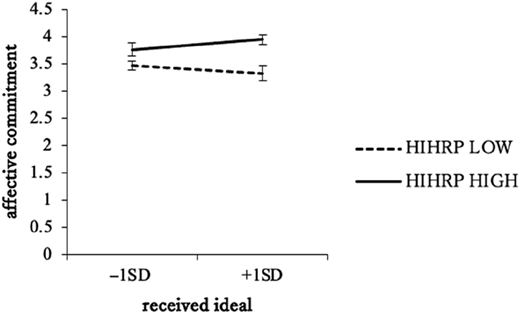
Estimated results of the three-way interaction predicting affective commitment: HIGH individualism samples. Source(s): Authors’ own work
Estimated results of the three-way interaction predicting affective commitment: HIGH individualism samples. Source(s): Authors’ own work
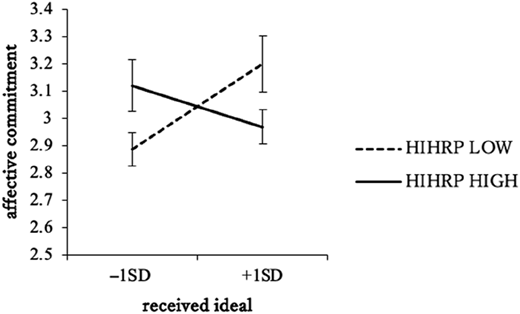
Estimated results of the three-way interaction predicting affective commitment: LOW individualistic samples. Source(s): Authors’ own work
Estimated results of the three-way interaction predicting affective commitment: LOW individualistic samples. Source(s): Authors’ own work
5. Discussions
The impact of control variables on affective commitment, such as the positive impact of organizational tenure and the negative impact of the female dummy, is generally consistent with the results of past meta-analyses (Mathieu and Zajac, 1990). The fact that H1 and H2 were supported suggests that the proposition of previous research that i-deals and HIHRP each bring about positive results independently is partially correct (Becker and Gerhart, 1996; Renkema et al., 2021; Hornung et al., 2008; Liao et al., 2016; Ng and Feldman, 2015). The important thing lies in Hypotheses 3 and 4, which relate to the gaps in previous studies. A major gap in prior research is that it does not consider the joint effects of these practices. The majority of organizations actually employ HIHRP and i-deals simultaneously, and in some cases, the effects of each practice may be offset by the other because those two may provide different messages to employees. However, H3 was not supported while H4 was supported. This finding can be explained by the theoretical tension between the assimilating effects of HIHRP and the differentiating nature of i-deals. Rather than reinforcing each other, the distinct relational signals sent by these practices may conflict, especially when cultural values such as collectivism dampen receptivity to individualized treatment. This result indicates that the optimal distinctiveness theory better explains the relationship between HIHRP, i-deals and affective commitment than social exchange theory. Both practices reflect the fact that the organization values employees, but they may convey different meanings. The polarization in which HIHRP treats all employees undeviatingly while i-deals favor specific individuals leads to differentiation in workplace relationships. According to the analysis results, the impact of their coexistence depends on employees’ level of individualism.
An individualistic employee tends to seek differentiation when strongly involved in the organization, whereas a collectivistic employee may reject further differentiation. In such cases, receiving i-deals may be undesirable rather than beneficial. Whether an employee feels comfortable with special treatment depends on their existing level of organizational involvement.
The first theoretical implication of this study is that i-deals, despite their positive effects, can lead to negative reactions when combined with other HR practices. Commitment-oriented HR practices, such as HIHRP and the high-commitment model (Walton, 1985), assume that high employee involvement fosters participation and contribution to organizational goals. However, these practices aim at building communitarian relationships, which may not align with i-deals that reflect individualistic or neoliberal values. Considering the horizontal alignment of i-deals with other HR practices is essential. The second theoretical implication is that employees’ cultural values must be considered when examining HR practices. This study was conducted with samples of East Asian employees who varied widely in individualism. It is uncertain whether the findings can be applied to U.S. employees, who generally score higher in individualism. Future research should incorporate both individual and country-level cultural values, considering that previous i-deals research has been predominantly North America-focused (Liao et al., 2016; Wasti et al., 2022). Few studies have explored how i-deals, as inherently individualized and often informal practices, align or conflict with broader high-involvement HR systems. The contribution of this study lies in theorizing this alignment not as fixed, but as contingent on employees’ value orientations, particularly their collectivist or individualist predispositions. This perspective advances the SHRM literature by showing that horizontal alignment is a matter of technical consistency and interpretive and cultural fit. The third theoretical implication is about the theory that explains how HIHRP and received i-deals co-operate in the workplace. Social exchange theory remains valid in explaining how each factor independently leads to positive employee attitudes and behaviors. However, when considering their combination with other HR practices, it is possible that other perspectives, such as optimal distinctiveness theory, would be needed.
Practically, this study suggests that many organizations simultaneously implement HIHRP for the broad workforce and i-deals for top performers. However, this combination may send mixed signals in collectivist environments, potentially undermining organizational commitment. Managers should be cautious in two respects: first, assessing employees’ cultural values when offering i-deals, and second, recognizing broader cultural differences across individuals. While our sample spans multiple industries and countries, our practical implications are framed at the organizational level to ensure generalizability.
This study has several limitations. First, the sample is limited to East and Southeast Asia, which may constrain generalizability to Western contexts. Second, although we examined micro-level individualism, country-level cultural variation was not modeled. Future research could use multi-level models combining individual- and country-level values (e.g. Hofstede’s individualism-collectivism) to examine cross-level interactions. For example, the positive effect of i-deals on commitment may weaken in highly collectivist countries when HIHRP is also present (e.g. the effect of i-deals on commitment is negatively moderated by national collectivism under HIHRP conditions). Third, the study does not consider recent developments in digital HRM, hybrid work, or AI, which may affect not only the accessibility of i-deals but also how employees perceive procedural fairness and relational cohesion. Future research could examine how digital transformation mediates or moderates these effects. Another direction is to explore the sequencing of HR practices. Rather than a simultaneous introduction, organizations may implement HIHRP and i-deals sequentially. Whether HIHRP precedes i-deals—or vice versa—may shape perceptions of fairness, inclusion, and legitimacy. Longitudinal or experimental designs could test these temporal dynamics.
6. Conclusions
This study examined how HIHRP and i-deals interact and influence employee affective commitment. While previous research has considered these HR practices to be independently effective, the findings demonstrate that their combined effects vary depending on employees’ cultural values (individualism vs. collectivism). This highlights the importance of horizontal alignment between HR practices. Rather than assuming that HR practices are effective in isolation, organizations must carefully design their implementation while considering cultural values. Future research should investigate similar dynamics across different cultural and industrial contexts as well as conduct multi-level analyses to examine the influence of individual and country-level cultural values.

