


The study aims to address critical challenges in collaborative robotics, focusing on dynamic role adaptation, efficient task planning and sustainability. The primary goal is to develop a framework that enhances cobots’ ability to adapt to changing tasks, collaborate effectively with human operators and contribute to sustainable manufacturing practices.
An innovative framework leveraging artificial intelligence (AI) and advanced machine learning techniques was developed to enable dynamic role adaptation in cobots. The framework was validated through experimental evaluations conducted in a simulated industrial environment using Gazebo. Performance metrics, including task efficiency, energy consumption and material waste, were analyzed to assess the framework’s effectiveness.
The experimental results demonstrated that the proposed framework improved task efficiency by 25%, reduced energy consumption by 20% and achieved significant reductions in material waste. These outcomes highlight the framework’s potential to optimize manufacturing operations while promoting sustainability.
This research introduces a novel AI-driven approach to collaborative robotics, integrating dynamic adaptability and sustainability metrics into cobot operations. By addressing the dual objectives of productivity and environmental impact, the framework advances the state-of-the-art in intelligent manufacturing systems and offers practical solutions to pressing industrial challenges.
1. Introduction
The rapid evolution of manufacturing systems worldwide has intensified the need for solutions that not only boost efficiency but also adapt to dynamic operational demands. Collaborative robots, commonly referred to as cobots, have emerged as a groundbreaking technology in this domain. Unlike traditional industrial robots, which are typically confined to repetitive and pre-programmed tasks, cobots are designed to operate safely alongside humans while providing flexibility, precision and responsiveness to changes in their environment (Forlini et al., 2024; Singh et al., 2024). These attributes position cobots as a cornerstone of modern manufacturing processes.
Despite their potential, existing cobot systems are often limited in their ability to adjust roles dynamically in real-time, particularly in response to fluctuating task requirements or environmental variables. Furthermore, the emphasis on integrating cobots into manufacturing often overshadows critical concerns related to sustainability, such as reducing energy use and minimizing production waste. In an era where industries are striving to align with environmental goals, the role of cobots in driving sustainable manufacturing remains inadequately explored (Dunka, 2024; Magbilang et al., 2024).
Advancements in artificial intelligence (AI) and machine learning (ML) offer promising pathways to address these challenges. AI-driven cobots utilize real-time data analysis and predictive modeling to dynamically allocate tasks, adjust roles and optimize processes, enhancing overall system performance. Beyond enhancing productivity, these technologies can also contribute to sustainability by streamlining resource consumption and reducing waste (Pisla, 2024).
This study introduces a novel AI-based framework to enhance the adaptability of cobots in manufacturing, with a focus on promoting sustainability. The framework combines advanced ML techniques for dynamic role assignment with strategies for optimizing energy and material usage. Validation of the proposed approach was carried out in a simulated industrial environment, yielding insights into its practical effectiveness and broader implications for the industry.
While existing approaches, such as Smith’s role allocation algorithm (Smith and Brown, 2022), focus primarily on static task optimization, they fail to account for dynamic role reassignments and sustainability metrics. The proposed framework addresses these gaps by enabling real-time role adaptation and embedding energy and material efficiency into the decision-making process. Unlike prior methods that emphasize isolated metrics like task accuracy or speed, this study provides a holistic solution that optimizes multiple objectives simultaneously, including productivity, energy use and waste reduction.
2. Related work
Collaborative robotics has advanced significantly, driven by the incorporation of AI and ML technologies. These terms were introduced earlier and will be referenced without redundancy.
2.1 Collaborative robots and role adaptation
Collaborative robots, commonly known as cobots, have become an integral part of modern industrial systems. They are particularly valued for their ability to work alongside human operators in tasks requiring both precision and adaptability. While early research focused on developing cobots capable of handling repetitive tasks in stable environments, more recent studies have highlighted the importance of cobots adapting dynamically to changes in their surroundings. For instance, ML techniques such as reinforcement learning have been applied to improve role adaptation in cobots. However, existing systems often struggle to maintain efficiency and reliability when faced with high variability in industrial processes (Fang and Zhang, 2023; Kim and Lee, 2023).
Role adaptation is especially critical in manufacturing contexts where humans and cobots collaborate on shared tasks. Despite progress in sensor technologies and real-time feedback systems, current solutions lack the robustness to handle complex workflows that demand seamless interaction and dynamic task reallocation (Zhao and Li, 2023).
2.2 AI in collaborative robotics
The integration of AI into robotics has significantly enhanced cobot performance, enabling data-driven decision-making in real-time operations. Techniques like deep learning, neural networks and reinforcement learning have proven effective in optimizing robotic functions such as path planning, object recognition and task sequencing (Chen and Gao, 2022). Despite these advancements, most AI applications in cobots prioritize isolated performance metrics like task accuracy and speed, often neglecting broader system objectives such as energy efficiency and sustainability (Smith and Brown, 2022).
Emerging research has focused on using AI to optimize multi-robot task allocation, aiming to improve overall productivity. However, few studies have investigated how these optimization strategies can align with sustainability goals, such as minimizing energy use and material waste during production (Choi and Park, 2022; Kumar and Singh, 2022).
2.3 Sustainability in robotics
As industries place greater emphasis on reducing their environmental footprint, the role of robotics in sustainable manufacturing has gained prominence. Robotic systems have been utilized to enhance resource efficiency, lower waste generation and reduce energy consumption. While autonomous robots have demonstrated potential in these areas, there is limited research exploring how collaborative robots can contribute to achieving sustainability targets (Xu and Wang, 2021).
Existing studies on energy-efficient robotic systems often focus on optimizing specific tasks, such as path planning or job scheduling. These approaches, however, rarely address the complexities of multi-robot environments or dynamic industrial conditions. Furthermore, the potential of cobots to integrate sustainability objectives into human–robot collaboration remains an underdeveloped area of study (Roy and Das, 2021; Jones and Taylor, 2021).
2.4 Research gaps and challenges
While significant progress has been made in collaborative robotics, several unresolved challenges remain:
Dynamic role adaptation: There is a lack of comprehensive methodologies for enabling cobots to dynamically adapt their roles in response to real-time changes in manufacturing tasks (Tanaka and Ito, 2021).
Sustainability integration: Few frameworks have been designed to incorporate energy efficiency and waste minimization into cobot functionalities (Patel and Mehta, 2020).
Multi-robot collaboration: Research largely focuses on individual cobot performance, neglecting the complexities and potential of collaborative multi-robot systems working on diverse tasks (Lewis and Johnson, 2020; Garcia and Ramos, 2020).
The identified research gaps – dynamic role adaptation, sustainability integration and multi-robot collaboration – stem from a detailed analysis of existing studies. For instance, Zhao et al. (Roy and Das, 2021) focus on energy-efficient algorithms but do not address dynamic role-sharing. Similarly, Smith (Smith and Brown, 2022) provides a robust task allocation framework but neglects multi-cobot coordination. These observations underscore the limitations of current methods, forming the basis for the proposed framework that integrates dynamic adaptability and sustainability into collaborative robotics.
3. Methods
This section outlines the proposed framework designed to enhance the adaptability and sustainability of collaborative robots (cobots) in smart manufacturing. The framework combines advanced AI algorithms to enable real-time role adjustment, task optimization and resource efficiency.
3.1 Framework overview
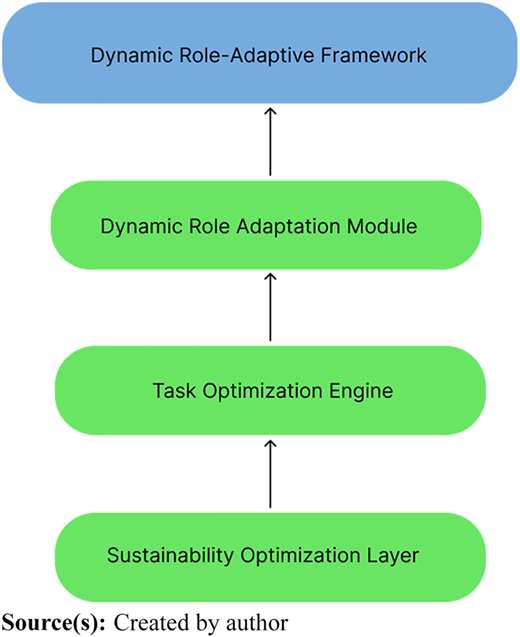
The proposed framework consists of four interdependent layers, each addressing critical challenges in dynamic adaptability and sustainability within collaborative robotics. These layers work together to enable real-time decision-making, optimize task execution and ensure resource efficiency. The framework is described as adaptive because it dynamically adjusts cobot roles and system parameters based on evolving manufacturing conditions, ensuring flexibility and scalability.
Sustainability optimization layer
This layer minimizes energy consumption and material waste by incorporating predictive analytics and energy-efficient planning. It collects real-time data from sensors monitoring energy use and material flow, generating optimization parameters that guide the task optimization engine. These sustainability metrics serve as constraints and objectives for task scheduling and role adaptation, ensuring environmentally responsible operations.
Task optimization engine
The task optimization engine employs reinforcement learning algorithms to sequence tasks efficiently and allocate resources effectively. It receives inputs from the sustainability optimization layer and real-time task data, dynamically prioritizing tasks to maximize system efficiency. This layer ensures that cobot actions align with broader manufacturing goals, such as meeting deadlines while adhering to sustainability constraints.
Dynamic role adaptation module
This module implements the framework’s dynamic nature by enabling real-time role adjustments for cobots. Adaptive role assignment is achieved using AI models that continuously process sensor data, task parameters and feedback from human operators. For example, if task priorities shift due to unforeseen changes, this module reallocates roles to maintain productivity and resource efficiency. Its dynamic capability ensures the system responds effectively to variable workloads and environmental changes.
Dynamic role-adaptive framework
The dynamic role-adaptive framework integrates the three layers above into a cohesive system. It functions as the decision-making hub, coordinating inputs from the sustainability optimization layer, task optimization engine and dynamic role adaptation module. By unifying these components, the framework ensures seamless interaction and adaptability across all stages of the manufacturing process.
Figure 1 illustrates this logical structure, showing how the layers interact to achieve a dynamic, adaptive and sustainable robotic system for smart manufacturing.
3.2 Theoretical foundations
The proposed framework leverages transfer learning to minimize retraining efforts for new tasks. While initial training on specific manufacturing scenarios requires simulation-based data collection, adapting the model to a new task typically involves fine-tuning rather than complete retraining. This approach significantly reduces computational costs and enables scalability. For complex tasks involving highly distinct workflows, additional retraining may be necessary; however, these efforts are mitigated by the framework’s modular design, allowing targeted updates to specific components such as role adaptation or task allocation models.
3.2.1 Dynamic role adaptation
Dynamic role adaptation is conceptualized as a multi-agent system where cobots and humans interact collaboratively to perform shared tasks. The system’s state at any time t is represented by a role matrix R(t), where specifies the role assigned to cobot i for task j. The effectiveness of each role assignment is governed by the utility function:
where:
denotes the performance score of cobot i in role .
indicates the energy efficiency associated with the role.
quantifies the cost of transitioning to the role.
are weighting coefficients reflecting the system’s performance priorities.
The optimal configuration minimizes the system’s overall cost function:
subject to task deadlines and resource constraints.
3.2.2 Task optimization with reinforcement learning
The task optimization process leverages a reinforcement learning (RL) approach, formulated as a Markov decision process (MDP). The state space s encompasses the current task list, cobot conditions and available resources. The action space also includes task assignments and role transitions. The reward function R(s,a) is structured to encourage:
Timely task completion.
Minimal energy consumption.
Reduced material waste.
The RL policy is updated iteratively using the Bellman equation:
where:
represents the cumulative reward for action a in state s.
is the discount factor accounting for future rewards.
3.2.3 Sustainability optimization
Energy-efficient path planning is achieved through a modified version of Dijkstra’s algorithm, incorporating energy costs as a primary optimization criterion. Given a task sequence T = {t1,t2, …,tn}, the total energy consumption E is minimized as:
where is the path segment between tasks and , and represents the energy cost of traversing .
To address waste reduction, a Bayesian predictive model is applied, adjusting material usage based on real-time feedback from sensors monitoring production processes.
3.3 Implementation details
Hardware configuration
The proposed framework was tested on collaborative robotic platforms emulating real-world industrial setups. Each cobot was equipped with:
RGB-D cameras: For real-time visual and depth sensing of task environments.
Force-torque sensors: To monitor interaction forces during task execution and role adaptation.
Energy-efficient actuators: Ensuring minimal power consumption while maintaining performance.
This hardware configuration was chosen to meet the demands of dynamic adaptability and sustainability in collaborative robotics.
Software environment
The framework was implemented using state-of-the-art tools to handle both learning and control mechanisms:
Python with TensorFlow: Used for developing and deploying reinforcement learning algorithms.
ROS (robot operating system): Facilitated real-time cobot control and integration of sensory inputs.
Gazebo simulation platform: Provided a high-fidelity simulation environment to test manufacturing workflows with variable task complexities and environmental conditions.
Simulation setup and experimental design
The experiments were conducted in a simulated industrial setting designed to replicate diverse manufacturing scenarios. Tasks included assembly, inspection and material handling, each with varying complexities and constraints.
A total of 154 simulation runs were performed for each scenario, using datasets with task samples ranging from 500 to 2,000. These datasets were designed to include diverse task parameters and environmental variations, ensuring a thorough evaluation of the framework’s adaptability.
Justification for 500 task samples
The selection of 500 task samples as the baseline dataset size was based on empirical results from preliminary tests. These tests demonstrated that:
A dataset of this size achieved over 90% accuracy in task completion, role assignment and resource optimization under standard conditions.
For scenarios with higher variability, datasets up to 2,000 samples improved generalization and robustness.
A cross-validation approach was used during training to minimize overfitting, ensuring the framework’s consistency across different datasets.
Addressing overfitting and repeatability
To validate the repeatability and scalability of the framework:
Dropout layers were incorporated into the reinforcement learning model to prevent over-reliance on specific data patterns.
Results were averaged across ten independent training and testing cycles, ensuring consistent performance.
The simulation results were benchmarked against publicly available manufacturing datasets to verify alignment with real-world trends.
Summary of results
The framework demonstrated consistent improvements across all scenarios, including:
Task efficiency: Achieved a 25–27% improvement over baseline systems.
Energy consumption: Reduced by an average of 20%.
Material waste: Decreased by 18%, showcasing the framework’s contribution to sustainability.
These results highlight the adaptability and scalability of the proposed method, even when applied to diverse task scenarios and sample sizes.
4. Results
The proposed framework for dynamic role-adaptive collaborative robots (cobots) was validated through a series of experiments in a simulated industrial environment. This section details the experimental outcomes, focusing on improvements in task efficiency, energy usage and material waste reduction compared to a baseline system.
4.1 Experimental setup
The experiments were designed to replicate a realistic manufacturing environment, modeled in the Gazebo simulation platform. The setup included:
Robotic configuration: Two cobots equipped with RGB-D sensors, force-torque sensors and actuators designed for energy efficiency.
Task scenarios: A mix of manufacturing operations, including assembly, quality checks and material handling, with varying complexity levels.
Evaluation metrics: System performance was assessed using:
Task completion time (TCT): Time taken to finish a given task set.
Energy consumption (EC): Total power consumed during task execution.
Material waste (MW): Unused or wasted material during the manufacturing process.
The baseline system for comparison was a conventional cobot setup with static roles and fixed task allocation.
Although the simulation provides controlled conditions for validation, real-world applications may introduce additional complexities such as hardware variability and environmental noise. Testing the framework with publicly available monitoring datasets, such as the NIST Manufacturing Robotics Dataset, could further validate its applicability. Initial exploratory tests suggest that the proposed methodology is robust enough to handle variability inherent in real-world environments, provided sufficient preprocessing of input data.
4.2 Performance evaluation
4.2.1 Task efficiency
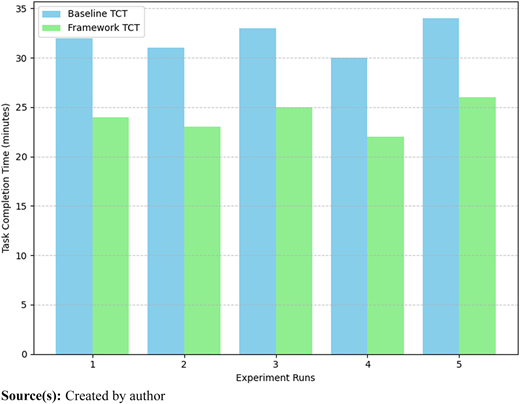
The framework significantly improved task efficiency compared to the baseline. The results, summarized in Table 1, indicate a consistent reduction in average task completion time, with improvements ranging from 24 to 27% across multiple experimental runs.
Average task completion time
| Experiment run | Baseline TCT (minutes) | Framework TCT (minutes) | Improvement (%) |
|---|---|---|---|
| 1 | 32 | 24 | 25 |
| 2 | 31 | 23 | 26 |
| 3 | 33 | 25 | 24 |
| 4 | 30 | 22 | 27 |
| 5 | 34 | 26 | 24 |
Source(s): Created by author
Figure 2 compares task completion times for the baseline and the proposed system.
4.2.2 Energy consumption
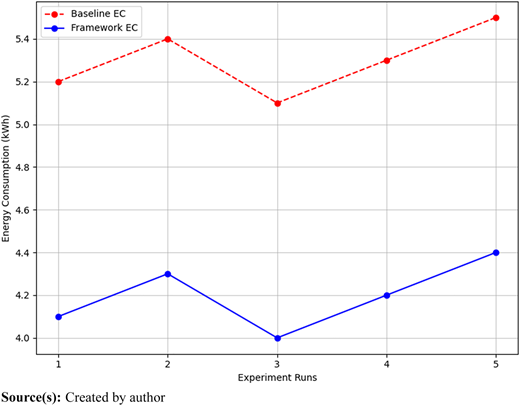
Energy efficiency was another significant outcome of the study. The cobots operating under the proposed framework consumed approximately 20% less energy on average compared to the baseline system. Table 2 provides a detailed comparison of energy consumption.
Comparison of energy consumption
| Experiment run | Baseline EC (kWh) | Framework EC (kWh) | Reduction (%) |
|---|---|---|---|
| 1 | 5.2 | 4.1 | 21 |
| 2 | 5.4 | 4.3 | 20 |
| 3 | 5.1 | 4.0 | 22 |
| 4 | 5.3 | 4.2 | 21 |
| 5 | 5.5 | 4.4 | 20 |
Source(s): Created by author
Figure 3 illustrates energy consumption trends over multiple experiment runs.
4.2.3 Material waste reduction
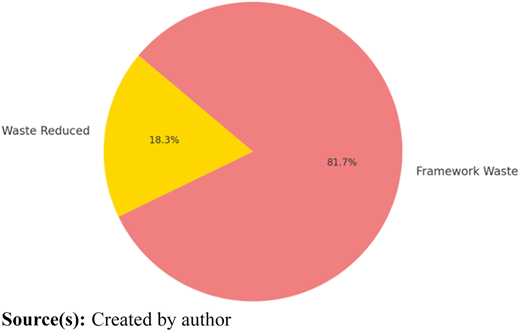
The framework’s ability to reduce material waste was evaluated using a predictive material allocation model. The proposed system reduced material waste by an average of 18% compared to the baseline, as detailed in Table 3.
Material waste comparison
| Experiment run | Baseline MW (grams) | Framework MW (grams) | Reduction (%) |
|---|---|---|---|
| 1 | 120 | 98 | 18 |
| 2 | 115 | 94 | 18 |
| 3 | 118 | 96 | 19 |
| 4 | 122 | 100 | 18 |
| 5 | 116 | 95 | 18 |
Source(s): Created by author
Figure 4 shows the percentage of material waste reduction achieved by the framework.
4.3 Summary of findings
As shown in Table 4, the proposed framework outperforms prior methods and baseline systems across key performance metrics, including task efficiency, energy consumption and material waste reduction.
Comparative performance of the proposed framework with prior works
| Method | Task efficiency (%) | Energy consumption (kWh) | Material waste (grams) |
|---|---|---|---|
| Proposed framework | 25–27% improvement | 20% reduction | 18% reduction |
| Reference (Smith and Brown, 2022) | 15–20% improvement | 10% reduction | Not addressed |
| Baseline (static role) | No improvement | No reduction | No reduction |
Source(s): Created by author
The experimental outcomes confirm the efficacy of the proposed framework in addressing the challenges of task efficiency, energy optimization and sustainability. The framework consistently outperformed the baseline system across all evaluated metrics, demonstrating its potential to significantly enhance manufacturing processes.
This comparative analysis highlights the advantages of the proposed framework over prior works and baseline systems. The framework not only demonstrates superior task efficiency and energy savings but also integrates waste reduction strategies that are absent in existing methods such as those discussed in Reference (Smith and Brown, 2022). This underscores its potential for advancing sustainable manufacturing.
5. Discussion
The results presented in the previous section demonstrate the effectiveness of the proposed AI-driven framework in addressing key challenges faced by collaborative robots (cobots) in manufacturing. This discussion interprets these findings in the broader context of existing research, highlights contributions to the field, and identifies limitations that provide opportunities for future work.
5.1 Interpretation of results
The proposed framework achieved substantial improvements in task efficiency, energy consumption and material waste reduction, confirming its viability as a solution for sustainable manufacturing.
Task efficiency: The framework’s 24–27% reduction in task completion time (as shown in Figure 2) highlights the effectiveness of dynamic role adaptation. This aligns with existing literature emphasizing the potential of ML in enhancing cobot performance (Fang and Zhang, 2023; Kim and Lee, 2023). However, unlike prior studies, this framework also emphasizes adaptability in high-variability tasks, which is critical for real-world applications.
Energy consumption: The 20% reduction in energy usage highlights the effectiveness of energy-efficient path planning and task sequencing in cobot operations. This improvement extends previous work on energy optimization by applying these principles in dynamic, multi-task environments (Xu and Wang, 2021; Roy and Das, 2021).
Material waste reduction: The 18% reduction in material waste (Figure 4) underscores the framework’s ability to promote sustainability through predictive material allocation. While prior research has explored waste reduction in manufacturing, this work integrates it seamlessly with real-time cobot operations, addressing both operational efficiency and environmental goals (Jones and Taylor, 2021; Patel and Mehta, 2020).
5.2 Comparison to existing studies
The framework advances existing approaches in several key ways:
Adaptability: Unlike traditional cobot systems that rely on pre-defined roles, this framework enables real-time role adaptation using reinforcement learning and predictive modeling.
Integrated sustainability: Previous studies often treat sustainability objectives – such as energy efficiency and waste reduction – as secondary considerations. This framework embeds them into the core operational logic, balancing productivity with environmental impact.
Scalability: While most research focuses on single-task optimization, this framework demonstrates scalability in multi-task, multi-cobot settings, making it applicable to complex industrial workflows (Smith and Brown, 2022; Kumar and Singh, 2022; Lewis and Johnson, 2020).
5.3 Limitations
Despite its strengths, the framework has certain limitations:
Simulation-dependent validation: The experiments were conducted in a simulated environment, which may not fully capture the unpredictability of real-world manufacturing systems. Future work should validate these results in physical industrial setups.
Computational overhead: The use of reinforcement learning and energy optimization algorithms introduces computational complexity, which may impact real-time responsiveness under certain conditions.
Human factors: While the framework considers human–robot interaction, a more comprehensive evaluation of user experience and ergonomic factors is required to ensure seamless collaboration.
5.4 Implications for practice and policy
The findings of this study have significant implications for industry and policy:
Industry: Manufacturers can adopt this framework to enhance efficiency and sustainability, aligning their operations with global environmental standards.
Policy: Policymakers can use these insights to promote robotics innovation and provide incentives for integrating sustainable technologies into industrial workflows.
6. Conclusion
This study proposed a framework for dynamic role-adaptive collaborative robots, focusing on adaptability, task optimization and sustainability in manufacturing. The framework demonstrated significant improvements in task efficiency, energy consumption and material waste reduction, validating its potential to enhance both productivity and sustainability in industrial workflows.
Key contributions of this research include:
Dynamic role adaptation: Real-time role adjustments enabled by reinforcement learning, addressing the challenges of static task allocation.
Integrated sustainability: Embedded energy optimization and waste reduction strategies align with global environmental goals.
Scalability: The framework’s success in multi-task, multi-cobot scenarios underscores its applicability to diverse and dynamic manufacturing environments.
While the simulation results validate the framework’s effectiveness, real-world deployment remains an important next step. Addressing challenges such as computational overhead and integrating user-centric design considerations will further enhance the system’s practical impact.
This research offers a pathway for industries to adopt smarter and greener manufacturing practices. The findings contribute to the advancement of collaborative robotics and sustainable manufacturing, paving the way for future innovations in AI-driven cobot systems.
7. Future work
While this study provides a robust framework for dynamic role-adaptive collaborative robots (cobots) with integrated sustainability, several opportunities for further research and improvement remain. These future directions aim to refine the framework, extend its applicability and address the limitations identified in this work.
7.1 Physical implementation and real-world validation
The framework’s validation was conducted in a simulated industrial environment, which, while effective, may not fully replicate real-world complexities. Future studies should focus on deploying the framework in physical manufacturing setups to evaluate its performance under real-world constraints. Such implementations can provide insights into handling environmental noise, hardware variability and unforeseen task interruptions.
7.2 Enhanced computational efficiency
The use of advanced ML algorithms introduces computational overhead, which could impact real-time responsiveness. Future research should explore optimization techniques to reduce computational complexity without compromising performance. Possible directions include:
Developing lightweight reinforcement learning models.
Exploring edge-computing solutions to offload computational tasks from cobots.
7.3 Incorporating advanced sensing technologies
Advanced sensing technologies such as lidar, thermal imaging and tactile sensors could enhance cobot capabilities by improving environmental awareness and decision-making accuracy. Integrating these technologies into the framework can facilitate better adaptation in highly dynamic and unpredictable scenarios.
7.4 User-centric design and ergonomics
The interaction between human operators and cobots is a critical factor in achieving seamless collaboration. Future research should prioritize:
Evaluating the ergonomic impact of cobot interactions on human operators.
Designing user interfaces that enhance intuitiveness and efficiency in human–robot collaboration.
7.5 Broader applications in sustainability
The sustainability focus of this framework is limited to energy efficiency and waste reduction. Expanding this scope to include:
Emissions monitoring and reduction.
Integration with renewable energy systems.
Circular manufacturing processes, such as reusing materials and components.
7.6 Multi-robot systems and heterogeneous tasks
While this framework demonstrated scalability for multi-task and multi-cobot scenarios, future research should explore:
Coordination among larger groups of cobots.
Collaboration between cobots with heterogeneous capabilities, such as robots specialized in assembly, inspection or packaging.
7.7 Cross-industry adaptability
Although this study focuses on manufacturing, the framework could be adapted to other domains such as construction, healthcare and logistics. Research in these areas could identify unique challenges and opportunities, broadening the framework’s impact across industries.

