

Tacit and explicit knowledge sharing play crucial roles in today’s rapidly changing business environment, particularly in fostering innovation. However, uncovering tacit knowledge sharing remains complex. The purpose of this study is to analyze the mediating roles of tacit and explicit knowledge in the relationship between a knowledge-sharing culture and organizational creativity.
In this study, the authors developed an extended analytical process to analyze the impact of explicit and tacit knowledge on a knowledge-sharing culture and organizational creativity. This process combines two analytical techniques: necessary condition analysis (NCA) and partial least squares structural equation modeling (PLS-SEM). NCA identifies essential bottlenecks for a specific outcome, while PLS-SEM uncovers strong connections between predictor and outcome variables. The authors applied these analyses to a sample of 155 IT experts from a leading telecom company in the Turkish ICT industry to test the relevant hypotheses.
The findings of this study indicate that tacit knowledge, rather than explicit knowledge, partially mediates the relationship between a knowledge-sharing culture and organizational creativity. This mediating role of tacit knowledge is particularly pronounced in the ICT sector. Additionally, the impact of organizational capabilities on organizational creativity is amplified by higher levels of tacit knowledge sharing.
The effect of organizational capabilities on organizational creativity was found to increase because of tacit knowledge sharing compared to explicit knowledge sharing, depending on the knowledge-sharing climate.
1. Introduction
Knowledge is one of the most valuable resources for organizations in today’s constantly changing and dynamic business world (Drucker, 1993). In recent years, the relationships between a competitive advantage, organizational creativity, performance and innovation that knowledge provides to organizations have been a significant focus of academic study (Kogut and Zander, 1996; Teece et al., 1997; Bock et al., 2005; Wang and Wang, 2012; Del Giudice and Maggioni, 2014; Yao et al., 2020b; El-Kassar et al., 2022; Iqbal et al., 2023). Previous studies have shown that, in line with Grant’s (1996) knowledge-based view of the firm, knowledge sharing within an organization is crucial for developing the intellectual capital of enterprises, fostering innovation within the enterprise and enhancing organizational performance and creativity (Ali et al., 2019; Iqbal, 2021; Iqbal et al., 2023).
The voluntary sharing of knowledge and creativity among employees is seen as extra-role behavior (Islam and Tariq, 2018; Imamoglu et al., 2023;Olan et al., 2016; Liu et al., 2018). As the relationship between knowledge sharing, innovation and creativity is widely acknowledged as a significant factor influencing a firm’s capacity for creativity and innovation, many academics have concentrated on it (Devi, 2024). Employees’ willingness to share explicit and tacit knowledge is a factor that may mediate and further explain the relationship between organizational creativity adoption in IT firms and a knowledge-sharing culture. In this context, tacit knowledge sharing (TKS) is particularly relevant for contemporary workplace organizations, such as information and communication technology (ICT) companies (Alsondos et al., 2015; Bou Reslan et al., 2021), where cognitive resources are promoted and used by employees in distributed teams. Moreover, creating an organization based on knowledge sharing is possible with a strong and supportive environment (Panaccio et al., 2015)
These factors should be taken into account to fully understand the relationship. Employee knowledge, both explicit and tacit, has been said to have a major influence on an organization’s capacity for organizational creativity (Rehman et al., 2015; Wang et al., 2016a; Nguyen and Malik, 2020; Santhose and Lawrence, 2023; Nguyen et al., 2024).
The uniqueness of the IT environment is suitable for investigating the phenomenon of explicit and implicit knowledge sharing because IT professionals are constantly exposed to new information (Borges, 2012). Especially in different cultures, explicit and tacit knowledge have been found to have different effects on organizational creativity or innovation in the IT sector (Kucharska, 2021; Kucharska and Erickson, 2023). This study is important because the willingness to share explicit and tacit knowledge is expected to be higher in IT firms in Turkey, where individualism is much lower than in American and European countries according to Hofstede’s cultural dimensions (www.hofstede-insights.com/country-comparison-tool). The fact that a study of this nature has yet to be conducted using a Turkish sample adds significant value to its originality. Turkey’s unique position as a rapidly developing economy with a burgeoning ICT sector makes it an important context for examining the dynamics of knowledge sharing and organizational creativity.
ICT companies are engaged in software development with systems management support. These highly knowledge-intensive activities involve many human elements with different levels of knowledge and attitudes (Rus and Lindvall, 2002). For the IT organization, people’s knowledge is an asset that affects the financial value of the organization. This knowledge is the capture and sharing of information about new technology among employees (Bartol and Srivastava, 2002). It is very important to share the knowledge of experienced people within the organization. Knowledge sharing improves work progress and also keeps an employee’s daily work under control. Song (2001) stated that through effective TKS in the ICT sector, these organizations can increase productivity, reduce training costs and reduce risk because of uncertainty. Teamwork in the ICT sector always exceeds the capacity of an individual and requires collaborative problem-solving.
While academics and managers have shown great interest in understanding what conditions foster knowledge sharing and creativity, as they are vital for organizations today, unanswered questions and situations remain unclear (Son et al., 2017; Imamoğlu et al., 2024). Therefore, investigating which factors are decisive in enhancing organizational creativity and employee knowledge sharing is essential. Various scholars have investigated the factors affecting knowledge sharing in the IT sector. However, there seems to be little consensus in the literature on this issue (Ghobadi, 2015; Karagoz et al., 2020; Malik and Malik, 2021). Some studies explore factors that determine employees’ willingness to share knowledge at the individual level, such as trust and dependency (Brown and Cregan, 2008; Jafari Navimipour and Charband, 2016; Zhang and He, 2016), perceived organizational support (Alfes et al., 2013; Khan et al., 2015) and individual motivation (Ismail et al., 2009). Other studies link employees’ willingness to share knowledge with organizational resources, such as incentives (Ismail et al., 2009), paradoxical leadership (Devi, 2024) and ambidextrous leadership style (Malik et al., 2024), and a few studies posit that it is related to organizational culture (Ismail et al., 2009; Mueller, 2015). Based on these studies, we believe that organizational culture should be considered as a whole in the willingness of employees to share knowledge in the IT sector, which is a very dynamic sector with a relatively high turnover rate of 18% (Gallup Report, 2018). In this context, to the best of the authors’ knowledge, this study is one of the first on the knowledge-sharing culture of organizations and the IT sector.
As little work has been done on the antecedents of organizational creativity, especially in the knowledge-sharing culture (Anderson et al., 2014; Son et al., 2017), an important contribution of this study is to fill this gap in the scientific literature by empirically testing the impact of a knowledge-sharing culture, especially at the organizational level, on the adoption of organizational creativity, and to provide a detailed and comprehensive analysis by looking at how explicit and tacit knowledge can facilitate the understanding of its impact on the adoption of organizational creativity. Furthermore, this study contributes to the literature through a multilevel analysis approach, which is applied to advance the theoretical concept by breaking it down into various elements and highlighting the relationships among them at different levels of analysis.
It is known that knowledge is created by knowledgeable workers in organizations (Tariq et al., 2024) and that the willingness to share knowledge and the ability to implement innovations created by these workers are directly proportional to their networking capabilities (Dabić et al., 2024) and depend on their ability to understand the environment and create new knowledge. In recent years, Hobfoll’s (1989) “Conservation of Resources Theory,” building on Grant’s work, has garnered significant attention in organizational behavior literature. The conservation of resources (COR) theory posits that humans are motivated to acquire, maintain and protect their resources. The theory’s basic concept is that resources are valued and cannot be distributed to all individuals. Organizations with greater capacity to create new knowledge, such as those in the IT sector, are better equipped to adapt promptly and efficiently to a continuously changing environment (Reychav and Weisberg, 2010). Recent empirical studies in business literature have focused on companies’ capacity to create new knowledge by exchanging unique and valuable information. Organizations often require their employees to contribute knowledge (Bergh et al., 2025) and adopt (Moraes et al., 2023) a knowledge management system such as an online database. This results in the automated dissemination of information in a manner that goes against the organic transmission of knowledge. Employees are reluctant to contribute valuable and unique tacit knowledge using an online platform (Lin, 2007; Hau et al., 2013). Two primary areas analyze information exchange among individual employees in businesses. The categories are referred to as explicit knowledge sharing (EKS) and TKS (Wang et al., 2021). As defined by Hau et al. (2013), EKS is the formal transmission of knowledge and information, typically recorded in coded or written forms, such as written documents and reports. TKS is the unspoken and spontaneous flow of knowledge between different departments and personnel, as explored by numerous researchers (Hau et al., 2013; Lei et al., 2019a; Iqbal et al., 2023; Hau and Evangelista, 2007). In this context, information sharing involves individuals sharing their important tacit and explicit information, expertise and skills within a department or company through social contact.
According to Wang et al. (2016a), although the innovation and corporate success of organizations depend on sharing the explicit and tacit knowledge of their employees, sharing tacit knowledge, which is more difficult to obtain and transfer, has attracted more attention in knowledge management (KM) research because of many factors. Previous research has found that a firm’s successful KM practices are positively related to the quantity and quality of their innovation output, especially in technology-oriented firms (Dabić et al., 2019). Many previous studies have shown that tacit knowledge is more important than explicit knowledge, especially in increasing organizational innovation and creativity (Akhavan and Hosseini, 2016; Reid, 2003). However, knowledge sharing, an important value and resource for employees, is affected by various factors. Employees’ sharing of their knowledge safely and freely is influenced by many factors, including organizational variables (Sestino et al., 2024), such as management’s attitude and incentives. The presence of each of these factors in the organization will positively affect employees’ knowledge sharing, significantly increasing creativity and innovation. Studies have confirmed that an organization can execute a cohesive strategy and achieve a lasting competitive advantage based on valuable and innovative knowledge gained through the exchange of tacit knowledge (Rajapathirana and Hui, 2018). Tacit knowledge is immutable and strongly associated with internal experience and experimental success (Guan and Ma, 2003). In his study on the role of KM in innovation, du Plessis (2007) emphasized that firms continue to evolve through the innovation process, which leads to the use of existing resources and the development of new, intangible assets. This innovation capability ultimately triggers organizational creativity. Explicit knowledge includes a set of routine procedures, while tacit knowledge includes common practices or strategies to deal with uncertainty (Nonaka, et al., 1996).
2. Theoretical background and hypothesis development
2.1 Knowledge-sharing culture and organizational creativity
In the era of globalization and technology-driven innovation, many managerial studies (Kim and Chang, 2019; Cillo et al., 2022) increasingly emphasize the impact of culture on innovation and performance. “Knowledge-sharing culture is one where people share openly, there is a willingness to teach and mentor others, where ideas can be freely challenged and where knowledge gained from other sources is used” (Smith and McKeen, 2003: p.6). The exchange of TKS and EKS among employees is a crucial element in the competitiveness and success of organizations (Nonaka, 1994; Egan et al., 2017; Sestino et al., 2020; Khan et al., 2015). This sharing is not just a process but a vital element for the continuity and growth of an organization. Organizations, therefore, are keen on encouraging employees to share this valuable knowledge (Albino et al., 1998; Bock et al., 2005; Thomas and Gupta, 2022a), as it can lead to significant advancements and innovations.
Human nature dictates that we do not readily share valuable knowledge acquired (Davenport et al., 1998). Therefore, organizational leaders are responsible for creating a suitable climate for knowledge sharing that fosters trust among their employees (Huber, 2001; Bock et al., 2005). This climate, known as a knowledge-sharing culture, is crucial for the continuity of EKS and valuable TKS in organizations. Leaders, therefore, play a pivotal role in establishing an environment of trust within their organization.
As mentioned above, the basis of COR theory is that people are driven to acquire and maintain new resources. According to Hobfoll (1988), resources are defined as items, conditions and other assets that people value. Resources have different values for different people, depending on their unique circumstances and experiences. This paper’s theoretical argument is that explicit and tacit knowledge, one of the most valuable resources, especially in the IT sector, can be protected as a resource and that the conditions in which it can be shared can be identified. This understanding underscores the crucial role of KM in organizational development and innovation, a concept that can inspire and enlighten organizational leaders and professionals.
Employees’ willingness to share this valuable knowledge can be ensured by reward and incentive systems within the organization, the example set by other employees to share knowledge and the organization’s mechanisms that internalize knowledge sharing. The primary role of top management is to create an organizational design and structure that is conducive to both the acquisition of tacit knowledge through discovery and the exploitation and integration of this new knowledge with existing knowledge to deliver new products (Smith and Tushman, 2005; Alonso et al., 2008).
“Organizational creativity is the creation of a valuable, useful new product, service, idea, procedure, or process by individuals working together in a complex social system. It is, therefore, the commonly accepted definition of creative behavior, or the products of such behavior” (Woodman et al., 1993: p.293). Remembering that information alone cannot produce meaningful value is key. The most crucial and difficult strategy for improving collective knowledge is knowledge sharing across organizational members (Chen et al., 2011). Moreover, knowledge sharing is generally considered one of the most fundamental processes of KM, bestowing advantages to the firm by leading to the creation of organizational knowledge (Osterloh and Frey, 2000).
Previous studies have shown that knowledge sharing is an important asset in the creative and innovative activities of organizations. Table 1 presents, in a synoptic context, the main studies on the relationship between knowledge sharing and creativity that have been recognized in the literature and have contributed to the development of this field.
Knowledge sharing and organizational creativity literature synoptic table
| Title | Source | Methodology | Main results |
|---|---|---|---|
| Woodman, R. W., Sawyer, J. E., and Griffin, R. W. (1993). Toward a theory of organizational creativity | Academy of Management Review | Conceptual Empirical | Within the individual, both cognitive (knowledge, cognitive skills and cognitive styles/preferences) and non-cognitive (e.g. personality) aspects of the mind are related to creative behavior They argued that knowledge sharing occurs at individual, group and organizational levels and that knowledge is the most valuable element for creativity In addition to identifying the relevant and useful knowledge of group members for use in solving group problems, groups provide an arena in which members can use others as resources to increase their own knowledge. In this way, the member not only contributes to his or her own knowledge but also uses the knowledge of others to promote the usefulness of his or her own skills |
| Ikujiro Nonaka (1994) A dynamic theory of organizational knowledge creation | Organization Science | Conceptual | Knowledge is also stored within organizations in the form of common organizational practices and routines. Organizational knowledge depends on the ability to institutionalize individual-based knowledge to make it available to other organizational members. It argues that explicit knowledge can be achieved through combination and internalization, while tacit knowledge can be achieved through socialization of internalized knowledge. This model is important, as it is the first design of the SECI model, as will be explained below |
| Nonaka, I. and Konno, N. (1998). The concept of “Ba”: Building a foundation for knowledge creation | California Management Review | Conceptual | They stated that knowledge management can be defined as a method that simplifies and improves the process of sharing, distributing, creating and understanding company knowledge. In this study, they developed the SECI Model design which is very valuable for explicit and tacit knowledge sharing (socialization, externatilization, combination and internatilization) |
| Stembert, R. J. and Lubart, T. I. (1999). The concept of creativity: Prospects and paradigms. In R. J. Stemberg (Ed.) | Handbook of Creativity, Cambridge University .New York, NY: Press | Conceptual | The study states that knowledge sharing supports creativity. Knowledge sharing has been recognized as a kind of human intellect for creativity. They argued that knowledge that improves decision-making, learning, human performance at work and problem-solving processes are essential for creativity |
| Taggar, S. (2002). Individual creativity and group ability to utilize individual creative resources: A multilevel model | Academy of Management Journal | Empirical | This study argues that teams can achieve a higher level of creativity when they include both creative members and effective processes where members can collectively approach and use the knowledge available within the team |
| Kessel, M., Kratzer, J. and Schultz, C. (2012). Psychological safety, knowledge sharing, and creative performance in healthcare teams | Creativity and innovation management | Empirical | This study examined (1) the contribution of knowledge sharing activities within teams to creative performance and (2) the extent to which knowledge sharing mediates the relationship between psychological safety and creative performance. Moreover, in line with the results of previous research, the results showed that there is a significant relationship between knowledge sharing and creativity. This study concluded that knowledge sharing contributes more to team creativity than information sharing. Moreover, this study is the first to empirically demonstrate that knowledge sharing is effective in explaining the relationship between psychological safety and creativity |
| Cheung, S. Y., Gong, Y., Wang, M., Zhou, L. and Shi, J. (2016). When and how does functional diversity influence team innovation? The mediating role of knowledge sharing and the moderation role of affect-based trust in a team. | Human relations | Empirical | This study examined the interaction between a cognitive factor (i.e. knowledge sources associated with functional diversity) and an affective factor (i.e. affect-based trust in a team) to understand when functional diversity can inhibit team innovation through knowledge sharing. The findings as a whole suggest that the integration of cognitive and affective approaches helps to clarify the mixed findings documented in the literature on the effects of functional diversity on team innovation and creativity |
Source:
In the ever-changing information age, many companies have focused more explicitly on the use of knowledge (Zhu et al., 2022; Ganguly et al., 2019; Leidner, 2010). Knowledge sharing (Lei et al., 2019a; Mas-Machuca and Martínez Costa, 2012; Davenport et al., 1998) facilitates knowledge transfer among employees (Yao et al., 2020a; Cabrera and Bonache, 1999). A knowledge-sharing culture significantly affects the transmission and generation of new knowledge and creative ideas among employees and organizational performance (Duan et al., 2022; Yew Wong, 2005), so it is important to use and share knowledge fully (Liu et al., 2018; King and Marks, 2008; Zhang et al., 2022). In this respect, organizations must explore how to motivate their employees to share knowledge, which is a strategic asset (Hafeez and Abdelmeguid, 2003).
Organizational creativity is essential, as it can produce innovative ideas that give firms a competitive advantage, aid in problem-solving and improve their products and services. Providing opportunities for personal growth and development can increase employee engagement and satisfaction (Wei et al., 2013). Encouraging creativity among employees can lead to the generation of fresh information that can improve various aspects of a business, such as training programs, management strategies and employee satisfaction (Williams, 2001). Ultimately, this can increase productivity, enhance market performance and create a competitive advantage (López-Cabarcos et al., 2020; Amabile’s, 1996) component model is frequently applied in creativity research. According to this paradigm, creativity depends on possessing domain-relevant abilities, that is, understanding the methods and processes necessary to perform a task (Conti et al., 1996). To be creative, individuals must have profound knowledge of a specific subject, profession or task (Gilson et al., 2013). Organizations must focus on KM methods and organizational creativity to further develop and gain a stronger competitive position. Organizations can enhance economic value and innovation because of their competitive advantages (Lei et al., 2019a). In this context, the following hypotheses were formulated:
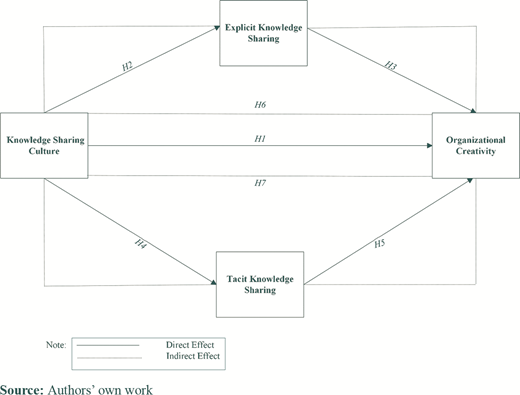
Knowledge-sharing culture significantly and positively affects organizational creativity.
Knowledge-sharing culture positively and significantly affects explicit knowledge sharing.
Knowledge-sharing culture positively and significantly affects tacit knowledge sharing.
2.2 Tacit knowledge sharing
Tacit knowledge, as mentioned above, is a type of knowledge that, by its very nature, is difficult to copy or imitate and also difficult to transfer to others (Polanyi, 1966; Nonaka and Takeuchi, 1995; Friedman and Bernell, 2006). Tacit knowledge cannot be easily codified or expressed because it is embedded in the individual’s brain or experience in the form of know-how or skills (Nonaka, 1994). “Tacit (or implicit) knowledge, on the other hand, involves less specifiable insights and skills 'embedded’ in individuals or organizational contexts. It is 'knowing how’, and it is associated with experience” (Connell et al., 2003: p.140). Therefore, tacit knowledge is more difficult to share among employees than explicit knowledge because it requires much more time and effort (Ipe, 1998; Dhanaraj et al., 2004; Hau et al., 2013). These characteristics create a structure that differs from explicit knowledge and gives organizations a competitive advantage (Martin and Salomon, 2003). Organizations benefit greatly when this valuable and rare tacit knowledge is shared voluntarily among their employees. It builds strong intellectual capital and makes innovation an organizational culture (Orlando et al., 2020). As mentioned above, establishing an environment of trust within the organization is imperative for the transfer of tacit knowledge (Lin, 2007a, 2007b). Such an environment can be achieved by promoting a knowledge-sharing culture in an organization. In essence, TKS is possible through socialization and communication among employees (Smith, 2001; Wang et al., 2016b; Thomas and Gupta, 2022a), although such an environment may not always be easily achieved. Tacit knowledge has a value structure that enables employees to retain resources for their benefit. The lack of a reward system within an organization may signal to employees that sharing tacit knowledge with their peers diminishes their position or status, causing tacit knowledge to be concealed (Duan et al., 2022). Obviously, concealing valuable and rare tacit knowledge will negatively affect the innovation quality of organizations and cause entropy over time. If employees have a significant competitive advantage over other employees with their tacit knowledge, and this is used as a hidden source of power in the organization (Connelly et al., 2019), then employees will not share this knowledge with their colleagues. When there is a hostile climate in organizations and employees are prevented from accessing knowledge sources (Singh, 2019), knowledge remains concealed, and innovation does not occur (Sukumaran and Lanke, 2020). However, in organizations in which knowledge sharing and organizational trust exist, organizations increase their creativity through TKS.
In this context, the following hypothesis was developed:
Tacit knowledge sharing significantly and positively affects organizational creativity.
2.3 Explicit knowledge sharing
Explicit information, as opposed to tacit knowledge, is more readily articulated and shared through written materials, such as manuals or reports (Nonaka and Takeuchi, 1995). Explicit knowledge is described in Nonaka and Takeuchi’s (1995) model of knowledge formation as an extensive or in-depth understanding as opposed to a “general idea” of how things work. EKS in its most general form; “Degree to which one believes that one will engage in an explicit knowledge and sharing act” (Bock et al., 2005: p.107).
Stated differently, explicit knowledge may pertain particularly to a business, industry or subject (Gilson et al., 2013). People pick up this explicit knowledge in a variety of ways. For instance, direct experiences such as classroom instruction or on-the-job training can be the source of explicit information (Leonard-Barton, 1998). Additionally, interacting with people from varying backgrounds and specialties might help to acquire explicit information (Boud and Middleton, 2003; Felstead et al., 2005). Employee knowledge sharing boosts absorptive capacity, innovative capability, organizational creativity and firm performance according to several studies on organization and KM (Liao et al., 2007; Liu and Phillips, 2011).
Von Hippel (1994) introduced the term “knowledge stickiness” to illustrate the challenges employees face when sharing their knowledge, both explicitly and implicitly. “The increasing expenditure required to transfer a particular body of knowledge to a particular location in a usable form by a particular knowledge seeker” (Von Hippel, 1994, p. 430) encapsulates this stickiness. Implicit knowledge, in comparison to explicit information, is inherently stickier (Hau et al., 2013). Employees naturally expect to receive sufficient intrinsic or extrinsic rewards for sharing their knowledge. Moreover, some scholars argue that the economic values of explicit and tacit knowledge differ (Reychav and Weisberg, 2010). Given its ease of transmission, explicit knowledge is considered relatively less costly. Similarly, Smith (2001) explored the distinct roles of these two forms of information sharing and found that a welcoming and dynamic learning environment is the most critical factor in the success of EKS and TKS.
Implicit knowledge, derived from firsthand interactions, behavioral observations and intricate methods of gathering information from other workers, holds unique value (Lei et al., 2021). Its inherent difficulty in sharing makes it more expensive, but its richness and depth make it invaluable to organizations (Reychav and Weisberg, 2010).
Businesses that effectively use ICTs have witnessed significant advancements in capacity and cost and are recognized for their ability to gather, store, process, retrieve and distribute knowledge. This primarily involves the collection and administration of explicit personal knowledge (Maule et al., 2002).
A key challenge in KM is consolidating information from various sources to create a unified knowledge base. Among the most critical systems to establish and maintain are those that foster better decision-making, faster response times, improved organizational communication and increased staff collaboration and creativity (Schwartz et al., 2000). In this context, the following hypothesis was formulated:
Explicit knowledge sharing significantly and positively affects organizational creativity.
2.4 The mediating effect of tacit and explicit knowledge sharing on organizational creativity
Organizations are expected to have organizational creativity and innovation through knowledge sharing (Černe et al., 2014; El-Kassar et al., 2022). The premise of innovation is undoubtedly organizational creativity (Amabile et al., 1996; Bogilović et al., 2017).
EKS and TKS are the two categories into which information sharing can be separated (Polanyi, 1962; Leonard and Sensiper, 1998; Nguyen et al., 2022). While TKS is more valuable than explicit knowledge, it is defined as the process of sharing individual knowledge and experiences derived from past actions, insights and intuitions (Nonaka, 1994; Smith, 2001; Borges, 2013; Lei et al., 2019b; Borges et al., 2019). EKS is the process of sharing systematic information and formal knowledge that can be easily distributed among employees. Organizational creativity can create both explicit and tacit knowledge when staff members come up with fresh concepts and solutions to issues (Gamble, 2020). López-Cabarcos et al. (2023) state that these organizational qualities are the essential competencies businesses use to develop long-term strategies and a competitive edge. The knowledge-based view (Grant, 1996) holds that knowledge is the most valuable organizational resource, and that incorporating specialized information from individuals into new products forms the basis of organizational capabilities. Individuals’ specialized knowledge is dispersed across the company.
KM processes play a pivotal role in organizations, effectively storing, sharing and applying both types of knowledge. By leveraging both explicit and tacit knowledge, organizations not only enhance their organizational creativity but also improve their performance and gain a competitive advantage in the market (Yousif, 2021; Giustiniano et al., 2016). These processes, when harnessed effectively, have the potential to unleash the full power of organizational creativity, leading to transformative outcomes.
There is a positive relationship between organizational creativity and KM (Goswami and Agrawal, 2023; Stojčić et al., 2024). Organizational creativity can lead to new knowledge, which can be managed and used through KM processes. In other words, creativity can help organizations generate new ideas and knowledge, while KM processes can help them effectively store, share and apply this knowledge to achieve their goals (Balkan-Akan et al., 2017).
In this context, the following hypotheses were developed:
There is a mediating effect of explicit knowledge on the effect of a knowledge-sharing culture on organizational creativity.
Tacit knowledge has a mediating effect on the effect of a knowledge-sharing culture on organizational creativity.
3. Methods
3.1 Procedures and sample
A questionnaire was created to assess the various constructs and test the assumptions mentioned above that illustrate the relationships of the conceptual model, as shown in Figure 1. Data from a survey were gathered from a subset of IT professionals who were contacted personally. The electronically distributed questionnaires targeted IT professionals from one of the most important companies in Turkey’s IT sector, which operates nationwide. The employees were sent a link to an online survey through the company’s social media communication networks and asked to complete the survey.
To ensure comprehensive data collection, we conducted a two-wave survey with a two-month interval between the waves. The first wave, Time 1 (T1), commenced on January 2, 2023, during which we gathered data on the variables knowledge-sharing culture and EKS and TKS. The second wave, Time 2 (T2), began on March 1, 2023 and focused on the organizational creativity variable and the participants’ personal demographic information. This meticulous approach to data collection is a testament to our commitment to providing accurate and reliable findings.
Before proceeding with the study, we ensured that the participants were fully informed about the research objectives and were assured of the anonymity and confidentiality of their data. The sampling error calculated for an organization with a total of 200 IT employees was 132 (www.qualtrics.com/blog/calculating-sample-size/). In total, 200 questionnaires were distributed. Of these, 185 were completed in T1, and the number dropped slightly to 168 in T2. The response rate was a satisfactory 84%. After scrutiny to eliminate incomplete or incorrect questionnaires and extreme values, we included 155 valid questionnaires in the study, respecting the rights and privacy of our participants throughout.
This study adopted a research and measurement method based on quantitative data. The questionnaire consisted of four sections. In the first part, closed-ended questions were included to determine the demographic characteristics of the employees in the study, such as gender, age, educational status and length of service in the organization. Data were collected between January and March 2023. Scale items were translated from English to Turkish and vice versa to ensure linguistic compatibility (Brislin, 1986). The Definition of Research Constructs are in Table 2.
Definition of research constructs
| Construct | Definition |
|---|---|
| Knowledge-sharing culture | “Knowledge-sharing culture is one where people share openly, there is a willingness to teach and mentor others, where ideas can be freely challenged and where knowledge gained from other sources is used” (Smith ve McKeen, 2003: p.6) |
| Explicit knowledge sharing | “Degree to which one believes that one will engage in an explicit knowledge and sharing act”. (Bock vd., 2005: p.107) |
| Tacit knowledge sharing | “Tacit (or implicit) knowledge, on the other hand, involves less specifiable insights and skills 'embedded’ in individuals or organizational contexts. It is 'knowing how’, and it is associated with experience” (Connell et al., 2003: p.140) |
| Organizational creativity | “Organizational creativity is the creation of a valuable, useful new product, service, idea, procedure, or process by individuals working together in a complex social system. It is, therefore, the commonly accepted definition of creative behavior, or the products of such behavior” (Woodman vd., 1993: p.293) |
Source:
3.2 Measuring constructs
Well-structured scales were adopted to measure the various constructs. These scales have been used in previous studies and tested for validity and reliability. A four-item scale used by Yao et al. (2020a), “Knowledge Sharing Culture,” labeled items SC-1 and SC-4. An example is “Our company prioritizes people, cares about employees, and supports employee development.” The reliability and internal consistency analysis of the scale yielded a Cronbach’s α of 0.903. A two-item scale used by Bock et al. (2005), “Open Information Sharing,” labeled items EX-1 and EX-2. An example is “In the future, I will share my work reports and official documents with members of my organization more often.” The reliability and internal consistency analysis of the scale yielded a Cronbach’s α of 0.930. A four-item scale used by Lin (2007a, 2007b), “Tacit Knowledge Sharing,” labeled its items TK-1 and TK-4. A sample item is “I share my work experiences with my coworkers.” Reliability and internal consistency analysis of the scale yielded a Cronbach’s α of 0.880. The scale with at least three items used by Giustiniano et al. (2016), “Organizational Creativity,” labeled items OC-1 and OC-3. An example is “Our company often tries new ideas.” Reliability and internal consistency analysis of the scale yielded a Cronbach’s α of 0.910. Respondents rated all items on a five-point Likert scale ranging from 1 (strongly disagree) to 5 (strongly agree).
3.3 Data analysis and findings
3.3.1 Respondents’ profiles.
Of the white-collar employees participating in the study, 83.2% (n = 129) were male; 9.7% (n = 15) were ages 20–30 years, 69.7% (n = 108) were ages 31–40 years, 16.1% (n = 25) were ages 41–50 years and 4.5% (n = 7) were 51 years or older. In terms of educational background, 92.2% (n = 143) had bachelor’s degrees, 6.5% (n = 10) had master’s degrees and 1.3% (n = 2) had doctorates. In terms of length of service in the organization, 16.1% (n = 25) had been working 1–5 years, 18.7% (n = 29) between 6 and 10 years, 56.1% (n = 87) between 11 and 15 years and 9% (n = 14) 16 years or more.
3.3.2 Evaluation of common method bias.
As the dependent and independent variables were collected simultaneously using the online survey method, the recommendations suggested by Podsakoff et al. (2003) were followed to avoid common method bias. In addition, three statistical analyses were conducted to minimize the effects of method bias. The first is Harman’s (1967) single-factor test, which found that only one factor explained 40.82% of the total variance, thus below the 50% threshold (Eigenvalue >1). This analysis showed that the potential effects of common variance bias were negligible in this study.
The second analysis was a one-factor confirmatory factor analysis (Korsgaard and Roberson, 1995). The results showed that the one-factor model fit significantly worse than the measurement model. Therefore, common method variance did not emerge as an issue in this study.
Using a directory of e-mail addresses, 200 questionnaires were sent to randomly selected participants, emphasizing that the survey would be administered anonymously. In total, 168 questionnaires were returned (response rate 77.5%). To test for non-response bias, the differences between the means of all variables for early (first 78%) and late (last 22%) respondents were examined. The Armstrong and Overton (1977) method was used to determine response rate bias and found no significant difference between the two survey groups.
3.3.3 The measurement model.
This study used partial least squares structural equation modeling (PLS-SEM) to examine the data (Hair et al., 2017). Construct validity was assessed by considering convergent and discriminant validity, as well as reliability. The indicators comprised item loadings, t-statistics, Cronbach’s alpha (α), composite reliability (CR) and average variance extracted (AVE). The alpha (α), CR and AVE values of each construct were evaluated to confirm convergent validity, as all estimates exceeded the traditional requirements of 0.70, 0.70 and 0.5, respectively (Hair et al., 2013).
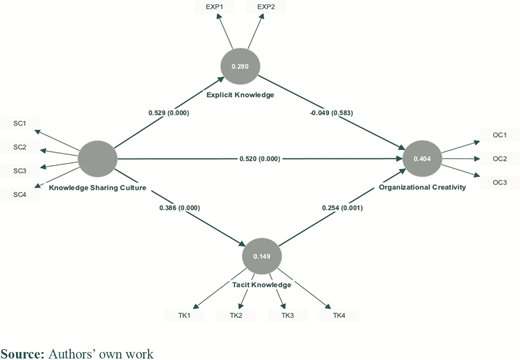
Because this method is less sensitive to the normality assumption and can estimate connections between variables in very small samples, it is preferred over covariance approaches (Henseler et al., 2016). The use of Smart PLS and necessary condition analysis (NCA) requires estimating the minimum sample size to be used (Ringle et al., 2015). The free G*Power program (www.gpower.hhu.de/en.html) was used to estimate the minimum sample size. When the data are entered into the software, the latent construct or variable with the highest number of predictors (receiving the highest number of arrows) should be evaluated. As can be observed in Figure 2, there are two parameters for the calculation. When power = 0.80 and f2 = 0.15 are entered into the G*Power software (Ringle et al., 2015; Sarstedt et al., 2021), it is determined that the sample should be at least 68 in the analysis. The 155 sets of survey data remaining after outlier exclusion show that these values are sufficient to continue the analysis.
The distribution of indicators for the questionnaire items is shown in Table 3. TK1 (4.755) had the highest mean score among the items, while KS4 (3.174) had the lowest. The standard deviation analysis did not reveal significant variations among the metrics. An indicator in output TK1 had a skewness score of 5.76, which suggests a distorted distribution based on the mean; the majority of replies lean toward full agreement for this indicator.
Descriptive statistical indicators for the conceptual model
| Items | Missing | Mean | Median | Minimum | Maximum | SD | Excess kurtosis | Skewness |
|---|---|---|---|---|---|---|---|---|
| EX1 | 0 | 3.374 | 4.000 | 1 | 5 | 1.340 | −0.956 | −0.402 |
| EX2 | 0 | 4.071 | 4.000 | 1 | 5 | 1.187 | 0.880 | −1.308 |
| KS1 | 0 | 3.439 | 3.000 | 1 | 5 | 1.270 | −0.900 | −0.338 |
| KS2 | 0 | 3.729 | 4.000 | 1 | 5 | 1.193 | −0.600 | −0.589 |
| KS3 | 0 | 3.697 | 4.000 | 1 | 5 | 1.199 | −0.441 | −0.666 |
| KS4 | 0 | 3.174 | 3.000 | 1 | 5 | 1.321 | −0.935 | −0.292 |
| OC1 | 0 | 3.826 | 4.000 | 1 | 5 | 1.159 | −0.134 | −0.758 |
| OC2 | 0 | 3.819 | 4.000 | 1 | 5 | 1.183 | −0.348 | −0.754 |
| OC3 | 0 | 3.529 | 4.000 | 1 | 5 | 1.297 | −0.900 | −0.432 |
| TK1 | 0 | 4.755 | 5.000 | 1 | 5 | 0.646 | 5.726 | −3.628 |
| TK2 | 0 | 4.429 | 5.000 | 1 | 5 | 0.952 | 3.926 | −2.002 |
| TK3 | 0 | 4.684 | 5.000 | 1 | 5 | 0.760 | 3.256 | −3.046 |
| TK4 | 0 | 4.632 | 5.000 | 1 | 5 | 0.795 | 5.170 | −2.734 |
Source:
In Table 4, PLS-SEM analysis reveals the scores for the external loadings, indicating the strength of each composite indicator in generating the reflective latent variable. All indicators above the 0.7 threshold for the expected outcome are shown in Table 3, which shows that the data have a satisfactory symmetrical distribution as the standardized external factor loading (> 0.70 and p < 0.000), and both skewness and skewness measures are within ± 5. Variance inflation factor values range from 1.70 to 3.25, indicating a nonsignificant multicollinearity problem (Henseler et al., 2016).
Outlier loadings, variance inflation factor values
| Construct | EX | KS | OC | TK | VIF |
|---|---|---|---|---|---|
| EX1 | 0.908 | 1.711 | |||
| EX2 | 0.906 | 1.711 | |||
| KS1 | 0.837 | 2.015 | |||
| KS2 | 0.873 | 2.553 | |||
| KS3 | 0.887 | 2.775 | |||
| KS4 | 0.863 | 2.288 | |||
| OC1 | 0.891 | 2.425 | |||
| OC2 | 0.918 | 3.121 | |||
| OC3 | 0.895 | 2.380 | |||
| TK1 | 0.851 | 2.031 | |||
| TK2 | 0.715 | 1.483 | |||
| TK3 | 0.901 | 3.254 | |||
| TK4 | 0.872 | 2.805 |
Notes:
KS = Knowledge-Sharing Culture; EX = Explicit Knowledge; TK = Tacit Knowledge; and OC = Organizational Creativity
PLS-SEM provides scores for internal consistency (Cronbach’s alpha and composite confidence level, Table 5), convergent validity (assessed by mean variance extracted, Table 5) and discriminant validity (assessed by Fornell–Larcker criterion and heterotrait–monotrait ratio [HTMT], Tables 6 and 7) for the reflective measurement model (Hair et al., 2013).
Assessment of internal consistency and convergent validity
| Cronbach’s alpha | rho_A | Composite reliability | Average variance extracted (AVE) | |
|---|---|---|---|---|
| Explicit knowledge | 0.784 | 0.784 | 0.903 | 0.822 |
| Knowledge-sharing culture | 0.888 | 0.888 | 0.923 | 0.749 |
| Organizational creativity | 0.885 | 0.888 | 0.929 | 0.813 |
| Tacit knowledge | 0.857 | 0.873 | 0.903 | 0.702 |
Source:
Fornell–Larcker criterion to assess discriminant validity
| Explicit knowledge | Knowledge-sharing culture | Organizational creativity | Tacit knowledge | |
|---|---|---|---|---|
| Explicit knowledge | 0.907 | |||
| Knowledge-sharing culture | 0.529 | 0.865 | ||
| Organizational creativity | 0.312 | 0.592 | 0.902 | |
| Tacit knowledge | 0.336 | 0.386 | 0.439 | 0.838 |
Source:
Heterotrait–monotrait criterion assessment of discriminant validity
| Explicit knowledge | Knowledge-sharing culture | Organizational creativity | Tacit knowledge | |
|---|---|---|---|---|
| Explicit knowledge | ||||
| Knowledge-sharing culture | 0.634 | |||
| Organizational creativity | 0.371 | 0.663 | ||
| Tacit knowledge | 0.404 | 0.441 | 0.500 |
Source:
As PLS-SEM algorithms are generally expected to perform particularly well with small samples and non-normal data and as it was observed that the loading factors on the indicators that make up all variables are not the same, the composite reliability score is within the desired levels, with a confidence level for all four variables exceeding the minimum threshold of 0.7 (Table 5). Moreover, Spearman’s rank correlation (rho-A) shows strong positive correlations for all variables (Hair et al., 2017).
Given that the composite reliability and Cronbach’s alpha values (Table 5) are significantly higher than the cutoff value of 0.7 (Henseler et al., 2016), the measurement model’s internal reliability is excellent. The AVE has a minimum value of 0.5749, exceeding the 0.5 cut-off value. Moreover, for every structure listed in Table 5, the square roots of the AVE were greater than the connections with any other latitudinal structure. As a result, the measurement model’s convergent and discriminant validity are acknowledged.
Fornell and Larcker’s (1981) criterion was evaluated to determine discriminant validity. The square root of the AVE for each construct was higher than the correlation coefficients with other constructs. In sum, the present results provide both convergent and discriminant validity.
The empirical model is supported by Table 7, which displays scores for each latent variable that are greater than the correlations displayed below the major diagonal. Strong discriminant validity for the structured model is implied by the HTMT analysis (Table 7), which shows that the scores are below the suggested statistical threshold of 0.85 (Henseler et al., 2015).
3.3.4 Model testing using PLS-SEM.
PLS-SEM does not require properly distributed data; hence, parametric significance tests cannot be used to assess the significance of coefficients such as external weights, external loadings and path coefficients (Drăgan et al., 2023). PLS-SEM uses a nonparametric bootstrap approach to assess the significance of route coefficients computed in PLS-SEM, as proposed by Efron and Tibshirani (1986) and Davison and Hinkley (1997). Bootstrapping relies on the creation of subsamples composed of observations randomly selected from the main data set. Subsamples were used for estimating the PLS path model. This method is reiterated until a sufficient number of random subsamples is produced. The significance and direction of the hypothesized associations were assessed using the bootstrap method and 5,000 subsamples. Figure 2 illustrates the structural model post-bootstrap method, with asymptotic significance (p-value) values indicated on the connections between the latent variables.
In the model, knowledge-sharing culture directly and positively affected organizational creativity (β = 0.520 and p = 0.000). H1 is accepted. Similarly, knowledge-sharing culture has a direct and significant effect on explicit knowledge (β = 0.529 and p = 0.000), and H2 is accepted. However, explicit knowledge diminished organizational creativity, and the p-value was insignificant (β = −0.049 and p = 0.583). Accordingly, H3 is rejected. Another hypothesis, knowledge-sharing culture, had a significant and positive effect on tacit knowledge, and H4 (β = 0.386 and p = 0.000) is accepted. The next hypothesis, that tacit knowledge has a significant and positive effect on organizational creativity (H5) is accepted (β = 0.254 and p = 0.001).
Then, following the guidelines suggested by Preacher and Hayes (2008) and Nitzl (2018), mediation/indirect effects were analyzed with confidence intervals excluding zero. The results of the mediation model (indirect effects) reveal that EKS (β = −0.026 and 95% CI = [−0.129; 0.071]) does not mediate the relationship between knowledge-sharing culture and organizational creativity (H6), but implicit knowledge sharing (β = 0.098 and 95% CI = [0.029; 0.190]) does (H7), as shown in detail in Table 8.
Summary of hypotheses testing
| Hypotheses | b | SE | t-values | BC 95% CI | p | Decision |
|---|---|---|---|---|---|---|
| Path coefficients/direct effects | ||||||
| H1- KSC → OC. | 0.520 | 0.090 | 0.549 | [0.365; 0.662] | 0.000 | Accepted |
| H2-KS → EXP | 0.529 | 0.074 | 7.160 | [0.377; 0.666] | 0.000 | Accepted |
| H3-EXP → OC | −0.049 | 0.076 | 6.810 | [−0.224; 0.129] | 0.583 | Rejected |
| H4-KSC → TKS | 0.386 | 0.081 | 4.751 | [0.211; 0.534] | 0.000 | Accepted |
| H5-TKS → OC | 0.254 | 0.078 | 3.243 | [0.103; 0.409] | 0.001 | Accepted |
| Mediation/indirect effects | ||||||
| H6- KSC → EXP → OC | −0,026 | 0.049 | 0.529 | [−0.129; 0.071] | 0.597 | Rejected |
| H7- KSC → TKS → OC | 0.098 | 0.041 | 2.376 | [0.029; 0.190] | 0.018 | Accepted |
Source:
3.3.5 Necessary conditions using necessary condition analysis.
An essential condition must be present to attain a specific result. Reaching a conclusion is impossible without this criterion (Dul, 2016). NCA has gained popularity in various disciplines, particularly business and management. It assesses how much an independent variable influences a dependent variable by serving as a bottleneck. NCA is a method primarily used for assessing hypotheses that state “X is necessary for Y to occur” or “Y cannot happen without X” (Dul, 2016; Dul, 2022). Thus, NCA is especially beneficial for assessing the importance of predictor variables in determining outcomes. Researchers must understand the pertinent literature well (Dul, 2016). NCA tries to determine if an event can happen without a specific circumstance, rather than focusing on how changes in a determinant affect an outcome (Richter et al., 2020; Dul et al., 2023).
Employees need to share their tacit knowledge for high levels of creativity in the IT sector.
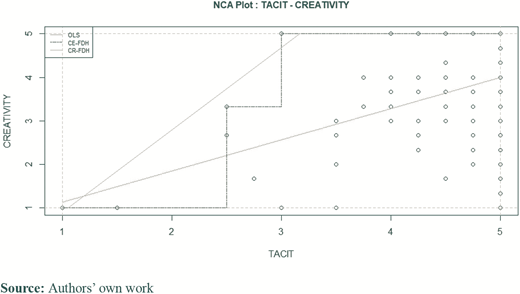
NCA, a method that uses two coordinate systems, can best be understood through an example. In organizational creativity, the predictor variable, such as the sharing of tacit knowledge by employees, is shown on the horizontal axis, and the outcome variable, such as the level of creativity, is shown on the vertical axis (Sukhov et al., 2022). A ceiling line is drawn with a region containing observations where these variables are shown and a region with no observations (Figure 3). A permutation test with a random sample size of 10,000 was then performed to test the effect sizes on the dependent variable (Dul, 2016). As can be seen in Table 9, the necessary conditions are met for organizational creativity with an effect size greater than zero.
Results of necessary condition analysis
| Condition | Method | Accuracy% | Effect size | p-value |
|---|---|---|---|---|
| Sharing culture | CR-FDH | 100 | 0.003 | 0.083 |
| Explicit knowledge | CR-FDH | 100 | 0.000 | 1.000 |
| Tacit knowledge | CR-FDH | 100 | 0.280* | 0.001** |
Notes:
The ceiling technique that produces the results is CR-FDH. Accuracy is the number of cases on or below the ceiling lines divided by the total number of cases multiplied by 100%. The effect sizes were based on 10,000 random samples generated by an approximate permutation. The extent to which a condition is necessary is expressed with the effect size d (d = the size of the space above the ceiling/the total space where cases are observed). General benchmark for effect size: 0 ≤ d < 0.1 “small effect,” 0.1 ≤ d < 0.3 “medium effect,” 0.3 ≤ d < 0.5 “large effect” and d ≤ 0.5 “very large effect.”. *p < 0.05 level
As shown in Table 10, the results indicate that a single condition (tacit knowledge) is necessary for organizational creativity, as they exhibit effect sizes greater than zero. Among these conditions, TKS (d = 0.280 and p < 0.01) shows the only significant effect with a moderate effect size (0.1 ≤ d ≤ 0.3) (Dul, 2016). The fact that the other two conditions (EKS and knowledge-sharing culture) do not show a significant effect size can be interpreted as indicating that tacit knowledge is a necessary condition for organizational creativity. These findings also support the related literature.
Bottleneck table
| Organizational creativity | Knowledge-sharing culture | Explicit knowledge sharing | Tacit knowledge sharing |
|---|---|---|---|
| 0 | NN | NN | 1.4 |
| 10 | NN | NN | 6.6 |
| 20 | NN | NN | 11.9 |
| 30 | NN | NN | 17.2 |
| 40 | NN | NN | 22.4 |
| 50 | NN | NN | 27.7 |
| 60 | NN | NN | 33.0 |
| 70 | NN | NN | 38.3 |
| 80 | NN | NN | 43.5 |
| 90 | NN | NN | 48.8 |
| 100 | NN | NN | 54.1 |
Source:
As a second step in NCA analysis, we created a bottleneck table (Table 10) to better understand the tacit knowledge characteristics necessary for organizational creativity. This table shows the minimum values of tacit knowledge characteristics expressed as percentages necessary to achieve high organizational creativity (80% and above). As can be seen, a high level of organizational creativity is achieved, with 43.5% TKS. As mentioned above, statistically significant results (p < 0.01) could not be obtained for the other two variables.
4. Discussion
Testing the structural model through PLS-SEM, this study revealed that tacit knowledge capacity plays an important role in the impact of a knowledge-sharing culture on organizational creativity in IT organizations. By merging PLS-SEM with NCA, a unified strategy is introduced to help distinguish between required and sufficient circumstances, to better comprehend correlations between results and predictive variables and to facilitate the identification of significant bottlenecks.
In this context, H3 and H6 were not supported in our study. The explicit knowledge of IT companies is largely digitized, with the company or development group storing documents, software components, models, algorithms and source code in digital form in a public knowledge base. This discovery aligns with the organizational knowledge-sharing framework outlined by Nonaka and Takeuchi (1995), who define explicit knowledge as “general knowledge” of how business is conducted. Von Krogh et al. (2000) suggest that an organization should have a system in place that promotes information sharing.
While a person who thinks in the traditional sense may approach a problem with some traditional technology tools used in the past, a person with a high level of creativity must think differently about the problem (Stojčić et al., 2024). The ability to think differently about IT includes several subdimensions (Wolverton et al., 2023), the most important of which is having more tacit knowledge about a heuristic to generate new ideas. Saide and Sheng (2024) found that ICT sector employees first develop explicit knowledge in written form and then transform it into tacit knowledge. In support of this view, Stenmark (2000) argues that IT management has much to contribute to organizational creativity and innovation by designing solutions to help exploit tacit knowledge without making it explicit. Therefore, IT professionals play the most central organizational role in tacit KM (Borges, 2012). In ICT firms, TKS is often considered as an important element of self-learning and helps to develop professional skills (Wenger and Snyder, 2000; Chandra et al., 2019). Despite the advancing technology in these organizations, from an operational perspective, skilled people are still the main drivers of knowledge-sharing practice in organizations (Bartol and Srivastava, 2002; Nonaka, 1994;Song et al., 2023). It has also been argued that these ICT companies with the right organizational culture suited to the new technology can leverage their knowledge capital to increase their competitive advantage (Davenport et al., 1998; Shirish et al., 2021).
On the other hand, difficulties in managing explicit knowledge in knowledge repositories can also make it difficult to share explicit knowledge (Montazemi et al., 2012; Santos et al., 2023). The specific characteristics of open knowledge show that although this type of knowledge is needed, it is difficult to manage. Considering that there are few documents produced for EKS in the IT sector and that this routine information can be easily obtained through written rules (Nonaka, 1994), it can be said that the focus is more on TKS based on communication (Santos et al., 2023).
This study indicates that tacit information sharing has a more significant impact on organizational creativity than EKS. This implies that TKS is more effective in fostering creativity and innovation. This discovery aligns with the arguments of Nonaka and Takeuchi (1995) and Yao et al. (2020a) that individuals can share explicit information related to innovation by acquiring, transferring and training others through manuals, books or articles. Creativity and innovation are deeply personal self-renewal processes for individuals and organizations. In their decision-making processes, companies should prioritize tacit knowledge, which includes subjective insights, intuitions and hunches learned through experience, above formal and systematized knowledge.
Knowledge, the most valuable production resource for organizations in our age (Drucker, 1993), also plays a very important role in the competitiveness of organizations. However, as mentioned in this study, although employees should share their knowledge with their colleagues, this is something that only some organizations can achieve. The main reason for this is the knowledge-sharing culture of organizations. This organizational culture is an important element that leaders and managers should consider. Suppose employees are asked to share their tacit knowledge, which is relatively more difficult to transfer than explicit knowledge. They may fear that, in doing so, they will lose some degree of power and resources, so this valuable knowledge remains hidden. As a result of not revealing tacit knowledge, their organization cannot develop their creativity and innovation capabilities.
More precisely, applying the logic of sufficiency helps to identify conditions with sufficient grounds to raise organizational creativity. In contrast, the logic of necessity guarantees that IT staff members present minimal requirements to attain high levels of satisfaction with organizational creativity. While the logic of competence is a widely accepted viewpoint in management and business, PLS-SEM is still a relatively new methodology. Furthermore, as a relatively new methodology, the implementation of NCA needs more investigation, particularly in the business and management domains. This work demonstrates the complementary nature of PLS-SEM and NCA when tacit knowledge is required for a high degree of organizational creativity.
We first analyzed the “should” and “must” factors regarding the effect of knowledge sharing on organizational creativity by analyzing the “requirements” with PLS-SEM. These requirements were tested with seven hypotheses supported in the relevant literature. Then, drawing on the logic of necessity, we know that bottlenecks must be resolved for IT professionals to demonstrate high levels of organizational creativity. Bottlenecks are “must” attributes to be prioritized. Using input from PLS-SEM, we used NCA to identify critical “must” attributes that needed attention. We conducted a series of analyses (Dul, 2016; Dul et al., 2021; Dul et al., 2023) in the R statistical program for NCA.
A significant degree of organizational creativity results from 43.5% of tacit knowledge exchange. It was not possible to generate statistically significant results (p < 0.01) for the other two variables (knowledge-sharing culture and EKS), as previously noted.
The bottlenecks that emerged in this study show that high-level TKS is essential, especially regarding creativity. Many studies in the literature (Reid, 2003; Huang et al., 2014; Akhavan and Hosseini, 2016; Yao et al., 2020a) coincide with this study in demonstrating that it is more valuable for employees to share tacit knowledge than explicit knowledge with regard to the creativity of organizations.
4.1 Theoretical implications
Through rigorous testing of the structural model using PLS-SEM, this study uncovers the pivotal role of tacit knowledge capacity in influencing the impact of a knowledge-sharing culture on organizational creativity within IT organizations. By integrating PLS-SEM with NCA, we introduced a cohesive strategy that distinguishes between necessary and sufficient conditions, enhances our understanding of the correlations between outcome and predictor variables and identifies critical bottlenecks.
Our findings resonate with previous research, underscoring the positive impact on organizational creativity of acquiring and using tacit knowledge, whether internal or external, within an environment of organizational trust (Liao et al., 2007; Lin, 2007a, 2007b; He et al., 2013; Kucharska and Kowalczyk, 2016; Kucharska, 2017; Zakariya and Bashir, 2021). Previous studies have examined how an organizational environment that promotes collaborative cultural elements influences knowledge sharing. Numerous studies have demonstrated that a company with a robust knowledge-sharing culture fosters positive social interactions between individuals and organizations, thereby increasing the likelihood of knowledge sharing and organizational creativity (Davenport et al, 1998; McDermott and O’Dell, 2001; Nonaka et al., 2006).
Additional researchers have confirmed that a positive culture of sharing encourages the sharing of knowledge, as demonstrated in various studies (Celia and Bonache, 2003; Heeseok and Byounggu, 2003; Han et al., 2010; Lin, 2008; Yao et al., 2020a). An organization in this setting should have an organizational framework that encourages a culture of sharing knowledge. Excessive formalization and hierarchy in organizations impede the exchange of employees’ implicit knowledge (Tsai et al., 2022; Lin, 2008).
Additionally, our findings align with earlier research emphasizing the positive role of tacit knowledge in creativity (Reid, 2003; Huang et al., 2014; Akhavan and Hosseini, 2016) and its impact on performance and innovation (Mohsen Allameh et al., 2014). Similar to the study by Yao et al. (2020a), our results indicate that face-to-face social interaction is crucial for TKS in the IT sector and that an organizational culture with frequent communication facilitates knowledge sharing. This study posits that tacit knowledge, a vital resource for IT employees, can be assessed within the framework of the conservation of resources theory (Hobfoll, 1989).
4.2 Managerial implications
From a practical standpoint, the findings of this research provide valuable insights for managers and practitioners in the IT sector. As frequently mentioned herein, open knowledge in IT companies is predominantly digitized, and information such as written documents, software components, models, algorithms and source codes are stored in an open knowledge base within the company. Similar to many other industries, knowledge sharing in the IT sector takes place through standardized communication channels and hierarchical structures without the need for frequent social interactions between employees. This emphasizes the importance of developing an environment that encourages TKS, as it has a deeper impact on organizational creativity than EKS. Managers should implement strategies that encourage frequent face-to-face interactions and open channels of communication to foster trust among the employees and enhance the sharing of valuable tacit knowledge. By doing so, organizations can significantly increase their creativity and innovation capabilities.
Organizations should build a culture that will create knowledge-sharing platforms and collaborative tools in the work environment and implement a mechanism with reward and incentive systems in this sharing environment. In addition, the organizations should oppose the behavior of withholding information and impose sanctions when they detect it. Managers need to create an organizational culture in which motivational tools are available to ensure and encourage continuous knowledge sharing within the organization. Such an organizational culture is one of the most important elements for innovation and creativity. At the same time, it is also important to establish clear KM policies to ensure that employees can share knowledge securely, subject to the company’s political regulations.
In an intensely competitive and fast-paced IT sector, enterprises can only develop an effective innovation and creativity environment if their employees can safely share their knowledge. Knowledge is the most critical and valuable resource in today’s highly competitive business world. Therefore, IT businesses need to have a strong culture of capturing internal and external knowledge resources and transforming them into valuable innovative and creative products and services.
5. Limitations and future research recommendations
The cross-level model demonstrates how tacit knowledge and an information-sharing culture affect organizational creativity. However, this study is constrained by some limitations. The study analyzed the cross-level model of organizational innovation in connection with explicit and tacit knowledge exchange. Future studies could explore this mediating mechanism or other facets of KM while examining possible modifiers. This study investigated the mediating roles of explicit and tacit knowledge exchange and NCA. Further research could explore other mediating factors that influence information sharing and retention behaviors that lead to knowledge sharing, or they could apply alternative methodologies in conjunction with NCA (Connelly et al., 2012). Future research might explore additional moderating variables, such as individual personalities, emotions and organizational climate, to delve deeper into the underlying mechanism of employee creativity – leadership or incentive mechanisms – that promote knowledge sharing (Liao et al., 2024).

