This study aims to investigate how artificial intelligence (AI) shapes knowledge management (KM) practices in FinTech and how these changes influence human judgement in strategic decision-making. It responds to the need for clearer understanding of how dynamic capabilities develop when AI is embedded in knowledge-intensive work.
This research draws on a qualitative case study of a global FinTech organisation. Data were gathered from ten semi-structured interviews with managers, KM specialists and operational staff, supported by internal documents. Thematic analysis was guided by the dynamic capabilities framework (DCF).
This study shows that AI-enabled KM develops through recursive and overlapping capability cycles, rather than linear stages. Three mechanisms support this process: knowledge trust and cross-functional alignment operate as ongoing preconditions for reliable AI use; mediation roles, such as Business Intelligence teams, link technical outputs with operational interpretation; and AI can ease cognitive load and improve efficiency but still requires active human judgement. These mechanisms highlight both the benefits of AI augmentation and the risks of over-reliance if knowledge or oversight structures lag behind.
As a single-case study, the findings reflect one organisational context and a specific moment in time. Future research should explore how these mechanisms operate across sectors and regulatory settings.
This research extends the DCF by identifying how AI changes the microfoundations of sensing, seizing and transforming. It clarifies the role of alignment and mediation as enabling capabilities and demonstrates how KM evolves from maintaining static repositories to supporting continuous interpretation and organisational adaptability.
1. Introduction
Artificial intelligence (AI) technologies including large language models, predictive analytics and machine-learning systems are increasingly embedded into organisational decision processes. These tools speed up analytical work by filtering large data sets, identifying pertinent information and reducing the manual effort required to process high-volume inputs (Al-Okaily and Al-Okaily, 2025; Khan et al., 2025). In sectors such as financial technology (FinTech)[1], where operational, risk and compliance functions are closely interlinked, AI adoption takes place under conditions that demand high levels of accuracy, explainability and timely adaptation (Bank for International Settlements, 2024; World Economic Forum and Accenture, 2025).
Although AI systems can improve efficiency, they remain limited in contextual reasoning, ethical sensitivity and interpretive nuance (Kamila and Jasrotia, 2025; Matei et al., 2025). Decisions such as customer verification, fraud assessment or exception handling often rely on information that requires human judgement, especially when cases do not fit standard patterns. Consequently, many organisations pursue AI-augmented decision-making approaches in which AI supports rather than replaces human expertise (Lui and Lamb, 2018; Wu and Chen, 2025). This model depends heavily on the quality, accessibility and interpretability of organisational knowledge.
These demands place renewed attention on knowledge management (KM). FinTech organisations need staff to work with knowledge that is both reliable and continually updated, yet traditional KM systems were designed for more stable organisational environments (Chierici et al., 2019). For AI to enhance KM effectiveness, it must be embedded in organisational conditions such as consistent knowledge curation, clear governance roles and trust in underlying data and processes (Wanberg et al., 2015; Kumar, 2025). Without these foundations, AI-enabled KM may generate faster outputs without improving decision quality.
Despite growing interest in AI-enabled decision support, existing research often underexamines the organisational capabilities required to integrate AI into knowledge-rich processes. Many studies focus on the technical properties of AI systems or treat organisational readiness as a secondary concern (Kerschbaum and Dachs, 2024; Bérubé et al., 2021). Less attention has been given to how organisations coordinate across functions, refresh knowledge as conditions evolve or ensure that human users can interpret AI-supported outputs in a defensible and consistent way. These questions are important in FinTech, where decision outcomes can carry regulatory, operational and customer consequences.
Dynamic capabilities (DC) offer a suitable framework for addressing these questions. DC theory explains how organisations sense change, mobilise resources and adjust routines in volatile environments (Kombo et al., 2023; Paterson et al., 2022). Although widely applied in digital transformation research, relatively little empirical work examines how dynamic capabilities develop in knowledge-intensive AI applications (Phan et al., 2022; Oshodin et al., 2019; Zakery and Saremi, 2025). This study addresses this gap by analysing how a multinational FinTech organisation builds and maintains the capabilities needed for AI-augmented KM.
This study makes three contributions. Firstly, it reconceptualises dynamic capability development in AI-enabled KM as a recursive rather than sequential process, characterised by overlapping cycles and feedback loops. Secondly, it positions stakeholder alignment and trust in organisational knowledge as structural preconditions for AI integration, challenging accounts that treat alignment as a downstream outcome. Thirdly, it identifies mediation structures that link data, knowledge and operational work as boundary-spanning microfoundations that stabilise interpretation and support coherent human–AI collaboration. These contributions refine assumptions in the dynamic capabilities framework (DCF) literature and extend its relevance to knowledge-intensive AI settings.
The research is guided by the following research questions (RQs):
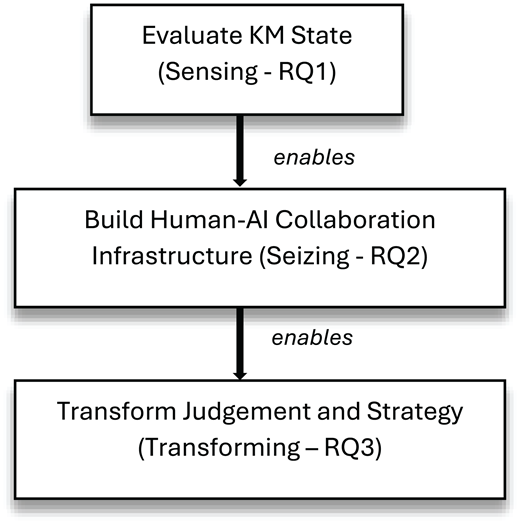
How can organisations evaluate KM practices to support AI-augmented decision-making in complex environments?
How do KM practices support human–AI collaboration in strategic decision-making?
How might AI augmentation influence human judgement in strategic decision-making?
To investigate these questions, a qualitative case study was conducted using semi-structured interviews and organisational document analysis. This design enables close examination of the routines, knowledge flows and interpretive practices through which AI becomes embedded in decision work (Yin, 2018; Merriam and Tisdell, 2015).
The paper proceeds as follows. Section 2 reviews literature on AI in KM and dynamic capabilities. Section 3 outlines the research design. Section 4 presents the findings and Section 5 discusses their theoretical and practical implications. Section 6 concludes the study.
2. Theoretical lens for AI-augmented KM in fintech
2.1 Knowledge management and the need for dynamic capabilities
Knowledge management has evolved from a focus on codifying explicit knowledge towards recognising the value of tacit insight, social interaction and interpretive judgement (Nonaka and Takeuchi, 1995; Von Krogh et al., 2000). In organisational settings shaped by ongoing digitalisation, KM is less concerned with storing information than with coordinating how knowledge is created, contextualised and applied under conditions of speed and uncertainty (Grant, 1996). AI technologies reinforce this shift by speeding up knowledge retrieval and pattern recognition, while at the same time heightening reliance on the quality and reliability of underlying organisational knowledge (Jarrahi et al., 2022; Olan et al., 2022).
However, AI also introduces significant ethical and social risks such as biased outputs, ambiguity in reasoning, data quality vulnerabilities and diffusion of accountability, all of which place additional pressure on KM systems. In financial environments, these risks are amplified by regulatory obligations, consumer protection requirements and the need for defensible, auditable decisions (Bank for International Settlements, 2024; Matei et al., 2025). Ensuring knowledge integrity and traceability therefore becomes operational requirement also protecting against ethically or legally problematic AI-supported decisions.
These developments expose the limits of resource-based strategy models such as resource-based view (RBV), which explains competitive advantage in stable environments but give little guidance on how organisations continually renew and reconfigure their knowledge and processes (Barney, 1991). RBV stresses valuable, rare, inimitable and non-substitutable resources - “ordinary capabilities”, as sources of sustained performance but these approaches underplay the dynamic processes through which firms renew resources to meet shifting markets (Teece, 2014; Murcia et al., 2022;Lacaze et al., 2025).
The DCF addresses this gap (Teece et al., 1997; Teece, 2007). It distinguishes between ordinary capabilities, which maintain efficiency in routine operations and dynamic capabilities, which involve sensing opportunities, seizing initiatives and transforming processes to maintain long-term agility (Teece, 2007). Dynamic capabilities are therefore typically firm-specific, embedded in routines and managerial cognition and thus difficult to imitate.
The DCF has also been criticised for conceptual abstraction and a lack of clarity regarding its microfoundations − the concrete practices and interaction patterns through which capabilities are enacted (Felin et al., 2012; Teece, 2018).
AI-supported knowledge systems make this challenge more pronounced. They compress decision cycles, increase the pace at which sensing must occur and introduce new interpretive and coordination demands that classical formulations of dynamic capabilities only partially address. This study therefore uses the DCF not as a complete explanatory model, but as a foundation requiring extension to capture the micro-level mechanisms involved in AI-augmented KM.
2.2 Dynamic capabilities framework in financial innovation
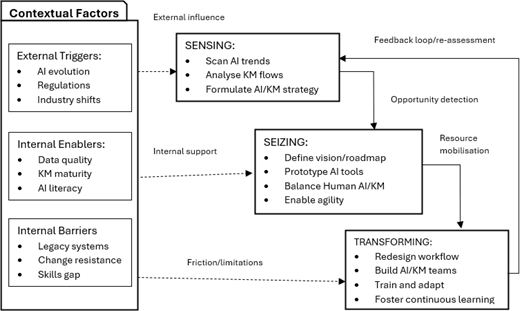
Financial services provide a rich context for examining dynamic capabilities due to rapid innovation cycles, stringent regulatory demands and high information intensity (Reyes-Mercado, 2021). Figure 1 illustrates an adaptation of Warner and Wäger’s (2019) model of dynamic capabilities for digital transformation, extended here to the context of AI-enabled knowledge management systems (AI-KMS). Following the contextual factors such as external triggers (acting as external influence), internal enablers (providing internal support) and barriers (representing friction/limitations), each stage is characterised by specific activities across the capability tiers.
Prior research shows that sensing in rapidly changing environments requires deliberate monitoring of technological, regulatory and market developments, supported by digital infrastructures and organisational learning mechanisms (De Paula Pereira et al., 2024). Seizing depends on coordinated resource mobilisation often via cross-functional collaboration and iterative development of AI tools (Abdurrahman, 2025; Zhang et al., 2024). Transforming involves reconfiguring workflows, updating knowledge artefacts and adjusting roles as AI becomes embedded in decision processes (Hutter et al., 2025).
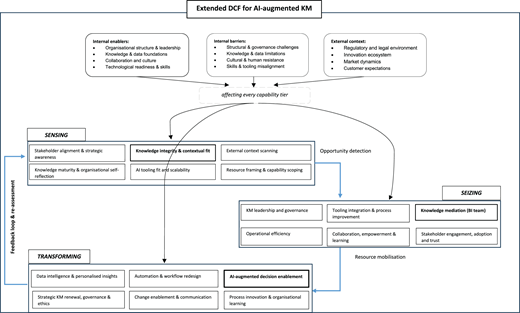
Evidence across regions and industries reinforces that sensing, seizing and transforming require repeated alignment as technologies, regulations and organisational priorities shift (Warner and Wäger, 2019; Zhang et al., 2024; Ismail and Rashidi, 2025; Tapia, 2025). In AI-enabled environments, this alignment must also encompass ethical oversight, bias monitoring and controls that ensure data accuracy and interpretability, particularly where model outputs directly influence risk, compliance or customer outcomes. Dynamic capabilities thus remain a relevant analytic frame, but they require closer attention to their microfoundations – namely, the concrete knowledge practices, coordination mechanisms and safeguards against ethical and model risks through which AI-enabled KM develops. These considerations inform the extended DCF for AI-augmented KM, which is elaborated in the discussion and synthesised in Figure 3.
3. Methodology
3.1 Research design and case context
This study adopts a qualitative single-case design (Yin, 2018), suitable for examining complex, context-dependent processes of capability development in real operational environments. The case organisation is a large financial services provider operating across multiple regions. It was selected as an information-rich case because strengthening knowledge management capabilities had become essential for managing rapid organisational scaling, evolving regulatory obligations and the complexity of digital service delivery. The company’s name is anonymised for confidentiality. While a single case limits statistical generalisability, it supports analytical generalisation to other similar knowledge-intensive and fast-changing environments.
Primary data were collected through semi-structured interviews, combined with analysis of internal documents, knowledge base articles, project reports and strategic materials. Triangulating interviews with documentary evidence allowed for a richer understanding of organisational context and reduced reliance on any one data source (Patton, 1999; Fusch et al., 2018).
Knowledge management work in the organisation is structured through an internal framework reflecting principles from project life cycle management (Kerzner, 2017; Turner, 2009) and knowledge-life cycle models (Nonaka and Takeuchi, 1995). The framework follows four high-level activities of:
knowledge capture;
knowledge structuring;
knowledge dissemination and communication; and
ongoing review and refinement.
These stages provide the operational foundation for ensuring that knowledge remains current, interpretable and aligned with organisational needs. Beyond repository maintenance, the KM function collaborates with cross-functional teams and evaluates opportunities for digital enhancement to support organisational learning and operational consistency. The framework therefore serves a dual role, supporting day-to-day work while enabling longer-term adaptation and knowledge renewal.
3.2 Data collection and analysis
Data collection combined semi-structured interviews with document review. Ten interviews were conducted in September–October 2024 via online platform (Zoom), each lasting between 40 and 60 min. Participants were selected through purposive sampling, initially via the head of knowledge management and subsequently expanded through snowball sampling as additional relevant roles emerged. Sampling aimed for functional representativeness and participants occupied strategic and operational roles linked to knowledge, data or decision-support activities (e.g. departments of knowledge management, analytics, operations). Selection criteria focused on seniority, subject-matter expertise and involvement in the KM team’s evolution. This ensured coverage of both strategic oversight and operational execution.
The first author had prior professional familiarity with the organisational context, which facilitated access to participants. To minimise bias, all interviews followed a standardised protocol and were analysed independently of organisational involvement. The interview protocol was developed jointly with co-authors who had no prior connection to the organisation, which helped keep the questions aligned with the study’s aims and prevented the introduction of organisational narratives. All interviews were conducted using a structured guide to limit the influence of pre-existing assumptions. Coding was carried out iteratively using Braun and Clarke’s (2006) approach, with codes grounded strictly in the empirical material and not personal experience. Interpretations were continually compared against interview excerpts and documentary evidence to avoid privileging insider perspectives. As the participants represented a variety of strategic and operational roles, the findings were not dependent on any single viewpoint. These measures align with recommended practices for mitigating researcher bias in qualitative case research (Patton, 1999; Yin, 2018) and support the credibility of the analysis.
Prior to participation, respondents received an informed consent form outlining the study’s purpose, their right to withdraw and assurances of confidentiality. Pseudonyms were used (ID1–ID10) and identifying details were removed during transcription. To complement interview data, internal company documents were reviewed. These included KM frameworks, stakeholder mappings, team structure reports, inter-departmental project reports and strategic agendas. Document analysis enriched contextual understanding, informed interview questions and allowed for triangulation with participant accounts. Interviews were audio-recorded with permission and transcribed. Analysis followed Braun and Clarke’s (2006) thematic approach, combining deductive coding informed by the DCF with inductive coding to capture patterns not anticipated in the framework. Atlas.ti software was used to organise transcripts, manage codes and retrieve excerpts efficiently. The coding process was guided by the DCF’s three dimensions:
Sensing: identifying opportunities, risks or emerging trends in AI-enabled KM;
Seizing: allocating resources, selecting tools and aligning initiatives with strategy; and
Transforming: reconfiguring workflows, training staff and embedding cultural change.
Codes were iteratively reviewed and refined across multiple rounds to ensure consistency, and triangulation with organisational documents strengthened analytical rigour.
4. Findings
The analysis identified five themes and 14 sub-themes for sensing (RQ1), 14 sub-themes for seizing (RQ2) and 17 sub-themes for transforming (RQ3). These are summarised in Table 1 and discussed in the sections that follow.
4.1 Sensing: Evaluating KM readiness for AI integration
RQ1 asked how organisations can evaluate KM practices to support AI-augmented decision-making in complex environments. At the sensing stage, the case company assessed its readiness by focusing on several critical conditions: data and knowledge reliability, stakeholder alignment, scalability demands and tooling suitability. These factors shaped the extent to which AI could be meaningfully integrated into existing decision-making processes.
A recurring theme was the reliability of data and knowledge assets. Several participants noted that knowledge artefacts required frequent updating due to evolving regulations and product changes, with one respondent explaining that materials “can become outdated quickly”. Participants also referenced the pace of organisational growth and the volume of regulatory and product updates that accompanied it. This environment required KM processes capable of absorbing rapid change: “As the company grows rapidly, we constantly face new regulations, rules, features, and products…” - illustrating the operational demands placed on knowledge maintenance in a fast-moving FinTech context. Thus, there was a need to ensure that the knowledge sources are up to date internally, but also reflect the domain specific, recent changes.
Equally important was stakeholder communication and alignment. Interviewees highlighted that AI adoption requires cross-department coordination, with one noting, “KM must be synchronized with operations, product, learning and development, and Quality Assurance to prevent double work and maintain efficiency”. This extends to another prominent theme which was role clarification of the KM team, their position in the ongoing transformation, responsibilities assigned to them and clarity of the scope (for maintaining cross-team efficiency mentioned by the respondent).
Finally, interviewees mentioned usability and workflow-integration readiness. The transition to the AI-enablement requires the restricting of the existing workflows which become operational with the appropriate tools in place. Thus, they saw AI as an opportunity to enhance accessibility and support decision-making, with one respondent suggesting that AI could “provide accurate answers based on reliable sources […]” thereby improving speed and consistency. This was combined with the necessity of the tooling being intuitive and user-friendly.
The findings thus indicate that the sensing stage is less about simply “evaluating AI” and more about assessing the maturity of existing KM practices as a foundation for augmentation. Without reliable data, cross-functional alignment and scalable processes, AI initiatives might be implemented in ways that erode human judgement instead of enhancing them.
4.2 Seizing: Embedding KM practices for human–AI collaboration
RQ2 question asked how KM practices support human–AI collaboration in strategic decision-making. At the seizing stage, the organisation strengthened structures that enable AI integration. A dedicated BI function played a boundary-spanning role mediating across functional divides linking data specialists, KM practitioners and operational teams and ensuring that knowledge, insights and requirements circulate coherently throughout the organisation. As one participant explained, the BI role “sits between the users of the data and the data analysts and engineers”, supporting KM with a variety of data requests. Their efforts improve how data is shared and interpreted, providing important foundation for AI tools to enhance decision-making.
Participants reported that clearer data flows, more consistent documentation and refined tooling improved efficiency. One respondent emphasised reductions in “search time and handle time”, noting that these enhancements helped staff feel more confident in locating and applying relevant information. These improvements also ensured that AI systems would draw on stable and accurate knowledge sources.
A recurring practice was the use of phased implementation, beginning with “soft launches” to test and refine new tools before wider adoption. This approach managed uncertainty and reduced disruption while encouraging feedback from early users. However, participants also noted that coordination across teams is an area that continues to evolve, with one senior manager observing that information flows might not always be fully transparent “However, being part of the service experience umbrella helps us work together to optimize communication and change procedures”.
Participants stressed the importance of external orientation − i.e. monitoring industry trends and best practices to remain agile. As one respondent put it, “we are always making sure we keep our eyes open to the industry best practices, and we’re trying to make sure that we are aligned”. This suggests that seizing is not only about internal alignment but also about positioning the organisation within a broader and shifting FinTech ecosystem.
These findings indicate that effective seizing requires both structural adjustments (e.g. BI integration and phased rollouts) and cultural ones (e.g. collaboration and external awareness). These practices enable AI systems to support and not replace human judgement in decision-making.
4.3 Transforming: Strategic impact of AI-augmented KM on human judgement
RQ3 examined how AI augmentation influences human judgement in strategic decision-making. At the transforming stage, the company began embedding operational and cultural changes that reflect broader strategic shifts. Themes at this stage centred on AI integration, personalised decision support and organisational renewal, alongside ongoing concerns about costs and scalability.
A key finding was the integration of AI with existing knowledge systems. Participants stressed that manually reviewing extensive knowledge bases and data sets was both time-consuming and cognitively demanding. AI was seen as a way to accelerate information retrieval and improve decision transparency. As one participant noted, “using AI to quickly retrieve answers related to company details from multiple resources instead of manually searching through them” both improved efficiency and enhanced confidence in outcomes.
Another prominent theme was personalised decision support. Respondents described how AI systems could be adapted to users’ needs, offering tailored recommendations while automating routine checks. One explained, “I see AI playing an increasing role in automating repetitive tasks, improving accuracy, and supporting decision-making. With AI handling routine data checks and communications, human agents can focus more on strategic analysis and deeper insights”. This shift reflects AI’s role in supporting cognitive offloading where routine or information-heavy tasks are delegated to external systems thereby freeing human cognitive resources for higher-order judgement, interpretation and problem-solving.
Transformation also entailed organisational renewal. Interviewees described how KM processes were evolving towards real-time integration and greater automation, with knowledge increasingly embedded in service delivery. As one put it, “KM is part of the servicing team, and the future strategy is to increase automation to provide instant services to customers”. This redefined KM from a support function to a strategic enabler of agility and customer value. Yet, participants also voiced concerns about funding, scalability and security, emphasising that transformation is not a linear progression but an ongoing balancing act between innovation and feasibility. As one respondent concluded, “I think it’s just about cost, security, and finding a way to implement it into your daily processes”.
Overall, the findings show that AI augmentation influences human judgement less by replacing it than by reshaping its conditions. By reducing cognitive load, improving data reliability and embedding adaptive KM frameworks, AI creates the space for judgement to become more strategic, integrative and forward-looking. Figure 2 illustrates this simplified process (i.e. sensing identifies drivers, seizing mobilises resources and practices and transforming embeds changes that shape how human judgement operates in AI-augmented decision environments).
5. Discussion
This section introduces Figure 3 which is an extended DCF framework of Figure 1 and depicts the stages the case organisation underwent during its transformative trajectory with the key activities characterising each stage. The subsections that follow elaborate the foundational activities supporting capability development, draw similarities and distinctions across sectors, outline the major theoretical contributions of this research and discuss its societal and practical implications.
5.1 Dynamic capabilities in AI-augmented knowledge environments
The extended framework (Figure 3) illustrates that dynamic capability formation in AI-augmented knowledge environments diverges from the linear or stage-based interpretations commonly associated with the DCF (Teece, 2007). The findings indicate that capability development unfolds through continuous and interdependent cycles in which sensing, seizing and transforming mutually reinforce one another. Sensing activities appear across all tiers, and capability cycles overlap as new technological developments reactivate or reshape existing routines. These dynamics introduce temporal unevenness, with certain routines evolving rapidly while others stabilise more slowly.
This pattern aligns with emerging research showing that dynamic capabilities in digitally intensive and rapidly changing contexts evolve recursively rather than sequentially, characterised by repeated reactivation, reconfiguration and feedback loops between capability elements and their antecedents, processes and outcomes (Warner and Wäger, 2019; de Aro and Perez, 2021; Abdurrahman, 2025). Such recursion requires continual recalibration between regulatory and market velocity, organisational knowledge infrastructures and operational routines. In AI-enabled knowledge environments where decision cycles shorten and knowledge assets change quickly, capability renewal becomes an iterative and cyclical process instead of progressing through discrete stages.
A second insight emphasises the role of alignment as an enabling microfoundation and not merely an outcome of system design. It starts with shared understanding among the organisational structures. The analysis demonstrates that interpretive coherence across product, risk, compliance, operations and data functions is essential for ensuring that sensing signals are interpreted consistently and translated into coordinated action. Alignment does not emerge naturally as technical systems mature; it needs to be prioritised from an early implementation step throughout the organisational journey (Dulipovici and Robey, 2013). Such alignment is a central organising capability supporting trustworthy, explainable, domain-consistent and coordinated decision processes. It enables the orchestration of stakeholder expertise and ensures that AI-augmented knowledge practices remain coherent with organisational priorities, regulatory expectations and knowledge assets evolve.
Existing AI readiness and maturity models such as those proposed by PwC (2019) and Gartner (2020) primarily emphasise data maturity, infrastructure development and tool adoption as indicators of organisational preparedness for AI. While these models offer useful diagnostic guidance, they pay considerably less attention to the interpretive and coordinative work through which data, knowledge and operational judgement are connected in practice. This limitation emphasises the need to examine the microfoundations that sustain AI-enabled knowledge work, as technical readiness alone does not ensure consistent or reliable decision-making in knowledge-intensive environments.
A third insight concerns the function of mediation structures which enable capability coordination. It entails human and organisational infrastructures that integrate data, knowledge and operational expertise. These are not peripheral support, instead, they act as mediation structures performing boundary-spanning work that protects data reliability, secures interpretive consistency and coordinates knowledge flows across domains. Mediation structures therefore represent core microfoundations through which sensing, seizing and transforming become actionable within complex socio-technical environments (De Aro and Perez, 2021).
The mechanisms identified here connect to evidence across other knowledge-intensive sectors. In advanced manufacturing, curated knowledge infrastructures strengthen effective AI deployment (Leoni et al., 2022); in healthcare, governance and alignment structures are essential for securing interpretive coherence (Lämmermann et al., 2024); and in public-sector algorithmic systems, oversight bodies act as integrating governance mechanisms (Almeida Almeida and Santos Júnior, 2025). Small and medium-sized enterprises undergoing digitalisation similarly exhibit iterative cycles of capability refinement (Ceptureanu et al., 2025). These parallels indicate that recursive capability development, alignment routines and mediation structures are not unique to FinTech but represent foundational microfoundations of AI-enabled organisational environments.
FinTech environments heighten these mechanisms because regulations shift rapidly, risk profiles evolve quickly and operational work is tightly connected to risk decisions. This places a stronger emphasis on keeping knowledge updated, maintaining alignment across functions and ensuring effective mediation. Although the intensity differs, these mechanisms themselves are not unique to FinTech. What varies across sectors is the pace of change and the types of institutional and operational pressures organisations face. This reinforces that the extended framework in Figure 3 is applicable across diverse domains, even if its expression takes different forms depending on contextual conditions.
5.2 Ethical and societal implications in AI-enabled knowledge management
The ethical and societal dimensions of AI-enabled knowledge management extend beyond internal organisational performance and directly shape how decisions are experienced by service users and the broader public. A recurring theme across the findings was the centrality of trust which is threefold - trust in data and knowledge artefacts, trust in system behaviour and trust in one’s own ability to interpret AI-supported outputs. These layers are interconnected: if any element becomes unstable, confidence in the overall decision process can weaken. Studies in healthcare and public-sector AI deployments describe similar “multi-layer” trust dynamics, emphasising that technical reliability alone is insufficient without interpretive confidence and organisational transparency (Starke et al., 2025; Mukherjee et al., 2025). These trust layers relate closely to broader societal expectations. In digital finance and other customer-facing fields, individuals expect decisions to be explainable, contestable and grounded in up-to-date knowledge. Otherwise, the concerns about fairness and the risk of unintentionally excluding certain groups may arise.
Interpretation also carries ethical weight. Across interviews, AI was framed as an analytical amplifier rather than a decision-maker. The speed with which AI retrieves or synthesises information can create an impression of certainty, but the responsibility for determining relevance, sufficiency and proportionality remain with humans. This aligns with evidence from higher-risk settings such as legal services, healthcare and welfare systems, showing that accuracy alone does not resolve ambiguity and that critical judgement is required to contextualise outputs (Nosrati et al., 2025; Khosravi et al., 2024; Vaccaro and Waldo, 2019). When interpretation falters, downstream effects can include inconsistent case handling, reduced procedural fairness or decisions that inadvertently disadvantage edge cases who do not fit model assumptions. This places interpretive capability at the core of responsible AI use: it is not simply a cognitive task but an ethical safeguard. Being “in the loop” is not enough; users must be able to interrogate outputs, recognise when a model’s recommendation may not apply and justify their decisions when they diverge from system suggestions. These interpretive practices protect decision quality and also help maintain public trust in AI-enabled services.
Accountability forms the third dimension of these ethical implications. AI-supported decisions are shaped by layered inputs − data, models, workflows and human judgement − which can blur responsibility. Research in defence, healthcare and financial services highlights how unclear accountability can lead to what some authors describe as “responsibility gaps” or “diffusion of responsibility” (Zeiser, 2024; Conn and Bode, 2025; Pasupuleti, 2025). The findings support the growing consensus that accountability needs to be distributed across those who curate data, validate models, design workflows and make decisions, rather than attributed post hoc to a single actor. Clarity around who verifies inputs, who validates system behaviour and who retains interpretive authority reduces ambiguity and strengthens the defensibility of decisions (Conn and Bode, 2025; Papagiannidis et al., 2025).
These ethical considerations also vary between regulatory and cultural contexts. In Europe, rights-based regimes such as the GDPR (European Union, 2016) and the EU AI Act (European Union, 2024) formalise expectations around explainability, traceability and human oversight, making many of the mechanisms identified here obligatory rather than optional. In North America, governance relies more on internal standards and organisational discretion e.g. National Institute of Standards and Technology (NIST) AI Risk Management Framework (National Institute of Standards and Technology, 2023), whereas in several Asian jurisdictions, state-led or technocratic approaches emphasise auditability, provenance and centralised oversight (China, 2023; Infocomm Media Development Authority, 2024). Cultural orientations shape practice further: for instance, high-uncertainty-avoidance contexts tend to institutionalise oversight mechanisms (Wilczek et al., 2025), while higher power-distance settings may centralise interpretive authority at specific organisational levels (Cannavale et al., 2025), These variations influence how trust, interpretation and accountability are enacted, but the underlying ethical concerns − fairness, transparency and responsible use − remain shared across contexts (Roberts et al., 2022).
5.3 Practical implications
Building on the capability tiers and activities in the extended framework, several practical implications follow for organisations working with AI-supported knowledge management.
Knowledge integrity needs to be handled as an ongoing operational task rather than something that is addressed only during periodic updates. In practical terms, this means assigning clear responsibility for specific knowledge assets, keeping track of which decisions and AI components depend on which rules and putting in place straightforward triggers so that regulatory or product changes lead to timely review.
The findings also point to the value of mediation structures that connect data work, knowledge maintenance and operational decision-making. Organisations can support this by creating small cross-functional groups or governance teams that monitor how changes in data, rules or product logic flow through service processes. When these teams have the mandate to question assumptions and coordinate updates, decision processes remain more stable even as risk patterns or regulatory expectations shift.
Alignment routines also need to be flexible but carried out with regularity. Brief cross-team check-ins, shared interpretation notes for regulatory updates and routine pre-deployment reviews help prevent small divergences in understanding from accumulating into inconsistent customer decisions. This becomes particularly important in settings where operational activity and risk management are closely linked.
Clarifying when human judgement is required is another essential element of responsible AI use. Setting out review points for borderline cases, documenting who is accountable for validating AI-supported outputs and specifying escalation paths for ambiguous situations help staff navigate uncertainty and maintain defensible decisions in regulated environments.
6. Conclusion
This study examined how organisations develop the capabilities required for AI-augmented knowledge management. Drawing on a single case, the analysis identified three core mechanisms that shape capability formation. Theoretically, it shows that capability development is recursive rather than sequential, and that alignment and mediation routines operate as capability-building mechanisms in their own right. Practically, the study offers a framework for designing knowledge processes that remain reliable and coherent when supported by AI. It points to ongoing knowledge stewardship, targeted mediation roles and clear boundaries for human involvement as central to maintaining consistent decision practices. Societally, the findings highlight the importance of trust, interpretive clarity and accountable oversight for fairness and transparency within semi-automated decision systems.
While the analysis provides a detailed account of capability development within one organisation, it also has limits. The single-case design means that contextual factors specific to the organisation may have influenced how these mechanisms appeared, and the qualitative data reflect conditions at one point in time. Even so, the capability patterns observed align with evidence from other knowledge-intensive domains and offer a basis for wider comparison.
Future research could examine how these mechanisms operate in settings with different regulatory or organisational arrangements or follow how they develop over longer periods of AI use. Studies that observe AI-supported knowledge work as it unfolds in practice would further clarify how human judgement, organisational knowledge and automated systems interact.
Note
The Financial Stability Board (2017) (FSB) defines FinTech as “technology-enabled innovation in financial services that could result in new business models, applications, processes or products with an associated material effect on financial markets and institutions and the provision of financial services”.