This paper aims to explore strategies used by teachers within and beyond the classroom to foster a sense of belonging at international boarding secondary schools. Drawing on the belonging hypothesis and Bronfenbrenner’s bioecological systems theory, this study considers the implications of low or high usage of evidence-based strategies on students’ membership within diverse learning communities.
This study used a mixed-method, sequential exploratory approach. Convenience sampling resulted in 53 teacher participants from 11 international boarding schools.
While teachers used a wide range of strategies to nurture students’ sense of belonging to the school community, there were limited links to children’s family and home community contexts. This gap may hinder students’ ability to navigate and develop their identities independently of institutional norms. Although schools excel in fostering community-building practices, they are less effective in providing professional development for educators on belonging and lack a unified vision for its implementation. Hence, individual teacher’s efforts to foster belonging maybe fragmented or underutilised.
While teacher perspectives provide valuable insights into students’ experiences, they represent an indirect meaning-making of students’ belonging, their interaction with peers and their involvement in the school community. It is acknowledged that teachers’ observations can be influenced by factors such as academic performance, behaviour or personal bias. Therefore, findings based on these perspectives should be interpreted with caution.
This research offers insights into the experiences of teachers working in international boarding schools regarding practices and pedagogies that can promote student belonging and the development of strong, stable interpersonal relationships with school staff and their peers. It provides contribution to deeper understanding of belonging, which can affect identity negotiation in a diverse schooling context. The study highlights the need for professional development opportunities that promote cohesive institution-wide approaches to student belonging, including increased collaboration with families and home communities to support the development of students’ multifaceted identities school belonging.
Introduction
A sense of belonging relates to the extent to which a student feels accepted, valued, included, supported and cared for by those within the school community (Allen et al., 2016). Research emphasises the importance of school belonging and the powerful impact this has on academic performance, mental well-being and propensity to engage in risky behaviours (Allen et al., 2016; Kiefer et al., 2015; Whidden et al., 2020). Nevertheless, a gap remains in understanding teachers’ beliefs about, understanding of and strategies for fostering belonging. This is concerning given the critical role teacher−student relationships play in shaping students’ sense of belonging (Brewster and Bowen, 2004).
International schools are a unique site to investigate school belonging because students do not experience cultural homogeneity (Hayden and Thompson, 1995). As they are removed from their local communities, and in the case of boarding schools, family members and challenges in personal identity formation (Cockburn, 2002) may cause obstacles for their sense of belonging. Conversely, a lack of belonging in such intercultural settings may complicate students’ ability to construct and express their identities.
In an increasingly globalised world, within the past five years alone, numbers of international schools operating have increased by 8.5% (to 14,010), and numbers of students enrolled by 10% (to 6.9 million) (ISC Research, 2024). Nevertheless, understanding of belonging in international boarding secondary school context remains limited. Moreover, little is known about how belonging can be seen beyond the personal and individual experience, i.e. seeing the systemic nature of belonging (Kuttner, 2023), or how institutional practices can have trickledown effect on students’ perception of school belonging. Notably, the relationship between family and home culture should be considered in the evolution of students’ school belonging in boarding context.
To address this gap, this study examines the frequency of which strategies that promote belonging are used through teachers’ perspectives at a set of international, boarding schools.
The following questions guide the research:
To what extent do teachers implement classroom practices aimed at promoting a sense of belonging?
What institutional practices, if any, are employed to enhance students’ sense of belonging at schools?
Literature review
Bronfenbrenner’s bioecological framework and belonging
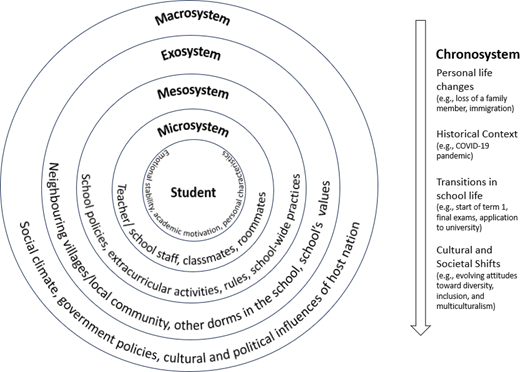
Bronfenbrenner’s bioecological framework offers a comprehensive lens for investigating belonging in boarding schools, focusing on interactions between students and their environments across time, context, personal agency and the direct (proximal) and indirect (distal) influences between the student and their surroundings (El Zaatari and Maalouf, 2022; Hayes et al., 2017). The model situates the individual student in the middle, with unique traits for emotional stability, characteristics and motivation. The student is nested within the microsystem which includes activities and relationships that most directly influence their development at school (e.g. peer/teacher/school staff support). This layer is followed by the mesosystem consisting of interactions between two or more factors in which the student actively participates (e.g. school policies, extracurricular activities and relations in family/boarding house). The next layer, the exosystem, includes links and processes between settings such as the neighbouring local village, other dorms within the school. The final layers are the macrosystem, which represents broad cultural/societal impacts, and the chronosystem which refers to the time dimension and how life events (e.g. parents’ divorce, moving from home to boarding school, …) affect development. In sum, this framework allows the current study to examine how strategies across ecological layers, specifically the individual, micro and mesosystem levels, interact and influence students’ sense of school belonging. Figure 1 illustrates the various layers of the Bronfenbrenner’s bioecological framework as applied to the context of this study.
Identity development in international schools
International schools, by its nature, create a “third place” (Grimshaw and Sears, 2008). Here, students create and negotiate an identity that is neither fully aligned with characteristics of their “home” culture, nor that of their new host culture. This in-between space helps students develop self-affirming identities, while also being a site of cultural disjuncture and mobility (Grimshaw and Sears, 2008).
At international schools, students identify their sense of belonging not to a country but to communities that accept diversity and value differences in thoughts (Cruz et al., 2023), yet the experience of belonging could be shaped by factors such as duration of attendance, whether students had a choice in the relocation and school characteristics (Bagnall, 2015). Schools play an important role in supporting students to adapt to a new environment, around peers with the same situation as them (Bagnall, 2015), but Fitzsimons (2019) cautioned that certain practices including curriculum, extracurricular activities and school celebrations, may privilege certain “identities” over others. This friction calls for an examination of what and how belonging strategies operate within international schools and their role in identity negotiation.
Belonging in schools
The idea of belonging was first considered important in the study of human psychology. In Maslow (1954), the need to belong is a prerequisite for the needs of self-esteem and self-actualisation. Belonging is multidimensional and has been described in the past as feeling of “being at home” (Antonsich, 2010). Within education, school belonging was coined “the extent to which students feel personally accepted, respected, included, and supported by others in the school environment” (Goodenow, 1993, p. 80), and later described as deep connection (Allen et al., 2021) and relating and acceptance (Longaretti, 2020). Nevertheless, the definition is constantly evolving.
In school, a sense of belonging can influence the socio-emotional development of young people and their academic success (Arslan et al., 2020). Conversely, a lack of belonging can lower motivation, resulting in reduced engagement, academic performance and even school withdrawal (Goodenow, 1993; Strayhorn, 2012). Belonging, in multicultural school environments, provides a framework for students to reconcile their home cultures with the institutional culture, influencing how they see themselves and relate to others (Hashemi, 2025a).
Contributing factors to a school climate conducive to nurturing belonging include effective learning environment, teacher−student relationship, school safety, extracurricular activities, peer interactions and parental involvement (El Zaatari and Maalouf, 2022).With our current understanding of belonging, research points to the need to not only explore factors within the layers of youth’s bioecological development, but also the interplay between them to understand how factors interact to create, nurture, or hinder belonging.
Microlevel impact: importance of teachers in students’ sense of belonging
Teacher support is consistently identified as the most critical factor in students’ sense of belonging, with positive teacher−student relationships linked to better adjustment, academic engagement and belonging (Brewster and Bowen, 2004; Chong et al., 2010, Allen et al., 2021). Additionally, teachers’ feedback influence students’ interest and enjoyment of a content subject (Chi et al., 2021). Wang and Holcombe (2010) study found that students who perceived their teachers as supportive and mastery-oriented reported higher school participation.
Vidourek et al. (2011) suggest that the most common strategies used by teachers to support belonging are referring to students by name, acting as a positive role model and maintaining high behavioural standards. The same study suggested that teachers are less likely to promote parental involvement or community engagement. However, research points to the importance of strong parent−adolescent relationships for nurturing psychological wellbeing, especially for students living in boarding schools (Hasanah et al., 2022), as emotional closeness with parents is crucial until young people achieve the psychological and social maturity to manage life independently (Xing et al., 2021). Parental involvement also associated with higher levels of belonging outside of boarding context (Peng and Joo, 2024). Teachers, as part of the microsystem interactions, hold influence as they can encourage or discourage students in relationship building with those in the school and in their family. This study investigates which strategies teachers use the most at classroom level to foster belonging.
Mesolevel impact: School belonging at an institutional level
Besides teacher-led strategies, schools can also implement institution-wide practices that aimed at increasing belonging for students. All schools function under a variety of institution-wide policies and practices, which encompass rules, guidelines and practical initiatives to create a consistent and supportive environment for students. Evidence suggests that inclusion on a school-wide level can be accomplished through shared leadership (Rice and Schneider, 1994), and effective policies built upon shared objectives (Van Gasse et al., 2016). A unified vision can allow for reconciling diverse ideas, establishing clear priorities and creating an actionable plan (Harris, 2003; Kessler, 1992).
Extracurricular activities foster peer connection and increase intrinsic motivation, with positive impact on belonging across diverse contexts, by providing opportunities for peer interaction outside the classroom which may foster and deepen existing connections based on shared interests and values (Schaefer et al., 2011; Jones and Morrow, 2022; Bouchard et al., 2022). The findings suggest that both the availability and quality of student engagement in activities outside the classroom matter.
In schools with diverse student populations, group membership opportunities tend to take the shape of school events and celebrations (Bennouna et al., 2021; Niemi and Hotulainen, 2015). Considering the various identities represented in the school’s student demographic, especially in intercultural contexts, this can allow adolescents to not only feel included but also build an increased appreciation of their own and others’ traditions.
While a strong sense of belonging is linked to well-being, positive affect and self-esteem among youth, few studies have explored school strategies to promote belonging, particularly from the teachers’ perspective. Existing research disproportionately focused on microsystem-level factors, prompting calls for broader, multi-level analyses within the bioecological framework (Kuttner et al., 2023). Thus, through teacher-reported surveys of self-led and school-wide strategies, this study addresses said gap by exploring how belonging is cultivated through the proximal relationships within the bioecological layers (i.e. between micro and mesolevel interactions).
Methodology
The purpose of this study is to explore teachers’ perception of students’ sense of belonging. It is rooted in constructivism, which acknowledges that multiple realities co-exist and there is little consensus around the nature of knowledge (Guba and Lincoln, 1994). An explanatory sequential mixed-method design was used (Creswell and Plano Clark, 2018). In the first, quantitative phase of the study, online survey data was collected from faculty at a set of 11 secondary international boarding schools to assess the use of strategies that promote a sense of belonging in the classroom and in the school environment. The second, qualitative phase was a follow-up to the quantitative results to help explore and explain their reason behind frequency rating of different strategies and gather deeper insights into their perception of students belonging. In this exploratory follow-up, the plan was to explore how institution-wide practices at the mesolevel interact with teacher-chosen strategies at the microlevel and the effects on the individual student. This study consists of data from a non-probabilistic convenience sampling (Creswell and Plano Clark, 2018). Participants are teachers from a network of schools that operate within one organisation. No additional institutional-level data beyond teacher perspectives was collected. Schools offer the International Baccalaureate Diploma Programme to students representing over 80 nationalities with English being the primary language of instruction. Student demographics are varied across a wide range of socioeconomic backgrounds due to the merit-based, scholarship-funded nature of these institutions. Due to this diversity, this study has a global reach, with participating schools spanning three continents of Asia, Europe and North America.
As survey responses were anonymous, school-level distribution could not be tracked, raising the risk of overrepresentation from certain schools. For the qualitative data collection, purposeful sampling was used to select teachers from each participating schools to ensure balanced representation (Creswell and Plano Clark, 2018). Quantitative data were collected via a Microsoft Forms survey. Table 1 outlines the thematic structure guiding the survey design by categorising variables into individual, microlevel and mesolevel domains, as adapted from evidence-based strategies for belonging in secondary schools (Allen et al., 2016).
Semi-structured interviews were later conducted to explore trends emerging from the quantitative survey results, taking into consideration the unique student demographic of each school. Participants expanded on contrasting responses to the same questions or provide similar answers, effectively creating a pattern that could potentially be generalised for all schools (Nowell et al., 2017).
SPSS Statistics software was used for descriptive and frequency analysis. Interview data was exported ported to NVivo 15 software for thematic analysis using Braun and Clarke (2021). This, reflexive thematic analysis framework provided a structured and reflexive approach to identifying initial codes, analysing themes and interpreting patterns of meaning. This flexible approach allowed for the modification of information and examination of contrasting perspectives of research participants while summarising a large data set (Nowell et al., 2017).
Research ethics approval was obtained from the Trinity College Dublin Research Ethics Committee, taking into consideration rights to withdraw, informed consent, data confidentiality and respondents’ anonymity.
While teacher perspectives provide valuable insights into students’ experiences, they represent an indirect meaning-making of students’ belonging, their interaction with peers and their involvement in the school community. It is acknowledged that teachers’ observations can be influenced by factors such as academic performance, behaviour or personal bias (Venetz et al., 2019). Therefore, findings based on these perspectives should be interpreted with caution.
Findings and discussion
This section presents a side-by-side analysis of qualitative and quantitative data, organised according to Bronfenbrenner’s ecological framework. It examines strategies used by educators and schools to foster belonging across three key levels: individual level, microlevel and mesolevel.
Of the 53 survey participants (see Table 2 for participants profiles), 19 participated in follow-up interviews. Participants were primarily female (n = 34), with varied roles including Anti-Racism, Diversity, Equity, and Inclusion (ARDEI) Committee Leaders, Socio-emotional Learning Coordinators, Deputy Heads of College, Head of Departments (Academics/Extracurricular/Residential Life), Learning Support Coordinators and Dorm Parents). Overall, the shortest tenure among participants in this school system is two years, while the longest is 22 years.
The following section analysing individual level and microlevel skills provides insights into the first research question: To what extent do teachers implement classroom practices aimed at promoting a sense of belonging?
Individual level skills
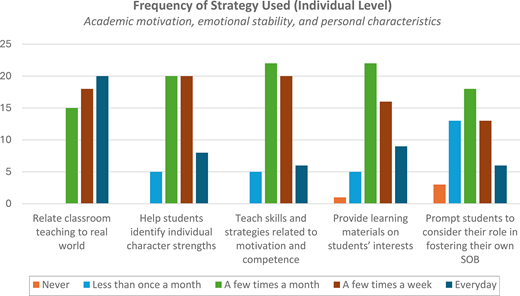
At the individual level, teachers indicated that the most frequently used strategy for belonging are relate classroom teaching to students’ real world and experiences as well as helping students identify individual character strengths. This finding broadly supports the work of other studies in this area (Wang and Holcombe, 2010; Chi et al., 2021) that emphasised the importance of teachers’ growth mindset about students’ abilities and their feedback in a subject. On the other hand, prompting students to consider their role in fostering their sense of belonging at school is a practice that is used the least often, with some indicating they never used this strategy (Figure 2).
Findings highlighted how educators emphasised student agency as a key driver of belonging. Teachers believed that the more students feel that they could do things with their lives and have a say on campus, the more they appreciate what’s going on, leading to a stronger sense of belonging. One teacher provided ways for which agency can play out in the classroom by facilitating learning that aligns with students’ interests:
[I] give them opportunities to propose their activities e.g. tutor group gathering, extra-curricular activities, block activities, overseas trips, involve students in designing the scheme of work, etc. So, they can take autonomy and ownership of their learning.
In multicultural settings, such agency is especially significant, as it allows students to assert their voices, make culturally meaningful choices and engage with the school environment in ways that reflect their diverse identities. Nevertheless, this active engagement of students is mostly limited to their learning, respondents did not mention how agency play a part in students’ own role in fostering belonging at school.
Microlevel strategies
Teacher−student relationships.
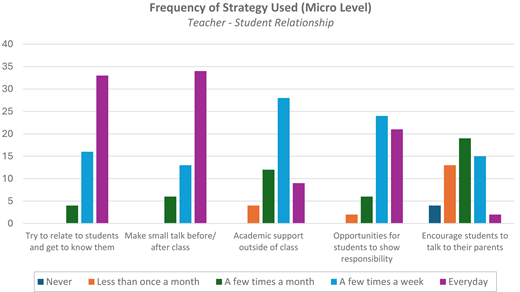
At the microlevel, to encourage belonging through teacher−student relationships, teachers often try and relate to students and get to know them. At the other end of the spectrum, teachers rarely encourage students to maintain relationships with parents, the only strategy that some teachers indicated they never use (Figure 3).
Educators prioritise seeing students in a holistic manner, getting to know them not only in the classroom but also in a pastoral setting. They highlighted the importance of daily dorm “check-in as moments where students feel seen by adults ‘from a place of genuine concern and care’” (P4).
However, teachers rarely encouraged students to maintain connections with their families − only three out of 19 mentioned parental involvement. Some expressed hesitation in involving parents:
[…] Not because parents are bad, but them not being here, we do not want to alarm them if it’s something that can be solved, just by giving it a little bit of time, because sometimes students they don’t give themselves the time. (P16)
In contrast, one teacher suggested the possibility of engaging parents more due to their rapport with the students prior to their attendance at the school, calling on the support of guardians, as they “can really help students not in a punitive manner, but more like, ‘hey, you are struggling. Let’s address this as a family.’” (P6)
The boarding school context may contribute to teachers’ reluctance to involve parents due to the physical removal of students from their home communities. While research highlights the positive impact of family support on student well-being (Peng and Joo, 2024; Stanley and Kuo, 2022), limited engagement may hinder early intervention and weaken students’ sense of continuity between home and school. Moreover, it has been suggested that autonomy, a necessary skill for boarders, is linked to better adjustment when occurring alongside warm and connected parent−adolescent relationship (Xing et al., 2021). Hence, family assistance could potentially support students in finding pockets of connection within the school.
Student−student relationships
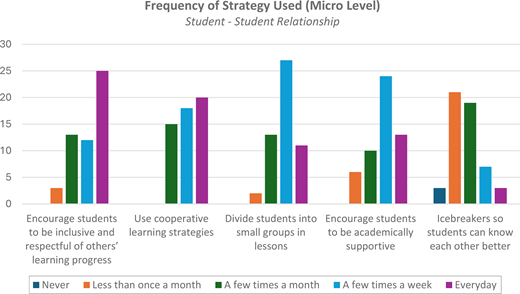
Teachers frequently supported student−student relationships by fostering respect and inclusivity around learning progress (Figure 4).
They emphasised the importance of creating a classroom culture where making mistakes is safe and encouraged, and building students rapport is essential for this to happen. One language teacher described building trust by ensuring that students know neither “[the teacher] nor any class member is not going to make fun of them when they make mistakes”. (P9)
When teachers are successful in supporting students to feel comfortable and confident in the company of the class, they are more at ease and it allows them to connect with others, regardless of the level of prior knowledge of the subject. Another teacher shared how students appreciated a maths class where questions were welcomed without criticism. He said: “I don’t know exactly what this teacher does to create such an environment, but I think it probably is just being patient, being nonjudgmental”. (P4)
The following section analysing mesolevel variables aims to answer the second research question: What institutional practices, if any, are employed to enhance students’ sense of belonging at schools?
Mesolevel variables
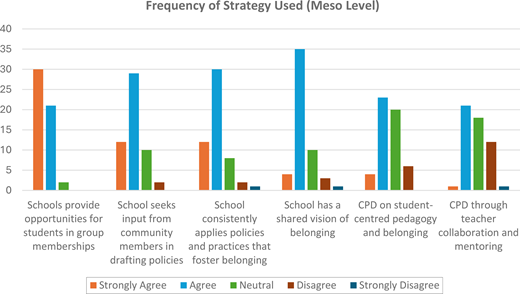
Practices at the mesosystem level included six items representing institutional-level strategies that promote belonging in students. Of these practices, teachers indicate their agreement most strongly with strategies under community building practices and school-wide strategies, while opinions remain mixed on those under continuing professional development (Figure 5).
Community building practices: creating opportunities for group membership.
The connection between group participation and belonging was powerfully echoed in the empirical findings. All participating schools were found to offer numerous opportunities for students to join or create group spaces. One particularly compelling example came from a teacher who described the impact of the creative writing club, highlighting how small, intentionally mixed groups allow for deep emotional sharing and interpersonal connection:
It’s this beautiful space where people share what they write. […] And it’s this weird group of kids who would never interact with each other, but they share their whole hearts. The safety and the coziness of it is like a little pocket of belonging for kids who won’t necessarily have that. (P3)
Cultural events were also described as central to community-building efforts in these boarding schools, which showcase the diverse identities of individuals through events like Black History Month, Pride, Lunar New Year, Holi and Eid. One teacher reflected on a shift away from traditional cultural weeks towards more inclusive and student-driven expressions of identity:
We said very early on that we weren’t going to do cultural weeks. Our anthropology teacher at the time said it was a form of cultural imperialism. […] So now what we do is the idea of [seasonal celebrations]. For spring day, we spend the morning gardening together and then in the afternoon students can run activities around spring that they bring from all over the world. […] (P14)
These findings align with the literature in confirming that group membership opportunities − whether through clubs or cultural events − play a central role in promoting belonging (Jones and Morrow, 2022; Thies and Falk, 2023). While Hashemi (2025b) notes that cultural celebrations can foster appreciation of diversity among all students, intentionality and culturally responsiveness is necessary to increase students’ sense of belonging, especially for those from nondominant culture groups (Bennouna et al., 2021). Research also questioned the idea of which “identity” is implicitly promoted through school curriculum, celebrations and extracurricular activities (Fitzsimons, 2019), further complicating the negotiation of students’ home identity in their process of creating their new-found self-affirming identities in boarding schools. This study extends existing literature by showing that promoting belonging needs to include intentionally designing culturally responsive spaces that honour students’ home identities and support the development of evolving identities.
School-wide support systems and practices.
In addition to offering group membership opportunities, schools implement various support systems and school-wide practices to nurture students’ sense of belonging including policies, shared vision, residential arrangements, advisor/tutor systems and wellbeing resources. A unified vision can harmonise diverse perspectives and guide concrete actions that enhance students’ community membership (Harris, 2003; Kessler, 1992).
While quantitative data suggests that most respondents agreed that their schools have a shared vision of belonging, when asked about policies or mission statements that highlighted this, teachers struggled to name specific ones. Some cited the general student code of conduct that provided guidance on expectations of being a community member. One teacher voiced their confusion regarding how policy could reflect belonging specifically and how that might work in practice:
You can have loads of policies, but [you’d] read them once and then you just forget about what’s in there. To me, [is] a sense of belonging or wellbeing such an obvious thing? […] What’s gonna be in a policy about it apart from, “we believe here that everybody should feel a sense of belonging?” (P11).
However, the Anti-Racism, Discrimination, Equity and Inclusion (ARDEI) policy was consistently mentioned, with teachers highlighting its role in promoting awareness and creating spaces for students to discuss identity, culture and stereotypes (P09). Considering the diverse student demographic at the schools, this seemed to be one of the few policies that are shared across the different campuses.
Taken together, these findings suggest that while the formalisation of a “belonging” policy may be rare, policies that foreground equity and inclusion function as critical levers for cultivating a sense of belonging. This aligns with the literature emphasising the importance of shared objectives and collaborative leadership in enacting school-wide visions that promote wellbeing and connectedness (Rice and Schneider, 1994; Van Gasse et al., 2016). The challenge for schools, then, lies in bridging the gap between broad values and actionable policies that make belonging explicit, visible and embedded in everyday practice.
Teacher’s informal support and CPD on belonging.
Teachers often mention individual practices to nurture students’ sense of belonging outside of the classroom. This support is personal, such as noticing when students may feel lonely on campus, recognising when they are present or absent in class, offering check-ins outside of the classroom and in pastoral settings, or engaging in small acts of kindness:
We kind of can predict student who might face issues with a sense of belonging. I would maybe approach them and […] in a in sort of a roundabout way, asking them maybe what have they done over the weekend, if they did anything interesting, where did they go? Did they manage to go the nearest town to explore a little bit? Did they go alone or with their friends? (P16).
While these efforts reflect strong relational instinct, they raise questions about whether such methods constitute intentional belonging strategies or simply good teaching? Without a coordinated vision or formal training, these practices rely heavily on individual teacher initiatives and may be inconsistent across the school. This is especially worth considering since international school teachers play a crucial role in helping students navigate a sense of cultural disjuncture and alienation (Grimshaw and Sears, 2008).
Continuous Professional Development (CPD) could play a key role in equipping teachers to foster belonging, but it appears that structured training is lacking. A notable number of respondents selected a neutral response to the statements under this category, suggesting a lack of clear perception or recall of targeted training in this area. This ambivalence may reflect the diffused nature of “belonging” as a concept, which intersects with various aspects of identity (e.g. race, language, gender, culture) and may not be explicitly foregrounded in professional development initiatives, even when indirectly addressed. Specifically, one participant mentioned CPD in general, but not focused or dedicated to belonging:
Homeroom teachers have to [be trained], and when we set up the school, we said that we would make sure that our staff do professional development. Every other month [CPD] will be on pastoral care. The other times, it’s pedagogical. So, we alternate and sometimes there’s an overlap. (P14)
Only three of 19 teachers mentioned CPD in the interview, suggesting a gap in training on evidence-based practices for belonging, and specifically on its intersection with identity, culture and wellbeing. Teachers pride themselves on being open and approachable, but without formal training, they may rely on instinct. Embedding belonging into CPD could ensure more consistent support across the school, reducing the risk that some students feel unseen or unsupported.
Conclusion
This study demonstrates an investigation into students’ sense of belonging through teachers’ perspectives while using the Bronfenbrenner’s socio-ecological framework for its designs. Strong evidence emerges regarding factors that contribute to students’ sense of belonging, while confirming practices within and beyond the classrooms that individual teachers and institutions are implementing to nurture a sense of belonging in students.
Three major findings emerged from the data analysis:
In terms of classroom strategies, teachers frequently related content to students lived experiences, built personal connections and promoted peer inclusivity. Less emphasis was placed on encouraging parent engagement or prompting students to reflect on their own role in fostering belonging.
Institutions are perceived as strong in community-building efforts but less consistent in offering professional development focused on belonging.
Gaps in mesolevel practices, such as limited training or shared understanding of belonging, can weaken micro level interactions (i.e. teacher−student relationship), where belonging is most directly experienced due to the proximal nature of these ecological layers, and possibly undermine belonging at the individual level.
Empirical research gives validity to what was previously only known as “anecdotal evidence” amongst educators by recording the experience of individual teachers to search for common patterns regarding students’ belonging and by extension, strategies being used in various schools. As Bagnall (2015) posited, when borders become more flexible, so do the ideas of belonging and identity. Belonging is not a linear process as it occurs within a synergetic framework that includes multitude of stakeholders. International schools that are aware of the issues of their students who moved globally can better provide supportive environments for students, which paved the path for better sense of belonging (Bagnall, 2015). This research encourages schools to consider the role of parental involvement in students’ progress in search of belonging, the role of individual student’s agency in finding their own belonging, and the importance of CPDs on providing a space for educators to update on best practices while sharing their experiences with one another to ensure unified approaches to students’ belonging. By highlighting both effective practices and areas of improvements in nurturing belonging at international schools, this research contributes to ongoing discussions of the complex relationship between identity negotiation and belonging in intercultural education settings. It urges key stakeholders contained within the various bioecological layers of students’ development to further the discussion and collaborate to create a more inclusive space for students.