This paper aims to present a systematic literature review of corporate tax incentives through a historical and organisational lens. It examines how such incentives have influenced not only fiscal policy but also organisational strategies, structures and behaviours across different economic periods and governance contexts.
The study follows a structured review protocol, analysing peer-reviewed articles published between 2004 and 2024 and indexed in Scopus. From an initial pool of 846 records, 45 articles were identified for preliminary screening. After refinement based on thematic relevance and methodological quality, 20 were selected for in-depth analysis.
The review identifies five key domains where tax incentives are most studied: research and development, foreign investment, sustainability, regional development and firm performance. While quantitative approaches dominate, few studies apply historical or organisational theory explicitly. Findings suggest that fiscal instruments are frequently reoriented in response to crises, with significant implications for corporate decision-making, innovation strategies and internal adaptation. Tax incentives not only influence external investment patterns but also shape organisational behaviour and transformation.
This paper contributes to management history by recontextualising tax incentives as historically embedded mechanisms of organisational change. It offers a conceptual framework connecting institutions, incentive types and firm-level responses, encouraging broader interpretations of tax policy as a driver of organisational adaptation.
1. Introduction
Corporate tax incentives have long served as strategic tools of fiscal governance, used by states to stimulate private investment, drive innovation and enhance economic competitiveness. These instruments, ranging from research and development (R&D) tax credits and investment allowances to preferential tax rates and geographically targeted exemptions, are embedded within broader frameworks of economic policy and developmental planning. Their usage reflects not only fiscal priorities but also deeper political, ideological and managerial shifts.
This study examines when and how corporate tax incentives operate as engines of organisational change rather than merely technical policy tools. Recent evidence shows heterogeneous effects: sustained R&D credits in Spain have institutionalised documentation routines and innovation prioritisation; France’s Crédit d’Impôt pour la Compétitivité et l’Emploi (CICE) payroll credit reallocated costs with implications for hiring and wage setting; poorly calibrated eligibility thresholds in China induced R&D-intensity bunching; and rules-based tax holidays in parts of Africa attracted foreign direct investment (FDI), whereas discretionary concessions underperformed. These tensions suggest that instrument design and institutional credibility shape budgeting, governance and risk routines within firms, motivating a historical–organisational synthesis.
The theoretical foundations of corporate tax incentives lie at the intersection of public finance, institutional economics and fiscal sociology. Classical tax theory emphasised the redistributive and allocative functions of taxation (Musgrave and Musgrave, 1989), while more recent approaches explore how tax policy shapes firm behaviour, market structures and governance practices. Over time, tax incentives have evolved from isolated technical mechanisms into complex and path-dependent policy instruments, heavily influenced by crises, reforms and institutional capacity. For instance, Spain’s persistent use of R&D tax credits, France’s CICE payroll tax credit and China’s high-tech incentive schemes illustrate how instruments have been repurposed in response to competitiveness pressures, fiscal reforms and industrial policy goals and how firms internalise these changes through budgeting, governance and compliance routines (Carbonnier et al., 2022; Labeaga et al., 2021; Liu et al., 2020; Sun et al., 2021).
In recent decades, research has increasingly focused on the organisational transformation and strategic adaptation induced by tax incentives. Studies have examined how these instruments influence not only corporate decision-making but also internal cultures of innovation, structural reorganisation and managerial priorities. During periods of economic disruption, such as financial crises, austerity episodes or the COVID-19 pandemic, governments have intensified the deployment of tax incentives to sustain investment and innovation (Kenc and Driver, 2020; Wang et al., 2024; Xu et al., 2023), prompting firms to adjust strategies, reallocate resources and redesign operational practices to align with shifting fiscal landscapes and policy signals (Labeaga et al., 2021; Sun et al., 2021).
This paper responds to these gaps by conducting a systematic review of corporate tax incentives through a historical and organisational lens. The review maps how incentives have been conceptualised, implemented and evaluated in relation to firm-level change and organisational adaptation. It identifies the types of incentives most studied, the organisational domains they affect and the strategic purposes they serve, both in periods of stability and during systemic disruption.
Despite growing attention, the literature remains fragmented and often reports contrasting results across countries and institutional contexts (e.g. Appiah-Kubi et al., 2021; Labeaga et al., 2021; Oyerogba et al., 2024; Sun et al., 2021). These variations reflect differences in design, credibility and administrative capacity, which this review seeks to reconcile through a comparative and historical perspective. Existing research rarely integrates fiscal instrument design with organisational behaviour and few studies provide longitudinal or cross-national comparisons that account for institutional variance. There is still limited understanding of how incentive stability, credibility and governance shape firms’ internal responses. Accordingly, this paper addresses four guiding questions that structure the review.
In light of these gaps, we ask how specific design features (e.g. thresholds, carry-forwards/claw-backs, tax base) translate into firm-level mechanisms (budgeting and documentation routines, project selection, governance and incentives); under what boundary conditions (institutional credibility, technological readiness, financial structure, administrative discretion) these mechanisms yield divergent outcomes; and what implications follow for theory and policy when evidence is read through a comparative, historical-organisational lens.
The following sections present the review’s theoretical foundations, methodological approach, results and integrative discussion. Section 2 outlines the theoretical background; Section 3 details the review protocol; Section 4 presents the findings and conceptual framework; and Section 5 concludes with implications for research and policy.
This review makes three contributions. Firstly, it integrates the historical evolution of corporate tax incentives with firm-level organisational responses, bringing a management-history perspective to a literature often treated through macro or legal lenses alone. Secondly, it maps where and how incentives are studied, across innovation/R&D, FDI and location choices and corporate behaviour and governance, highlighting boundary conditions such as institutional credibility, policy stability and administrative burden. Thirdly, it synthesises the mechanisms that link incentive design to organisational change (e.g. threshold-driven budgeting and compliance routines; adjustments to governance, capital structure and risk management; distributional and bargaining effects) and translates these into practical implications for policy and managerial practice. The review also consolidates these insights in a concise conceptual framework anchored in the core evidence base.
2. Theoretical background
The literature on corporate tax incentives intersects multiple theoretical domains, including optimal taxation theory, investment under uncertainty, institutional economics and organisational change. Each contributes distinct insights into how fiscal instruments influence both policy environments and firm-level behaviour.
According to optimal taxation theory (Mirrlees, 1971), fiscal policy should balance economic efficiency with distributive equity. In the corporate context, income taxation constitutes a direct cost that influences decisions regarding investment, capital structure and reinvestment (Mooij and Ederveen, 2008). From this perspective, tax incentives, by reducing marginal tax rates, can reshape firms’ opportunity structures, increasing their propensity to innovate and expand.
The investment under uncertainty framework (Dixit and Pindyck, 1994) further highlights the importance of stability in the fiscal environment. Predictable tax regimes reduce perceived risk and the cost of capital, thereby facilitating irreversible investments and long-term strategic planning. In this sense, tax incentives act as signals of policy commitment, capable of shaping organisational expectations and forward planning.
These theoretical lenses converge on a shared premise: fiscal instruments influence firms not merely through cost adjustments but by altering decision routines, risk perceptions and governance arrangements. The linkage between tax policy and organisational change operates via mechanisms such as compliance formalisation, budgeting synchronisation around thresholds and managerial control systems, each conditioned by institutional credibility and administrative capacity (Jensen, 2013; Liu et al., 2020; Tang et al., 2019).
Institutional theory complements these economic perspectives by emphasising the role of credibility, administrative capacity and governance coherence in determining the effectiveness of tax incentives (North, 1990). In transitional or complex fiscal systems, the institutional environment often conditions how organisations perceive and respond to policy instruments.
Public Choice offers a complementary lens by treating policy as the outcome of strategic interaction among self-interested actors operating under political and institutional constraints. Rather than assuming that tax incentives are designed solely to maximise social welfare, this perspective highlights the role of rent-seeking, concentrated benefits and diffuse costs in shaping the scope, targeting and durability of fiscal instruments (Buchanan and Tullock, 1960; Peltzman, 1976; Stigler, 1971). In the context of corporate taxation, credits, allowances and holidays often emerge from bargaining between policy-makers and organised interests, with consequences for who qualifies, how stable the rules are over time and how transparent the allocation becomes.
At the firm level, these political-economy dynamics translate into organisational responses: companies adapt governance, compliance routines and project design to match eligibility thresholds, hedge against policy reversals and exploit informational advantages (Jensen, 2013; Olson, 1965). Public Choice therefore complements optimal taxation and institutional theory by explaining why some incentive schemes become sticky or cyclical, why others remain narrow and opaque and how these features condition managerial decisions. For this review, the perspective clarifies the mechanisms through which incentive design and credibility shape organisational behaviour, linking the political logic of policy formation to the internal adjustments firms make when incentives are introduced or reformed.
Tax-policy perspectives converge on a set of design features, eligibility thresholds, time limits, carry-forward rules, claw-backs, sectoral targeting and administrative burden that condition how firms respond internally. Optimal-taxation arguments clarify efficiency and incidence trade-offs; Public Choice explains why benefits and costs are distributed asymmetrically; and institutional theory highlights credibility and enforcement. Taken together, these perspectives predict that the organisational salience of an incentive depends on its stability, transparency and administrative tractability, as well as on the broader political–institutional environment (e.g. Jensen, 2013; Liu et al., 2020; Lu and Yang, 2006; Silajdzic and Mehic, 2022).
At the firm level, these features map onto recognisable mechanisms. Where eligibility thresholds bind, companies adjust project selection, budgeting calendars and documentation routines to ensure compliance (Labeaga et al., 2021; Sun et al., 2021). Financing channels can amplify effects, particularly for green innovation, when incentives interact with debt–equity choices and investment sequencing (Wang et al., 2024; Xu et al., 2023). Governance and control systems are likewise re-tuned: boards and chief financial officers (CFOs) recalibrate oversight of tax-planning mandates and managerial discretion (Hamzah et al., 2021; Tang et al., 2019). Distributional effects may surface in wage setting where rent-sharing varies across worker groups (Carbonnier et al., 2022) and survival risks respond to effective tax burdens and cash-flow safeguards (Cevik and Miryugin, 2022). Path-dependence is visible when persistent use of credits embeds routines (Labeaga et al., 2021), while policy volatility increases the value of real options and precautionary slack (Kenc and Driver, 2020; Wasiluk and Białek-Jaworska, 2020).
In summary, optimal taxation theory clarifies efficiency trade-offs, Public Choice explains policy persistence and rent-seeking and institutional theory highlights credibility constraints; together, these foundations inform the empirical mapping that follows in Sections 3 and 4.
Boundary conditions help explain heterogeneous results across settings. Institutional credibility and administrative discretion shape take-up and durability; sectoral targeting and local competition interact with location screening and multi-plant coordination; and international regimes alter the calculus for entry modes and capital structure (Appiah-Kubi et al., 2021; Silajdzic and Mehic, 2022). From a management-history standpoint, these contingencies accumulate over policy cycles, producing organisational routines and selection effects that a purely macro or legal lens would miss. This synthesis motivates the empirical mapping that follows and anchors the framework developed later in the paper.
Most relevant to this review, however, are theories of organisational change and strategic management cultures, which explore how firms adapt internally to external policy stimuli. These frameworks suggest that tax incentives can influence organisational structures, decision-making processes, innovation strategies and cultural norms. The dynamic interplay between fiscal policy and internal transformation is shaped by managerial agency, organisational learning and strategic alignment (Baz et al., 2024; Pederzini, 2016).
This review therefore adopts a multi-theoretical lens, integrating insights from public finance, institutional economics and organisational theory. By doing so, it aims to understand how tax incentives are not only designed and deployed by policymakers but also internalised and operationalised within organisations over time.
3. Methodology
This study adopts a systematic literature review (SLR) approach, following the methodological guidance of Grant and Booth (2009). The review is characterised by explicit inclusion and exclusion criteria, transparent procedures and an emphasis on replicability and methodological rigour, key requirements for scholarly synthesis in management and fiscal studies. Recent contributions in management history have increasingly used systematic reviews to explore the evolution of strategic and organisational responses within historical contexts (Wijekoon et al., 2025), supporting the relevance of this approach.
We implemented a transparent protocol in Scopus, searching title/abstract/keywords with a corporate qualifier, restricting to peer-reviewed, final-stage articles (2004–2024) and documenting sequential filters in Tables 1–2 and the preferred reporting items for systematic reviews and meta-analyses (PRISMA)-style flow.
The Scopus database was selected due to its broad multidisciplinary coverage, inclusion of high-quality peer-reviewed journals and robust bibliometric capabilities. Relying exclusively on this database ensures methodological consistency and aligns with best practices in recent systematic reviews in the fields of taxation, accounting and public management (Booth et al., 2012; Jesson et al., 2011).
Retaining a single-database design preserves consistency and replicability of the original protocol. We explicitly acknowledge the trade-off: using only Scopus may reduce recall (exhaustiveness) but does not undermine the coherence of the organisational mechanisms under review, which is our analytic focus. This limitation is noted again in the Conclusion.
The methodological choices were made to maximise thematic precision and replicability for a management-history readership. We used a SLR design and selected Scopus because of its breadth across social sciences, business, management and accounting and public administration, which matches the interdisciplinary nature of corporate tax incentives in organisational contexts. The 2004–2024-time window captures the modern reform era and enables comparison across regulatory cycles. Restricting the document type to peer-reviewed articles and the final publication stage reduced grey-literature noise and ensured methodological transparency. Search fields and filters are detailed in Tables 1–2 and the PRISMA-style flow, while the open-access constraint enhances reproducibility and post-publication verifiability.
We acknowledge, upfront, the limitations inherent in these decisions. Using a single database can omit records indexed elsewhere; the open-access constraint may under-represent paywalled studies; and field restrictions can exclude adjacent work in law or pure macroeconomics. Exact-phrase queries with a corporate qualifier were prioritised to maximise conceptual precision; while this improves focus, it may miss lexical variants outside title/abstract/keywords. To mitigate these risks, all 45 eligible studies were screened and coded in full (Supplementary Table S1); the core set of 20 used for in-depth synthesis reflects explicit thematic alignment (firm-level organisational mechanisms under tax incentives) and methodological comparability, while the remaining 25 are transparently documented with brief summaries and objective reasons for non-inclusion in the core analysis (Supplementary Tables S2–S3). This approach preserves breadth for reference and depth for interpretation.
A total of 45 peer-reviewed articles published between 2004 and 2024 were identified, focusing on corporate tax incentives under income tax regimes. From these, a subset of 20 articles was selected for in-depth analysis based on thematic relevance, methodological robustness and contribution to the understanding of fiscal incentives as drivers of organisational transformation. The review prioritised studies that explored how tax incentives influence firm-level behaviour, particularly in terms of strategic change, innovation management and internal resource allocation. This focus aligns with current research in management history that investigates the interaction between fiscal policy and organisational change.
All 45 eligible studies identified through the protocol (Table 2; Supplementary Table S1) were read in full and coded. To preserve conceptual coherence and ensure that the synthesis directly addressed the research questions, we applied a second-stage refinement using two objective criteria. Firstly, thematic alignment: only studies that examined tax incentives in ways that revealed a clear corporate organisational mechanism (e.g. threshold-driven budgeting and documentation, governance and control adjustments, changes to investment sequencing and financing) were retained in the core set. Articles whose primary emphasis was macroeconomic, regulatory or sector-specific, without a firm-level organisational link, were not taken forward to the in-depth synthesis. Secondly, methodological comparability: we prioritised research designs that allowed cross-case interpretation (theoretically grounded or systematic empirical approaches), excluding descriptive or highly context-specific narratives from the core discussion. The resulting core sample consists of twenty studies (Supplementary Table S2). The remaining 25 studies are fully documented in Supplementary Table S3, each with a brief summary and an explicit reason for non-inclusion in the core set. This preserves transparency and reproducibility while keeping the analytical narrative focused on mechanisms that speak directly to the research questions.
The four research questions stated in the Introduction were operationalised through the protocol reported in Tables 1–2. For Q1 (where incentives are most frequently studied), each article was coded for its primary thematic focus, innovation/R&D; FDI and location; corporate behaviour and governance and frequencies were summarised in Section 4 (see also Supplementary Table S2). For Q2 (historical evolution), we recorded the period and policy context of each study and extracted evidence of design changes or stability over time. For Q3 (how incentives are used to promote responsibility, innovation or regional development), we captured the type of instrument [e.g. credits, allowances, holidays; corporate income tax (CIT)/value-added tax provisions (VAT)] and the firm-level organisational outcomes identified. For Q4 (gaps and emerging issues), limitations, boundary conditions and under-explored links (e.g. governance and distributional effects) were logged during coding and consolidated in the Discussion. All records were retrieved using title/abstract/keywords fields with a corporate qualifier and filtered as specified in Table 2; eligibility and core selection are reported in Supplementary Tables S1–S3.
In addition, the results of the review informed the development of a conceptual framework, presented in Section 4.6. This framework was constructed through an inductive synthesis of the main themes, types of tax incentives and organisational responses identified across the selected articles. It integrates theoretical perspectives from organisational change, fiscal strategy and investment theory (as outlined in Section 2), offering a structured interpretation of how tax incentives are operationalised within firms. The framework serves both as an analytical tool for interpreting the findings and as a conceptual contribution to the literature on strategic fiscal governance and corporate adaptation.
3.1 Research protocol
Establishing clear quality standards and methodological criteria is essential in SLRs, as it guarantees that the selected studies adhere to high levels of scientific rigor. To guide the research process and ensure alignment with the study’s objectives, a structured research protocol was developed (see Table 1).
This protocol outlines the core elements of the review, such as its purpose, search terms, scope, selection criteria and methodological boundaries, serving as a framework to ensure both the reliability of the data collected and the replicability of the review process. The protocol emphasised transparent, replicable steps from query design to screening and coding, aligning scope with firm-level organisational phenomena.
In line with the protocol, exact-phrase queries with a corporate qualifier were preferred to maximise precision; we acknowledge the potential recall loss relative to wildcard/truncation strategies and treat it as a documented limitation (see Table 1).
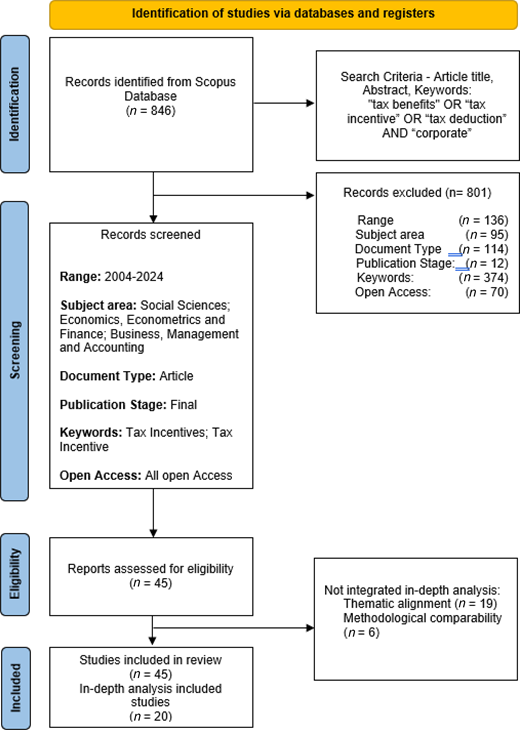
Following the definition of the research protocol, the search process was implemented in the Scopus database. To maintain protocol integrity, the search was confined to Scopus, supporting consistency and replicability across steps. Table 2 summarizes the application of successive filters based on the predefined criteria, including temporal scope, subject area, document type and access limitations, to ensure the selection of high-quality, thematically relevant publications. The initial search yielded 846 results, which were progressively narrowed down to 45 peer-reviewed articles that fully met the inclusion and quality criteria described above.
Figure 1 summarises the identification-to-inclusion flow in a PRISMA-style diagram, mirroring the sequential filters reported in Table 2. Records were identified in Scopus via title/abstract/keywords (n = 846); the time window filter (2004–2024) reduced the set (n = 710); subject-area constraints further narrowed it (n = 615); limiting to article (n = 501) and Final publication stage (n = 489) preceded the application of the specific keyword filter (n = 115) and the open-access constraint (n = 45). Full texts for these 45 records were screened and coded (Supplementary Table S1). The core set used for in-depth synthesis comprises 20 studies (Supplementary Table S2), while the remaining 25 are documented with brief descriptions and objective reasons for non-inclusion in the core analysis (Supplementary Table S3). No duplicates were removed because a single database was used and no additional sources were queried outside Scopus.
For transparency, per-article citation counts (Scopus, 2004–2024) are listed in Supplementary Table S1, these metrics are descriptive only and are not used for inference in this review.
4. Presentation of key themes identified
We present thematic, mechanism-centred syntheses (R&D; FDI/location; green; performance/survival; behavioural/distributional), integrating convergences and contrasts in narrative form. The domain-level inferences remain when the full set of 45 studies is considered (see Supplementary S2–S3), while detailed descriptors are kept in the supplement for economy of space.
4.1 Descriptive bibliometric profile
To contextualise the sample, we report a brief descriptive snapshot. Author affiliations are dispersed, with several institutions appearing twice (e.g. Universitat de València; Universiti Teknologi MARA; Universität Mannheim; Renmin University of China; Iscte – Instituto Universitário de Lisboa), indicating distributed activity across Europe and Asia. Authorship is likewise dispersed: only one author contributes two papers (Hamid, NA), with the remainder being single-paper contributors. By country, China leads (n = 10), followed by the USA (n = 5) and Japan (n = 4); Spain, Portugal and the Russian Federation register three each and Malaysia, the UK, Taiwan and Serbia appear with two. By subject area, Social Sciences (28) and Economics, Econometrics and Finance (25) dominate, with Environmental Science (14) and Business, Management and Accounting (12) also well represented, alongside smaller counts for Energy (10) and Computer Science (9), among others. These counts are descriptive only and not used for inference; the analytical sections focus on mechanisms linking incentive design to organisational responses.
4.2 Presentation of the analysed articles
This analysis is based on a detailed review of 20 peer-reviewed articles, selected from an initial set of 45, spanning from 2006 to 2024, with the objective of exploring corporate tax incentives as drivers of organisational change. Rather than organising the studies geographically, we adopt a thematic-organisational framework that clusters the articles by their primary strategic objective. This taxonomy enables the identification of convergences and divergences in the rationale, design and organisational effects of tax incentives across different economic and governance contexts. A cross-cutting analysis of the dominant fiscal instruments used, such as tax credits, exemptions and allowances, further supports the identification of patterns in organisational adaptation and behavioural response (see supplementary Table S2).
The studies reviewed were grouped into five main strategic objectives:
promoting innovation and R&D;
attracting FDI;
supporting green and sustainable development;
improving firm-level performance; and
analysing behavioural and distributive outcomes.
Each group is discussed below with attention to organisational responses and the internal transformations reported, as well as the external policy mechanisms involved.
4.2.1 Incentives for innovation and R&D.
A core group of studies focuses on how tax incentives drive corporate innovation through R&D investment. Ravšelj and Aristovnik (2018) examined Organisation for Economic Co-operation and Development (OECD) countries and demonstrate that tax incentives, particularly when paired with private R&D spending, significantly promote sustainable corporate growth. Labeaga et al. (2021) assess the persistence of Spanish firms in using R&D tax credits and find a positive association with product innovation, especially in SMEs. Sun et al. (2021), analysing Chinese listed firms, reveal how manipulation of R&D intensity can occur when tax eligibility thresholds are poorly designed, raising concerns over policy misuse. Similarly, Wasiluk and Białek-Jaworska (2020) compared Germany and France and find that higher effective tax burdens suppress R&D spending, particularly in less profitable firms. These studies highlight not only the fiscal design of incentives but also the internal organisational shifts they trigger in firms’ innovation strategies and R&D governance.
Where eligibility rules are credible and stable, firms tend to routinise documentation and budgeting around the credit cycle and persistent claiming is associated with stronger product innovation, particularly among SMEs (Labeaga et al., 2021). Cross-country evidence also indicates that incentives complement private R&D effort in sustaining growth, especially in high-tech settings (Ravšelj and Aristovnik, 2018). Organisationally, these patterns show up as calendar-based pipeline management, codified evidence-keeping and explicit board oversight linking tax-claim routines to innovation milestones.
By contrast, when thresholds bind or monitoring is weak, companies re-optimise around the cut-offs, bunching reported intensity just above eligibility values. The result is compliance scripting with uneven real innovation gains (Sun et al., 2021). Effective tax pressure further shapes the CFO’s portfolio: under heavier corporate tax burdens, firms tilt away from riskier R&D unless credits partly offset financing constraints (Wasiluk and Białek-Jaworska, 2020). The mechanism is visible in capitalisation policies, stage-gating of projects and the sequencing of expenditures to maximise claimability, which helps explain why nominally similar R&D instruments yield divergent organisational responses across contexts.
The dominant instrument in these cases is the tax credit, which is often conditional on documented R&D intensity. Historically, such policies emerged in response to global competitiveness pressures, with many countries adopting them in alignment with European Commission (2020) or OECD (2022) recommendations. The studies reveal tensions between administrative control, behavioural effectiveness and the risk of rent-seeking.
4.2.2 Incentives to attract foreign direct investment (FDI).
Several articles evaluate how tax incentives influence cross-border investment decisions. Appiah-Kubi et al. (2021) conducted a panel study of 40 African countries and conclude that lower corporate tax rates and tax holidays are effective in attracting FDI, whereas discretionary tax concessions yield negligible results. Oyerogba et al. (2024) focus on Nigeria’s manufacturing sector and highlight that while tax incentives do stimulate FDI, their effectiveness is conditioned by firm-specific characteristics and administrative efficiency. Silajdzic and Mehic (2022), analysing South-East European countries, find that tax reductions only enhance FDI when coupled with technological readiness and infrastructural capacity.
Multi-country evidence suggests that transparent, rules-based incentives, rate reductions and time-limited holidays with clear eligibility, are associated with higher inflows, whereas discretionary concessions underperform (Appiah-Kubi et al., 2021). Firm-level work in Nigeria indicates that effectiveness is conditional on firm attributes and administrative efficiency, with investment committees explicitly weighing the compliance burden in their go/no-go screens (Oyerogba et al., 2024). In transition economies, reductions in statutory rates attract FDI primarily when technological readiness is sufficient to absorb investment; otherwise, results are muted (Silajdzic and Mehic, 2022). Survey evidence on East Asian logistics hubs emphasises political stability and perceived credibility of rules in location scoring (Lu and Yang, 2006). Spatial analyses for China, finally, document how subnational competition produces heterogeneous outcomes and amplifies the salience of monitoring and standardised compliance across plants (Liu et al., 2020).
Inside firms, the channel is organisational rather than purely price-based. Decision routines embed incentive stability and administrative burden into site-selection scorecards; compliance capabilities and local enforcement risk shape entry mode and the pace/scale of deployment; and multi-plant groups standardise documentation and controls to hedge against policy reversals across jurisdictions. These governance adjustments reconcile why nominally similar packages can trigger durable investment in one setting, but only short-lived shifts or reshuffling in another.
The instruments used here include tax holidays, corporate income tax rate reductions and location-based incentives. These approaches are frequently deployed in transitional or post-colonial economies seeking to integrate into global markets. Liu et al. (2020) reinforce this concern by showing how inequality in subnational fiscal policies in China fuels inefficient tax competition, with heterogeneous effects across localities. Their spatial panel analysis highlights the need for more harmonized and carefully designed decentralized fiscal policies. Studies on location-based incentives, such as Lu and Yang (2006), further illustrate how political stability and tax advantages influence strategic decisions in international logistics zones.
4.2.3 Incentives for green and sustainable development.
Another group of studies addresses the use of tax incentives to promote sustainability and environmental innovation. Wang et al. (2024) show that VAT-based tax preferences in China significantly foster green technology innovation when mediated through R&D. Xu et al. (2023) reinforced this by demonstrating that tax incentives enhance green innovation efficiency through improved access to debt and equity financing. Rohov et al. (2021) further show that institutional quality, such as corruption control and minority shareholder protection, conditions the impact of tax policy on environmental performance.
Evidence on environmental instruments highlights a financing channel. VAT-based preferences in China appear more potent than CIT reliefs for fostering green technology innovation, with R&D investment acting as a mediator (Wang et al., 2024). Broader analyses show that tax incentives improve green innovation efficiency through improved access to debt and equity, suggesting that board-level capital-structure choices condition how far fiscal support translates into capability building (Xu et al., 2023). Cross-country results also underscore that institutional quality, corruption control, investor protection, conditions environmental performance under tax policy (Rohov et al., 2021).
Organisationally, firms respond by re-sequencing capex to exploit VAT timing, tightening project gating and documentation for eligibility and aligning treasury and R&D so that fiscal support and external finance reinforce one another. Where technological readiness is lower or administrative burden higher, uptake can remain procedural, eligibility is achieved, but the internal learning curve flattens, clarifying why similar green instruments yield heterogeneous innovation trajectories.
The most common instruments are R&D tax credits and VAT exemptions, often integrated into broader green policy agendas. These studies highlight how sustainability-oriented tax policy is increasingly institutionalised, especially in countries where environmental governance is politically salient.
4.2.4 Incentives to improve firm performance.
Other studies examine the macro- and microeconomic outcomes of tax incentives on firm survival, profitability and regional development. Lazăr and Istrate (2018) show that an increase in overall tax burden (corporate, labour and property taxes) leads to a significant reduction in return on assets in Romanian firms. Cevik and Miryugin (2022) find that higher marginal tax rates reduce firm survival probabilities, particularly in lower-income countries. Ilyin and Povarova (2017), in the Russian context, show that weak administrative capacity to tax large corporations undermines regional budgets and public investment.
Studies linking taxation to firm outcomes find that higher effective tax burdens are associated with lower profitability in Romanian listed firms (Lazăr and Istrate, 2018) and with reduced survival probabilities in a large international panel (Cevik and Miryugin, 2022). Real-options simulations indicate that credits and allowances lower the cost of capital and can accelerate investment, but uncertainty and leverage can neutralise these gains (Kenc and Driver, 2020). The organisational responses mirror these pressures: reinforced cash-flow safeguards, escalation protocols in treasury and investment pacing to balance liquidity and tax timing.
These studies frequently involve effective tax rate analysis and use instruments such as total tax wedges or targeted rate reductions. Historically, these policies are often linked to fiscal consolidation strategies or post-crisis recovery programmes. They highlight the critical need for aligning tax policy with firm resilience and regional fiscal autonomy. Kenc and Driver (2020) analyse how tax incentives interact with leverage and uncertainty, showing that even well-designed incentives can be neutralised by financial fragility. They highlight the critical need for aligning tax policy with organisational resilience, financial adaptability and long-term performance strategies.
4.2.5 Behavioural and distributional effects of tax incentives.
Finally, several articles explore how tax incentives affect firm behaviour and income distribution. Hamzah et al. (2021) offer a longitudinal view of tax avoidance in Malaysia, revealing how firms receiving incentives, particularly via the Reinvestment Allowance, maintain artificially low effective tax rates (ETRs) over time. Their analysis suggests that overly generous incentives can facilitate legal avoidance strategies, calling for targeted reforms. Carbonnier et al. (2022) analyse France’s CICE programme and show that wage gains from the tax credit accrued primarily to high-skilled workers, despite the policy’s intention to support low-wage employment. Sun et al. (2021) and Tang et al. (2019) raise concerns about strategic responses to tax policies, including R&D manipulation and executive opportunism.
Behavioural and distributional effects are uneven. In France, payroll-type credits (CICE) accrued largely to high-skilled workers, revealing rent-sharing asymmetries inside firms (Carbonnier et al., 2022). In Malaysia, generous reinvestment allowances sustained low ETRs over time, underscoring the need for stronger governance and audit controls (Hamzah et al., 2021). Evidence from Chinese listed firms shows that managerial power and board oversight shape avoidance choices (Tang et al., 2019), while cross-national work links domestic institutions to the taxing of multinationals (Jensen, 2013). Together, these findings situate HR–finance coordination and internal control systems as the mechanisms that determine who benefits from incentives and how they are operationalised.
The instruments analysed in these cases include payroll tax credits and profit-linked deductions. These studies are particularly valuable in revealing how tax incentives may reinforce existing inequalities or be subject to rent-seeking, depending on firm characteristics and enforcement capacity. Jensen (2013) highlights how democratic institutions correlate with higher tax collection from multinationals, underlining the role of political accountability in shaping fiscal impact.
This thematic-institutional taxonomy illustrates that corporate tax incentives are not neutral or uniform tools, they are embedded within broader governance frameworks and institutional trajectories. Their impact depends not only on their fiscal design but also on how they interact with regulatory enforcement, strategic firm behaviour and national development priorities. As such, any comparative evaluation of tax incentives must account for the socio-political contexts that shape their implementation and outcomes. These studies are particularly valuable in revealing how tax incentives may reinforce or reshape organisational behaviour, resource distribution and executive decision-making structures. Liu et al. (2020), for instance, demonstrate that decentralised tax policy in China, when poorly coordinated, can fuel inefficient competition between jurisdictions, showing that even pro-growth incentives can become distortive without intergovernmental alignment. Similarly, Hamzah et al. (2021) reveal how overly generous reinvestment incentives in Malaysia enabled long-term tax avoidance behaviours, highlighting the unintended consequences of insufficiently monitored policies. This thematic-organisational taxonomy illustrates that corporate tax incentives are not neutral or uniform tools, they are embedded in governance systems but also actively shape organisational practices, cultures and strategies. Their impact depends not only on fiscal design and enforcement but also on how they are perceived, internalised and operationalised within firms. As such, any comparative evaluation of tax incentives must account for the organisational contexts and strategic adaptations that mediate their implementation and outcomes.
4.2.6 Organisational mechanisms.
Across the innovation-focused studies, tax incentives trigger internal adjustments that are recognisably organisational. Firms recalibrate project selection and budgeting to align with eligibility thresholds, synchronise R&D calendars to minimise threshold risk and formalise compliance routines to document qualifying expenditures (e.g. Labeaga et al., 2021; Sun et al., 2021). These changes typically involve tighter coordination between finance and R&D units, revisions to capitalisation policies and portfolio tilts towards projects with clearer tax-credit visibility (Wasiluk and Białek-Jaworska, 2020). Where green innovation is at stake, incentives operate through financing channels, prompting firms to adjust governance over debt–equity mix and to re-sequence investments so that tax support and external finance reinforce one another (Wang et al., 2024; Xu et al., 2023).
4.3 Divergences identified
While convergences can be observed in the strategic objectives pursued through corporate tax incentives, such as innovation, investment, sustainability and competitiveness, the reviewed literature also reveals significant divergences in how organisations interpret and integrate these instruments into their internal decision-making. These divergences are not only shaped by institutional contexts but also by organisational structures, strategic capacities and sectoral priorities.
4.3.1 Divergence in innovation behaviour.
While some firms respond to R&D incentives by intensifying long-term innovation efforts (Labeaga et al., 2021; Ravšelj and Aristovnik, 2018), others engage in strategic manipulation to meet eligibility thresholds without altering underlying innovation capacity (Sun et al., 2021). This suggests that identical fiscal instruments can produce very different organisational outcomes, depending on managerial intent and governance culture.
4.3.2 Divergence in investment and internationalisation strategies.
FDI-related incentives generate varied organisational responses, ranging from genuine long-term investment in high-capacity firms (Silajdzic and Mehic, 2022) to opportunistic capital flows in contexts of weak enforcement (Oyerogba et al., 2024). Liu et al. (2020) further demonstrate that decentralised and uneven subnational tax policies in China can fuel harmful local tax competition, distorting firm location decisions and producing regionally heterogeneous outcomes. Firms with greater strategic clarity and international orientation tend to internalise these incentives more effectively.
4.3.3 Divergence in sustainability and environmental, social and governance (ESG) alignment.
Environmental incentives have triggered organisational transformation in firms committed to green transition (Wang et al., 2024; Xu et al., 2023), while others treat them as compliance mechanisms with limited internal restructuring. The degree of integration into core strategy varies widely.
4.3.4 Divergence in temporal orientation.
Some firms adopt fiscal incentives with a long-term perspective, incorporating them into strategic planning and innovation pipelines (Xu et al., 2023), whereas others pursue short-term gains, reinforcing opportunistic behaviours such as rent capture or temporary wage adjustments (Carbonnier et al., 2022). Hamzah et al. (2021) reinforce this by showing how firms in Malaysia strategically use the Reinvestment Allowance to maintain artificially low tax burdens over time, exemplifying how short-term fiscal exploitation can persist even within long-term incentive frameworks.
4.3.5 Divergence in equity and internal distributional impact.
Incentives also vary in their internal organisational distribution: some reinforce inclusive growth and SME development, while others disproportionately benefit executives or capital-intensive divisions (Carbonnier et al., 2022; Jensen, 2013).
Taken together, these divergences highlight the importance of examining tax incentives not merely as fiscal instruments but as catalysts for organisational change. Their effectiveness depends on how firms interpret and internalise them, mediated by leadership dynamics, organisational culture and long-term strategic alignment.
4.3.6 Organisational mechanisms.
In the FDI cluster, incentives reshape location screening, risk management and the governance of multi-plant coordination. Firms embed tax criteria into site-selection scorecards, renegotiate location-specific compliance capacities and adjust entry modes and capital structure to reflect incentive stability and administrative burden (Appiah-Kubi et al., 2021; Silajdzic and Mehic, 2022). At the same time, political-institutional conditions mediate these choices, with internal guidelines placing greater weight on transparency and rule credibility when incentives are material to the investment case (Jensen, 2013; Lu and Yang, 2006). These organisational responses help explain why nominally similar incentives yield heterogeneous uptake across contexts.
4.4 Historical evolution of tax incentives: evidence from the literature
Beyond thematic and organisational divergences, the reviewed literature reveals a clear temporal evolution in how corporate tax incentives have been strategically used and how firms have responded to them, across different economic periods and policy paradigms. While each national case reflects specific institutional configurations, the selected studies demonstrate how fiscal instruments have been repeatedly reoriented in response to macroeconomic cycles, global crises and shifting policy paradigms.
Drawing on the findings from the 20 articles analysed, Table 3 summarises five distinct phases in the historical trajectory of corporate tax incentives between 2008 and 2024. Each phase corresponds to a broader economic context, where tax policies were mobilised with specific strategic purposes and dominant incentive types.
In the immediate aftermath of the 2008–2010 financial crisis, governments deployed tax incentives primarily as counter-cyclical instruments to stimulate private investment and restore economic confidence. This is evident in the use of broad investment tax relief measures, as shown in studies such as those by Appiah-Kubi et al. (2021) and Carbonnier et al. (2022).
From 2011 to 2015, particularly within the European Union, fiscal consolidation pressures reshaped the incentive landscape. Emphasis shifted towards preserving R&D activity and protecting tax bases, often through more targeted instruments such as tax credits or super-deductions. Studies by Labeaga et al. (2021) and Ravšelj and Aristovnik (2018) highlight this attempt to reconcile budgetary restraint with innovation-led growth.
The 2016–2019 period reflects a phase of stabilisation and digitalisation, during which tax incentives increasingly supported long-term competitiveness, R&D digitalisation and regulatory compliance, as evidenced by studies such as Sun et al. (2021) and Wasiluk and Białek-Jaworska (2020) Administrative capacity-building and fiscal governance reforms also became prominent during this phase.
In response to the COVID-19 pandemic (2020–2022), fiscal instruments were redirected towards resilience and survival. Tax incentives were repurposed to safeguard employment, support strategic sectors and buffer firms from financial collapse. As Xu et al. (2023) and Wang et al. (2024) demonstrate, this period also saw the embedding of environmental and sustainability targets into fiscal support schemes.
Finally, in the 2023–2024 period, tax incentive strategies are increasingly aligned with green industrial policy, reindustrialisation efforts and ESG frameworks. The emphasis is now on integrated, conditional and performance-linked incentives that respond to inflationary pressures, climate imperatives and digital transformation. Studies such as Rohov et al. (2021) and Silajdzic and Mehic (2022) capture this transition towards more strategic and institutionalised use of fiscal tools.
Taken together, the phases summarised in Table 3 demonstrate that corporate tax incentives are not static or purely technical mechanisms. Rather, they are historically embedded policy instruments, adapted over time to respond not only to macroeconomic challenges, but also to evolving organisational needs, behavioural patterns and strategic realignments. Understanding their temporal trajectory is essential to analysing how firms reshape their internal practices in response to external fiscal stimuli. The historical evolution of corporate tax incentives illustrates not only shifts in fiscal priorities and macroeconomic conditions, but also how organisations have strategically adapted to changing incentive structures, reshaping internal practices, governance models and behavioural routines in response to external fiscal stimuli
4.4.1 Organisational mechanisms.
Studies of corporate behaviour show that incentives alter managerial discretion, compliance architecture and workforce outcomes. Where managerial power is high, boards recalibrate control systems and tax-planning mandates to curb opportunistic responses and to align incentive use with strategic goals (Hamzah et al., 2021; Tang et al., 2019). Under tighter fiscal pressure, firms redesign cash-flow safeguards and escalation protocols, as higher effective burdens are associated with lower survival probabilities (Cevik and Miryugin, 2022). Distributional evidence further indicates that incentive incidence interacts with bargaining structures, prompting HR–finance coordination to anticipate wage effects (Carbonnier et al., 2022). Finally, local tax-competition dynamics lead organisations to monitor policy reversals more closely and to standardise compliance to reduce exposure to discretionary enforcement (Liu et al., 2020).
The evidence from the 45 screened records and the 20 core studies shows a consistent pattern: research on corporate tax incentives concentrates in five domains, R&D and innovation, FDI and location, green and sustainability, firm performance and survival and behavioural/distributional effects and the most informative contributions are those that connect instrument design to firm-level mechanisms. Across these domains, incentives are not neutral transfers; they work through budgeting routines, governance and control, financing channels and risk management, with heterogeneous effects conditioned by institutional credibility and administrative burden. This reading integrates the thematic results in Section 4.2 and the divergences and historical phases discussed in Sections 4.3–4.4.
In R&D and innovation, studies report that credits and similar reliefs shape the allocation and timing of internal R&D. For instance, the combination of private R&D effort with public incentives is associated with stronger innovation outcomes, while persistent claiming embeds routines that reinforce product development over time; poorly calibrated thresholds, however, can induce bunching around eligibility rather than substantive innovation (e.g. Labeaga et al., 2021; Ravšelj and Aristovnik, 2018; Sun et al., 2021; Wasiluk and Białek-Jaworska, 2020). In organisational terms, firms re-prioritise pipelines, synchronise calendars with fiscal cut-offs and formalise documentation to secure claims, with CFO policies on capitalisation and portfolio risk mediating the overall response.
In FDI and location decisions, the evidence differentiates between transparent, rules-based incentives (e.g. rate reductions, holidays with clear eligibility) and discretionary concessions. The former tend to be associated with more robust effects on entry and scale in settings where institutional quality is adequate; the latter are frequently ineffective or short-lived. Studies also show that technological readiness and policy stability condition outcomes and that decentralised regimes can fuel inefficient inter-jurisdictional competition (Appiah-Kubi et al., 2021; Liu et al., 2020; Oyerogba et al., 2024; Silajdzic and Mehic, 2022). Internally, investment committees adjust site-selection scorecards, weigh administrative burden and factor rule credibility into risk matrices when incentives are material to project net present value.
The green and sustainability strand highlights a financing channel: VAT-type reliefs and well-targeted tax preferences can raise green innovation, often via increased R&D investment or improved access to debt and equity, while broader institutional quality (e.g. corruption control, investor protection) shapes the effectiveness of policy (Rohov et al., 2021; Wang et al., 2024; Xu et al., 2023). Organisationally, boards recalibrate capital structure and treasury policies and managers re-sequence investments so that fiscal support and external finance reinforce one another.
Studies on firm performance and survival link higher effective tax burdens to lower profitability and reduced survival probabilities, especially among financially constrained firms (e.g. Lazăr and Istrate, 2018; (Cevik and Miryugin, 2022). Here, incentives interact with cash-flow safeguards and leverage: real-options work suggests that reliefs reduce the cost of capital and can accelerate investment, but excess debt and uncertainty can neutralise these gains (Kenc and Driver, 2020). These findings explain why similar instruments can produce divergent outcomes depending on balance-sheet strength and governance.
The behavioural and distributional literature underscores that incidence is uneven. Payroll-type credits in France largely benefited higher-skilled workers; in Malaysia, generous reinvestment allowances allowed sustained low ETRs among recipients; managerial power and institutional transparency shape avoidance and reporting choices (Carbonnier et al., 2022; Hamzah et al., 2021; Jensen, 2013; Tang et al., 2019). At the organisational level, boards and HR/finance functions adjust control systems and rent-sharing expectations; compliance architectures are standardised where enforcement is uneven.
Viewed historically, the literature maps onto phases aligned with major economic episodes. Broad investment reliefs played counter-cyclical roles during the global financial crisis; austerity saw a pivot to targeted R&D continuity; the pre-COVID period emphasised compliance and digitalisation; the pandemic redirected instruments towards resilience and sectoral support, often integrating green targets; most recently, incentives increasingly align with ESG and reindustrialisation agendas. These shifts reflect policy learning and changing organisational priorities over time (see Table 3 and Section 4.4).
Across domains and phases, three cross-cutting points emerge. Firstly, design features, thresholds, time limits, carry-forwards, claw-backs, sectoral targeting and administrative burden, are the levers through which policy meets organisation; their credibility and clarity condition take-up and internalisation. Secondly, boundary conditions, institutional readiness, financial structure and local competition, explain much of the heterogeneity in results across settings. Thirdly, the literature still under-delivers on longitudinal and comparative designs and on explicit links to corporate governance: these gaps limit what we can infer about persistence, diffusion and equity effects across institutional environments (as flagged in the coding and summaries in Supplementary Table S2). Together, these insights motivate the integrative framework that follows in Section 4.6, which connects institutions, instrument types and organisational mechanisms.
4.5 A conceptual framework for understanding tax incentives
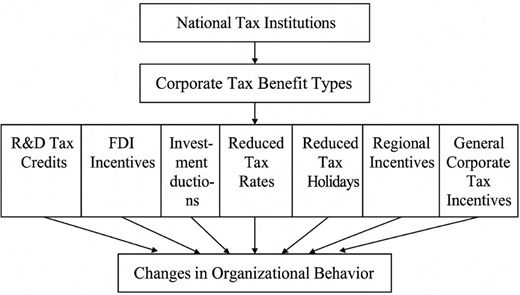
This section develops a mechanism-centred framework by making explicit the links between where incentives are designed (institutions), how they are designed (instrument features), what firms do in response (organisational mechanisms) and what follows (innovation, investment, distributional and performance outcomes). The architecture draws on institutional theory and governance (Scott, 2008; Williamson, 2000) and on the tax-planning literature that treats incentives as designable levers acting on firm decisions (Scholes et al., 2015). The framework adopts a historical-organisational reading and does not compare country levels; it abstracts common mechanisms and boundary conditions across settings. It is anchored in the core evidence reviewed in Sections 4.2–4.4.
4.5.1 Institutional environment – instrument design.
Credibility, administrative capacity and policy stability shape the feasible design space of incentives. Where transparency and constraints on discretion are stronger, incentives tend to be rules-based and durable; where governance is weaker, instruments are more discretionary and volatile (Jensen, 2013). Subnational heterogeneity can also steer design towards localised deals and inter-jurisdictional competition (Liu et al., 2020). Developmental and technological readiness conditions which instruments are likely to have traction (Lu and Yang, 2006; Silajdzic and Mehic, 2022). In short, institutional quality delimits both instrument credibility and the costs of administration and compliance.
4.5.2 Instrument design – organisational mechanisms.
Specific features, eligibility thresholds, time limits/carry-forwards, claw-backs, targeting, compliance burden and tax-base channel (CIT vs VAT), map onto recognisable firm behaviours. Thresholds trigger project selection and budgeting calendars around cut-offs; persistence rules embed routines; timing and base interact with capital structure and cash-flow management (Kenc and Driver, 2020; Labeaga et al., 2021; Sun et al., 2021; Wasiluk and Białek-Jaworska, 2020). VAT-type incentives often operate via working-capital cycles and procurement sequencing, while CIT reliefs interact more with profitability and loss-offset rules (Wang et al., 2024; Xu et al., 2023). Governance and managerial power frame how far tax planning is bounded by internal controls (Hamzah et al., 2021; Tang et al., 2019). These links specify the channels through which design features become internal routines (budgeting, documentation, governance and incentives).
4.5.3 Organisational mechanisms – outcomes (with boundary conditions).
When routines and controls re-align, we observe changes in innovation effort, location/scale of investment, wage incidence, ETRs and survival. Effects are heterogeneous and hinge on: Institutional credibility/administrative burden (rules-based vs discretionary concessions: Appiah-Kubi et al. (2021; Oyerogba et al., 2024);; Technological/sectoral readiness (Silajdzic and Mehic, 2022); Financial structure and slack (Cevik and Miryugin, 2022; Kenc and Driver, 2020; Lazăr and Istrate, 2018); and bargaining structures and labour composition (Carbonnier et al., 2022).
These contingencies explain why similar instruments may induce learning-by-claiming and productivity gains in some contexts (Labeaga et al., 2021; Ravšelj and Aristovnik, 2018) but threshold gaming or limited real effects in others (Sun et al., 2021). Accordingly, boundary conditions are not peripheral; they are integral to interpreting effect heterogeneity.
4.5.4 Dynamics over time (feedback and path-dependence).
The same linkages evolve across phases (Section 4.4). Crisis episodes favour broad reliefs that prioritise liquidity; austerity settings push targeted R&D continuity; stabilisation emphasises compliance and digitalisation; pandemic responses add resilience and green objectives; recent phases integrate ESG and reindustrialisation. Organisationally, repeated eligibility and routinised documentation create path-dependence, whereas policy volatility increases the value of real options and precautionary slack (Kenc and Driver, 2020; Wang et al., 2024; Wasiluk and Białek-Jaworska, 2020; Xu et al., 2023). This temporal perspective clarifies how designs sediment into routines-or unravel under volatility.
4.5.5 Propositions and practical implications.
The framework clarifies how institutional design features cascade into organisational responses through bounded managerial agency and adaptive routines, foregrounding the interplay between credibility, administrative burden and firms’ internal interpretation of incentives. It also yields testable propositions that summarise the evidence:
P1 (credibility) – Rules-based incentives with low discretion and clear carry-forward rules exhibit higher firm-level take-up and more persistent organisational routines than discretionary concessions (Appiah-Kubi et al., 2021; Jensen, 2013).
P2 (thresholds) – Tight eligibility thresholds increase compliance scripting and bunching; graduated schedules or ex-post claw-backs reduce manipulation while preserving innovation effort (Labeaga et al., 2021; Sun et al., 2021)
P3 (finance channel) – VAT-base and accelerated allowances more strongly affect investment timing and working capital, while CIT reliefs more strongly affect project selection conditional on profitability and loss-offsets (Wang et al., 2024; Wasiluk and Białek-Jaworska, 2020; Xu et al., 2023).
P4 (capability matching) – Incentive effectiveness rises when instrument complexity matches administrative capacity and technological readiness (Lu and Yang, 2006; Silajdzic and Mehic, 2022).
P5 (governance) – Stronger internal controls and balanced managerial power reduce avoidance-type responses and align tax planning with strategy (Hamzah et al., 2021; Tang et al., 2019).
P6 (distribution) – Where bargaining favours high-skill labour, payroll-type credits are more likely to yield regressive wage incidence unless targeted safeguards are built in (Carbonnier et al., 2022).
These propositions synthesise existing evidence from the core sample; they introduce no new empirical analysis and are intended to guide future comparative and longitudinal tests.
How to read Figure 2: The top layer (“Institutions”) reflects credibility, stability and administrative capacity (Scott, 2008; Williamson, 2000), which delimit the design space of instruments. The middle layer lists instrument families and features (e.g. thresholds, carry-forwards, claw-backs, base). Arrows to the lower layer (“Organisational mechanisms”) correspond to the behaviours observed in the core sample, budgeting and documentation routines (Labeaga et al., 2021; Sun et al., 2021), capital-structure and risk management (Kenc and Driver, 2020; Wasiluk and Białek-Jaworska, 2020), site-selection governance (Appiah-Kubi et al., 2021; Lu and Yang, 2006) and HR/finance rent-sharing (Carbonnier et al., 2022), which feed into outcomes across innovation, FDI, sustainability, performance and distribution. Boundary conditions (right-hand column) capture institutional quality, technological readiness, financial slack and bargaining structures, explaining heterogeneous effects across settings (Cevik and Miryugin, 2022; Lazăr and Istrate, 2018; Liu et al., 2020; Silajdzic and Mehic, 2022). Taken together, these elements provide the nuance needed to interpret design–response relationships over time and across contexts.
The framework is therefore both a synthesis of the reviewed evidence and a guide for future comparative and longitudinal research. Beyond these propositions, it underscores feedback loops between firms and policy institutions: repeated claiming behaviour and administrative learning reinforce policy path-dependence over time, an especially salient dynamic for management-history research.
The framework integrates institutional/governance lenses (Scott, 2008; Williamson, 2000) with a tax-planning perspective on instrument design (Scholes et al., 2015) and is empirically anchored in the core studies reviewed, including Appiah-Kubi et al. (2021), Carbonnier et al. (2022), Cevik and Miryugin (2022), Kenc and Driver (2020), Labeaga et al. (2021), Liu et al. (2020), Ravšelj and Aristovnik (2018), Sun et al. (2021), Wang et al. (2024) and Xu et al. (2023).
5. Conclusion
This article has presented a SLR of corporate tax incentives, aiming to identify how these instruments have been studied, conceptualised and historically applied within organisational contexts. Guided by four research questions, the review examined 45 peer-reviewed articles published between 2004 and 2024, from which 20 were selected for in-depth analysis using transparent inclusion criteria and a thematic-organisational coding strategy. This methodologically rigorous approach enabled a comprehensive synthesis of both empirical findings and theoretical insights into the evolution and organisational implications of tax incentives.
The analysis demonstrates that research on corporate tax incentives is concentrated in five core domains:
R&D and innovation;
foreign direct investment;
sustainability;
behavioural and distributional effects; and
firm performance.
While these areas reflect the strategic importance of fiscal instruments, the literature also reveals considerable divergence in how organisations perceive, interpret and respond to them, responses shaped by leadership structures, strategic orientation and organisational adaptability. Tax incentives emerge not merely as economic levers, but as embedded stimuli that trigger organisational learning, behavioural recalibration and structural change.
A key contribution of this review is the development of a conceptual framework that integrates organisational theory and fiscal policy literature to explain how tax incentives function as instruments of organisational transformation. The framework illustrates how fiscal institutions influence the design of incentives, which are then internalised by firms through processes such as innovation planning, resource mobilisation and strategy realignment. This model offers a structured lens to understand how public policy intersects with firm-level adaptation across time.
Nonetheless, this study is not without limitations. The exclusive use of the Scopus database and the restriction to open-access publications may have limited access to valuable grey literature or non-indexed regional contributions. Furthermore, the proposed framework remains theoretical and would benefit from future empirical validation across sectors and institutional settings. Research that investigates the lived experience of firms in adapting to fiscal stimuli, across varying scales, industries and governance systems, would enrich our understanding of the micro-processes of organisational change.
In sum, this systematic review reframes corporate tax incentives as historically embedded drivers of organisational transformation. It bridges disciplinary silos, consolidates fragmented insights and invites further exploration of how fiscal policy shapes, and is shaped by, the evolving dynamics of organisational behaviour and strategic adaptation.
Supplementary material
The supplementary material for this article can be found online.