
Skip to Main Content
Purpose

This study develops and validates, through expert consensus, a framework for achieving antifragility in manufacturing by strategically integrating modern digital technologies with capabilities that enable organizations to grow stronger through disruption. It moves beyond traditional resilience-focused approaches by emphasizing continuous adaptability, sustained growth and competitive advantage in an environment characterized by volatility and rapid technological change.

Design/methodology/approach

Grounded in the dynamic capability perspective, the study synthesizes insights from an extensive literature review with the results of a Delphi study involving a panel of 14 industry and academic experts. The process identified and refined a set of critical supporting capabilities, including cross-functional governance, interoperability assessment and risk-responsive integration, that enable the alignment of digital transformation initiatives with antifragile objectives.

Findings

Antifragility is positioned as a higher-order dynamic capability that transforms volatility into a driver of innovation and strategic renewal. The resulting expert-based framework maps emerging technologies such as artificial intelligence, the Internet of Things and big data analytics to specific sensing, seizing and transforming capabilities, providing a structured pathway for operationalizing antifragility in manufacturing contexts.

Practical implications

The framework offers manufacturers a structured approach for aligning technology investments with antifragile objectives, ensuring that digital transformation enhances rather than undermines adaptability and growth. It encourages a phased, resource-aware implementation strategy that leverages disruptions as strategic assets, fostering both business continuity and long-term competitiveness.

Originality/value

This research conceptualizes antifragility as a distinct and advanced capability in manufacturing and demonstrates how it can be purposefully developed through strategic technology integration. By combining theoretical grounding with expert validation, it bridges the gap between digital transformation and antifragility, offering a practical roadmap for turning uncertainty and variability into sources of competitive advantage.

Interesting because – Manufacturing firms face persistent turbulence that challenges traditional approaches to stability and recovery. This study is noteworthy because it reframes disruption as a driver of progress. It introduces antifragility as a strategic capability that enables organizations to improve through variability rather than resist it. By linking digital transformation to capability development, the research explains how sensing, seizing, and transforming can operate as an integrated system that strengthens with each cycle of change.

Theoretical value – The study extends dynamic capability theory by formalizing antifragility as a higher-order construct that unites technological adaptation with continuous learning. It distinguishes operational responsiveness from operational dynamism and explains how their interaction drives cumulative capability growth. The results demonstrate how technologies such as IoT, AI, and analytics foster self-reinforcing improvement, transforming variability into structured renewal and long-term adaptability.

Practical value – For managers, the framework provides actionable guidance for aligning digitalization with antifragile growth. It helps prioritize which capabilities to develop, design governance that promotes cross-functional coordination, and select technologies that enhance learning and flexibility. The approach encourages firms to treat disruptions as learning cycles, use technology adoption strategically, and build systems that improve performance, responsiveness, and competitiveness over time.

In today’s dynamic and uncertain environment, manufacturing systems face recurrent disruptions ranging from supply chain volatility to technological shifts and macroeconomic shocks (Ivanov, 2023a). Established disorder response approaches increasingly fall short in enabling firms not only to withstand shocks but to improve because of them (Nikookar et al., 2024). This has renewed interest in antifragility, a capacity to benefit from variability that remains underdeveloped in manufacturing research and practice (Becker et al., 2024). Antifragility is multifaceted and strategic, requiring cohesive capabilities that operate across the organization rather than isolated tools or ad hoc fixes (Hillson, 2023). Digitalization intensifies the need for such cohesion. Firms of all sizes invest in artificial intelligence (AI), the Internet of Things (IoT), data analytics, and automation to enhance efficiency and adaptability (Fosso Wamba et al., 2024), yet many initiatives are not aligned with antifragility aims. Misalignment risks missed opportunities and can even increase fragility (Roy et al., 2024).

Recent studies have advanced understanding of how manufacturers can survive and even thrive under turbulence (Javed et al., 2024a, b; Rashid et al., 2024). For instance, evidence shows that supply chain integration and knowledge capabilities, when aligned with technological dynamism, foster ambidextrous innovation in manufacturing (Javed et al., 2024a). Research on pandemic-related disruptions indicates that combining advanced technologies with supply chain collaboration enhances sustainable supply chain performance (Javed et al., 2024b). Complementary work suggests that innovation and knowledge-based capabilities, supported by technological capabilities, can strengthen greener and higher-performing manufacturing (Javed et al., 2025). However, the literature does not yet conceptualize antifragility as a distinct capability system that improves through volatility, nor does it provide an implementable mapping that links digitalization to this system across sensing, seizing, and transforming while clarifying organizational boundaries in relation to resilience and viability. Addressing this gap is the motivation for the present study.

Theoretical gaps therefore persist in specifying the capabilities that underpin antifragility in manufacturing (Becker et al., 2024; Priyadarshini et al., 2022). Foundations in resilience and adaptability are relevant yet insufficient because they prioritize resistance and recovery. Antifragility treats volatility as a source of systematic improvement rather than only a risk to be managed (Ghobakhloo et al., 2025; Munoz and Zhou, 2023). The literature still lacks a cohesive account that defines antifragility as a distinct capability system, distinguishes it from resilience and viability, and maps how digitalization supports that system in volatile, complex manufacturing settings.

Practice reflects similar challenges. Many firms remain unsure how to operationalize antifragility strategically when integrating it with digital transformation (Giordino et al., 2024). Common problems include misaligned resources, weak cross-functional coordination, and difficulty embedding new tools into day-to-day work, which can leave investments costly yet ineffective (Ghobakhloo et al., 2023; Sony et al., 2022). Misalignment between digital initiatives and antifragile objectives can introduce operational vulnerabilities and inefficiencies (Ghobakhloo and Iranmanesh, 2021). For manufacturers seeking durable advantage in shifting markets, strategy must connect digital capabilities to an explicit antifragility capability set.

This study addresses these gaps in three steps. First, it defines antifragility for manufacturing as a distinct higher-order dynamic capability and specifies a coherent capability set across sensing, seizing, and transforming, clarifying its difference from resilience and viability (Becker et al., 2024; Ghobakhloo et al., 2025). Second, it develops a technology–capability map that links contemporary digitalization domains to those capabilities and identifies organizational catalysts required for reliable implementation at scale (Munoz and Zhou, 2023). Third, it validates and refines the framework through expert input to ensure conceptual clarity and practical relevance. Together, these steps translate a broad capability conversation into an implementable approach for manufacturing antifragility. Accordingly, the study strives to answers the following research questions:

RQ1.

How can antifragility capability be conceptualized in the context of manufacturing systems?

RQ2.

What role do digital technologies play in enabling antifragility in manufacturing?

This paper contributes to the literature by conceptualizing antifragility in manufacturing as a distinct higher-order dynamic capability and by specifying its underlying capability system across sensing, seizing, and transforming. It advances theory by clarifying how antifragility differs from resilience and viability and by integrating digital technologies as enablers of this capability system. From a practical perspective, the framework provides manufacturers with a structured approach to align digitalization with antifragility objectives, offering guidance on how to turn disruptions into opportunities for learning, adaptation, and long-term competitiveness.

Antifragility in manufacturing represents a distinct way of dealing with variability and disorder. Taleb (2012) defines antifragility as the capacity to improve because of stressors, volatility, and uncertainty. This stands apart from approaches that aim to resist change or recover after disturbances. Antifragile systems treat uncertainty as a driver of adaptation, innovation, and long-term advantage. The idea has gained prominence with advances in digital technologies and a growing recognition that dynamic environments can be harnessed for opportunity rather than only managed as threats (Becker et al., 2024; Nikookar et al., 2024).

To clarify this distinction, it is useful to compare antifragility with other disorder response systems. Table 1 outlines fragile, robust, resilient, viable, and antifragile systems according to their goals and expected responses to disruption. Fragile systems are highly vulnerable and deteriorate under stress, which is often the case in smaller firms with limited resources (Becker et al., 2024; Corvello et al., 2023). Robust systems prioritize stability by resisting change within design limits, which minimizes exposure but leaves little room for adaptation and may reduce competitiveness in shifting environments (Mondal et al., 2014; Srivastava et al., 2021). Resilient systems emphasize recovery, restoring operations after disruptions but generally aiming for a return to baseline rather than improvement (Kähkönen et al., 2023; Lerch et al., 2024; Ghobakhloo et al., 2025; Ivanov, 2023b). Viable systems extend resilience by balancing adaptability and sustainability to maintain long-term functioning, although their equilibrium orientation constrains the ability to turn volatility into growth (Ruel et al., 2024; Zekhnini et al., 2022; Ivanov and Dolgui, 2020).

Antifragility differs in both objective and logic. Instead of seeking stability, balance, or recovery, antifragile systems improve through disruption. In manufacturing this involves proactive mechanisms such as early sensing, experimentation, and continuous learning that convert shocks into innovation and renewal. Digital technologies, including real time analytics, predictive modeling, and digital experimentation, reinforce these mechanisms by enabling firms to transform variability into strategic advantage (Größler, 2020; Lotfi et al., 2023; Becker et al., 2024). While some practices such as redundancy or adaptability may appear across resilience, viability, and antifragility, the purpose they serve is not the same. In resilience they support recovery, in viability they secure long-term balance, and in antifragility they create the conditions for growth through volatility.

These categories should not be interpreted as stages on a continuum. They are distinct orientations, each suited to different contexts and objectives. The contrasts summarized in Table 1 highlight antifragility as a separate construct that moves beyond stability or recovery to focus on systematic improvement because of variability (Nikookar et al., 2021; Ruel et al., 2024).

The Delphi method was used because antifragility in manufacturing is still an emerging concept with limited empirical grounding. This method allows experts to iteratively refine definitions and relationships through structured, anonymous, and feedback-driven discussions (Beiderbeck et al., 2021). It was therefore well suited for identifying and validating the capabilities and technology linkages that underpin antifragile manufacturing.

Experts were recruited through professional networks, publication records, and industry reputation. Eligibility required at least ten years of experience in senior manufacturing or supply chain roles or multiple peer-reviewed publications on Industry 4.0, dynamic capabilities, or operational resilience. Fourteen experts were selected to ensure variation across industries, firm sizes, and roles, including plant managers, digital transformation leads, supply chain directors, and academic researchers. Anonymity was maintained to promote independent judgment and reduce social or hierarchical bias.

The Delphi process followed three iterative rounds adapted from Okoli and Pawlowski (2004). In Round 1, experts reviewed literature-based statements that defined candidate capabilities and technological enablers grouped under sensing, seizing, and transforming. Participants commented on clarity, scope, overlaps, and missing links. Peer comments were hidden to avoid anchoring. Round 2 provided a structured summary of the main points of agreement and contention, along with a visual draft of the capability–technology framework. Experts refined definitions, adjusted links, and proposed new relationships. Round 3 concentrated on unresolved items only, where participants voted to retain, revise, or remove each element while providing short justifications. Controlled feedback ensured that opinions evolved through reflection rather than persuasion.

Consensus thresholds were defined in advance. Agreement required at least 80% endorsement with no strong objections for definitions and 75% agreement for relationships. Items that remained stable between Rounds 2 and 3 were considered confirmed, while unresolved items were retained as contested. Qualitative inputs from all rounds were coded using structured content analysis. Two coders independently analyzed a subset of the data to develop a shared codebook that included affirmations, definitional refinements, merges or splits, new capability proposals, and links between capabilities and technologies. Discrepancies were reconciled, and the codebook was applied to the entire dataset to trace how expert input informed framework revisions.

Several measures supported validity and reliability. Anonymity, randomization of item order, hidden peer comments, and inclusion of minority opinions helped minimize bias. Seeding Round 1 with literature-derived definitions ensured comprehensive coverage of relevant topics while leaving room for refinement. Independent double coding enhanced interpretive accuracy. Robustness was further tested through sensitivity analyses, showing that excluding any single expert did not alter consensus outcomes, and subgroup comparisons indicated stable responses across professional backgrounds. By the conclusion of Round 2, the discussion had stabilized, and few new ideas or changes were proposed, indicating that the experts had reached a shared understanding of the key constructs and relationships. All participants provided informed consent and could withdraw at any time. Only aggregated findings were reported, and no confidential information was collected.

Antifragility, as conceptualized by Taleb (2012), refers to a system’s capacity not only to withstand stress and disruption but to benefit and grow stronger from them. In such systems, disruptions act as catalysts for improvement, fostering conditions where volatility and uncertainty fuel adaptation, learning, and long-term growth. In the manufacturing context, this study draws on the dynamic capability perspective (DCP) (Teece et al., 1997) as a robust theoretical foundation for translating antifragility into operational terms. DCP emphasizes an organization’s capacity to sense, seize, and transform in response to changing environments (Teece, 2023), thereby enabling the reconfiguration of resources and processes to adapt to or capitalize on variability (Wilhelm et al., 2015). These capabilities capture the essence of antifragility, outlining how manufacturing systems can evolve and improve in the face of fluctuating conditions.

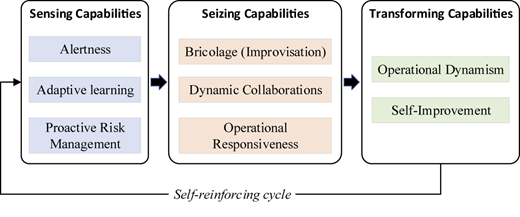
The initial framework, shown in Figure 1, was constructed through an extensive review and synthesis of prior literature, identifying and defining the capabilities most critical for manufacturing antifragility and linking them to enabling technologies and governance mechanisms. These literature-derived constructs were then subjected to expert review and consensus building through the Delphi process described earlier. The Delphi engagement served to examine the clarity, relevance, and completeness of each capability definition and to refine the interrelationships between them based on practitioner and scholarly expertise.

DCP underscores three primary capabilities that allow firms to navigate complex and fluctuating environments strategically. Sensing refers to the ability to identify and interpret environmental changes, anticipating disruptions or opportunities (Kähkönen et al., 2023) through continuous monitoring and analysis (Ghosh et al., 2022). Seizing involves mobilizing resources and making strategic commitments to capitalize on opportunities or mitigate threats (Wohlleber et al., 2024), ensuring swift and effective reconfiguration of resources (Ghosh et al., 2022). Transforming encompasses the ongoing adaptation and renewal of a firm’s resource base in response to cumulative insights and environmental shifts (Kähkönen et al., 2023).

The sensing dimension includes adaptive learning and alertness, which equip systems to detect and interpret subtle environmental shifts (Größler, 2020; Nikookar et al., 2024). Adaptive learning builds on past experiences and integrates real-time data and insights from disruptions to improve processes over time (Gölgeci and Kuivalainen, 2020). Alertness enhances vigilance, enabling the detection of emerging patterns, weak signals, and nascent trends (Mandal, 2019). Proactive risk management anticipates potential disruptions using scenario analysis and contingency planning (Can Saglam et al., 2021; Hillson, 2023). These capabilities shift the organizational posture from reactive adjustments to proactive strategic positioning.

The seizing dimension enables manufacturing systems to respond dynamically to variability, with capabilities such as bricolage, which entails improvising with available resources to solve unexpected challenges (Essuman et al., 2023; Nikookar et al., 2024), and dynamic collaborations, which flexibly reconfigure relationships with suppliers, customers, and other stakeholders to secure complementary resources (Ghobakhloo et al., 2025; Ramezani and Camarinha-Matos, 2020). Operational responsiveness ensures rapid adaptation of production schedules, resource allocation, and supply chains in response to emerging conditions (Munir et al., 2022), supported by human and technological agility (Größler, 2020).

The transforming dimension embeds learning from disruptions into continuous improvement, with operational dynamism enabling processes and structures to evolve through the use of real-time data, analytics, and accumulated experience (Samadhiya et al., 2023). Operational responsiveness here supports the rapid reconfiguration of co-specialized resources to align with changing demands (Yu et al., 2019; Iyer et al., 2023). Self-improvement promotes decentralized decision-making and iterative learning, ensuring that each disruption strengthens organizational adaptability (Junaid et al., 2023; Hillson, 2023).

Figure 1 further illustrates how sensing, seizing, and transforming capabilities operate in a self-reinforcing cycle. Real-time data informs sensing capabilities, which detect and interpret changes; seizing capabilities mobilize resources to act on these insights; and transforming capabilities integrate lessons learned into structural and process improvements, which in turn enhance sensing over time. This continuous loop reflects the system-level nature of manufacturing antifragility, where the whole is greater than the sum of its parts.

Table 2 presents the final, expert-confirmed set of manufacturing antifragility capabilities, explaining how each capability’s function within the framework, emphasizing that the construct is both theoretically grounded in the DCP and empirically refined through structured expert consensus.

The enabling role of technology in manufacturing antifragility was established through a two-stage process: a synthesis of Industry 4.0 and resilience-oriented manufacturing research, followed by structured validation and refinement across the Delphi rounds. The literature review surfaced candidate technologies linked to sensing, seizing, and transforming; these links were then presented to the panel, who assessed relevance, clarified operational roles, and proposed refinements and additions. Table 3 reports the technology–capability links.

Across capabilities, IoT data, cloud integration, big-data platforms, and AI provide the shared information and analytics that support sensing, seizing, and transforming throughout the cycle. IoT-centric data capture provides continuous operational and supply signals, while cloud and big-data platforms enable integration, storage, and scalable analytics for monitoring, prediction, and coordination (Roy et al., 2024). AI converts these streams into forecasts, prescriptions, and decision aids that shorten detection and response times in sensing, seizing, and transforming (Chari et al., 2022; Ghobakhloo et al., 2025). Generative approaches are considered within AI because their effects arise through mechanism-specific contributions such as knowledge extraction, content generation, and scenario exploration rather than through a separate infrastructure layer (Ghobakhloo et al., 2024).

Within sensing, both the literature and the panel emphasized comprehensive data acquisition, real-time monitoring, and predictive insight generation (Ghobakhloo et al., 2024). IoT sensors embedded across production and logistics streams provide a shared signal on equipment condition, flow, and supply status that supports adaptive learning and early weak-signal detection (Ghaleb et al., 2020; Vilkas et al., 2024). Big-data platforms and AI analytics render these signals actionable by uncovering recurrent patterns and generating predictive and prescriptive outputs that guide attention and triage (Bag et al., 2023; Silva et al., 2021). Where uncertainty is high, generative methods expand scenario exploration by producing alternative futures and synthetic data to probe detection thresholds (Ghobakhloo et al., 2024; Silva et al., 2021).

Within seizing, technologies that enable synchronized decisions and agile resource moves are most salient. Cloud connectivity supports location-independent access to shared information and coordinated adjustment across teams and sites (Corvello et al., 2023; Roy et al., 2024). In contexts where multi-party trust, traceability, and auditability are binding, blockchain can strengthen collaboration and automate inter-organizational coordination (Ghobakhloo et al., 2025). IoT supports local control actions that stabilize flow under shifting constraints, including parameter changes and event-triggered responses at machines and cells (Zhang et al., 2021). When conventional configurations are constrained, AI methods, including generative ones, can help propose feasible alternatives for short-cycle resequencing, buffer moves, or resource reallocation (Klar et al., 2024; Ghobakhloo et al., 2024).

Within transforming, emphasis shifts to validated change and disciplined learning. Digital twins allow low-risk experimentation and pre-implementation evaluation of process, layout, or coordination changes before they are introduced into live operations (Bellavista et al., 2023; Lepore et al., 2022). AI-enabled learning systems consolidate feedback from prior episodes into improved models and decision rules, supporting operational dynamism over time (Belinski et al., 2020; Ghobakhloo et al., 2024). Generative AI can broaden the option set for design and process changes when conditions shift, accelerating the review of viable alternatives (Ghobakhloo et al., 2024). Experts also noted the importance of decentralized decision environments that allow local teams to apply insights consistently, which supports self-improvement and diffusion of new routines (Bag et al., 2023; Fosso Wamba et al., 2024).

Several technologies act as amplifiers whose salience depends on product, process, and workforce context. AR and VR primarily enhance learning, training, and guided execution, which improves sensing quality and accelerates the institutionalization of improvements during transforming (Egger and Masood, 2020; Munir et al., 2022; Roy et al., 2024). Additive manufacturing is most consequential where rapid reconfiguration, localization, or customization is required; it supports transforming by lowering changeover barriers and, in specific cases, near-term seizing through fast part availability (Iqbal et al., 2020). In inter-organizational settings where verification and shared records are pivotal, blockchain contributes to trusted coordination; in the absence of these conditions its incremental effect is smaller relative to the core data and intelligence layer and the context-specific amplifiers (Ghobakhloo et al., 2025).

In sum, Table 3 organizes technologies by how they help build capabilities rather than treating them as interchangeable tools. Shared data and analytics resources enable sensing, seizing, and transforming across settings, while other technologies matter most in specific product, process, or inter-organizational contexts. This structure stays true to the study’s theoretical intent, reflects the validated links, and shows how digitalization supports the capability system needed for antifragility.

The Delphi results suggest that antifragility in manufacturing is best understood as a system of interdependent mechanisms across sensing, seizing, and transforming. The eight capabilities that reached consensus cohere as a logic of action that is compatible with dynamic capability thinking yet differs in orientation. Rather than aiming primarily at recovery to baseline or balanced functioning, the target is improvement because of volatility, which places the results closer to the emerging view that variability can be harnessed when learning and redesign are institutionalized as routine outcomes of disruption (Ghobakhloo et al., 2025; Munoz and Zhou, 2023).

Interpreting the pattern begins with early recognition. Alertness, Adaptive Learning, and Proactive Risk Management cluster because faster and more accurate detection requires weak-signal scanning, disciplined interpretation, and pre-commitment to viable responses. This corroborates long-standing arguments in resilience and reliability research that emphasize monitoring, preparedness, and anticipation as foundational to adaptation (Mandal, 2019; Tiwari et al., 2024). The present results extend that view in two ways. First, they position recognition not only as protective but as developmental, since better sensing today should raise the quality and speed of sensing tomorrow through feedback from transforming. Second, they emphasize that risk practices are most useful when they enable action rather than cataloging threats, which aligns with proactive risk perspectives that couple assessment with option generation.

The mobilization stage is explained by Bricolage and Dynamic Collaborations. In resource-constrained settings, bricolage enables creative recombination of what is already available, while collaboration opens access to complementary resources and knowledge across partners. This pattern is consistent with supply chain and operations studies that link transparency, information sharing, and flexible coordination to performance under shocks and demand swings (Hamann-Lohmer et al., 2023). It also fits evidence from human–machine teaming where collaborative robots help reassign work and rebalance flow when variability increases (Zafar et al., 2024). The results therefore corroborate prior work on the value of coordination and improvisation, while extending it by placing these mechanisms within a loop whose explicit aim is cumulative capability gain, not just short-term continuity.

A key conceptual clarification is the separation between Operational Responsiveness and Operational Dynamism. Responsiveness adjusts execution within the current operating design, often on short cycles, through changes to parameters, schedules, or local resource allocations. Dynamism changes the design itself when conditions demand it, often on longer cycles, through reconfiguration of assets, processes, and decision rights. The literature often treats these as points on a single continuum of flexibility. The present study suggests they are different levers whose misapplication can be costly. Overreliance on Responsiveness where structural change is required leads to chronic firefighting. Initiating redesign where short-cycle control would suffice creates churn and crowding out of execution. This distinction complements dynamic capability theory, which differentiates between first-order adjustments and higher-order reconfiguration, and it aligns with our positioning of transforming as the hinge that governs renewal over time (Ghobakhloo et al., 2024).

Self-Improvement closes the loop. After-action reviews, standard-work updates, and playbook revisions ensure that lessons are retained and diffused. This is consistent with organizational learning research in operations, which links codification and reuse to performance stabilization. The contribution here is directional. Learning is not only aimed at variance reduction; it is also aimed at raising future returns under disorder by reducing detection and adjustment time and lowering the coordination cost of change in subsequent episodes (Wolf et al., 2021; Lafuente and Sallan, 2024). This helps explain why antifragility is cumulative. The benefits accrue through repeated cycles where transforming feeds back into sharper sensing and more reliable seizing.

Situating the findings within adjacent literatures shows both continuity and extension. Relative to resilience, which prioritizes recovery, the results add a feedback mechanism that targets improvement as the default outcome when volatility is persistent. Relative to viability, which seeks balance between stability and adaptability, the results tilt the balance toward growth through well-governed change. Relative to the dynamic capability tradition, the results specify microfoundations for a looped interaction in which transforming is not a terminal stage but a generator of future sensing and seizing capability. This interpretation aligns with, and extends, recent work that links capability building to technology context and collaboration while stopping short of articulating improvement because of volatility as a first-order objective.

Digitalization enters the picture as mechanism rather than catalogue. Shared data and analytics resources provide the information and intelligence base that sensing, seizing, and transforming require, which fits evidence on IoT, cloud integration, and analytics improving detection, coordination, and review (Ghobakhloo et al., 2024; Roy et al., 2024). Other technologies amplify particular parts of the loop when conditions warrant. Where multi-party coordination depends on verification and traceability, auditability tools increase the feasibility of collaboration and shorten time to action. Where redesign must be validated before physical change, simulation and visualization through digital twins and AR or VR reduce risk and speed diffusion of new routines (Li et al., 2023; Bellavista et al., 2023; Lepore et al., 2022). This role-based reading supports recent findings on technology-enabled collaboration and innovation yet moves beyond prior lists by linking technologies to specific capability effects that advance the antifragility loop.

The results also surface contingencies and risks that qualify scope. Differences in digital maturity, process coupling, product clockspeed, and network structure matter. Capabilities such as cross-functional governance, IT or OT maturity assessment, and digital resource readiness can be resource intensive, which makes sequencing important. Smaller firms can still progress by focusing on narrow, high-leverage routines that create the loop, such as weak-signal reviews, brief after-action learning cycles, and safe-to-fail experiments tied to operational goals, and by using lightweight assessments, simplified governance practices, and ecosystem partnerships for expertise and infrastructure. This reading is consistent with digital transformation studies that caution against tool-led deployments and fragmentation under resource constraints (Sony et al., 2022; Ghobakhloo and Iranmanesh, 2021). Risks follow directly. Poor data quality elevates false alarms and erodes trust in sensing. Deployments that are not anchored in capability priorities fragment effort and increase fragility. Collaboration tools can generate new dependencies if decision rights are unclear. These risks reinforce the importance of the catalyst capabilities documented earlier, which channel technology toward capability growth and maintain coherence during change.

The mechanism implies testable propositions for future work even though the study itself is conceptual and expert-based. Transforming that consistently codifies learning and revises the operating design should be associated with shorter detection and adjustment times in subsequent disruption episodes. The joint presence of Bricolage and Dynamic Collaborations should lower the cost of first actions when constraints bind, relative to either capability in isolation. Misalignment between the chosen lever of change, whether short-cycle Responsiveness or structural Dynamism, and the disturbance type should be associated with higher variance and lower performance gains from volatility. These propositions can be examined through longitudinal field designs that track capability growth and performance over repeated disturbances, through process tracing in multi-site cases that reveal decision rights and coordination patterns, and through pilot interventions that couple targeted capability changes with measurable outcomes.

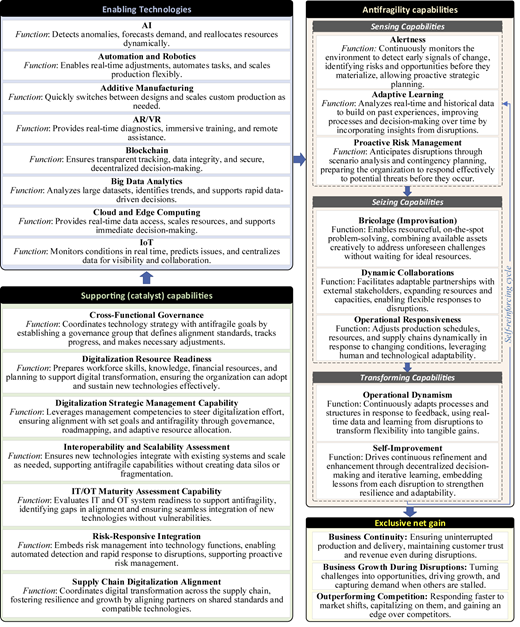
Finally, the expert-based framework in Figure 2 integrates the capability set, catalyst capabilities, and enabling technologies into a single design logic. Cross-functional governance aligns initiatives with antifragility aims and reduces fragmentation across functions (Papagiannidis et al., 2023; Wang et al., 2022). Interoperability and scalability assessment reduces integration risk when new tools must coexist with legacy systems and helps maintain cohesion during change (Jimeno-Morenilla et al., 2021; Pan et al., 2021). Risk-responsive integration embeds detection and mitigation into deployment so that systems react as issues arise rather than after the fact (Riahi et al., 2021; Spieske and Birkel, 2021). IT or OT maturity assessment identifies structural gaps that otherwise become points of fragility during digitalization (Ghobakhloo and Iranmanesh, 2021; Qader et al., 2022; Ehie and Chilton, 2020). Supply chain digitalization alignment extends these logics across the network so partners share standards and signals for coordinated responses to volatility (Chi et al., 2020; Ghobakhloo et al., 2025). Digitalization strategic management links roadmaps, resources, and monitoring to antifragility aims, and digitalization resource readiness builds skills and financial flexibility for sustained implementation (Santos et al., 2023; Gupta et al., 2022; Ansari et al., 2023). Under these conditions, enabling technologies support the eight capabilities in a way that makes the sensing, seizing, and transforming loop repeatable and value creating. Over repeated cycles, firms should observe faster detection, lower cost of first actions, fewer frictions in redesign, and ultimately performance gains under volatility relative to prior baselines.

This study has elaborated on the concept of antifragility in manufacturing by developing a framework that links advanced technologies with strategic capabilities to create systems that strengthen through disruption. Theoretically, the study advances understanding of antifragility by tracing its evolution and clarifying how it differs from resilience, robustness, and viability. While those perspectives emphasize restoring or preserving performance under stress, antifragility reframes disruption as a source of improvement. This is not a semantic shift but a reorientation: disorder becomes an input for capability development rather than a threat to be contained. For manufacturing, the design objective is no longer recovery or balance but purposeful strengthening through variability. This view extends resilience and viability research by showing how firms can move beyond stability toward systematic gains in volatile environments.

The framework also contributes to dynamic capability theory by conceptualizing antifragility as a higher-order capability with distinct mechanisms. Building on the established sensing, seizing, and transforming logic, it specifies how these activities interact iteratively to create cumulative improvement. Transforming does not merely end a response episode, as it codifies lessons and reconfigures routines in ways that enhance subsequent sensing and seizing. This self-reinforcing cycle clarifies why antifragility is more than adaptability. It identifies how variability can be converted into durable advantage, and it delineates boundaries with resilience, which focuses on recovery, and viability, which balances stability and adaptability.

A further contribution lies in digital transformation research. The framework positions digitalization not as an end in itself but as a means to capability building. Many digital initiatives falter because they are tool-led and fragmented. By linking antifragility to organizational mechanisms such as cross-functional governance, digital resource readiness, and risk-responsive integration, the study shows how technologies and organizations co-evolve under turbulence. This integrated perspective connects microfoundations of capability development with the strategic role of digitalization in volatile contexts. The formulation is necessarily provisional, yet it clarifies constructs, specifies mechanisms, and sets a basis for empirical testing of scope conditions and performance effects.

Beyond theory, the framework generates practical implications. Antifragility is proposed as both a novel concept and a viable strategy for manufacturers in unpredictable environments. The central implication is directional: organizations should design recurring cycles of sensing, seizing, and transforming so that disruptions generate cumulative learning and growth. Unlike resilience, which prioritizes recovery, antifragility is an orientation toward systematic improvement and should be treated as a long-term, iterative process.

Practical feasibility depends on firm size and readiness. Supporting capabilities such as IT/OT maturity assessment, cross-functional governance, and digitalization resource readiness are resource-intensive and may appear inaccessible to smaller firms. Yet SMEs are not excluded. Progress can be achieved incrementally through simplified maturity assessments, lightweight governance that clarifies decision rights, and ecosystem partnerships that provide external expertise. By sequencing investments and focusing on feasible steps, smaller firms can gradually embed antifragility while still benefiting from its underlying logic.

Another implication concerns technology adoption. Technology should follow capability priorities rather than drive them. Firms should first identify whether their most pressing need is to strengthen sensing, seizing, or transforming, and then select tools that directly support those aims. IoT and predictive analytics can enhance sensing, while digital twins and additive manufacturing may be more relevant for transforming. A pragmatic starting point is to deploy a limited set of tools that address immediate needs, such as IoT monitoring of critical assets, basic cloud integration for visibility, or targeted AI for urgent problems. As routines mature, these foundations can be expanded with more advanced technologies such as digital twins for testing reconfigurations or AR/VR for workforce training. For SMEs, phased adoption through pilot projects with clear goals and reinvestment of demonstrated gains reduces risk and supports sustainable progress. In this way, technology decisions remain tied to capability building, avoiding fragmented investments and ensuring that digitalization contributes directly to antifragility.

Leadership attention is a critical enabling factor. Managers should assign responsibility for maintaining the sensing–seizing–transforming cycle, establish regular reviews of lessons learned, and ensure that improvements are codified and reused. Tracking simple indicators such as detection speed, adjustment time, and share of lessons incorporated into practice helps sustain focus on capability growth rather than technology deployment alone. This reinforces that antifragility is as much about organizational learning and redesign as it is about tools.

The framework also aligns with sustainability where environmental initiatives strengthen adaptability, efficiency, or responsiveness. Circular systems that reduce dependence on volatile inputs, or energy-efficiency programs that create operational slack, illustrate how sustainability and antifragility can reinforce one another. Evaluating sustainability projects through an antifragility lens helps firms prioritize initiatives that deliver both environmental and organizational benefits.

Antifragility thus becomes actionable when pursued as a program of continuous, small-scale improvements that accumulate over time. Large firms may deploy the full set of governance mechanisms and capabilities, while SMEs can progress incrementally by sequencing investments, leveraging partnerships, and focusing on routines that turn disruption into lasting learning. Across contexts, sustainable advantage derives less from owning every technology and more from aligning selected technologies with organizational routines and decision rights that make sensing, seizing, and transforming mutually reinforcing.

The study also acknowledges limitations, which point to important directions for future research. The framework remains conceptual and expert-informed rather than empirically validated. A central element, the self-reinforcing cycle linking sensing, seizing, and transforming, is theoretically reasoned and based on expert judgment rather than direct observation. Empirical testing is essential to confirm this mechanism and establish its performance effects. Longitudinal field studies could track how capabilities evolve and how firms perform under volatility, using indicators such as disruption detection speed, adjustment speed, share of lessons retained, and changes relative to pre-disruption baselines. Research designs employing panels, event windows, or difference-in-differences could strengthen causal inference. Complementary case studies can provide insight into process dynamics and decision-making within the cycle, drawing on evidence such as sensor logs, rescheduling records, and change requests. Multi-site cases across industries and firm sizes, including SMEs, could reveal how digital maturity, supply network structures, regulatory contexts, and governance models shape outcomes.

Another priority is measurement development. Future work should build constructs that distinguish antifragility from resilience and viability and capture systematic improvement through volatility. Scale development should follow established steps, including expert review, pilot testing, and confirmatory factor analysis, ideally complemented by archival or operational data to reduce common method bias. Targeted studies of specific technologies are also needed. Quasi-experimental pilots or design science interventions could test, for example, how digital twins affect transforming or how IoT and analytics enhance sensing. Mixed-methods designs that combine quantitative outcomes with qualitative narratives would provide richer evidence of how technologies contribute to capability growth. Replication across sectors and geographies should test generalizability and examine moderators such as firm size, partnerships, and governance intensity.

The data that support the findings of this study are available from the corresponding author, Dr Morteza Ghobakhloo, upon reasonable request.

While preparing this work, the authors used AI-based editing tools to proofread some parts of the manuscript. After using this tool/service, the authors reviewed and edited the content as needed and take responsibility for the publication’s content.
Ansari
,
I.
,
Barati
,
M.
,
Sadeghi Moghadam
,
M.R.
and
Ghobakhloo
,
M.
(
2023
), “
An Industry 4.0 readiness model for new technology exploitation
”,
International Journal of Quality and Reliability Management
, Vol. 
40
No. 
10
, pp. 
2519
-
2538
, doi: .
Bag
,
S.
,
Dhamija
,
P.
,
Singh
,
R.K.
,
Rahman
,
M.S.
and
Sreedharan
,
V.R.
(
2023
), “
Big data analytics and artificial intelligence technologies based collaborative platform empowering absorptive capacity in health care supply chain: an empirical study
”,
Journal of Business Research
, Vol. 
154
, 113315, doi: .
Becker
,
M.
,
Kasprowicz
,
D.
,
Kurkina
,
T.
,
Davari
,
M.D.
,
Gipperich
,
M.
,
Gramelsberger
,
G.
 
and
Trauth
,
D.
(
2024
), “Toward antifragile manufacturing: concepts from nature and complex human-made systems to gain from stressors and volatility”, in
Letmathe
,
P.
,
Roll
,
C.
,
Balleer
,
A.
,
Böschen
,
S.
,
Breuer
,
W.
,
Förster
,
A.
,
Gramelsberger
,
G.
,
Greiff
,
K.
,
Häußling
,
R.
,
Lemme
,
M.
,
Leuchner
,
M.
,
Paegert
,
M.
,
Piller
,
F.T.
,
Seefried
,
E.
and
Wahlbrink
,
T.
(Eds),
Transformation towards Sustainability: A Novel Interdisciplinary Framework from RWTH Aachen University
,
Springer International Publishing
,
Cham
, pp. 
425
-
448
.
Beiderbeck
,
D.
,
Frevel
,
N.
,
von der Gracht
,
H.A.
,
Schmidt
,
S.L.
and
Schweitzer
,
V.M.
(
2021
), “
Preparing, conducting, and analyzing Delphi surveys: cross-disciplinary practices, new directions, and advancements
”,
MethodsX
, Vol. 
8
, 101401, doi: .
Belinski
,
R.
,
Peixe
,
A.M.
,
Frederico
,
G.F.
and
Garza-Reyes
,
J.A.
(
2020
), “
Organizational learning and Industry 4.0: findings from a systematic literature review and research agenda
”,
Benchmarking: An International Journal
, Vol. 
27
No. 
8
, pp. 
2435
-
2457
, doi: .
Bellavista
,
P.
,
Bicocchi
,
N.
,
Fogli
,
M.
,
Giannelli
,
C.
,
Mamei
,
M.
and
Picone
,
M.
(
2023
), “
Requirements and design patterns for adaptive, autonomous, and context-aware digital twins in industry 4.0 digital factories
”,
Computers in Industry
, Vol. 
149
, 103918, doi: .
Can Saglam
,
Y.
,
Yildiz Çankaya
,
S.
and
Sezen
,
B.
(
2021
), “
Proactive risk mitigation strategies and supply chain risk management performance: an empirical analysis for manufacturing firms in Turkey
”,
Journal of Manufacturing Technology Management
, Vol. 
32
No. 
6
, pp. 
1224
-
1244
, doi: .
Chari
,
A.
,
Niedenzu
,
D.
,
Despeisse
,
M.
,
Machado
,
C.G.
,
Azevedo
,
J.D.
,
Boavida-Dias
,
R.
and
Johansson
,
B.
(
2022
), “
Dynamic capabilities for circular manufacturing supply chains—exploring the role of Industry 4.0 and resilience
”,
Business Strategy and the Environment
, Vol. 
31
No. 
5
, pp. 
2500
-
2517
, doi: .
Chi
,
M.
,
Huang
,
R.
and
George
,
J.F.
(
2020
), “
Collaboration in demand-driven supply chain: based on a perspective of governance and IT-business strategic alignment
”,
International Journal of Information Management
, Vol. 
52
, 102062, doi: .
Corvello
,
V.
,
Verteramo
,
S.
,
Nocella
,
I.
and
Ammirato
,
S.
(
2023
), “
Thrive during a crisis: the role of digital technologies in fostering antifragility in small and medium-sized enterprises
”,
Journal of Ambient Intelligence and Humanized Computing
, Vol. 
14
No. 
11
, pp. 
14681
-
14693
, doi: .
Egger
,
J.
and
Masood
,
T.
(
2020
), “
Augmented reality in support of intelligent manufacturing – a systematic literature review
”,
Computers and Industrial Engineering
, Vol. 
140
, 106195, doi: .
Ehie
,
I.C.
and
Chilton
,
M.A.
(
2020
), “
Understanding the influence of IT/OT Convergence on the adoption of Internet of Things (IoT) in manufacturing organizations: an empirical investigation
”,
Computers in Industry
, Vol. 
115
, 103166, doi: .
Essuman
,
D.
,
Ataburo
,
H.
,
Boso
,
N.
,
Anin
,
E.K.
and
Appiah
,
L.O.
(
2023
), “
In search of operational resilience: how and when improvisation matters
”,
Journal of Business Logistics
, Vol. 
44
No. 
3
, pp. 
300
-
322
, doi: .
Fosso Wamba
,
S.
,
Queiroz
,
M.M.
,
Ngai
,
E.W.T.
,
Riggins
,
F.
and
Bendavid
,
Y.
(
2024
), “
The interplay between artificial intelligence, production systems, and operations management resilience
”,
International Journal of Production Research
, Vol. 
62
No. 
15
, pp. 
5361
-
5366
, doi: .
Ghaleb
,
M.
,
Zolfagharinia
,
H.
and
Taghipour
,
S.
(
2020
), “
Real-time production scheduling in the Industry-4.0 context: addressing uncertainties in job arrivals and machine breakdowns
”,
Computers and Operations Research
, Vol. 
123
, 105031, doi: .
Ghobakhloo
,
M.
and
Iranmanesh
,
M.
(
2021
), “
Digital transformation success under Industry 4.0: a strategic guideline for manufacturing SMEs
”,
Journal of Manufacturing Technology Management
, Vol. 
32
No. 
8
, pp. 
1533
-
1556
, doi: .
Ghobakhloo
,
M.
,
Vilkas
,
M.
,
Stefanini
,
A.
,
Grybauskas
,
A.
,
Marcinkevicius
,
G.
,
Petraite
,
M.
and
Sarvari
,
P.A.
(
2023
), “
Developing capabilities underlying to Industry 4.0 design principles within the manufacturing context
”,
Journal of Manufacturing Technology Management
, Vol. 
34
No. 
7
, pp. 
1183
-
1207
, doi: .
Ghobakhloo
,
M.
,
Fathi
,
M.
,
Iranmanesh
,
M.
,
Vilkas
,
M.
,
Grybauskas
,
A.
and
Amran
,
A.
(
2024
), “
Generative artificial intelligence in manufacturing: opportunities for actualizing Industry 5.0 sustainability goals
”,
Journal of Manufacturing Technology Management
, Vol. 
35
No. 
9
, pp. 
94
-
121
, doi: .
Ghobakhloo
,
M.
,
Iranmanesh
,
M.
,
Foroughi
,
B.
,
Tseng
,
M.-L.
,
Nikbin
,
D.
and
Khanfar
,
A.A.A.
(
2025
), “
Industry 4.0 digital transformation and opportunities for supply chain resilience: a comprehensive review and a strategic roadmap
”,
Production Planning and Control
, Vol. 
36
, pp. 
1
-
31
, doi: .
Ghosh
,
S.
,
Hughes
,
M.
,
Hodgkinson
,
I.
and
Hughes
,
P.
(
2022
), “
Digital transformation of industrial businesses: a dynamic capability approach
”,
Technovation
, Vol. 
113
, 102414, doi: .
Giordino
,
D.
,
Troise
,
C.
,
Culasso
,
F.
and
Cutrì
,
L.
(
2024
), “
The operationalization of antifragility through organizational slack and the moderating effect of firms reliance on collaborative networks
”,
European Journal of Innovation Management
, Vol. 
28
No. 
8
, pp. 
3526
-
3548
, doi: .
Gölgeci
,
I.
and
Kuivalainen
,
O.
(
2020
), “
Does social capital matter for supply chain resilience? The role of absorptive capacity and marketing-supply chain management alignment
”,
Industrial Marketing Management
, Vol. 
84
, pp. 
63
-
74
, doi: .
Größler
,
A.
(
2020
), “
A managerial operationalization of antifragility and its consequences in supply chains
”,
Systems Research and Behavioral Science
, Vol. 
37
No. 
6
, pp. 
896
-
905
, doi: .
Gupta
,
A.
,
Singh
,
R.K.
and
Gupta
,
S.
(
2022
), “
Developing human resource for the digitization of logistics operations: readiness index framework
”,
International Journal of Manpower
, Vol. 
43
No. 
2
, pp. 
355
-
379
, doi: .
Hamann-Lohmer
,
J.
,
Bendig
,
M.
and
Lasch
,
R.
(
2023
), “
Investigating the impact of digital transformation on relationship and collaboration dynamics in supply chains and manufacturing networks–A multi-case study
”,
International Journal of Production Economics
, Vol. 
262
, 108932, doi: .
Hillson
,
D.
(
2023
), “
Beyond resilience: towards antifragility?
”,
Continuity and Resilience Review
, Vol. 
5
No. 
2
, pp. 
210
-
226
, doi: .
Iqbal
,
A.
,
Zhao
,
G.
,
Suhaimi
,
H.
,
He
,
N.
,
Hussain
,
G.
and
Zhao
,
W.
(
2020
), “
Readiness of subtractive and additive manufacturing and their sustainable amalgamation from the perspective of Industry 4.0: a comprehensive review
”,
The International Journal of Advanced Manufacturing Technology
, Vol. 
111
Nos
9-10
, pp. 
2475
-
2498
, doi: .
Ivanov
,
D.
(
2023a
), “
The Industry 5.0 framework: viability-based integration of the resilience, sustainability, and human-centricity perspectives
”,
International Journal of Production Research
, Vol. 
61
No. 
5
, pp. 
1683
-
1695
, doi: .
Ivanov
,
D.
(
2023b
), “
Intelligent digital twin (iDT) for supply chain stress-testing, resilience, and viability
”,
International Journal of Production Economics
, Vol. 
263
, 108938, doi: .
Ivanov
,
D.
and
Dolgui
,
A.
(
2020
), “
Viability of intertwined supply networks: extending the supply chain resilience angles towards survivability. A position paper motivated by COVID-19 outbreak
”,
International Journal of Production Research
, Vol. 
58
No. 
10
, pp. 
2904
-
2915
, doi: .
Iyer
,
K.N.
,
Srivastava
,
P.
and
Srinivasan
,
M.
(
2023
), “
Symbiotic association of resources and market-facing capabilities in supply chains as determinants of performance: a resource orchestration perspective
”,
European Journal of Marketing
, Vol. 
57
No. 
11
, pp. 
2893
-
2917
, doi: .
Javed
,
A.
,
Li
,
Q.
and
Basit
,
A.
(
2024a
), “
Enhancing ambidextrous green innovation: the role of green supply chain integration, knowledge capabilities and technology dynamism in manufacturing
”,
Journal of Manufacturing Technology Management
, Vol. 
36
No. 
2
, pp. 
431
-
454
, doi: .
Javed
,
A.
,
Basit
,
A.
,
Ejaz
,
F.
,
Hameed
,
A.
,
Fodor
,
Z.J.
and
Hossain
,
M.B.
(
2024b
), “
The role of advanced technologies and supply chain collaboration: during COVID-19 on sustainable supply chain performance
”,
Discover Sustainability
, Vol. 
5
No. 
1
, p.
46
, doi: .
Javed
,
A.
,
Li
,
Q.
,
Basit
,
A.
and
Khan
,
K.A.
(
2025
), “
A holistic approach to greening manufacturing supply chains: integrating innovation, absorptive capacity and big data for sustainable performance
”,
Journal of Manufacturing Technology Management
, Vol. 
36
No. 
5
, pp. 
1026
-
1048
, doi: .
Jimeno-Morenilla
,
A.
,
Azariadis
,
P.
,
Molina-Carmona
,
R.
,
Kyratzi
,
S.
and
Moulianitis
,
V.
(
2021
), “
Technology enablers for the implementation of Industry 4.0 to traditional manufacturing sectors: a review
”,
Computers in Industry
, Vol. 
125
, 103390, doi: .
Junaid
,
M.
,
Zhang
,
Q.
,
Cao
,
M.
and
Luqman
,
A.
(
2023
), “
Nexus between technology enabled supply chain dynamic capabilities, integration, resilience, and sustainable performance: an empirical examination of healthcare organizations
”,
Technological Forecasting and Social Change
, Vol. 
196
, 122828, doi: .
Kähkönen
,
A.-K.
,
Evangelista
,
P.
,
Hallikas
,
J.
,
Immonen
,
M.
and
Lintukangas
,
K.
(
2023
), “
COVID-19 as a trigger for dynamic capability development and supply chain resilience improvement
”,
International Journal of Production Research
, Vol. 
61
No. 
8
, pp. 
2696
-
2715
, doi: .
Klar
,
M.
,
Ruediger
,
P.
,
Schuermann
,
M.
,
Gören
,
G.T.
,
Glatt
,
M.
,
Ravani
,
B.
and
Aurich
,
J.C.
(
2024
), “
Explainable generative design in manufacturing for reinforcement learning based factory layout planning
”,
Journal of Manufacturing Systems
, Vol. 
72
, pp. 
74
-
92
, doi: .
Lafuente
,
E.
and
Sallan
,
J.M.
(
2024
), “
Digitally powered solution delivery: the use of IoT and AI for transitioning towards a solution business model
”,
International Journal of Production Economics
, Vol. 
277
, 109383, doi: .
Lepore
,
D.
,
Dubbini
,
S.
,
Micozzi
,
A.
and
Spigarelli
,
F.
(
2022
), “
Knowledge sharing opportunities for Industry 4.0 firms
”,
Journal of the Knowledge Economy
, Vol. 
13
No. 
1
, pp. 
501
-
520
, doi: .
Lerch
,
C.M.
,
Heimberger
,
H.
,
Jäger
,
A.
,
Horvat
,
D.
and
Schultmann
,
F.
(
2024
), “
AI-readiness and production resilience: empirical evidence from German manufacturing in times of the Covid-19 pandemic
”,
International Journal of Production Research
, Vol. 
62
No. 
15
, pp. 
5378
-
5399
, doi: .
Li
,
M.
,
Fu
,
Y.
,
Chen
,
Q.
and
Qu
,
T.
(
2023
), “
Blockchain-enabled digital twin collaboration platform for heterogeneous socialized manufacturing resource management
”,
International Journal of Production Research
, Vol. 
61
No. 
12
, pp. 
3963
-
3983
, doi: .
Lotfi
,
R.
,
Hazrati
,
H.
,
Ali
,
S.S.
,
Sharifmousavi
,
S.M.
,
Khanbaba
,
A.
and
Amra
,
M.
(
2023
), “
Antifragile, sustainable and agile healthcare waste chain network design by considering blockchain, resiliency, robustness and risk
”,
Central European Journal of Operations Research
, Vol. 
33
No. 
3
, pp. 
1047
-
1080
, doi: .
Mandal
,
S.
(
2019
), “
The influence of big data analytics management capabilities on supply chain preparedness, alertness and agility: an empirical investigation
”,
Information Technology and People
, Vol. 
32
No. 
2
, pp. 
297
-
318
, doi: .
Mondal
,
S.C.
,
Ray
,
P.K.
and
Maiti
,
J.
(
2014
), “
Modelling robustness for manufacturing processes: a critical review
”,
International Journal of Production Research
, Vol. 
52
No. 
2
, pp. 
521
-
538
, doi: .
Munir
,
M.
,
Jajja
,
M.S.S.
and
Chatha
,
K.A.
(
2022
), “
Capabilities for enhancing supply chain resilience and responsiveness in the COVID-19 pandemic: exploring the role of improvisation, anticipation, and data analytics capabilities
”,
International Journal of Operations and Production Management
, Vol. 
42
No. 
10
, pp. 
1576
-
1604
, doi: .
Munoz
,
A.
and
Zhou
,
Q.S.
(
2023
), “
An operationalization of antifragility in inventory management
”,
Management Decision
, Vol. 
61
No. 
9
, pp. 
2809
-
2828
, doi: .
Nikookar
,
E.
,
Varsei
,
M.
and
Wieland
,
A.
(
2021
), “
Gaining from disorder: making the case for antifragility in purchasing and supply chain management
”,
Journal of Purchasing and Supply Management
, Vol. 
27
No. 
3
, 100699, doi: .
Nikookar
,
E.
,
Stevenson
,
M.
and
Varsei
,
M.
(
2024
), “
Building an antifragile supply chain: a capability blueprint for resilience and post-disruption growth
”,
Journal of Supply Chain Management
, Vol. 
60
No. 
1
, pp. 
13
-
31
, doi: .
Okoli
,
C.
and
Pawlowski
,
S.D.
(
2004
), “
The Delphi method as a research tool: an example, design considerations and applications
”,
Information and Management
, Vol. 
42
No. 
1
, pp. 
15
-
29
, doi: .
Pan
,
S.
,
Trentesaux
,
D.
,
McFarlane
,
D.
,
Montreuil
,
B.
,
Ballot
,
E.
and
Huang
,
G.Q.
(
2021
), “
Digital interoperability in logistics and supply chain management: state-of-the-art and research avenues towards Physical Internet
”,
Computers in Industry
, Vol. 
128
, 103435, doi: .
Papagiannidis
,
E.
,
Enholm
,
I.M.
,
Dremel
,
C.
,
Mikalef
,
P.
and
Krogstie
,
J.
(
2023
), “
Toward AI governance: identifying best practices and potential barriers and outcomes
”,
Information Systems Frontiers
, Vol. 
25
No. 
1
, pp. 
123
-
141
, doi: .
Priyadarshini
,
J.
,
Singh
,
R.K.
,
Mishra
,
R.
and
Bag
,
S.
(
2022
), “
Investigating the interaction of factors for implementing additive manufacturing to build an antifragile supply chain: TISM-MICMAC approach
”,
Operations Management Research
, Vol. 
15
No. 
1
, pp. 
567
-
588
, doi: .
Qader
,
G.
,
Junaid
,
M.
,
Abbas
,
Q.
and
Mubarik
,
M.S.
(
2022
), “
Industry 4.0 enables supply chain resilience and supply chain performance
”,
Technological Forecasting and Social Change
, Vol. 
185
, 122026, doi: .
Ramezani
,
J.
and
Camarinha-Matos
,
L.M.
(
2020
), “
Approaches for resilience and antifragility in collaborative business ecosystems
”,
Technological Forecasting and Social Change
, Vol. 
151
, 119846, doi: .
Rashid
,
A.
,
Rasheed
,
R.
,
Ngah
,
A.H.
and
Amirah
,
N.A.
(
2024
), “
Unleashing the power of cloud adoption and artificial intelligence in optimizing resilience and sustainable manufacturing supply chain in the USA
”,
Journal of Manufacturing Technology Management
, Vol. 
35
No. 
7
, pp. 
1329
-
1353
, doi: .
Riahi
,
Y.
,
Saikouk
,
T.
,
Gunasekaran
,
A.
and
Badraoui
,
I.
(
2021
), “
Artificial intelligence applications in supply chain: a descriptive bibliometric analysis and future research directions
”,
Expert Systems with Applications
, Vol. 
173
, 114702, doi: .
Roy
,
V.
,
Schoenherr
,
T.
and
Jayaram
,
J.
(
2024
), “
Digital enabled agility: industry 4.0 unlocking real-time information processing, traceability, and visibility to unleash the next extent of agility
”,
International Journal of Production Research
, Vol. 
62
No. 
14
, pp. 
5127
-
5148
, doi: .
Ruel
,
S.
,
El Baz
,
J.
,
Ivanov
,
D.
and
Das
,
A.
(
2024
), “
Supply chain viability: conceptualization, measurement, and nomological validation
”,
Annals of Operations Research
, Vol. 
335
No. 
3
, pp. 
1
-
30
, doi: .
Samadhiya
,
A.
,
Yadav
,
S.
,
Kumar
,
A.
,
Majumdar
,
A.
,
Luthra
,
S.
,
Garza-Reyes
,
J.A.
and
Upadhyay
,
A.
(
2023
), “
The influence of artificial intelligence techniques on disruption management: does supply chain dynamism matter?
”,
Technology in Society
, Vol. 
75
, 102394, doi: .
Santos
,
B.
,
Dieste
,
M.
,
Orzes
,
G.
and
Charrua-Santos
,
F.
(
2023
), “
Resources and capabilities for Industry 4.0 implementation: evidence from proactive Portuguese SMEs
”,
Journal of Manufacturing Technology Management
, Vol. 
34
No. 
1
, pp. 
25
-
43
, doi: .
Silva
,
A.J.
,
Cortez
,
P.
,
Pereira
,
C.
and
Pilastri
,
A.
(
2021
), “
Business analytics in Industry 4.0: a systematic review
”,
Expert Systems
, Vol. 
38
No. 
7
, e12741, doi: .
Sony
,
M.
,
Antony
,
J.
,
Tortorella
,
G.
,
McDermott
,
O.
and
Gutierrez
,
L.
(
2022
), “
Determining the critical failure factors for industry 4.0: an exploratory sequential mixed method study
”,
IEEE Transactions on Engineering Management
, Vol. 
71
, pp. 
1862
-
1876
, doi: .
Spieske
,
A.
and
Birkel
,
H.
(
2021
), “
Improving supply chain resilience through industry 4.0: a systematic literature review under the impressions of the COVID-19 pandemic
”,
Computers and Industrial Engineering
, Vol. 
158
, 107452, doi: .
Srivastava
,
S.C.
,
Nehme
,
J.J.
,
Luherne
,
A.
and
Kone
,
B.
(
2021
), “
How orange achieved long-term adaptability and value creation by proactively transforming its business
”,
MIS Quarterly Executive
, Vol. 
20
No. 
1
, pp. 
39
-
60
, doi: .
Taleb
,
N.N.
(
2012
),
Antifragile: Things that Gain from Disorder
,
Random House
,
New York
.
Teece
,
D.J.
(
2023
), “
The evolution of the dynamic capabilities framework
”, in
Adams
,
R.
,
Grichnik
,
D.
,
Pundziene
,
A.
and
Volkmann
,
C.
(Eds),
Artificiality and Sustainability in Entrepreneurship: Exploring the Unforeseen, and Paving the Way to a Sustainable Future
,
Springer International Publishing
, pp.
113
-
129
, doi: .
Teece
,
D.J.
,
Pisano
,
G.
and
Shuen
,
A.
(
1997
), “
Dynamic capabilities and strategic management
”,
Strategic Management Journal
, Vol. 
18
No. 
7
, pp. 
509
-
533
, doi: .
Tiwari
,
M.K.
,
Bidanda
,
B.
,
Geunes
,
J.
,
Fernandes
,
K.
and
Dolgui
,
A.
(
2024
), “
Supply chain digitisation and management
”,
International Journal of Production Research
, Vol. 
62
No. 
8
, pp.
2918
-
2926
, doi: .
Vilkas
,
M.
,
Stefanini
,
A.
,
Ghobakhloo
,
M.
and
Grybauskas
,
A.
(
2024
), “
Digital technology-enabled capability development pathways
”,
Computers and Industrial Engineering
, Vol. 
196
, 110473, doi: .
Wang
,
J.
,
Xu
,
C.
,
Zhang
,
J.
and
Zhong
,
R.
(
2022
), “
Big data analytics for intelligent manufacturing systems: a review
”,
Journal of Manufacturing Systems
, Vol. 
62
, pp. 
738
-
752
, doi: .
Wilhelm
,
H.
,
Schlömer
,
M.
and
Maurer
,
I.
(
2015
), “
How dynamic capabilities affect the effectiveness and efficiency of operating routines under high and low levels of environmental dynamism
”,
British Journal of Management
, Vol. 
26
No. 
2
, pp. 
327
-
345
, doi: .
Wohlleber
,
A.J.
,
Bock
,
M.
,
Birkel
,
H.
and
Hartmann
,
E.
(
2024
), “
Implementing vital dynamic capabilities to succeed in digital transformation: a multiple-case study in maritime container shipping
”,
IEEE Transactions on Engineering Management
, Vol. 
71
, pp. 
13627
-
13645
, doi: .
Wolf
,
T.
,
Jahn
,
S.
,
Hammerschmidt
,
M.
and
Weiger
,
W.H.
(
2021
), “
Competition versus cooperation: how technology-facilitated social interdependence initiates the self-improvement chain
”,
International Journal of Research in Marketing
, Vol. 
38
No. 
2
, pp. 
472
-
491
, doi: .
Yu
,
W.
,
Jacobs
,
M.A.
,
Chavez
,
R.
and
Yang
,
J.
(
2019
), “
Dynamism, disruption orientation, and resilience in the supply chain and the impacts on financial performance: a dynamic capabilities perspective
”,
International Journal of Production Economics
, Vol. 
218
, pp. 
352
-
362
, doi: .
Zafar
,
M.H.
,
Langås
,
E.F.
and
Sanfilippo
,
F.
(
2024
), “
Exploring the synergies between collaborative robotics, digital twins, augmentation, and industry 5.0 for smart manufacturing: a state-of-the-art review
”,
Robotics and Computer-Integrated Manufacturing
, Vol. 
89
, 102769, doi: .
Zekhnini
,
K.
,
Cherrafi
,
A.
,
Bouhaddou
,
I.
,
Chaouni Benabdellah
,
A.
and
Bag
,
S.
(
2022
), “
A model integrating lean and green practices for viable, sustainable, and digital supply chain performance
”,
International Journal of Production Research
, Vol. 
60
No. 
21
, pp. 
6529
-
6555
, doi: .
Zhang
,
G.
,
Shang
,
X.
,
Alawneh
,
F.
,
Yang
,
Y.
and
Nishi
,
T.
(
2021
), “
Integrated production planning and warehouse storage assignment problem: an IoT assisted case
”,
International Journal of Production Economics
, Vol. 
234
, 108058, doi: .
Published by Emerald Publishing Limited. This article is published under the Creative Commons Attribution (CC BY 4.0) licence. Anyone may reproduce, distribute, translate and create derivative works of this article (for both commercial and non-commercial purposes), subject to full attribution to the original publication and authors. The full terms of this licence may be seen at Link to the terms of the CC BY 4.0 licence.

Data & Figures

Figure 1
A diagram shows sensing, seizing, and transforming capabilities linked in a self-reinforcing cycle.The diagram shows three large rectangular boxes arranged horizontally, labeled from left to right as “Sensing Capabilities”, “Seizing Capabilities”, and “Transforming Capabilities”. Each box has smaller boxes arranged vertically inside it. The three vertical boxes inside “Sensing Capabilities” from top to bottom are “Alertness”, “Adaptive learning”, and “Proactive Risk Management”. The three vertical boxes inside “Seizing Capabilities” from top to bottom are “Bricolage (Improvisation)”, “Dynamic Collaborations”, and “Operational Responsiveness”. The two vertical boxes inside “Transforming Capabilities” from top to bottom are “Operational Dynamism” and “Self-Improvement”. A right arrow connects each box. A left arrow, with three 90-degree turns, labeled “Self-reinforcing cycle”, points back from “Transforming Capabilities” to “Sensing Capabilities”.

The antifragile manufacturing framework. Source: Authors’ own work

Figure 1
A diagram shows sensing, seizing, and transforming capabilities linked in a self-reinforcing cycle.The diagram shows three large rectangular boxes arranged horizontally, labeled from left to right as “Sensing Capabilities”, “Seizing Capabilities”, and “Transforming Capabilities”. Each box has smaller boxes arranged vertically inside it. The three vertical boxes inside “Sensing Capabilities” from top to bottom are “Alertness”, “Adaptive learning”, and “Proactive Risk Management”. The three vertical boxes inside “Seizing Capabilities” from top to bottom are “Bricolage (Improvisation)”, “Dynamic Collaborations”, and “Operational Responsiveness”. The two vertical boxes inside “Transforming Capabilities” from top to bottom are “Operational Dynamism” and “Self-Improvement”. A right arrow connects each box. A left arrow, with three 90-degree turns, labeled “Self-reinforcing cycle”, points back from “Transforming Capabilities” to “Sensing Capabilities”.

The antifragile manufacturing framework. Source: Authors’ own work

Close modal
Figure 2
A flowchart links enabling technologies, supporting capabilities, antifragility capabilities, and resulting business gains.The flowchart is divided into four main sections. The first section on the bottom left is labeled “Supporting (catalyst) capabilities”, with seven vertically arranged boxes. Each box has a heading with a function. The text in the boxes is as follows: “Cross-Functional Governance” with the function: “Coordinates technology strategy with antifragile goals by establishing a governance group that defines alignment standards, tracks progress, and makes necessary adjustments”. “Digitalization Resource Readiness” with the function: “Prepares workforce skills, knowledge, financial resources, and planning to support digital transformation, ensuring the organization can adopt and sustain new technologies effectively”. “Digitalization Strategic Management Capability” with the function: “Leverages management competencies to steer digitalization effort, ensuring alignment with set goals and antifragility through governance, roadmapping, and adaptive resource allocation”. “Interoperability and Scalability Assessment” with the function: “Ensures new technologies integrate with existing systems and scale as needed, supporting antifragile capabilities without creating data silos or fragmentation”. “I T or O T Maturity Assessment Capability” with the function: “Evaluates I T and O T system readiness to support antifragility, identifying gaps in alignment and ensuring seamless integration of new technologies without vulnerabilities”. “Risk-Responsive Integration” with the function: “Embeds risk management into technology functions, enabling automated detection and rapid response to disruptions, supporting proactive risk management”. “Supply Chain Digitalization Alignment” with the function: “Coordinates digital transformation across the supply chain, fostering resilience and growth by aligning partners on shared standards and compatible technologies”. An upward arrow from this section leads to the second section at the top left labeled “Enabling Technologies”, with eight vertically arranged boxes. Each box has a heading with a function. The text in the boxes is as follows: “A I” with the function “Detects anomalies, forecasts demand, and reallocates resources dynamically”. “Automation and Robotics” with the function “Enables real-time adjustments, automates tasks, and scales production flexibly”. “Additive Manufacturing” with the function “Quickly switches between designs and scales custom production as needed”. “A R or V R” with the function “Provides real-time diagnostics, immersive training, and remote assistance”. “Blockchain” with function “Ensures transparent tracking, data integrity, and secure, decentralized decision-making”. “Big Data Analytics” with the function “Analyzes large datasets, identifies trends, and supports rapid data-driven decisions”. “Cloud and Edge Computing” with the function “Provides real-time data access, scales resources, and supports immediate decision-making”. “I o T” with function “Monitors conditions in real time, predicts issues, and centralizes data for visibility and collaboration”. A right arrow from this section leads to the third section on the top right, labeled “Antifragility capabilities.” This section has three vertically arranged dashed boxes with headings. Each box is further divided into subsections, with a heading and a function. The top box inside “Antifragility Capabilities” is “Sensing Capabilities.” It has three vertically arranged boxes, labeled from top to bottom as: “Alertness” with the function: “Continuously monitors the environment to detect early signals of change, identifying risks and opportunities before they materialize, allowing proactive strategic planning”. “Adaptive Learning” with the function: “Analyzes real-time and historical data to build on past experiences, improving processes and decision-making over time by incorporating insights from disruptions”. “Proactive Risk Management” with the function: “Anticipates disruptions through scenario analysis and contingency planning, preparing the organization to respond effectively to potential threats before they occur”. A downward arrow leads to the middle box inside “Antifragility Capabilities”, labeled “Sensing Capabilities.” It has three vertically arranged boxes, labeled from top to bottom as: “Bricolage (Improvisation)” with the function: “Enables resourceful, on-the-spot problem-solving, combining available assets creatively to address unforeseen challenges without waiting for ideal resources”. “Dynamic Collaborations” with the function: “Facilitates adaptable partnerships with external stakeholders, expanding resources and capacities, enabling flexible responses to disruptions”. “Operational Responsiveness” with the function: “Adjusts production schedules, resources, and supply chains dynamically in response to changing conditions, leveraging human and technological adaptability”. A downward arrow leads to the bottom box inside “Antifragility Capabilities”, labeled “Transforming Capabilities.” It has two vertically arranged boxes, labeled from top to bottom as: “Operational Dynamism” with function: “Continuously adapts processes and structures in response to feedback, using real-time data and learning from disruptions to transform flexibility into tangible gains”. “Self-Improvement” with function: “Drives continuous refinement and enhancement through decentralized decision-making and iterative learning, embedding lessons from each disruption to strengthen resilience and adaptability”. An upward arrow, labeled “Self-reinforcing cycle”, from the bottom box in “Antifragility Capabilities” loops back to the top box in the same section. A downward arrow from the third section leads to the fourth and final section on the bottom right, labeled “Exclusive net gain”. This section has three vertically arranged boxes with headings. The first section is labeled “Business Continuity”, followed by the text: “Ensuring uninterrupted production and delivery, maintaining customer trust and revenue even during disruptions”. The second section is labeled “Business Growth During Disruptions”, followed by: “Turning challenges into opportunities, driving growth, and capturing demand when others are stalled”. The third section is labeled “Outperforming Competition”, followed by: “Responding faster to market shifts, capitalizing on them, and gaining an edge over competitors”.

Manufacturing antifragility capability development framework. Source: Authors’ own work

Figure 2
A flowchart links enabling technologies, supporting capabilities, antifragility capabilities, and resulting business gains.The flowchart is divided into four main sections. The first section on the bottom left is labeled “Supporting (catalyst) capabilities”, with seven vertically arranged boxes. Each box has a heading with a function. The text in the boxes is as follows: “Cross-Functional Governance” with the function: “Coordinates technology strategy with antifragile goals by establishing a governance group that defines alignment standards, tracks progress, and makes necessary adjustments”. “Digitalization Resource Readiness” with the function: “Prepares workforce skills, knowledge, financial resources, and planning to support digital transformation, ensuring the organization can adopt and sustain new technologies effectively”. “Digitalization Strategic Management Capability” with the function: “Leverages management competencies to steer digitalization effort, ensuring alignment with set goals and antifragility through governance, roadmapping, and adaptive resource allocation”. “Interoperability and Scalability Assessment” with the function: “Ensures new technologies integrate with existing systems and scale as needed, supporting antifragile capabilities without creating data silos or fragmentation”. “I T or O T Maturity Assessment Capability” with the function: “Evaluates I T and O T system readiness to support antifragility, identifying gaps in alignment and ensuring seamless integration of new technologies without vulnerabilities”. “Risk-Responsive Integration” with the function: “Embeds risk management into technology functions, enabling automated detection and rapid response to disruptions, supporting proactive risk management”. “Supply Chain Digitalization Alignment” with the function: “Coordinates digital transformation across the supply chain, fostering resilience and growth by aligning partners on shared standards and compatible technologies”. An upward arrow from this section leads to the second section at the top left labeled “Enabling Technologies”, with eight vertically arranged boxes. Each box has a heading with a function. The text in the boxes is as follows: “A I” with the function “Detects anomalies, forecasts demand, and reallocates resources dynamically”. “Automation and Robotics” with the function “Enables real-time adjustments, automates tasks, and scales production flexibly”. “Additive Manufacturing” with the function “Quickly switches between designs and scales custom production as needed”. “A R or V R” with the function “Provides real-time diagnostics, immersive training, and remote assistance”. “Blockchain” with function “Ensures transparent tracking, data integrity, and secure, decentralized decision-making”. “Big Data Analytics” with the function “Analyzes large datasets, identifies trends, and supports rapid data-driven decisions”. “Cloud and Edge Computing” with the function “Provides real-time data access, scales resources, and supports immediate decision-making”. “I o T” with function “Monitors conditions in real time, predicts issues, and centralizes data for visibility and collaboration”. A right arrow from this section leads to the third section on the top right, labeled “Antifragility capabilities.” This section has three vertically arranged dashed boxes with headings. Each box is further divided into subsections, with a heading and a function. The top box inside “Antifragility Capabilities” is “Sensing Capabilities.” It has three vertically arranged boxes, labeled from top to bottom as: “Alertness” with the function: “Continuously monitors the environment to detect early signals of change, identifying risks and opportunities before they materialize, allowing proactive strategic planning”. “Adaptive Learning” with the function: “Analyzes real-time and historical data to build on past experiences, improving processes and decision-making over time by incorporating insights from disruptions”. “Proactive Risk Management” with the function: “Anticipates disruptions through scenario analysis and contingency planning, preparing the organization to respond effectively to potential threats before they occur”. A downward arrow leads to the middle box inside “Antifragility Capabilities”, labeled “Sensing Capabilities.” It has three vertically arranged boxes, labeled from top to bottom as: “Bricolage (Improvisation)” with the function: “Enables resourceful, on-the-spot problem-solving, combining available assets creatively to address unforeseen challenges without waiting for ideal resources”. “Dynamic Collaborations” with the function: “Facilitates adaptable partnerships with external stakeholders, expanding resources and capacities, enabling flexible responses to disruptions”. “Operational Responsiveness” with the function: “Adjusts production schedules, resources, and supply chains dynamically in response to changing conditions, leveraging human and technological adaptability”. A downward arrow leads to the bottom box inside “Antifragility Capabilities”, labeled “Transforming Capabilities.” It has two vertically arranged boxes, labeled from top to bottom as: “Operational Dynamism” with function: “Continuously adapts processes and structures in response to feedback, using real-time data and learning from disruptions to transform flexibility into tangible gains”. “Self-Improvement” with function: “Drives continuous refinement and enhancement through decentralized decision-making and iterative learning, embedding lessons from each disruption to strengthen resilience and adaptability”. An upward arrow, labeled “Self-reinforcing cycle”, from the bottom box in “Antifragility Capabilities” loops back to the top box in the same section. A downward arrow from the third section leads to the fourth and final section on the bottom right, labeled “Exclusive net gain”. This section has three vertically arranged boxes with headings. The first section is labeled “Business Continuity”, followed by the text: “Ensuring uninterrupted production and delivery, maintaining customer trust and revenue even during disruptions”. The second section is labeled “Business Growth During Disruptions”, followed by: “Turning challenges into opportunities, driving growth, and capturing demand when others are stalled”. The third section is labeled “Outperforming Competition”, followed by: “Responding faster to market shifts, capitalizing on them, and gaining an edge over competitors”.

Manufacturing antifragility capability development framework. Source: Authors’ own work

Close modal
Table 1

Classification of system types for addressing disruptions

Disorder response systemCharacteristics of the response system
Timeframe focusDisorder characteristicsCore objectiveExamples of use cases
FragileShort to medium-termAll disorders, regardless of their nature, will be harmfulAvoid collapse; minimal stability under stressSmall firms with limited capacity facing major disruptions
RobustMedium to long-termAll disorders, regardless of their nature, should be considered harmful and avoidedMaintain stability; resist variability without adaptationHighly regulated industries prioritizing stability over growth
ResilientShort to medium-termPredominantly concerns naturally harmful and unpredictable disruptionsReactively restore the previous state after disruptionIndustries reliant on rapid recovery, such as healthcare or utilities during disasters
ViableLong termPredominantly concerns naturally harmful disruptions (both foreseeable and unpredictable variants)Achieve stability and adaptability for continued survival and growthSustainable manufacturing with a focus on balancing profit and impact
AntifragileLong termPredominantly predictable disorders, which can be positive or even harmfulLeverage variability to achieve growth and innovationTech startups or innovation leaders leveraging uncertainty to innovate and expand
Table 2

Expert-driven dynamic capabilities of manufacturing antifragility

CapabilityOperational definitionMain functionsDynamic role
Adaptive LearningContinuously gathering insights from disruptions and refining processes based on past experiencesEnhances resilience, improves situational awareness, and informs future responses to variabilityFacilitates continuous adaptation by creating a feedback loop that allows the system to evolve based on cumulative learning from disruptions and changing conditions
AlertnessProactively detecting weak signals and emerging trends to anticipate changes in the environmentEnables early detection of potential opportunities and threats, facilitating preemptive action and preparednessEnhances the system’s sensing capability by actively scanning for environmental changes, enabling the system to anticipate and proactively adapt to new challenges
Proactive Risk ManagementAnticipating and planning for potential risks by creating scenarios and contingency strategiesReduces vulnerability to disruptions, turns potential threats into manageable challenges, and supports strategic agilityEnables the organization to prepare and adapt to evolving risk landscapes, supporting flexibility and strategic adaptation
Bricolage (Improvisation)Resourcefully using available assets in innovative ways to adapt to unexpected challengesAllows flexible and creative problem-solving in resource-constrained situations, maintaining continuity and adaptabilitySupports the reconfiguration of resources by enabling quick, innovative responses using available assets, allowing the system to adapt under unexpected conditions
Dynamic CollaborationsForming and adjusting partnerships with stakeholders to access resources and capabilities as neededExpands resource base, enhances responsiveness, and strengthens adaptability through cooperative networksEnables adaptive resource access and collaborative flexibility, allowing the system to dynamically reconfigure external resources for sustained adaptability
Operational ResponsivenessRapidly reconfiguring resources, routines, and processes to capitalize on opportunities or address risksAligns co-specialized resources and capabilities with evolving opportunities, enabling rapid strategic actionEmpowers the system to rapidly adjust resources, routines, and processes to capture new opportunities or mitigate risks, enabling proactive alignment with strategic demands
Operational DynamismEvolving processes and structures continuously based on cumulative learning, real-time data, and predictive analyticsPromotes proactive adjustments, drives operational adaptability, and translates flexibility into growth and competitivenessProvides long-term adaptability by continuously aligning processes and structures with emerging demands, supporting sustained strategic transformation
Self-ImprovementIteratively refining processes and implementing improvements, with decentralized decision-making for rapid applicationSupports continuous improvement and efficiency, fostering a learning culture that strengthens resilience and adaptabilityEmbeds iterative learning and rapid implementation of improvements, ensuring that lessons learned enhance resilience and adaptability organization-wide
Table 3

Expert-driven mapping of enabling technologies to antifragility capabilities

TechnologyAntifragility capabilityContribution
AIAlertnessMonitoring operational data continuously to detect anomalies and signal potential disruptions; Predictive analytics for demand forecasting and trend detection, identifying shifts early
 Proactive risk managementForecasting market and supply chain risks through economic and demand data; Identifying vulnerabilities in suppliers and logistics; Monitoring compliance risks; Simulating financial risk scenarios to predict impacts on cash flow and costs
 Operational ResponsivenessRedirecting resources dynamically to high-priority tasks as conditions shift; Predicting bottlenecks and addressing them before they impact flow; Scaling operations up or down seamlessly based on data-driven demand forecasts
 Operational DynamismReconfiguring workflows in response to changing market demands or supply chain shifts; Supporting flexible scheduling to optimize resources as priorities evolve; Enabling seamless integration of new technologies or production lines; Monitoring performance continuously to adjust operations for peak efficiency under varying conditions
Automation and roboticsBricolage (Improvisation)Reprogramming robots and adjusting Robotic Process Automation (RPA) workflows on the fly to handle unexpected tasks; repurposing equipment for multiple functions; supporting real-time problem-solving by blending automation with manual work
 Operational ResponsivenessReallocating resources automatically in response to shifts; automating order processing for quick turnaround
 Operational DynamismSwitching between product variations with minimal setup, scaling production up or down based on demand, and integrating new configurations and workflows with ease
Additive manufacturingOperational ResponsivenessRapidly switching between designs or products with minimal setup and resource orchestration, facilitating the rapid development of customized products quickly to respond to specific customer needs
Operational DynamismShifting easily between product lines without retooling; scaling production from single items to batch orders as needed; integrating new designs or materials flexibly into existing workflows
AR/VRAlertnessProviding real-time visual overlays to highlight issues on the shop floor; detecting equipment or process abnormalities through AR-enhanced diagnostics; alerting operators instantly to deviations via immersive displays; tracking production conditions visually for faster awareness
 Adaptive learningEmpowering the workforce for rapid adaptation via interactive training; capturing user performance data to tailor future training
  Supporting real-time remote assistance by allowing off-site experts to view and guide on-site operators through augmented visuals; Enhancing collaborative product and process design review
BlockchainAlertnessTransparent and immutable ledger to track every transaction; enabling real-time visibility into supply chain data; identifying discrepancies quickly through automatic record verification; enhancing traceability across all production and logistics stages
 Proactive Risk ManagementSecuring data integrity by preventing unauthorized modifications to records; reducing contracting risks by providing a verifiable history of transactions; enabling traceability of materials and parts, supporting compliance and quality assurance; using smart contracts to automate risk-triggered actions in supply chains
 Bricolage (ImprovisationAllowing flexible sourcing by verifying alternate suppliers’ credentials quickly; enabling decentralized decision-making by providing trusted information to all stakeholders; supporting quick adaptation of supply channels with real-time data visibility
Big data analyticsAlertnessContinuously analyzing large datasets to detect anomalies or patterns indicating potential disruptions and opportunities
 Adaptive LearningLeveraging historical data to identify long-term trends that inform strategic planning; comparing past and current data to adjust processes based on evolving market demands; using data from different sources to learn which operational adjustments yield the best results
 Bricolage (Improvisation)Providing rapid access to a wide array of data sources to identify alternative suppliers, materials, or configurations in times of need; enabling teams to access relevant historical data for quick decision-making under unexpected circumstances
 Dynamic CollaborationsSharing comprehensive insights across the supply chain to align suppliers and partners; integrating data from multiple stakeholders to create a transparent, unified information environment; building trust by enabling real-time data sharing with partners, facilitating quicker, data-backed collaborative decisions
 Self-ImprovementProviding long-term performance data for continuous process refinement; using historical data to benchmark progress and optimize KPIs; supporting a culture of improvement by enabling data-driven performance evaluations and adjustments over time
Could and edge computingAlertnessProviding real-time data access and reducing latency to enable instant alerts on critical metrics; aggregating data from distributed locations in the cloud for a comprehensive operational view
 Proactive Risk ManagementEnabling localized processing for faster detection and mitigation of on-site issues; distributing data to prevent disruptions affecting centralized systems
 Operational DynamismEnabling manufacturers to adjust computing resources based on production needs dynamically; boosting reconfigurability of production lines to accommodate new products or changes in design specifications
 Self-ImprovementEnabling immediate and localized decision-making; supplying centralized performance data to make continuous, small improvements in processes
IoTAlertnessMonitoring equipment and environmental conditions in real time; detecting anomalies like temperature, vibration, or storage issues immediately; providing continuous visibility into the entire production process
 Proactive Risk ManagementPredicting equipment failures by monitoring real-time health data from sensors; reducing downtime through instant notification before issues escalate; enhancing compliance with automated monitoring of safety and regulatory conditions; tracking supply chain and logistics data to identify risk factors early
 Bricolage (Improvisation)Enabling quick, flexible responses by providing real-time insights on resource availability; adapting operations with real-time sensor feedback to manage disruptions; supporting improvised solutions by showing current equipment or material status immediately
 Dynamic collaborationsFacilitating seamless information sharing across departments by centralizing sensor data; enabling real-time collaboration with partners by providing live insights into inventory and production; synchronizing operations across multiple locations with unified IoT data

Supplements

References

Ansari
,
I.
,
Barati
,
M.
,
Sadeghi Moghadam
,
M.R.
and
Ghobakhloo
,
M.
(
2023
), “
An Industry 4.0 readiness model for new technology exploitation
”,
International Journal of Quality and Reliability Management
, Vol. 
40
No. 
10
, pp. 
2519
-
2538
, doi: .
Bag
,
S.
,
Dhamija
,
P.
,
Singh
,
R.K.
,
Rahman
,
M.S.
and
Sreedharan
,
V.R.
(
2023
), “
Big data analytics and artificial intelligence technologies based collaborative platform empowering absorptive capacity in health care supply chain: an empirical study
”,
Journal of Business Research
, Vol. 
154
, 113315, doi: .
Becker
,
M.
,
Kasprowicz
,
D.
,
Kurkina
,
T.
,
Davari
,
M.D.
,
Gipperich
,
M.
,
Gramelsberger
,
G.
 
and
Trauth
,
D.
(
2024
), “Toward antifragile manufacturing: concepts from nature and complex human-made systems to gain from stressors and volatility”, in
Letmathe
,
P.
,
Roll
,
C.
,
Balleer
,
A.
,
Böschen
,
S.
,
Breuer
,
W.
,
Förster
,
A.
,
Gramelsberger
,
G.
,
Greiff
,
K.
,
Häußling
,
R.
,
Lemme
,
M.
,
Leuchner
,
M.
,
Paegert
,
M.
,
Piller
,
F.T.
,
Seefried
,
E.
and
Wahlbrink
,
T.
(Eds),
Transformation towards Sustainability: A Novel Interdisciplinary Framework from RWTH Aachen University
,
Springer International Publishing
,
Cham
, pp. 
425
-
448
.
Beiderbeck
,
D.
,
Frevel
,
N.
,
von der Gracht
,
H.A.
,
Schmidt
,
S.L.
and
Schweitzer
,
V.M.
(
2021
), “
Preparing, conducting, and analyzing Delphi surveys: cross-disciplinary practices, new directions, and advancements
”,
MethodsX
, Vol. 
8
, 101401, doi: .
Belinski
,
R.
,
Peixe
,
A.M.
,
Frederico
,
G.F.
and
Garza-Reyes
,
J.A.
(
2020
), “
Organizational learning and Industry 4.0: findings from a systematic literature review and research agenda
”,
Benchmarking: An International Journal
, Vol. 
27
No. 
8
, pp. 
2435
-
2457
, doi: .
Bellavista
,
P.
,
Bicocchi
,
N.
,
Fogli
,
M.
,
Giannelli
,
C.
,
Mamei
,
M.
and
Picone
,
M.
(
2023
), “
Requirements and design patterns for adaptive, autonomous, and context-aware digital twins in industry 4.0 digital factories
”,
Computers in Industry
, Vol. 
149
, 103918, doi: .
Can Saglam
,
Y.
,
Yildiz Çankaya
,
S.
and
Sezen
,
B.
(
2021
), “
Proactive risk mitigation strategies and supply chain risk management performance: an empirical analysis for manufacturing firms in Turkey
”,
Journal of Manufacturing Technology Management
, Vol. 
32
No. 
6
, pp. 
1224
-
1244
, doi: .
Chari
,
A.
,
Niedenzu
,
D.
,
Despeisse
,
M.
,
Machado
,
C.G.
,
Azevedo
,
J.D.
,
Boavida-Dias
,
R.
and
Johansson
,
B.
(
2022
), “
Dynamic capabilities for circular manufacturing supply chains—exploring the role of Industry 4.0 and resilience
”,
Business Strategy and the Environment
, Vol. 
31
No. 
5
, pp. 
2500
-
2517
, doi: .
Chi
,
M.
,
Huang
,
R.
and
George
,
J.F.
(
2020
), “
Collaboration in demand-driven supply chain: based on a perspective of governance and IT-business strategic alignment
”,
International Journal of Information Management
, Vol. 
52
, 102062, doi: .
Corvello
,
V.
,
Verteramo
,
S.
,
Nocella
,
I.
and
Ammirato
,
S.
(
2023
), “
Thrive during a crisis: the role of digital technologies in fostering antifragility in small and medium-sized enterprises
”,
Journal of Ambient Intelligence and Humanized Computing
, Vol. 
14
No. 
11
, pp. 
14681
-
14693
, doi: .
Egger
,
J.
and
Masood
,
T.
(
2020
), “
Augmented reality in support of intelligent manufacturing – a systematic literature review
”,
Computers and Industrial Engineering
, Vol. 
140
, 106195, doi: .
Ehie
,
I.C.
and
Chilton
,
M.A.
(
2020
), “
Understanding the influence of IT/OT Convergence on the adoption of Internet of Things (IoT) in manufacturing organizations: an empirical investigation
”,
Computers in Industry
, Vol. 
115
, 103166, doi: .
Essuman
,
D.
,
Ataburo
,
H.
,
Boso
,
N.
,
Anin
,
E.K.
and
Appiah
,
L.O.
(
2023
), “
In search of operational resilience: how and when improvisation matters
”,
Journal of Business Logistics
, Vol. 
44
No. 
3
, pp. 
300
-
322
, doi: .
Fosso Wamba
,
S.
,
Queiroz
,
M.M.
,
Ngai
,
E.W.T.
,
Riggins
,
F.
and
Bendavid
,
Y.
(
2024
), “
The interplay between artificial intelligence, production systems, and operations management resilience
”,
International Journal of Production Research
, Vol. 
62
No. 
15
, pp. 
5361
-
5366
, doi: .
Ghaleb
,
M.
,
Zolfagharinia
,
H.
and
Taghipour
,
S.
(
2020
), “
Real-time production scheduling in the Industry-4.0 context: addressing uncertainties in job arrivals and machine breakdowns
”,
Computers and Operations Research
, Vol. 
123
, 105031, doi: .
Ghobakhloo
,
M.
and
Iranmanesh
,
M.
(
2021
), “
Digital transformation success under Industry 4.0: a strategic guideline for manufacturing SMEs
”,
Journal of Manufacturing Technology Management
, Vol. 
32
No. 
8
, pp. 
1533
-
1556
, doi: .
Ghobakhloo
,
M.
,
Vilkas
,
M.
,
Stefanini
,
A.
,
Grybauskas
,
A.
,
Marcinkevicius
,
G.
,
Petraite
,
M.
and
Sarvari
,
P.A.
(
2023
), “
Developing capabilities underlying to Industry 4.0 design principles within the manufacturing context
”,
Journal of Manufacturing Technology Management
, Vol. 
34
No. 
7
, pp. 
1183
-
1207
, doi: .
Ghobakhloo
,
M.
,
Fathi
,
M.
,
Iranmanesh
,
M.
,
Vilkas
,
M.
,
Grybauskas
,
A.
and
Amran
,
A.
(
2024
), “
Generative artificial intelligence in manufacturing: opportunities for actualizing Industry 5.0 sustainability goals
”,
Journal of Manufacturing Technology Management
, Vol. 
35
No. 
9
, pp. 
94
-
121
, doi: .
Ghobakhloo
,
M.
,
Iranmanesh
,
M.
,
Foroughi
,
B.
,
Tseng
,
M.-L.
,
Nikbin
,
D.
and
Khanfar
,
A.A.A.
(
2025
), “
Industry 4.0 digital transformation and opportunities for supply chain resilience: a comprehensive review and a strategic roadmap
”,
Production Planning and Control
, Vol. 
36
, pp. 
1
-
31
, doi: .
Ghosh
,
S.
,
Hughes
,
M.
,
Hodgkinson
,
I.
and
Hughes
,
P.
(
2022
), “
Digital transformation of industrial businesses: a dynamic capability approach
”,
Technovation
, Vol. 
113
, 102414, doi: .
Giordino
,
D.
,
Troise
,
C.
,
Culasso
,
F.
and
Cutrì
,
L.
(
2024
), “
The operationalization of antifragility through organizational slack and the moderating effect of firms reliance on collaborative networks
”,
European Journal of Innovation Management
, Vol. 
28
No. 
8
, pp. 
3526
-
3548
, doi: .
Gölgeci
,
I.
and
Kuivalainen
,
O.
(
2020
), “
Does social capital matter for supply chain resilience? The role of absorptive capacity and marketing-supply chain management alignment
”,
Industrial Marketing Management
, Vol. 
84
, pp. 
63
-
74
, doi: .
Größler
,
A.
(
2020
), “
A managerial operationalization of antifragility and its consequences in supply chains
”,
Systems Research and Behavioral Science
, Vol. 
37
No. 
6
, pp. 
896
-
905
, doi: .
Gupta
,
A.
,
Singh
,
R.K.
and
Gupta
,
S.
(
2022
), “
Developing human resource for the digitization of logistics operations: readiness index framework
”,
International Journal of Manpower
, Vol. 
43
No. 
2
, pp. 
355
-
379
, doi: .
Hamann-Lohmer
,
J.
,
Bendig
,
M.
and
Lasch
,
R.
(
2023
), “
Investigating the impact of digital transformation on relationship and collaboration dynamics in supply chains and manufacturing networks–A multi-case study
”,
International Journal of Production Economics
, Vol. 
262
, 108932, doi: .
Hillson
,
D.
(
2023
), “
Beyond resilience: towards antifragility?
”,
Continuity and Resilience Review
, Vol. 
5
No. 
2
, pp. 
210
-
226
, doi: .
Iqbal
,
A.
,
Zhao
,
G.
,
Suhaimi
,
H.
,
He
,
N.
,
Hussain
,
G.
and
Zhao
,
W.
(
2020
), “
Readiness of subtractive and additive manufacturing and their sustainable amalgamation from the perspective of Industry 4.0: a comprehensive review
”,
The International Journal of Advanced Manufacturing Technology
, Vol. 
111
Nos
9-10
, pp. 
2475
-
2498
, doi: .
Ivanov
,
D.
(
2023a
), “
The Industry 5.0 framework: viability-based integration of the resilience, sustainability, and human-centricity perspectives
”,
International Journal of Production Research
, Vol. 
61
No. 
5
, pp. 
1683
-
1695
, doi: .
Ivanov
,
D.
(
2023b
), “
Intelligent digital twin (iDT) for supply chain stress-testing, resilience, and viability
”,
International Journal of Production Economics
, Vol. 
263
, 108938, doi: .
Ivanov
,
D.
and
Dolgui
,
A.
(
2020
), “
Viability of intertwined supply networks: extending the supply chain resilience angles towards survivability. A position paper motivated by COVID-19 outbreak
”,
International Journal of Production Research
, Vol. 
58
No. 
10
, pp. 
2904
-
2915
, doi: .
Iyer
,
K.N.
,
Srivastava
,
P.
and
Srinivasan
,
M.
(
2023
), “
Symbiotic association of resources and market-facing capabilities in supply chains as determinants of performance: a resource orchestration perspective
”,
European Journal of Marketing
, Vol. 
57
No. 
11
, pp. 
2893
-
2917
, doi: .
Javed
,
A.
,
Li
,
Q.
and
Basit
,
A.
(
2024a
), “
Enhancing ambidextrous green innovation: the role of green supply chain integration, knowledge capabilities and technology dynamism in manufacturing
”,
Journal of Manufacturing Technology Management
, Vol. 
36
No. 
2
, pp. 
431
-
454
, doi: .
Javed
,
A.
,
Basit
,
A.
,
Ejaz
,
F.
,
Hameed
,
A.
,
Fodor
,
Z.J.
and
Hossain
,
M.B.
(
2024b
), “
The role of advanced technologies and supply chain collaboration: during COVID-19 on sustainable supply chain performance
”,
Discover Sustainability
, Vol. 
5
No. 
1
, p.
46
, doi: .
Javed
,
A.
,
Li
,
Q.
,
Basit
,
A.
and
Khan
,
K.A.
(
2025
), “
A holistic approach to greening manufacturing supply chains: integrating innovation, absorptive capacity and big data for sustainable performance
”,
Journal of Manufacturing Technology Management
, Vol. 
36
No. 
5
, pp. 
1026
-
1048
, doi: .
Jimeno-Morenilla
,
A.
,
Azariadis
,
P.
,
Molina-Carmona
,
R.
,
Kyratzi
,
S.
and
Moulianitis
,
V.
(
2021
), “
Technology enablers for the implementation of Industry 4.0 to traditional manufacturing sectors: a review
”,
Computers in Industry
, Vol. 
125
, 103390, doi: .
Junaid
,
M.
,
Zhang
,
Q.
,
Cao
,
M.
and
Luqman
,
A.
(
2023
), “
Nexus between technology enabled supply chain dynamic capabilities, integration, resilience, and sustainable performance: an empirical examination of healthcare organizations
”,
Technological Forecasting and Social Change
, Vol. 
196
, 122828, doi: .
Kähkönen
,
A.-K.
,
Evangelista
,
P.
,
Hallikas
,
J.
,
Immonen
,
M.
and
Lintukangas
,
K.
(
2023
), “
COVID-19 as a trigger for dynamic capability development and supply chain resilience improvement
”,
International Journal of Production Research
, Vol. 
61
No. 
8
, pp. 
2696
-
2715
, doi: .
Klar
,
M.
,
Ruediger
,
P.
,
Schuermann
,
M.
,
Gören
,
G.T.
,
Glatt
,
M.
,
Ravani
,
B.
and
Aurich
,
J.C.
(
2024
), “
Explainable generative design in manufacturing for reinforcement learning based factory layout planning
”,
Journal of Manufacturing Systems
, Vol. 
72
, pp. 
74
-
92
, doi: .
Lafuente
,
E.
and
Sallan
,
J.M.
(
2024
), “
Digitally powered solution delivery: the use of IoT and AI for transitioning towards a solution business model
”,
International Journal of Production Economics
, Vol. 
277
, 109383, doi: .
Lepore
,
D.
,
Dubbini
,
S.
,
Micozzi
,
A.
and
Spigarelli
,
F.
(
2022
), “
Knowledge sharing opportunities for Industry 4.0 firms
”,
Journal of the Knowledge Economy
, Vol. 
13
No. 
1
, pp. 
501
-
520
, doi: .
Lerch
,
C.M.
,
Heimberger
,
H.
,
Jäger
,
A.
,
Horvat
,
D.
and
Schultmann
,
F.
(
2024
), “
AI-readiness and production resilience: empirical evidence from German manufacturing in times of the Covid-19 pandemic
”,
International Journal of Production Research
, Vol. 
62
No. 
15
, pp. 
5378
-
5399
, doi: .
Li
,
M.
,
Fu
,
Y.
,
Chen
,
Q.
and
Qu
,
T.
(
2023
), “
Blockchain-enabled digital twin collaboration platform for heterogeneous socialized manufacturing resource management
”,
International Journal of Production Research
, Vol. 
61
No. 
12
, pp. 
3963
-
3983
, doi: .
Lotfi
,
R.
,
Hazrati
,
H.
,
Ali
,
S.S.
,
Sharifmousavi
,
S.M.
,
Khanbaba
,
A.
and
Amra
,
M.
(
2023
), “
Antifragile, sustainable and agile healthcare waste chain network design by considering blockchain, resiliency, robustness and risk
”,
Central European Journal of Operations Research
, Vol. 
33
No. 
3
, pp. 
1047
-
1080
, doi: .
Mandal
,
S.
(
2019
), “
The influence of big data analytics management capabilities on supply chain preparedness, alertness and agility: an empirical investigation
”,
Information Technology and People
, Vol. 
32
No. 
2
, pp. 
297
-
318
, doi: .
Mondal
,
S.C.
,
Ray
,
P.K.
and
Maiti
,
J.
(
2014
), “
Modelling robustness for manufacturing processes: a critical review
”,
International Journal of Production Research
, Vol. 
52
No. 
2
, pp. 
521
-
538
, doi: .
Munir
,
M.
,
Jajja
,
M.S.S.
and
Chatha
,
K.A.
(
2022
), “
Capabilities for enhancing supply chain resilience and responsiveness in the COVID-19 pandemic: exploring the role of improvisation, anticipation, and data analytics capabilities
”,
International Journal of Operations and Production Management
, Vol. 
42
No. 
10
, pp. 
1576
-
1604
, doi: .
Munoz
,
A.
and
Zhou
,
Q.S.
(
2023
), “
An operationalization of antifragility in inventory management
”,
Management Decision
, Vol. 
61
No. 
9
, pp. 
2809
-
2828
, doi: .
Nikookar
,
E.
,
Varsei
,
M.
and
Wieland
,
A.
(
2021
), “
Gaining from disorder: making the case for antifragility in purchasing and supply chain management
”,
Journal of Purchasing and Supply Management
, Vol. 
27
No. 
3
, 100699, doi: .
Nikookar
,
E.
,
Stevenson
,
M.
and
Varsei
,
M.
(
2024
), “
Building an antifragile supply chain: a capability blueprint for resilience and post-disruption growth
”,
Journal of Supply Chain Management
, Vol. 
60
No. 
1
, pp. 
13
-
31
, doi: .
Okoli
,
C.
and
Pawlowski
,
S.D.
(
2004
), “
The Delphi method as a research tool: an example, design considerations and applications
”,
Information and Management
, Vol. 
42
No. 
1
, pp. 
15
-
29
, doi: .
Pan
,
S.
,
Trentesaux
,
D.
,
McFarlane
,
D.
,
Montreuil
,
B.
,
Ballot
,
E.
and
Huang
,
G.Q.
(
2021
), “
Digital interoperability in logistics and supply chain management: state-of-the-art and research avenues towards Physical Internet
”,
Computers in Industry
, Vol. 
128
, 103435, doi: .
Papagiannidis
,
E.
,
Enholm
,
I.M.
,
Dremel
,
C.
,
Mikalef
,
P.
and
Krogstie
,
J.
(
2023
), “
Toward AI governance: identifying best practices and potential barriers and outcomes
”,
Information Systems Frontiers
, Vol. 
25
No. 
1
, pp. 
123
-
141
, doi: .
Priyadarshini
,
J.
,
Singh
,
R.K.
,
Mishra
,
R.
and
Bag
,
S.
(
2022
), “
Investigating the interaction of factors for implementing additive manufacturing to build an antifragile supply chain: TISM-MICMAC approach
”,
Operations Management Research
, Vol. 
15
No. 
1
, pp. 
567
-
588
, doi: .
Qader
,
G.
,
Junaid
,
M.
,
Abbas
,
Q.
and
Mubarik
,
M.S.
(
2022
), “
Industry 4.0 enables supply chain resilience and supply chain performance
”,
Technological Forecasting and Social Change
, Vol. 
185
, 122026, doi: .
Ramezani
,
J.
and
Camarinha-Matos
,
L.M.
(
2020
), “
Approaches for resilience and antifragility in collaborative business ecosystems
”,
Technological Forecasting and Social Change
, Vol. 
151
, 119846, doi: .
Rashid
,
A.
,
Rasheed
,
R.
,
Ngah
,
A.H.
and
Amirah
,
N.A.
(
2024
), “
Unleashing the power of cloud adoption and artificial intelligence in optimizing resilience and sustainable manufacturing supply chain in the USA
”,
Journal of Manufacturing Technology Management
, Vol. 
35
No. 
7
, pp. 
1329
-
1353
, doi: .
Riahi
,
Y.
,
Saikouk
,
T.
,
Gunasekaran
,
A.
and
Badraoui
,
I.
(
2021
), “
Artificial intelligence applications in supply chain: a descriptive bibliometric analysis and future research directions
”,
Expert Systems with Applications
, Vol. 
173
, 114702, doi: .
Roy
,
V.
,
Schoenherr
,
T.
and
Jayaram
,
J.
(
2024
), “
Digital enabled agility: industry 4.0 unlocking real-time information processing, traceability, and visibility to unleash the next extent of agility
”,
International Journal of Production Research
, Vol. 
62
No. 
14
, pp. 
5127
-
5148
, doi: .
Ruel
,
S.
,
El Baz
,
J.
,
Ivanov
,
D.
and
Das
,
A.
(
2024
), “
Supply chain viability: conceptualization, measurement, and nomological validation
”,
Annals of Operations Research
, Vol. 
335
No. 
3
, pp. 
1
-
30
, doi: .
Samadhiya
,
A.
,
Yadav
,
S.
,
Kumar
,
A.
,
Majumdar
,
A.
,
Luthra
,
S.
,
Garza-Reyes
,
J.A.
and
Upadhyay
,
A.
(
2023
), “
The influence of artificial intelligence techniques on disruption management: does supply chain dynamism matter?
”,
Technology in Society
, Vol. 
75
, 102394, doi: .
Santos
,
B.
,
Dieste
,
M.
,
Orzes
,
G.
and
Charrua-Santos
,
F.
(
2023
), “
Resources and capabilities for Industry 4.0 implementation: evidence from proactive Portuguese SMEs
”,
Journal of Manufacturing Technology Management
, Vol. 
34
No. 
1
, pp. 
25
-
43
, doi: .
Silva
,
A.J.
,
Cortez
,
P.
,
Pereira
,
C.
and
Pilastri
,
A.
(
2021
), “
Business analytics in Industry 4.0: a systematic review
”,
Expert Systems
, Vol. 
38
No. 
7
, e12741, doi: .
Sony
,
M.
,
Antony
,
J.
,
Tortorella
,
G.
,
McDermott
,
O.
and
Gutierrez
,
L.
(
2022
), “
Determining the critical failure factors for industry 4.0: an exploratory sequential mixed method study
”,
IEEE Transactions on Engineering Management
, Vol. 
71
, pp. 
1862
-
1876
, doi: .
Spieske
,
A.
and
Birkel
,
H.
(
2021
), “
Improving supply chain resilience through industry 4.0: a systematic literature review under the impressions of the COVID-19 pandemic
”,
Computers and Industrial Engineering
, Vol. 
158
, 107452, doi: .
Srivastava
,
S.C.
,
Nehme
,
J.J.
,
Luherne
,
A.
and
Kone
,
B.
(
2021
), “
How orange achieved long-term adaptability and value creation by proactively transforming its business
”,
MIS Quarterly Executive
, Vol. 
20
No. 
1
, pp. 
39
-
60
, doi: .
Taleb
,
N.N.
(
2012
),
Antifragile: Things that Gain from Disorder
,
Random House
,
New York
.
Teece
,
D.J.
(
2023
), “
The evolution of the dynamic capabilities framework
”, in
Adams
,
R.
,
Grichnik
,
D.
,
Pundziene
,
A.
and
Volkmann
,
C.
(Eds),
Artificiality and Sustainability in Entrepreneurship: Exploring the Unforeseen, and Paving the Way to a Sustainable Future
,
Springer International Publishing
, pp.
113
-
129
, doi: .
Teece
,
D.J.
,
Pisano
,
G.
and
Shuen
,
A.
(
1997
), “
Dynamic capabilities and strategic management
”,
Strategic Management Journal
, Vol. 
18
No. 
7
, pp. 
509
-
533
, doi: .
Tiwari
,
M.K.
,
Bidanda
,
B.
,
Geunes
,
J.
,
Fernandes
,
K.
and
Dolgui
,
A.
(
2024
), “
Supply chain digitisation and management
”,
International Journal of Production Research
, Vol. 
62
No. 
8
, pp.
2918
-
2926
, doi: .
Vilkas
,
M.
,
Stefanini
,
A.
,
Ghobakhloo
,
M.
and
Grybauskas
,
A.
(
2024
), “
Digital technology-enabled capability development pathways
”,
Computers and Industrial Engineering
, Vol. 
196
, 110473, doi: .
Wang
,
J.
,
Xu
,
C.
,
Zhang
,
J.
and
Zhong
,
R.
(
2022
), “
Big data analytics for intelligent manufacturing systems: a review
”,
Journal of Manufacturing Systems
, Vol. 
62
, pp. 
738
-
752
, doi: .
Wilhelm
,
H.
,
Schlömer
,
M.
and
Maurer
,
I.
(
2015
), “
How dynamic capabilities affect the effectiveness and efficiency of operating routines under high and low levels of environmental dynamism
”,
British Journal of Management
, Vol. 
26
No. 
2
, pp. 
327
-
345
, doi: .
Wohlleber
,
A.J.
,
Bock
,
M.
,
Birkel
,
H.
and
Hartmann
,
E.
(
2024
), “
Implementing vital dynamic capabilities to succeed in digital transformation: a multiple-case study in maritime container shipping
”,
IEEE Transactions on Engineering Management
, Vol. 
71
, pp. 
13627
-
13645
, doi: .
Wolf
,
T.
,
Jahn
,
S.
,
Hammerschmidt
,
M.
and
Weiger
,
W.H.
(
2021
), “
Competition versus cooperation: how technology-facilitated social interdependence initiates the self-improvement chain
”,
International Journal of Research in Marketing
, Vol. 
38
No. 
2
, pp. 
472
-
491
, doi: .
Yu
,
W.
,
Jacobs
,
M.A.
,
Chavez
,
R.
and
Yang
,
J.
(
2019
), “
Dynamism, disruption orientation, and resilience in the supply chain and the impacts on financial performance: a dynamic capabilities perspective
”,
International Journal of Production Economics
, Vol. 
218
, pp. 
352
-
362
, doi: .
Zafar
,
M.H.
,
Langås
,
E.F.
and
Sanfilippo
,
F.
(
2024
), “
Exploring the synergies between collaborative robotics, digital twins, augmentation, and industry 5.0 for smart manufacturing: a state-of-the-art review
”,
Robotics and Computer-Integrated Manufacturing
, Vol. 
89
, 102769, doi: .
Zekhnini
,
K.
,
Cherrafi
,
A.
,
Bouhaddou
,
I.
,
Chaouni Benabdellah
,
A.
and
Bag
,
S.
(
2022
), “
A model integrating lean and green practices for viable, sustainable, and digital supply chain performance
”,
International Journal of Production Research
, Vol. 
60
No. 
21
, pp. 
6529
-
6555
, doi: .
Zhang
,
G.
,
Shang
,
X.
,
Alawneh
,
F.
,
Yang
,
Y.
and
Nishi
,
T.
(
2021
), “
Integrated production planning and warehouse storage assignment problem: an IoT assisted case
”,
International Journal of Production Economics
, Vol. 
234
, 108058, doi: .

Languages

or Create an Account

Close Modal
Close Modal

Gift article access

As a benefit of your subscription, you can share temporary access to restricted articles.

Each link will stop working after 30 days or 10 uses. You may create up to 10 links in a 30 day period.

Please sign in to your personal account to gift article access.

Register

Gift article access

As a benefit of your subscription, you can share temporary access to restricted articles.

Each link will stop working after 30 days or 10 uses. You may create up to 10 links in a 30 day period.

Gift articles remaining: --

Gift article access

Each link will stop working after 30 days or 10 uses. You may create up to 10 links in a 30 day period.

Gift articles remaining: --

Gift article access

As a benefit of your subscription, you can share temporary access to restricted articles.

Each link will stop working after 30 days or 10 uses.

You have reached the limit of 10 links within a 30 day period.
