

Stagecoach Group has developed an innovative proposal for a new dedicated fund to pump-prime specific bus improvement projects. This initiative, known as Kick Start, is driven by the entrepreneurial expertise of bus operators, who carry the business risk and have an incentive to grow passenger volumes, rather than by local authority planners. Central and local government already play a key role in developing non-commercial, socially necessary bus services by working in partnership with bus operators and providing public support. However, the company believes there is a compelling case for a new partnership approach that will tap a latent commercial market across the country that cannot be accessed by bus operators without Government support. This paper describes how Kick Start can attract people out of their cars and into buses, deliver better value for taxpayers, produce better bus services for communities and help Government achieve its growth targets on the UK's bus network.
1. INTRODUCTION: WHAT IS KICK START?
Bus companies have unique market knowledge concerning routes and opportunities, and a system of public investment that encourages risk and enterprise is the most efficient way of generating passenger growth.
Existing approaches to public funding start with local authority planners. Under current legislation, local authorities are able to provide for services that are not commercially viable and that they deem to be socially necessary. However, it is the nature of these routes that there is little prospect of passenger growth or commercial sustainability and that they will require ongoing taxpayer support.
Stagecoach Group supports public funding for socially necessary routes, but believes there is also a strong case for the Government to draw more widely the rules that cover current public investment, such as the Rural Bus Grant and Rural and Urban Bus Challenge funding, to improve other parts of the bus network.
The company argues that additional public funding should be made available by Government to pump-prime bus improvement projects that are not commercially viable in the short term but which can be developed into commercially sustainable services over three years as a result of one-off public support.
This initiative, known as Kick Start, would
replace long-term, non-incentive subsidy with short-term, targeted public investment encouraging enterprise and risk
generate passenger growth rather than allow passenger levels to stagnate
fund running costs and marketing ideas, as well as servicing capital and interest payments
improve the quality of bus services
stimulate demand from current non-users, and achieve modal shift from the car, rather than cater solely for the current user market
help increase social inclusion by improving access to work, health, education and leisure
create new jobs in bus-service operations and vehicle manufacture.
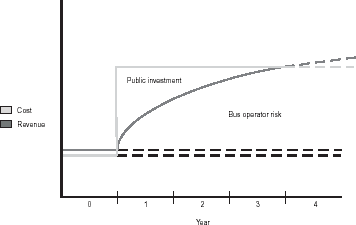
Kick Start funding would bridge the critical gap between project launch and commercial sustainability, a process that can take up to three years. Public investment would be focused in year one of the project, where costs of a project are highest, with staged reductions in years two and three as passenger volumes increase and the service becomes established.
Crucially, at the end of the three-year funding period, the enhanced service can operate without public support. Bus operators would have a contractual agreement with Government to operate a specific level of service over the three-year period. Government would sign up to a public investment profile based on passenger growth projections.
The Kick Start fund would cover the difference between the projected revenue and cost of the project. However, the risk would be borne by the bus operator, so that if passenger volumes and revenue do not rise in line with projections or costs increase beyond forecast, the bus operator would be contractually bound to absorb the loss.
As well as providing value for money for the taxpayer, Stagecoach believes Kick Start has a number of key attractions to Government
higher-quality bus services
increased passenger numbers
modal shift from cars to buses
reduced congestion and emissions
increased social inclusion
new employment opportunities
additional vehicle investment.
The next section discusses the New Zealand experience of Kick Start which was a forerunner to the Perth experiment (which is discussed in section 3).
2. HOW THE SYSTEM WORKED IN NEW ZEALAND
The Kick Start approach has a proven track record in New Zealand where Stagecoach has developed the initiative in partnership with that country's Government. Both partners recognised that bus priority measures alone were insufficient to develop rapid organic passenger growth.
The New Zealand system incorporates
Transfund, a Government-established central funding body, which makes payments to regional councils to enable authorities to contract bus operators to introduce service increases
short-term investment over three years to fund public transport improvements until they attract sufficient new passengers to make these services sustainable.
Each project must meet efficiency criteria set by central government and must be centrally approved. At least 50% of expenditure under this scheme must be on additional services, and in practice most projects have been of this nature. Projects may also be for infrastructure improvements and public transport marketing initiatives. The majority of Kick Start projects have arisen from ideas for service improvements developed by bus operators and then submitted to regional councils.
New contractual arrangements between regional councils and operators have been put in place which allow Kick Start funded service improvements to be introduced on the basis of negotiated short-term contracts specific to those improvements. It is anticipated that, at the end of these short-term special contracts, the service improvements concerned will, if they are deemed to be successful, either be contracted out under the normal tendering process or be registered as commercial by the operator.
To date, the most successful projects have related to increasing frequency on existing routes. Encouraging patronage increases—up to 27% over a 20-month period1—have resulted on some of the main corridors in Auckland, where the provision of extra capacity and frequency has uncovered a latent demand.
3. CASE STUDY: PERTH, SCOTLAND
Following the success of the New Zealand scheme, Stagecoach decided to undertake the first pilot of this approach in the UK to test whether similar results could be achieved. It identified a poor-performing, low-frequency bus route in Perth, a Scottish city with a population of around 50 000, as a candidate for the Kick Start approach. The route had a profile of aged owner-occupiers with high car dependency.
Perth and Kinross Council was about to introduce a bus priority scheme on the route, the first major use of such a scheme in the city. Further complementary local authority measures included new bus shelters and transponders to give buses priority at traffic-light-controlled junctions.
The bus company supported these steps by
doubling the frequency of the bus service and introducing low-floor buses, although there was no business case in terms of historic profitability and the additional cost involved
rezoning fares to make them simple and more understandable, resulting in a number of sizeable fare reductions
devising and implementing a detailed marketing strategy
distributing launch publicity and direct marketing to householders
undertaking follow-up door-to-door interviews with potential customers, including a discussion of the Government's environmental targets, the new bus lanes and the company's new service
offering free trips to prospective customers
launching a programme of on-bus marketing, children's competitions, pensioners' lunches and other promotions.
In year two of the project, non-users were targeted through a tailored direct marketing campaign to offer the bus as a transport mode of choice.2 Results of the project were
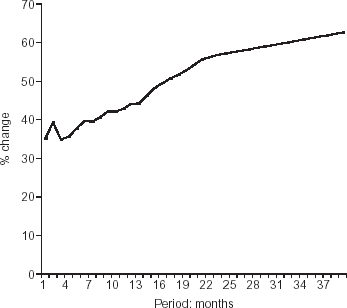
passenger growth of 56% on the service for the first two years (Fig. 1)
forecast of 63% cumulative growth over a three-year period3 (Fig. 1)
modal shift from private car to bus
break-even point forecast for year four, following a pattern of improved financial results: from a loss of £120 0004 in year one to a £43 000 loss in year two to a loss of only £30 000 in year three (Table 1).
Case study: Perth, Scotland. Route profitability: £000
| Years ending period 6 | Total revenue | Total costs | Marketing costs | Total profit pre-finance | Finance* charge | Total profit post finance |
|---|---|---|---|---|---|---|
| 2001 actual | 342 | 341 | 0 | 1 | 0 | 1 |
| 2002 actual | 462 | 492 | 66 | −95 | 25 | −120 year 1 |
| 2003 projected | 546 | 553 | 11 | −18 | 25 | −43 year 2 |
This represents a return on capital of 8% on additional capital required for the project.
Revenue growth over the period has matched pricing as fares returned to original levels, with no elasticity observed. On the basis of primary research undertaken in Perth,5 new users in Perth are less price-sensitive than in other areas of the UK.
Market research undertaken in Perth nine months into the project showed
high user satisfaction levels of 89%,5 significantly better than the DTLR Quality Indicators Report,6 which recorded average overall satisfaction levels of 82% across the UK
positive perception of the service by existing non-users, with 46% of non-users stating they would ‘definitely’ or ‘very likely’ use the service within the next few months.5
Using this information, the company tailored a telephone-based direct marketing campaign specifically targeted at these non-users to persuade them to travel by bus. This resulted in the conversion of 8% of those in the contact database to public transport2 and latterly feedback from these new customers has been very positive.
A Kick Start fund would have enabled the company to bid for sufficient support to cover the project costs outlined above. The costs of the Perth project equate to a subsidy per passenger of only 18·5p (Table 2). Other Government subsidy schemes cost up to £5·30 for each extra passenger.7
Case study: Perth, Scotland–equivalent subsidy per passenger
| Route 7 passenger journeys | Total passenger journeys: thousands | Passenger journey increase: thousands] |
|---|---|---|
| Base year (prior to service change) | 634 | |
| Year 1 | 915 | 281 |
| Year 2 | 1001 | 367 |
| Year 3 | 1031 | 397 |
| Total increase in passenger journeys over 3 years | 1045 | |
| Route 7 net loss over 3 years (Table 1) | £193 000 | |
| Cost/passenger journey | 193/1045 = 18·5p per passenger journey | |
4. KICK START'S UK POTENTIAL
Stagecoach believes the results of these projects illustrate that there is a large, latent market of non-users who are prepared to change modes.
Service expectations are much higher with these new customers and service delivery and marketing need to be tailored and innovative. Company research8 indicates that a potential 40% of the population of the UK have a suitable demographic profile for similar conversion to bus travel (87% of these live within 6 min of a bus stop with a service at least once an hour9). In terms of suitable routes, the company estimates that 10% of the existing Stagecoach route profile across the UK meets the necessary criteria and the market opportunity across the country could be substantial.
The commercial reality, with the vast majority of bus operations run by transport groups with responsibilities to investors, is that no company would be in a position to attempt to roll out such a three-year programme due to the impact on profits and margins. However, if the Kick Start project was replicated across the UK, the company believes it could transform the existing pattern of bus use across the country to one of organic growth.
Stagecoach estimates that a modest total fund of £140 million would cover the three-year project period across the UK. This estimate was based on determining the level of Kick Start funding needed for Route 7 in Perth as a percentage of revenue in the last full year prior to the service change. The funding required for Route 7 to break even over the first three years is £193 000. This equates to 56% of revenue in the base year. This percentage was then applied to the relevant amount of UK non-London revenue to arrive at an estimate for the industry (see Table 3).
Estimated UK Kick Start funding
| Non-London revenue was calculated as follows: | |
| Non-London revenue 1999/200010: £ million | 2196 |
| Add non-London concessionary fare reimbursement11: £ million | 350 |
| Total | 2546 |
| Suitable market is 10% of non-London, i.e. £250 million revenue | |
| Kick Start funding therefore would be £250 million × 56% = £140 million | |
Stagecoach argues that a Kick Start fund of £140 million to cover the three-year project period would
boost annual patronage numbers by 2% per annum across the whole network (see Table 4)
deliver the Government's ten-year 10% bus passenger growth target speedily
save some 169 million car journeys per annum12 and approximately 228 000 t of CO2 noxious emissions per annum,13 making a significant contribution to the Government's environmental targets
deliver an additional £200 million of investment in new Euro III standard buses (see Table 5)
create approximately 5500 jobs13
facilitate social inclusion in public transport.
Kick Start—passenger growth potential for UK bus industry
| Non-London passenger journeys in 1999/200014: 2972 million | ||
| Suitable market is 10% of non-London; i.e. 297 million passenger journeys | ||
| Growth based on Route 7 experience: | ||
| Base year | 297 million | |
| By year 3 (base + 63%) | 484 million | |
| Growth | 187 million | |
| Non-London growth for UK industry | 187/2972 | 6·3% |
| This equates to compound annual growth of | 2·1% | |
Kick Start—estimated investment in new Euro III buses in the UK
| 2001 total fleet15 | 36 104 |
| Less London fleet* | (6 500) |
| Total | 29 604 |
| Suitable market = 10% of above figure | 2 960 |
| Route 7 experience was an investment in new buses equivalent to 75% of the fleet in operation prior to the service change. | |
| Non-London figure for the industry would therefore be investment in 2220 vehicles (i.e. 2960 × 75%). | |
| Total investment, at average of £90 000 per vehicle, would therefore be £200 million. | |
Stagecoach estimate.
At the end of the Kick Start funding period, the above benefits would continue to flow year on year as the bus services became fully commercial and self-supporting.
5. HOW KICK START WOULD OPERATE
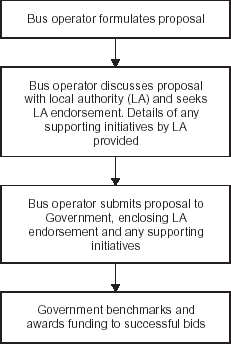
Stagecoach recommends that the Government establish a dedicated fund, which would be used to finance accepted Kick Start proposals as illustrated by the flowchart in Fig. 2.
The underpinning principle of Kick Start is that the intervention funding is an incentive to encourage risk and enterprise. Bus operators would have a contractual agreement with Government to operate a specific level of service over the three-year period. Government would agree a public investment profile based on passenger growth projections as submitted by the bus operator. Public support would fund the difference between the projected revenue and cost of the project. However, the bus operator would bear the risk. In the event that passenger volumes and revenue did not rise in line with projections or costs increased beyond forecast, the bus operator would be contractually bound to absorb the loss.
The risk and public investment profile is illustrated in Fig. 3. By the start of year four, the service has become commercially sustainable and no further public investment is required.
5.1. Next steps
Stagecoach recommends that the Government should
carry out a best value assessment of Kick Start compared to other more long-term subsidy-dependent schemes
establish a small Kick Start fund, to be administered by the Department for Transport (DfT), in early course to allow a best value assessment of the concept in relation to other more capital-intensive projects
select a number of trial areas to test the innovation and ability of bus operators to bring forward suitable pilot schemes
choose pilot schemes from bids submitted by bus operators, based on a range of criteria, including value for money, potential to deliver higher-quality services, increased patronage forecasts, delivery of modal shift from cars to buses, contribution to social inclusion and environmental objectives and creation of employment opportunities
consider a full roll-out across the UK if the pilot schemes are successful.
5.2. Update
In January 2004, the DfT included pilot Kick Start schemes as part of its £40 million Urban and Rural Bus Challenge funding schemes. The DfT said the funding would ‘pump-prime services which local authorities and operators have identified as having sufficient potential for patronage growth to become commercial.’

