

To meet Government targets for the building of infrastructure and new homes, particularly in London and the South East, redundant brownfield sites will need to be rapidly brought into use. This paper describes the challenges surrounding these aspirations, specifically the problems that accompany brownfield developments. These are outlined by reference to specific building projects undertaken by St George during its 17 years of developing in London, on brownfield sites. The paper also describes the company's areas of research and concludes by making recommendations for the future.
1. INTRODUCTION
The government's drive to increase the supply of new homes of all tenures, particularly in London and the South East, is bringing increasing challenges to us all. Recently the Chancellor of the Exchequer identified that the increase in the delivery of new homes was critical to the economy of the UK and for its potential entry into the Economic and Monetary Union. He jointly commissioned, with the Deputy Prime Minister, the Barker Review of Housing Supply.1
Kate Barker's final report and recommendations2 confirm this interrelationship between housing and economic growth. The report also confirmed the need to rapidly accelerate the delivery of new homes in London and the South East by almost doubling current completions. Inevitably, to meet these targets and aspirations, redundant brownfield sites will need to be rapidly brought into use.
In developing in London over the past 17 years, the build programme at St George has been 100% on brownfield land. This brings with it technical challenges that can be extremely costly. In many instances, the cost of remediation is far greater than the land value for such sites. Changes to Hazardous Waste Regulations will further increase costs, but removing materials from site is only one aspect of bringing brownfield sites into use. Examples of such challenges are outlined below.
2. REMEDIATION OF FORMER GAS WORKS SITE
To construct Riverside West in the London Borough of Wandsworth, St George remediated a contaminated former gas works site, bounded by the River Thames and adjacent to a waste transfer loading station. The remediation involved dealing with benzene in both liquid and gaseous form trapped within the ground. In addition, pockets of creosote and other associated products from the gas distillation process had to be dealt with.
These harmful matters were removed by vacuum extraction so that excavation could be safely commenced. The vacuum extraction process involved the installation of 435 gas extraction wells. These were linked to high-capacity vacuum pumps, each extracting the deleterious matters out of the ground and treating them by the use of carbon filtering techniques.
The site was further contaminated with over one million litres of domestic heating oil which, in previous years, had been spilt when an oil storage depot was demolished on an adjacent site. This had flowed along the ancient riverbed of a Wandle tributary which lay under the site. Earlier river wall construction had trapped this oil within the river terrace gravels under the site. The extraction of the oil from the gravels was undertaken through a complex system of 18 pumping wells linked together by deep French drains. These eased the flow of oil and associated low viscous products towards the pumping wells. Once removed, the oil was then cleaned and recycled for further industrial/domestic use.
In addition, further measures were necessary to prevent the underlying aquifer contained within the chalk strata becoming contaminated from oil migration during the processes of construction. Particular care was required with the installation of the foundation piling. Here permanent linings were installed such that they were sealed into the underlying London clay to prevent the leakage of any remaining oil and other contaminated matters into the chalk strata below.
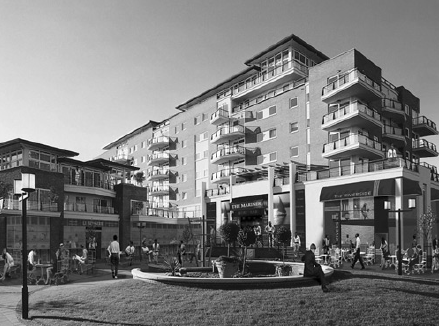
By undertaking these remediation processes in parallel with construction of the project, St George was able to proceed with the build process at the earliest time. The site is now nearing completion and will provide 533 new homes including affordable housing for key workers. Underground car parking is provided which has achieved the UK police's Secured by Design accreditation. A major health and fitness facility, restaurants, day nursery, children's gym, convenience store and hotel have been successfully integrated into this mixed-use scheme which also provides a public piazza and new river walkway (Fig. 1).
3. GEOTECHNICAL CHALLENGES
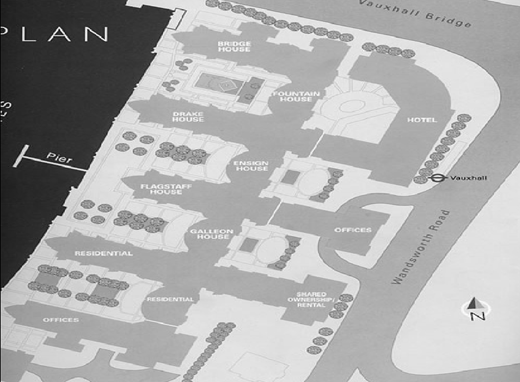
Other technical challenges such as those at the company's site in Vauxhall, St George Wharf, included building over the twin tunnels of the Victoria line, the crowns of which were only some 8 m below the site (Fig. 2). This involved boring piles, 65 m long and up to 2·1 m in diameter, actually positioned between the running tube tunnels and as close as 2 m each side (Fig. 3).
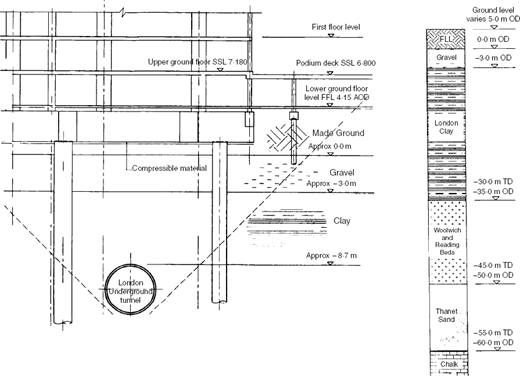
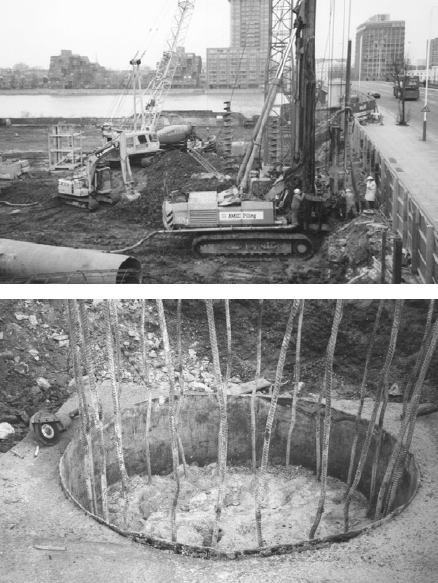
The Vauxhall main station tunnels were also very close; this brought us within the operational limits of piling technology at that time. Strain gauges were installed in the tunnels to monitor any tunnel movement that may have occurred from the effects of both downward piling skin friction forces and the risk of tunnel flotation arising from the removal of overburden for the undercroft basement excavation. The installation of the 80 large-diameter piles was completed successfully. To build the development it has also been necessary to undertake extensive repairs and strengthening of the existing river-wall structure (Fig. 4).
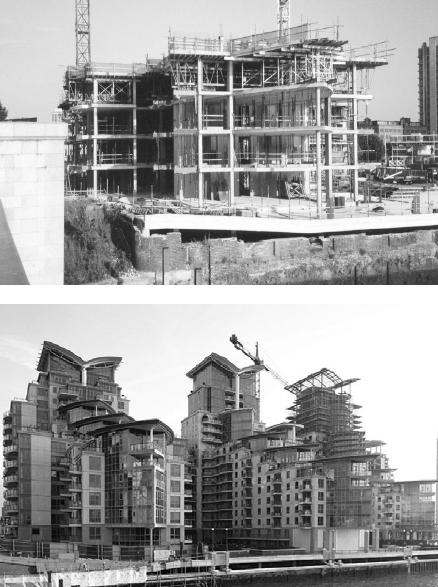
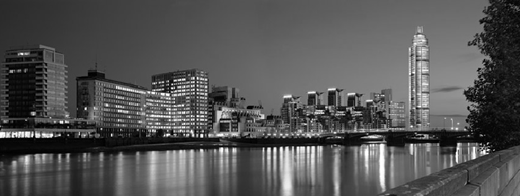
This 7-acre site had lain derelict for almost 40 years. The current scheme rises to 22 storeys and will provide 942 homes, of which 219 will be ‘affordable’. Sentinal Point, a grade A major office headquarters building of 63 000 sq. ft, is incorporated which has just achieved a Building Research Establishment Environmental Assessment Method ‘very good’ rating. This is part of a wide range of mixed use, which has generated around 800 jobs (Fig. 5).
4. ENVIRONMENTAL RESPONSIBILITY
St George plc has submitted for planning approval at St George Wharf, what it believes to be the leading environmentally responsible 50-storey residential tower in Europe (Fig. 6). The tower will incorporate
the heating, cooling and generation of hot water by heat pump systems, using the underground aquifer as a heat/cooling source
the generation and utilisation of electricity using wind turbine power
a thermal buffer known as the Winter Garden
high-performance triple wall façade system.
Enough electricity can then be generated from the wind power to light and heat all of the common areas.
Current environmental initiatives at St George Wharf include pioneering waste management and recycling initiatives. A collaborative recycling agreement with British Gypsum ensures plasterboard is pre-cut in the factory and site waste is separated on site and returned to the supplier. Additional waste management controls and recycling processes have been introduced. This includes a fixed-price waste management system incorporating
waste production record sheets showing forecast/actuals for operatives bins, rolonofs and skips
compaction/non-compaction ratios
contract-specific assessed tonnages
duty of care documentation
segregation for recycling at source on site where space is available
segregation of recycling at associated waste transfer stations.
This system also provides package waste production information as a percentage of total waste output and the package cost as a percentage of main contract value. Regular information reports provide the company with a clear understanding of the nature and type of waste and the volume of recycling processes.
5. SPEEDING UP THE BUILDING PROGRAMME
The Vauxhall project has been part of the Government's Constructing Excellence Demonstration Project programmes. By adopting an integrated project team, innovative research and collaborative agreements initiatives have included
electronic transfer of drawing information from designers to suppliers
efficient supply of materials and waste removal within subcontractors' packages
trade contractor design elements ensuring effective value engineering and optimisation
continuous re-evaluation of design elements, for example gull-wing roof, increased speed, cost reductions and greater build efficiency.
St George has worked closely with the Building Research Establishment (BRE) to further advance current concrete technology to develop ways of accelerating the speed of construction. The BRE website www.bre.com shows how this research resulted in practical application of best practice in concrete frame construction and identifies
rationalisation of reinforcement
accurate prediction of defections
early-age strength assessment
new criteria for striking
continuous improvement quantifiable value improved efficiency and profitability
the establishment of early benchmarks and the potential for increasing the market share of concrete frame technology within the housing market.
Key benefits have included techniques which minimised the use of scaffolding and the utilisation of advanced flat slab construction. These initiatives secured 16% savings in programme time and a 39% reduction in operative days for elements of the construction (Figs 7 and 8).
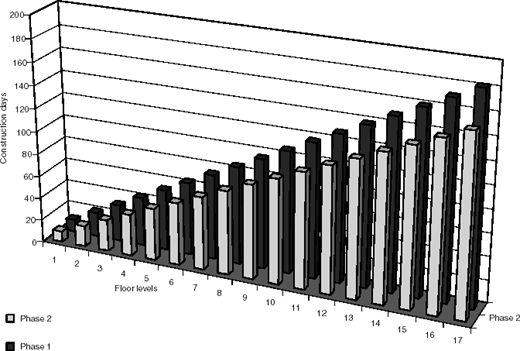
Comparison of phase 1 and phase 2 reinforced concrete frame construction. The new techniques achieved a 16% reduction in the frame programme time
Comparison of phase 1 and phase 2 reinforced concrete frame construction. The new techniques achieved a 16% reduction in the frame programme time
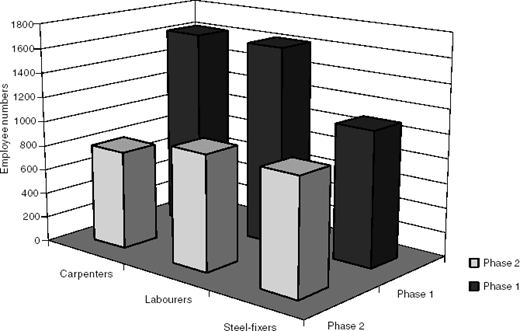
Phase 1 and phase 2 typical working day comparison. A 39% reduction in operative days was achieved for elements of the construction
Phase 1 and phase 2 typical working day comparison. A 39% reduction in operative days was achieved for elements of the construction
These recent initiatives have led St George to continue to pursue research and development into concrete technology. The company has now incorporated the latest jump shutter formwork at its development at Battersea Reach where it has been used for the construction of lift and stair cores (Fig. 9). It has proved to be cost-effective compared with traditional slip form shuttering, to give programme advantages by removing vertical structures from the critical path of the programme.
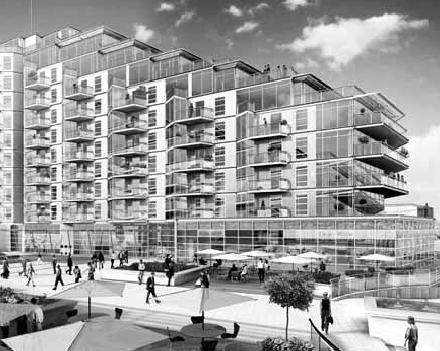
Other initiatives at Battersea Reach have included the introduction of panelised curtain walling which is factory preassembled to achieve high-quality standards. This is fitted from the internal floors using manipulators—mobile robotic trucks. This system provides scaffold-free installation methods that have assisted greatly in the speedy development of 16-storey high mixed-use structures. In addition, the prefabrication of three-storey high panelised curtain walling is also being piloted on this development. This is crane-lifted into place as these complete units reduce build times and provide early watertight dates.
6. FLOOD ATTENUATION
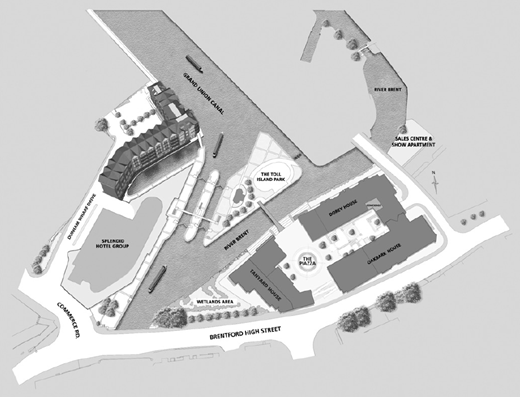
With the growth of riverside developments, it is also necessary to consider flood attenuation measures. At Brentford Lock on the confluence of the Grand Union Canal and the River Brent, new wetlands have been designed into the scheme as the flood attenuation solution (Fig. 10). In addition, anti-scouring measures were incorporated.
The site was a former tannery and the archaeological dig found evidence of a former Roman road running through the site. A number of Roman artefacts have now been preserved.
In order to maximise the best use of land on this site, basement car parking was incorporated. Carefully designed behind the water's edge, a naturally formed volclay mat protects the car park from water ingress. The six-storey loadbearing masonry superstructure sits on a reinforced concrete transfer slab from first floor level (Fig. 11). As the car parking was incorporated in the basement, this enabled a new public piazza to be created at the heart of the scheme.

Building on the water's edge required careful design, particularly with regard to basement car parking. Here, a naturally formed volclay mat protects the car park from water ingress
Building on the water's edge required careful design, particularly with regard to basement car parking. Here, a naturally formed volclay mat protects the car park from water ingress
This development has been undertaken as a joint venture with British Waterways and Charles Church. It has introduced a mixed-use, mixed-tenure development into an area which was desperately in need of regeneration. Charles Church is developing what is known as the Island Site with 193 homes, canal and riverboat moorings. The Toll Island Site has been upgraded for the enjoyment of visitors and residents and a new timber footbridge provides pedestrian access between the Toll Island and the public piazza.
When completed, the St George element of the scheme will comprise 152 new homes of which 30 are ‘affordable’ and will be made available for key workers in the London Borough of Hounslow. In addition, a further 19 homes and office accommodation will be built on the area known as the West Bank together with a new Harbour Master's Office, chandlery and boaters' facilities. As part of the joint venture, St George is providing three commercial units to British Waterways, which bound the pubic piazza. The public piazza has been designed to ensure full accessibility so that everyone can enjoy this new environment. The whole of the new development will benefit from CCTV, with the cameras being monitored by the management company.
7. CAR PARKING
For some time, St George has been monitoring the level of car parking in relation to its developments. Anecdotally, the company observed that car parking provision was being oversupplied and this prompted St George to commission research to provide independent analysis into how people in modern apartment developments own and use cars.
This needed to include results from mixed-use schemes with local facilities close to hand and where a choice of public transport is available. The report, 21st Century London Living: A Travel Research Survey,3 was undertaken by three eminent transport consultancies—WSP, Simmons and PFA together with the Planning Consultancy, Barton Willmore. Twelve representative sites were selected across London to enable study of both mixed-use and parking characteristics on residential developments within inner and outer London. This was designed to augment the paucity of knowledge in this field. The research now almost triples the available information in respect of apartment developments in London.
The results identified that people living in such developments were increasingly likely to live without a car or to use it very little and travel by public transport. The levels of car ownership for private development were well below 100%, even in outer London locations with relatively poor access to public transport. The study also identified that there was no correlation between the number of cars owned on a development and their use in peak periods.
In summary, the research confirmed that, for brownfield apartment developments with reasonable access to public transport, both car ownership and car usage are much lower than previously thought. The study had been concluded prior to the introduction of the Mayor's congestion charge for central London and it will be important to build on this work for future patterns of parking provision.
8. THE CHALLENGES AHEAD
These examples highlight only a few of the challenges that are facing residential developers in bringing forward brownfield sites. These, coupled with the Government's aspirations for contributions towards infrastructure and provision of affordable housing, have resulted in many developers moving away from building more homes in London. Radical initiatives need to be made by Government if it wishes to deliver the volume of new homes that have been identified as being crucial to the future of Britain's economy. The Government now needs to consider carefully how it can attract more residential developers to deliver these new homes in the capital on the available brownfield sites.

