Recently, solid oxide-ion conductors have been receiving considerable attention owing to their potential applications in solid oxide fuel cells, oxygen sensors and so on. An innovative solid oxide-ion conductor, lanthanum–molybdenum oxide (La2Mo2O9), presents a reversible phase transformation at around 580°C from the low-temperature form α-La2Mo2O9 to the high-temperature form β-La2Mo2O9, leading to variation in the ionic conductivity. This paper reviews the research progress of lanthanum–molybdenum oxide and its doping systems; the structure and phase transition of the material, the conductivity of the oxide ion and the ionic conductivity and chemical stability of the material in a reducing atmosphere and at high temperatures are discussed. The research progress of the lanthanum–molybdenum oxide electrolyte was reviewed from four aspects – structure, conduction mechanism, preparation method and conductivity – and its future prospects assessed.
1 Introduction
Solid oxide fuel cell (SOFC) technology converts chemical energy produced by oxidizing fuel directly into electrical energy. The prime problem in developing SOFC applications is the high operating temperature (900–1000°C) condition that leads to the expensive operation of SOFC devices.1 It is noteworthy that SOFCs have attracted much attention due to the clean and efficient production of energy. Nowadays, one of the current hot research topics is to reduce the operating temperature of an SOFC to enable its functioning at moderate or even low temperatures. Lanthanum–molybdenum oxide (LMO; La2Mo2O9) was first reported by Lacorre et al.1 in 2000. Due to its high inherent oxygen (O) vacancy concentrations, a convenient pathway for oxide (O2−) ions to diffuse and migrate in the lattice results in oxide-ion conductivity of 0.06 S/cm at 800°C.2 Additionally, the cost-effective raw materials and simple preparation process make it a competitive candidate material for medium-temperature SOFC electrolytes. LMO shows a reversible phase polymorph at 853 K, and the ionic conductivity of the high-temperature polymorph (β-LMO) is much better than that of the low-temperature one.2,3
So far, the studies on LMO have been focused on its structure determination and conductivity, elevation of material properties and the microscopic mechanisms of oxide-ion migration.4,5 Recently, the lanthanum (La) phase has been doped with alkaline earth elements, which achieved a certain effect in stabilizing the high-temperature β-LMO phase,6,7 although the synthesis of La2−xAxMo2−yByO9 by lanthanum/molybdenum (Mo) doping still needs attention from scientific communities.
Typically, the LMO material undergoes a phase transition from a high-temperature cubic phase to a low-temperature monocline at 580°C, accompanied by a decrease in conductivity of two orders of magnitude. The molybdenum (Mo6+) ion in LMO is easily reduced in a reducing atmosphere, increasing the electron conductance.8 The low-temperature phase of LMO can be approximately regarded as a 2 × 3 × 4 superlattice of the high-temperature phase.8
It has been reported that partial doping substitution of potassium (K), calcium (Ca), strontium (Sr), barium (Ba), bismuth (Bi) and other lanthanide elements into the lanthanum sites of LMO and doping substitution of tungsten (W) and vanadium (V) into molybdenum sites can effectively inhibit the occurrence of phase transitions.8,9 Moreover, doping fluorine (F) into oxygen sites can reduce the phase transition temperature without inhibiting the phase transition process completely. Notably, double doping of lanthanum and molybdenum into LMO can form solid electrolyte materials with excellent ionic conductivity.10
This paper reviews the recent research work on solid oxide-ion conductor LMO and future prospects of development and SOFC-based applications. So far, research directions are mainly focused on doping at different sites of LMO to suppress the phase transition and improve electrical conductivity. The comprehensive discussion based on the research progress of LMO-based electrolyte materials is presented in this review paper.
2 Experimental preparation and characterization methods
Current research interests are mainly focused on inhibiting the phase transition of materials, improvement in the reduction resistance of materials in a reducing atmosphere, reduction of the thermal expansion coefficient of materials and refinement of the fabrication process to obtain high conductivity.
2.1 Solid-phase reaction method
Several national and international researchers have reported the synthesis of LMO-based solid electrolytes through the high-temperature solid-phase method.11–20
2.2 Sol–gel method
Compared with the solid-phase method, the liquid-phase method can be distributed uniformly at the molecular level, which has been widely addressed by researchers.20,21 Tian et al.22 considered lanthanum nitrate hexahydrate (La(NO3)3·6H2O), barium nitrate (Ba(NO3)3), manganese sulfate monohydrate (MnSO4·H2O) and ammonium molybdate tetrahydrate ((NH4)6Mo7O24·4H2O) as raw materials and obtained barium-doped LMO through the sol–gel self-combustion process.
2.3 Freeze-drying method
Marrero-López et al.23 used lanthanum oxide (La2O3), molybdenum trioxide (MoO3), calcium nitrate (Ca(NO3)2), strontium nitrate (Sr(NO3)2), barium nitrate (Ba(NO3)2) and potassium carbonate (K2CO3) as raw materials and dissolved them, respectively, and then added 1,2-ethyldithiol and adjusted the pH to 9 by adding ammonia. The obtained solution was flash-frozen in liquid nitrogen and placed in a freeze-drying machine for 3 days. After 5 h of precursor pyrolysis, the residual organic matter was removed to obtain the doped LMO-based solid electrolyte.24
2.4 Other synthesis methods
Through the multielement alcohol method, Sellemi et al.25 obtained LMO powder by using La(CH3CO2)3·1.5H2O and ammonium molybdate tetrahydrate as raw materials and added the mixture of polyols.
2.5 Characterization methods
The most commonly used technical tools are as follows: X-ray diffraction (XRD), differential scanning calorimetry (DSC), scanning electron microscopy (SEM), transmission electron microscopy (TEM), X-ray photoelectron spectroscopy (XPS), Fourier transform infrared spectroscopy, energy-dispersive X-ray spectroscopy and so on. The phase purity of the material is determined by XRD analysis with the help of a powder diffraction file database. The phase is identified by using the Joint Committee on Powder Diffraction Standards card through the XRD data. The morphology of the roasted powder and the microstructure of the sintered ceramic surface are investigated by TEM and SEM. To corroborate the XRD results, DSC of the LMO ceramic sample is performed. Impedance spectroscopy is used to measure electrical properties. The chemical states of the elements on the surface for various compositions sintered in air and reducing atmosphere are analyzed by XPS. The ionic conductivity is studied using impedance spectroscopy, and the EDS spectrum is recorded to confirm further the composition of the prepared powders. According to the reports by Sellemi et al. and Li et al.,26–28 the main absorption bands detected under 1000 cm−1 should correspond to inorganic groups (metal–oxygen bonds).
3 Structure and conduction mechanism
3.1 Structure and phase transition of LMO
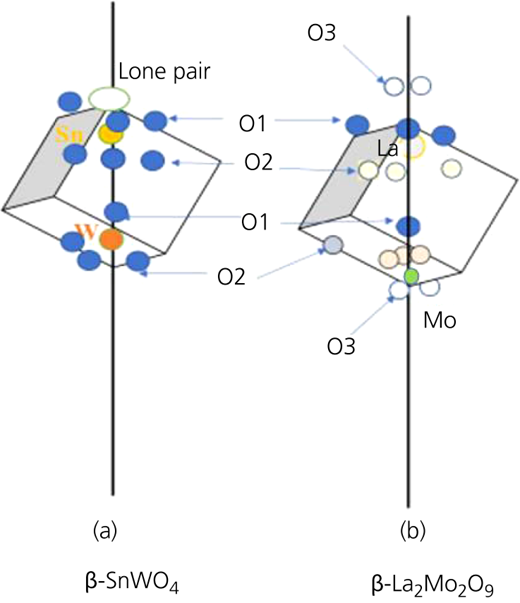
At below 580°C, the cubic structure of the LMO material converts to a monoclinic phase. As shown in the structural comparison between stannous sulfate (β-SnWO4) and β-LMO in Figure 1, there are three types of oxide-ion positions in the crystal structure of LMO. At 617°C, XRD patterns show that a = b = c = 0.72014 nm, while the possible positions of oxide ions are O1(4a) and O2 and O3(12b) sites for the P213 structure.30
Zhang et al.30 described for the first time the full three-dimensional (3D) atomic structure of room-temperature α-LMO. The structural results offer significant insight into the oxide-ion migration pathway to the anion-conducting high-temperature form β-LMO.30
A single unit cell of LMO contains four lanthanum (La3+) and four molybdenum ions, and four O(1) completely occupy the 4a position, and the remaining 14 oxide ions occupy the two 12b positions in turn for a total of 24 oxygen positions. It can be seen that the concentrations of oxygen vacancy in the LMO crystal structure are itself high.30 These oxygen vacancies of the oxide ion in the lattice diffusion transfer provide a channel, thereby making LMO a fast oxide-ion conductor with high ionic conductivity under medium-temperature conditions. Specifically, its oxide-ion diffusion transfer direction can be 3D.
In LMO, two cations occupy the apex angle of the cube alternately, and oxide ions are distributed in the cube composed of cations in three different ways of occupation. As seen in the comparison of the structures between stannous sulfate and β-LMO in Figure 1, the lanthanum ion has no lone pair electrons, and its ionic radius is close to that of the tin (II) (Sn2+) ion.29 In stannous sulfate, the tin (II) ion has lone pair electrons, so it can be formulated to Sn2W2O8E2 (lone pair electrons denoted as E). Substituting the tungsten (W6+) ion with a molybdenum ion and the tin (II) ion with a lanthanum ion results in a vacancy and an oxygen. It is the high concentration of intrinsic oxygen vacancies in LMO that provides a channel for oxide-ion diffusion. This can be attributed to the high ionic conductivity of LMO.
3.2 Mechanism of internal consumption–temperature spectrum
Wang et al.31 showed the relationship between the peak height, peak temperature of the internal consummation peak, and frequency. The heating rate was found consistent with the general characteristics of a first-order phase transition through the measurement of the frequency conversion and variable heating rate. This indicates that the peak of an internal consumption near 567°C in the process of temperature rise measurement is the first-order phase change peak of an internal consumption.31 The experiment also showed that there are two different oxide ions with different positions in the lattice of LMO, corresponding to two different relaxation processes, which require different activation energies. This shows that the diffusion motion of the oxide ion in the LMO crystal confirms the 3D (or higher) relaxation hypothesis. Fang et al.32 measured the internal loss–temperature spectrum and dielectric loss of LMO and concluded that there were at least two unequal relaxation processes in the diffusion of oxygen vacancies of LMO.
3.3 Conductive mechanism of LMO
To specify the electrical conductivity of LMO, Lacorre et al.1 proposed the theory of lone pair substitution (LPS). The oxygen-vacancy-generating mechanism of LMO was analyzed theoretically, and it successfully explains the conduction mechanism of LMO.1,7
Through oxygen vacancies, oxygen ions can migrate directionally under the action of an electric field, thus making LMO a good oxide ionic conductor. According to the LPS theory, after two with a lone pair of electrons are replaced by two M+( n +1) without a lone pair of electrons, one of the two lone pairs is occupied by an oxide ion involved in neutral compensation and the other one forms a vacancy.1,7 Thus, under the action of an electric field, anion conduction occurs by directional diffusion through the vacancy.
3.4 Electrical properties
By increasing the temperature from 700 to 900°C, Marozau et al.8 found that the contribution of electrons to the total conductivity of undoped LMO and La2Mo1.7W0.3O9, La2Mo1.95V0.05O9 and La1.7Bi0.3Mo2O9 is significantly increased. Wang et al.33 realized that a potassium-doped LMO oxide-ion conductor through the traditional solid-phase method can effectively inhibit the phase transition and exhibits high conductivity at a lower temperature.
Tsai et al.20 mixed 10 mol% each of cerium (Ce), neodymium (Nd), samarium (Sm), gadolinium (Gd), dysprosium (Dy), erbium (Er) and ytterbium (Yb) in LMO. They reported that erbium and dysprosium showed inhibition of the α–β phase transition and high conductivity.
3.5 Concentration-difference battery with an oxygen pump
According to Pan et al.,34 the oxide-ion migration number of La1.95Sr0.05Mo2O9 was very high as found by oxygen concentration-difference battery measurement, indicating that La1.95Sr0.05Mo2O9 was a pure oxide-ion conductor. The discharge curve of the oxygen concentration-difference battery and the oxygen pump is used to prove that the sample is a pure oxide-ion conductor.
3.6 Fuel cell
Ruan et al.35 studied the high ionic conductivity of the new LMO-based oxide-ionic conductor and used an LMO solid electrolyte instead of yttrium oxide-stabilized zirconia (YSZ), which reduced the operating temperature of the SOFC by more than 150°C.
SOFCs work in the same way as other fuel cells, which, in principle, is the ‘inverse’ of hydro-electrolysis. YSZ is the most common oxide-ion conductor electrolyte, which acts as a catalyst in solid electrolyte cell reactions, and is a mainstay in the process of commercial SOFCs. YSZ has excellent chemical stability compared with other ceramic conductors and is also used in liquid-phase applications.
SOFCs are the main component of electrolytes, cathodes and anodes. The electrolyte is an ionic conductor, and the anode and cathode are mixed conductors. The selection of the required five cell materials has become more focused on the anode material – namely, nickel/YSZ cermets. Generally, a cermet anode is used as the support material with a thin layer of YSZ, and electrolytes are still dominated by YSZ. Lanthanum strontium manganite, particularly in composite form with YSZ, is used as a cathode, which provides mixed conduction and improves three-phase boundary contact.
The single cell consists of an anode, a cathode and a solid oxide electrolyte. The anode is the place where the fuel is oxidized, and the cathode is the place where the oxidant is reduced. Both electrodes contain catalysts to accelerate the electrochemical reaction of the electrode. In addition to the general benefits of fuel cells, SOFCs are highly adaptable to fuel and can operate on a variety of fuels, including carbon-based fuels. Precious metal catalysts are not required, which influences the cost of SOFC greatly. With all solid components, there are no leakage- or corrosion-management problems.
SOFCs can be used for power generation, thermoelectric recycling, transportation, space, aerospace and many other fields and have been called the green energy of the twenty-first century. Kong et al.36 tested the fuel cell performance of ceramic samples at 600, 800 and 1000°C and demonstrated a maximum output current density of 280 mA/cm2 for a hydrogen (H2) gas–oxygen fuel cell and a maximum output power density of 112 mW/cm2 at 1000°C.
3.7 Main applications of solid electrolytes with oxide-ion conductivity
Oxide-ion conductors have been developed for more than 100 years and are widely used in energy storage and conversion, environmental protection and other fields to improve human lives and environmental, economic and other aspects with great impact. SOFCs are one of the most popular and promising applications based on solid electrolytes. They have the potential to revolutionize society in terms of energy, environment and economy. In China, the research on SOFCs is still in the initial stage, and accelerating the research work in this aspect is of great and far-reaching significance for China’s sustainable development strategy.
3.8 A new type of oxide-ion conductor: LMO
As a new type of ionic conductor, LMO ceramic oxide has a structural phase transition from a slightly distorted low-temperature phase to a volume-centered cubic high-temperature phase at around 580°C. The phase transition of LMO causes constant lattice mutation and even disintegration of the crystal structure. It is noteworthy that the molybdenum ion in LMO is easily restored in a reducing atmosphere, which seriously limits the practical application of LMO.
Because of the simple preparation process and the low price of raw materials, lanthanum molybdenum ceramics have a great competitive advantage as a favorable material for electrolytes and electrodes of medium-temperature SOFCs. At present, the research on the LMO oxygen conductor material has clarified some basic information such as the crystal structure, phase transition characteristics and electrical conductivity of the material. The research on modification by doping has been carried out at large scale, and abundant experimental results have been obtained.
The discovery of a new oxide-ion conductor LMO has led to the discovery of medium-temperature electrolyte applications such as SOFCs and oxygen sensors. This novel oxide-ion conductor LMO exhibits a P213 spatial group structure with a cubic phase at high temperature.1 Due to its inherent intrinsic vacancy formation mechanism, the lattice structure of LMO shows a high oxygen vacancy concentration, which facilitates the diffusion and migration of oxide ions in the lattice, resulting in good anion conductivity.
3.9 LMO electrolyte doping modification
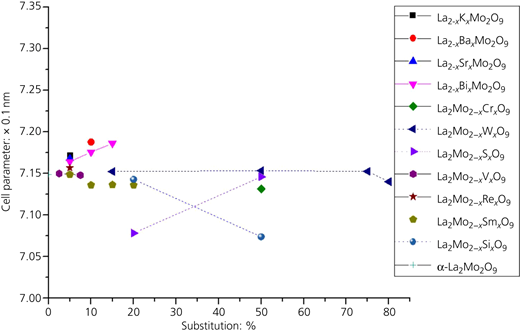
Lately, the reported research is mainly focused on the lanthanum or molybdenum position, doping and replacement with low or isovalent metal ions. It is found that doping at the lanthanum and or molybdenum sites can effectively inhibit the phase transition process and improve the low-temperature conductivity. However, its conductivity decreases at high temperature. Since tungsten and molybdenum belong to the same main group and the ionic radii of tungsten and molybdenum ions are very close, doping with tungsten can inhibit the loss of oxygen in LMO and improve its stability in a reducing atmosphere. When tungsten is doped to the lattice of LMO, the lattice constant presents a non-linear change, as shown in Figure 2.
Doping with tungsten can reach a high doping limit of up to 80% in LMO. In the La2Mo2−xWxO9 system, the β-LMO phase can be completely stabilized to room temperature as long as x exceeds 0.25.31 When the doping amount of tungsten is about 15%, the conductivity of the material is the highest, reaching 0.06 S/cm at 800°C, which is similar to that of pure LMO. However, at 500°C, the conductivity increases by more than three times.5
Recent studies further confirmed the stabilizing effect of tungsten on LMO and further discussed the mechanism of tungsten doping. It is pointed out that the conductivity of the material after tungsten doping conforms to the Arrhenius equation at higher temperatures (450–800°C).35
Besides tungsten doping on molybdenum, the more common dopants include vanadium group elements such as vanadium, niobium (Nb) and tantalum (Ta). None of these elements can completely suppress the phase change of the material at 580°C, but the phase change temperature can be reduced.
It has been found that the lattice expansion caused by a large ionic radius or ion doping with one pair of electrons at the lanthanum site (e.g. potassium and bismuth doping) can also be inhibited well. Double doping with various elements increases the diffusion activation energy of oxygen vacancy, which decreases the material conductance at high temperatures. Similarly, due to the inhibitory effect of potassium and bismuth on the phase transition, the change in conductivity around the phase transition temperature is relatively small, so that the conductivity of the electrolyte material at low temperatures increases. At doping with 2.5% potassium, the maximum conductivity is reached.3 It has been reported in the literature that a doping limit of 10% barium in La2−xBaxMo2O9 prepared through the citric acid combustion method and traditional solid-state reaction can inhibit the phase transition of LMO.5,37 Doping with 3% barium can also improve electrical conductivity at both high and low temperatures.38 However, both limits can stabilize the β-LMO phase.
Besides bismuth and potassium, alkaline earth group elements and rare earth elements are doped commonly into lanthanum. The most common alkaline earth elements are barium, strontium and calcium. The element strontium can increase the conductivity slightly above the phase transition temperature and stabilize the β-LMO phase similarly to calcium and barium. Lanthanum belongs to the rare earth element group, and its chemical properties are very similar to those of other rare earth elements, so a large amount of doping can be realized in LMO. Lacorre et al.1 first proposed doping with neodymium, gadolinium and yttrium (Y) to improve the conductance of LMO. Among them, gadolinium and yttrium can stabilize the phase to room temperature. It should be noted that Lacorre et al.1 also reported the double-doping system of neodymium, gadolinium and tungsten to evaluate the anti-reducibility of the system.
Saradha et al.39 reported that doping with dysprosium and erbium significantly improves the electrical conductivity of the material, reaching 0.26 S/cm at 700°C. It is significantly higher than the highest reported conductivity (0.08 S/cm) of LMO-based materials. After that, Liu et al.16 also reported double-doped dysprosium and tungsten materials and increased conductivity up to 0.18 S/cm. Doping with samarium was effective in improving the oxide-ion conductivity of LMO, and maximum oxide-ion conductivity of 0.196 S/cm was attained at 750°C for La1.7Sm0.3Mo2O9.16
The doping elements of the LMO oxide-ion conductor can be divided into two categories. One plays a role in stabilizing the oxygen phase, such as tungsten, bismuth, potassium, vanadium and chromium (Cr). The other category of ions can improve the conductivity of the material, such as neodymium, barium, dysprosium, erbium and niobium. So far, double-doped systems such as neodymium–tungsten, gadolinium–tungsten, dysprosium–tungsten and yttrium–tungsten have been studied. La2−xKxMoWO9−δ was synthesized through a solid-state reaction method.40 The reported electrochemical impedance spectroscopy in air and 5% hydrogen/argon (Ar) mixed gas demonstrates that the conductivity of La1.97K0.03MoWO9−δ is twice as high as that of La2MoWO9 at 800°C. At the same time, the reducibility is also enhanced by potassium (K+) and tungsten ion double doping.40 Therefore, both tungsten and potassium ion dopants improve the stability of LMO in a reducing atmosphere, and potassium- and tungsten-ion double-doped samples possess further enhanced reducibility in the counterpart of single-doped tungsten samples.
3.10 Electrical properties and chemical stability of LMO materials
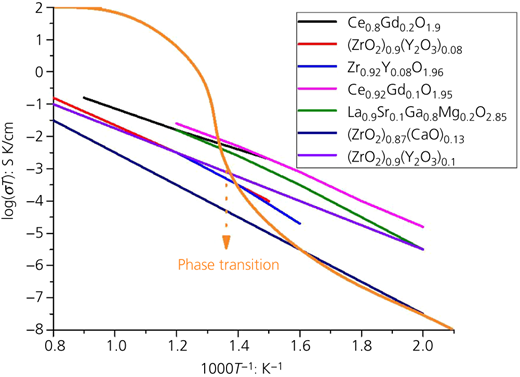
The relationship between the conductivity and temperature of LMO, compared with those of GDC (Ce0.8Gd0.2O1.9), YSZ (Zr0.92Y0.08O1.96) and LSGM (La0.9Sr0.1Ga0.8Mg0.2O2.85), is shown in Figure 3. At the phase transition temperature, it conforms to the Arrhenius rule. LMO undergoes a phase transition around 580°C, from the α-LMO phase to the high-temperature β-LMO phase. For other systems (GDC, YSZ, LSGM and YCZ), there is no phase change phenomenon of high- and low-temperature conversion. The conductivity of LMO changes dramatically in the temperature range of the phase transition. The activation energy below the phase transition temperature is higher than its counterpart above the phase transition temperature, depicting an ordered arrangement of oxygen vacancies. At a high temperature, LMO has higher conductivity than other systems.
3.11 Composite electrolyte
Fu et al.41 studied a large number of cerium–salt composite electrolytes and their applications in medium- and low-temperature fuel cells. These composites are widely involved in doped or undoped cerium oxide complexes with carbonate, halide, hydroxide, oxalate (e.g. lithium sulfate (Li2SO4)) and so on. The diffusion and conduction of ions between the surface phase boundaries were enhanced by the two-phase composite.
LMO–tripotassium phosphate (K3PO4)–calcium phosphate (Ca3(PO4)2) and LMO–sodium chloride (NaCl)–strontium chloride (SrCl2) are composite salt electrolyte materials, The conductivity of LMO solid electrolyte was improved at low and high temperatures. However, the phase transition could not be inhibited, because the inorganic salt covered the surface of LMO with a separate phase and had no effect on its crystal structure.42 The conductivity test shows that the introduction of inorganic salts cannot inhibit the phase transition of LMO but can improve the conductivity of both low-temperature and high-temperature regions.
4 Conclusion
LMO-based electrolyte material exhibits high conductivity of the oxide ion and stability in a certain range of temperatures, and it can be a potential candidate in SOFCs, oxygen sensors, oxygen-permeable membranes and other fields.
Few research groups have reported the preparation of LMO-based materials in the form of thin-film samples and nanocrystalline blocks to improve the conductivity of the oxide ion.
Notably, the sample prepared through the sol–gel method showed a better inhibitory effect on the structural phase transition, resulting in an excellent electrolyte material. The characteristics match well with the electrode material of the battery.
LMO-based material prepared through the sintered powder method offers complicated conditions during development. Therefore, more traditional solid-state synthesis methods, such as precursors for freeze-drying, mechanical ball mill and sol–gel method, should be used, which make small-particle powder-based materials and effectively improve the material performance.
The high coefficient of thermal expansion is also an important factor that restricts the practicability of LMO-based materials. Therefore, it will be an important research direction to reduce the coefficient of thermal expansion by doping or improving the process.
Acknowledgements
This work was financially supported by the Hefei University Quality Engineering Demonstration Experimental Training Center Project (2020hfusxzx02), the Guangdong Basic and Applied Basic ResearchFoundation (numbers 2021A1515010671 and 2020A1515011221), the Natural Science Foundation of Shaoguan University (SZ2020KJ03), the Teaching Reform Research Project of Shaoguan University (SYJY20201203), the Natural Science Foundation of China (61804039), the Characteristic Innovation Project of Guangdong Province Ordinary University and the Excellent Young Talents Fund Project in Universities of Anhui Province (Research on Construction and Ion transport Mechanism of Alkali Metal Salt-Ln2O3 Medium and Low Temperature SOFC Composite Electrolyte).