


This review article explores the interface between thermodynamics and nanotechnology, paying special attention to the unique difficulties and possibilities of working at the nanoscale. Using basic ideas from quantum physics and statistical mechanics, it shows how thermodynamics is crucial for understanding how nanoscale systems behave. In the context of small-particle ensembles, where quantum effects significantly impact energy landscapes, the use of statistical thermodynamics becomes crucial. The equilibrium conditions are controlled by surface energy, capillarity, and wetting events, and the research delves into the thermodynamics of nanoscale interfaces. The revolutionary power of nanotechnology is highlighted in the field of energy conversion, namely in thermoelectric nanomaterials and nanoscale photovoltaics. More specifically, the study aims to provide light on the complex interactions among phonons by investigating thermal processes at the nanoscale. It highlights the importance of thermodynamics in developing methods for controlling heat on such a microscopic scale. The study also delves into nanomaterials’ inherent thermodynamic tendency for organisation, illuminating how they self-assemble according to molecular thermodynamics. In order to tackle the ever-changing field of nanotechnology, which presents problems to traditional thermodynamic models, the article stresses the need of creative methods and multidisciplinary collaboration. Safety and environmental impact are integrated into the inquiry process to guarantee that it is in line with sustainability standards. In the end, the study shows how thermodynamics and nanotechnology work hand in hand, describing all the complex phenomena that need to be studied together in order for society to reap the advantages of both fields to the fullest.
1. Introduction
The ability to generate and control matter at a whole new level is made possible by nanotechnology, which functions at the size of individual atoms and molecules.1–3 This magnitude is a significant departure from conventional thermodynamics, requiring a thorough comprehension of statistical mechanics and quantum phenomena.4,5 The significance of thermodynamics in clarifying the behaviour of nanoscale systems is highlighted in this introduction to provide the context.6–8 An overview of issues including quantum physics impacting energy levels and statistical mechanics driving tiny particle ensembles is provided, laying the foundation for further investigation.9 The influence of indium doping on the magnetic characteristics of sol-gel auto-combustion synthesised SrInxFe12−xO4/Ni0.5Zn0.5Fe2O4 (SIFO/NZFO) nanocomposites is highlighted in a study conducted by Almessiere et al. Saturation magnetisation and coercive field are both improved by an adjusted composition (x = 0.01), which also reduces intergranular dipolar interactions. There is a correlation between the amount of indium in a material and its electrodynamic properties, which could mean that it can absorb electromagnetic radiation. This could be useful in magnetic media where intense electromagnetic absorption is required, as it would help to decrease the phase composition degradation that other materials experience when exposed to bad environments.10
This review was conducted based on an extensive study of the basic concepts of thermodynamics at the nanoscale. When attempting to understand the behaviour of systems made up of tiny particles, statistical thermodynamics plays a crucial role.11 Quantum effects, often disregarded in macroscale thermodynamics, alter the energy landscapes of nanomaterials.12 The basic principles of thermodynamics of nanoscale systems are described in this section.13–15
The importance of interactions increases as materials become smaller.16–19 At nanoscale interfaces, the equilibrium conditions are determined by surface energy, capillarity, and wetting behaviors.20–28 This section delves into the intricate thermodynamics of these events, elucidating the distinct obstacles and prospects brought about by the prevalence of surface effects.29 Using nanomaterials based on copper, a study conducted by Dalal et al. aims to build electrocatalysts that are extremely active for the oxidation of water. The rapid electron transfer (Tafel value of 53 mV dec−1) and outstanding electrocatalytic performance for the oxygen evolution process (OER) are ascribed to the synergistic effects between the CuTe and gCN in the synthesised hierarchical CuTe-gCN nanocomposite. The overpotential is minimal at around 277 mV. Based on these results, effective water electrolysis might be a viable solution to the energy crisis.30
The efficient energy conversion potential of nanotechnology is a frontier with wide-ranging implications.31–33 Thermoelectric nanomaterials and nanoscale photovoltaics (PV) are two instances of how nanotechnology may completely transform energy production and use.34–42 This section reviews recent advances and offers insights into the thermodynamic concepts underpinning this invention.
Magnetic resonance imaging (MRI) contrast chemicals, which increase tissue visibility for illness detection, are the primary biological uses of iron oxides. Furthermore, they are multipurpose carriers in medication delivery systems, which allows for localised distribution to particular areas of the body and lessens the likelihood of adverse effects. Potential applications for iron oxide nanoparticles include hyperthermia therapy for cancer treatment and biosensing for biomolecule identification.43
Nanoscale thermal phenomena are fundamentally caused by a complicated dance of phonons and the production of size-dependent effects.44 These phenomena need full knowledge and manipulation for applications ranging from health devices to nanoelectronics.45–47 This chapter explores the topic of nanoscale heat transfer and how thermodynamics may be used to enhance thermal control methods.
The outcome may be fine-tuned by employing techniques including sol-gel, hydrothermal, and co-precipitation, all of which have their own set of benefits. Complex oxides have versatile and potentially game-changing uses in biomedicine, catalysis, and electronics; by fine-tuning synthesis conditions and parameters, scientists may build these materials with desired properties.48
Nanomaterials’ natural tendency to self-assemble is evidence of their innate thermodynamic urge for order.49 Nanoscale structures emerge spontaneously according to molecular thermodynamics and entropy-driven processes.50–53 This section explores the laws of thermodynamics that govern self-assembly and highlights the possibility of creating customised functional nanomaterials.54
New problems arise as they travel this frontier, demanding creative answers. Size-dependent effects and precise nanoscale predictions need modifications that challenge traditional thermodynamic models.55–60 Working across academic boundaries in thermodynamics, quantum mechanics, and materials science becomes essential to further our knowledge.61,62 In addition, the study tackles safety and environmental issues, ensuring that the development of nanotechnology aligns with sustainability and safety requirements. Considerations of sustainability in thermodynamic research guarantee that breakthroughs in nanotechnology conform to environmental and safety regulations.63,64 The study underscores the necessity of assessing the environmental implications of nanomaterial manufacturing and utilisation, emphasising secure synthesis techniques, waste minimisation, and energy-efficient methodologies.
This study concludes with a summary of the mutually advantageous link between nanotechnology and thermodynamics and discusses its uses, problems, and possible future trends. The complex tapestry of phenomena we investigate requires synthesising knowledge from several fields to realise their potential for humanity’s benefit fully.
2. Fundamentals of nanoscale thermodynamics
Nanotechnology and other fields have all seen a remarkable increase in the importance of thermodynamics.65 Nanotechnology has rekindled interest in the research of heat-to-work conversion in recent years.66 When applying heat exchange across physical systems, nanofluids with improved thermal conductivity are quite helpful because they don't obstruct the flow channel while slightly lowering pressure.67 A quantitative nanothermodynamics model has been used to examine a variety of features concerning the effects of size, dimensionality, and composition.68 The average behaviour of a group of molecules is described by the immensely potent framework of thermodynamics, A group of molecules must (a) have a sufficient number and (b) be able to exchange energy in order to reach thermodynamic equilibrium.69 Without a doubt, the thermodynamic characteristics of materials, which are regarded as the primary factor in the study of materials, are strongly related to the use of those materials.70 Many tribological applications need the development of the thermodynamics of nanoscale friction, where the main goal is to optimally manage energy dissipation.71 Recently, interfacial phenomena have been analysed using statistical mechanics at strong coupling, which readily yielded equations that have been demonstrated to be true at the nanoscale.72 Recently, the thermostatistical technique has been used to describe nanoscale interfacial phenomena73 and nanomechanical systems.74
Thermodynamics by Hill,75 and Tsallis, nanoscale thermodynamics based on classical thermodynamics, and fluctuation theorem are just a few of the methods used to characterise the thermodynamics of nanosystems.76 Hill created the first theoretical foundation for the thermodynamics of nanoscale objects, known as “nano thermodynamics”.6,77 Traditional thermodynamics is initially discussed, and the nanoscale impact is then introduced.75 Thermodynamics of nanoalloys seeks to identify the most stable of these common phases at equilibrium as a function of size, content, temperature, and other potential external influences resulting from a potential environment, characterising nanoalloys’ equilibrium thermodynamics and their susceptibility to changes in environmental factors is important.78 In both nanotechnology and nanoscale thermal transport, carbon nanotubes (CNT) are crucial. A CNT with a 10 nm spatial extension that is filled with gallium could be utilised as a thermometer.79 One such paradigm is dynamic computing, which combines nanoscale thermodynamic computing with momentum computing to create an incredibly energy-efficient design framework.80
Understanding the impact of substrate features, temperature, and pressure on the properties of water in nanoscopic confinement can be easily done by starting with the thermodynamics of a liquid contained by impermeable barriers.81 At a specific pressure and temperature, the polymorph with the most stable bulk structure is not necessarily the one with the most stable surface structure. Consequently, polymorphs that are thermodynamically stable as bigger or micrometre-sized crystals may also be so at the nanoscale.67 The Langevin thermostat was used to establish the heat sink and the heat source. The temperatures of the heat sink and the heat source are calculated by subtracting and adding the same temperature step, respectively, using 300 K as the base temperature. There are four temperature increments: 30, 60, 90, and 120 K. The primary distinction between conventional bulk solid-state devices and nanostructures is seen in Figure 1. All the interesting dynamics seen in nanostructures are governed by a much smaller scale than the conventional one across which electrons relax to local thermal equilibrium. This suggests that an equilibrium electron distribution inside the nanostructure may be significantly deviated from. It implies that the classic Boltzmann transport theory cannot adequately describe these systems and they may exhibit the complicated physics associated with considerably non-equilibrium distributions. Furthermore, since a nanostructure may have a size similar to an electron’s wavelength, it often exhibits quantisation of energy levels similar to those seen in an atom; for this reason, these forms are sometimes called artificial atoms.
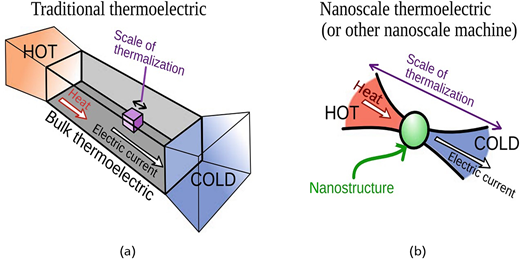
(a) The length scale on which the electrons relax to a local equilibrium is less than any length scale associated with the structure; (b) and other nanoscale devices is smaller or around the same size as the length at which electrons relax to a local equilibrium
(a) The length scale on which the electrons relax to a local equilibrium is less than any length scale associated with the structure; (b) and other nanoscale devices is smaller or around the same size as the length at which electrons relax to a local equilibrium
In Figure 1 a typical thermoelectric (a), the length scale on which the electrons relax to a local equilibrium is less than any length scale associated with the structure. As a result, the structure’s electrons may be thought of as being in a condition of local thermal equilibrium because their local temperatures vary smoothly across it. Therefore, the system is well described by the Boltzmann transport equations. However, the nanoscale structure of nanoscale thermoelectric (b) and other nanoscale devices is smaller or around the same size as the length at which electrons relax to a local equilibrium. This opens up far deeper, very non-equilibrium physics ramifications for the system. The dynamics exhibit intrinsic quantum effects since there is no local thermalisation, which would typically be counteracted by the unavoidable decoherence that results from thermalisation. Quantum mechanics profoundly affects thermodynamic parameters at the nanoscale because of quantum confinement, energy quantisation, and fluctuations. These impacts modify conventional macroscopic thermodynamic principles. In quantum heat engines, quantum superposition and entanglement influence energy conversion efficiency, establishing basic constraints on entropy creation. Statistical thermodynamics is utilised to elucidate energy distributions in minuscule systems, where fluctuations are more significant. The correlation between entropy and information theory is essential in elucidating how nanoscale systems achieve thermal equilibrium. These principles are essential for the advancement of thermoelectric materials and quantum dots utilised in energy harvesting applications.82
It should be noted that a temperature differential significantly greater than that on the macroscale would be necessary to overcome the significant variation of thermodynamic parameters on the nanoscale.83 The nanoscale parts of a quantum heat engine exchange heat and energy with macroscale bodies to accomplish a particular purpose. Studies of the quantum heat engine, the nanoscale equivalent of the large-scale heat engine, and other quantum thermal devices are ongoing in an effort to establish the theory of thermodynamics from quantum principles.84 Based on both theoretical and practical research, energy budgeting is essential for a nanoscale system to exist in both classical and quantum contexts.67
There is a close relationship between quantum mechanics and thermodynamics. The rate of entropy formation for a heat engine is constrained by both a lower constraint and an upper bound imposed by quantum mechanics. Particles exhibit strange phenomena like superposition and entanglement, which are explained by quantum mechanics, the study of subatomic particles. The comprehension of microscopic matter and energy relies on these occurrences. In contrast, the field of thermodynamics studies the transformation and flow of energy in systems of varying sizes. To understand particles in thermal equilibrium, one must investigate the link between thermodynamics and quantum mechanics. Particles still behave erratically even at this atomic scale due to quantum fluctuations. Thermodynamic parameters, such as entropy, which quantifies system disorder, are affected by these variations. Even in apparently stable systems, there is inherent uncertainty owing to fluctuations, according to quantum mechanics. This is especially true at the nanoscale, where quantum effects are very noticeable. The physical universe, from particle behaviour to commonplace thermodynamic processes, can be better understood by combining quantum mechanics with thermodynamics. Because of this integration, our knowledge of thermodynamic principles can be improved, especially for systems where quantum effects are not negligible. Together, quantum mechanics and thermodynamics give light on the nature of energy and its transformations, allowing for a more complete comprehension of the physical universe.85–87
Recent research has revealed that nanoscale systems, which are far from the thermodynamic limit and may even contain a single particle, have thermodynamic parameters that are consistent with their quantum characteristics.88 Nanotechnology is made effective by using quantum confinement, a kind of quantum mechanics. Nanotechnology and quantum physics are related in a number of ways, including spintronics and quantum computing.89 A large portion of nanotechnology and the exciting quantum information theory paradigm are both supported by quantum mechanics.90 We hope that this paradigm, with its strong relationship to big deviation theory and irreversible thermodynamics, will be helpful in simulating non-equilibrium nanoscale events.91
Multiscale simulations that combine molecular dynamics (MD) and Monte Carlo techniques are employed to connect atomic-level interactions with macroscopic thermodynamic predictions. MD simulations resolve Newton’s equations of motion for discrete atoms:
where mi is the mass of the ith atom, ri is the position, and Fi is the force acting on it. These simulations offer insights into phase transitions and thermal characteristics at the nanoscale. Monte Carlo techniques augment molecular dynamics by using probabilistic sampling to investigate phase space, therefore calculating free energy landscapes and equilibrium characteristics. The integration of these methodologies allows precise modelling of nanomaterial behaviour.
From an information-theoretic perspective, thermodynamics examines mesoscopic systems using standard quantum information methods. For instance, an abstract representation of dynamics with low Hamiltonian complexity is often used in quantum information. Dynamics is a mapping between quantum states that yields generic dynamics laws that are helpful in the study of technology and computers. This section offers examples from quantum thermodynamics to explain some of these techniques and theorems.92
Quantum thermodynamics may be applied to single particles. This suggests that the thermodynamic characteristics of very simple models are the same as those of devices that are macroscopic. For example, finite-time thermodynamics is related to efficiency at maximum power. Furthermore, the behaviour of quantum adiabatic systems and thermodynamic systems are closely related. Deviations reduce efficiency because they create friction.93
2.1 Quantum mechanics and statistical physics
Quantum effects significantly influence the energy landscapes of nanoscale particle ensembles by modifying thermodynamic parameters, including entropy, free energy, and phase stability. Quantum confinement effects, superposition, and entanglement result in variations from classical thermodynamics, necessitating alterations in conventional models. The work examines how statistical thermodynamics and quantum mechanics collectively offer insights into these modified energy landscapes. A number of basic rules and equations from statistical physics and quantum mechanics might be discussed in order to build a clear physical picture within the framework of thermodynamics and nanotechnology. Important laws and equations are presented here:
2.1.1 Hamiltonian operator
A fundamental operator in quantum physics, the Hamiltonian operator expresses the system's total energy. The total energy operators of kinetic and potential components
Here,
= kinetic energy of the operator; and
= potential energy of the operator.
2.1.2 Partition function
The idea of the partition function is fundamental to statistical physics. The Boltzmann factor weighted total of all potential system states is the partition function Z for a system at temperature T.
Here,
Ei = the energy eigen values of the system; and
β = the inverse temperature.
2.1.3 Schrödinger equation
The dynamical evolution of a physical system’s quantum state is characterised by this equation. Here is the formula:
Here, = reduced plank constant; = the state vector of the system; and = the Hamilton operator representing the total energy of the working system.
2.1.4 Boltzmann transport equation
The Boltzmann transport equation (BTE) is introduced to model phonon transport in nanomaterials:
Here,
F = the distribution function;
V = phonon velocity;
F = external force; and
also, the right-hand term accounts for phonon scattering processes.
This equation is essential in understanding nanoscale thermal conductivity and energy dissipation in nanomaterials.
2.1.5 Quantum heat engine
Quantum coherence and decoherence play a pivotal role in nanoscale thermodynamics, influencing system behaviour. Quantum coherence facilitates superposition states, substantially influencing energy transfer efficiency, whereas decoherence results in classical-like behaviour. A significant instance is the quantum heat engine, which functions with quantum working ingredients instead of traditional thermodynamic cycles. The efficacy of such systems can be represented by the Carnot-like equation:
where TH and TC are the temperatures of the hot and cold reservoirs, respectively. In contrast to conventional heat engines, quantum heat engines display distinct characteristics attributable to quantum entanglement and coherence, resulting in non-classical efficiency constraints.
2.1.6 Quantum information theory
Quantum information theory contributes to thermodynamics by characterising entropy through von Neumann entropy.
where ρ is the density matrix of the system. This formula is crucial in understanding the entropy changes in quantum thermodynamic systems.
With the use of these rules and equations, which combine statistical representations of particle ensembles with quantum mechanical concepts, we may begin to comprehend how systems behave at the nanoscale.
3. Thermodynamics of nanoscale interfaces
The term “interfacial” phenomenon implies behaviours that are associated with the interactions of a single stage (solid or liquid) with a different stage (solid, liquid, gas, or vacuum) within a small area wherein the change in stage takes place.94 “Interfaces” describes the minuscule regions in which various stages of nanocomposite interact, usually within the micro/nanoscale.95
Nanoparticle size, shape, and composition may be controlled in a variety of ways through the investigation of techniques including thermal breakdown, solvothermal analysis, and co-precipitation. These techniques highlight the promise of complex metal alloys for improving cancer imaging and treatment by allowing the fabrication of multifunctional nanoparticles designed for medicinal uses.96 In the natural sense, the interfacial phenomena that influence the characteristics of substances are generated from particles that interact with the surface and have distinct energy levels from the substance itself. Due to the differences in molecular interactions between the interior of phases and the interfaces, interfacial energies emerge for particles with a defined surface area. The interface is referred to as the boundaries of grains, while the associated surface energies are known as grain boundary energies whenever the interaction is comprised of identical solids. In general, corresponding surface or interface energy governs a solid's physical structure, which is thought to govern the interactions of nanoscale materials. Therefore, various bulk interfacial energies and the accompanying spatial dependencies are modelled using conventional thermodynamics, a potent classical analytical tool.97 Considering these reasons, there has been a huge surge in enthusiasm for investigations into low-dimensional nanoscale thermal transmission lately.98–100 Researchers have found that the solid–vapour, liquid–vapour, solid–solid, and solid–liquid interface energies of nanoparticles and thin films fall as their diameters or thicknesses approach numerous nanometres in size.97
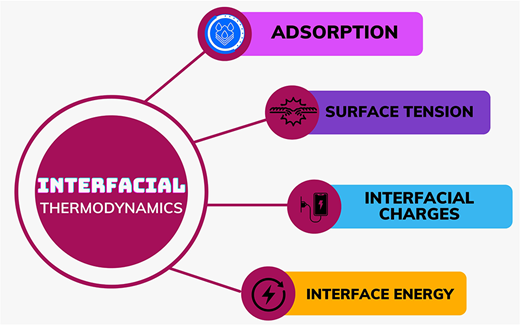
Interfacial thermodynamics deals with subjects like adsorption, interface energy, surface tension, and interfacial charges that are covered in the study of how thermodynamics is applied to interface phenomena (Figure 2), as well as the relationships between these topics. The thermodynamics of nanoscale interfaces is crucial for comprehending surface energy, capillarity, wetting behaviour, and adsorption processes. It is essential in ascertaining interfacial energy in diverse material interactions, including solid–vapour, liquid–vapour, and solid–liquid systems. These investigations offer essential insights into nucleation, coarsening, and phase transitions at the nanoscale.101 Interfacial thermodynamics has an enormous effect on the emergence of materials at the nanoscale by regulating phases of nucleation, expansion, coarsening, and numerous additional applications. Interfacial thermodynamics, designed by Gibbs, was expressed in terms of surface behaviours in relation to a hypothetical geometrical interface that divided the existing phases.102 Surface and interface are both frequently employed interchangeably, whereas interfaces tend to be discussed from a thermodynamic perspective. A true thermodynamic inference is achievable while taking into account the entire system, which includes the interface and each of the surrounding zones, as an interface cannot be distinguished in separate ways.103
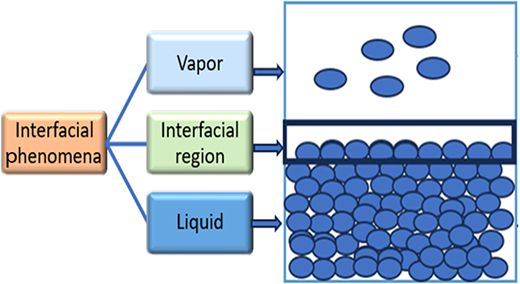
A schematic representation of interfacial phenomena between the liquid and vapour phases
A schematic representation of interfacial phenomena between the liquid and vapour phases
Figure 3 illustrates the fundamentals that interfacial thermodynamics deals with. In the study and use of nanomaterials, interfacial thermodynamic parameters, especially interfacial tension, are extremely important, yet it is hard for researchers to measure precisely because there is currently no reliable methodology to identify their characteristics.104 Zhang et al. measured the soluble content of nanoparticles in water at various temperatures in order to figure out the interfacial tension. But instead of interfacial tension within the particles and the gases, the result they obtained represented the interfacial tension within the nanoparticles and the water.105 However, Gibbs provided the first thermodynamic description regarding the sphere-shaped gas–liquid interfaces, and Tolman expanded on it by obtaining a qualitative equation that is frequently employed to explain the modest drop in interfacial tension at the nanoscale.106 Wang et al. used adsorption thermodynamics and kinetics to figure out the Tolman sizes, temperature coefficients of surface tension, and interfacial tension (solid–liquid and solid–gas interfaces) at the nanoscale. It was found that the tension between surfaces and temperature coefficients are significantly influenced by the size of the nanomaterials. The surface tension and temperature coefficients remain constant with decreasing radius, while the radius is greater than 10 nm. The temperature coefficients of the interface tension are negative as the radius is smaller than 10 nm, while the interfacial tension declines abruptly, and the temperature coefficients rise rapidly with a reduction of the radius.107
The integration of thermodynamics, nanoscale absorption, and heterogeneous catalysis is a crucial aspect in the advancement of new adsorbents for wastewater purification. The comprehension of the energetic aspects involved in adsorption processes plays a crucial role in facilitating the elimination of various pollutants, such as Zn(II), Hg(II), Congo red (CR), and malachite green (MG). Efficient adsorption is observed in materials such as Fe3O4-graphene oxide-chitosan (MGOCS), magnetic graphene oxide-chitosan nanohybrid (MGC), and phytic acid functionalised graphene oxide (PA-GO) owing to their nanoscale structures. These structures exhibit elevated surface area-to-volume ratios, so augmenting the affinity for adsorption and facilitating meticulous regulation of the adsorption process. Furthermore, the incorporation of functional groups such as phytic acid, chitosan, and graphene oxide has the potential to enhance heterogeneous catalysis, hence presenting opportunities for the degradation of pollutants and the synthesis of chemicals. The adoption of an interdisciplinary approach facilitates the development of sophisticated adsorbents that possess the ability to effectively tackle intricate environmental issues.108–110
Whenever the concentrations within the interfaces have differences from the ones in the adjacent bulk stage, then a number of the substances in a multicomponent, multiphase system have adsorption at several or more of the phase borders.104 Studying adsorption thermodynamics and the interaction between molecules seems indispensable. There are numerous technical applications for the adsorption of two-dimensional (2D) graphene oxide (GO) nanosheets at liquid–liquid interface interactions, including drug delivery and the dispersion of water and petroleum-based products.111–113 It has been discovered that the presence of unprotonated GO (GOCOO) exhibits poor interfacial adhesion, whereas the presence of unaltered GO (GOCOOH) exhibits clear interfacial interaction and a drop in interfacial tension. The use of GO-based surfactant phenomena is made possible by molecular dynamics (MD) modelling, which offers microscopic knowledge of the adsorption process and the interfacial phenomena for GO sheets at liquid–liquid interfaces.111
The interfacial energy of liquid–liquid and liquid–gas interfaces has significance in many branches of technological and scientific advancement. Adsorption of nanoparticles and agents at the interface of liquid and gas and the separation of the non-adsorbed nanoparticles on the minute film surface that isolates the phase with dispersion and reduction of surface tension at the liquid’s interface stabilise bubbles and formulations. The adsorption of nanoparticles and surfactants at their interfaces is influenced by the solid–liquid interface’s wettability and the fluids’ interface energies. Nanoparticles’ exceptional capabilities, like lowering tension at the interface, altering wetting ability, and increased potential to adsorb, allow them to stand out as appealing options for enhanced oil recovery (EOR). EOR involves a procedure based on chemicals that increases the fluid-flooded sweeping efficacy within the liquid-oil mechanism, thereby reducing the interfacial tension. By contrast, conventional reserves with water-flooding have an optimum oil extraction rate of 35%–50%, where, in addition to increasing the extraction of oil, nanoparticles like ZnO, TiO2, ZrO2, Al2O3, and MgO, which possess distinct nanoscale characteristics and surface-active agents, are introduced into the reserves as the incorporated nanomaterials and surface-active agents are adhered to the liquid–liquid and solid–liquid interfaces, changing the interfacial energies and wettability, which ultimately has a great impact on EOR applications.114–130 Unique nanoscale properties of nanoparticles modify wetting and lower interfacial tension in Figure 4.
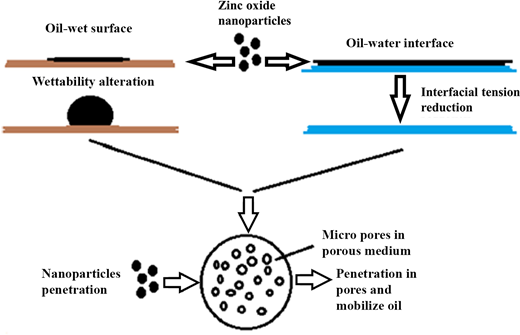
Nanoparticles that possess distinct nanoscale characteristics alter wetting and reduce interfacial tension115
Nanoparticles that possess distinct nanoscale characteristics alter wetting and reduce interfacial tension115
The reliability of the surface, the interfaces, and the interaction phases that form if various solid and/or liquid metals and alloys are placed into immediate interaction (at a certain temperature and pressure) is significant for the efficacy of the assembly and the improvement of the behaviour of nano-sized materials made from metals. The properties of the intrinsic interfaces and interfacial transitions of nano-sized crystalline, amorphous, or liquefied metallic alloys are largely determined by the thermodynamics of nanoscale phenomena. In order to demonstrate the significance of interfacial thermodynamics for nanoscale technology, instances of amorphisation in multiple layers of Fe and Zr, silicon crystallisation caused by aluminium, and layer interchange in bi-layers of crystallised Al and homogeneous Si are discussed.131
4. Nanotechnology applications in energy conversion
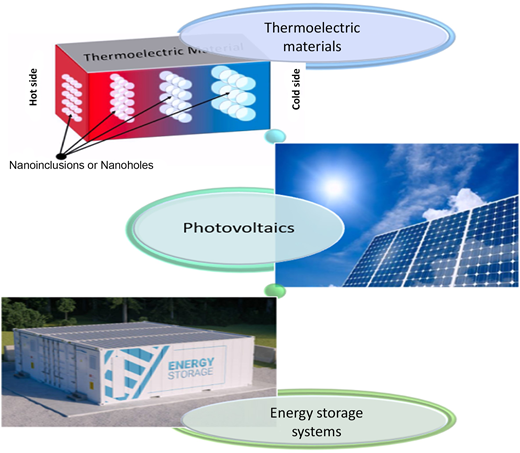
Nanotechnology has brought about a profound transformation in numerous facets of energy conversion procedures, resulting in notable progress in the fields of thermoelectric materials, solar power technology, and energy storage systems. Harnessing the effects at the nanoscale has allowed researchers to boost effectiveness and refine the overall capabilities of these energy conversion technologies. Here is a brief summary of the progress achieved in each of these fields. Figure 5 shows the major fields of nanotechnology applications in energy conversion.
4.1 Thermoelectric materials
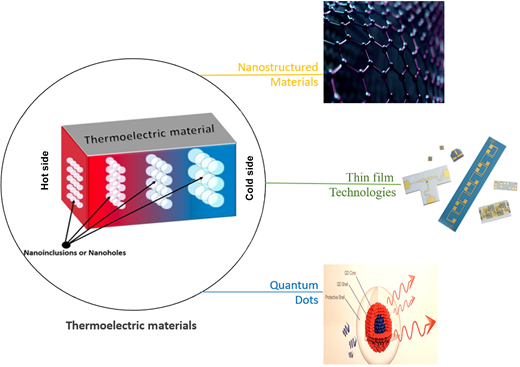
Thermoelectric materials can transform electricity and heat into one another.132 Through the improvement of their thermoelectric characteristics, nanotechnology has been essential in raising the effectiveness of thermoelectric materials.133 How effective thermoelectric devices are is heavily influenced by the laws of thermodynamics, such as entropy, Gibbs free energy, and the Seebeck coefficient. The Seebeck coefficient, electrical conductivity, and thermal conductivity dictate the efficacy of thermoelectric materials. Nanostructuring diminishes phonon transport while preserving electron flow, thereby enhancing the thermoelectric figure of merit (ZT). Moreover, quantum confinement effects augment carrier mobility, resulting in enhanced efficiency.134 Heat and electricity flow are impacted by entropy; therefore, it is critical to maximise the change in Gibbs free energy across interfaces. Furthermore, a high Seebeck coefficient suggests a good conversion of thermal energy into electrical power. Improving the efficiency of thermoelectric devices for use in energy harvesting and waste heat recovery relies on optimising these parameters.134,135 Some notable developments have been included in Figure 6.
4.1.1 Nanostructured materials
Nanostructured materials are condensed materials that are partially or entirely made up of structural components with typical dimensions between a few nanometres and several tens of nanometres known as nanostructured materials.136 Due to their nanoscale size, nanostructured materials frequently have special and enhanced characteristics over bulk equivalents.137 Because it controls energy landscapes and driving forces, thermodynamics is fundamental to surface reactions, self-assembly, and nanoparticle production. It controls how molecules or nanoparticles are organised during self-assembly, how reactions on surfaces proceed, and how nucleation and growth paths in nanoparticle production are dictated. To maximise the stability and functionality of nanomaterials and nanodevices in a wide range of applications, it is crucial to understand these thermodynamic principles.138 Scientists have created nanoscale materials, including nanowires and nanoparticles that are very efficient thermoelectric materials.139 More efficiently scattering phonons (heat-carrying vibrations) is possible with these nanostructured materials.140 As a result, the efficiency of energy conversion is improved while also raising the thermoelectric ZT.141
4.1.2 Thin film technologies
Thin film technology represents another notable progress in the field. New avenues for energy conversion applications in nanotechnology have been made possible by thin-film technologies. These technologies provide creative answers to the expanding need for effective energy storage and conversion.142 One of the remarkable aspects of thin film technology is its versatility, Allowing for the precise control of material properties and the fabrication of incredibly thin layers.143 These developments have produced thin-film solar cells, which are more efficient at converting sunlight into electricity while also being more affordable.144,145 Furthermore, batteries and capacitors with thin-film coatings have improved energy storage capacities.146 There have been developed thin sheets of nanoscale thermoelectric materials.147 This makes it possible to manage heat conduction and electron transport more effectively.148,149 As a result, waste heat recovery thermoelectric devices are now more effective.150
4.1.3 Quantum dots
Among the many uses of nanotechnology in energy conversion, quantum dots – the wonders of the semiconductor world at the nanoscale are essential. These tiny particles have amazing electronic properties that are used to take advantage of their special qualities. Quantum dots have been utilised to enhance the electron transport characteristics and decrease thermal conductivity, thereby boosting the efficiency of thermoelectric devices.151,152 Future creative solutions that take advantage of quantum dots’ extraordinary properties will be made possible by their versatility in energy conversion.153
4.1.4 Magnetic field alignment during polymerisation for improved electromagnetic performance of nanocomposites
The composites show enhanced electromagnetic performance when the BaFe12xGaxO19 filler is aligned in a magnetic field during polymerisation. Another advantage of combining oxides and carbon-based materials with other polymers is the ability to create novel nanocomposites with improved and appealing electrical characteristics. These state-of-the-art materials might be used in microwave devices, radar systems, and electromagnetic shielding, among other places where electromagnetic qualities are vital.154
4.1.5 Effects of oxygen nanostructure on electrical characteristics
The presence of an excess or deficiency of oxygen in the La0.70Sr0.30MnO3−γ system might cause changes in the oxidation state of the 3d transition metals. Electrical characteristics like resistivity and band gap can be affected by changes in the charge state of three-dimensional metals caused by variations in oxygen concentration. Another possible explanation for a rise in the unit cell parameter is an oxygen shortage.155
4.2 Photovoltaics
Nanotechnology has played a pivotal role in the progress of photovoltaic technologies, leading to increased efficiency and cost-effectiveness in the harnessing of solar energy.156 This section reviews the many cooling techniques that the researchers have documented, along with their impacts. Consideration is also given to each technology’s capacity to apply or not apply heat expelled. Quantum dots augment solar cell efficiency by multiple exciton generation (MEG), wherein a single photon produces several electron–hole pairs, hence enhancing energy conversion. The use of perovskite materials is analysed via Gibbs free energy reduction, guaranteeing stability while enhancing charge transfer. The factors influencing the cooling of the concentrated case photovoltaic cells will differ from those of the flat case because of the cells’ much greater temperature. Consequently, it is essential to research, evaluate, and contrast the cooling techniques in both the PV and CPV categories, taking into account the same theory for PV and CPV cooling systems.157 Table 1 summarises the pertinent reviews of the literature on PV modules.
The features of the cooling techniques used for photovoltaic cells in various nations
| Method | Country | Ref. | Type of study | Model | Environment condition | Basic fluid/ heat transfer coefficient (W/mK)/ nanoparticles | Cogeneration | Use energy | Findings | |||||
|---|---|---|---|---|---|---|---|---|---|---|---|---|---|---|
| Tamb (°C) | Tmod (°C) | Vw | Gsolar (kW/m2) | Δη (%) | In (%) | (°C) | ||||||||
| Heat pipe |  | 143 | Experimental and simulation |  | 33.1 | 55 | – | 0. 678 | R404a, R600a, R290, R407C, R22, R134a, H2O, NH3/ -/ - | Yes | No | – | 29.6 | – |
| Airflow and heat sink |  | 144 | Experimental |  | 32 | 50 | – | 0.8 | Air/ k: 0.026/ - | No | Yes | 2 | 28.5 | – |
| Phase change material |  | 145 | Experimental |  | 33.9 | 68.7 | – | 1 | Paraffin wax (PCM) – water working fluid/ k (PCM): 0.20 – k: 0.6089/ - | Yes | No | – | – | 23 |
| Liquid immersion |  | 146 | Experimental |  | 38.4 | 59.4 | – | 1.17 | Water/ k: 0.6089/ - | No | No | 0.72 | 17.8 | 24.6 |
| Coating by spectral splitting filter or water film |  | 147 | Simulation |  | 31 | – | – | 0. 855 | / k: 0.6089/ - | No | No | 1.1–6.8 | 16 | – |
| Combined methods |  | 148 | Experimental |  | 32 | 45 | 1 | 1 | Water/ k: 0.6089/ - | No | Yes | – | 14.32 | – |
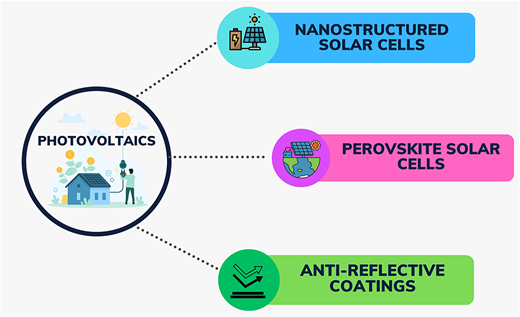
PV, the process of turning sunlight into energy, has advanced tremendously with the help of nanotechnology and a solid understanding of thermodynamics. Nanotechnology has proved crucial in enhancing the efficiency and performance of solar cells by resolving problems with traditional photovoltaic materials. The intersection of thermodynamics and nanotechnology in the field of PV is in Figure 7.
The convergence of nanotechnology and thermodynamics in the domain of photovoltaics
The convergence of nanotechnology and thermodynamics in the domain of photovoltaics
4.2.1 Nanostructured solar cells
Nanostructured solar cells are a transformative aspect of nanotechnology applications for energy conversion. In solar cell designs, nanostructures including nanowires, quantum dots, and nanotubes have been included.158–160 These designs can increase light absorption and promote charge carrier movement, both of which contribute to increased solar cell efficiency.161,162 Their integration is a promising path toward increasing the use of renewable energy sources and achieving our objectives for more effective and sustainable energy conversion technologies.
4.2.2 Perovskite solar cells
In the field of PV, perovskite solar cells represent a state-of-the-art innovation with great potential for the future of renewable energy. Nanoscale engineering has played a beneficial role in enhancing perovskite solar cells, a promising advancement in next-generation photovoltaic technology. The performance and stability of perovskite materials have been positively impacted by the integration of nanostructures.163 This discovery could completely change the solar energy market by providing more economical, environmentally friendly, and efficient replacements for traditional photovoltaic systems.164 However, there are still issues, especially about durability and stability over the long run.165 Perovskite solar cells have the potential to become an essential part of our sustainable energy future as a result of continued research and development in this area.
4.2.3 Anti-reflective coatings
Nanoscale anti-reflective coatings are a key element in the field of energy conversion applications using nanotechnology. Nanoscale anti-reflective coatings on solar panels decrease the loss of incoming sunlight owing to reflection, ensuring more sunlight is harnessed and transformed into usable energy,166 and improving the overall efficiency of energy conversion.167 Nanoscale anti-reflective coatings are a prime example of how nanotechnology can promote effective and sustainable energy conversion,168 which is a crucial tool in our search for sustainable energy sources.
4.3 Energy storage systems
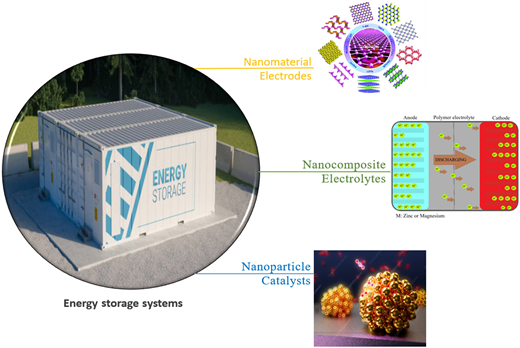
Energy storage systems are now much more efficient and perform better because of nanotechnology, which has revolutionised the industry.169 Because of special characteristics found in the nanoscale, materials may be used to improve energy storage. Nanomaterials like graphene and nanotubes are used in supercapacitors and batteries to boost capacity, surface area, and conductivity while enabling quicker charge/discharge rates. Furthermore, the use of nanostructured materials in the manufacturing process of enhanced lithium-ion batteries facilitates the creation of more powerful and compact energy storage devices. With the use of nanotechnology, energy storage devices like batteries and supercapacitors have also experienced considerable advancements.170 Figure 8 illustrates the significant advancements in the energy storage systems field.
4.3.1 Nanomaterial electrodes
One of the most innovative areas of energy conversion applications using nanotechnology is nanomaterial electrodes. Innovative supercapacitors and batteries with large capacities and quick charging times have been made possible by nanomaterial electrodes.171 The creation of high-capacity and quick-charging electrodes for batteries and supercapacitors has made use of nanoscale materials including CNTs, graphene, and nanowires, among others.172,173 These materials offer greater charge storage surface areas and accelerated ion transit.174 The development of advanced energy storage solutions is fuelled by this innovation, which signals a more efficient and sustainable energy landscape.
4.3.2 Nanocomposite electrolytes
Leading the way in the application of nanotechnology to energy conversion are nanocomposite electrolytes. Nanocomposite electrolytes with nanoscale fillers that improve ion conductivity and reduce dendritic formation have improved the performance of lithium-ion batteries.175 Nanoscale fillers, which improve ion conductivity and reduce dendrite formation, a crucial component of battery stability and longevity, are incorporated into these advanced electrolytes.174–176 Energy storage is being revolutionised by nanocomposite electrolytes, which provide more dependable and effective solutions for the changing energy environment.
4.3.3 Nanoparticle catalysts
Catalysts made of nanoparticles are revolutionising the field of energy conversion applications using nanotechnology.177 Different energy storage devices have used nanoparticle catalysts to improve charge/discharge kinetics and overall energy density.178 Because of their size and surface characteristics, catalysts made of nanoparticles enable more effective energy conversion processes.179 To meet the growing demand for high-performing, sustainable energy solutions, nanoparticle catalysts present a promising path for energy storage technology advancement.
The progress in thermoelectric materials, PV, and energy storage systems, propelled by nanotechnology, has greatly enhanced the effectiveness, dependability, and sustainability of energy conversion processes. With the continued progress of nanotechnology, we can look forward to additional discoveries and advancements in the field of energy conversion and storage.
4.3.4 Microwave properties of nanocomposites
Due of the high connections between electromagnetic properties and CFO content, magnetic and structural investigations have revealed perfect exchange coupling at room temperature. This finding could have potential uses in radar technology and electromagnetic compatibility. There is great potential for nanocomposites to be utilised in microwave applications due to their single magnetic domain behaviour.180
4.3.5 Characteristics of cation-ordered manganite synthesis and the effect of catalyst size on nanoparticle organisation
Nanoparticle size and arrangement control is key to cation-ordered manganite production. More nucleation sites and more control over crystal development might be enabled by larger catalyst sizes, which could lead to the production of more ordered structures. Because of their larger surface area and greater reactivity, smaller nanoparticles may influence the creation of the target phase and the material’s subsequent characteristics, leading to better ordering and enhanced properties.181
5. Nanoscale heat transfer and thermal management
The combination of thermodynamics and nanotechnology presents important issues in the realm of nanoscale heat transmission. Comprehending the process by which heat spreads through nanomaterials is essential for effective thermal control in various applications. Through the elucidation of these concepts, scholars’ endeavour to enhance the efficiency of thermal energy usage in various domains such as electronics and biomedical equipment. Enhancing the significance of nanotechnology in tackling contemporary heat transfer difficulties is achieved through the clarification of these relationships.182,183
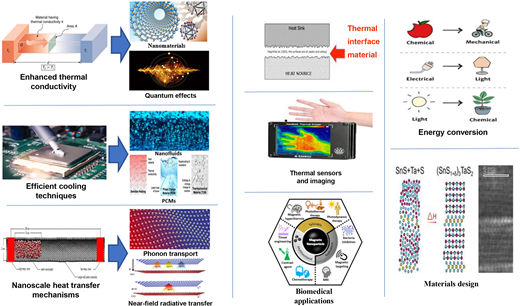
Nanoscale heat transfer and thermal management represent pivotal domains of scientific inquiry, boasting diverse applications that span from microelectronics and materials science to energy conversion and biomedical devices. Due to the prominence of quantum and surface effects, heat transmission behaviours at the nanoscale differ dramatically from those seen in macroscopic systems.178 The following are some essential features (Figure 9) of nanoscale heat transfer and how it may be used to enhance thermal management.
5.1 Enhanced thermal conductivity
Enhanced thermal conductivity is the ability of a substance to transport heat more effectively than in its natural state or with normal materials. Nanomaterials and quantum effects are the techniques and technologies that have made this breakthrough feasible.
Nanomaterials with structural elements in the nanometre range (1–100 nm) have distinct properties when compared to bulk materials.184 Nanomaterials come in many different forms, including nanoparticles, nanowires, nanotubes, and nanocomposites,185 each with its own set of properties and applications ranging from medicine to electronics.186 Apart from this, Thermal conductivity increase has undergone a radical change thanks to the emergence of nanomaterials including CNTs, graphene, and nanowires.95,187–189 These materials can be integrated into composites to enhance the overall thermal performance of materials since they have extraordinarily high thermal conductivities.190,191
Nanoscale materials’ quantum confinement phenomena may provide unusual thermal characteristics. These effects are used in a variety of applications, including the creation of advanced nanoelectronics devices,192 quantum computing,193 quantum sensors with extreme sensitivity,194 secure quantum communication,195 quantum simulators,196 and assisting in the advancement of fundamental scientific research, electronics, and security.197–199 For instance, phonon transport can be severely constrained in thin films or nanowires, which has an impact on thermal conductivity.200
Even though this topic has seen a lot of studies, there has not been much done on thermal conductivity in phase-change material (PCM) in terms of micromechanism and material shape. The question of how to increase PCM’s thermal conductivity is still one that needs further investigation.201 Several elements influence composite PCMs’ thermal conductivity, with phonon scattering being one significant aspect that restricts the material’s thermal conductivity. The transmission of heat at the microscopic level is best described by the study of phonons.202 Overview of chemical modification to enhance composite PCMs’ thermal conductivity in Table 2.
Overview of chemical modification to enhance composite PCMs’ thermal conductivity
| Method of chemical modification | PCM | Thermal conductivity of PCMs kp W/(m·K) | Chemical processing | Composite PCMs | Thermal conductivity of composite PCM kc W/(m·K) | Improvement: % | Ref |
|---|---|---|---|---|---|---|---|
| Doping | MA-SA | 0.17 | Nitrogen-doped porous carbon | NPC/MA-SA | 0.37 | 217.65 | 203 |
| PA | 0.28 | Nitrogen doped graphene | PA/NDG | 1.73 | 617 | 204 | |
| Paraffin | 0.28 | Mesoporous carbons | Paraffin/ C-900-85 | 0.35 | 125 | 205 | |
| Graft functional groups | PEG | 0.298 | CNTs grafted MOFs | (PEG) /CNT@ MOFs | 0.464 | 200.9 | 206 |
| SA | 0.18 | MIL-101-NH2 | SA/MOFs | 0.51 | 283.3 | 207 | |
| Paraffin | 0.2312 | Grafted CNTs-C18 | Paraffin/CNTs | 0.7903 | 341.68 | 208 | |
| n-octadecane | 0.19 | Octadecyl amine grafted graphene oxide (GO-ODA) | n-octadecanemelamine formaldehyde (MF) resin/GO-ODA | 0.26 | 136.84 | 209 |
5.2 Efficient cooling techniques
Efficient cooling methods and technologies are approaches and systems engineered to efficiently remove heat from a variety of systems and devices. Engineered fluids known as nanofluids are made up of nanoparticles dissolved in a base fluid, like glycol, water, or oil,210 Materials like metals, oxides, or carbon-based compounds are frequently used to make nanoparticles. Nanofluids have improved transport and thermal characteristics.211 Utilising these fluids in cooling systems can enhance the efficiency of heat transfer.212 Their enhanced convective heat transfer capabilities and superior thermal conductivity can boost the efficiency of solar thermal collectors, electronics cooling systems, and heat exchangers.213–215 Nanofluids are an active area of research and hold promise for addressing thermal management challenges in modern technologies.
Materials known as PCMs, can absorb and release large amounts of thermal energy when they transition from one phase typically solid to another typically liquid and vice versa.216 PCMs can be found in a variety of materials, including inorganic (like salts and metals) and organic (like fatty acids and paraffin waxes).217 The heat storage capacity, thermal conductivity, and phase change temperature of each type vary. PCMs are used in thermal energy storage systems to store and release surplus heat,218 as well as in building materials to improve indoor temperature control,219 and solar thermal collector efficiency optimisation.220 Effective thermal energy storage and release is possible with nanostructured PCMs,221 making them appropriate for temperature control and passive cooling in a variety of applications.222 PCMs provide an innovative and sustainable solution for energy storage and temperature control, aiding energy efficiency and environmental goals across industries.
5.3 Nanoscale heat transfer mechanisms
For many applications, nanoscale heat transfer mechanisms which include the transport of heat at the nanometre scale are crucial. The process through which quantised lattice vibrations, or phonons, propagate through a material is referred to as phonon transport.223 Phonon transport, or the movement of quantised vibrational energy, is an important factor in nanoscale materials.224 It is vital in many domains, such as materials science, electronics, and thermoelectric devices,225,226 and it is critical in determining a material’s thermal conductivity.227 To create materials with specific thermal properties and maximise energy-efficient technologies, it is essential to comprehend and manage phonon transport.
On the nanoscale, heat transfer through radiation can happen through near-field interactions,228 where the exchange of heat is enabled by the electromagnetic fields between objects positioned closely to each other.229 For applications like thermophotovoltaics, this phenomenon has consequences for nanoscale heat transport.230
5.4 Thermal interface materials (nanoscale)
Thermal interface materials (TIMs) based on nanomaterials are intended to enhance the thermal coupling between two surfaces. They can fill cavities and gaps at the interface,231 enhancing heat transfer efficiency and minimising thermal resistance between components within electronic devices.232 As TIMs improve the thermal conductivity between two surfaces, they are essential for controlling heat dissipation in electronic devices. Effective heat transmission is more crucial than ever to avoid overheating and preserve peak performance in electronic components as they become smaller and more powerful. By using nanotechnology, nanoscale TIMs may improve their thermal characteristics. The use of improved thermal interface materials (TIMs) in high-power electronic devices presents new challenges and opportunities due to the heat dissipation model of TIMs and the variety of advanced TIM types (Figure 10).
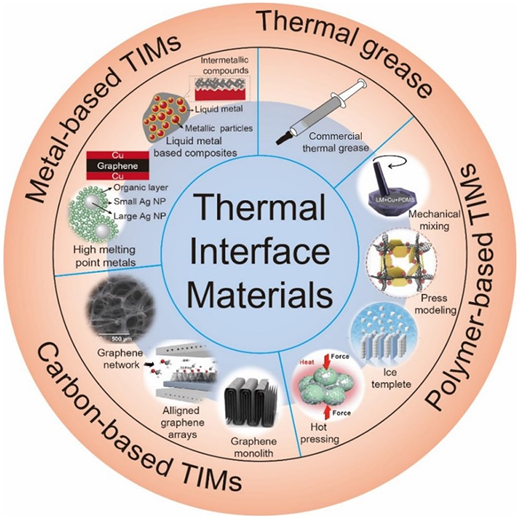
TIMs with enhanced features for high-power electronics heat dissipation are explained schematically.232
TIMs with enhanced features for high-power electronics heat dissipation are explained schematically.232
5.5 Thermal sensors and imaging (nano-resonators)
Key elements of thermal sensors and imaging systems are nano-resonators, which enable extremely sensitive detection and accurate nanoscale thermal measurements.233,234 As a result of these microscopic structures’ ability to vibrate in response to temperature changes, sophisticated thermal imaging devices have been developed for use in the field of medical diagnostics.235,236 Also, high-resolution thermal imaging is possible with these sensors.237 All things considered, tracking and understanding temperature-related activities at the nanoscale will be made easier with the help of thermal sensors and imaging technologies based on nano-resonators, which will have an impact on many scientific and technological fields.
5.6 Biomedical applications
Nanoscale heat transfer and thermal management play a pivotal role in various biomedical applications. In the area of medicine, nanoscale heat transfer finds application in practices such as hyperthermia therapy,238 employing nanoparticles to selectively elevate temperatures and eradicate cancer cells.239 The development of minimally invasive surgical techniques is one prominent application, where tissue ablation can be facilitated by localised heating via nanoscale thermal effects,240 thereby eliminating the necessity for conventional surgical procedures. The design of temperature-sensitive drug delivery systems makes use of nanoscale thermal management.241 Therefore, accurate temperature control at the nanoscale is advancing medical diagnostics and treatments.
5.7 Energy conversion
It is essential to use nanoscale materials and structures to increase the effectiveness of energy conversion processes. Examples of these applications include thermoelectric materials employed in the reclamation of waste heat and nanostructured materials utilised in the conversion of solar energy into thermal energy.242,243 Nanotechnology may, for the most part, be used for technologies for converting energy to produce systems that are more efficient, compact, and sustainable. Improvements in thermodynamics and nanotechnology are driving advances in material and device design and optimisation for improved energy utilisation processes.
5.8 Materials design
Studying how heat transfer behaves at the nanoscale is essential for creating novel materials that are manufactured to have certain thermal characteristics for specific applications, ranging from surprisingly effective insulators to exceptional thermal conductors.244 Nanotechnology is enabling the creation of innovative materials with specific properties and functionalities that have the potential to change a variety of industries by pushing the boundaries of materials design. In this field, engineers and scientists strive to get beyond challenges and make the most of nanomaterials for practical uses.
In conclusion, nanotechnology has created enticing opportunities for enhancing thermal management and heat transmission in a variety of industries. To meet the special problems and opportunities posed by nanoscale heat transfer, researchers continue to investigate nanoscale phenomena and create revolutionary materials and methodologies.
6. Thermodynamics of nanoscale self-assembly
The thermodynamics required for nanotechnology is a fascinating and vital component of nanoscience and self-assembly. The spontaneous assembly of nanoscale building blocks such as nanoparticles or molecules is referred to as nanoscale self-assembly.245 Because of the wide range of potential applications in fields like materials science, biology, and electronics, it is very crucial to have a firm grasp of the thermodynamic terms of nanomaterial synthesis and assembly.246 The basic laws of thermodynamics govern the path and the stability of self-assembly.247 Terms like entropy, energy minimisation, enthalpy, and Gibbs free energy are all examples of notions that fall under this category of principles. The interactions between these factors primarily cause nanoparticles to spontaneously organise themselves into complex and properly functional structures.248
6.1 Nanoscale self-assembly and intermolecular forces
When a pair of molecules or nanoparticles is near one another, they may experience either an attractive force or a repulsive interaction.249 The technical term for such interactions is intermolecular forces. These forces are fundamental to understanding the thermodynamics of self-assembly at the nanoscale, which in turn determines how the system behaves.250
Scientists and engineers may uncover a broad variety of applications in domains like materials science, nanotechnology, and biomedicine by understanding and managing these forces.251 Molecular units self-assemble when they communicate with one another via a delicate balancing act between intermolecular forces that are typically weak and not covalent.252 These forces are crucial in keeping the building blocks of molecules in their proper places.253 They are the driving force behind the units’ ability to assemble themselves.254 Other interactive forces, such as shown in Figure 11 also determine the orientation and properties of self-organised structures.255 All of these weak ties hold the self-assembled structures together in a variety of situations.
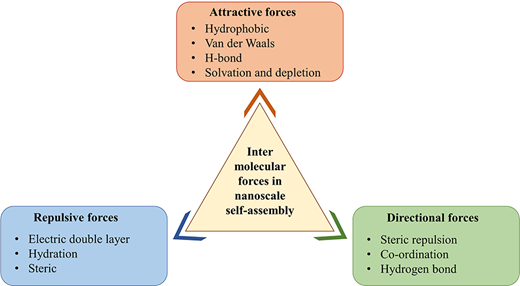
Nanoscale self-assembly is driven by three different types of intermolecular forces
Nanoscale self-assembly is driven by three different types of intermolecular forces
6.2 Van der Waals forces
Forces of attraction and repulsion between molecules at intermediate distances are what make van Waals engagements.256 Interactions between dipoles or induced dipoles on the atomic and molecular scale are the source of these forces.257 Electron distribution variations around atoms and molecules give rise to this force.258 When it comes to self-assembly at the nanoscale, van der Waals forces often play the most important role in bringing particles together.259 Nanoparticles’ surface qualities determine whether or not they are attracted to or repelled by forces such as London dispersion forces, dipole–dipole interactions, and hydrogen bonding.260
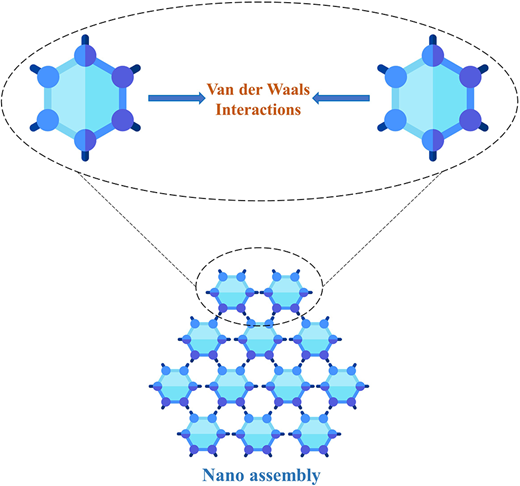
Predicting the behaviour of nanoscale systems requires an understanding of how their forces play a role in self-assembly.261 Surface coating interactions are affected by this as well, which in turn affects adhesion, wear resistance, corrosion protection, and other qualities. In addition, the stability of suspensions in the food, cosmetics, and pharmaceutical industries depends on the fact that particle interactions are governed by van der Waals forces in colloidal stabilisation. Discussions on van der Waals forces are made more relevant and practical by explicitly emphasising these industrial situations.262 Self-assembly at the nanoscale relies heavily on van der Waals interactions, as illustrated in Figure 12, which depicts nanoparticles as separate entities susceptible to van der Waals forces.
6.3 Hydrogen bonding
When it comes to managing intermolecular and intramolecular orientations in nanoscale self-assembly, hydrogen bonds are by far the most appealing form of connection.263 The dipole–dipole attraction between a hydrogen atom bound to an electronegative atom and a nearby electronegative atom with a lone pair of electrons is the primary mechanism by which hydrogen bonds form.264 Hydrogen bonding has the added property of providing self-assembly with both directionality and stability.265 The ability to self-assemble into a wide variety of shapes with biological applications is made possible by this feature of hydrogen bonds.266 Nanostructures may be formed in the form of controlled arrays, super molecular structures, and nano-assemblies with perfect control over their compositions and characteristics thanks to the powerful stabilising mechanism provided by hydrogen bonds.267
Hydrogen bonding is a powerful intermolecular force that has many practical uses in industry. In areas like drug delivery systems, where it affects the structural integrity of biomolecules, understanding its ramifications is particularly critical. Also, hydrogen bonding is a big deal in polymer science since it determines how materials behave, which in turn affects things like packaging. Discussions on hydrogen bonding take on more practical significance and utility once these industrial settings are defined.268
To fully grasp how these interactions affect the characteristics and behaviour of nanomaterials, Table 3 gives a more in-depth look at the many features of H-bonding in nano-assembly.273
An analytical overview of the role of hydrogen bonds in nano-assembly
| Hydrogen bonding | Description | Impact on nano-assembly | Reference |
|---|---|---|---|
| Bond strength of hydrogen –bond | Hydrogen bonds have strengths between 1 and 40 kJ/mol, making them much weaker than covalent bonds | Different nanostructures made of H-bonds can easily be disassembled because the bonds are weak and reversible | 269 |
| Direction of H-bond | Hydrogen bonds display directionality in the same manner as atomic bonds | The directionality of H-bonds determines the unique structure and alignment of proteins in nanostructures | 270 |
| Interactional consequences | Cooperative action between many hydrogen bonds can greatly increase stability | Protein tertiary structures, which are the result of hydrogen bonding co-operation, are examples of extremely stable nano-assemblies | 271 |
| Temperature sensitivity of hydrogen bonds | Assembly dynamics are affected by temperature because of the sensitivity of hydrogen bonds | Nanostructures with reversible transitions in phase can be created by making use of hydrogen bonds that respond to temperature | 272 |
6.4 Entropy and free energy
Entropy is a central notion in thermodynamics that quantifies the degree to which a system is chaotic or unpredictable.274 In contrast, free energy is a single metric that incorporates both enthalpy and entropy which are used to access the energetic viability of a self-assembly process.275 A phase transition occurs when a material goes from a disordered phase (i.e. fluid or gas) to an ordered phase (i.e. solid or crystal), and this is triggered mainly by the self-assembly process.276 Changes in entropy are the driving force behind these transformations. To develop materials with desired characteristics, it is crucial to have a firm grasp of the entropy changes that occur during such transitions.277
7. Challenges and future directions
The potential for using the strength of thermodynamics at the nanoscale made possible is enormous, but several obstacles must be overcome. Creating comprehensive conceptual structures for nanoscale thermodynamics is a significant obstacle. While there has been a lot of progress, knowing the complex nature of non-equilibrium events is essential for leaping from macroscopic to nanoscale thermodynamics. This knowledge gap must be addressed if innovative nanomaterials and devices are to be developed and optimised.
In addition, there are still a few numbers of constraints to be overcome when trying to ensure consistency and scalability in the nanomaterial creation and characterisation processes. Nanotechnology’s widespread acceptance in different applications, including energy conversion and thermal control, will depend critically on the standardisation of characterisation techniques and cost-effective synthesis processes. Furthermore, concerns about environmental effects and safety must be carefully considered when nanoparticles find their way into practical applications. Studying these topics is crucial for ensuring the safe implementation of nanotechnology in everyday life.
Nanoscale thermodynamic simulations encounter problems including boundary conditions, finite-size effects, and computing expenses. Boundary circumstances profoundly influence simulation accuracy, as nanoscale systems do not possess the broad environments seen in bulk materials. Periodic boundary conditions are frequently employed to simulate infinite systems; nevertheless, they can create artefacts. Finite-size effects result in discrepancies from bulk values, necessitating meticulous extrapolation methods. The computational price constitutes another restriction, as precise nanoscale simulations need high-resolution computations. High-performance computing (HPC) and machine learning-enhanced simulations provide viable answers to these difficulties by optimising resource distribution and enhancing forecast accuracy.
Understanding the principles of thermodynamics is crucial in the field of nanotechnology, as it allows scientists to skilfully design and manipulate materials and devices at the nanoscale. Having a deep understanding of thermodynamics in this context is crucial for maximising the efficiency of processes like nanoparticle synthesis, self-assembly, and surface reactions. This optimisation leads to progress in different applications within nanotechnology.
Nanotechnology and thermodynamics provide promising prospects for the future. Better energy conversion devices are on the horizon as a result of developments in nanoscale heat transfer and thermal management. Nanoscale self-assembly is demonstrating immense potential for the creation of tunable nanostructures with thus far unseen features. Interdisciplinary work among physicists, chemists, materials scientists, and engineers is crucial if these possibilities are to be realised shortly. Collaboration across thermodynamics, quantum mechanics, and materials science is essential. The study emphasises the significance of integrating knowledge from many fields to create novel applications, such as energy conversion, nanoelectronics, and medicinal advancements. The incorporation of artificial intelligence (AI) and machine learning is examined as a prospective instrument for modelling and improving nanoscale systems. Also, a promising area of research is the application of AI and machine learning to the problem of modelling and building nanoscale systems. In the years to come, the field of nanotechnology and thermodynamics will be shaped by how these issues are met and how these new approaches are embraced as the exploration of the nanoworld continues.
An essential component of sustainability in nanotechnology is assessing energy and material inputs during nanoparticle manufacturing relative to conventional materials. The thermodynamic efficiency of nanomaterial synthesis may be evaluated via entropy generation. Life-cycle assessment (LCA) studies indicate that whereas nanomaterials have superior features, their production often necessitates increased energy expenditure and resource utilisation. Enhancing synthesis methods, including green chemistry strategies and recycling procedures, can reduce their thermodynamic impact, promoting sustainable progress in nanotechnology.
There are a number of limitations that need to be overcome before nanomaterial production and characterisation techniques can be considered consistent and scalable. Among them are:
Rigid purification procedures are required to ensure the material is free of contaminants that could compromise the characteristics and functionality of nanoparticles.
As different synthesis settings can provide different outcomes, it is necessary to have established methods in place to ensure consistent production.
The development of sophisticated characterisation methods with high sensitivity and resolution is required for the accurate characterisation of nanomaterials because of their tiny size.
Many nanomaterial synthesis methods are not amenable to large-scale scalability, necessitating optimisation or alternate strategies for mass production.
It can be difficult to continuously achieve the precise control over the size, shape, and surface chemistry of nanomaterials, which is required for their targeted applications.
To advance nanotechnology and realise its full potential in many industries and applications, it is crucial to address these limitations through research and innovation.
8. Conclusion
This study explores the complex connection between nanotechnology and thermodynamics, revealing an innovative frontier at the nanoscale. The exploration commences by emphasising the deviation from traditional thermodynamics, requiring a deep comprehension of statistical mechanics and quantum phenomena to decipher the dynamics of nanoscale systems. The review highlights the importance of statistical thermodynamics and the significant influence of quantum effects on the energy landscapes of nanomaterials, based on a thorough examination of fundamental thermodynamic principles. This text thoroughly examines the importance of interactions at the nanoscale, specifically at interfaces that are influenced by surface energy, capillarity, and wetting behaviours. It provides a detailed analysis of both the challenges and opportunities that arise from surface effects. The paper demonstrates the capabilities of nanotechnology in converting energy, specifically through the use of thermoelectric nanomaterials and nanoscale PV. It also investigates current progress in this field and offers an understanding of the fundamental thermodynamic principles involved. The intricate exploration of thermal phenomena at the nanoscale and the inherent self-assembly propensities of nanomaterials are specifically examined, with a focus on their wide-ranging applications in domains such as healthcare devices and nanoelectronics. Conventional thermodynamic models frequently neglect size-dependent effects and quantum events at the nanoscale. By synthesising ideas from statistical mechanics, quantum physics, and experimental nanotechnology, researchers may formulate advanced models that precisely forecast nanoscale behaviour. The paper examines developments in nanoscale heat transmission, molecular thermodynamics, and self-assembly that facilitate the bridging of these gaps. The study emphasises the importance of multidisciplinary collaboration in addressing the new difficulties that arise in this frontier, which require innovative solutions. This collaboration should involve experts from the fields of thermodynamics, quantum mechanics, and materials science. The study guarantees that the advancement of nanotechnology adheres to sustainability requirements, taking into account safety and environmental problems. In order to effectively harness the vast potential of nanotechnology for the betterment of humanity, it is crucial to integrate knowledge from other fields.
Author contribution
Mustafizur Rahman — Resources, Supervision, Writing, Visualisation, Validation; Md. Shah Oliullah — Resources, Writing, Visualisation; Md Israfil Hossain Rimon — Resources, Writing, Visualisation; Zahid Hasan — Writing, Visualisation; S M Fazle Rabbi — Reviewing, Editing, Visualisation; Md Hosne Mobarak — Conceptualisation, Reviewing, Editing, Supervision, Validation; Nayem Hossain — Reviewing.
Data availability
No data has been use any research purpose before.
Statement of usage of artificial intelligence
This manuscript did not utilise artificial intelligence for data collection.

