


This article explores how issues of shared responsibility are discursively negotiated within the realm of managing collaborative efforts between organizational actors for sustainable urban development abiding to the agenda 2030.
The research explored shared responsibility as localized, micro-discursive negotiations within and between local organizations in Sweden.
Analysis displays how speakers’ use of rhetorical resources vacillates along two continuums: the who responsible for sustainability and the discursive construction of agency. This shows that the position where the actors share responsibility, that is when the actors are constructed as both able and willing to take responsibility and as sharing a collective identity, is continuously being negotiated in communication.
The article contributes to literature on collaborative ways of organizing and managing complex public challenges. With a focus on the discursive construction of shared responsibility, the concept of in-here-ness is introduced to denote accepted and assumed responsibility, which may shift through the use of pronouns: from a narrow “I” or “we” of stakeholders to a wider “we” of collaborating parties. The article further contributes to the empirical field of sustainable development at the municipal level.
Introduction
Collaboration is one of 17 goals in Agenda 2030. It is a way to integrate activities within organizations, between and across sectors, actors (local authorities, government agencies, private sector and civil society), rich and poor countries and time frames. Much of the responsibility to fulfil the agenda 2030 goals rests on municipalities. Since these goals cannot be fulfilled by single organizations, collaborative ways of organizing and managing are key (Koschmann et al., 2012; Head and Alford, 2015; Fobbe, 2020), since uncoordinated actions can cause limitation, fragmentation and missed synergies (Stafford-Smith et al., 2017).
Research has stressed discursive negotiations as a key component when studying interorganizational collaborations (e.g. Koschmann et al., 2012). Research approaches to language use in localized settings often find contradictory views on sustainability on organizational, functional and individual levels (Stoughton and Lumena, 2012). This study provides additional knowledge on this matter by focusing on how shared responsibility is constructed in negotiations by using empirical data from meetings where stakeholders of a municipal company discuss how to share responsibility for sustainable urban development. Focusing on communication at the micro-level, particularly, in the interactions and communicative events in the everyday life where managers and employees respond to issues of choice and responsibility, allows for understanding how shared responsibility is accomplished (Stokes and Harris, 2012).
Collaborative accomplishments are the sum of micro-level communicative practices. Understanding micro-level sustainable and responsible practices will therefore provide foundations for more effective change processes in organizations (Stokes and Harris, 2012). Drawing on discursive psychology (Edwards and Potter, 1992; Wetherell and Potter, 1993), the negotiation of shared responsibility is seen as a relational process where the stakes (Potter, 1996) between organizational positions are linguistically mediated. Text or talk is used to negotiate – that is to explain, justify or excuse actions. In such negotiations, out-there-ness is used to discursively construct something as objectively “out there”, independent of the speaker – for example by using connotations, metaphors, anecdotes or factual accounts (Potter, 1996).
That said, this article focuses on how shared responsibility for sustainable development is negotiated by using discourses in face-to-face talk within the realm of collaboration for sustainable urban development. The aim is to explore how shared responsibility is constructed through the use of discourses, focusing on the discursive construction of shared responsibility in collaboration. Empirical material from a one-year project on how to improve the working process in a municipal company for strategic collaboration and partnering in the area of sustainable urban development is analysed. Dialogues between actors who have obliged themselves to work towards the agenda 2030 goals, and to collaborate at the city district level, are examined. With a focus on the discursive construction of shared responsibility, the concept of in-here-ness is introduced to denote accepted and assumed responsibility, which may shift between a narrow “I” or “we” of stakeholders to a wider “we” of collaborating parties.
Within the academic, corporate and political domains, collaboration denotes joint efforts to accomplish something of common interest, indicating a shared responsibility. In this article, responsibility is considered in a forward-looking sense (Cane and Gessner, 2002; Brunsson et al., 2022). Thus, rather than discussing responsibility (in terms of praise or blame) for something that already happened, the social construction of responsibility for what must be done in the future, is in focus. Agreements on shared responsibility pertain to a mutual promise to act responsibly together, honouring the agreement and making efforts to fulfil it. Such spoken or written agreements are neither the beginning nor the end goal of the collaboration. Rather, handling complex challenges together, for example working towards sustainable development goals is an ongoing negotiation of agreements, deliverables or goals, followed by actions in daily work practices and linguistic negotiations to fulfil the shared responsibility. Yet, for future sustainability it is pivotal and the primary focus of this article.
Shared responsibility for sustainability in municipal organisations
To carry out tasks too complex for public organizations to accomplish by themselves collaboration is required (Koschmann et al., 2012; Head and Alford, 2015; Fobbe, 2020). This implies engaging managers and/or employees in decision making and managing “across the boundaries of public agencies, levels of government and/or the public, private and civic spheres” (Emerson et al., 2012). Such collaborations are, however, hardly straightforward endeavours, since they usually involve members with contrasting goals and approaches (Vangen and Huxham, 2012), are inclined to fragmentation (Head and Alford, 2015) and sometimes add to challenges they are to resolve (Bryson et al., 2006).
Collaboration indicates some form of shared responsibility. Responsibility is a concept with multiple meanings. At its core are assumptions that acting impacts on the world, that acting is under the actors’ control, and that consequences of actions, to some extent, can be foreseen (Jonas, 1984). The concept of shared responsibility is often mobilized when discussing how to work together to meet a public purpose, for instance represented in the field of corporate social responsibility (CSR) (Velte, 2022). This research establishes an empirical relationship between organizations’ CSR activities and financial performance and on how organizations benefit from such activities through costs and risks reduction, brand reputation or competition. Furthermore, much of this research focuses on private companies, whereas public sector organizations seldom have been discussed as responsible entities (Hawrysz and Foltys, 2015). Neither has shared responsibility been addressed in the responsible management field, which typically focuses on individual (ir)responsible managers and their efforts to manage responsibly (Laasch et al., 2020). Thus, the literature lacks knowledge on managers working together (Adler and Laasch, 2020).
Moreover, a distinction can be made between social constructions of forward- or backward-looking responsibility (Cane and Gessner, 2002; Brunsson et al., 2022). Shared responsibility is not the mere aggregation of each actor’s responsibility; it is a responsibility for acting together in a direction only collectively available where each actor has reason to consider this direction the best option forward (Schwenkenbecher, 2019). Thus, shared responsibility is accomplished if both actors are willing and able to respond to forward-looking responsibility (Björnsson, 2020) and, if we-reasoning is employed when negotiating what needs to be done. The latter means that each actor chooses the collectively available options over the individual, by asking “what should we do?” instead of “what should I do?” (Schwenkenbecher, 2019). How this is linguistically negotiated remains to be explored.
A discursive psychology approach to negotiations
Collaborations must be understood as communication processes and communicative practices (text and talk) that may accomplish and assess the collective agency needed to carry out a public purpose that could not otherwise be accomplished (Koschmann et al., 2012). Hence, collective agency can be considered a process of emergence based on communication and a process of meaning negotiation and construction, where meanings produced coordinate and control activity and knowledge.
Within an organizational context several discourses are usually used in interaction between people, building on socially constructed negotiations of arguments and counterarguments around a phenomenon (Lindell et al., 2022; Whittle, 2006). Similarly, processes of organizational change and organizational collaborations can be understood as ongoing linguistic negotiations (e.g. Plotnikof and Reff Pedersen, 2019), “in the everyday discursive interplay between different organizational actors” (Koschmann et al., 2012).
To gain access to localized, situated negotiations on a discursive micro- and meso-level (Alvesson and Kärreman, 2000), a discursive psychology approach (Edwards and Potter, 1992; Wetherell and Potter, 1993) is used in this study. Thus, negotiations of shared responsibility are approached as a relational process, expressed through language, where the stakes, that is that the speaking parties have something to gain or lose depending on outcomes of the conversation (Potter, 1996), are continuously linguistically mediated.
Discursive psychology acknowledges the performative and transformative power of language; to talk is to do something, and talk(ing) has consequences for people (Author, 2015). That said, everyday conversations are composed via relational sense-making, acknowledging human´s agency in their active use of discourses (Burr, 2003; Edwards and Potter, 1992; Wetherell and Potter, 1993). People use accounts to explain, justify, or excuse actions (Potter, 1996). Such accounts often comprise descriptions of phenomena that, rather than being true, are constructed versions of something that happens. By talking, people convey images of themselves, take credit for something or manage responsibility. Further, talk can be used to manage dilemmas of individual and collectively shared responsibility and related dilemmas of stake (Stokoe, 2003).
According to Potter (1996, p. 110), “Anything that a person (or group) says or does may be discounted as a product of stake or interest.” That said, dilemmas of stake pertaining to shared responsibility can be handled in different ways. Constructing an “I” or a “we” as without responsibility (or interest or blame) may in some situations be a desirable position when negotiating stake (Edwards and Potter, 1992). Other ways are to acknowledge counter claims, give “concessions”, reject direct claims using “disclaimers”, acknowledge self-interest as “stake confession”, rebut self-interest as “stake inoculation”, claim legitimacy through “category entitlement” or claim legitimacy by using someone else’s statements or claims as “footing shifts” (Potter, 1996). With this in mind, responsibility can either be linguistically assigned to the speaker(s) or rhetorically externalized to matters outside of the speaker(s), as out-there (Potter, 1996). The use of out-there-ness transfers stake from the speaker(s) to someone else (another organization or position within an organization), or matters of material or ideological circumstances (e.g. economic conditions or political realities).
According to Potter (1996), out-there-ness is a rhetorical resource people use to construct descriptions as void of individual or collective agency–as factual, beyond the control of the speaker. Thus, something is presented as objectively “out there”, independent of the speaker, making responsibility impossible. Out-there-ness is typically used when something negative or less favourable is at stake for the interlocutors and employed to distance oneself from and avoid blame, moral condemnation, criticism or responsibility. Thus, dilemmas of stake pertaining to shared responsibility can be managed by reporting views related to others, referring to facts or others’ observations or adopting a position of impersonality, neutrality or vagueness. This creates a sense of consensus or corroboration, for instance, within a company, and removes stake from the individual speaker (Potter, 1996). Similarly, non-responsibility is created by pointing to the absence of agency, inclusion of others and relationships to others (individuals and communities).
As a contrast to out-there-ness to manage stake, stake can be managed by accepting and assuming responsibility to present oneself as an individual or one’s group as positive, professional or morally driven. Thus, even though out-there-ness is a useful concept, stake is not merely about managing responsibility – for example by avoiding responsibility or blame. It can be about maximizing positive prospects, by being viewed positively or being acknowledged by others. To denote this, we introduce the concept of in-here-ness.
Empirical context and methodological approach
For cities, the agenda 2030 resolution (UN, 2015), particularly Goal 11 making “cities and human settlements inclusive, safe, resilient, and sustainable.” On the one hand, cities accounting for 70% of energy consumption and 70% of greenhouse emissions and high standard of living are unevenly distributed between the poor and the rich (Florida, 2017). On the other hand, cities offer a range of opportunities for change, for example financial strength, technological innovation, green design and participatory initiatives (Florida, 2017; Krellenberg et al., 2019).
To fulfil the agenda 2030 sustainability goals, much responsibility falls on public sector municipalities, which include a variety of actors in civil society, government and industry. In Sweden, this responsibility is largely delegated to municipal companies, which operate services (e.g. housing, energy, water and waste management). However, this has proven to be a challenge, and most municipal level operations continue to be performed as usual (Taylor et al., 2021; Fox and Macleod, 2022).
The empirical material in this study stems from a one-year project at a municipal company (herein referred to as Middletown Energy). Middletown Energy plays an important role in the work to achieve the goals of Agenda 2030 in the geographic area of the municipality. The owner directive (2021) states that the company is to act as a tool for the municipality for sustainable urban development and emphasizes the need for collaboration with the municipality and other important stakeholders. This is also acknowledged in the company’s strategic plan (2021): “Our success builds on our ability to collaborate with other actors and to take part in different kinds of partnerships.”
To boost strategic collaboration for sustainable urban development, a co-creation project was initiated by Middletown Energy and included employees across the organization. The project was led by the first author, at the time an in-house industrial doctoral student. The project aimed to develop instructions and routines for strategic collaborations, over a period of one year (May 2020–April 2021) going through four phases:
Phase 1. Stakeholder mapping: The first author completed 17 interviews with team members in Middletown Energy’s upper management and key people in different organization functions, including strategy, communication, purchasing, marketing and sales and quality control.
Phase 2. Stakeholder dialogues: Twelve external stakeholder organizations, including the owner (the municipality), customers, suppliers and public institutions, were selected for subsequent dialogues. These dialogues aimed to gain a better understanding of the stakeholders’ expectations of Middletown Energy, their strategies and plans and whether stakeholders had suggestions for long-term collaboration. In each dialogue meetings one or two Middletown employees with an established stakeholder relationship participated.
Phase 3. Internal meetings: Expectations and ideas for collaboration produced in the dialogues were discussed in internal meetings (24 in total), in which strategists, marketing and sales representatives, purchasers and sustainability experts across the Middletown organization participated, as well as the top management team. Based on the outcomes from these meetings, several improvement areas were chosen for further action.
Phase 4. Follow-up dialogues: Twelve follow-up dialogues were held with each stakeholder to decide how to proceed together. Participants from the stakeholder organization and Middletown who participated in phase two of the dialogue meetings also participated in the follow up dialogues.
All interviews, stakeholder dialogues, internal meetings and follow-up dialogues were recorded and transcribed verbatim by the first author, who acted both as an active participant in initiating, developing and negotiating the different interactions and an observer – that is a participant observer (Burgess, 1984). This dual role immersed her in the real time flow of events and offered an opportunity to study linguistic practices while the flow was produced (Gherardi, 2019). She could act as an emic insider, with access and close proximity to the data and empirical context, including language, norms and experience, and gained acceptance of the other participants. At the same time, this process presented a potential limitation as to how to interpret what was observed (Langley and Klag, 2019). This limitation was accommodated for since the other authors had no relationship with the company, and therefore could approach the empirical material with an etic outsider approach (see Pike, 1967).
Selecting and analysing data
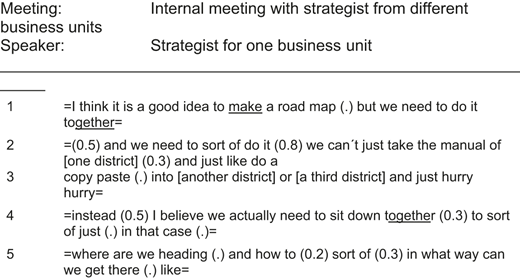
In the first round of selecting data for analysis, the transcribed empirical material was carefully read to find dialogues where collaboration was mentioned. One recurrent issue was found in seven different meetings (see Table 1), concerning sustainable urban development collaborations concentrating on the development of one city districts at the time.
Explanation the meeting (1–7) and project phase (1–4) from which each of the four extracts (A–D) were chosen
| Project phase | Meetings related to collaboration on district level | Extracts selected for further analysis |
|---|---|---|
| 2 | 1. Stakeholder dialogue with a client, a property owner in a city district | |
| 2 | 2. Dialogue with the municipality in a meeting with the Steering committee for Urban development | A. One of the managers from the municipality raises the issue of collaboration at the district level |
| 3 | 3. Internal meeting with strategist from different business units of Middletown Energy | B. A strategist from one of the business units reflects on stakeholder dialogues and collaboration at the district level |
| 3 | 4. Internal workshop with the top management team and other key employees of Middletown Energy | |
| 3 | 5. Internal meeting with strategist from different business units of Middletown Energy | C. Another strategist from one of the business units reflects on collaboration at the district level |
| 3 | 6. Planning for the follow-up dialogue with the municipality | |
| 4 | 7. Follow-up dialogue with the municipality in a meeting with the Steering committee for Urban development | D. Manager from the municipality responds to the idea of collaboration at the district level |
Source(s): Authors’ own work
Zooming in on the parts of the seven meetings when district-based collaborations was being discussed, a new, further detailed, round of transcription was performed, using a simplified version of Jefferson (2004) notations (see Table 2). This renewed transcription proved to be an important and useful way to become further acquainted with the material and allowed for capturing how responsibility for sustainable urban development is collectively enacted in dialogue.
Transcription symbols, simplified version of The Jeffersonian Transcription System
| Symbol | Definition and use |
|---|---|
| = | End of one sentence and beginning of next begin with no gap/pause in between |
| (.) | Brief interval, usually between 0.08 and 0.2 s |
| (1.4) | Time (in absolute seconds) between end of a word and beginning of next |
| Word | Underlining indicates emphasis |
| >word< | Right/left carats indicate increased speaking rate (speeding up) |
| <word> | Left/right carats indicate decreased speaking rate (slowing down) |
| w(hhh)ord | Indicates abrupt spurts of breathiness, as in laughing while talking |
| [ ] | Analyst comments or descriptions |
Source(s): Authors’ own work
To analyse how shared responsibility is constructed through the use of discourses a discursive psychology approach (Edwards and Potter, 1992; Wetherell and Potter, 1993) is applied. With this approach, shared responsibility is seen as something that is constructed on an ongoing basis through talk and text in negotiation (Potter, 1996) and the construction is the sum of micro-level communicative practices. Since all communicative practices are constructed from a range of rhetorical resources, for example, arguments, metaphors, anecdotes, terms or factual descriptions (Potter, 1996), a useful way of analysing how shared responsibility is constructed is by focusing on how rhetorical resources are used to manage dilemmas of stake in dialogue.
For this, four extracts (A-D, see Table 1), that specifically show how dilemmas of stake pertaining to shared responsibility are managed in dialogue, were chosen in a second round of selection. The four extracts were translated from Swedish into English, accounting for original language nuances and making the extracts understandable, thoroughly checked against the original transcripts throughout the analysis. Each of the translated four text extracts (A-D) were scrutinized to understand the linguistic constructions of what may be at stake by paying attention to how rhetorical resources in terms of pronouns (I, we, they, you) were used and how these relate to the context in the transcript and for whom, and the potential consequences that may be communicated in this negotiation (i.e. the dialogue in the transcript). Moreover, attention was paid to rhetorical resources related to agency for assuming responsibility, how these are used and relate to the context, ad what consequences this may have.
Findings: negotiating shared responsibility
In the selected extracts (A–D), three overall findings were found to be consistent. The first was the linguistic construction of the respondents as willing to take responsibility for sustainability. As sustainability is commonly constructed as urgent and important in Swedish media and public debate and is mandatory (legal) for public sector organizations, we can assume that it is not possible for the participants to explicitly state not taking responsibility for sustainability.
A second finding was that responsibility for sustainability is never ascribed to a “they”. In turn, this led to the third finding: responsibility can only be associated with an “I” or a “we”. However, in the conversational sequences “I” and “we” can vacillate. Thus, who is included in an “I” or a “we” changes as the sequence “flows”, within the same extract or within the same sentence. The use of “I” or “we” can differ depending on the individual, function, unit or organization, or with regard to several functions, units, organizations, society and possible several generations.
To visualise the overall findings, one of the extracts (A) from a dialogue meeting (phase 2 of the project) will be presented in full below. Using this extract, we identify sequences that illustrate four ways to position responsibility. Here one of the managers from the municipality brings up the issue of collaboration at the district level.
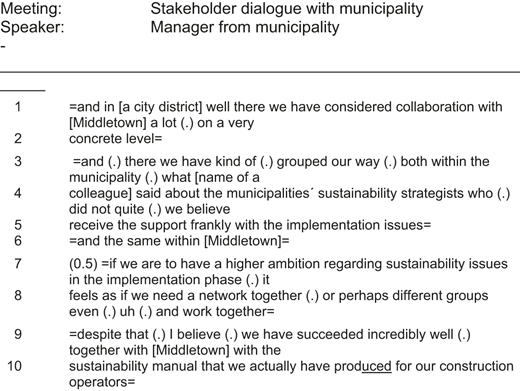
Below, four ways that responsibility is positioned in the extract will be further detailed, one at the time. To ensure consistency between the findings and to display the richness of the data, sequences from the other three extracts are presented thereafter.
Constructing a narrow “I” or “we” willing and able to take responsibility
In the first sequence (extract A, row 1–2), a narrow “we” is constructed as willing to take responsibility and able to do so.

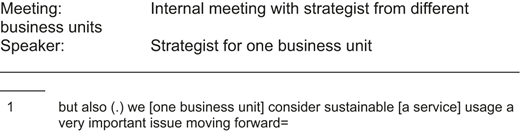
Here, “we” implies that the municipality is separate from the municipal company, Middletown, as is the subject of responsibility. By referring to what has been done (“we have considered collaboration with”), the speaker linguistically demonstrates how the organization is both willing and able to share responsibility. This way of positioning oneself as willing and able is common in all the extracts as show in the following example.
Proof quote (Pratt, 2008) from extract B is one example:
Constructing a narrow “I” or “we” as willing but not able to take responsibility
In the sequence below (Extract A, rows 3–6) the speaker manages responsibility by using the pronoun “we” to construct the speaker’s own organization as wanting to take responsibility but lacking agency.

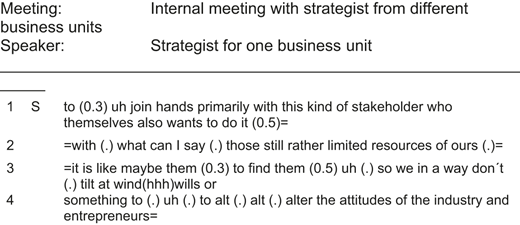
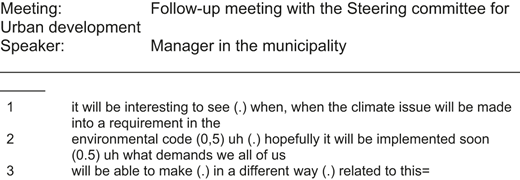
The speaker manages responsibility by positioning the first “we” as the speaker’s own organization (the municipality), separate from Middletown, and thereby constructs a narrow “we”. While the organization is positioned as willing to take responsibility for sustainability (“we have kind of (.) grouped our way”) this is not possible due to others (“did not quite (.) we believe receive the support”). The inability to take responsibility is thus rhetorically managed by addressing circumstances beyond the speaker’s control, constructing it impossible to take responsibility or conveying a lack of agency – that is consistent with Potter’s (1996) notion of out-there-ness. This way of constructing a narrow “we”, willing but not able to assume responsibility, reoccurs in the other extracts. Two examples follow.
Proof quote from extract B:
Proof quote from extract D:
Constructing a wider “we” as willing but not able to take responsibility
In the second sequence, presented in the quote (Extract A, rows 7–8), the speaker positions shared responsibility by using the rhetorical resource of pronouns (we) and addressing circumstances (ability) for constructing the own organization as wanting to take responsibility but lacking agency.

Here, the first “we” points to the speaker’s organization as willing (“ = if we are to have a higher ambition”) or includes both the speaker’s organization and Middletown Energy (as two organizations with higher ambitions). This sets up the transfer to a wider “we”. The second “we” includes both the municipality and Middletown Energy. However, even if the speaker assumes responsibility for sustainability, the first “we” implies that the ambition at this point might not be “higher”, whereas the second “we” points to a current lack of a network (“we need a network together”), which inhibits responsibility. By doing this, the wider “we” manages the question of higher ambition responsibility for sustainability. This constructs responsibility as something that can be assumed in collaboration, but again points to Potter’s (1996) notion of constructing a lack of agency, and in turn avoiding responsibility, by referring to out-there-ness.
Constructing a wider “we” as willing and able to take responsibility
A wider “we” could encompass several functions, units, organizations or generations and’ may be positioned as both willing and able to assume responsibility for sustainability (rows 9–10).

The first “we” refers to the speaker’s organization, whereas the second includes both the speaker’s organization (the municipality) and Middletown Energy. By pointing to past success (“we have succeeded incredibly well together”), the speaker positions the collective “we” as willing and able to share responsibility.
In this sequence, the speaker positions the wider “we” in relation to yet other actors in the district development (“our construction operators = ”), who are positioned as “they”. Rather than linguistically including them in an even wider “we”, “they” are positioned as recipients of the work produced for whom the “we” referred to, the Municipality and Middletown, take responsibility. Constructing a wider “we”, willing and able to assume responsibility, is also found in other extracts, here illustrated by one example.
Proof quote from extract C:
Two continuums of who and agency
Here, the positioning of “I” and “we”, and the construction of the ability to assume responsibility, are constructed along two continuums. Along the first, the speaker positions himself or herself as “I”, the narrow function, unit or organization, relative to the wider entity of several functions, units, organizations, etc. This positioning could stretch even further and include society, nations or generations. Thus, the first continuum constructs who is responsible for sustainability through a fluctuating “we”.
The second continuum pertains to discursive constructions of agency: the ability of the who to assume responsibility. As the unwillingness to accept responsibility is nonoptional, the different “I” and “we” must position themselves as willing to assume responsibility. As Potter (1996) acknowledge, despite such willingness, rhetorical resources may be used to construct obstacles beyond the control of the speaker, that is circumstances as objectively “out there”, independent of the speaker. This second continuum ranges from discursive constructions of the inability to assume responsibility, due to circumstances preventing responsibility, to constructions of the ability to assume responsibility without anything standing in the way.
The two continuums are shown in Figure 1, including the four rhetorical positions explained above.
 The horizontal axis runs from left to right, labeled on the left as “I (me or my organization)” and on the right as “We (several units, several organizations)”. The vertical axis runs from bottom to top and is labeled at the top as “Out-there-ness”. Each quadrant contains a rounded rectangular box with the following text: Top-left quadrant: “I want to but can’t because of ellipsis”. Top-right quadrant: “This is everyone’s responsibility”. Bottom-left quadrant: “This is my responsibility”. Bottom-right quadrant: “This is our responsibility”.
Responsibility between who and agency
The horizontal axis runs from left to right, labeled on the left as “I (me or my organization)” and on the right as “We (several units, several organizations)”. The vertical axis runs from bottom to top and is labeled at the top as “Out-there-ness”. Each quadrant contains a rounded rectangular box with the following text: Top-left quadrant: “I want to but can’t because of ellipsis”. Top-right quadrant: “This is everyone’s responsibility”. Bottom-left quadrant: “This is my responsibility”. Bottom-right quadrant: “This is our responsibility”.Responsibility between who and agency
Discussion
The first continuum displays a linguistic distribution of responsibility between a narrow “we” (one’s unit or organization) and a wider “us” (several units or organizations). Who is responsible is thus displayed using a range of rhetorical resources – such as the use of pronouns. The matter of expressed agency along the second continuum, the discursive construction to assume responsibility, ranges from being prevented due to obstacles (out-there-ness) to accepting and assuming responsibility which might rely on arguments of more favourable circumstances (in-here-ness). Actors use out-there-ness to avoid responsibility, that is to discursively construct something as objectively independent of the speaker (Potter, 1996), whereas in-here-ness is used to denote the act of assuming responsibility. These findings illustrate how fragile the construction of shared responsibility is in negotiations of collaboration for sustainable urban development. The linguistic position where the actors share responsibility, that is constructed as both able and willing to take responsibility and as sharing a collective identity, is not accomplished once and for all in a linear process, but is continuously being negotiated in communication.
The study adds to the literature on collaboration and how assuming shared responsibility as discursive action presupposes both a discursive construction of in-here-ness and a discursive construction of collective identity. The construction of in-here-ness and collective identity are accomplished by using certain rhetorical resources. It also shows that collective agency is a process of emergence based of communication and that communicative practices (in text or talk) may accomplish the collective agency needed to carry out what can only be accomplished in collaboration – a finding consistent with what Koschmann et al. (2012) argue. Moreover, the study points to the fragility of localized discursive constructions of willingness to accept forward looking responsibility as a collective “we”. In previous research, this has been described as prerequisites for shared responsibility in practice (Björnsson, 2020; Schwenkenbecher, 2019).
As a rhetorical resource, in-here-ness is used to discursively construct agency for taking responsibility. Rather than avoiding responsibility by linguistically redistributing stake in negotiations (Potter, 1996) by using accounts that justify, blame or explain circumstances as objectively outside of the speaker’s control, in-here-ness is used to convey willingness and ability to take responsibility. By linguistically embracing stake and showing interest by using accounts positioning the speaker as able and willing to make a difference, stake is transferred to the speaker and responsibility is acknowledged as possible and desirable. Thus, in-here-ness constructs responsibility as an obligation and as objectively possible for a speaker. In-here-ness, admittedly is just one aspect of shared responsibility, yet one necessary for responsibility to be accepted and assumed, whether separate or collective.
At the same time, in-here-ness can be used to ignore actual and non-discursive circumstances making assuming responsibility for sustainability impossible. Out-there-ness can be used even if the speaker is formally and practically responsible (e.g. required due to a role in the organization). Thus, negotiating responsibility as possible and attainable, or as impossible or unattainable, has different outcomes in conversations and impacts the prospects of assuming responsibility for sustainably in practice. Thus, rhetorical resources are not absolute but relative. They can be used as a juxtaposition with respect to other actors to manage stake or dilemmas making responsibility visible and possible to negotiate.
By illustrating how fragile the discursive construction of shared responsibility is, how it is a process of emergence based of communication and by introducing in-here-ness as a counter-discourse to the use of out-there-ness (Potter, 1996; Gilbert and Mulkay, 1984) a theoretical contribution is made to previous literature on organizational collaboration (e.g. Bryson et al., 2006; Koschmann et al., 2012; Emerson et al., 2012).
Moreover, this study adds to the literature on collaborative ways of organizing and managing complex public challenges (e.g. Bryson et al., 2006; Koschmann et al., 2012; Emerson et al., 2012). By recognizing shared responsibility as a product of situational outcomes, it also contributes to the empirical field of sustainable development – involving municipalities, municipal companies and private corporations (Taylor et al., 2021; Fox and Macleod, 2022; Fenton and Gustafsson, 2017). The study shows a complex dialectic between the individual (micro-level) and the collective (macro-level) in collaborations that becomes echoed in sustainable-unsustainable and responsible-and irresponsible practices. By highlighting the importance of communication, particularly the use of rhetorical resources, and how managing responsibly together unfolds constantly, the findings add to the understanding of why operations in organizations, despite claiming responsibility for sustainability, seem to fall back on a “business as usual” approach (Taylor et al., 2021).
Conclusions
Drawing upon on discursive psychology and a one-year project on how to manage interorganizational collaborations in a municipal energy company, this study shows how shared responsibility is discursively constructed in negotiations.
Previous research posits a need for detailed studies of collaborative ways of organizing and managing complex public challenges (e.g. Bryson et al., 2006; Koschmann et al., 2012; Emerson et al., 2012). Further, Stokes and Harris (2012) have stressed the importance of thorough investigations of critical micro-moments impacting (un)sustainable and (ir)responsible behaviour on an organizational macro-level. This study adds to the understanding of how shared responsibility is assumed, or opposed, through micro-level negotiations. The findings build on, and nuance, the results from previous studies which explored collective agency as a communicative accomplishment (Koschmann et al., 2012).
An empirical contribution is made to the field of sustainable development at the municipal level (Taylor et al., 2021; Fox and Macleod, 2022) by illustrating how a fragile the discursive construction of shared responsibility is and how important rhetorical resources (e.g. pronouns and in-here-ness), are for collaboration on sustainability to move towards the agenda 2030 goals. This study can equip scholars and practitioners to understand the subtle linguistic processes present in the struggle to legitimate organizational responsibility. In future research on responsible management as shared between organisations, the concept of in-here-ness deserves further attention.
Declaration of interests: Karin Ahlström was at the time of the study an Industrial doctoral student, employed by Mälarenergi AB and associated with Mälardalen University. Both Karin Ahlström and Mälarenergi AB were associated to the research school Future proof cities and thereby financially supported by the Swedish Knowledge Foundation (kks.se) under grant nr 20190129. Mälarenergi AB is also the case of the study this article is based on.
Proof of consent statement: The manuscript contains one figure and two tables, all source of the authors own work. Thereby no additional consent or permissions are required.

