


This manuscript presents a process for students to identify, articulate, and refine their intrinsic assumptions and beliefs about leadership character virtues. A leadership virtue is a deep property of leadership character encompassing habituated thoughts, emotions, motivations, and intentions. Increasingly, scholars are calling for an exploration of character in leadership development. Accordingly, this exercise aims to help students develop greater self-awareness and deepen their intentions about the dimensions of character that are important to them, fostering a sense of introspection and personal growth.
This activity invites students to explore and practice virtues they may want to be known for as leaders. Specifically, this activity introduces students to the essential elements of any human virtue: benefits, behaviors, mindset, emotions and balance.
Students who complete this exercise feel a stronger sense of purpose in whom they strive to become leaders.
The most important value of this exercise is the holistic framework for unpacking the different dimensions of character virtue. The exploration of virtues in leadership education needs to account for the complexity of character virtues.
This approach is consistent with calls from scholars in virtue ethics and positive social science for more robust theories of virtues. Every student will benefit from the opportunity to reflect on their assumptions about beliefs about how to develop and exercise leadership character. Leaders may repeat this exercise as they mature and their character is tested.
This activity invites students to explore and practice virtues they may want to be known for as leaders. More specifically, it introduces students to a theoretical framework that helps them articulate the dimensions of any human virtue: benefits, behaviors, mindset, emotions, and balance. Students learn about this framework by researching several virtues in a team assignment. The process culminates in a capstone project in which they use this virtues framework to identify and articulate the leader virtues that they most want to be known for.
Background
Scholars and practitioners have increasingly emphasized the importance of character in leadership, often framed as virtues or strengths (Crossan, Seijts, & Gandz, 2016; van Zyl, Gaffaney, van der Vaart, Dik, & Donaldson, 2023). This movement began with the rise of virtue ethics, as influenced by philosophers such as Anscombe (1958) and MacIntyre (2007). Examining virtues has become a core element of research in the positive social sciences (Bright, Winn, & Kanov, 2014; Cameron, Dutton, & Quinn, 2003). Peterson and Seligman (2004) were the first to publish a foundational typology of virtues. More recently, scholars such as Crossan et al. (2016) and Quinn (2015) have further established the role of character as an essential attribute of leadership effectiveness.
In recent years, several scholars have expressed concerns about how social science addresses the study of character virtues (van Zyl et al., 2023; Newstead, Macklin, Dawkins, & Martin, 2018). One of the most potent critiques is that character virtues are often operationalized in research through a reductionist lens, leading to an incomplete, fragmented understanding of what a character virtue may entail. In addition, there may be a wide variance in the pragmatic conceptualizations of virtue among people in general (Bright et al., 2014). These observations have led to calls for holism and more pluralism in teaching about and discussing the potential meanings of virtues in daily practice (Crossan et al., 2016; Bright et al., 2014). The approach outlined in this article is intended to address this challenge, inviting students and teachers to articulate, unpack, and explore the complex ideas they may hold about leadership character virtues.
Basic premises
A virtue is a deep trait encompassing habituated behavior, thought, emotion, and volition (or will). Scholars have demonstrated that virtues such as courage, compassion, drive, wisdom, humanity, and accountability are common character traits in influential leaders (Crossan et al., 2016; Hackett & Wang, 2012; Peterson & Seligman, 2004).
Any virtue is a practice encompassing a complex set of habits and skills developed and refined over a lifetime (Fowers, Carroll, Leonhardt, & Cokelet, 2021). These habits of being (Bright et al., 2014) allow a person to enjoy the benefits of overcoming a difficult challenge or dilemma in the human experience.
For example, a person who cultivates the virtue of courage learns how to deal with the challenge of fear in a way that helps a person maintain a sense of self-efficacy and confidence. Additionally, a courageous person enjoys the admiration and trust of others who may look to them as a source of inspiration, energy, or motivation. These benefits accrue and may become a significant resource as a person consistently and effectively overcomes their fears.
Such habits become trait-like when they are integral to a person’s character. A virtue becomes a “second-nature” trait when practiced with excellence and consistency, meaning it becomes an intrinsic aspect of a person’s character [1].
A holistic approach to articulate and explore leadership virtues
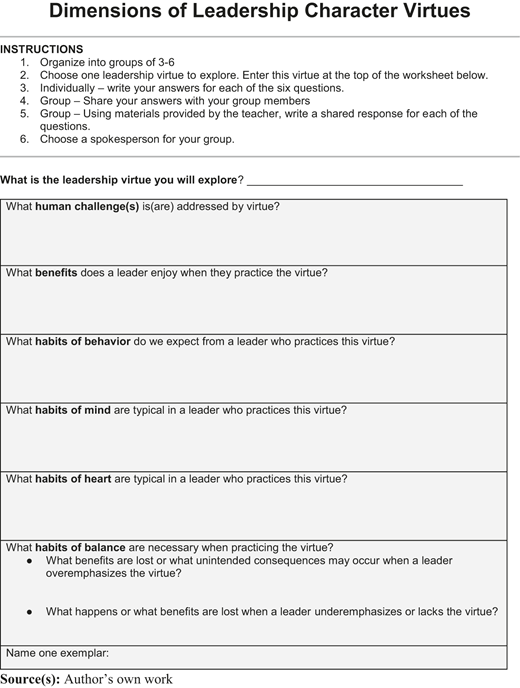
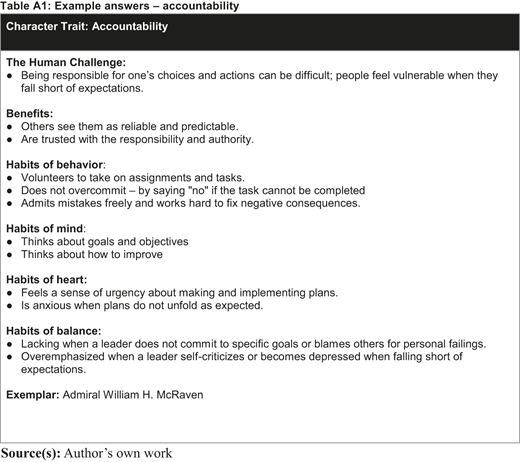
For this exercise, we specifically encourage students to consider six questions, each tied to an element of a leadership virtue. I will illustrate using the virtue of accountability (see Appendix 1- Table A1), a commonly identified character virtue of effective leaders (Crossan et al., 2016) [2].
What human dilemma is resolved or addressed through the practice of the virtue?
Every virtue helps a person overcome a challenging aspect of human nature. Such dilemmas may entail dysfunctional tendencies, where people intrinsically avoid painful emotions or experiences, or broader challenges that can affect society more broadly. Examples include dealing with fear (addressed by courage), human suffering (addressed by compassion), or laziness (addressed by drive). Articulating the human dilemma helps students understand the “why” or purpose of practicing and developing the virtue.
As illustrated in Appendix 1- Table A1, accountability may address the stigma or feelings of embarrassment that may arise when people do not fulfill societal expectations. People also tend to feel vulnerable when they fall short of expectations. When people exercise the virtue of accountability, they create a social context in which these anxieties are prevented or directly addressed.
What benefits does a person enjoy when they practice the virtue?
Virtue ethicists consistently discuss the importance of “goods” that accompany the practice of virtues (MacIntyre, 2007; Bright et al., 2014). These can be intrinsic (e.g. the experience of well-being or eudaimonia) or extrinsic (e.g. benefits of reputation, capacity, or other beneficial outcomes). A clear perspective of a virtue’s expected benefits provides a vision, or compass, that guides the practice of character. Simply stated, if the expected benefits are present around a person, they have reason to believe they are on target in how they exercise the virtue. As an example, the benefits of accountability may include reputation (e.g. being seen as reliable) and social capital (e.g. trust, responsibility, and authority).
What habits of behavior do we expect from someone who practices this virtue?
Through this question, the student outlines the behaviors they might expect to see in a person who practices a virtue. Behaviors might refer to specific actions, competencies, or skills that require practice and mastery over time. All leadership virtues include behavioral expectations: compassionate leaders may be expected to speak kindly to those who are suffering; courageous leaders are expected to speak up when it may be risky; humble leaders might ask questions to seek for others perspectives. Appendix 1- Table A1 illustrates actual, observable actions: consistently arriving on time to meetings, volunteering to take assignments, or declining to fulfill tasks that are beyond one’s capacity, acknowledging mistakes and working to correct failures.
What habits of mind are typical in someone who practices this virtue?
This question addresses the internal dialogue in a person. There may be a particular mindset or types of internal narratives that characterize a person when they exercise a particular virtue. For example, a person who is accountable may consistently think about how to set and achieve goals and milestones with respect to areas of responsibility. This person may also have a habit of thinking about how to make improvements.
What habits of heart are typical in a leader who practices this virtue?
This question addresses the habitual feelings and emotions that support or sustain a person’s exercise of the virtue. Such emotions are often cultivation in connection with the thoughts that a person consistently focuses on. As illustrated in Appendix 1- Table A1, a person may consistently feel a sense of urgency about making and implementing plans, or they may feel anxiety when plans do not unfold as expected.
What habits of balance are necessary when practicing virtue?
This question addresses how to make adjustments in reaction to context. Aristotle calls this the “golden mean” (Aristotle, 1999; Bright et al., 2014). When addressing this question, students describe the unintended consequences that may occur when virtue is overemphasized. Conversely, they describe what happens or what benefits are lost when virtue is underemphasized. For instance, as indicated in Appendix 1 - Table A1, a lack of accountability may be present when a leader does not commit to specific goals or has a habit of blaming others for personal failings. On the other hand, accountability may be overemphasized when a leader is overly self-critical or becomes overly depressed when falling short of expectations.
Description of the pedagogical approach
By addressing the above six questions, students are able to articulate their own comprehensive, holistic “theory-in-use” (Argyris & Schon, 1978) for what they understand the character to entail. This provides them with their own, in-depth model of the character trait that they are striving to develop. Typically, this ownership provides them with greater motivation to actually develop the trait with greater intention.
Students can learn about and internalize this holistic approach to leadership character through an incremental process, beginning with instruction and practice (Phase 1), followed by a deepening of knowlege and skill (Phase 2), and internalizing the process (Phase 3).
Phase 1: introducing through instruction and practice
This phase centers on a group-based discussion that encourages students to think about their own assumptions about a character virtue, listen to others’ perspectives, and work with others to practice using the questions outlined above. Before the class for this topic, it can be helpful for students to complete a set of introductory readings (e.g. Crossan et al., 2016). The instructions for a class activity are outlined in the worksheet found in Appendix 1. First, the students form groups of 3–6 individuals. Second, the teacher reviews the questions in the handout, proving a short theoretical description of each attribute of a virtue. Each group then chooses a virtue to focus on for this exercise.
Third, each student writes answers to the questions from their own individual perspective. Next, the students share their answers with one another. The instructor should encourage group members to listen deeply and to ask clarifying questions as they discuss their perspectives with one another. Then, they develop answers from the group, where they combine the perspectives into a coherent, shared set of perspectives.
At this point, the professor invites each group to report on their work. A representative from each group share the outcome of their discussion. The instructor discusses and clarifies the answers from each group, offering insight, correction, and encouragement where improvements in the language are needed.
The class session culminates with a summary of the critical insights from this exercise, reiterating (1) the elements of character virtues and (2) how to use the questions define any element of character that a student may want to develop. This exercise is usually very insightful for students. They typically learn that there is more to a virtue than they may have assumed. They also find it fruitful to realize that there are often many ways to understand and practice a virtue.
Phase 2: deepening of knowledge and skill
The next phase of development involves students working as a deep to replicate this exercise for a whole set of leadership character virtues (e.g. Crossan et al., 2016). Students work together on this assignment so that they can share their discoveries, thoughts, and ideas with one another about the various meanings of virtues. The instructions for this phase are found in Appendix 2.
Phase 3: internalizing the process
As illustrated in Appendix 3, the capstone project is an individual culminating experience in which the students choose three virtues that they want to be known for. Each student writes an in-depth description for their chosen virtues by following the six questions. The students then prepare a presentation for their future selves in which they describe the leader characteristics that they are striving for. Through this activity, they express their commitment to continue developing character.
Conclusion
In sum, the process and activities outlined in this article help students to examine deeply held thoughts, beliefs, and feelings about leadership character in alignment with recent calls by scholars and practitioners to reemphasize the significance of character in leadership. Most importantly, the series of activities outlined in this paper help students explore and develop virtues they wish to embody as leaders. By addressing critical questions related to each virtue, students learn how to integrate these traits into their leadership practice, fostering the development of leaders with character who are equipped to navigate complex challenges.
Notes
We see this link between person and character in the way that a person is described in common vernacular. In popular speech, it would atypical to say, “John demonstrates attributes of compassion.” Instead, we say, “John is compassionate.” This way of referring to character in common speech demonstrates the degree to which people can be tied to virtuous traits in the way that we think and talk.
Due to space constraints, these questions are only briefly explained. More substantive teaching and theoretical notes are available upon request from the author.
Appropriate courses: Leadership Development, Business Ethics, Introduction to Management.
Author note: Versions of this exercise were presented at an October 2022 Babson College retreat at West Creek Ranch, Montana (sponsored by the Arthur M. Blank Family Foundation) and at the 2023 Academy of Management Annual Meeting. I also thank the many students who have completed versions of this exercise in numerous classes during the past six years.
References
Further reading
Appendix 1 Sample handout
Appendix 2 Instructions for group assignment on leadership character
Explore leadership character virtues
In this exercise, each group will explore several leadership virtues. You should address the following instructions for all eleven virtues in the Crossan et al. (2016) model.
Explore the research and philosophy that exists on each virtue. Find a minimum of three resources for each virtue from well-regarded sources such as academic journals or books.
Write answers to all six questions for each of the virtue. Use the format outlined in the worksheet you received in class. Make sure to include a list of the resources at the end of each virtue.
Prepare a ten-minute workshop for our class to learn about two of the virtues. Make sure that the workshop is creative, interactive, informative, practical, and polished. Participants should leave your workshop with a better understanding of the trait and how to develop it
Key resource: Crossan et al. (2016)
Appendix 3 Instructions for the leadership character capstone assignment
Your character and future as a leader
This exercise will help you to clarify the character traits that you see as defining your leadership. You will develop a personal definition of the leadership virtues that are most important you. Then you will establish a plan for working on these character habits after this class is completed. This assignment includes both a written and oral component.
WRITTEN ASSIGNMENT – Part one: developing character traits
Complete the following instructions:
Choose THREE character virtues that you would like to develop as a leader. Think of these as the virtues you MOST want to be known for.
Using the model of virtues we have discussed in this class, describe YOUR perspectives on these leadership virtues.
ORAL ASSIGNMENT – Part two: a message to your future self
Create and post a video on the class website. Imagine that you are talking to your future self. Convince your future self of your potential to be an outstanding leader. In your presentation, you should address the following:
Who am I? Drawing from the self-reflection exercises of this class, provide a perspective about who you are when you are at your best.
Your Character: Include your three signature virtues and how you define those virtues.
Future Best Self: Describe your future as a leader.
How You Will Change: Describe what it will feel like to be at your best 3–5 years from now.
Your Commitment: Describe what you will do to be your best self. Use “I am” or “I will” statements.

