


Traditional K–12 leadership programs often rely on compliance-based character-education curricula that emphasize behavior management rather than empowerment (Baker, 2024). Such approaches overlook the lived realities of poor and working-class youth of color and rarely provide opportunities for structural critique or civic engagement. K–12 leadership education should be reimagined through a “desire-based” framework – one that centers community knowledge, student advocacy, and structural critique (Tuck, 2009). To transform school culture, leadership development must affirm the humanity, resilience, and brilliance of marginalized students (Baker, 2024; Love, 2019).
This pedagogy paper presents an illustrative case of a justice-oriented leadership curriculum implemented in Clarke County, Georgia (2017–2023). Rather than positioning the course as a universal model, the manuscript offers a contextually grounded example of how justice-oriented, culturally sustaining leadership pedagogy can be enacted within a Title I public school setting. Drawing on activist and participatory pedagogies, the article details curriculum design decisions, classroom practices, and structural constraints to support leadership educators seeking adaptable approaches rather than prescriptive programs.
A 5-year, multisite youth mentor program in Athens, Georgia, included increased student agency, critical inquiry, and engagement across academic tracks, highlighting both the transformative potential and institutional challenges of situating leadership development within high-poverty schools. These programs are replicable and transformative in traditional public Title I schools.
The article concludes with recommendations for educators seeking to move beyond character education toward humanizing, justice-oriented leadership curricula that affirm student brilliance and cultivate collective hope for school transformation. This article urges administrators and educators in Title 1 schools to forge partnerships between counseling and teaching staff, and to encourage and invest in local, ground-up leadership curriculum that addresses local and specific history and social ills that plague school communities and isolate and stigmatize youth.
Efffective grassroot educatorsin Athens, Georgia have moved beyond character education toward humanizing, justice-oriented leadership curricula that affirm student brilliance and cultivates collective hope for school transformation. Administrators and educators in Title 1 schools should forge partnerships between counseling and these teaching staff, and encourage and invest in local, ground-up leadership curriculum that addresses local and specific history and social ills that plague school communities and isolate and stigmatize youth.
Moving beyond empowerment, transformative opportunities in student leadership development will need to affirm other values than compliance. The author's use of activist pedagogies provides an interesting re-examination of conventional leadership development theories of action.
Introduction
Developing leadership in impoverished youth of color should instill in them what psychiatrist Frederic Wertham described as the “will to survive in a hostile world” (“Medicine: Psychiatry in Harlem,” 1947). All too often, scholarship on student leadership and civic engagement fails to recognize the importance of youth activism among modern, poor youth. As Kirshner (2015) explained, in most educational settings, marginalized youth can “interpret, critique, and, sometimes, take action to change oppressive conditions” (p. 55). Yet what could marginalized youth accomplish, particularly if supported by educators and researchers, for long-term, sustained transformation of school district policy?
School-based leadership programs emphasize personal responsibility and individual behavior over systemic critique (Kirshner, 2015). According to Love (2019), such programs often focus on the concept of “grit,” which refers to a personal ability to “sustain interest in and effort toward very long-term goals” and, in educational settings, is strongly correlated with “attainment and performance” (p. 7). This exclusive focus on personal characteristics, however, “leaves social conditions unexamined and reinforces the myth of self-reliance” and “by definition does not get at the roots of the structural contradictions that many young people face” (Kirshner, 2015, p. 7). The cultivation of grit could help youth defy the odds, but it does not challenge or change their environment, particularly in an era when social mobility is stagnant and income inequality is growing. As Fox et al. (2010) have explained, character education enforces that only those students who demonstrate “ethical behavior” in school are leaders. Within this framework, leaders are expected to model to others how to be submissive to rules within schools. These programs often reflect broader conservative frameworks designed to maintain civil order rather than empower youth for social transformation.
Often, leadership courses in urban schools reduce students to mere deficits, focusing on behavior management or vocational training rather than leadership development (Scott, Davis, & Lopez, 2022). As Irizarry and Brown (2014) explained, the pressure to “close the achievement gap” has led Title I schools to “intensify discipline and control, narrow the focus and flexibility of the curriculum, and focus on test preparation in a way that equates becoming educated with performance on standardized tests” (p. 63). Although teachers and administrators have no nefarious intentions, the pressure from government and state powers to prove academic gains leads to a culture that focuses on rote memorization. As Rhodes (1994) has explained, such approaches perpetuate the myth of meritocracy, positioning students of color as needing “dummied down” curricula and stricter behavioral control (Normore, Moyer, & Bickmore, 2007). Brown (2009) has warned that such programs can function as “etiquette courses” intended to condition students – particularly Black and Brown youth – into white, middle-class behavioral norms. This educational climate ends up devaluing critical thinking, creativity, and empathy – three skills vital to civic engagement (Freire, 1970; Love, 2019).
In 2025, the Clarke County School District (CCSD) in Georgia purchased Leader in Me, a leadership curriculum developed by Franklin Covey (Fonzi & Ritchie, 2011), for an estimated district-wide cost of $50,000. The program was introduced in a context where, according to 2023 Census data, nearly 25% of Clarke County children live in poverty. Specifically, 22% of African Americans are below the poverty line, and 15.5% of Hispanic families, a massive disparity compared to 6.1% of white families below the poverty line (National Institute of Minority Health, 2025). While the final board-approved budget has not been located, this initiative marked the universal implementation of a structured social-emotional learning (SEL) curriculum during high school advisement and “enrichment learning time” in elementary and middle schools, which sometimes seems disconnected from the realities of urban youth. Because the curriculum does not specifically address the challenges unique to students' realities, their struggles are framed as individual problems rather than structural issues that can be collectively fought against.
Literature review
Providing leadership opportunities for students of color has been shown to decrease disciplinary action against youth of color (Gooden & Dantley, 2012). Particularly in high-need, urban schools, educators and staff often spend much of their time on “discipline prevention, not student leadership development, especially for African Americans and Latinx students” (Scott et al., 2022, p. 124). Such a focus can leave students out of spaces in which they should naturally be engaged.
Traditional pathways to leadership typically privilege middle-class norms and exclude low-income students who may exhibit leadership differently (Williams, Larke, & Thompson, 2021). Student councils typically draw from youth who already possess the cultural and social capital to campaign successfully, while leadership courses often uplift students who meet behavioral or academic standards, reinforcing structures that exclude marginalized voices (Stewart & Williams, 2019; Winn, 2020). Furthermore, leadership is often equated with compliance and academic success, ignoring informal leadership displayed by students who may struggle academically (Ford, 2011; Kirshner, 2015).
Leadership educators often develop students who are merely well-behaved so that they “provide a model for others of personal responsibility and ethical behavior” (Aldrich et al., 2003, p. 5). Even if students of color are present on student councils or in leadership classes, they may be praised because of their behavior or work, not for their humanity (Winn, 2020, p. 121). Furthermore, as Scott et al. (2022) explained, “Teachers are often aware of who the informal leaders are in the classroom” (p. 125), and Ford (2011) has pointed out that leaders are not always “the talkative students or the ones whose grades are the highest” (p. 128). Moreover, it is common to have a minimum GPA requirement to run for student councils (Kirshner, 2015), which can further exclude some natural leaders.
From 1995 to 2011, just nine peer-reviewed studies were published on “youth organizing” and “youth activism,” with hardly any school-based courses (Kirshner & Ginwright, 2012, p. 289). As Kirshner and Ginwright (2012) explained, “youth activism is an emerging domain of research” (p. 289). Youth leadership programs have historically thrived outside of traditional schools. Kirshner and Ginwright also found that of 160 youth organizing groups nationwide, nearly half had been founded since 2000, with significant growth in the South and Southwest (pp. 288–289). These programs flourish partly due to their structural freedom and intergenerational models. Kirshner (2015) found that youth-only movements often lose momentum when participants age out, whereas intergenerational groups – with steady adult leadership – ensure sustainability (pp. 78–79).
The official SEL curriculum implemented in CCSD is Leader in Me. However, research on Leader in Me remains limited and inconclusive. SEL programs in general, particularly those that lack rigorous evaluation, have largely been indicated as failing to achieve meaningful outcomes (Fonzi & Ritchie, 2011). As Goble et al. (2015) discovered, “No significant difference was found between The Leader in Me schools and non-Leader in Me schools on social emotional constructs” (p. 1). The Institute of Education Sciences (Sparks, 2011) found that seven widely adopted character education programs yielded no significant social or academic gains. Another study reported that only 14% of 80 national programs evaluated demonstrated effectiveness (Zins, 2004). Furthermore, CASEL reported that programs implemented by external facilitators rather than classroom teachers resulted in lower impact (Payton et al., 2008).
While some research has noted that students perceive programs like Leader in Me as reducing classroom conflict (Humphries, McArthur, & Shanklin, 2015), challenges often arise during implementation. Such issues are often exacerbated when programs are not contextually grounded in the realities of students' poverty, racial inequity, or local history.
Leadership education should be grounded not only in character development but in healing and justice. Ginwright (2015) has argued for a “radical healing” model – one that addresses trauma while promoting social change. This perspective draws from liberation psychology (Gondra, 2013), sociotherapy (Fanon, 1961/2007), and critical pedagogy (Freire, 1970), emphasizing the need to humanize leadership education within the context of structural oppression. In the process of this curriculum implementation, some of the most brilliant and fearless leaders within Title I schools are disciplined and silenced at an early age. If the goal is to cultivate transformative leaders, especially within Title I schools, educators must design and implement leadership programs that validate students' lived experiences, prioritize critical inquiry, and teach students to question the system and speak up about the injustices they witness (Tuck, 2009).
Peer leadership in Clarke County: an illustration of a justice-oriented implementation
This section is offered as an illustrative pedagogical case, not as a standardized or universally replicable model. The Clarke County peer leadership course reflects one locally situated response to racialized discipline, academic tracking, and youth marginalization within a Southern Title I district. While the specific historical, racial, and institutional conditions are unique, the pedagogical commitments – centering student agency, justice-oriented inquiry, and community knowledge – are intentionally articulated to support adaptation across diverse educational contexts.
Athens, Georgia, has a complicated racial history whose challenges continue to be reflected in its public schools. In 2016, for example, Clarke County conducted more than 200 disciplinary hearings for middle- and high-school students; nearly 85% of these involved African American students. In 2017, when the program began in Athens, Black students comprised only 49% of the student body but were involved in 80% of disciplined “behavior incidents” (Clarke County School District, n.d.).
School spaces in Athens, particularly those for high-achieving students, are informally but heavily segregated, and mentorship programs reinforce these gaps among students of varying backgrounds and experiences (Fine, 2018), often resulting in some students being ignored as leading “throwaway lives” (Shalaby, 2017, p. xvii). Against backgrounds like this, however, educators can create spaces of belonging for students by intentionally “chip[ping] away at the ills of historical neglect and find ways to forge ‘pockets of hope’ within these communities” (De los Reyes & Gozemba, 2001, p. 658).
The Peer Leadership course, initiated in Clarke County and taught from 2017 to 2022, sought to create authentic avenues for leadership by intentionally connecting students across grade levels and academic tracks. In this work, our team of researchers employed a culturally sustaining participatory framework (Paris & Alim, 2017), one that centers youth funds of knowledge (Moll, Amanti, Neff, & González, 2006) and aims to disrupt the white gaze (Yancy, 2025). Within this framework, students co-constructed meaning by blending home, school, and community knowledge into leadership work that reflected their lived realities.
In order to create a powerful youth mentoring and activist course, educators must strategically work together with the social workers and counselors within a school to identify the students most likely to benefit and thrive in a course focused on critical history and agency. Unlike many traditional leadership programs, GPA was not a criterion for entry. In fact, many students were selected precisely because they had struggled academically in previous years. In this peer leadership course, approximately one-third of the students were mentored by peers and were failing two or more classes, were fighting in school, but would occasionally buy into school with culturally-relevant educators (Ladson-Billing, 1995). Other students were emerging bilinguals and needed extra support and care. These students were mentored over two years and eventually became mentor-activists themselves (Johnson, 2024).
Every year in Georgia, students are asked to complete the anonymous statewide Georgia School Health Survey, responding to a variety of items, such as “I know a student at my school I can talk to if I am feeling sad or down.” In 2017, the year I began the program at my school, 19.29% of freshmen and 25% of sophomores either strongly or somewhat disagreed with this statement (Office of Whole Child Supports [OWCS], 2017). Every year, the survey also asks whether “students in my school are welcoming to new students.” In 2017, 22.85% of freshmen at CSHS and 28% of sophomores disagreed or strongly disagreed with that statement (OWCS, 2017).
By partnering with the counseling staff members of Cedar Shoals HS, I sought to create an improved school environment where students had someone they could talk to if they were “feeling sad or down” and where juniors and seniors could welcome younger students to the school. It was the quarter of the lower school population who disagreed with those statements that we most wanted to reach (Office of Whole Child Supports (2017). Georgia School Health Survey). The goal was to choose mentors and mentees who would benefit from a dialogical peer mentoring relationship. By identifying students who had diverse backgrounds and experiences, we hoped that students would expand their networks of care within their school and community.
Beginnings of the peer leadership program
The peer leadership class was piloted in 2017 at Cedar Shoals HS. Students had to complete an application to be admitted to the program; the application process itself showed students' initiative. The application asked questions about why applicants were interested in the peer leadership program, their plans for connecting and building relationships with their peers, their self-identified strengths, and their interactions with adults in authority positions, among others (see Appendix A for full list of questions). These applications were scored by current peer leaders using a rubric I developed (see Table 1), Peer leaders read the applications and interviewed the applicants, thereby ensuring that the students selected for the program had full peer support from the beginning.
Peer leadership rubric
| Criterion | Score |
|---|---|
| Social charisma | 1, 2, or 3 |
| Familiar with struggle | 1, 2, or 3 |
| Relatable/can connect with a diverse set of people | 1, 2, or 3 |
| Out of the box/creative thinking | 1, 2, or 3 |
| Social power/peer respect | 1, 2, or 3 |
| Empathy | 1, 2, or 3 |
| Authenticity/honesty | 1, 2, or 3 |
| Persistence | 1, 2, or 3 |
| Critical thinking | 1, 2, or 3 |
| Emotionally aware/vulnerability | 1, 2, or 3 |
Note(s): Scoring range 1–3; higher numbers indicate a stronger demonstration of the criterion
Bridging unforeseen gaps
Initially, in 2017, the program was envisioned as a summer literacy and peer mentoring program. The mentors were “high-achieving” students, but they had not been taught the critical racial history of our Athens community, and this proved to be a problem. The first year, the students developed problematic, racist, and ableist beliefs as they grappled with the “racial vertigo” in the Clarke County School District. After a year, I realized the need that as a classroom community, I had to unpack the situation explained by Ginwright (2015) who explained that young people – especially young people of color – who “have fallen prey to these discriminatory practices often have few opportunities to address the psychosocial harm resulting from persistent exposure to an ‘ecosystem of violence’” (p. 3). As a result, marginalized students may also engage in “horizontal” aggression against one another to be like the powerful, to command their power, to exert dominations over others, and through that domination, achieve a sense of agency and control” (Gaztambide, 2015, pp. 136–137). Kirshner (2015) explained how oppression is internalized “at the political level and at the psychological level,” with psychological oppression being particularly insidious because “people participate in their own marginalization or stigmatization by internalizing the norms and standards of those with the most power” (p. 120). Observations were made of manifestations of internalized oppression and violence play out within the walls of Cedar Shoals HS, publicly in fight culture (Canada, 1996), and on social media communication between students, and privately in conversations I had with students.
As I reworked the peer mentorship program and curriculum to address these local issues, I aimed to expand students' peer group and community to include figures from their community's recent history as well as their classroom peers. Students who might otherwise not engage with each other in their traditional classes were able to find connections to each other that expanded their definition of themselves, and identify the issue in their community.
Leadership curriculum as storytelling
An effective way to instill pride in students was to teach them local stories of their ancestors and local leaders often ignored by the state curriculum. The peer leadership course intentionally introduced students to figures who had contributed to the formation of their community identity.
Every week, community leaders, many of whom I had met while attending a historically Black congregation during my undergraduate degree, came to speak to the peer leaders. Students took notes throughout the dialogue to answer the question: “Why is this person a leader?” These local leaders listened to the ideas, stories, and visions of our student leaders, and the students learned how these Black leaders were part of the genealogy of their city. I welcomed back Black leaders and educators who had been pushed out after CCSD's so-called integration (Knight, 2007, p. 29) and created a space of restorative justice for both the elders and the young people. At the end of the semester, students had to write a paper on their favorite speaker who had inspired them most, which would in turn be shared with the community leaders who had spoken in this class. Importantly, who the students saw as leaders was often different from the prevailing opinions of community members at our local University of Georgia. Cain (all students' names are pseudonyms), a graduate of the program (Baker, 2024), explained the continuing impact of peer leadership on his plans for the future: “I always had that fire in me, knowing that shows how important this was to the people who came before me. And just having the pleasure of being able to continue on and leave my own legacy behind like them” (Baker, 2024).
Understanding the roots of school culture
In addition to expanding students' understanding of their community, I also realized that I needed to unpack the historical and psychological roots of fight and prison culture impacting our school community. To help students understand fight culture as an injustice and their participation in it as perpetuating racist and classist beliefs held by the majority, students/mentors read the graphic novel Yummy (Neri, 2010) and Fist, Stick, Knife, Gun (Canada, 1996), and 50 Cent's memoir Playground (Jackson & Akana, 2012) as core texts. To detail the national historical roots of the American prison system, students read Just Mercy (Stevenson, 2015) as part of a yearlong project. For three years, the course culminated with a completely crowdfunded trip to the Equal Justice Museum in Alabama, which allowed students to explore and contextualize the racial history of not only Clarke County but also most of the Southeastern United States.
Owning self-expression
For many of the students chosen to be in this course together, it was one of the first times that they had met some students from within their own grade cohort, who had always been tracked into different advanced classes (Fine, 2018). As one of my senior peer leaders, Ty Templeton (pseudonym), wrote in his beginning-of-course narrative,
I would not say I grew up in the hood, but at the same time, I did. The environment that I was in taught me a lot about reality – what to do and what not to do. People always call me the ‘odd’ one out of the group, but I look at myself as gifted.
Despite this student's self-identification as gifted, his mother had not requested that he test in the gifted program through the school district. Instead, he channeled his creativity into other venues, such as his popular YouTube and TikTok channels. Deep down, Ty never stopped believing that he had gifts to offer the world: “I'm gifted because I learned how to turn negative things into positive things, and also, I'm way different than the rest of my family. Sometimes people call me ‘white’ because of how professional I look, and how I represent myself” (January 9, 2020). Through the peer leadership class, Ty recognized that he did not need to label his gifts as “white” simply because of the way he dressed and spoke. In response to the question “What did you gain from the peer leadership program at Cedar Shoals?” he replied, “What peer leadership did for me was it showed me that I wasn't in this alone, and I always had peers that can encourage me to do things that I wasn't confident in doing” (Student Exit Interview, 2020).
Addressing racial demographic disparities
Part of the dire need for peer mentoring within schools is to work against racial disparities in the demographics of teaching staff. In 2021, only 26 of the 116 teachers at CSHS were Black, representing 22% of the teaching staff in a school where 51% of the students were Black. Even more egregious, there were just two Latinx teachers, yet 31% of the students were Hispanic. One peer mentor expounded on the effects of these educator demographics and the need for peer mentors:
Sometimes, students at home they don’t got role models or whatever. Their parents might not know the information that they are being taught at school, so, they [mentees] got us [peer mentors] -- it’s like a job -- for us, but we don’t get paid. We do it because we want them to succeed and do great things in life -- because you know kids be all depressed and stuff. (Jan 24, 2018)
Allen hit on the need to have students of color bridge the information divide separating other students of color from thriving in school spaces.
In 2019, the peer leadership class was designed to intentionally mirror the racial demographics of the school, which has, to my knowledge, never been attempted before for a gifted class in Clarke County School District. Of the 1,276 students enrolled at CSHS, 55 were enrolled in the peer leadership course this year. Table 2 summarizes the racial and ethnic demographics of the peer leadership class and the CCHS student body for the 2019–2020 school year.
Demographics of CSHS peer leadership and student body, 2019–2020
| Peer leadership | CCHS student body |
|---|---|
| 27% Hispanic (15 students) | 28% Hispanic |
| 52% Black (29 students) | 52% Black |
| 14% White (8 students) | 14% White |
| 2 students identified as multiracial | |
| 1 student identified as South Asian (Nepalese) |
Additional support for similar types of leadership curricula
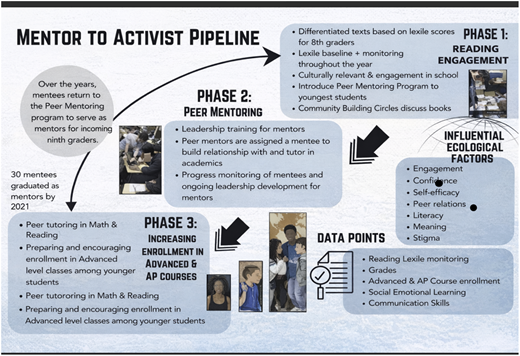
From 2017 through 2021, a total of 240 CCSD students graduated from this peer leadership program. In the 2017–2018 school year F.A.M. club (established prior to the formal peer leadership class), 94 at-risk freshmen were mentored during advisement classes once a week. In the 2018–2019 peer leadership course, 95 students were mentored within remedial courses twice a week for 70 minutes. In the 2019–2020 school year, 105 freshmen were mentored during Wednesday's advisory. In the 2021–2022 school year at Clarke Middle, 51 students were mentored. In total, 345 students were mentored in the program. Of those students who were once identified by counselors as most likely to fail or drop out after Freshman year, 30 ultimately graduated from the mentor program and were positioned as leaders within their school as graduating Seniors. Although in 2022 Clarke Middle School and Clarke Central High School (CCHS) adopted some form of the curriculum, a mentoring component was never established at the West Side High School, and the program was discontinued after two years without a clear social focus for the student activists. In the 2022 school year, the district and superintendent came to a whole-district peer leadership event honoring the Civil Rights leaders of Athens, signaling that the justice-oriented and advocacy work of the course had been formally recognized by district leadership. The school culture and engagement of at-risk youth continued to climb in the four schools where the curriculum was adopted.
By constructing rare avenues of connection between these 345 Cedar Shoals students, who would otherwise never engage in class discussions, peer leadership stood in opposition to imbalances of “AP classes on the top floor, special education in the basement” (Fine, 2018, p. 83). In other words, by mirroring the racial demographics of the school, Cedar Shoals Peer Leadership intentionally worked in contrast to the “pseudo-underground railroads'' where “brown faces fill the hallway, but administrators don't know their names, they are just the free ticket to funding” (Fine, 2018, p. 83). Students recognized this unique power dynamic, though parents did criticize a course intentionally aimed, like Affirmative Action, to work against historical racial inequalities. Damon noted that as a sophomore, he loved learning to speak up from seniors, who were not in advanced or gifted courses before peer leadership:
I used to love when Deanne used to speak because she's, again, someone who I learned how to be - I learned how to speak up from. I saw other people around me doing it from such a strong force [...] And I was like, okay, this kind of gets stuff done. It works. I remember that year, it was so interesting. People who just blend in, you just... You end up in Athens here. Yes, you don't want to blend in. You don't want to blend in in Athens. Like, it sounds cool, I guess, at first, and then as you get older, you realize, okay yeah, what does [blending in ] mean?
The peer leadership course ensured that critical-need freshmen who were mentees could eventually mentor the following year, working against the concept of “othering” or “stigmatizing” and making sure we did not engage in practices where helping hurts. Participant Gerald, for instance, was mentored in the 2016–2017 school year and mentored over five freshmen (2017–2018, 2018–2019, 2019–2020), and considers himself a mentor still, in his role as baseball coach at Cedar Shoals in the present day. As he stated,
I still think about it to this day, those two guys, they had so much effect and pulled on my first few years as becoming a teenager and a young adult. I just want to make an impact like them for some of these kids. And now, all of my mentees have graduated as of this year.
To lead their school, even high-achieving and more affluent students like Rachel and Andre had to learn the concept of “ubuntu,” or the “measure of their compassion lies not in their service to those on the margins, but in their ability to see themselves in kinship” (pp. 188) with their struggling mentees. It is only in the development of both empathy and vulnerability that our mentors learned how to impact those at the “circuits of dispossession” by depositing hope “in low-income communities of color” (Weis & Fine, 2012, p. 173). As Andre stated in his counter-narrative,
Cedar Shoals is a rich vein of diverse backgrounds where anyone can feel welcome. Here, every person is cherished and supported with the full strength of the community. Here, everyone belongs. In peer leadership, I realized the true definitions of family, community, and team, which are all the same - they are formed when each person utilizes the gifts they have to benefit others around them. I have since vowed to express empathy rather than apathy, to invest in my community rather than bemoan my circumstances.
Since I did not have GPA requirements to gain entry into the class, I blended students who had been in the same grade their entire lives but who never got to know one another intimately. As Rachel stated,
Because of the gifted track you've had classes together with the same students your whole life. Oh, the band was big for me then, that was a big community. I did band for one year in high school and then I wanted to do journalism. But I don't think I loved the band, really. I was kind of just there because everyone around me was doing it. That's the other thing about the gifted track - you kind of just follow each other, right?
Suddenly, the behavior that students witnessed in their freshman mentees and in the Cedar Shoals hallways made sense in light of the critical history of Athens specifically (Hammond, 2014) and learning a critical history of racial violence and backward integration in Clarke County of the 20 students I went on to interview in 2023–2024 about the peer leadership course in Clarke County, over 50% of them have remained actively volunteering in their community through coaching and mentoring, and continue to work in official capacities to speak up for Athens' issues. Four of the fourteen participants expressed interest in returning to Clarke County as educators or politicians after they finish graduate school (Baker, 2024).
Evaluations
Educators must not count rule-breaking students out of leadership pathways. When poor, marginalized students of color are excluded from these opportunities, they may grow despondent, lacking belief in their own assertiveness, and resign themselves to the status quo (Gaztambide, 2015). As Gaztambide noted, “Until the oppressed discover the ‘oppressor within’ and in turn the depths of their psyche, they will oscillate between a fatalistic attitude and a fanatical one” (p. 136). Creating spaces where youth of color can gain agency and control is not only therapeutic but transformative. Within this humanizing and psychoanalytic framework, youth leadership and activism must be analyzed. Toxic school environments – characterized by a lack of opportunities, blocked access, and constrained resources – erode trust and inhibit collective action (Ginwright, 2010).
Rather than viewing misbehavior solely as defiance, educators must recognize its potential as an early marker of leadership. Misbehavior is not something to be ignored or tolerated, but redirected – ideally with parental collaboration – to build learning environments while affirming the student's emerging identity (Hammond, 2014). As Hammond (2014) observed, hopelessness can manifest in classroom withdrawal, not laziness. Students can disengage because they believe the system is rigged against them, leading them to feel their efforts are futile (p. 91). These students may mask fear of failure with resistance or withdrawal. Early in her teaching career, Hammond realized she was asking students to risk vulnerability in a hostile environment, leading to a spectrum of resistance behaviors: crying, defensiveness, or silence (p. 94).
Youth leadership and development programs must seek to help individuals and their communities heal while developing “an awareness and actions that address the conditions that created the trauma in the first place” (Ginwright, 2015, p. 11). Researchers have found that student well-being is largely determined by the agency and sense of control that young people experience in their lives, both in their communities and at school (Morsillo & Prilleltensky, 2007; Prilleltensky & Prilleltensky, 2006). Accordingly, community healing must be centered on the youth development work of marginalized leaders.
Youth organizing that has led to social transformation simultaneously looks outward and inward. Ginwright (2015) referred to youth activist organizations that only seek to change culture as dry ground that cannot hold or receive water (p. 10). Fostering a sense of hope is crucial. As Ginwright (2015) explained, although many psychologists have studied hope, especially at the individual level, educational researchers have yet to study collective hope (p. 20). Nonetheless, sources of collective hope can be a powerful force of healing and transformation within communities. Hope is a “form of resistance” (Ginwright, 2015, p. 20), and youth are best suited to lead when they have been instilled with hope and the ability to dream. Healing justice practitioners do not view student well-being as “an individual act of self-care” but as “political action” because reclaiming the well-being that is threatened by the structures of oppression is both an act of leadership and a “collective necessity” for community healing (Ginwright, 2015, p. 7).
Pedagogical recommendations for justice-oriented leadership education
The following recommendations translate the Clarke County case into concrete pedagogical considerations for leadership educators. These practices are not intended as a checklist or fixed curriculum, but as adaptable strategies that can be reshaped according to local histories, student populations, and institutional constraints.
Identify and empower natural student leaders
Leadership educators seeking to design justice-oriented curricula can begin by intentionally identifying informal and relational student leaders, particularly those excluded from traditional leadership pathways due to academic tracking or behavioral labeling. Educators seeking to counteract segregated and rigid school structures that marginalize stigmatized and low-income youth of color should begin by identifying natural leaders within the student body, including those who may not excel academically. These students often maintain diverse peer networks and wield significant social influence, even if they are stigmatized for redirecting attention away from teachers. Observational tools, such as Table 1, can help educators and counseling staff identify informal leadership in non-classroom spaces like buses, cafeterias, and athletic fields.
Once identified, students should be offered purposeful responsibility. Starting small – such as a voluntary after-school mentoring club – allows educators to observe how students navigate freedom and influence. At Cedar Shoals High School, peer leadership began in 2016 with 12 mentors, expanded to an official advisement group in 2017, and became a course by 2018. Over five years, the program grew to more than 100 students, demonstrating the scalability of student-driven leadership initiatives. Leadership identification should extend beyond GPA thresholds and formal nominations to include observation of peer influence in informal school spaces.
Cultivate agency and community
Providing students with meaningful agency and opportunities to guide peers fosters engagement, commitment to behavioral agreements, and leadership growth. Peer leadership programs that prioritize relational trust and student autonomy can become spaces where students experience freedom, safety, and voice. Graduate Ari reflected:
We are growing up in a school system where we don’t get too much freedom… When you get the freedom, you don’t even know what to do with it. But then, when you’re like, okay, it’s fine to just talk about anything—you get to engage in a different way. It felt good going to peer leadership. (Baker, 2024)
Similarly, peer leadership captain Damon described:
A big part of Cedar Shoals for me was peer leadership—just eating lunch there, keeping my food in your fridge, having a microwave. It became a safe space to be myself without even realizing it. (Baker, 2024).
These reflections underscore the importance of cultivating grassroots peer leadership communities that emphasize student agency and relational trust.
Create humanizing learning spaces
Peer leadership programs are most effective when classrooms and mentorship spaces are less controlled and more humanizing, particularly in Title I schools. Providing access to basic needs – rest, food, and storage – supports students' material well-being while facilitating meaningful engagement (Duncan-Andrade, 2009). Incorporating youth mentor–activist pedagogy grounded in Restorative Justice and AVID Socratic Circles encourages critical reflection on social conditions, allowing students to become “critical consumers” of district-prescribed schooling (Irizarry & Brown, 2014).
Small structural changes – avoiding rigid seating arrangements, minimizing dress code policing, and reducing bureaucratic restrictions – can significantly impact students' sense of autonomy and belonging (Givens, 2021; Fine, 2018). Horton (1990) reminds educators that all teaching carries a social dimension: content must be taught in light of students' social realities. Administrators should provide teachers opportunities to learn from the communities they serve before implementing peer leadership programs.
Support underrepresented and critical-need students
Peer leadership programs can intentionally counteract systemic inequities by pairing critical-need students with upperclassmen mentors who possess a more secure sense of identity. At Cedar Shoals, mentors were selected through a process involving teachers, parents, and students themselves, ensuring student ownership and equitable access to leadership opportunities.
Student journalist Duncan-Barnett (2022) emphasized:
Peer leadership supports students who are struggling academically by pairing them with a peer mentor. According to Johnson, this class cannot be taught without examining systemic racism… The reason my whole class has an exploration on race and society is because you can’t have high-achieving kids mentoring kids who are ‘low achieving’ unless you look critically at why most of them are Black and Hispanic boys.
By recruiting underrepresented populations into leadership roles and gifted courses, programs can challenge negative stereotypes while fostering a culture of mentorship, equity, and peer accountability. I encourage new peer leadership educators to start with these simple steps to jumpstart a similar program:
Step 1: Identify 20 upperclassmen mentors who are outgoing, friends with all sorts of kids, critically conscious, cool, maybe athletic, everyone wants to be their friends - often highly liked by ALL students and some culturally relevant teachers, but sometimes don't have perfect grades because they are often socializing.
Step 2: Place them with two lower-classmen who are having a hard time transitioning to the school community-smart, but also may have a smart mouth. Maybe they are starting to fight already or stirring drama. These underclassmen will be on the fence about buying into school - could be successful, but need positive influences, aren't loving school yet, but need that extra push to buy in through socialization and peer influence. Usually smart and score middle in reading, but not truly applying themselves yet.
Step 3: Buy Tshifts for both mentors and mentees and throw a fun kick-off event where they meet and begin to forge a relationship. Then, you dive into the critical history of your school and community a month after mentoring begins.
Scalability
As students collectively confront and heal the inherited scars of systemic inequity, they can grow motivated to transform their schools and communities. This desire to “give away” their newfound agency and efficacy to younger peers fueled what became the Mentor-to-Activist Pipeline.
As noted above in Figure 1, students themselves conducted the interviews of the applicants and voted together over who would enter the course. Administrators, policy-makers, and educators must remember that the people best-suited to transform a school or community are the young people who grew up in that ecosystem. When given agency, focus, and a safe space, students can revolutionize culture. I am certain the lesson we learned in Athens, Georgia with these youth-mentor-activists can be applied to similar districts across the nation with similar results.
Critics of school-based leadership and social-emotional learning initiatives have argued that widely adopted programs often emphasize behavioral compliance rather than transformative leadership development. Programs such as Leader in Me are frequently implemented with the promise of improving student leadership or school culture, yet empirical evidence demonstrating sustained civic or justice-oriented outcomes remains limited. The program described in this study challenges those critiques by demonstrating that youth leadership education grounded in critical pedagogy and counter-narrative work can produce measurable outcomes. Students participating in this initiative demonstrated increased civic engagement, leadership identity development, and the capacity to analyze structural inequality within their communities. These outcomes suggest that leadership education becomes more impactful when it moves beyond compliance-based SEL models and instead centers youth voice, lived experience, and justice-oriented inquiry.
For leadership educators, this illustrative case demonstrates how justice-oriented leadership pedagogy can move beyond compliance-based models toward humanizing, relational, and community-responsive curriculum design. While no single program can be universally applied, the practices described here – student co-construction, critical historical inquiry, and shared leadership – offer adaptable entry points for educators seeking to cultivate leadership as collective action rather than individual compliance.
The supplementary material for this article can be found online.

