This study explores why soft budget constraint (SBC) practices emerged and flourished within a Norwegian public university faculty, what drove and sustained these practices and their impact on financial discipline, resource allocation and efficiency.
Theories on institutional logic and SBC theory underpin the paper’s analysis. An explorative research design and document analysis methods were employed, analyzing three unrelated professional departments within one university faculty.
SBC practices were rooted in a dysfunctional department structure and centralized, non-transparent financial management. Competing institutional logic – academic, bureaucratic and business – drove the practices. Academic logic prioritized research over economic efficiency, while bureaucratic logic centralized financial decisions, shielding departments from accountability. Business logic, though present, was secondary, limiting its impact on monetary discipline.
While SBC theory has traditionally been applied to state-owned enterprises, its application to academic institutions suggests that the concept has broader relevance across various organizational types. This extension enriches SBC theory by demonstrating how SBCs manifest in non-corporate entities, thus expanding our understanding of financial discipline and organizational efficiency in diverse settings. The study addresses interdisciplinary collaboration by highlighting the lack of synergies between academically unrelated departments with distinct operational models. It suggests that fostering interdisciplinary synergies is crucial for optimizing both research and educational outcomes. This has theoretical implications for organizational structure, offering a foundation for further exploration of how universities can be restructured to promote collaboration and efficiency across departments.
This research contributes to the literature on financial management in academic institutions by exposing misalignments between activity levels, such as student enrollment and resource allocations. It underscores the importance of aligning economic resources with institutional goals, offering a critical perspective on the need for more effective financial planning processes in higher education. The findings suggest that the sustainability of universities depends on governance structures that support transparent, accountable and goal-oriented resource management.
The study illustrates how financial management practices driven by institutional logic influence SBC practices, impact faculty motivation and productivity, and induce interdepartmental conflicts. This ties into organizational behavior theories by revealing the intricate relationships between financial incentives, employee motivation and performance outcomes, particularly in public-sector educational institutions.
Unlike previous studies emphasizing external factors, this research focuses on internal organizational structures and cultural dynamics, offering a unique perspective on how SBC practices can persist in academic institutions.
Introduction
The concept of soft budget constraints (SBCs)—where organizations anticipate financial support to cover their deficits—has raised concerns about the long-term sustainability of public sector entities (Fossestøl et al., 2015; Kornaï, 1986; Kornaï et al., 2003; Keren, 2021). Initially conceptualized in the context of state-owned enterprises, SBC theory has been widely applied to transition economies and other public-sector institutions (Dewatripont and Maskin, 1995). However, there is a notable gap in the literature concerning the impact of SBCs on the financial management of public universities, which encounter distinct challenges compared to other public organizations (Haugdal et al., 2023).
Public universities operate in a complex institutional environment where they must simultaneously navigate the financial pressures of budgetary accountability and the mission-driven goals of academic excellence (Salmi and Hauptman, 2006). These competing pressures can give rise to SBC practices (Skoog, 2000), where individual departments or faculties that overspend their budgets can rely on central funding to absorb their deficits. Such practices reduce incentives for departments to improve financial efficiency and create a dependency culture that distorts resource allocation and fosters misaligned incentives (Li and Liang, 1998). This can result in chronic inefficiencies as departments become accustomed to receiving additional funding without being held accountable for financial mismanagement.
The emergence of SBCs in universities is particularly concerning because it undermines efforts to create a more accountable and efficient financial governance system (Estermann et al., 2013). As higher education institutions grow larger and more complex, the challenge of maintaining financial discipline becomes even more acute. Universities are tasked with balancing diverse and sometimes competing objectives—such as expanding access to education, advancing research, and meeting the expectations of external stakeholders—while operating within constrained budgets. This institutional complexity exacerbates the risks associated with SBCs, as different departments often operate under different financial and operational logics, further complicating efforts to enforce financial discipline across the organization (Amans et al., 2015; Grossi et al., 2024).
While SBCs have been extensively examined in sectors such as banking, healthcare, and government agencies, the literature has not adequately addressed how these practices evolve within the unique context of higher education. Existing research on universities’ financial management often focuses on technical or procedural aspects, such as budgeting processes or revenue generation strategies, without fully considering the broader organizational behaviors and cultural factors contributing to SBCs (Suwarto et al., 2022). Moreover, few studies have explored the complex interactions between university governance structures and financial incentives, leaving a significant gap in understanding how SBC practices can emerge, persist, and proliferate within academic institutions (Upton and Warshaw, 2017).
This study addresses this gap by providing an in-depth analysis of how SBC practices manifested within a Norwegian public university faculty, focusing on how institutional logic shaped financial decision-making. This case study research examines key drivers that sustained SBC practices (Busco et al., 2017) and their consequences for financial discipline, resource allocation, and organizational performance. The study specifically investigates the dynamics between the central faculty administration and its departments, exploring how financial misalignments between professionally unrelated entities with distinct operational models led to persistent inefficiencies and conflicts. This research aims to shed light on the following research questions (RQs):
Which conditions at the case faculty promoted the emergence of SBCs?
How did the interplay of competing institutional logics shape SBCs and contribute to their persistence?
What were the consequences of SBC practices on resource allocation, departmental efficiency, and the broader financial performance of the faculty?
One of the critical insights from this study is the recognition that public universities, dissimilar from other public-sector entities, face unique pressures that influence their financial behaviors (Salmi and Hauptman, 2006). Unlike state-owned enterprises or government agencies, where SBCs are often driven by external factors such as political considerations or market conditions, universities are primarily influenced by internal dynamics—such as the need to manage interdepartmental competition and align resource allocation with academic goals (Pache and Santos, 2010). This internal structural and institutional complexity, coupled with the growing financial pressures on public universities, creates a fertile ground for developing SBC practices that are problematic to reverse without significant structural reforms.
This research contributes to the broader literature on soft budget constraints by expanding the theoretical framework to encompass the higher education sector, which has been underexplored in previous studies (Keren, 2021). By applying SBC theory to a public university context, this study highlights the potential for soft budget constraints to create financial distortions in settings where academic priorities can override financial considerations (Parker, 2012). Moreover, the study provides valuable insights into how different institutional logics—such as academic logic, bureaucratic logic, and business logic—interact to shape financial behaviors within universities, offering a nuanced understanding of the forces that sustain SBC practices in these institutions (Busco et al., 2017).
In conclusion, this research aims to fill a critical gap in the literature by exploring how SBC practices can be embedded in the structure of a public university faculty and offer a theoretical framework that can be used to study these practices in other educational contexts. By focusing on the interactions between university departments and their central faculty administration, this study sheds light on organizational and cultural factors that can potentially promote the emergence and persistence of SBCs with detrimental economic consequences.
Institutional logic underpinning soft budget constraints in universities
The theoretical framework explores the interplay between institutional logic and soft budget constraints (SBCs) to provide a robust basis for understanding the study’s findings. By connecting these concepts to universities, the framework underscores how competing logic and systemic pressures can shape organizational behaviors and financial practices.
The concept of SBCs, introduced by Janos Kornaï (1979, 1980, 1986), describes situations where organizations anticipate external financial bailouts during crises, leading to inefficiencies and moral hazard (Farhi and Tirole, 2012). SBCs have been explored across various domains, including transition economies (Maskin and Xu, 2001) and banking (Bergløf and Roland, 1995; Dewatripont and Maskin, 1995; Mitchell, 2000). These studies demonstrate how institutional factors and regulatory environments shape expectations of financial rescue, perpetuating SBCs. Similarly, SBCs in team sports, such as football clubs supported by wealthy benefactors, highlight how cultural or political considerations protect organizations from financial accountability (Andreff, 2022; Bertheussen, 2023; Storm and Nielsen, 2012). These parallels offer valuable insights into universities, where institutional logic mediates financial behavior and perpetuates SBC practices.
This study aims to integrate SBC theory with the theory of institutional logic to understand financial inefficiencies and the cultural and organizational drivers that sustain them in universities. By examining the interactions between academic, bureaucratic, and business logic, the integrated theoretical framework provides a lens for interpreting the tensions that can give rise to persistent SBCs.
Academic, bureaucratic, and business logic in university governance
Institutional logic provides the belief systems and practices shaping decision-making, power structures, and organizational behaviors within institutions (Thornton et al., 2012). Universities operate within a framework of multiple, often competing, logics, creating complex dynamics that influence governance, resource allocation, and performance.
Academic logic prioritizes knowledge generation and dissemination through teaching, research, and scholarship. This logic values quality, intellectual advancement, and educational impact over financial considerations (Bastedo, 2009; Shields and Watermeyer, 2020). Departments operating under academic logic may justify overspending to achieve excellence, assuming that the central faculty administration will cover shortfalls. Focusing on outcomes such as student learning and disciplinary advancement often leaves financial accountability secondary (Grossi et al., 2020). Such behavior contributes to SBC practices, where resources are allocated to protect academic priorities, even at the expense of operational efficiency. Additionally, Kallio et al. (2017) highlight the ambiguity of performance indicators, with academic logic often emphasizing qualitative outcomes over quantitative metrics.
Bureaucratic logic emphasizes structure, rules, and centralized control to ensure order, predictability, and accountability (Grossi et al., 2024; Cai and Mountford, 2022). Bureaucratic logic governs public universities’ administrative and financial systems, relying on oversight and rule-following to implement policies (Kallio et al., 2020). While these processes can ensure uniformity, they often reduce departmental autonomy and transparency, fostering expectations of financial bailouts for deficits. Such leniency weakens incentives for cost optimization, further entrenching SBC practices (Ezzamel et al., 2012). Grossi et al. (2023) note that bureaucratic governance models can exacerbate tensions when multiple institutional logics intersect, particularly resource allocation.
Business logic focuses on efficiency, performance, and market responsiveness, increasingly gaining traction due to performance-based funding models and accountability demands (Ferlie et al., 2008; Kallio et al., 2020). Business logic seeks to align funding with measurable outputs, such as research productivity or student enrollment, encouraging financial discipline and resource optimization (Kallio et al., 2021). Grossi et al. (2024) emphasize the challenges of integrating performance-based budgeting in European universities, particularly in hybrid models where conflicting priorities coexist. This tension often complicates efforts to align governance models with financial accountability while preserving institutional missions.
The interplay between these logics creates a dynamic yet challenging environment for university governance. While academic logic preserves institutional values, bureaucratic logic prioritizes uniformity, and business logic introduces pressures for accountability, resource efficiency, and performance.
Budgeting practices as a reflection of institutional tensions
Budgeting practices in universities provide a microcosm for understanding institutional tensions. Business logic integration often encounters resistance from entrenched academic and bureaucratic priorities, prioritizing stability and intellectual goals over financial performance (Upton and Warshaw, 2017; Kallio et al., 2021). For instance, performance-based funding, a hallmark of business logic, is often perceived as misaligned with academic values, leading to pushback from faculty and administrative bodies (Kallio et al., 2021).
Studies of budgeting in other contexts provide valuable parallels. Abernethy and Chua (1996) show how control system design reflects institutional logic, prioritizing stability over innovation in complex environments. Similarly, Amans et al. (2015) reveal how budgeting practices in performing arts organizations mirror tensions between artistic and financial priorities, akin to those in universities.
Ezzamel et al. (2012) and Cruz et al. (2009) emphasize how budgeting mechanisms reinforce power structures and institutional dynamics, often marginalizing alternative logic or reform initiatives. Grossi et al. (2020) highlight that university performance management systems usually struggle to balance accountability requirements with institutional values, reinforcing the challenges of aligning competing logic.
The persistence of soft budget constraints in universities
The interaction of academic, bureaucratic, and business logic creates an environment conducive to SBC practices. Bureaucratic structures, prioritizing stability, and centralized control foster expectations of financial bailouts when deficits arise (Grossi et al., 2024). Academic logic, emphasizing intellectual priorities, further reinforces this leniency, leading departments to prioritize their missions over cost discipline (Pache and Santos, 2013).
The institutional logic theory explains why SBCs persist, as organizations are embedded in environments prioritizing public service over strict financial accountability (Kallio et al., 2022). Changing these profoundly ingrained practices is challenging, particularly when academic and bureaucratic logic dominate governance. Kallio et al. (2022) highlight how rational and symbolic uses of performance measures in universities often fail to bridge the gap between accountability and autonomy, reinforcing persistent inefficiencies.
The shift from soft to hard budget constraints involves a transition in dominant logic (Keren, 2021). As universities face increasing market pressures and performance-based funding models, business logic gains prominence, emphasizing efficiency, accountability, and competition (Kallio et al., 2020). However, implementing hard budget constraints requires balancing this emerging logic with the entrenched values of academic and bureaucratic logic.
Performance-based funding models illustrate this shift. By linking resource allocation to measurable outcomes, such as research productivity or student enrollment, universities can incentivize cost discipline and reduce reliance on bailouts (Cai and Mountford, 2022). However, transitioning to such systems requires navigating tensions between traditional logic and market-oriented reforms. As Besfamille and Lockwood (2008) and Greenwood et al. (2011) argue, aligning financial practices with institutional missions requires careful negotiation to avoid alienating key stakeholders.
The interplay between institutional logic and SBCs provides a comprehensive framework for understanding universities’ financial and organizational dynamics. Academic, bureaucratic, and business logic coexist in tension, shaping budgeting practices, resource allocation, and institutional performance. While academic and bureaucratic logic sustain traditional values, business logic introduces pressures for efficiency and accountability, challenging the status quo.
Addressing SBC practices requires a nuanced approach that balances competing logic. Universities can transition toward more sustainable financial practices by integrating business logic into governance models while preserving core academic values. This balance is essential for aligning institutional goals with the demands of a rapidly evolving higher education landscape.
Methods and data
This case study explores the financial management practices at a Norwegian public university faculty, focusing on the origins, drivers, and consequences of soft budget constraint (SBC) practices within the institution. Given the need to capture the evolution of these practices over time, a historical, in-depth case study research design was employed to ensure a comprehensive understanding of long-term financial dynamics.
According to Yin (2014), using multiple data sources, case studies can offer rich empirical descriptions of a phenomenon. The method is particularly suited for theory development, where patterns or relationships among constructs are identified inductively (Eisenhardt and Grabner, 2007). In this context, the theory is emergent, shaped by the complex interactions and dynamics that surface during the research process.
Case selection and methodology
The case faculty was selected as a convenience case for two key reasons. First, to effectively study the relationship between institutional logic and SBCs in an academic setting, focusing on a faculty operating within a complex institutional environment was essential. In contrast to private institutions, public universities typically present greater institutional complexity due to their multi-faceted governance structures and diverse stakeholder pressures.
Additionally, the faculty in question consists of academically diverse departments with incompatible operational models (see next chapter), further adding to institutional complexity (Greenwood et al., 2011). These factors make the present case particularly well-suited for investigating how conflicting institutional logic can influence financial management practices.
Second, the case was selected based on practical considerations like ease of access and availability. As the author is employed at the faculty, access to data and internal documents was readily available, facilitating a more detailed and comprehensive exploration of SBC practices. While convenience sampling may limit the generalizability of findings, it remains valuable for exploratory research in complex institutional contexts, where the goal is to uncover deep insights rather than achieve broad representativeness (Fletcher et al., 2018).
A document analysis methodology was applied to investigate the faculty’s financial management practices—a qualitative research method that systematically reviews, evaluates, and interprets documents to generate insights. Document analysis is well-suited for understanding institutional and financial management processes through the lens of written records (Bowen, 2009).
Data sources and analysis
This study analyzes secondary data sources, including internal reports, meeting minutes, policy documents, academic publications, newspaper articles, and archival records. Using multiple document types allows for a comprehensive understanding of the financial dynamics and the institutional context that shapes these dynamics.
The study integrates and triangulates several sources of data from the period 2009 to 2023. Key documents are outlined in Appendix and include the Faculty Economics Committee Report–Spring 2023, Hearing responses from the action group at BIZ, the Faculty Board’s response, and Records from a town hall meeting with the rector. Additional data were gathered from industry media sources, including newspapers, to supplement and corroborate the information obtained from internal documents.
Data collection and analysis occurred concurrently using a data reduction process, where essential information was categorized based on relevant themes and topics of interest. Given the voluminous nature of the qualitative data collected, it was necessary to distill the information into manageable sections while preserving the richness of the data. As is typical in case study research, the goal was to provide thick descriptions (Geertz, 2008) of the faculty’s SBC practices, allowing for a more profound theoretical contribution.
This study utilizes the extensive qualitative and quantitative data available in the documents listed in Appendix. These documents capture diverse stakeholder perspectives, including those of the rector, faculty board chair, dean, academic staff, students, and experts, providing valuable insights into the university faculty’s financial decision-making processes. The documents are categorized in the appendix based on the stakeholder perspective or voice they represent.
Department-specific accounting data is essential for calculating precise deficits and their corresponding funding allocations, enabling the assessment of whether such practices represent a standard approach at the case faculty. Even though department-specific accounts are not prepared or at least not published by the faculty, we have managed to create such accounts based on data that was published in the Faculty Economics Committee Report–Spring 2023 (see Appendix, Doc 1, Expert perspective).
The department-specific accounts in Table 1 result from data extracted from twelve pie charts on p. 19 of the report. Department-specific data is thus available, but at best, they are not presented by the faculty in a reader-friendly way.
Findings
To be able to uncover any SBC practices and their underlying institutional drivers, at the heart of this investigation is a critical analysis of department-specific accounts (see Table 1) and productivity (see Table 2) within the Biology (BIOL), Fishery (FISH), and Economics (BIZ) departments of a faculty at a public Norwegian university.
Departmental deficits
Funding deficits based on ongoing needs are an archetypical characteristic of an SBC practice (Kornaï, 1986; Li and Liang, 1998; Skoog, 2000). Table 1 presents and compares the development of various types of grants, costs, and deficits for the business school (BIZ), school of fisheries (FISH), and biology department (BIOL) at two different points in time, i.e. in 2010, 2013, 2017, and 2023.
Table 1i shows that BIZ’s deficit was smaller than that of the other two departments throughout the study period of 2010–2023. This is reflected in correspondingly smaller base grants used to cover the deficits (Table 1a). BIZ performs significantly better than FISH and BIOL in education (Table 1b) but lags behind in research (Table 1c), external projects (Table 1d), and earmarked funding (Table 1e). FISH and BIOL are strikingly similar in allocations and deficits throughout the period studied.
Departmental productivity
The core activity of a department is to provide education and conduct research within its respective fields. The subject areas naturally vary from department to department, as does the balance between teaching and research. Social science departments offering popular subjects tend to be more teaching-oriented than natural science departments, which primarily focus on research.
Academic full-time equivalents (FTEs) are the critical input for most departments, although natural scientists require more infrastructure than social scientists, such as laboratories and technical staff. Table 2 presents an overview of the operational models that underpin the activities and outputs of the three departments within the BFE faculty. The less compatible these models are, the less likely they will be able to create synergies. The table presents information on input in the form of FTEs for teaching, research, and dissemination (TRD FTEs), output in the form of study credits (stc.) and publication points (pubp.), and, finally, the productivity of the academic staff per FTE. The measurements were taken at two different points in time, in 2017 and 2023. In 2017, the business environments of the regional colleges in Alta, Harstad, Narvik, and Tromsø were merged with BIZ, which had been consolidated as a business school at UiT The Arctic University of Norway by then.
Variations in deficits and productivity
The differences in efficiency and deficit levels between BIZ, BIOL, and FISH can be understood through their fundamentally different operational models and institutional priorities. BIZ follows a performance-driven, teaching-focused model, while BIOL and FISH operate under resource-intensive, research-oriented models. These organizational priorities and funding structure variations can help explain why BIZ maintains smaller deficits, whereas BIOL and FISH rely more heavily on base grants to cover financial shortfalls.
BIZ’s performance-driven model and financial efficiency
As shown in Table 2, BIZ has consistently produced higher study credit output compared to BIOL and FISH, despite operating with fewer full-time equivalents (FTEs). This teaching-intensive approach generates higher performance-based funding (Table 1b), enabling the department to sustain operations with a lower reliance on base grants. The business school also benefits from a high degree of standardization in course delivery, making it possible to scale teaching operations efficiently. Larger student groups and lecture-based pedagogy deliver cost-effective education, minimizing per-student expenses relative to research-intensive programs. While BIZ lags behind in research-related funding (Table 1c) and external project contributions (Table 1d), it compensates through stronger performance-based education funding, which has helped maintain financial stability over time.
BIOL and FISH’s research-oriented models and financial deficits
BIOL and FISH, in contrast, operate under research-intensive and hybrid models, respectively, as seen in Table 2. These models emphasize research output over student enrollment and study credit production, resulting in higher fixed costs per faculty member and a heavier reliance on base grants. Natural science departments like BIOL and FISH require specialized infrastructure, such as laboratories and technical staff, which increases operational costs. Unlike BIZ, these departments cannot easily scale student numbers without proportionally increasing resource investments. The hybrid model at FISH, which balances both research and teaching, is reflected in its intermediate levels of performance-based education funding (Table 1b) and research funding (Table 1c). Despite this, FISH has continued to receive larger base grant increases over time (Table 1a), signaling an ongoing reliance on central financial support.
Institutional and policy contextualization of the differences
The financial governance structure at the faculty level has reinforced these differences. As discussed in Response to the Action Group from the Faculty Board ( Appendix, Doc 3, Dean’s and faculty board’s perspectives), faculty leadership has defended the existing financial allocation model, arguing that base grants provide financial stability and enable long-term research development. However, this approach effectively subsidizes research-intensive departments like BIOL and FISH while leaving performance-driven units like BIZ to operate under stricter financial discipline. This centralized funding model has contributed to the persistence of soft budget constraints (SBCs) in BIOL and FISH, as deficits are systematically covered by increased base grants instead of being linked to performance metrics. As Kornaï (1986) argued, such financial mechanisms reduce incentives for fiscal discipline and allow inefficiencies to persist.
The resistance to linking funding more directly to performance indicators is a key institutional factor influencing the disparities observed between BIZ and the other departments. The faculty board’s position ( Appendix, Doc 3, Dean’s and faculty board’s perspectives) emphasizes that allocations should not be strictly tied to short-term performance metrics, reflecting adherence to bureaucratic and academic logic over business logic. This institutional stance further entrenches the reliance on base grants in BIOL and FISH.
SBC practice #1: unrelated departments failing to create synergies
From Tables 1 and 2, we can deduce that the business school (BIZ) has a different operational model than the biology department (BIOL) and the College of Fisheries (FISH) (also, see Appendix, Chronicles 1–3, Academic staff’s perspectives and Chronicle 5, Faculty chairman’s perspective). The largest income item for BIZ in 2023 was performance-based educational grants (62 MNOK; Table 1b). Therefore, the existence of this unit is based on an educational model with a primary focus on teaching and the production of academic credits.
Base grants were most important for BIOL and FISH in the same year (62 and 63 MNOK; Table 1a). However, we can also see that performance-based research grants (Table 1c), net contributions from external research projects (Table 1d), and earmarked funds (Table 1e) are essential for BIOL and FISH. Thus, these two departments primarily follow a research-based operational model. Of course, research will also be conducted at BIZ. Still, as in other social science environments, this department conducts cost-effective research that does not require a large influx of external funding (see Appendix, Doc 2, Academic staff’s perspective).
Driving institutional logic
The inability of unrelated departments such as BIOL, FISH, and BIZ to create synergies underscores the tension between academic and business logic, shaping their operational models. Academic logic, as highlighted by Shields and Watermeyer (2020), prioritizes discipline-specific excellence over collaboration, fostering operational silos. BIOL and FISH operate under research-driven models heavily reliant on external funding, while BIZ emphasizes teaching performance and the production of academic credits. This divergence reflects the prioritization of specialized missions at the expense of interdisciplinary initiatives (Musselin, 2007).
Kallio et al. (2020) explain how institutional logic and public policies influence university configurations, noting that the coexistence of unrelated disciplines within a single faculty makes achieving horizontal synergies challenging due to misaligned priorities. Grossi et al. (2020) further emphasize that the hybrid nature of modern universities exacerbates these tensions, as dominant logic varies across departments, hindering opportunities for shared initiatives. Such misalignment reinforces the isolation of departments, perpetuating inefficiencies and limiting potential collaborative gains.
Cai and Mountford (2022) observe that institutional logic evolves under external pressures; however, academic logic in this faculty appears resistant to change. Departments prioritize specialized goals—advancing scientific inquiry or producing academic credits—over pursuing interdisciplinary synergies aligned with business logic’s efficiency-driven agenda. Grossi et al. (2024) highlight how universities often struggle to integrate performance-based management systems into diverse institutional contexts, further complicating efforts to align departmental objectives.
The fragmented operations of these departments align with Ezzamel et al.’s (2012) findings, which show how variations in financial practices reinforce silos and hinder collaboration in educational institutions. BIOL and FISH’s reliance on research-based funding models contrast BIZ’s performance-driven approach, entrenching their operational independence and reducing opportunities for cost-saving synergies. Amans et al. (2015) echo this by demonstrating how institutional complexity impedes the integration of financial practices across organizational units, reflecting the absence of collaborative projects or shared courses in this faculty.
Ferlie et al. (2008) argued that business logic could incentivize collaboration by promoting shared resources, interdisciplinary research, and joint funding initiatives to optimize operations and reduce costs. However, Kallio et al. (2021) note that integrating business logic into university governance often faces resistance from entrenched academic logic prioritizing specialized excellence over cost-efficiency. Kallio et al. (2022) similarly argue that public sector reforms emphasizing accountability frequently clash with traditional academic values, further limiting the adoption of collaborative practices.
Achieving synergies requires balancing academic and business logic to align incentives with institutional goals. Lounsbury (2008) and Grossi et al. (2020) suggest that hybrid approaches can foster collaboration by bridging operational models and promoting shared initiatives. Such efforts might involve developing interdisciplinary teaching programs or joint research projects to align departmental priorities for this faculty. However, the departments’ unrelated and structurally fragmented nature remains a significant barrier to such initiatives.
The absence of synergies reflects more profound issues of institutional misalignment. Cruz et al. (2009) emphasize how entrenched practices limit adaptability, particularly in complex settings, while Abernethy and Chua (1996) highlight how rigid institutional processes constrain strategic choices. These dynamics, also observed by Conrath-Hargreaves and Wüstemann (2019) in German universities, reveal how competing priorities hinder cross-departmental initiatives. The lack of collaboration for this faculty exacerbates financial inefficiencies, increasing reliance on centralized funding to cover deficits.
SBC practice #2: departmental deficits balanced with soft funding
The Faculty Economics Committee Report–Spring 2023 ( Appendix, Doc 1, Expert perspective) states (p. 50 in Fig. 20) that the deficits of the departments are equivalent to their base grants, thus implying that base grants are used to balance ongoing deficits. This statement is supported by the findings in Table 1, showing that base grants (Table 1a) equal the department-specific deficits (Table 1j). Funding deficits on an ongoing basis are an archetypical characteristic of an SBC practice (Kornaï, 1986; Li and Liang, 1998; Skoog, 2000).
The financial data for the departments from 2010 to 2023 (as shown in Table 1) clearly shows how differently the departments have relied on soft funding to cover persistent deficits. For example 2017, FISH and BIOL received approximately NOK 55 million in base grants. By 2023, this amount had increased by around NOK 8 million. In contrast, BIZ received approximately NOK 10 million less than the other two departments in 2017, and by 2023, this gap had widened to NOK 20 million. Notably, BIZ was the only department to receive fewer base grants in 2023 than in 2017 despite experiencing a significant increase in student numbers (945) over the same period (see Table 2). The two other departments only increased their student numbers by 35 (BIOL) and 50 (FISH), respectively.
While BIZ also receives soft funding, it operates with a performance-driven approach emphasizing financial efficiency and cost control. The smaller deficits suggest that BIZ is more responsive to economic pressures, reflecting a greater focus on aligning expenses with its revenue streams, such as student enrollment and performance-based educational grants (see Table 2).
Driving institutional logic
Using base funding to balance departmental deficits reflects the tension between academic and business logic in resource allocation. Shields and Watermeyer (2020) argue that academic logic prioritizes maintaining high standards of teaching and research, often sidelining financial efficiency. This dynamic is evident in FISH and BIOL, which continue to rely on increased base grants to sustain operations despite small student numbers and growing deficits. This reliance aligns with soft budget constraints, where financial inefficiencies are tolerated to uphold academic standards (Kornaï, 1986).
Kallio et al. (2020) contextualize this phenomenon by highlighting how institutional configurations and public policies reinforce university academic priorities, often at the expense of financial discipline. The contrast between the economic models of BIOL and FISH, which operate under a needs-based framework, and BIZ’s more performance-driven approach underscores the tension between these competing logics. This disparity mirrors Musselin’s (2007) findings on academic institutions prioritizing discipline-specific excellence over economic considerations.
Ezzamel et al. (2012) explain that budgeting practices often reflect broader institutional logic, leading to variations in resource allocation and deficit management. The faculty’s approach of using base grants to cover deficits ( Appendix, Doc 1, Expert perspective and Doc 3, Dean’s and faculty board’s perspectives) exemplifies this decoupling of financial accountability from performance metrics (Kallio et al., 2017). This practice reflects Kornaï’s (1986) description of SBCs, where entities anticipate financial bailouts, diminishing incentives for fiscal discipline. Grossi et al. (2020) emphasize that such systemic decoupling often undermines the implementation of performance-driven management systems, reinforcing financial inefficiencies.
Amans et al. (2015) provide further insights, showing that institutional complexity often hinders coherent budgeting practices across organizational units. Their findings parallel this case, where the challenges of balancing academic priorities with economic realities perpetuate reliance on centralized funding. Similarly, Besfamille and Lockwood (2008) argue that centralized funding mechanisms sustain SBC practices by fostering expectations of financial support, as observed in this faculty.
While business logic remains secondary, its influence can be seen in BIZ’s more performance-driven approach. Abernethy and Chua (1996) suggest that organizations adopting strategic changes often implement budgeting systems that reward efficiency and penalize inefficiency. BIZ’s ability to maintain relatively minor deficits indicates that performance-based funding mechanisms can incentivize more financially disciplined behavior. However, Kallio et al. (2022) caution that attempts to embed performance indicators often clashes with entrenched academic norms, further complicating business logic integration.
Cai and Mountford (2022) note that institutional logics evolve under internal and external pressures, yet the dominance of academic logic in this faculty reflects resistance to change. This resistance is evident in the disparity in base grant allocations: despite its growing student numbers and efficiency gains, BIZ does not receive proportional funding increases. Grossi et al. (2020) argue that such misalignments between financial performance and resource allocation are symptomatic of hybrid institutions, where competing logics obstruct coherent governance reforms.
Decoupling resource allocation from performance metrics poses significant risks to the faculty’s long-term financial stability. Cruz et al. (2009) emphasize that institutionalized practices like reliance on soft funding perpetuate inefficiencies and hinder organizational adaptability. Here, the continued use of base grants to balance deficits reinforces SBC practices and limits the faculty’s capacity to implement market-driven strategies for cost optimization.
Lounsbury (2008) and Grossi et al. (2020) suggest that addressing such inefficiencies requires adopting hybrid logic that balances academic and business priorities. For this faculty, tying base grant distributions to performance indicators—such as student enrollment, research output, or cost efficiency—could incentivize departments to align financial practices with institutional goals, reducing reliance on soft funding over time.
The dominance of academic logic and the persistence of SBC practices in resource allocation highlight the challenges of balancing competing institutional logic. Insights from Kallio et al. (2020) and Grossi et al. (2020) underscore the role of institutional and policy frameworks in sustaining these practices, while Ezzamel et al. (2012) and Amans et al. (2015) emphasize the financial implications of such systemic inefficiencies. Kornaï (1986) and Skoog (2000) further illustrate how SBCs become deeply embedded in institutional culture, creating barriers to reform.
SBC practice #3: funds allocated without regard to activity level
The faculty unit is at level 2 in the university hierarchy and is allocated a budget frame from level 1. A portion of this frame finances the faculty administration, while the remainder finances the deficits at level 3 in the hierarchy, i.e. the faculty’s departments. Considering base grants as residuals used to balance deficits means that there are no guidelines from the top level of the university on how the faculty shall further allocate funds.
Accordingly, base grants are allocated by the faculty to the departments independent of their activity level. For instance, base grants are unrelated to funded study places or other output measures. The then-rector at the university reflected at a general meeting on the allocation key being used (minutes from the meeting on January 12, 2024) (see Appendix, Doc 4, Rector’s perspective):
The dissemination and development of knowledge in collaboration with the business sector is essential. The issue of resources has been a concern. The Rector draws on the board—a curve showing increased students over time. With more students, there also comes more money. If you look at the economic development of the business school, it has been different financially from the growth in student numbers. This is because the business school has been able to enroll more students each year. This is sent as a request to the faculty, which incorporates it into the board matter for UiT. The problem is that there is no link between activity and finances (the author’s emphasis). It’s a strange way to think about budgets. But that’s how we do it – we manage our operations through a framework. The state probably thinks differently – they have some KPIs that we are supposed to deliver. But we don’t operate like that. We don’t present KPIs along with the budget. Therefore, there is a decoupling between activity and budget.
Driving institutional logic
The allocation of funds without regard to departmental activity levels highlights a critical tension between academic and business logic. As noted by the Rector, the absence of performance-linked budgeting reflects a misalignment between institutional goals and resource allocation practices. This disconnect is deeply rooted in academic logic, prioritizing the intrinsic value of education and research over measurable outcomes, such as student enrollment or financial efficiency (Kodeih and Greenwood, 2014; Musselin, 2007).
Academic logic emphasizes intellectual advancement and quality, often justifying funding based on perceived academic needs rather than activity-based metrics (Kallio et al., 2021). This explains the continued distribution of base grants independent of departmental performance, allowing underperforming units to operate without accountability for deficits. Ezzamel et al. (2012) argue that such entrenched norms decouple resource allocation from operational realities, perpetuating inefficiencies and reinforcing soft budget constraints (SBCs).
Business logic offers an alternative by aligning funding with measurable performance indicators, incentivizing efficiency and accountability. Conrath-Hargreaves and Wüstemann (2019) suggest that performance-based funding models can reward departments demonstrating strong outcomes, such as increased student enrollment, research productivity, or external partnerships. Ferlie et al. (2008) further highlight how market-oriented governance links funding to outputs, fostering financial discipline and operational efficiency.
However, as Kallio et al. (2020) observe, integrating business logic into university governance often encounters resistance from entrenched academic priorities. This resistance is evident in the continued reliance on needs-based funding, where metrics such as KPIs are absent from budget planning, as reflected in the Rector’s statement: “There is no link between activity and finances … we don’t present KPIs along with the budget.”
The persistence of SBCs underscores the dominance of academic logic in resource allocation. Kornaï (1986) describes how SBC practices shield departments from the consequences of underperformance, reducing incentives for fiscal discipline and operational improvements. Grossi et al. (2020) note that this dynamic is particularly prevalent in hybrid institutions, where competing logic obstructs coherent governance reforms. Departments operating under SBCs can continue receiving financial support irrespective of their activity levels, perpetuating inefficiencies and limiting alignment with institutional goals (Besfamille and Lockwood, 2008).
Institutionalized budgeting practices further exacerbate these challenges. Cruz et al. (2009) highlight how such practices limit adaptability and reinforce operational silos, while Abernethy and Chua (1996) show that institutional processes often constrain strategic choices, particularly in organizations resistant to change. In this case, the decoupling of funding from activity levels mirrors these findings, allowing departments to operate without aligning resource use with measurable outputs.
The lack of performance-driven budgeting poses significant risks to financial sustainability. Lounsbury (2008) emphasizes that addressing such inefficiencies requires adopting hybrid logic that balances academic priorities with business-oriented practices. For this faculty, integrating performance indicators—such as student enrollment, research output, or cost efficiency—into budget planning could incentivize departments to align operations with institutional goals, reducing reliance on soft funding. Grossi et al. (2020) argue that incorporating performance management systems in public institutions can drive accountability and adaptability, providing a framework for aligning financial practices with broader objectives.
Amans et al. (2015) acknowledge the challenges of implementing performance-based funding in complex institutional environments but also highlight its potential to enhance accountability and efficiency when supported by clear guidelines. Linking base grants to departmental activity levels could mitigate the financial inefficiencies associated with SBCs, encouraging departments to optimize resource use and improve performance. Similarly, Kallio et al. (2022) note that public sector reforms emphasizing measurable outcomes can bridge the gap between financial discipline and institutional values, fostering long-term sustainability.
SBC practice #4: centrally planned financial management
The Action Group challenged the principle of centrally planned financial management by asking the faculty ( Appendix, Doc 2, Academic staff’s perspective):
Why has the case faculty retained a centrally planned financial management model that has not provided employees, management, and the board with clear, decision-relevant information at the departmental level over so many years?
In response, the management stated ( Appendix, Doc 3, Dean’s and faculty board’s perspectives):
The faculty board adopts the faculty’s economic model and makes decisions based on this, assuming sufficient information is available for decision-making.
This response reflects the board’s preference for a centrally planned financial model and suggests they are satisfied with the current decision-making foundation. However, centralizing financial management across academically unrelated departments with vastly different operational models introduces significant drawbacks (Taylor, 2013).
Driving institutional logic
The faculty’s adherence to a centrally planned financial management model underscores the dominance of bureaucratic logic, which emphasizes control, consistency, and stability. Conrath-Hargreaves and Wüstemann (2019) argue that bureaucratic logic prioritizes centralized oversight to ensure uniformity, often at the expense of flexibility and efficiency. This approach shields departments from financial accountability, with deficits absorbed by the central faculty administration, perpetuating soft budget constraint (SBC) practices (Kornaï, 1986).
Centralization limits departmental autonomy and reduces the flow of decision-relevant financial data, undermining departments’ ability to identify inefficiencies or develop cost-optimization strategies. Libby and Lindsay (2010) highlight that centralized systems restrict access to critical financial information at the departmental level, weakening transparency and accountability. This dynamic entrenches SBC practices by insulating departments from economic pressures and discouraging innovation. Kallio et al. (2020) add that such centralized models often reinforce traditional norms, resisting performance-driven reforms that could improve financial management.
Taylor (2013) critiques one-size-fits-all financial models as inadequate for managing diverse academic units with unique financial and operational needs like BIOL, FISH, and BIZ. The centralized approach exacerbates inefficiencies by failing to consider these differences, disconnecting resource allocation from departmental performance metrics. Grossi et al. (2020) similarly note that hybrid institutions often struggle to balance the competing demands of academic and business logic, with centralized models perpetuating resource misallocation and inefficiencies.
In contrast, business logic advocates decentralization, granting departments greater financial control and linking resource allocation to measurable outcomes. Decentralized systems promote accountability and transparency by tying financial decisions directly to departmental performance, such as research productivity, student enrollment, and cost efficiency (Maskin and Xu, 2001; Magnussen et al., 2007). Grossi et al. (2020) emphasize that integrating performance management systems can align financial practices with institutional goals, fostering adaptability and innovation. Performance-based funding frameworks could incentivize departments to align their operations with institutional priorities while reducing reliance on central funding.
However, bureaucratic inertia often resists decentralization. Luo et al. (2012) highlight that centralized systems, while consistent, fail to adapt to evolving demands, preserving inefficiencies. Kallio et al. (2020) and Ezzamel et al. (2012) observe that entrenched institutional norms prioritize stability over reform, limiting opportunities to implement performance-driven financial practices. Grossi et al. (2020) argue that such resistance to change is a hallmark of hybrid institutions, where traditional academic values often outweigh efficiency considerations.
SBC practice #5: soft financial management
The faculty has not prepared departmental budgets with corresponding accounts ( Appendix, Doc 1, Expert perspective), indicating a soft financial management approach (Davila and Foster, 2005; Haugdal et al., 2023). This SBC practice stems directly from the centralized financial management model described in SBC #4.
Driving institutional logic
The absence of department-specific budgets underscores the dominance of bureaucratic logic, which prioritizes uniformity and control over financial accountability. Centralization removes departmental responsibility for financial decisions, shielding departments from the consequences of inefficiencies and further entrenching soft budget constraint (SBC) practices (Kornaï, 1986; Conrath-Hargreaves and Wüstemann, 2019). This system fosters an environment where financial discipline is deprioritized in favor of stability, creating significant barriers to reform.
Academic logic exacerbates this dynamic by emphasizing intellectual goals over financial efficiency. Departments operating under this logic often prioritize advancing research and educational missions, viewing financial constraints as secondary concerns (Musselin, 2007; Kallio and Kallio, 2014). This perspective is reinforced by the lack of financial benchmarks or accountability mechanisms, leaving departments unmotivated to optimize resource use or address inefficiencies. Kallio et al. (2020) argue that such entrenched academic priorities create resistance to integrating performance-based approaches, perpetuating inefficiencies and insulating departments from the economic pressures that could drive reform.
Suwarto et al. (2022) describe how centralized systems resist adopting decentralized tools, such as department-specific budgets, due to bureaucratic inertia. This resistance reflects a systemic preference for stability over reform, further insulating departments from accountability and reducing their motivation to align operations with institutional priorities. Grossi et al. (2020) emphasize that this dynamic is particularly pronounced in hybrid organizations like universities, where competing logics make implementing performance-driven financial practices more challenging.
In contrast, business logic provides a pathway for addressing these inefficiencies by emphasizing accountability and transparency through decentralized financial management. Linking resource allocation to measurable outcomes—such as student enrollment, research productivity, or external funding—incentivizes departments to align their operations with institutional goals (Chong and Mahama, 2014). Kallio et al. (2020) highlight how integrating performance management systems, including key performance indicators (KPIs), can provide departments with clear benchmarks, fostering a culture of continuous improvement and aligning financial decisions with strategic priorities.
Decentralization also addresses the transparency issues inherent in centralized financial systems. Departments operating under defined budgets and performance metrics are better positioned to optimize resource use, reducing reliance on central funding. Grossi et al. (2020) argue that decentralized budgeting enhances adaptability and accountability, allowing departments to take greater responsibility for their financial performance while improving alignment with institutional goals.
To mitigate inefficiencies, the faculty should adopt a hybrid financial model that balances centralized oversight with decentralized accountability. Amans et al. (2015) emphasize providing decision-relevant financial data to enhance transparency and accountability.
Implementing department-specific budgets and integrating KPIs into the budgeting process would promote cost efficiency and encourage departments to take ownership of their financial performance. Lounsbury (2008) supports balancing academic and business logic to ensure accountability and alignment with institutional objectives. Kallio et al. (2022) add that public sector reforms incorporating measurable outcomes can drive a shift toward performance-based management, helping institutions transition from traditional needs-based models to more sustainable financial frameworks. The faculty can address inefficiencies, improve transparency, and foster cost-effective resource use by integrating business logic into its financial management practices. Such reforms would position the faculty to move away from soft financial management practices, establishing a more sustainable and accountable governance model.
Discussion
By integrating SBC theory with the theory of institutional logic, this study sought to provide a deeper and more nuanced understanding of how soft budget constraint practices were shaped, maintained, and reinforced within a Norwegian public university faculty and the resulting impact on financial discipline, resource allocation, and efficiency.
Internal structural complexity promotes the emergence of SBCs
The first research question posed in this study was: (RQ1) Which conditions at the case faculty promoted the emergence of SBCs?
SBCs often emerge in complex institutional environments, where conflicting priorities driven by different institutional logics coexist (Keren, 2021; Greenwood et al., 2011). In public universities, the institutional context is particularly intricate due to the coexistence of bureaucratic, academic, and business logic (Grossi et al., 2020). Kallio et al. (2020) emphasize that public universities often face tensions between these logics, with traditional academic priorities frequently resisting pressures for financial accountability and performance-driven reforms. This dynamic becomes especially pronounced within faculties composed of academically diverse departments, where differing priorities and operational models intensify institutional tensions (see SBC #1).
Academically unrelated departments face more institutional complexity than those aligned in their missions. Similarly, departments with incompatible operational models—such as research-intensive versus teaching-driven models—experience greater friction and coordination challenges (Ezzamel et al., 2012). In the present case, the faculty included unrelated academic disciplines and incompatible operational models, leading to heightened structural complexity and a fertile ground for SBCs. The divergent priorities of departments such as BIZ (business-focused and teaching-oriented) and BIOL (science-focused and research-driven) illustrate the difficulties in managing finances under such a complex institutional setup. Grossi et al. (2020) further highlight that hybrid organizations like universities, with overlapping academic and market priorities, are particularly prone to institutional tensions that hinder coherent governance and financial accountability.
The complex institutional environment at the faculty not only fostered SBC practices but also amplified the influence of competing institutional logic on decision-making processes. Academic logic, which prioritized intellectual and educational advancement, often clashed with business logic, emphasizing efficiency and financial accountability. As these logics compete for influence, decision-makers must balance academic needs with economic sustainability. This frequently led to soft financial management practices, where deficits were absorbed centrally rather than rectified at the departmental level (see SBC #1 and SBC #4).
Grossi et al. (2020) note that such practices indicate a broader trend in public institutions, where centralized financial management often shields departments from the consequences of inefficiency, perpetuating SBCs.
While much of the existing SBC literature emphasizes external factors like government policies or market conditions (Ezzamel et al., 2012; Pache and Santos, 2010), this study diverges by placing a stronger emphasis on the internal structural complexity, organizational behavior, and cultural dynamics that foster SBCs. Kallio et al. (2022) highlight that public sector reforms often overlook these internal dynamics, focusing instead on external pressures for accountability.
Tensions between institutional logics persevere SBCs
The second research question raised in this study was: (RQ2) How did the interplay of competing institutional logics shape SBCs and contribute to their persistence?
In complex institutional contexts, multiple institutional logics coexist, often aligning in some areas while conflicting in others (Conrath-Hargreaves and Wüstemann, 2019; Thornton et al., 2012). This dynamic is particularly pronounced in public universities, where academic, bureaucratic, and business logic intersect and compete for dominance (Kallio et al., 2022). The tension between academic logic, which prioritizes research and teaching excellence with less emphasis on cost-efficiency, and business logic, which emphasizes financial accountability and performance metrics, is a key feature of this case (Thornton et al., 2012; Greenwood et al., 2011).
This tension is exemplified by departments such as BIOL and FISH, which primarily operate under research-driven models (see SBC #1). These departments focus on advancing research excellence, even when doing so results in economic inefficiencies. This reinforces SBC practices, where base funding routinely covers deficits rather than addressed through structural reforms (see SBC #2; Kornaï, 1986). Kallio et al. (2020) argue that such patterns are common in hybrid organizations like universities, where academic priorities dominate resource allocation, often sidelining efforts to integrate efficiency-focused reforms.
In contrast, BIZ’s performance-driven approach, which aligns more closely with business logic, results in smaller deficits (see Table 1j and Table 2). However, as noted by Kallio et al. (2020) and Grossi et al. (2020), the influence of business logic in universities often remains secondary due to entrenched resistance from traditional academic priorities. In this case, academic logic remains dominant, preserving SBC practices even in BIZ, where deficits are still absorbed—albeit to a lesser extent than in other departments (see SBC #3).
Bureaucratic logic serves as an overarching framework that shields departments from the financial consequences of their decisions (see SBC #4). By centralizing financial governance and absorbing departmental deficits at the faculty level, bureaucratic logic reduces incentives for departments to improve their financial management (Kallio et al., 2020; Grossi et al., 2024). This centralized model creates a system where departments expect their deficits to be covered, fostering dependency on central funding and reinforcing SBC practices (Kornaï, 1986). As Kallio et al. (2020) observe, such centralized systems often resist performance-driven reforms because their stability aligns with institutional priorities for control and uniformity.
The uneven application of bureaucratic logic further complicates the dynamics within the faculty. BIOL and FISH consistently benefit from centralized protection (see Table 1a), while BIZ experiences comparatively less shielding due to its relatively efficient operations and alignment with business logic. This discrepancy highlights how variations in institutional logic influence financial practices and performance outcomes.
The combined effects of academic and bureaucratic logic sustain and reinforce SBC practices. Academic logic justifies deficits as necessary for achieving high-quality research and teaching outcomes, while bureaucratic logic ensures these deficits are absorbed centrally, normalizing financial inefficiency (Busco et al., 2017). Meanwhile, business logic, though present, functions as a subordinate force advocating for accountability and the alignment of funding with measurable performance outcomes. However, as Pache and Santos (2010), Kallio et al. (2020), and Grossi et al. (2020) note, the dominance of academic and bureaucratic logic often limits the capacity of business logic to drive meaningful reforms.
This analysis underscores the role of competing institutional logics in perpetuating SBC practices and shaping financial governance. Insights from Grossi et al. (2020) and Kallio et al. (2020) highlight the challenges of implementing business-oriented reforms in environments where academic and bureaucratic priorities dominate. They also point to the potential of hybrid governance models that balance these competing demands, enabling universities to navigate the complexities of financial sustainability while maintaining their academic missions.
Consequences of SBCs: erosion of financial discipline, skewed resource allocation and inefficiency
The third research question was: (RQ3) What were the consequences of SBC practices on resource allocation, departmental efficiency, and the broader financial performance of the faculty?
The primary consequences of SBCs were the erosion of financial discipline, skewed resource allocation, and departmental inefficiencies (see Table 2). Departments that consistently operate with large deficits, such as BIOL and FISH, were not incentivized to improve their economic performance. Grossi et al. (2020) highlight that such patterns are characteristic of hybrid organizations like universities, where conflicting institutional logics allow inefficiencies to persist. In contrast, a more efficient department like BIZ, which experienced less protection under the centralized financial model, still faced inefficiencies due to the overarching influence of SBC practices. Kallio et al. (2020) emphasize that even performance-driven departments can struggle to align their financial practices with institutional goals when the dominant governance model tolerates inefficiencies.
The uneven application of bureaucratic logic creates additional disparities in managing deficits, with BIOL and FISH consistently receiving more than BIZ (see Table 1a). This inconsistency not only exacerbates operational imbalances across departments but also weakens the overall financial sustainability of the faculty. As Kallio et al. (2020) note, centralized systems that shield specific units from financial pressures often fail to incentivize cost efficiency, further entrenching dependency on central funding.
SBC #5 highlights the absence of department-specific budgets and financial accountability as a significant factor in perpetuating reliance on central funding. Without clear financial benchmarks or performance-based resource allocation, departments lacked the motivation to optimize resource use or address inefficiencies. Grossi et al. (2020) observe that institutions operating without decentralized financial controls often face challenges in fostering accountability, transparency, and cost-effective practices.
The persistence of SBC practices undermined the broader financial sustainability of the faculty. By protecting departments from the economic consequences of their deficits, the current model discourages the adoption of performance-driven approaches that align resource allocation with institutional priorities. Kallio et al. (2020) and Grossi et al. (2020) emphasize that addressing these inefficiencies requires governance reforms that balance academic priorities with financial accountability. Introducing department-specific budgets and linking funding to measurable outcomes, such as student enrollment and research output, could mitigate these inefficiencies.
A tentative theoretical model
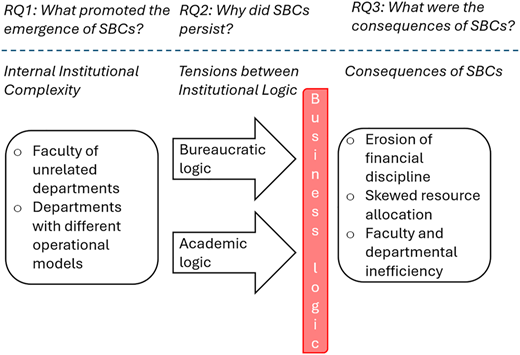
The theoretical model in Figure 1 aims to summarize the present study’s main findings.
According to Figure 1, internal institutional complexity driven by a faculty structure comprising unrelated departments with different operational models promoted the emergence of SBC practices (see SBCs #1 to #5). Next, academic and bureaucratic logic combined to sustain and reinforce SBC practices. Academic logic justified deficits in pursuit of high-quality research, while bureaucratic logic ensured the faculty absorbed these deficits centrally.
Business logic, which could mitigate these practices by demanding accountability and performance-based resource allocation, was subordinate to the dominant logic, limiting its capacity to bring about meaningful financial discipline. The model suggests that the persistence of SBC practices in this faculty was, therefore, rooted in conflicting institutional logic that drove soft financial management practices. The primary outcomes of the practices were a lack of financial discipline, skewed resource allocation between departments, and inefficiency at departmental and faculty levels.
Theoretical implications
The study’s theoretical implications, which center around institutional logic, soft budget constraints, and their subsequent consequences in an academic setting, significantly extend across organizational behavior, financial management, and higher education policy.
This study argues that intra-organizational factors—such as conflicting priorities of unrelated departments, the dominance of academic and bureaucratic logic, and resistance to business-oriented reforms—are all critical drivers of SBCs. These internal dynamics illustrate how the interplay of institutional logic and structural complexity creates a fertile environment for the emergence of SBC practices. By focusing on internal organizational factors, this study offers a novel contribution to the literature, aligning with Grossi et al.’s (2020) call for more nuanced analyses of how hybrid organizations manage competing priorities. It underscores that internal complexities, rather than external factors alone, significantly promote soft budget constraints within academic institutions. This perspective broadens the understanding of SBCs in public universities, highlighting the need for governance strategies that address structural and cultural challenges inherent in such settings.
SBC theory has traditionally been applied to state-owned enterprises (Conrath-Hargreaves and Wüstemann, 2019); its application to academic institutions suggests that the concept has broader relevance across various organizational types (Bastedo, 2009). This extension enriches SBC theory by demonstrating how SBCs manifest in non-corporate entities, thus expanding our understanding of financial discipline and organizational efficiency in diverse settings (Bertheussen and Solberg, 2022).
This study addresses interdisciplinary collaboration by highlighting the lack of synergies between academically unrelated departments with distinct operational models. It suggests that fostering interdisciplinary synergies is crucial for optimizing research and educational outcomes. This has theoretical implications for organizational structure, offering a foundation for further exploration of how universities can be restructured to promote collaboration and efficiency across departments (Kallio et al., 2020).
The study illustrates how financial management practices driven by institutional logic impact productivity and induce interdepartmental conflicts (Chong and Mahama, 2014; Kallio and Kallio, 2014). This ties into organizational behavior theories by revealing the intricate relationships between financial incentives, employee motivation, and performance outcomes, particularly in public-sector educational institutions (Musselin, 2007).
Additionally, this research contributes to the literature on financial management in academic institutions by exposing misalignments between activity levels, such as student enrollment and resource allocations. It underscores the importance of aligning economic resources with institutional goals, offering a critical perspective on the need for more effective financial planning processes in higher education (Bastedo, 2009; Davila and Foster, 2005). The findings suggest that the sustainability of universities depends on governance structures that support transparent, accountable, and goal-oriented resource management (Grossi et al., 2024).
The study also engages with governance and accountability theories by highlighting the role of governance structures in mitigating the harmful effects of SBC practices (Tjerbo and Hagen, 2009). Effective governance mechanisms, characterized by clear accountability and transparency, are essential for avoiding resource mismanagement and ensuring long-term financial sustainability in public institutions (Hong, 2023). This aligns with broader discussions on the importance of public sector governance and its role in promoting economic efficiency (Hood, 1991).
The focus on resource allocation efficiency within faculty departments provides insights into economic theories of resource distribution and institutional efficiency. By exposing inefficiencies in the current model of resource distribution, the study challenges universities to reconsider how they allocate resources to maximize output and minimize waste (Besfamille and Lockwood, 2008). This contributes to a more nuanced understanding of economic efficiency in higher education, extending theories of resource optimization beyond the corporate realm (Kornaï et al., 2003).
In conclusion, the theoretical implications of this study are wide-ranging, touching on several domains, including organizational theory, economic efficiency, and educational policy. By applying and extending institutional logic and SBC theory to the academic context, this research opens new avenues for understanding and improving financial management and governance in higher education (Gisch et al., 2021).
Practical implications
This study has significant practical implications, particularly if the goal is to increase organizational productivity and efficiency while reducing inter-departmental conflicts (see Chronicles #1–3 and Doc 2, Academic staff’s perspectives). Several managerial recommendations emerge from the findings.
First, the faculty’s composition of three professionally unrelated departments, each following distinct operating models unable to foster synergies, was a key driver of the observed SBC practices (SBC #1). A practical solution would be to spin off BIZ, allowing this incompatible unit to operate independently from the two more aligned departments, as is standard practice at other universities (see Appendix, Chronicles #1–3, Academic staff’s perspective and Doc 2, Academic staff’s perspective).
From a business economics perspective, balancing departmental deficits with soft funding (SBC #2) undermines the incentive for departments to pursue operational efficiency (see Table 2). To address this, financial management should transition to a more stringent hard budget constraint (HBC) approach (Keren, 2021), where departments are held accountable for their economic performance, and deficits are not automatically covered.
The current practice of decoupling funding allocations from departmental activity levels (SBC #3) led to an underfunded, growth-oriented department (see Tables 1 and 2), limiting its ability to expand and improve overall productivity. This mismatch hindered the department’s motivation to increase activity and pursue growth (Kallio and Kallio, 2014). Therefore, the funding model should be revised to ensure that resources are aligned with activity levels, as suggested by the university’s rector when stating, “The problem is that there is no link between activity and finances” ( Appendix, Doc 4, Rector’s perspective).
Failure to adequately recognize high-performing departments can demotivate faculty and staff, leading to reduced productivity (Skoog, 2000), stifled innovation (Bisbe and Otley, 2004), increased conflicts, and diminished quality of education (see Appendix, Chronicle 4, Student’s perspective) and research outputs. Rewarding and acknowledging high performers is essential to fostering a culture of excellence and incentivizing more remarkable achievements.
The disproportionate allocation of resources across departments (SBC #2 and #4) raised concerns about equity and fairness, often fueling inter-departmental conflicts (see Appendix, Chronicles 1–3, Academic staff’s perspective and Chronicle 5, Faculty chairman’s and Dean’s perspectives). This unequal distribution also reflected inefficient resource utilization and should be re-evaluated to promote fairness and improve overall effectiveness.
In conclusion, this study demonstrates that soft budget constraints (SBC) can persist in public universities due to internal organizational structures and competing institutional logics. The primary reason for SBC is that academic logic prioritizes research and education over financial discipline, while bureaucratic logic centralizes decision-making and shields departments from financial accountability. Meanwhile, business logic, which could promote financial efficiency, has limited influence. This creates a culture where base grants systematically cover deficits without clear incentives for financial responsibility. The practical implications are that universities must link funding more closely to activity and performance while balancing academic goals with financial sustainability.
Limitations and future research
Given a study on institutional logic and SBCs’ within an academic context, several limitations arise, impacting the interpretation and generalizability of the findings. The study’s findings are derived from a single university faculty and a specific set of departments. This limits the applicability across different types of academic environments or organizational structures. The unique characteristics of the studied faculty might not mirror those of other faculties, universities, or higher education systems, potentially restricting the broader applicability of the conclusions.
The reliance on department-specific accounts and financial data presents challenges. If the data is not comprehensive or lacks granularity, it may not fully capture the nuances of financial management practices or the depth of institutional SBC drivers. Additionally, any inconsistencies or inaccuracies in the reported data could skew the analysis and interpretation of results (Davila and Foster, 2005).
The study’s methodological approach comes with limitations. For instance, the quantitative analyses might not fully account for the qualitative aspects of SBC practices, such as faculty motivation or departmental cultures. Conversely, qualitative analyses might not be readily generalizable or miss broader patterns that more extensive quantitative data could reveal.
The analysis might be constrained by its temporal scope, focusing on a specific period. Financial management practices and the prevalence of SBC drivers can evolve, and findings may not reflect future changes in policy, funding mechanisms, or university priorities.
The researcher’s interpretations of institutional SBC drivers and their implications are subject to biases and assumptions. These interpretations might be influenced by the theoretical framework adopted, potentially leading to alternative explanations or factors being overlooked.
While this study provides valuable insights into the persistence of soft budget constraints (SBC) in higher education, it primarily focuses on internal organizational dynamics, such as institutional logic and governance structures. One limitation of this approach is that it does not fully account for the role of external financial and political factors that may reinforce or mitigate SBC practices.
A promising avenue for future research is to examine how external pressures—including national funding systems and political incentive structures—interact with internal financial governance mechanisms to sustain or weaken SBC practices. Soft budget constraints in higher education refer to the expectation that universities, faculties, and departments will receive financial support to cover deficits, potentially diminishing incentives for financial discipline. While the present research has examined internal factors, such as institutional logic, a critical need remains to explore the interplay between external pressures—such as national funding mechanisms and political incentive structures—and internal financial governance in sustaining or mitigating SBC practices.
A future research project could investigate the extent to which state funding models, political incentives, and university governance contribute to the persistence of SBC as a structural challenge in higher education. By conducting an in-depth analysis of the Norwegian university sector’s funding framework, such a study could yield valuable insights into how external financial and policy factors shape institutional financial management and decision-making processes. Addressing these aspects would provide a more holistic understanding of the mechanisms that sustain SBC and inform policy reforms to foster greater financial accountability in higher education institutions.
Ethical considerations
The secretary of the action group sent the following request by email to the dean and chairman of the faculty:
Several of us in the action group have invested significant effort over the past year regarding a more sustainable future for BIZ. This case, involving a business school strategically nested within a faculty of natural sciences, is so unique that it may have national and international relevance for our industry. Therefore, we wish to utilize publicly available material (the Economics Committee’s report, responses to consultations, the administration’s feedback on the responses to consultations, board minutes, and the dean’s weekly updates) to write one or several scholarly articles on this topic. Not only will our institution be able to accrue publication points from such activity, but it will also be in line with the faculty board’s request to the entire case faculty organization to derive as much learning as possible from the process that has taken place. As you know, published articles are peer-reviewed by anonymous experts in the relevant field.
Response from the Chairman of the Faculty Board:
Great – objective academic validity and reliability, for example, concerning the committee’s report, was what the board desired concerning the selection, so further research in this area will be interesting to follow.
I want to thank the “Action Group for a Sustainable Business School” at the university for contributing to eliciting the documentation that forms the empirical basis of this study (see Appendix).