In recent years, celebrity brands have become widely available in major retailers. However, knowledge on characteristics and outcomes of celebrity brand – retailer relationships is sparse. Aligned with the brand resonance model, this study proposes a triadic fit (i.e. three distinct types of fit) framework of effective celebrity brand – retailer relationships and spillover effects on retailer outcomes. Differences in effects across celebrity worshippers versus non-worshippers are also examined.
Two surveys were conducted. Direct effects were tested in Study 1 (n = 154, undergraduate student sample). Results were validated and extended by adding moderation effects in Study 2 (n = 433, adult shopper sample). Consistent partial least squares structural equation modeling and bootstrap multigroup analysis were used to evaluate hypotheses.
Results from the two studies support the triadic fit theorization and reveal that store attractiveness is enhanced by the fit between (1) the celebrity and the product category, (2) the celebrity and the store, and (3) the celebrity brand and the store’s brand assortment. Furthermore, the findings support sequential relationships between store attractiveness, store equity and store loyalty. Study 2 reveals that the effects of the three fit constructs on store attractiveness vary across celebrity worshippers versus non-worshippers, offering a nuanced perspective on consumer evaluations of partnerships between celebrity brands and retailers.
By examining when and how celebrity brands benefit retailers, this research advances the celebrity brands literature. Practical insights for managers of celebrity brands and retailers on forging partnerships to enhance store loyalty across different segments are offered.
Introduction
Celebrities have historically occupied a prominent role in marketing strategies and campaigns, serving as an influential conduit between brands and consumers (e.g. Erdogan, 1999; Knoll and Matthes, 2017). The influence of celebrity endorsements on consumers’ attitudes and behavior (Calvo-Porral and Lévy-Mangin, 2024; Suprawan et al., 2025), brand image and positioning (Erdogan et al., 2001), and brand purchase intention (Derdenger et al., 2018; Gupta et al., 2025) is well documented. More recently, however, celebrities have transcended from merely being endorsers of third-party brands to becoming brand owners by launching their own branded offerings (Tseng and Wang, 2023). Broadly termed as “celebrity brands,” such offerings are commercially available products that are designed, developed or cocreated by celebrities, with the celebrity’s appeal being an important part of the value proposition (Calvo-Porral and Lévy-Mangin, 2024; Israeli et al., 2024; Kowalczyk and Royne, 2013; Osorio et al., 2022; Rodrigues et al., 2026; Roy et al., 2024; Santos et al., 2019; Teng et al., 2020; Tseng and Wang, 2023). Celebrity brands are ubiquitous in fashion, fitness, sports, personal care, home décor, and food and beverage sectors, and generate several billion dollars in sales annually (Intelligence Node, 2025; NielsenIQ, 2024). Fenty Beauty by Rihanna, SKIMS by Kim Kardashian, Kylie Cosmetics by Kylie Jenner, and CR7 by Cristiano Ronaldo are some germane examples.
Celebrity brands, especially those positioned as masstige brands (Özer et al., 2025; Rodrigues et al., 2026), typically exploit their commercial potential through partnerships with major retailers (e.g. Beautiful by Drew Barrymore in Walmart, Rare Beauty by Selena Gomez in Sephora, and Shaquille O’Neal clothing at JCPenney). Such partnerships enable celebrity brands to use retailers’ distribution, merchandizing and customer service expertise for reaching market segments. Yet, there is very little research on the characteristics of effective celebrity brand – retailer relationships, and importantly, how celebrity brands benefit retailers.
This is a notable knowledge gap for three reasons. First, the failure rate of celebrity brands remains high, often due to misalignments, consumer apathy and other psychological patterns (Cascadia, 2024; Knoll and Matthes, 2017). As these failures incur financial and imagery losses (Ladeira et al., 2025; Victory et al., 2025) as well as potential consumer backlash against celebrities and retailers that carry celebrity brands (Hussain et al., 2026; Liu et al., 2026; Vinuales and Sheinin, 2026), articulating spillover benefits of celebrity brand – retailer relationships becomes essential for assuaging retailer concerns and garnering support. Second, extant research has investigated consumer responses toward celebrity brands (Kennedy et al., 2021; Kowalczyk and Royne, 2013; Osorio et al., 2022; Rodrigues et al., 2026; Santos et al., 2019; Teng et al., 2020; Tseng and Wang, 2023) and brand – retailer relationships (Arnett et al., 2010; Glynn et al., 2012). Yet, there is insufficient guidance on celebrity brand – retailer relationships as the celebrity brand literature has not addressed spillover benefits to retailers, while the brand – retailer relationships literature has not addressed celebrity brands. Thus, the question of how celebrity brand – retailer relationships enhance consumer attitudes and responses toward retailers remains unanswered. Third, successful brand management requires strong relationships between not only brands and consumers, but also between brands and retail partners (Webster, 2000). Yet, extant branding research has largely adopted a consumer-centric perspective, with minimal attention on building mutually beneficial relationships with retailers (Glynn et al., 2012; Webster, 2000). Here, research on spillover benefits of celebrity brand – retailer relationships offers valuable insight on building downstream value creation narratives, and, ultimately, protecting brand and retailer investments (Ailawadi and Keller, 2004; Osorio et al., 2022).
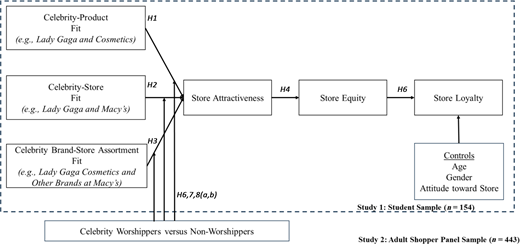
By focusing on celebrity brand – retailer relationships, this study bridges two literature streams: the celebrity brand literature and the brand – retailer relationships literature. Specifically, using the brand resonance model (Keller and Swaminathan, 2020) as a theoretical roadmap, a triadic fit framework of the spillover effects of celebrity brand – retailer relationships on retailer outcomes is proposed. The triadic fit notion encapsulates three relevant fit types underpinning consumer evaluations of celebrity brand – retailer relationships, including:
the celebrity and the product category;
the celebrity and the store; and
the celebrity brand and the store’s brand assortment.
Following the hierarchical schematic of the brand resonance model, sequential spillover effects from the triadic fit constructs to retailer attractiveness, equity and loyalty are examined (Study 1: survey of 154 undergraduate students). Subsequently, these results are validated and extended by evaluating how the effects of the triadic fit constructs are moderated by celebrity worship tendencies, a critical contingency variable in the celebrity brands and endorsement literature (McCutcheon et al., 2002; Roy and Mishra, 2018; Suprawan et al., 2025) (Study 2: survey of 433 adult shoppers). Results from the two studies offer novel theoretical contributions to the evolving literature on celebrity brands as well as nuanced managerial implications on how celebrity brand – retailer relationships should be cultivated and promoted successfully.
In the following sections, a literature review, theoretical framework and hypotheses, methodology and results are presented. The article concludes with theoretical and managerial implications, study limitations and directions for future research.
Literature review
Celebrity brands
The power of celebrities to attract and captivate consumer attention, enhance brand appeal and credibility, and influence consumer engagement and behavior is apparent through the extensive use of celebrity endorsements in marketing programs (e.g. Bergkvist and Zhou, 2016; Schimmelpfennig and Hunt, 2020). Prior studies have uncovered different explanations to explain how celebrity endorsements shape consumers responses. For instance, research has demonstrated that consumer attitudes and behaviors are shaped by the celebrity’s credibility (e.g. Calvo-Porral and Lévy-Mangin, 2024), attractiveness (e.g. Eisend and Langner, 2010), congruence between the celebrity’s image, the brand endorsed and the audience (e.g. Bergkvist and Zhou, 2016), and the transference of meaning from the celebrity endorser to the brand and consumer (e.g. Jain and Roy, 2016).
In recent years, to better leverage and monetize their brand value, many celebrities have created their own brands (Israeli et al., 2024; Santos et al., 2019). Specifically, celebrity brands are different from human brands or celebrity endorsements. Human brands are celebrities or productized celebrities (e.g. Ralph Lauren) (Fournier and Eckhardt, 2019; Thomson, 2006). Celebrity endorsements entail a celebrity promoting another entity’s brand through advertisements, sponsorships and personal appearances for a fee and contracted time. In contrast, celebrity brands are products that bear the celebrity’s existing or newly created brand elements and involve a higher level of celebrity involvement in creation, design, branding and marketing of the offering (Kowalczyk and Royne, 2013; Roy et al., 2024).
Prior research has emphasized perceived fit between celebrities and the product category enhances attitude toward celebrity brands across different product categories (Kowalczyk and Royne, 2013). Similarly, Santos et al. (2019) find that perceived celebrity – product category fit influences willingness to pay for celebrity brands but further underscores that celebrity – product category fit is influenced by the celebrity’s characteristics such as personality, trustworthiness, credibility and likeability albeit to varying degrees across product categories. In contrast, Teng et al. (2020) find that celebrity – product category fit and celebrity’s credibility influence attitude and purchase intentions toward celebrity brands. More recent evidence suggests that celebrity – product category fit is especially relevant for evaluations of functional celebrity brands, whereas celebrity authenticity is more important for evaluations of hedonic celebrity brands (Osorio et al., 2022).
Building on this, studies have shown that other factors, such as consumer-celebrity fit, celebrity authenticity and celebrity involvement complement celebrity-product category fit in influencing attitude and purchase intentions toward celebrity brands (Tseng and Wang, 2023). Recent interpretive research conceptualized celebrity capital (e.g. cool personality traits, self-usage of the celebrity-owned brand, concurrent brand endorsements) as driving celebrity brand coolness and ultimately brand experience, consisting of sensory, affective and behavioral elements (Radhika and Mishra, 2025). The clout of celebrity brands is perhaps best captured by findings demonstrating that brands (Co.)created by celebrities generate more favorable brand attitudes and intentions than brands merely endorsed by celebrities (Roy et al., 2024).
Celebrity brand – retailer relationships
It is important for brands and retailers to forge symbiotic, mutually beneficial relationships (Arnett et al., 2010). For brands, retailers serve as gatekeepers of consumer access as they control the context in which the brand is presented – physically in the store environment as well as through salespeople and other promotional efforts (Buchanan et al., 1999). While retailers are receptive to stocking brands that increase store traffic and profitability (Ailawadi and Keller, 2004), they are also concerned with optimizing store equity and performance of other brands in their store assortment (Glynn et al., 2012). Thus, in addition to a brand’s appeal and established consumer demand, retailers expect brands to contribute to their own credibility and image (Webster, 2000). However, as Webster (2000, p. 21, italics in original) succinctly notes, “The traditional definition of a brand as a guarantee of consistent features, quality and performance to consumers largely ignores its function as a pledge of support to retailers.” Prior research demonstrates that brands that deliver on this pledge enjoy sustained relational benefits and competitive advantages (Arnett et al., 2010).
To sustain their appeal as houses of brands, retailers cannot be indifferent to the growing popularity of celebrity brands. Celebrity brands cannot only infuse fresh energy into the store environment, but the presence of the celebrity element also makes them inimitable by store brands. Clearly, forming partnerships with the right celebrity brands can produce affiliation benefits and competitive advantages for retailers; yet missteps can result in tarnished image and financial losses (Israeli et al., 2024). At the same time, celebrity brands are heavily reliant on retailer support and sales platforms as they lack the merchandizing and marketing expertise that other brands typically possess. Given that celebrity brands are often unproven commercial entities, commonly riding on the power of celebrity appeal, it is extremely imperative for celebrity brands to demonstrate how they can forge synergistic partnerships with retailers and enhance retailer outcomes. Yet, research is lacking on how celebrity brands offer spillover benefits for retailers.
Prior research on celebrity endorsements, celebrity brands or brand-retailer partnerships is not directly transferable to celebrity brand – retailer relationships as evaluations of the latter are shaped by the juxtaposition of three entities: the celebrity, the product category and the retailer. In such situations, balance theory (Heider, 1946) suggests that examination of fit between different pairs of entities in the triad is essential for reducing cognitive tension and fostering positive attitudes. Thus, merely focusing on celebrity-product category fit or brand-retailer fit, based on prior research, provides incomplete insight. Therefore, the current study adopts a triadic fit theorization to describe three pairwise fit constructs as inherent characteristics of celebrity brand – retailer relationships:
the celebrity and the product category;
the celebrity and the store; and
the celebrity brand and the store’s brand assortment.
Adding further complexity, it is unknown whether the effect of celebrity brand – retailer relationships varies across consumers who are merely attracted to celebrities versus those who possess excessive forms of admiration toward celebrities. Celebrity worship tendency has been identified as an important moderating variable in prior research on celebrity endorsements and celebrity brands (Suprawan et al., 2025; Teng et al., 2020); yet, the role of celebrity worship tendencies in the context of celebrity brand – retailer relationships is unknown. Interestingly, research on the effect of celebrity worship tendencies on brand-related responses has yielded mixed results. While some studies find that celebrity worship tendencies positively influence equity of celebrity brands (e.g. Parmar and Mann, 2021), others report an attenuating effect (Kowalczyk and Royne, 2013). Thus, there is no reliable evidence on how varying levels of celebrity worship tendencies influence celebrity brand – retailer relationships.
Addressing the abovementioned gaps, this study leans on the brand resonance model to address two questions:
How do the triadic fit characteristics of celebrity brand – retailer relationships influence retailer loyalty?
How do the effects of these characteristics vary across customer segments that differ on celebrity worship tendencies?
Theoretical framework and hypotheses
The brand resonance model (Keller and Swaminathan, 2020) is used as a conceptual blueprint to develop the proposed framework. Specifically, the brand resonance model postulates that strong consumer-brand relationships are built sequentially through the building blocks of brand associations (“Who are you?”), brand imagery (“What are you?”), brand judgment (“What about you?) and brand resonance (“What about you and me?). At the apex of the consumer-brand relationship pyramid, brand resonance embodies a level of synchronization that evokes brand loyalty, i.e. a strong relationship with a brand and the willingness to invest personal resources to remain connected with the brand (Keller, 2014). The constructs and posited relationship in this study’s framework (see Figure 1) are aligned with the incremental steps in the brand resonance model. Here, the triadic fit constructs are proposed to encompass foundational associations about celebrity brand – retailer relationships. Next, aligning with the subsequent focus of the brand resonance model on imagery, judgment and resonance, the spillover effects of the triadic fit constructs on store attractiveness and sequential derive effects on store equity and store loyalty are examined. Finally, consistent with the stated objectives, celebrity worship tendencies are examined as moderators of the effects of the triadic fit constructs on store attractiveness.
Celebrity – Product fit in celebrity brands and store attractiveness
Celebrity-product fit refers to consumers’ holistic evaluation of how well a celebrity’s identity, image, traits and expertise align appropriately or logically with the product category they endorse or launch. When the product aligns with the celebrity’s field (e.g. a chef and cookware or an athlete and sportswear), fit is readily discernable; however, even when the product category is outside of the celebrity’s field (e.g. an actor and financial services or a singer and beauty products), fit is inferred through effortful processing of celebrity attributes such as personality, authenticity and credibility (Santos et al., 2019; Yeung and Wyer, 2005). Overall, prior research supports that celebrity-product fit facilitates fluency of affect and meaning transfer, thus increasing acceptance, attractiveness and success of celebrity endorsed brands (Erdogan, 1999; Knoll and Matthes, 2017). Similarly, studies have found celebrity-product fit to be a predictor of attitudes and willingness to buy celebrity brands (Santos et al., 2019; Tseng and Wang, 2023).
Extending these perspectives, it is expected that when celebrity-product fit is adequately embodied by celebrity brands, spillover benefits ensue to retailers carrying such brands. Store attractiveness is gauged by consumers’ evaluation of various store attributes, of which the brands carried by the store is one of the most important (Ailawadi and Keller, 2004; Pan and Zinkhan, 2006). When shoppers encounter celebrity brands in the retailer store, high celebrity-product fit increases processing fluency, i.e. the celebrity brand “makes sense,” leading to positive affect that transfers to the store environment. Furthermore, the presence of celebrity brands with high celebrity-product fit signals retailer expertise as curators of coherent offerings, thus increasing store attractiveness. In addition, the seminal meaning transfer model (McCracken, 1989) and source credibility theory (Hovland and Weiss, 1951) lend theoretical support for the argument that celebrity brands that demonstrate good celebrity-product fit will augment perceived attractiveness of retailers. Thus:
Celebrity-product fit in celebrity brands is positively related to store attractiveness in the context of celebrity brand – retailer relationships.
Celebrity-store fit and store attractiveness
In the context of celebrity brand – retailer relationships, celebrity-store fit refers to the extent to which the celebrity’s brand image is perceived to be congruent with the retailer’s image.
Celebrity-store fit facilitates consumer evaluations of the alliance between the celebrity brand and the retailer (Simonin and Ruth, 1998). When there is perceived fit between partners in a brand alliance, the brands and the alliance itself are viewed favorably (Fleck and Quester, 2007; Simonin and Ruth, 1998). For instance, a celebrity associated with luxury will be perceived to fit better with upscale retailers as compared to discount retailers. In turn, perceived celebrity-store fit facilitates the transfer of traits from the celebrity to the store, similar to processes highlighted in the brand alliance literature (e.g. Knoll and Matthes, 2017; Schimmelpfennig and Hunt, 2020), thus enhancing store attractiveness. In addition, celebrity-store fit strengthens the retailer’s value proposition as a purveyor of a specific type of brands (Netemeyer et al., 2012), increasing experiential and destination appeals for the retailer (Vieira et al., 2018). Conversely, lack of celebrity-store fit could trigger adverse consequences, just as mismatched partnerships between premium brands and hard discounters (van der Plas et al., 2026). Thus:
Celebrity-store fit is positively related to store attractiveness in the context of celebrity brand – retailer relationships.
Celebrity brand-store assortment fit and store attractiveness
A retailer’s assortment of brands plays an important role in shaping shopper perceptions, choice and purchase intentions (Sethuraman et al., 2022). Increasing the breadth of brand assortment is beneficial for retailers (Briesch et al., 2009; Pan and Zinkhan, 2006). Yet, more is not necessarily better; rather, retailers need to construct consistent and complementary brand portfolios to enhance store evaluations (Keller, 2014). Prior research has found that strong alignment, or perceived consistency, in a retailer’s assortment of brands increases store attractiveness (Badrinarayanan and Becerra, 2019b). Conversely, if a celebrity brand is deemed an outlier in a store’s brand assortment – whether it be in terms of imagery, price or functionality – evaluations of misalignment can evoke cognitive dissonance, which can adversely affect store evaluations (Badrinarayanan and Becerra, 2019b; van der Plas et al., 2026). This argument is further supported by categorization theory (Sujan and Bettman, 1989), which supports that brands that are consistent with a store’s brand schema reinforce perceptions of the store’s brand assortment coherence and brand curation capabilities, thus increasing store’s attractiveness. Therefore:
Celebrity brand – store brand assortment fit is positively related to store attractiveness in the context of celebrity brand – retailer relationships.
Store attractiveness and store equity
Store equity refers to the ‘“the differential effect of store knowledge on customer response to the marketing of the store” (Hartman and Spiro, 2005, p. 1114). Along with the store’s brand name strength, attractiveness and uniqueness (Badrinarayanan and Becerra, 2019a; Pappu and Quester, 2006), it represents the consumers” positive store associations that are easily accessible, including perceptions about the store’s brand or name, and the store’s attributes, such as the assortment of brands or its customer service (Fuentes-Blasco et al., 2017; Hartman and Spiro, 2005). Store equity is influenced by perceptions of various store-related aspects and positive assessments of a store (Pan and Zinkhan, 2006). For instance, customer shopping experience factors, such as service quality and store atmosphere, kickstart a sequential process to retail brand equity (Zhang et al., 2023). Just as branding research emphasizes that brand attractiveness enhances brand equity (Keller and Swaminathan, 2020; Yoo and Donthu, 2001), retailing studies also suggest a positive relationship between favorable store evaluations and store equity (Arnett et al., 2010). Therefore:
Store attractiveness is positively related to store equity.
Store equity and store loyalty
The brand resonance model (Keller and Swaminathan, 2020) suggests that the consumer relationship with the brand is manifested by how the consumers think, feel and act toward the brand. Action toward the brand includes activity and intensity toward the brand; activity indicates how frequently the consumer buys and uses the brand while intensity indicates how attached the consumer is to the brand (Keller and Swaminathan, 2020). Activity toward the brand is best demonstrated by brand loyalty, while intensity is best demonstrated by brand evangelism (Becerra and Badrinarayanan, 2013); collectively, they represent the highest level of the brand relationship with the brand (Keller and Swaminathan, 2020). Brand activity and intensity are the result of feelings and evaluations about the brand or brand equity. Consequently, brand equity leads to brand loyalty (Keller and Swaminathan, 2020; Taylor et al., 2004). Corroborating this effect in a retail setting, across traditional, online and cross-channel settings, retail brand equity relates positively to retail loyalty (Klink and Swoboda, 2025). Thus:
Store equity is positively related to store loyalty.
The role of celebrity worship tendency
Individuals can become obsessed with a celebrity for fun, entertainment or social reasons, or to the pathological point of developing an imaginary relationship or bond with the celebrity (e.g. Hyman and Sierra, 2010). There are three stages of celebrity worship. In the first stage (low worshipping tendencies), the obsession is for either entertainment or social purposes; in the second stage (moderate worshipping tendencies), the obsession becomes more personal, and the individual develops mild compulsive behaviors toward the celebrity; lastly, in the third stage (high worshipping tendencies), the obsession become almost pathological to the point that the individual may develop an imaginary relationship or bond with the celebrity and may be willing to do anything for the celebrity (McCutcheon et al., 2002).
While celebrities are known to have the power to pull consumers, the lure of celebrities varies across consumers who are merely attracted to celebrities versus fans who possess excessive forms of admiration. Prior research has investigated the effects of celebrity worship and consumer responses toward brands endorsed by celebrities. However, as noted below, direct extrapolation of findings from these studies to understanding celebrity brand – retailer relationships is limited due to contextual differences and, importantly, due to the lack of consensus in the literature on the effects of celebrity worship tendencies.
Studies have shown that individuals with high celebrity worship tendencies demonstrate greater acceptance of celebrity endorsed brands as compared to those with low celebrity worship tendencies due to differences in underlying motives (Roy and Mishra, 2018). Similarly, research on the effects of “influencer” worship on the brand endorsed by the influencer finds that “influencer” worship, akin to celebrity worship, increases the consumer connection with the influencer endorsed brand (Paredes et al., 2023). Yet, in a study of celebrity worship among Gen Z consumers, celebrity worship tendency was found to exert a direct positive effect on brand love but not brand advocacy, although a sequential pathway linking celebrity worship tendencies, brand love and brand advocacy was supported (Suprawan et al., 2025). Similarly, a study on the effects of celebrity worship on attitudes toward the ad of a celebrity endorsed brand, attitudes toward the brand endorsed, and brand purchase intentions, found that celebrity worship negatively affects brand attitudes but positively affects attitudes toward the ad and brand purchase intentions (Singh and Banerjee, 2019). It has also been uncovered that celebrity worship moderates the relationship of celebrity-product fit on consumers’ attitudes toward the celebrity brand, with higher levels of celebrity worship weakening the effect of celebrity-product fit on consumers’ attitudes toward the celebrity brand (Kowalczyk and Royne, 2013). In a study on celebrity worship and celebrity brands, Osorio et al. (2022) uncovered that celebrity worship aids celebrity brands that are authentic and fit with the celebrity, but the effect is attenuated on hedonic brands.
The lack of consensus in extant branding research on the influence of celebrity worship tendencies makes it plausible that celebrity worship tendencies could positively or negatively influence the effects of the triadic fit constructs on store attractiveness. To enhance objectivity when previous findings suggest two or more plausible hypotheses, competing hypotheses are appropriate (Armstrong et al., 2001; Kirkby et al., 2023). Therefore:
The effect of celebrity-product fit on store attractiveness will be (a) higher/(b) lower for celebrity worshippers versus non-worshippers.
The effect of celebrity-store fit on store attractiveness will be (a) higher/(b) lower for celebrity worshippers versus non-worshippers.
The effect of celebrity brand-store assortment fit on store attractiveness will be (a) higher/(b) lower for celebrity worshippers versus non-worshippers.
Methodology and results
Study 1: Data collection
After obtaining approval by the Institutional Review Board at the authors’ university, two studies were conducted. In Study 1, proposed linear relationships were tested using an online survey of undergraduate students in a large, suburban university in the southcentral USA. Students enrolled in marketing classes participated in the survey for nominal extra credit. The questionnaire required respondents to enter names of their favorite celebrity (open-ended, with a prompt that the celebrity can be an athlete, a fashion icon, a movie or TV star, a singer, etc.), most-familiar department store (from a finite set of choices with an open-ended “other” option), and a product category that they were thinking about purchasing from department stores (from a finite set of choices with an open-ended “other” option). These responses were then auto populated in the questionnaire using the piped text feature offered by Qualtrics; this feature is a dynamic, code-based approach through which previously collected responses are inserted into subsequent questions. Accordingly, a customized survey experience was provided for each participant, while controlling for any bias arising from researcher specified celebrity, product category, celebrity brand or retailer examples.
Specifically, each respondent’s answers on favorite celebrity, familiar department store and product category intending to purchase were used to phrase subsequent questions items on focal constructs (see Table 1). That is, stated responses were populated within questions on celebrity-product fit, celebrity-store fit, celebrity brand-store assortment fit, and other retailer outcomes. Thus, the celebrity brand each respondent saw was hypothetical as the survey automatically created it by merging responses on their favorite celebrity and the product they intended to purchase. The use of hypothetical examples allows for collecting data on a wide range of celebrity brands and celebrity brand – retailer relationships and is supported by prior studies in the branding literature (e.g. Völckner and Sattler, 2006). In all, about 180 respondents were invited to participate. After screening out those who failed attention and speeding checks, 154 completed responses were collected. The average age of respondents was 24.80 years (SD = 4.00 years), 78 (76) were male (female), and the average response time was 12 min (SD = 6 min).
The questionnaire employed established multi-item scales (five-point, 1 = “strongly disagree and 5 = “strongly agree”) for all constructs (see Table 2). Celebrity-product fit and celebrity-store fit were measured by adapting the three-item brand extension fit scale from Keller and Aaker (1992). Celebrity brand-store assortment fit was measured by adapting a four-item scale proposed to gauge perceived alignment between store-within-store brands and retailers by Badrinarayanan and Becerra (2019a). As for the store-related constructs, store attractiveness was measured by borrowing three items from Freling et al. (2011) and adapting them to the current context; store equity was measured using a three-item scale from Badrinarayanan and Becerra (2019a); and store loyalty was measured using a three-item scale that included two items (future visits and recommendation intentions) from Swoboda et al. (2016) and one item (gift card giving intentions) from Wolter and Cronin (2016) so that both intensity and activity aspects of loyalty are captured. Age, gender and attitude toward the store, measured using a four-item semantic differential scale from Badrinarayanan and Becerra (2019a), were included as control variables.
Study 1: Data analysis
Data analysis was conducted using SmartPLS 4.0. Before testing the hypothesized relationships, psychometric properties of the scales were evaluated. Following prescribed guidelines (Hair et al., 2019), indicator loadings, construct reliability values, average variance extracted (AVE), heterotrait–monotrait (HTMT) ratio of correlations, and variance inflation factors (VIFs) were examined. All indicator loadings (outer loadings) exceeded the recommended cutoff of 0.70 [range 0.82–0.96]. This implies that respective constructs explain more than 50% of the indicator’s variance and offers support for item reliability. As for construct reliability values, Cronbach’s alphas [range 0.82–0.96], and composite reliabilities ρA [range 0.83–0.97], ρc [range 0.89–0.97] exceeded acceptable thresholds, providing evidence for internal reliability of constructs. The AVE values for all constructs exceeded the suggested threshold of 0.50 [0.73–0.91], indicating that each construct explains more than 50% of variance of its items and offering support for convergent validity of construct measures. The AVE for each construct was greater than that construct’s shared variances with other constructs (Fornell and Larcker, 1981), suggesting that each construct is empirically distinct from other constructs in the model. The HTMT ratio of average correlations of indicators across constructs was below the recommended cutoff of 0.90 [0.25–0.85] (Henseler et al., 2015), offering further evidence of discriminant validity. The VIFs were below the ideal cutoff of 3 [1.0–2.3], suggesting that multicollinearity is not an issue. All items/scales, loadings, Cronbach’s alphas and composite reliabilities are provided in Table 1. Construct properties such as interconstruct correlations, means, standard deviations and AVEs are provided in Table 2.
Procedural precautions were employed to minimize common method bias (Podsakoff et al., 2003). While designing the questionnaire, questions were carefully evaluated to reduce ambiguous wording and enhance comprehension, independent and dependent variable survey items were placed in different sections, anonymity was ensured to respondents, and an introductory statement indicating there are no right or wrong answers was included. In addition, we used the marker variable technique (Lindell and Whitney, 2001) by including a theoretically unrelated variable to the model. Specifically, we included “survey completion time” (Itani et al., 2023) to the model and found no significant changes to the results. Hence, we conclude that common method bias was ruled out.
Next, the direct effects hypotheses (H1–H5) were tested with consistent partial least square structural equation modeling (10000 bootstrapping runs). Model fit indices, except dULS fared well against thresholds [SRMR = 0.05, NFI = 0.89, dULS = 0.80 (>95th percentile of 0.60), and dG = 0.58 (<95th percentile of 0.65)]; however, given that SRMR should be used as the most reliable predictor of model fit in composite factor models, acceptable model fit is determined (Cheah et al., 2026). The results provide support for four of the five direct effects hypotheses. Celebrity-product fit (β = 0.41; p < 0.001) and celebrity-store fit (β = 0.24; p < 0.05) relate positively to store attractiveness, supporting H1 and H2. However, celebrity brand-store assortment fit is not significantly related to store attractiveness (β = 0.15; p > 0.05), thus failing to support H3. Furthermore, store attractiveness relates positively to store equity (β = 0.72; p < 0.001) and store equity relates positively to store loyalty (β = 0.68; p < 0.001), providing support for H4 and H5. Specific indirect effects, from celebrity-product fit to store loyalty (β = 0.20; p < 0.05) and from celebrity-store fit to store loyalty (β = 0.12; p < 0.05) were also significant. None of the control variables exerted any significant effects.
Study 2: Data collection
Study 2 was conducted to validate and extend the findings from Study 1 (i.e. replication with extension) (Toncar and Munch, 2010). An online survey was used to collect data from a respondent panel of adult (nonstudent) consumers in Qualtrics. Protocols, prompts, piped text features and question sequence mirrored Study 1. Before handing over responses, Qualtrics removed respondents who failed screening, speeding and attention checks, thus ensuring objectivity in data deletion (Babin et al., 2016). In all, 443 qualified respondents completed the survey. The average age of respondents was 50.10 years (SD = 15.54 years), 140 (303) were male (female), and the average response time was 12 min (SD = 6 min). The same multi-item scales (five-point, 1 = “strongly disagree and 5 = “strongly agree”) were used for all studied constructs. In addition, the seven-item Celebrity Attitude Scale (CAS) from Zsila et al. (2024) was added to measure celebrity worship tendency. Attitudes toward the store, age and gender were included as control variables.
Study 2: Data analysis
As with Study 1, partial least squares structural equation modeling analyses was conducted using SmartPLS 4.0. All indicator loadings (outer loadings) exceeded the recommended cutoff of 0.70 [range 0.76–0.96], providing support for item reliability. Cronbach’s alphas [range 0.84–0.96], and composite reliabilities ρA [range 0.86–0.96], ρc [range 0.89–0.97] exceeded acceptable thresholds, providing evidence of construct reliability. The AVE values for all constructs exceeded the suggested threshold of 0.50 [0.68–0.94], offering support for convergent validity of construct measures. The AVE for each construct was greater than that construct’s shared variances with other constructs and the HTMT ratio of average correlations of indicators across constructs were below the recommended cutoff of 0.90 [0.05–0.80], offering evidence of discriminant validity. The VIFs were below the ideal cutoff of 3 [1.0–2.4], suggesting that multicollinearity is not an issue. All items/scales, loadings, Cronbach’s alphas and composite reliabilities are provided in Table 1. Construct properties such as interconstruct correlations, means, standard deviations and AVEs are provided in Table 3.
The procedural precautions and statistical tests used in Study 1 were undertaken to minimize and test for common method bias. The unrelated marker variable “survey completion time” was added to the model and no significant changes were observed in the results, allaying concerns about common method bias.
Next, the proposed hypotheses (H1–H8) were tested with consistent partial least square structural equation modeling (10000 bootstrapping runs). Model fit indices fared well against thresholds [SRMR = 0.03, NFI = 0.95, dULS = 0.11 (<95th percentile of 0.15), and dG = 0.20 (<95th percentile of 0.45)]; thus, acceptable model fit is determined (Cheah et al., 2026). The results provide support for all five direct effects and partial support for three competing moderation hypotheses (see Table 4). Celebrity-product fit (β = 0.22; p < 0.001), celebrity-store fit (β = 0.12; p < 0.05), and celebrity brand-store assortment fit (β = 0.34; p < 0.001) relate positively to store attractiveness, supporting H1, H2 and H3. Furthermore, store attractiveness relates positively to store equity (β = 0.70; p < 0.001) and store equity relates positively to store loyalty (β = 0.72; p < 0.001), providing support for H4 and H5. Specific indirect effects, from celebrity-product fit (β = 0.13; p < 0.001), celebrity-store fit (β = 0.09; p < 0.10) and celebrity brand-store assortment fit (β = 0.19; p < 0.001) to store loyalty were significant. As the direct effects of celebrity-product fit (β = 0.13; p < 0.001), celebrity-store fit (β = 0.09; p < 0.10) and celebrity brand-store assortment fit (β = 0.19; p < 0.001) on store loyalty Among the control variables, attitude toward the store was positively related to store loyalty (β = 0.15; p < 0.05); however, age and gender did not exert any significant effects.
Celebrity worship tendency was operationalized as a two-factor construct following Zsila et al. (2024). The two-factor solution revealed that both first-order dimensions, entertainment-social (β = 0.55; p < 0.001) and intense-pathological (β = 0.50; p < 0.001) were significant predictors of the second-order construct, celebrity worship. Consistent with prior studies on celebrity worship tendencies (Roy and Mishra, 2018), a median split approach was used to classify celebrity worship tendency into two groups: celebrity worshippers (at or above 3.11, n = 225) versus non-worshippers (below 3.11, n = 218). The median split approach was deemed appropriate for this study for two reasons advocated by Iacobucci et al. (2015b). First, the focus of our research is on eliciting differences across two categories of consumers: celebrity worshippers versus non-worshippers, rather than explicating moderating effects for which a continuous measure would also be suitable. Second, our data revealed unambiguous evidence for discriminant validity and lack of multicollinearity pertaining to our predictor variable, a necessary condition for robustness of median split analysis and avoidance of Type I errors. The suitability of the median split approach is also supported by recent studies in the branding literature (e.g. Bhalla and Zeba, 2026; Kuo and Olivia, 2026). Accordingly, Bootstrap Multigroup Analysis (MGA) was conducted to examine differences in the proposed relationships. The MGA analysis revealed critical differences in several paths, notably pertaining to the triadic fit constructs. The positive effects of celebrity-product fit (Δβ = 0.18; p < 0.05) and celebrity-store fit (Δβ = 0.29; p < 0.05) on store attractiveness were stronger (weaker) among celebrity worshippers versus non-worshippers, whereas the positive effect of celebrity brand-store assortment fit (Δβ = -0.39; p < 0.01) on store attractiveness weaker (stronger) among celebrity worshippers versus non-worshippers. Thus,H6a, H7a and H8b, which predicted these differences in the effects of the triadic fit constructs on store attractiveness across celebrity worshippers versus non-worshippers were supported. Although not hypothesized, differences in other paths in the framework across celebrity worshippers versus non-worshippers were also examined; no differences were found on the paths from store attractiveness to store equity (Δβ = −0.05; p > 0.05) and from store equity to store loyalty (Δβ = 0.06; p > 0.05).
Discussion
Addressing the growing popularity of celebrity brands, this study focuses on how consumers evaluate celebrity brand – retailer relationships and subsequent spillover benefits to retailers. Results from two studies demonstrate that effective celebrity brand – retailer relationships are characterized by (1) celebrity-product fit, (2) celebrity-store fit and (3) celebrity brand-store assortment fit. Consistent with the conceptual blueprint of the brand resonance model (Keller and Swaminathan, 2020), these triadic fit elements are shown to jointly benefit retailers through the sequential pathways of store attractiveness, store equity and store loyalty. In addition, the effects of the triadic fit elements were found to vary across consumers that differ on celebrity worship tendencies. The effects of celebrity-product fit and celebrity-store fit on store attractiveness were larger (smaller) among celebrity worshippers versus non-worshippers, whereas the effect of celebrity brand-store assortment fit on store attractiveness was smaller (larger) among celebrity worshippers versus non-worshippers. Given that this research bridges together multiple, related literature streams, several novel theoretical contributions are presented. Furthermore, from a managerial standpoint, practical implications are offered on how celebrity brands can forge partnerships with retailers, articulate spillover benefits to secure retailer support, and leverage targeted promotion of such partnerships to achieve beneficial outcomes.
Theoretical implications
First, prior research on celebrity brands has predominantly focused on how consumer attitudes and behaviors are shaped by evaluations of the celebrity or the celebrity-product fit evidenced in celebrity brands (Kowalczyk and Royne, 2013; Osorio et al., 2022; Rodrigues et al., 2026; Santos et al., 2019). Yet, with celebrity brands relying on partnerships with major retailers for market reach and commercialization, understanding consumer evaluations of the interconnectedness between celebrity brands and retailers has become imperative. In this regard, this study identifies three types of fit that jointly capture consumer perceptions of celebrity brand – retailer partnerships:
celebrity-product fit;
celebrity-store fit; and
celebrity brand-store assortment fit.
Prior research on celebrity brands shows celebrity-product fit enhances evaluations of celebrity brands (Santos et al., 2019; Tseng and Wang, 2023). Similarly, retailing research highlights the importance of brand-retailer fit (Arnett et al., 2010) and brand-store assortment fit (Badrinarayanan and Becerra, 2019a). The current study integrates these siloed types of fit in the context of celebrity brand – retailer partnerships and demonstrates how they jointly generate spillover benefits for retailers through the sequential pathways of store attractiveness, store equity and store loyalty.
Second, research on brand – retailer partnerships emphasize that brands need to demonstrate value to retailers to secure and maintain mutually beneficial relationships (Ailawadi and Keller, 2004; Glynn et al., 2012; Webster, 2000). This study, aligned with the brand resonance model (Keller and Swaminathan, 2020), extends this literature by uncovering the sequential pathway of benefits entailing the three fit constructs, store attractiveness, store equity and store loyalty. In doing so, this study adds to the limited empirical validations of the brand resonance model (Badrinarayanan et al., 2016) and builds on prior research on consumer perceptions of fit in retail settings (Badrinarayanan et al., 2012). Importantly, while prior research has examined retailers’ partnerships with manufacturer brands (e.g. Glynn et al., 2012), designers (Childs and Jin, 2020) and artists (Kim et al., 2018), this study establishes celebrity brands as important sources of value for retailers. Overall, our findings broaden the theoretical reach of the extant research on celebrities in marketing campaigns (Erdogan et al., 2001; Israeli et al., 2024).
Third, although research has explored the direct effects of celebrity worship tendencies on brand attitudes and purchase intentions in the context of celebrity endorsements (e.g. Parmar and Mann, 2021; Singh and Banerjee, 2019), investigations on the moderating role of celebrity worship tendencies are limited and lack consensus (e.g. Kowalczyk and Royne, 2013; Roy and Mishra, 2018). This study reveals that contingent effects of celebrity worship tendencies in the context of celebrity brand – retailer relationships are complicated to unpack. For celebrity worshippers, higher evaluations of celebrity-product fit and celebrity-store fit transfer into positive evaluations of the retailer, while higher evaluations of celebrity brand-store assortment fit tend to diminish store attractiveness. From a theoretical standpoint, these deviations can be explained by drawing from socio-psychological theories such as source credibility theory (Hovland and Weiss, 1951), schema congruity theory (Mandler, 1982) and cognitive dissonance theory (Festinger, 1957). The positive effects of the first two fit constructs on store attractiveness can be explained through source credibility and congruity theoretical lens (Hovland and Weiss, 1951; Mandler, 1982). However, the decreased effects of celebrity brand-store assortment fit on store attractiveness among high celebrity worshippers can be attributed to emergent consumer evaluations that their celebrity is not being afforded special treatment or placed on a pedestal by the retailer, which then creates dissonance and lowered assessment of store attractiveness (Festinger, 1957). This finding provides a textured understanding of the complex effects of celebrity worship tendencies on consumer evaluations of celebrity brands and retailers.
Managerial implications
To the management team of celebrity brands, this study offers actionable implications. While it is knowns that celebrity brands must possess good celebrity-product fit to reduce chances of product failure and consumer backlash, this study further amplifies the value of celebrity-product fit as an important characteristic of celebrity brand – retailer relationships. When celebrity brands possess high celebrity-product fit, they become more attractive partnership targets for retailers. This is of strategic importance to celebrity brands as they are more reliant on retailer expertise than typical manufacturer brands. Furthermore, managers of celebrity brands should leverage celebrity-store fit as a tactical ploy to secure partnerships with specific retailers. Indeed, celebrity-store has far-reaching consequences as selling celebrity brands through a retailer can be construed as an implicit or explicit celebrity endorsement of the retailer. Finally, attention should be given to choosing retail partners where the celebrity brand aligns seamlessly with the retailer’s portfolio of offerings. Celebrity brand-store assortment fit is essential for demonstrating partnership curation abilities and facilitating meaning transfer from celebrity brands to retailers. As our findings indicate, the triadic fit constructs are essential for forging and leveraging effective celebrity brand – retailer relationships. As such, these fit perceptions can be assessed through traditional marketing research techniques such as focus groups and surveys or through scraping websites, forums and social media sites for customer sentiments on the celebrity brand and the retailer.
Retailers can also evaluate (1) celebrity-product fit, (2) celebrity-store fit and (3) celebrity brand-store assortment fit before pursuing partnerships with celebrity brands. Moreover, retailers must continuously monitor key metrics to understand whether goals associated with celebrity brand partnerships are being met. Understanding if and how shoppers perceive the addition of the celebrity brand enhances store attractiveness, equity and loyalty will offer valuable insight into whether benefits from carrying the celebrity brand are accruing to the retailer. In addition, retail managers must be vigilant about customizing the promotion of partnerships with celebrity brands to different shopper segments. Social media allows consumers to absorb vast amounts of carefully curated information about celebrities and form intimate parasocial relationships with their favorite celebrities. To shopper segments that score high on celebrity worship tendencies, the availability of celebrity brands must be promoted by emphasizing celebrity-product fit and celebrity brand-store fit. This can be executed through creative strategies that align the imagery of the celebrity, the product category and the store. However, to this segment, promoting celebrity brand-store assortment fit must be minimized. For instance, messaging that suggests that the store also carries a number of other celebrity brands should be avoided; instead, the prominence of the celebrity brands should be emphasized, such as when retailers dedicate focal areas of their store to promoting celebrity brands. These promotional tactics should be calibrated in the opposite direction for shopper segments that score low on celebrity worship tendencies. Understandably, retailer success also depends on a variety of other marketing mix factors, such as store environment, ambiance, customer service, employee characteristics and pricing policies. While these are beyond the scope of this study, a strong case can be made that carefully planned and executed partnerships with celebrity brands should be an important component of retailers’ strategic toolkit.
Limitations and future research directions
This research is not limitation-free. The findings from Study 1 (with undergraduates) and Study 2 (with adults, nonstudents) may not generalize to all populations. Therefore, cross-cultural brand- and celebrity worship-related investigations spanning various sample types should be pursued. Although the path models here provide insight into partnerships between retailers and celebrity brands, limitations regarding single-source data and causality remain. These can be addressed with field experiments based on real celebrity brands and objective store sales data, thus supporting causal inferences and ruling out extraneous interferences. While the use of median splits has clear theoretical (Iacobucci et al., 2015b) and contextual (Bhalla and Zeba, 2026; Kuo and Olivia, 2026; Roy and Mishra, 2018) support, we acknowledge that there is a methodological debate about this approach (McClelland et al., 2015; Rucker et al., 2015) and recommend adherence to appropriate procedural guidelines to ensure analytical robustness (Iacobucci et al., 2015a).
Given the lack of research on the growing phenomenon of celebrity brand – retailer relationships, opportunities abound for future research. For gaining better understanding of consumer responses to celebrity brands, delineating the impact of overlaps in celebrity and consumer personalities (Mishra et al., 2015), celebrity brand coolness (Bagozzi and Batra, 2025), celebrity brand tribalism (Taute and Sierra, 2014) and celebrity brand evangelism (Becerra and Badrinarayanan, 2013) are important extension opportunities. Examining variations in effects of different types of branding strategies employed by celebrity brands, such as using the celebrity’s name, an umbrella brand name or a new name, are promising avenues. Likewise, testing the proposed model across different retail store types (e.g. department stores, sporting goods stores, hardware stores, clothing stores, etc), store formats (e.g. offline versus online, chain store, standalone retailer, discounter, etc) and partnership structures (e.g. exclusive versus nonexclusive) would help in developing a more holistic understanding of celebrity brand – retailer relationships. Similarly, it is worth investigating whether the focal celebrity’s field (e.g. athlete, artist, actor, politician, etc), brand portfolio and demographic characteristics play a role in influencing celebrity brand fit perceptions and subsequent retailer evaluations. Relatedly, the role of celebrity overexposure and scandals and the carryover effect on retailers who carry these celebrity brands are intriguing areas of future research. From a consumer perspective, understanding differences across customer segments, cultures and countries would guide global expansion strategies for celebrity brand – retailer relationships. Finally, examining how celebrity-generated social media content such as directive (e.g. purchase reminders), interactive (e.g. brand response surveys/polls), and expressive (e.g. lifestyle suitability) (Zhang et al., 2025), moderate the effects of celebrity brand – retailer relationships on derived store evaluations would benefit brand managers.
The authors thank the editor, associate editor and anonymous reviewers for their valuable guidance during the review process.
Authors’ contributions
Vishag Badrinarayanan: conceptualization, data collection, formal analysis, writing – original draft, writing – reviewing and editing; Enrique P. Becerra: conceptualization, data collection, formal analysis, writing – original draft, writing – reviewing and editing; Jeremy J. Sierra: conceptualization, writing – original draft, writing – reviewing and editing.