This paper aims to introduce the place characteristics framework (PCF), a design-informed tool that reframes place identity models through a symbolic lens to support the identification and organisation of visually and culturally meaningful attributes. The PCF categorises place characteristics across natural, built and social domains to structure early-stage symbolic inquiry.
The framework was developed through a multi-phase, mixed-method, design-led research process, including comparative synthesis of existing frameworks, visual analysis of curated national imagery and exploratory testing with practitioners and design students.
The study demonstrates how the PCF functions as a structured research scaffold, enabling designers and place practitioners to surface, organise and reflect on place-specific symbolic material prior to visual translation. Initial testing indicates its usefulness in supporting early-stage identity development within participatory and strategic contexts.
While place branding scholarship recognises the importance of symbolism, existing models provide limited structured support for identifying and organising “symbolic DNA” of place – the pool of culturally meaningful characteristics that can be translated into symbolic form. The PCF contributes a design-oriented perspective to place branding by offering a transferable framework that bridges conceptual place identity models and symbolic exploration.
1. Introduction
Attracting visitors, residents and investors has become a critical priority for cities, regions and nations (Anholt, 2007; Kaefer, 2021; Dinnie, 2022). In an increasingly interconnected and competitive global landscape, place branding has emerged as a strategic tool for shaping place perceptions and managing identity (Anholt, 2007; Kavaratzis, 2004; Govers and Go, 2009; Kaefer, 2021). A central challenge within this context is differentiation: how places can present a distinctive identity that reflects its cultural and social character.
While place identity and branding are widely theorised, existing frameworks tend to prioritise narrative, perception or strategy, offering limited guidance on how symbolic imagery is identified and organised for use in place branding. A meta-analytical review by Adamus-Matuszyńska and Dzik (2023) suggests that place branding scholarship is characterised by diverse, often incompatible models, with limited methodological coherence across approaches. Governance and perception-oriented frameworks similarly provide few practical structures that translate into design processes (Eshuis and Klijn, 2012; Eshuis and Edwards, 2013).
This research adopts a designer-centred lens to address this gap at the point where symbolic meaning is first explored. Rather than proposing a new theory of place identity, it extends existing scholarship by focusing on how symbolic material is surfaced, organised and analysed prior to visualisation. By introducing a systematic framework for early-stage symbolic exploration, the research strengthens the connection between place identity theory and the practical processes through which distinctive visual identities are developed.
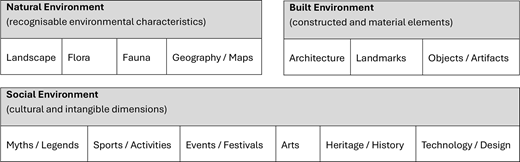
This article introduces the place characteristics framework (PCF), a design-oriented categorisation tool that organises place attributes into three domains – natural, built and social – to support early-stage symbolic exploration. The framework does not prescribe aesthetic outcomes or replace participatory design processes; it functions as a pre-visual scaffold that expands and organises symbolic material before it is interpreted and translated into visual form. Developed through a multi-phase, mixed-method design-led research process, including systematic framework synthesis, visual analysis and exploratory testing with practitioners and students, the PCF supports identity development by helping practitioners review and structure place-based symbolic material prior to its interpretation, discussion and translation into visual form.
2. The challenges of visual representation in place branding
Symbols play a critical role in communicating identity. From coats of arms and flags to logos and icons, they function as a condensed visual shorthand, distilling cultural narratives, histories and values into recognisable forms (Barthes, 1972; Goodnow, 2008; Šifta and Chromý, 2016; Wheeler, 2017). In semiotic terms, meaning is produced through repetition, circulation and interpretation rather than fixed or inherent content (Barthes, 1972). Within place branding, symbols become focal points through which collective memory and imagined communities are articulated, contested and reworked over time (Anderson, 1983; Billig, 1995; Edensor, 2002). Branding, originally rooted in commercial practice, adopts these same symbolic principles through visual and verbal systems that distinguish places and make them meaningful to audiences (Kapferer, 2012; Wheeler, 2017; Govers, 2020; Dinnie, 2022). In this context, cohesive identity systems and devices such as logos and emblems support recognition and emotional attachment within and across audiences (Wheeler, 2017; Kelly, 2017). Logos typically combine text and visual elements to provide structured identifiers, while emblems, coats of arms and flags foreground continuity, authority and tradition (Šifta and Chromý, 2016). In this research, the term symbol describes any visual form, standalone or within a wider identity system, which contributes to the construction and communication of place identity.
Scholars emphasise that places must establish recognisable points of difference in competitive contexts (Baker, 2007; Ren and Blichfeldt, 2011; Kavaratzis and Hatch, 2013; Dinnie, 2022). In visual identity, differentiation must be communicated through symbolic cues that signal cultural meaning and distinctiveness. Yet there is little consensus on how much weight symbolic devices carry in shaping identity. Contemporary place branding scholarship argues that such cues must be grounded in a place’s deeper cultural and social “DNA,” rather than relying on superficial or generic imagery. Kaefer (2021, p. 7) describes place DNA as the “unique, distinctive character,” encompassing tangible attributes (architecture, landscape and built form) and intangible associations (memories, affect). Symbols therefore mediate between lived qualities and projected identity, while needing to remain credible and locally grounded (Baker, 2007; Sandbach, 2022). These dual pressures, directly shape how symbols are selected, stylised and interpreted.
Despite ongoing debate, scholarship maintains that symbolic devices play a central role in mediating place identity. Wilson (2018) argued that graphic identifiers can bridge past, present and future by staging continuity while signalling transformation. Empirical studies further suggest that logos and related visual devices can shape international perceptions and tourism behaviour when operating within broader destination communication systems (Lee et al., 2012; Tsaur et al., 2020; Sandriester and Pizzera, 2024). Kelly (2017) observed that contemporary place brands often rely on flexible systems that accommodate variations while remaining unified by a central symbolic logic. This emphasis on logos and slogans as core symbolic vehicles aligns with Kladou et al.’s (2017) argument that dominant branding approaches often position symbolic brand elements as primary tools through which place identity is strategically articulated and communicated.
At the same time, scholars caution against overstating the role of visual identity alone. Govers (2013) emphasised that place branding also involves managing reputation and relationships, while Kaefer (2021) argued that attempts to distil uniqueness into a single graphic device often fails because lived practices and institutional behaviours shape identity more powerfully than visual shorthand. Research in place and destination branding further suggests that while logos are necessary and carefully managed components of intentional branding, their communicative capacity is structurally limited when treated as standalone devices, particularly within complex and crowded symbolic environments (Beritelli and Laesser, 2018). Rather than negating the symbolic function of visual markers, these critiques underscore the need to understand symbols as operating within wider social, cultural and organisational systems.
Similarly, Lucarelli (2012) maintains that place identities must be communicated through elements that are both recognisable and operational, yet capable of carrying multidimensional meanings. This challenge is particularly visible in symbolic representation, where visual forms must remain simple and reproducible while still embodying layered cultural narratives. Yet, when culturally attuned and grounded in shared narratives, symbols continue to foster recognition, affective engagement and create a sense of belonging (Goodnow, 2008; Müller and Schade, 2012). However, this very requirement for symbolic reduction introduces an inherent risk, as over-simplification can lead to generic or clichéd imagery, while reliance on heritage motifs can entrench outdated or exclusionary representations (Wilson, 2018). As Šifta and Chromý (2016) observed, the effectiveness of symbols depends not only on their formal design, but on how they are produced, circulated and perceived within society, rendering their meanings dynamic and socially negotiated across institutional, cultural and everyday contexts. These tensions do not undermine the value of symbolic representation; rather, they highlight the need for greater care and structure in how symbols are identified, developed and mobilised in place branding. The challenge lies not in whether symbols should be used, but in how designers can negotiate simplicity and depth, continuity and change and local resonance and global legibility without resorting to reductive visual shorthand.
In practice, this tension often results in execution taking precedence over cultural depth, producing symbols that privilege surface appeal over meaningful connection to lived narratives (Govers, 2013). This concern is echoed across broader critiques of branding that describe how socio-cultural discourse is flattened into marketable shorthand (Govers and Go, 2009), a pattern also observed in the repeated use of scenic clichés and familiar motifs in place branding (Mayes, 2008; Porter, 2015; Aiello and Parry, 2019). As a result, symbolic differentiation alone often fails to address the deeper drivers of place perception and attachment, especially when branding strategies privilege representational imagery over lived social and economic realities (McManus and Connell, 2014). Landscape imagery in place branding is frequently reduced to a narrow set of familiar scenic tropes, reinforcing a limited symbolic repertoire. This pattern shows how visual conventions shape what is perceived as “appropriate” for representing place, privileging motifs that are convenient and legible over those that may be more complex (Porter, 2015; Mayes, 2008; Aiello and Parry, 2019). Over time, these repeated motifs acquire a kind of symbolic “stickiness”: even as their meanings shift or become contested, they retain visibility and authority because they are embedded within everyday media environments and circulatory systems (Aiello and Parry, 2019).
This everyday symbolic environment both enables and constrains place branding practice: while familiar visual conventions provide accessible reference points, they also narrow the symbolic repertoire available to designers. This tension becomes particularly significant when considered alongside perspectives that frame place identity as fluid, layered and evolving (Anholt, 2007; Govers and Go, 2009; Kalandides, 2011; Wheeler, 2017), raising the question of how symbolic material can meaningfully represent places that are inherently dynamic.
While existing scholarship richly interrogates the meanings, politics and effects of place symbols, it offers comparatively little methodological clarity regarding how symbolic material is systematically surfaced, organised and compared in the early stages of place branding development. Practitioners, including designers, strategists and stakeholders may use participatory, narrative or strategic research methods to identify place characteristics, yet there remains limited structured guidance for categorising and expanding this material prior to visual translation. As a result, symbolic selection can default to familiar or culturally sanctioned motifs, narrowing the representational repertoire available to practitioners.
3. Conceptualising place meaning and symbolic translation
To understand how symbolic material is currently conceptualised in place branding, this section reviews a selection of influential frameworks drawn from branding, regional studies, cultural geography and visual communication. Although developed for different purposes, these models reveal recurring assumptions about where place meaning is located and how it is translated into communicable form. When examined comparatively, a pattern emerged: early strategic and perception-oriented models operate at a high level of abstraction, while later cultural and symbolic approaches focus more on how place is encountered through everyday environments and practices. However, across the frameworks reviewed, there remains a lack of structured, design-oriented methods for identifying and organising place characteristics as symbolic material, a limitation also noted in destination branding research (Kotsi et al., 2018).
The challenge for designers and practitioner in place branding is to move beyond privileging surface appeal over meaningful connection to lived narratives. This need for a more systematic approach informed the development of the PCF. A wide range of models and conceptual contributions were reviewed, spanning strategy-led brand approaches (e.g. Caldwell and Freire, 2004; Ashworth, 2009; Moilanen and Rainisto, 2009), narrative and identity-based work grounded in belonging and place attachment (Ren and Blichfeldt, 2011; Campelo et al., 2014; Kavaratzis and Hatch, 2013) and domain-specific perspectives focusing on sensory identity, landscape, built form or cultural expression (Castillo-Villar, 2016; de San Eugenio Vela et al., 2017; Hu and Chen, 2018; Rodrigues et al., 2020).
While these perspectives enrich understanding of how place is experienced, governed and communicated, most frameworks remain conceptual, strategic or perception-focused and do not provide a structured method for identifying or organising symbolic attributes for visual design. For this reason, the discussion below concentrates on frameworks most relevant to symbolic interpretation, those that outline place characteristics, identity components or recurring motifs used in branding practice. In line with Lucarelli’s (2012) call for more pluralistic and interdisciplinary approaches, this synthesis draws together branding, regional studies and everyday nationhood to establish both the common ground across frameworks and their limitations for guiding early-stage symbolic selection.
The following analysis presents selected frameworks in a conceptually ordered sequence, beginning with strategic branding models (Anholt, 2006; Baker, 2007) and progressing to identity-based and symbolic approaches (Lucarelli, 2012; Šifta and Chromý, 2016; Edensor, 2002; Skey, 2017; Wilson, 2018). This ordering reflects a shift from abstract, perception-oriented models of place identity towards more grounded approaches that identify the cultural, spatial and symbolic dimensions of place.
Anholt’s (2006) Nation Brand Hexagon and subsequent City Brand Index exemplify a strategic, perception-oriented approach. His model organises place reputation across six dimensions – presence, place, people, pulse, potential and prerequisites – designed to capture how external audiences evaluate countries and cities as holistic entities. These categories emphasise reputation, experience and opportunity rather than specific visual or material characteristics. While people, culture and everyday life sit implicitly at the core of the framework, the model remains at a high level of abstraction and does not articulate which concrete attributes (such as landscapes, buildings or cultural practices) might translate into symbolic form. As such, it offers a valuable macro-level view of place perception, but limited guidance for designers tasked with deciding what to depict.
Baker (2007) moved closer to the material qualities of place through his seven-step process for destination and city branding. He identified a wide array of positioning variables – such as architecture, cuisine, history, the natural environment, people and events – as potential sources of differentiation. Importantly, Baker explicitly recognised that distinctive place brands often emerge from combinations of tangible features (e.g. built form, landscape and landmarks) and intangible qualities (such as values, personality and emotional associations). This tangible–intangible distinction recurs across place branding and identity literature, even when expressed in different terms. As seen in later frameworks by Lucarelli (2012), Šifta and Chromý (2016) and (Edensor, 2002), place meaning is consistently conceptualised as emerging from the interaction between material form and lived, affective experience. Yet, as with Anholt, Baker’s framework remains primarily oriented towards marketing strategy and messaging. While his variables are expansive and insightful, they are not explicitly organised in ways that support the systematic selection of symbolic attributes for visual design.
Lucarelli’s (2012) analysis of city brand equity offers a structured typology of the elements through which city brands are expressed. Drawing on a grounded review of 72 city branding studies originally identified in Lucarelli and Berg’s (2011) broader analysis of 217 articles, brand elements were inductively grouped into five categories: history and heritage; artefacts and spatial plan; events and activities; processes and institutions; and graphics and symbols. These categories encompass many of the components designers and marketers commonly draw upon, including historical narratives and cultural heritage; landmarks, buildings and spatial environments; festivals and hallmark events; and governance, planning and institutional activities. The category of graphics and symbols includes logos, pictures, maps, promotional videos, slogans and other visual and textual artefacts that serve as communicative expressions of the brand. While this typology acknowledges the important role of visual media in representing city identity, graphics and symbols are positioned primarily as communicative manifestations of branding rather than as outcomes of a systematic process for identifying and translating place characteristics into symbolic form. As a result, the framework describes what constitutes city brand expression but offers limited guidance on how symbolic elements are selected, prioritised or derived from the broader material, cultural and social characteristics of place.
Šifta and Chromý (2016) shifted the focus more directly onto symbolic representation by developing a classification of graphic regional symbols, emblems, coats of arms, flags and logos that can be used in regional marketing and branding. Drawing on Paasi’s work on the institutionalisation and symbolic construction of regions, alongside a multidisciplinary literature review, they examine how regions are given symbolic form through natural elements (flora, fauna, forests, mountains, bodies of water), cultural and historical landmarks and social activities such as events and festivities. Their typology shows how recurring motifs such as landscapes, built heritage and cultural practices function as shorthand for regional narratives. While this framework offers rich insight into the kinds of images that recur in regional symbolism, it remains descriptive, cataloguing which motifs appear, but does not offer a structured way to categorise or organise these elements as symbolic material, leaving practitioners without a clear guidance to mapping underlying place attributes before visual exploration begins.
From a more sociological standpoint, Edensor (2002) and Skey (2017) broaden the discussion by examining “visual markers of nation” in everyday environments. Edensor identifies markers ranging from landscapes, rituals and material artefacts to textures, smells and sounds, arguing that national identity is embedded in mundane spaces and practices rather than only in official symbols. Skey’s photo-elicitation work maps recurring markers, schools, hospitals, post offices, shops, street furniture, road signs, sports facilities and other public utilities within what he terms the national “signscape.” These approaches highlight how places are experienced and recognised through a dense ecology of material and visual cues. However, many of these markers (for example smells, sounds or functional infrastructures) are difficult to translate directly into graphic symbols. Their greatest contribution to the present study lies in underlining which kinds of elements tend to be noticed, remembered and associated with nation and place and in emphasising the need to connect symbolic representation back to lived environments.
Wilson’s (2018) study of place brand heritage bridges strategic branding and visual communication. Through content analysis of place-related advertising in business magazines, he distinguishes between nomenclature, verbal and visual elements and catalogues a wide repertoire of potential symbolic resources. These include colours, flags, flora and fauna, maps, heritage buildings, artworks, famous people and characters, myths and legends and references to values, religion, recreation and industry. Wilson’s framework confirms and consolidates themes already seen in Baker, Lucarelli and Šifta and Chromý: natural features, built heritage and cultural practices consistently recur as carriers of place meaning. At the same time, his analysis underscores that the selection and combination of these elements is usually guided by strategic considerations and existing conventions, rather than by any shared, design-oriented method for surfacing and organising symbolic content.
Scholars increasingly emphasise participatory and co-creative approaches in place branding, highlighting the importance of political sensitivity, cultural nuance and collaboration in shaping identity narratives (Sandbach, 2022; Ripoll González et al., 2025). However, within branding practice, execution often takes precedence over cultural depth, resulting in symbols that prioritise surface appeal over meaningful connection to lived narratives (Govers and Go, 2009; Govers, 2013). Across these frameworks, a consistent pattern emerges symbolic resources are identified, classified or evaluated retrospectively, but are rarely organised in ways that support early-stage design exploration.
Existing frameworks that categorise place attributes or identity drivers (Baker, 2007; Lucarelli, 2012; Šifta and Chromý, 2016; Wilson, 2018) were developed as conceptual or strategic models rather than tools for visual communication practice. While they offer valuable insight into how place meaning is constructed and perceived, their application within design processes can be fragmented, context-specific and difficult to translate directly into visual form (Lucarelli and Berg, 2011; Adamus-Matuszyńska and Dzik, 2023). As Aiello and Thurlow (2006) noted, visual elements are often deployed without methodological support, leaving designers to navigate the shift from cultural insight to graphic form.
From a design perspective, the challenge is therefore not a lack of conceptual richness, but a lack of structured support for moving from insight to visualisation. As Frascara (2004) argued, effective design requires both invention and organisation, a balance also evident in Sandbach’s (2022) documentation of the Mtns Made initiative in regional Australia, where symbolic depth emerged through sustained collaboration between strategists, creatives and local stakeholders. Collectively, these observations point to a gap: the need for a transferable, design-aware method that helps surface, organise and contextualise symbolic meaning prior to visualisation.
4. Reframing place identity frameworks for symbolic interpretation
Building on the preceding literature review, the following section shifts from conceptual discussion to analytical synthesis. Across the reviewed frameworks, recurring patterns in how place attribute are described begin to emerge, suggesting underlying structural relationships between different types of place characteristics. Viewed through a communication designer’s lens, these patterns indicate that place meaning is constructed through a combination of environmental, material and socio-cultural elements that may serve as potential sources of symbolic material.
Rather than functioning solely as analytical categories, these attributes can be understood as elements that may be selected, interpreted and translated into visual forms. This perspective highlights the designer’s role in identifying which aspects of place are visually translatable, recognisable and capable of abstraction, while also recognising that not all attributes lend themselves equally to symbolic expression. Table 1 presents a comparative synthesis of place-identity attributes across the selected frameworks, providing the basis for the analytical process outlined in the following section.
While recurring patterns are evident across these frameworks, the relationships between attributes and their potential for symbolic translation require further analysis from a design perspective. The following section outlines the methodological process through which these patterns were systematically extracted, coded and refined.
5. The development of the place characteristics framework
The PCF emerged from a design-led, interpretivist research process examining symbolic material across public spaces in Sydney, Australia, supported by visual audits of institutional collections. Drawing on ethnographic and design research principles (Edensor, 2002; Pink, 2013; Skey, 2017), this phase identified recurring symbolic cues, while also revealing fragmentation and reliance on established motifs. This limitation prompted a shift from collecting images to structuring underlying place attributes.
Rather than treating symbols as isolated motifs, the research reframed them as expressions of broader natural, built and social characteristics. This conceptual shift marked the transition from discovery to categorisation and led to the development of the PCF. While originally developed for strategic or analytical purposes, these models can be reinterpreted as sources of symbolic material. The PCF translates these recurrent clusters into a structured, design-oriented tool for organising place characteristics prior to visualisation. The framework focuses on identifying symbolic content rather than prescribing aesthetic form; decisions regarding style, colour and composition are typically addressed in subsequent stages of the design process (Frascara, 2004). In this way, the PCF supports early-stage symbolic inquiry without determining visual outcomes.
The framework was constructed through four phases, moving from analytical synthesis to applied testing:
Phase 1: Comparative synthesis
Phase 2: Visual archive triangulation.
Phase 3: Practitioners perspectives on symbolic exploration.
Phase 4: Exploratory testing in design education.
Phase 1: Comparative synthesis
During the synthesis stage, place-related attributes were manually extracted from selected frameworks and compiled into a comparative matrix (see Table 1). Each framework was reviewed to identify references to place characteristics, with emphasis on attributes that could be visually or represented, including natural features (e.g. landscape, flora, climate), built elements (e.g. architecture, infrastructure, landmarks) and social or cultural aspects (e.g. heritage, events, practices, values). These attributes were then coded through an iterative grouping process, where conceptually similar terms were clustered together (e.g. “landscape,” “geography” and “environment” were grouped under natural features; “buildings,” “landmarks” and “infrastructure” under built elements; and “heritage,” “events” and “cultural practices” under social dimensions). Not all attributes were retained; those lacking clear visual or symbolic referents were excluded. Attributes that operated at a strategic, experiential or abstract level (such as perception, personality or accessibility) were therefore omitted from the analysis. The analysis therefore focused on attributes that could be meaningfully translated into symbolic form.
Through comparison across frameworks, consistent patterns emerged. These were refined into three domains – natural, built and social– derived inductively from the analysis. Table 2 summarises the frameworks selected for synthesis and their contribution to the PCF.
Across the reviewed literature, a shared constraint emerged: not all aspects of place identity are readily translatable into symbolic form. While existing models catalogue a wide range of attributes – landscape, heritage, infrastructure, social practice – symbolic representation requires visual simplification, recognisability and repeatability. As a result, certain characteristics lend themselves more readily to symbolic expression, while others, such as sensory experience, affective atmospheres or complex social relations, resist direct representation.
This highlights a misalignment between the conceptual breadth of place identity frameworks and the reductive requirements of visual communication design, where only certain attributes can be readily translated into recognisable symbolic form, while others require more interpretive or indirect representation. Existing models were not developed to guide symbolic translation and therefore do not distinguish between attributes that can function as symbolic identifiers and those that resist direct visualisation. This reinforces the need for a structured approach to identifying and organising symbolically relevant attributes within place identity frameworks.
These domains are outlined below as a structured outcome of the cross-framework synthesis:
Natural environment:
Encompassing flora, fauna, climate and geographical features. These elements function as symbolic anchors in national and regional identity systems due to their recognisability.
Built environment:
Including architecture, infrastructure, landmarks and material artefacts. These elements often reflect historical layering, aesthetic identity and societal development.
Social environment:
The cultural and intangible dimensions of place, including stories, festivals, heritage, sport and everyday practices. These elements evolve dynamically and reflect collective meaning-making.
While the PCF organises attributes into natural, built and social domains, it acknowledges cultural specificity, particularly Indigenous symbolic systems. Indigenous visual languages embody deep relationships to Country, time and belonging, and are increasingly recognised across tourism, public art and national branding (Kennedy, 2015; Seiver and Matthews, 2019; Whitford and Ruhanen, 2019). Although Indigenous perspectives are not treated as a separate domain, they can be incorporated through sub-identifiers such as art, heritage, story and material culture, with scope for a dedicated Indigenous lens in future iterations where cultural consultation or co-design is prioritised.
Phase 2: Visual archive triangulation
As curated carriers of national imagery, stamps commemorate figures, events and places, functioning as official visual messages that preserve historical memory and project national values (Anderson, 1983; Raento and Brunn, 2005; Raento, 2006). In this sense, they operate as a form of nation branding, circulating government-endorsed representations of identity both domestically and internationally. To triangulate the identified domains, Australian postage stamps were analysed as a curated archive of national imagery (Anderson, 1983; Raento and Brunn, 2005; Billig, 1995), providing a longitudinal record of state-endorsed symbolic representation.
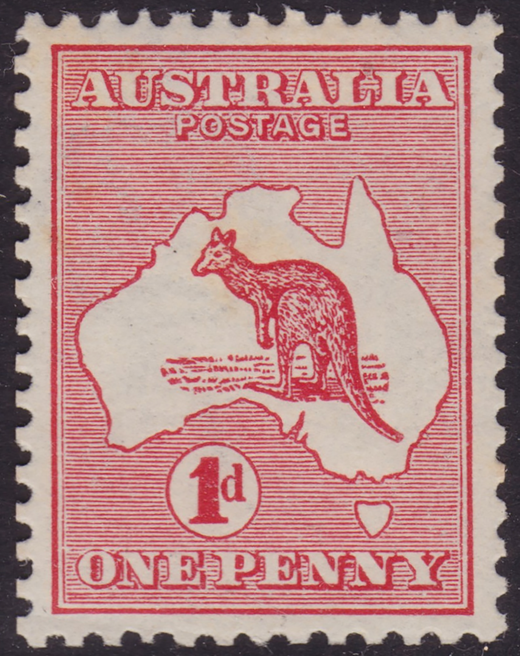
In Australia, stamps have historically played an explicit nation-building and promotional role. Following Federation, Postmaster-General Charles Frazer described stamps as one of the country’s most powerful promotional tools, reflected in the 1913 kangaroo and map stamp, widely regarded as the first emblematic image of the new Commonwealth (Cowles and Walker, 2005) (Figure 1). Curatorial insights from Australia Post (E. Gertsakis, personal communication, November 2, 2020; H. Ericksen, personal communication, November 10, 2020) indicate that stamp selection is shaped by public submissions, design competitions, collector interests and government priorities, highlighting the multiple stakeholders involved in shaping national imagery. To examine how symbolic attributes have been publicly selected and circulated over time, a data set of Australian postage stamps was compiled from Renniks Stamps of Australia (Renniks Publications, 2019), spanning Federation-era issues through to contemporary releases (1913–2018), including Australian Antarctic Territory and Norfolk Island.
A thematic review grouped stamp issues by dominant subject matter (Table 3). Across the data set, motifs consistently mapped onto the natural, built and social domains, reinforcing the recurrence of these categories in both academic frameworks and public visual culture. Comparable international studies document similar patterns (Raento, 2006), suggesting that these domains extend beyond a single national case.
These findings affirmed that the natural, built and social themes identified in the literature frequently guide symbolic representation practices. Similar participatory patterns have been documented internationally (Raento, 2006), reinforcing the role of stamps as both ordinary and deliberate instruments of nation narration (Billig, 1995; Raento and Brunn, 2005). Although this analysis focuses on Australia, studies of postage stamps in other national contexts demonstrate similar uses of flora, fauna, landscapes, heritage figures and cultural narratives as recurring symbolic devices (Raento and Brunn, 2005; Raento, 2006), indicating that the thematic domains identified here extend beyond a single national case. Across the data set, symbolic motifs mapped consistently onto the three domains of the PCF, reinforcing the stability of these categories across both academic frameworks and public visual culture (see Table 3).
Testing the place characteristic framework.
Building on the synthesis of framework analysis (Phase 1) and visual triangulation (Phase 2), the PCF was developed as a structured tool for organising symbolically relevant attributes. A simplified template of the framework is provided in Figure 2, enabling designers and practitioners to organise place characteristics across natural, built and social domains during early-stage research.
The following phases examine how the framework operates in practice through practitioner perspectives and educational testing.
Phase 3: Practitioner perspectives on symbolic exploration
Nine semi-structured interviews examined how designers identify symbolic material in place branding projects. The sample comprised eight professional designers and one strategist with experience across national, regional and commercial identity projects, selected through purposive sampling based on relevant practice experience. Participants included both Indigenous and non-Indigenous practitioners and represented a range of career stages. Interview transcripts were analysed using inductive thematic coding, where responses were reviewed iteratively and grouped into recurring themes relating to intuitive processes, absence of formal frameworks, participatory methods and responses to the PCF. Participants are identified using coded labels (e.g. D1–D7 for designers and ID1–ID2 for Indigenous designers) to maintain confidentiality.
Participants described symbolic exploration as intuitive and adaptive rather than structured. As one participant noted, “our design firm has definitely developed its own frameworks… but it’s less framework and more a set of exercises” (D1), highlighting the iterative and practice-based nature of design processes. Immersion was also emphasised, with one participant observing that “nothing truly replaces spending time in a place… to tap into the DNA of it” (D7). Another participant highlighted the absence of formal frameworks, instead emphasising “the environment… and that connection to country” (ID1).
While most participants described informal and adaptive processes, one participant observed that “academia and practice operate in different worlds” (D1), reflecting the limited use of formal frameworks in professional contexts. When introduced to the PCF, eight participants identified its value as an early-stage scaffold for organising symbolic material. The framework was viewed as complementary to existing practices rather than prescriptive.
Phase 4: Exploratory testing in design education
The PCF was trialled in a third-year design studio on place branding at the University of Technology Sydney (40 students; 10 substantive users). The framework was introduced as an optional resource during the research and concept development phase, allowing students to incorporate it alongside their existing design research methods.
Student engagement was evaluated through analysis of assessed research reports, including visual research mapping, contextual analysis and initial design directions and written reflective feedback responding to questions about the framework’s usability. Structural adaptations and patterns of domain use were identified through review of submitted reports, while student perceptions of clarity, cognitive load and usefulness were derived from their written reflections.
All ten students applied the PCF adaptively. Eight of the ten used the three primary domains – natural, built and social – as organisational headings, drawing on the associated subcategories to record notes, add dot points and highlight characteristics within each domain. Two students worked primarily with the overarching domains without engaging the subcategories in detail. Four students extended their analysis by incorporating additional strategic tools such as PESTLE and SWOT, using insights generated through the PCF to inform broader contextual evaluation. In addition, two students introduced project-specific subcategories to reflect particular functional and cultural aspects of the site. For example, one student working on the Oxford Street project added subcategories such as bars, restaurants and cafés to foreground the precinct’s nightlife and hospitality culture, while another developing a place brand identity for Bali incorporated political and economic considerations alongside the social domain.
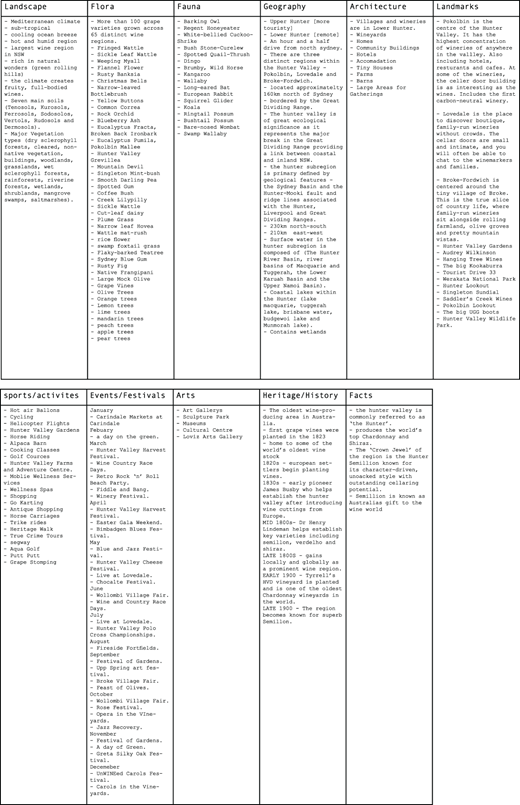
One student working on a branding project for the Hunter Valley described how the PCF reduced complexity:
Before I started my research, I had no idea just how big the Hunter Valley actually is[…] I realised my concept could get really complex, really fast[…] breaking it down helped me not feel so overwhelmed. (Figure 3).
Another student noted:
I found it to be an extremely useful starting point for research into the social and environmental aspects of place. The object/artefact grouping specifically was a category I hadn’t considered and ended up being one of the most important research threads.
Students identified the framework as a clear and useful starting point for organising research, reducing complexity and prompting exploration of overlooked attributes. Feedback also highlighted areas for refinement, including initial difficulty interpreting certain subcategories (e.g. “landscape” vs “geography”) and the need for clearer definitions or flexibility in adapting categories to specific project contexts. This prompted the relabelling of the subcategory to “geography/maps,” aligning with terminology in the literature (e.g. Wilson, 2018). Several students also adapted or extended categories to suit specific project contexts. Primarily used during the research phase, students reported that the framework reduced cognitive overload, supported conceptual clarity and strengthened their ability to justify symbolic decisions.
The educational testing indicates that the PCF functions most effectively as a flexible front-end research scaffold rather than a prescriptive methodology. Students used the framework to organise complex symbolic material, focus their research direction, surface overlooked or non-stereotypical attributes and articulate the rationale behind visual decisions. Together with practitioner insights, these findings suggest that the PCF holds value both pedagogically and professionally as a structured yet adaptable tool for early-stage symbolic exploration.
An example of the PCF in use is shown in Figure 3, illustrating how students adapted the framework to organise and interpret place-specific attributes.
6. Conclusion
Designing symbols that meaningfully represent place identity remains a complex and unresolved challenge within place branding. While existing models provide valuable conceptual and cultural insight, they offer limited guidance for translating place characteristics into symbolic form within design practice. This article has introduced the PCF as a design-oriented structure that extends current scholarship by focusing specifically on the identification and organisation of symbolic attributes across natural, built and social domains. In doing so, it reframes place branding through a designer-centred lens, strengthening the connection between theoretical understandings of place identity and the practical processes through which visual identities are developed.
Exploratory testing with practitioners and design students suggests that the PCF functions most effectively as a flexible front-end research scaffold rather than a prescriptive methodology. The framework supported users in structuring complex symbolic material, identifying under-recognised attributes and articulating the rationale behind visual directions. Rather than replacing participatory or context-driven approaches, the PCF complements them by offering a structured means of navigating symbolic complexity prior to visual translation.
The contribution of this study lies in advancing place branding scholarship through the introduction of a design-informed framework that bridges theoretical discourse and early-stage visual exploration. By foregrounding symbolic potential as a distinct analytical concern, the PCF expands the methodological toolkit available to both researchers and practitioners.
As testing to date remains exploratory and primarily situated within educational and practitioner contexts, further research is required to evaluate the framework across comparative case studies and through the development of realised visual identities. Future iterations may incorporate contextual lenses or community-specific dimensions to support culturally sensitive applications. In this way, the PCF establishes a structured foundation for ongoing symbolic inquiry and design-led exploration within place branding.