

This paper aims to explore how arts-based methods can foster place-based innovation and affective activation in rural areas, focusing on the Duemila30 Film Residency in Cassine, Italy. It examines how the filmmaking residency can activate the community’s sense of place and promote sustainable alternatives to mass tourism and place commodification.
Using a qualitative and inductive approach combining affective ethnography and thematic analysis, the study draws on interviews and focus groups with residents and filmmakers, in addition to participant observation.
Results highlight some fundamental characteristics of arts-based methods to create meaningful connections with the residents to co-construct and foster place-based innovation. Hospitality, reflexivity, co-creation and shared responsibility transformed the artistic collaboration into a community-building experience. The residency fostered affective bonds, renewed local identity and opened pathways toward proximity tourism and proximity economics.
Limitations of this research come from the short duration of the project, which only amounts to two editions and from the lack of data and indicators on the effective transformation of the community in the future.
The paper advances a process model of arts-based community-driven reflection on sense of place, illustrating how artistic collaboration can generate meaningful place-based innovation and affective activation in rural contexts by privileging process over product, relationship over commodification and identity co-creation with communities.
1. Introduction
Rural communities’ challenges, such as depopulation and lack of services, have generally been addressed as a matter of attractiveness and destination competitiveness in the broader framework of tourism. While in Italy, tourism is still framed institutionally as the “oil of Italy” (TTG Italia, 2025) and it is naturalized as the only viable path for urban and territorial transformation, civic movements have emerged to contest touristification both in larger touristic cities like Naples, Florence, Bologna and Venice and in smaller towns and rural communities, like Ponza or Amatrice (Esposito in Agostini et al., 2022).
Overtourism has emerged as a critical concern in recent years, attracting widespread public and academic attention due to its social, ecological and urban implications (Giuzio, 2024). Defined by the UNWTO report (2018) as tourism’s excessive impact on residents’ quality of life and visitors’ experiences, overtourism reflects not only issues of volume but also deeper structural dynamics in how places are produced, represented and lived. It has been described as a form of monoculture (Agostini et al., 2022), reducing diversity, commodifying culture and transforming local life into staged authenticity for global consumption (Zukin, 2008). In privileging tourism as the dominant mode of development, cities and towns experience inflated housing costs, erosion of public spaces and increasing inequalities – dynamics that also extend to rural and marginal areas transformed into nostalgic, static images of themselves.
In response, alternative approaches such as proximity tourism, slow and community-based models, creative tourism (Duxbury and Richards, 2019), creative placemaking (Courage, 2021), sensory tourism (Oliveira, 2022; Agapito et al., 2013) and participatory planning are gaining traction. These models emphasize collective stewardship and sustainable local economies, challenging extractive tourism logics.
Parallel to this debate, a growing body of research explores how arts-based practices and cultural and creative work are mobilized in rural contexts to foster identity, revitalization and community development (EU CAP Network, 2024; Duxbury, 2021) and how creative hubs can enhance rural entrepreneurship (Hill et al., 2025). Rural areas are increasingly seen as laboratories for experimentation, where artistic interventions can address demographic decline, ecological transformation and social fragmentation (Balfour et al., 2018). While art can activate social cohesion and place attachment (Anwar-McHenry, 2011; Kolokytha, 2023; Duxbury and Campbell, 2011), stimulate local economies (Markusen and Schrock, 2006; Gibson, 2002; Drummond, 2021) and support CCIs clusters through festivals, residencies and creative placemaking (Qu and Cheer, 2021; Moayerian et al., 2022; Duxbury, 2021; Skippington and Davis, 2016), critics note that cultural branding – “the economy of enrichment” – may reproduce homogenization and gentrification (Boltanski and Esquerre, 2017) or transform art into a form of territorial colonization (Tartari et al., 2022). The dual potential of art and creativity – as both a catalyst for inclusion and a vehicle for commodification – makes it a valuable lens for investigating place-based dynamics in rural Italy.
While these literatures focus on how to enhance and revitalize the touristic aspect and entrepreneurial activity of rural communities, little is known about how rural communities feel about it. What is generally missing is a critical reflection on how creativity and regeneration would impact the territory from a community perspective and if this is a desirable option. If critical debates on tourism and creative homogenization are now emerging in big cities mostly affected by overtourism (Agostini et al., 2022), rural communities are still understudied from this critical research perspective (Barbera et al., 2022), even if they – especially the borghi – have been the privileged locations for attracting public funds on creative placemaking and marketing campaigns for repopulation.
In addition, from a methodological perspective, arts-based methods have generally been used both as branding tools for communication purposes also as research ones – for instance as ethnographic research tools (Pink, 2021), visual elicitation sources (Rose, 2022) or independent artistic outputs – while less attention has been paid to the effects of their process on the community they address and to its social change (Mitchell et al., 2017), especially from an affective perspective. Indeed, it is generally the community that directly uses the recording technology (cameras, photographs, cellphones) to produce visual materials, while investigating reflexively the related power imbalances in participatory videomaking. For instance, Mitchell et al. (2017) have analyzed audience engagement in participatory visual methods, developing the critical audience engagement in which community engagement is put in relation with reflexivity and political listening.
This article focuses on the affective dimension of the participatory process of an arts-based method (film residency) in the rural context of Cassine (Piedmont). In particular, it investigates how arts-based activities can serve as catalysts for community reflection on the sense of place of Cassine by analyzing the Duemila30 film residency as a case of participatory arts-based methodology aimed at reimagining local identity beyond tourism exploitation. The “affective turn” in the 1990s has extended discussions about culture, subjectivity, identity and bodies in critical theory, focusing on “the dynamism immanent to bodily matter and matter generally” (Clough, 2008). We understand affect not just as the emotions felt by the subject but as the interrelated dynamics (entanglement) between bodies interacting with each other and the place. In this sense, the film residency assumes the characteristics of a socio-material practice: as Leonardi (2012) argues, the socio-material practice is not the individual activity but rather the “socially shaped arena in which activities are negotiated” (p. 14). The residency in all its steps is, then, understood as “the space in which the social and the material become constitutively entangled” (Orlikowski, 2010).
So, rather than analyzing the outputs of the film residency (short films), the object of our analysis is the process: how the residency – through affect – fosters community activation, co-creation of local meanings and critical reflections on tourism and Cassine’s sense of place. The paper situates this initiative within debates on sense of place in creative rural development and community-based art practices, arguing that the value created by the residency does not lie in its artistic outputs but in the collaborative, affective-transformative process through which residents and filmmakers collectively negotiate the meaning and future of their place. The article contributes also to the literature on arts-based methodologies in community-based research (Coemans and Hannes, 2017), especially in its use to foster change and influence social identities.
The following sections introduce the notion of a sense of place as a socially constructed and negotiated concept, which forms the theoretical foundation for understanding the role of arts-based practices in place-making. The case study is then presented, outlining its processual stages and examined in detail within the Results section. The Methodology section explains how data were collected, analyzed and interpreted. The findings reveal affective dynamics of arts-based methodologies to establish meaningful relationships with residents and to co-create and sustain place-based innovation. Hospitality, co-creation and shared responsibility emerge as essential conditions that transform artistic collaboration into a community-building process. Through these dynamics, the residency fostered affective bonds, revitalized local identity and opened new pathways toward proximity tourism and proximity economics. In the conclusion, the film residency is presented as the first step toward the development of proximity tourism and proximity economics, conditional to the political listening of policymakers.
2. Sense of place and placeness
The concept of “sense of place” has been widely theorized across different disciplines, such as geography, environmental psychology, anthropology and cultural studies (Erfani, 2022), becoming a key analytical category to understand how people relate and assign meanings to their environments. Cresswell (2014) describes places as “meaningful sites” shaped through social practices and symbolic constructions and in the interaction between places and people Lalli (1992) underlines place identity, especially “urban-related identity” as a key part of self-identity, while Massey (1994) conceptualizes it as inherently relational, open and contested, rejecting essentialist or bounded notions of identity. So, the construction of a sense of place includes both the material “place satisfaction” (Stedman, 2003) and the “place attachment” of residents toward their local environment (Twigger-Ross and Uzzell, 1996) and the more social aspect of a place intended as the outcome of common behavior and situated processes of identity (Manzo, 2003).
The distinction between space and place has been central in human geography and related disciplines. Scholars usually argue that space – generally abstract and undifferentiated – becomes place when it is endowed with meaning through lived experience (Relph, 1976), embodying attachment, familiarity and values (Tuan, 1977). Place is a “meaningful location” composed of three interrelated aspects: a geographical position, a material form and the meanings invested in it (Cresswell, 2014) – the latter are understood as relational flows, power structures and cultural representations (Massey, 1994; Gieryn, 2000). A central reference on space is Henri Lefebvre (1974)’s The Production of Space arguing that space is socially produced through historical processes, power relations and modes of production. His “spatial triad” (spatial practice, representations of space and representational spaces) demonstrates how space is simultaneously material, symbolic and lived.
Researchers have explored the affective bonds connecting people to places. Altman and Low (1992) define place attachment as “a complex phenomenon” that integrates affect, cognition and practice, while Manzo and Devine-Wright (2014) highlight that attachment can also include ambivalence and conflict in contexts of socio-spatial change. Gherardi (2019), Brennan (2004) and Rodaway (1994) conceptualize placeness as an “affective atmosphere” that shapes embodied experience. In this view, affective atmospheres embody both the sense of place and the potential for action: “To experience a place means to learn to be affected by place” (Gherardi, 2019: 750).
While some have attempted to measure sense of place quantitatively (Nanzer, 2004; Shamai and Ilatov, 2005) and draw some models of people-place relations (Wartmann et al., 2021; Scannell and Gifford, 2010), recent research has highlighted qualitative and arts-based approaches. Duxbury et al. (2015) argue that artistic practices can “uncover, articulate and circulate local meanings of place” (p. 20), enabling communities to reflect on and reimagine local identity. This perspective aligns with broader literature on cultural placemaking, which views artistic engagement as a catalyst for social cohesion and critical reflection on local development. Cultural and community events such as festivals (Duffy, 2000; Derrett, 2002) and microbrewing (Flack, 1997) have been studied as forms of performing and reproducing a sense of place.
Overall, the literature conceives of a sense of place as a dynamic, relational and contested process through which communities negotiate their identities, histories and futures. Despite extensive research, few studies have addressed sense of place in rural areas or its relationship to civic participation and local management (Soini et al., 2011), leaving open important questions about how sense of place can foster sustainable, community-driven forms of territorial development.
3. Duemila30 film residency in Cassine
3.1 The place
Cassine, a small town in Piedmont’s Alto Monferrato Acquese, lies along the Bormida River and maintains a multiple identity as a rural community shaped by viticulture, an historical border territory culturally relevant and a small town approximately at 1.5-hour drive from Torino Milano Genova and Piacenza. Like many Italian rural towns, it has faced demographic decline in recent decades, with its population decreasing from over 3,000 in 2001 to fewer than 2,800 in 2023, driven by negative natural growth, only partially mitigated by modest in-migration. Despite these challenges, Cassine has sought to sustain its civic and cultural vitality through traditional festivities – such as the Festa Medioevale, the Sagra del Raviolo and the Patronal Feast of San Giacomo – and through newer initiatives like the 2021 on Espresso Masterclass festival, which combined music, heritage and community participation. These cultural practices highlight the town’s strategy of balancing demographic and economic constraints with the pursuit of place-based identity and limited, locally driven cultural tourism, resisting the pressures of massification. Cassine has little experience in tourist attraction: a limited number of international tourists (mainly from Northern Europe) are attracted by nature and the wine culture; visitors from neighboring villages take part in daily activities; visitors from the big cities are second-home owners, sometimes from several generations. Tourist infrastructure is not very developed.
3.2 The film residency process
Duemila30 is a cultural project committed to fostering social change through a range of artistic and community-based initiatives. Among these, Duemila30 Lab is a film residency held in Cassine, organized in collaboration with Casa Arcasio, a local association based in a historic house in the village center. The ten-day residency brings together ten young international filmmakers to explore the intersection between storytelling and social transformation by producing five short films set in Cassine. Participants work collaboratively to create films that engage with the traditions, landscapes and voices of the local community, combining artistic expression with themes of sustainability and inclusion.
Conceived as an immersive experience rather than a conventional film production workshop, the residency encourages participants to connect with the land, the people and the narratives that shape a shared sense of future. The process emphasizes collective creation under time constraints, requiring participants to share skills, equipment and ideas in a highly collaborative environment. The organizational model is grounded in active community engagement and shared responsibility, inviting residents to play an integral role in the project – as actors, hosts and contributors who open their homes and everyday lives to take part in the filmic narrative.
The stages of the residency are summarized in Figure 1. The first stage – an immersive experience of place – constitutes a crucial moment of interaction between local residents and international filmmakers. Immersive activities included visits to agricultural enterprises owned by local inhabitants, cultural tours of Cassine’s historical landmarks guided by residents, collective lunches and dinners for informal exchanges of stories and memories, walks through the natural surroundings and visits to local cultural industries (e.g. Ferrania).
 The flow proceeds through 5 stages. Stage 1 is immersive experience in Cassine for 3 days, then stage 2 is team formation and screenplay writing for 2 to 3 days. Stage 3 is co-directing and shooting for 2 to 3 days, then stage 4 is editing for 1 day. Stage 5 ends with collective screening.t.
Process of the film residency
The flow proceeds through 5 stages. Stage 1 is immersive experience in Cassine for 3 days, then stage 2 is team formation and screenplay writing for 2 to 3 days. Stage 3 is co-directing and shooting for 2 to 3 days, then stage 4 is editing for 1 day. Stage 5 ends with collective screening.t.Process of the film residency
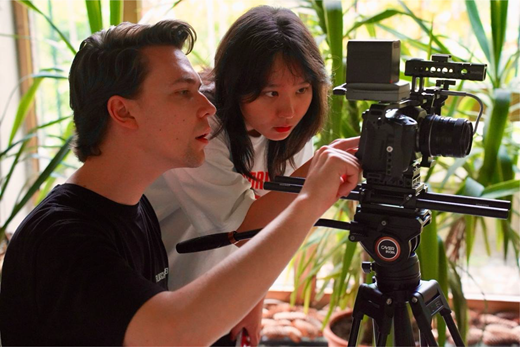
The second stage involves the formation of pairs or small working groups to co-direct the short films (Plate 1). This moment is often perceived as the most challenging in terms of group integration and collaboration among filmmakers. The identification of the film’s theme and the development of the screenplay are supported by professional filmmakers who facilitate the creative process.
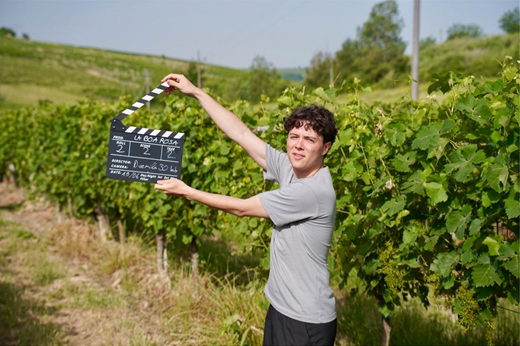
The third stage is dedicated to the shooting phase (Plate 2), during which participants not only co-direct but also engage with residents who take on roles as nonprofessional actors (Plate 3). This phase, typically the most dynamic and demanding, also generates the deepest connections and trust between filmmakers and the community who actively co-create shared meanings and activities.
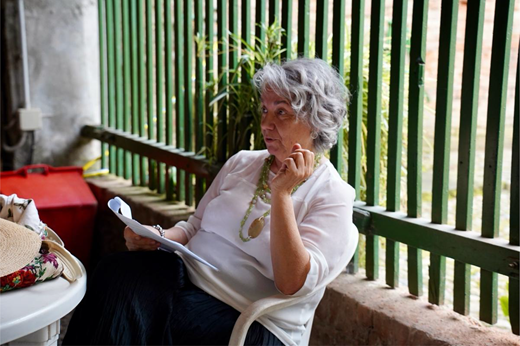
A Cassine resident reading the screenplay of the short film
Source(s): Duemila30
A Cassine resident reading the screenplay of the short film
Source(s): Duemila30
The fourth stage focuses on the editing of the filmed material, followed by the final stage – the collective screening of the short films (Plate 4). The screening becomes a community-wide event, enthusiastically attended by the town’s residents, symbolizing the culmination of shared effort and creative collaboration. Throughout the residency, the relationships among the filmmakers are further strengthened by their shared living experience at Casa Arcasio, fostering a sense of collective belonging and creative synergy.
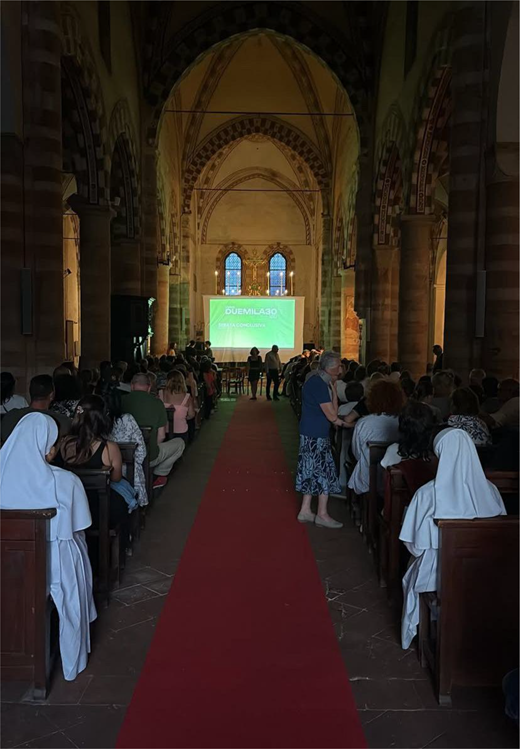
Collective screening of the short film in the church of Cassine
Source(s): Duemila30
Collective screening of the short film in the church of Cassine
Source(s): Duemila30
4. Methodology and data
The article adopts a qualitative methodology based on multiple sources of data collection, including semi-structured interviews, focus groups and ethnographic work. The empirical material covers both the 2024 and 2025 editions of the film residency and involves two main groups of participants: filmmakers and local residents. Two focus groups were conducted with the filmmakers: one in October 2024 with participants from the first edition (10 people) and one in August 2025 with participants from the second edition (9 people). Both were held online and recorded, later transcribed and thematically analyzed. A focus group with residents took place in person in September 2024 (8 participants), involving community members who had taken part in the residency, some of whom also held institutional roles (e.g. local councilor for culture) or organized local cultural events. The participants of the focus group were invited by Duemila30 (it invited all the filmmakers) and Casa Arcasio (it invited the residents) and among those invited, the ones who were willing to participate in this research activity by sharing their experiences constitute the sample. In addition, an online interview with the coordinator of Duemila30 (November 2024, 1 h) provided further insight into the association’s aims and organizational structure. This set of data captures participants’ narratives of their experiences – both filmmakers and residents – their sense-making processes regarding the residency and the personal and collective changes it generated.
An affective ethnography (Gherardi, 2019) and 4 days of participant observation were carried out by the author during the 2025 residency, while for the 2024 edition ethnographic observations were recorded in 9 h of video footage documenting the residency’s daily activities, backstage moments and interviews. These data shed light on everyday interactions between filmmakers and residents, group dynamics and the affective atmosphere that emerged from their encounters. In this sense, placeness was explored as both an analytical and experiential resource for conducting affective ethnography, supported by field notes and direct observation of the residency process. Emotions and affect were, thus, registered in the verbal accounts of people in focus groups, in the video footage of the first edition and in the field notes of the author, who had a role in interpreting all these data. All the members of the residency were informed about the research objectives of the author and agreed to take part in it by signing the GDPR module.
The short films themselves – six from the 2024 edition and five from the 2025 edition – were collected as informative data to understand what residents and filmmakers were talking about in their experiences. As already said, the article focuses primarily on the processual dimension of the film residency and not on its artistic outputs.
Following a grounded theory approach and an inductive reasoning process (Langley, 1999), the thematic analysis of the focus groups was analyzed through coding, intended as an interpretative process to assign meaning to qualitative data and as a reflexive and iterative process through which analytical insights are developed on the studied phenomenon (Saldaña, 2013). Several first-order codes emerged from the thematic analysis, namely, freedom of creation and career, learning new skills, affective dimension of the residency, change of gaze and self-perception of value, participation versus attendance, tourism attractiveness, trust with the community, hospitality and shared ownership. These were subsequently organized into three overarching, second-level categories following the processual focus of the article:
motivations for participating in the film residency, which included freedom of creation and career, learning new skills, tourism attractiveness;
effects of the film residency: participation and reflexivity, which included change of gaze and self-perception of value, participation versus attendance; and
processes of the residency: affect and ownership, which included affective dimension of the residency, trust with the community, hospitality, shared ownership.
The first category encompasses both filmmakers’ and residents’ perspectives: for the filmmakers, motivations centered on creative freedom, career development and the opportunity to acquire new skills; for the residents, participation was driven by the desire to rethink and reimagine the sense of place of Cassine. The second category refers to the participatory dimension and to the residents’ transformation in terms of gaze and self-perception of value. The third category highlights the development of mutual trust between the local community and the filmmakers, as well as the emergence of shared ownership and collective responsibility for the residency’s success.
Findings from the affective ethnography further complement this analysis by illuminating the lived dynamics among participants, residents and the local environment during the immersive activities. These ethnographic observations enrich the understanding of how the residency fostered emotional connection, collaboration and a collective sense of belonging through embodied engagement with place. The author watched the 9 h film footage and experienced the residency as a participant observer to understand the interpersonal dynamics and the sense of place that emerged in the immersive experiences, in the relation with the residents and in the everyday communal life of the filmmakers.
5. Results
In this section the thematic analysis of the focus group is presented, following the second-order codes identified in the thematic analysis, namely:
motivations for participating in the film residency;
effects of the film residency: participation and reflexivity; and
process of the film residency: affect and ownership.
5.1 Motivations for participating in the film residency
Among the motivations for participating in the film residency, filmmakers consistently emphasized the freedom of creation (“I guess it’s a huge chance to be free. To do what you want to do” – Filmmaker 1, 2024), contrasting it with the constraints of the conventional commission-based production model (“It was very hard to get back to work or to do other jobs, to find creativity for work in Germany” – Filmmaker 2, 2024; “That’s why it was really, really hard to face the ending of the residency and be back to work where you need to do what you been told to do and also” – Filmmaker 1, 2024).
Beyond this, some filmmakers underlined the symbolic value of the residency in affirming their artistic identity and career trajectory (“I think it also [was a] huge validation as an artist” Filmmaker 3, 2024). Filmmakers also considered the residency an opportunity to acquire new skills, such as co-directing, which was described as a significant challenge or even acting in colleagues’ films.
For residents, joining the first edition of the residency was part of an ongoing reflection on how to valorize Cassine from a tourism perspective and how to rethink the identity of their town. As previously mentioned, the conversation began from a shared desire to make Cassine more attractive, driven by an awareness of its cultural and natural richness but also by the need to face the broader demographic challenges common to rural Italian areas – depopulation, the increased presence of non-Italian residents and an aging community. At the same time, some residents displayed a clear awareness of the risks of mass tourism. As one noted:
Before, it was an area [Ed: Cinque Terre in Liguria] of fishermen, a few rabbits, and not much wine. Then, thanks to European projects, a lot of money came in […] now it seems to be a bit like Trentino: there are all these perfect, painted houses, but you also pay for the air you breathe. So, the question I was already asking myself back then is: in areas dedicated to agriculture or fishing, pastoralism, what remains after tourism? Well, the generation that created tourism is no longer there. And the new generation is unable to rediscover its roots, because those roots are no longer there (Resident 1).
Residents thus expressed a dual perspective: on the one hand, they criticized commodification, homogenization and the displacement of non-tourist activities – identifying these as clear effects of mass tourism’s monocultural logic; on the other hand, they acknowledged that Cassine’s lack of hospitality infrastructure and tourist services represents a limitation. They are also aware of their marginal position within Italy’s tourist geography, identifying a hierarchy of tourist locations (art cities, islands and sea tourism and wine-gastronomic tourism in rural areas) in which rural communities come as the “third round” of tourists visiting Italy.
Building on this critical awareness, some residents began to imagine alternatives such as proximity tourism, aiming to attract visitors from nearby areas and specific audiences interested in food and wine, cultural events or outdoor activities. Yet they also recognized that before developing new forms of tourism, the community needed to re-elaborate and negotiate its place-identity. The residency thus became a collective experiment: through dialogue with foreign filmmakers, residents engaged in a reflexive process of seeing their own territory through different eyes, reinterpreting their sense of place and beginning to imagine new, more sustainable futures.
5.2 Effects of the film residency: participation and reflexivity
The film residency was unanimously described by the participating filmmakers as a transformative experience: “life-changing,” “the best time of our lives,” and “an experience that touched our hearts.” It was often compared to a love story – marked by intensity, affection and ultimately melancholy and nostalgia at its conclusion – or even to a form of therapy for the reflective knowledge and self-awareness it generated. The residency also produced a strong emotional bond with the place itself and the people (“They [Ed.: the residents] have a lot of care of us, like they are really, really loving persons to us and it was a really nice experience”). As another filmmaker explained:
Cassine forever will be a place where I fell in love with the people and I think for us it’s a pretty special place. It became a special place because of the residency itself […] So it always will be like a small fairy tale in my head. I think all of us, I feel at least like I am living like through a breakup. You know, because I fell in love with this place, with people and with projects, and that time was very magical. And now I’m so sad, like I’m very nostalgic. So Cassine is a very special place for me (Filmmaker 2, 2024).
The affective dimension of the residency was rooted in the relationships among filmmakers and local residents, often beyond linguistic barriers. One filmmaker recalled:
[The resident who acted in the movie] She did not understand English and I did not understand Italian, but we still formed such a sweet bond that when the screening was done – she had pain in her legs so she could not stand that long – but she was waiting in the corner of the church under the street light on a bench for me to finish and come back to meet her. She gave me her address to send her a postcard when I was back in India. So it’s not just that I went there and made a film and came back. I made so many memories and so many bonds – not just bonds for the sake of networking, but bonds worth cherishing. And that is something, you know, that makes you feel human at the end of the day, doing something that you love (Filmmaker 4, 2025).
The residents were moved and surprised by their participation in the residency (“you have no idea how big of a gift you gave to me. I’m usually a shy person, but I was very, very, very moved”) – although their participation in the shooting was very limited, the emotional and empowering effect was very profound. The residency also functioned as an enabler of people’s potential that otherwise would have remained unexpressed. These testimonies demonstrate how personal and emotional exchange – often beyond words – was central to the residency, shaping both the creative process and its outcomes. In contrast to the tendency of academic research to neglect affect, here it emerges as a determinant of success. Interactions between filmmakers and residents relied on mutual learning, reflexive mirroring and non-verbal understanding, allowing participants to discover aspects of themselves and their identities through collaboration.
Two moments during the residency are relevant to the development of this genuine affection: first, organizers welcomed residents to Casa Arcasio for a mingling party to meet the artists in residence. It recalls a tradition of the area – “merenda sinoira” – a long pre-dinner food-based get-together. Residents contributed food and Casa Arcasio also provided food, drinks and seating; the organizers of the residency stimulated interactions via short ice-breaking activities. During the first edition, this celebration took place immediately before the final screening and represented a moment of collective gratitude, during which filmmakers and organizers acknowledged the residents’ support and active involvement in the filmmaking process. Nearly 50 people attended. The second year, the communal dinner and party took place on day one of the residency, was open to all and involved over 100 residents. During this event, residents shared food with filmmakers and were encouraged to mingle and get to know each other following both ice-breaking activities and personal preferences.
The second moment is the collective screening in the church, which crystallized the interpersonal dynamics, offering residents an unexpected reflection of their town through the filmmakers’ eyes:
It was also an opportunity to see each other in a different light, even among ourselves, I mean as the population of Cassine […] I have to make a comparison with what happens during other events, which you enjoy, whereas this is an event in which you participate, and it has a completely different meaning. It’s not a question of whether it’s more or less beautiful or important, but they are two necessary things, in my opinion, especially when it comes to a reality like this, where I believe participating is still the most important thing today (Resident 4, 2024).
The distinction between attending a cultural event and participating in it is understood as a central dynamic in changing the community’s perspective on itself. This aspect is also relevant because it stresses the point that it is not a matter of artistic representation through the filmic medium but rather a transformative process of the participants through engagement. Another resident reflected on how the films changed their perception of Cassine:
Watching the short films, I found it [Cassine] more beautiful and I asked myself this question: […] Is it possible that no one from Cassine, except for a few individuals who left and then returned, perceives the value of this village? […] this experience is beautiful because it has opened the eyes, perhaps of people who have never opened them, those in the bar, those who have seen strange people wandering around like ghosts (Resident 2, 2024).
Ultimately, the residency enabled inhabitants to see themselves and their town through new eyes, producing a renewed sense of self-worth and belonging and cultivating a renewed sensitivity and collective pride. The surprise of the new recognition of the town is fundamental to leading toward a social and place-based change process.
5.3 The process of the film residency: affect and ownership
The establishment of trust between filmmakers and residents proved to be a cornerstone of the residency, enabling the emergence of a genuine community of practice. The hospitality and generosity of Cassine’s inhabitants – expressed through the sharing of homes, meals and personal stories –fostered a climate of reciprocity, in which filmmakers felt a deep responsibility to return this care through their creative process. As one filmmaker recalled:
We were no longer strangers after 10 days. We were feeling like part of the community […] Because you can really feel how the community was thankful of the work that we’ve done because they are really proud of their village and they have the will to share their place with all over the world, and for them was that 10 people from all over the world were in that place just for them. I think that was very unique (Filmmaker 5, 2024).
Care and affect were echoed many times in the interviews as unique aspects of the relationship with the community: (“I will always think about it, these people with a lot of love, with a lot of care about the place and the people that open their lives and open their hearts to our human experience” – Filmmaker 1, 2024).
Affect also emerged in the small, everyday encounters through which residents shared fragments of their personal histories, as part of a broader collective memory: (“[…] this legacy, this collective memory was made of the personal memories of the people of the city […] If you think about this as kind of a gift to somebody sharing that with you […] that was precious” – Filmmaker, 2025).
During a conversation with filmmakers reflecting on this exchange with the residents, it emerged that what they were part of was not a nostalgic moment of the community remembering the past but instead a moment of memory building, intersecting different generations of residents equally engaged in building and sharing it. The relationship among place, local identity and collective memory emerged in the sense of belonging and care for common heritage (“if you belong, you preserve”). However, this sense of belonging is grounded in the awareness that, rather than being anchored to the past, a community must actively sustain its shared identities in the present – an outcome that emerges through the affective and processual dynamics of the residency.
From a processual perspective, this affective dimension was carefully mediated by Duemila30 and Casa Arcasio, whose presence helped bridge the cultural and linguistic distance between residents and filmmakers, expanding what one participant called “a web of trust” (Filmmaker 3, 2024).
Residents themselves confirmed that the residency called them to step outside of the boundaries of their everyday life and engage in an unfamiliar yet stimulating process:
The great thing was that we were forced to enter an unknown world and once we were in, we had fun, we felt rejuvenated, I personally had the opportunity to see people again that I wouldn’t have easily met otherwise, and what’s more, in my opinion, there was a great response from the town (Resident 2, 2024).
All the people involved not only involved their families, but were forced, were torn from their micro reality of the town and projected into an unknown world, so it was an act of trust in the director who tore them away, but also an unexpected openness on the part of the people. I never would have imagined that the people of Cassine would participate (Resident 1, 2024).
This positive and constructive estrangement created opportunities for renewed social ties and a strengthened sense of collective belonging through shared ownership of the process. The commitment extended to local institutions as well:
I want to give a shout out for the mayor because basically, he convinced people to participate [Ed: in the shooting]. The mayor basically was doing everything, he was casting, he was doing production, design […] and in the morning, two of the old guys cancelled and he found other two persons like in a blip, you know. And then he also acted in the short (Filmmaker 3, 2025).
So, both the mediation of Duemila30 and that of institutions such as the municipality were necessary to build a strong sense of trust toward the filmmakers and a sense of responsibility toward the project.
What emerges from this experience is that reflexivity, hospitality and generosity were not by-products but constitutive elements of the residency, shaping both the creative outcomes and the social impact of the project. The intertwining of artistic practice, local hospitality and institutional support enabled Cassine to become a site of mutual recognition, where residents and filmmakers jointly produced new forms of memory, identity and belonging.
6. Discussion
This section first analyses Cassine film residency as an arts-based method to rethink the sense of place in a collective transformative process, highlighting the affective entanglement as its core dimension. Second, we ground the case of the residency in Cassine in a broader place-based innovation and social transformation process toward the integration of proximity economics and proximity tourism.
6.1 Arts-based methodologies for affective activation
Building on Coemans and Hannes (2017), who show how arts-based methodologies are increasingly used as tools to facilitate change in social settings and to influence social policy, the case of the Duemila30 film residency strengthens the role of arts-based methodologies as powerful tools for place-based affective activation of communities. The effectiveness of this social activation lies in its affective dimension, which is sustained throughout the process. Starting from the specificity of Cassine’s residency, a process model of arts-based methods for affective activation can be developed and serve as the basis for future implementations in different settings (Figure 2).
 The process moves from immersive experience in Cassine to screenplay in teams, co-directing and shooting, editing, and collective screening. Filmmakers and residents appear as the main participant groups, with affect dimension linked across the stages. In the immersive experience stage, residents contribute sharing memories, local identities, and placeness, leading to hospitality fostered by relational legitimacy. The screenplay and editing stages show two-way interaction between filmmakers and residents. The co-directing and shooting stage shows participation in the creative process, exchange, and collaboration, leading to co-creation fostered by shared responsibility. The collective screening stage leads to surprise, fun, reflexivity, social transformation, and flipped perspective, ending with restitution.
Process model of arts-based methods for affective activation
The process moves from immersive experience in Cassine to screenplay in teams, co-directing and shooting, editing, and collective screening. Filmmakers and residents appear as the main participant groups, with affect dimension linked across the stages. In the immersive experience stage, residents contribute sharing memories, local identities, and placeness, leading to hospitality fostered by relational legitimacy. The screenplay and editing stages show two-way interaction between filmmakers and residents. The co-directing and shooting stage shows participation in the creative process, exchange, and collaboration, leading to co-creation fostered by shared responsibility. The collective screening stage leads to surprise, fun, reflexivity, social transformation, and flipped perspective, ending with restitution.Process model of arts-based methods for affective activation
In the first step, the immersive process is deeply embedded in hospitality, which emerges as a relational dimension of knowing and learning, where the openness of residents to host artists and share everyday lives and memories becomes a central condition for knowledge exchange. Hospitality also reflects the capillary diffused collective memory of the place, where everyone has a story to tell and the generosity to share it. Hospitality – fostered by the relational legitimacy of the organizers – actively fosters trust in the people and produces an affective relationship between residents, filmmakers and the place – indeed, it shapes the placeness of Cassine.
In the third step, the co-creation of the film between the filmmakers and the residents that act and collaborate in different ways actively contributes to the creation of shared meanings and experiences about the place and strengthens the personal relationship among individual filmmakers and residents. The acting on behalf of the residents – as nonprofessional actors – creates, in their words, a sort of estrangement, a flipped perspective where, from being the stories narrators they become the interpreters. In this co-creation step, the responsibility of the final outcome is collectively shared: as shown by the mayor, the problems are solved collectively, putting all the efforts of the community together. Indeed, Duemila30’s way of organizing the residency emphasized the direct role and engagement of citizens as a fundamental element for the success of the program. The process of the film residency represents an example of a participatory activity in which filmmakers and community members are partners in the process of developing strategies for change, in “this way, the community has ownership, in relation to identifying the research issue, developing the research approach and co-constructing knowledge” with filmmakers from outside the community (Durham Community Research Team cit. in Mitchell et al., 2017: 15).
The final step becomes a moment of collective restitution, returning the residency experience to the community. At first, the screening is experienced as a shared moment of enjoyment and surprise, as participants recognize friends on the screen and feel a collective sense of pride in having contributed to such a demanding project. In a second moment, it opens up to critical reflexivity, wondering on the capabilities of its inhabitants and the transformational potential of the community. As noted by scholars, in participatory visual methods reflexivity happens both on the part of participants who “learn about their own” and on the part of researchers/filmmakers as they learn more about research’ practices (Whiting, Symon, Roby and Chamakiotis cit. in Mitchell et al., 2017: 12). More in particular, in this case, “artists [filmmakers] have a vital role of driving and incubating the conversations through community-based and explorative methodologies” (Courage, 2021: 3). As shown by the testimonies of the participants, both filmmakers and residents have been affected by the residency from a reflexive point of view, which has led them to know more about themselves and the potentialities of the community.
Two fundamental conditions have contributed to the success of the residency, the first being the relational legitimacy of the proponent subjects. Casa Arcasio and Duemila30 acted as insiders leveraging on already established social bonds with the community and facilitate participation and trust among the process: Casa Arcasio holds credibility within the community of Cassine, whereas Duemila30 already had established relationships with the filmmakers. The creation and sustaining of relational legitimacy are the result of long-term engagement and nurturing activities with the communities, which obviously exceeds the 10 days of the residency. Relational legitimacy provides a network of engaged people who not only actively participate in the process but who can also mobilize their relational resources to solve problems.
The second condition refers to the shared responsibility of the arts-based process among residents and filmmakers. Shared responsibility calls to act collectively and collaboratively for the success of the residency, which suspends everyday interactions and creates a temporary condition of extraordinary collaboration. An example of this is represented by the mayor who felt engaged in the project and acted as a facilitator between the filmmakers and the community members by solving problems and using his social capital to make things happen.
The process model of arts-based methods for affective activation emerges by integrating the three affective phases with the two conditions just outlined: a first moment of hospitality in which residents and artists get to know each other and the place, fostered by the relational legitimacy of the organizers; a second phase of artistic co-creation and collaboration between residents and artists who share collective responsibility over it; and finally, a last phase of restitution and reflexivity (Figure 6). This process model can apply to different arts-based methods, not only to the film residency or to visual ones – which is why we do not consider the short films the relevant part of the residency but rather the affective dimension created in the process. Indeed, as Courage (2021) reminds, “when projects are done with integrity and hold the expertism of the community paramount, the community are active producers, not consumers, of the public realm” (p. 3). The generativity of the process relies exactly on the affective dimension that fosters placeness through sharing memories and reflexivity through surprise. In doing so, it opens new pathways for rethinking the sense of place in rural contexts, offering alternatives to commodification and tourism, as demonstrated by the new self-perceived value of the residents. For this reason, the process of collaboration takes precedence over the aesthetic result of the short film, distinguishing this practice from rebranding-oriented art-led regeneration projects. In this manner, the arts-based method shapes a community rather than visually representing it.
6.2 Film residency as the first step for place-based innovation
We see the residency as a part of a broader process of placemaking, intended as “an approach and a set of tools that puts the community front and center of deciding how their place looks” (Courage, 2021:2), place-based innovation and social transformation, which obviously must take time and include multiple actors. This broader process includes three macro interventions:
the identification of common issues and areas of intervention on behalf of the community;
community activation and co-creation through arts-based methods; and
the enactment of place-based innovation through various activities and policies.
The residency covers the first two areas of intervention by grounding the artistic practice in a reflexive need of the community – that of rethinking the identity of Cassine and questioning the mass-touristic exploitation as the only possibility for rural or marginal areas – and by proposing an arts-based transformative common experience. As argued also by Mitchell et al., (2017) concerning critical audience engagement, social change can emerge only if audience activation is interrelated with political listening and reflexivity, enabling the development of policies from policymakers. Indeed, power differentials between participants to the film residency and actual policymakers cannot be overlooked.
In this sense, the film residency in Cassine can be understood as a first step toward the development of a community-based ideal of tourism, which seems to point toward proximity tourism, offering an alternative to mass tourism. Proximity tourism extends beyond mere geographical closeness, encouraging individuals to reengage with familiar places through renewed perspectives and, in doing so, fostering social equity, inclusion and cultural identity. Within this framework, the residency in Cassine can be seen as a first step toward a model of critical assessment of tourism that departs from conventional paradigms, strengthening the attractiveness and livability of rural areas while creating new forms of community living grounded in collective sense-making and identity creation. Such practices are closely tied to community engagement and participatory governance, as residents are actively involved in shaping cultural narratives and co-creating experiences with artists. In this way, authenticity emerges not as a static attribute to be consumed but as the result of values and identities co-created with and for local inhabitants. By situating authenticity in the lived experience and participation of residents, the Cassine residency demonstrates how arts-based, proximity-oriented initiatives can open pathways toward sustainable place-making and innovative rural development. Within this framework, proximity tourism plays a role in supporting the long-term development of rural communities, balancing economic vitality with social cohesion and environmental care.
Proximity tourism relies on the same principles highlighted in the literature on proximity economies, namely short value chains, community-embedded interactions and the re-localization of production and consumption within specific territorial ecosystems (Tricarico et al., 2025). Just as proximity economics emphasizes resilience, sustainability and social cohesion by rooting economic processes in local contexts, proximity tourism encourages residents and visitors to co-create meaningful experiences that strengthen cultural identity, equity and inclusion. Both paradigms are grounded in trust, reciprocity and participatory governance: proximity tourism demands the active engagement of local communities in co-designing identities, while proximity economics requires cooperation among local actors to sustain short supply chains and localized innovation. Thus, the Cassine residency exemplifies how arts-based methodologies can function as a testing ground for a broader proximity tourism option and proximity economy, where cultural practices foster social learning, activate local networks and reorient development strategies toward sustainability and identity co-created with and for local communities.
7. Conclusion
This article has addressed the challenges posed by touristic exploitation in rural areas and examined how alternative approaches, grounded in proximity, reflexivity and community engagement, can open new trajectories for rural development. By situating the Duemila30 film residency in Cassine within broader debates on sense of place and arts-based methodologies, we have demonstrated how cultural practices can function as catalysts for community activation, reflexive identity building and place-based innovation. The analysis shows that the residency’s transformative value lies not in the artistic products per se, but in the affective and relational dynamics generated through the collaborative process between residents and filmmakers.
From the specific case study of Cassine, a general process model of arts-based methods for affective activation has been advanced, based on three key steps: hospitality, co-creation and moments of restitution, organizationally sustained by relational legitimacy and shared responsibility as distinctive elements of the residency. Such a model is potentially replicable in other contexts, provided that certain enabling conditions are present: mediation between artists and residents carried out by actors endowed with relational legitimacy; shared responsibility across all the participants; and a clear focus on critical issues previously identified by the community itself.
At the same time, the long-term impact of these kinds of initiatives depends on the responsiveness of policymakers and local administrators. The Cassine case indicates an emerging orientation toward proximity tourism and proximity economics as viable and desirable futures for the town’s development. While the study suggests that such initiatives can contribute to more sustainable development pathways in marginal and rural areas, their consolidation requires specific action plans and dedicated policies – dimensions that extend beyond the scope of this article.
Ultimately, the Cassine film residency illustrates how arts-based, community-driven practices can offer concrete alternatives to the extractive logics of mass tourism through a critical resignification of place identity. By privileging process over product, relationships over commodification and identity co-creation with and for local communities, such initiatives demonstrate how rural territories can reimagine their sense of place and cultivate more equitable, sustainable and resilient futures.
Limitations of this research come from the short duration of the project, which only amounts to two editions and to the lack of data and indicators on the effective transformation of the community in the future. The arts-based method enacts the first two steps of community activation and engagement, which must be taken into consideration by policymakers and progressively translated into different forms of social and economic actions. Also, in spite of the enthusiasm shown by residents and filmmakers for the experience, the absolute number of people involved is quite limited. Compared with outcomes of more aggressive tourism-oriented initiatives, this initiative represents a small-scale project, inevitably producing limited economic outcomes. Yet, this project highlights opportunities for forms of tourist experiences that go well beyond the rhetoric on tourist development of rural areas and paves the way for a critical understanding of sustainable and proximity tourism.

