Business discontinuation rate among entrepreneurial start-ups is tremendously high due to the liability of newness faced by nascent entrepreneurs. The purpose of this paper is to examine how nascent entrepreneurs can utilize entrepreneurial networks to build legitimacy and enhance their ability to effectively practice entrepreneurial marketing (EM) for start-up survival.
The current piece of writing is a conceptual paper based on a thorough study of the existing literature at the intersection of entrepreneurial networking (EN), legitimacy and EM.
This paper finds that legitimacy is a foundational and operational dimension of EM and a mediating mechanism between network attention and EM outcomes. Entrepreneurs build confirming and strategic legitimacies by directing network attention to peripheral actors (who are not directly invested, such as customers and media), which serves as a prerequisite for initial market acceptance. Consequently, this process enhances cognitive, pragmatic and moral legitimacies, thereby attracting committed actors (who are directly invested, such as investors and suppliers). This allows entrepreneurs to acquire vital resources and mitigate the liability of newness.
Entrepreneurs who direct their network attention appropriately are better positioned to leverage networks and practice EM. The network of peripheral actors is more useful in the early stages to validate products, enhance visibility and build confirming and strategic legitimacies. In contrast, the network of committed actors becomes critical as the firm begins to scale and requires strategic resources and impactful EM.
This paper shifts the focus of EM theory from broad descriptions of network utility toward a systematic, actor-level and legitimacy-sensitive understanding of how entrepreneurs leverage networks for building legitimacy, effective EM and venture success.
Introduction
Entrepreneurship development is a global concern as it brings revenue to the economies and creates jobs. Thus, governments and institutions worldwide spend plenty of resources encouraging, developing and supporting nascent entrepreneurs in launching their start-ups. On the contrary, looking at the ground reality worldwide, the failure rate among entrepreneurial start-ups is tremendously high. This is because nascent entrepreneurs often face a “liability of newness.” To overcome this, the institutional theory emphasizes the importance of legitimacy building (Suchman, 1995). It argues that entrepreneurs who ignore institutional norms (e.g. violating industry standards or resisting cultural expectations) may be viewed as illegitimate, and this perception can erode trust with customers, regulators and investors. Thus, entrepreneurs must establish legitimacy during the initial phase of their start-ups by effectively using entrepreneurial networks (Mort et al., 2012). However, many nascent entrepreneurs lack the understanding of using their networks to build legitimacy, hindering their ability to effectively practice entrepreneurial marketing (EM) and survive their start-ups (Amjad et al., 2020; Fisher et al., 2017).
Since EM is highly social by nature (Whalen et al., 2016), it requires entrepreneurs to align their key marketing decisions with the needs of their network actors, which is referred to as network attention (Alqahtani et al., 2022). Thus, it creates heavy reliance of entrepreneurs on their networks to build legitimacy and practice EM. However, studies at the intersection of entrepreneurial networking (EN), legitimacy and EM are currently scant (Amjad et al., 2023). The literature still awaits detailed discussions on two critical questions. First, how does network attention help nascent entrepreneurs build legitimacy? And second, how does that legitimacy then help entrepreneurs practice EM effectively and ensure their start-up’s survival?
To bridge this gap, the current paper makes three key contributions. First, the paper proposes that an entrepreneur’s network and network actors could be classified into two distinctive categories:
network of committed actors; and
network of peripheral actors.
Committed actors are entities that stand to benefit from the growth and success of a nascent entrepreneur or firm, including actors such as investors, suppliers and partners. In contrast, peripheral actors are those who hold importance for an entrepreneur; however, they are not directly invested in the growth and success of a nascent entrepreneur or firm, including actors such as customers, regulatory bodies and media. The paper explains how both networks require different network attention based on the goals an entrepreneur aims to achieve.
Second, the paper posits that entrepreneurs build confirming and strategic legitimacies (Tornikoski and Newbert, 2007) by directing network attention to peripheral actors, which serves as a prerequisite for initial market acceptance. Consequently, this process enhances cognitive, pragmatic and moral legitimacies (Suchman, 1995), thereby attracting committed actors and opening doors to vital resources. Thus, legitimacy is not merely an outcome of network attention but also a key enabler of entrepreneurial network growth.
Third, the paper explains how, after attaining cognitive, pragmatic and moral legitimacies and accessing vital resources, strategic network attention to both the network of committed actors and the network of peripheral actors facilitates the practice of key dimensions of EM. Thus, the paper advances the understanding of EM by redefining legitimacy as a foundational and operational dimension that is integral to the EM process.
Literature review
The role of social networking in EM has evolved significantly over time, with scholars progressively uncovering its strategic value. Early contributions by Shaw (1999) revealed that social networks extend beyond mere connections – they serve as vital channels for information, advice and support, positioning networking as a fundamental EM tool. Around the same time, Hill et al. (1999) introduced a theoretical model of network evolution in small firms, offering a structured way to understand how entrepreneurial networks develop dynamically. These foundational works marked the beginning of a growing recognition that EN and EM are deeply interdependent.
As research advanced, Chaston (2000) demonstrated how high-growth firms strategically leverage networking to strengthen organizational competence, particularly in resource-constrained environments. This study shifted the focus from mere network size to the quality of relationships, emphasizing that competitive advantage stems from strategic connections rather than sheer volume. Soon after, Gilmore et al. (2001) reinforced this perspective by framing networking as an essential marketing function, particularly for SMEs, as they rely on relationships with customers and even competitors to thrive.
The theoretical landscape expanded further as scholars began exploring cultural and contextual influences. Lin (2007), for instance, examined how Chinese entrepreneurs harness social capital to build network marketing businesses, enriching EM theory by highlighting the role of cultural dynamics in shaping networking effectiveness. Similarly, Felzensztein and Gimmon (2009) revealed that social networks facilitate interfirm marketing cooperation beyond geographic proximity, with trust and shared values acting as key enablers of collaboration. These insights underscored networks as critical drivers of competitive advantage in diverse settings.
In more recent years, the focus has shifted toward the global and strategic implications of EN. Andersson et al. (2018) highlighted how born-global firms rely on network-based relationships to accelerate internationalization and exchange market insights. Presutti and Odorici (2019) further emphasized that entrepreneurs with extensive networks gain significant advantages by aligning entrepreneurial and market orientations.
Recent empirical studies introduce even more nuanced dimensions. Alqahtani et al. (2022) proposed “network attention” as a key EM dimension, defining it as a firm’s ability to strategically engage actors and use partnerships. Gliga and Evers (2023) reinforced this by showing how SMEs develop dynamic marketing capabilities through networking, directly linking EN to growth and competitiveness. McCartan (2023) further validated this, demonstrating that networking enhances marketing performance by granting access to critical resources and opportunities.
The latest developments continue to refine this understanding as Robledo et al. (2023) established that effectual decision-making enhances networking behaviors, which in turn generate positive word of mouth, bridging cognitive strategies with market outcomes. Similarly, Torres et al. (2024) examined how network capabilities influence EM implementation and sales performance, concluding that the strength of network connections determines the effectiveness of EM strategies.
Although these studies significantly advance EM and EN theories, important theoretical gaps remain that hinder a deeper understanding of network-driven EM practices. While Shaw (1999), Hill et al. (1999), Chaston (2000) and subsequent researchers have established the foundational importance of networking in EM, the literature still awaits a detailed explanation of how entrepreneurs practice different dimensions of EM using their networks, with most studies providing broad conceptualizations rather than granular mechanisms of network utilization across specific EM dimensions.
Furthermore, although recent advances by Alqahtani et al. (2022) introduced the concept of “network attention” and researchers like Robledo et al. (2023) and Torres et al. (2024) have explored networking’s strategic implications, the literature lacks detailed discussions on how this network attention helps entrepreneurs achieve legitimacy and survive their start-ups, representing a critical oversight given that legitimacy is fundamental to new venture survival and growth. Although studies have demonstrated networking’s impact on performance outcomes (McCartan, 2023), competitive advantage (Felzensztein and Gimmon, 2009) and internationalization (Andersson et al., 2018), to date, none have examined the legitimacy-building function of network attention. Moreover, literature awaits a comprehensive framework explaining how entrepreneurs, alongside gaining legitimacy, operationalize each EM dimension through network attention.
Entrepreneurial marketing dimensions and network attention
Morris et al. (2002) proposed seven dimensions of EM that are commonly used and widely accepted by prominent EM scholars (Alqahtani and Uslay, 2020). These dimensions are: proactiveness, opportunity-driven, innovation-focused, resource leveraging, risk management, customer intensity and value creation. According to the literature, entrepreneurs practice all these dimensions through network attention (Alqahtani et al., 2022). Thus, following the social network theoretical paradigm (Granovetter, 1973), the current paper borrows the concept of strong ties, which include actors with frequent and trust-based connections, such as investors, cofounders, key employees and strategic partners. They play a central and committed role in an entrepreneur’s network, and these “committed actors” are often embedded in the entrepreneur’s core network and contribute sustained support and resources and share risk (Hoang and Antoncic, 2003). In contrast, “peripheral actors” are typically connected through weak or infrequent ties and offer episodic or situational value, such as reputation signals or market feedback, but without a strong, ongoing commitment (Uzzi, 1997; Whitley, 2024), including actors such as customers, regulators and media.
The current paper proposes that by distinguishing between committed and peripheral actors and their respective networks, entrepreneurs can more effectively allocate their network attention. Thus, advancing the social networking theory in the EM context, the paper posits that an entrepreneur’s network and network actors could be classified into two distinctive categories:
network of committed actors; and
network of peripheral actors.
The term “committed actors” aligns with literature describing actors with a direct, vested interest in a firm’s success, often through formal contracts, resource commitments or strategic partnerships (Clarkson, 1995). Thus, committed actors are entities that stand to benefit from the growth and success of an entrepreneur or firm, including actors such as investors, suppliers and partners. In contrast, “peripheral actors” refer to those who affect or are affected by the firm but do not have a direct financial or contractual tie to its core functioning. They influence legitimacy, public perception and compliance, but are less invested in the firm’s strategic outcomes. Whitley (2024) also uses the term “peripheral actors” to describe actors with lower capacity to influence firm decisions due to limited affiliation or capital. Thus, peripheral actors, although important, are not directly invested in the growth and success of an entrepreneur or firm, including actors such as customers, regulatory bodies and media. In light of this categorization and drawing on the existing literature, this paper elucidates in subsequent sections how entrepreneurs engage in network attention, using both networks to operationalize each dimension of EM.
Proactiveness, opportunity driven and innovation focused
According to Bhatli et al. (2012), entrepreneurs demonstrate proactive behaviors to exploit opportunities. In addition, Jones and Rowley (2012) argue that proactiveness often leads entrepreneurs toward the propensity to innovate. Morris et al. (2002) also confirm that entrepreneurs proactively define new market positions and quickly develop and launch new products using suitable marketing approaches in a competitive environment. Thus, it could be concluded that entrepreneurs demonstrate proactive behavior in exploiting opportunities and making innovations; however, the literature suggests that both are not achievable without network attention (Alqahtani et al., 2022).
In light of the current network categorization, the paper proposes that entrepreneurs recognize and exploit new opportunities by using both networks, depending on the type of opportunities. For example, in the case of an investment opportunity, an entrepreneur may rely on a close strategic partner (from the network of committed actors); and in the case of exploiting a market opportunity, an entrepreneur could rely on the customer information (from the network of peripheral actors) (Bhatli et al., 2012). Thus, network attention to both networks is inevitable for exploiting opportunities.
Similarly, in the case of innovation, the success heavily relies on how the network partners play their roles (Gomes et al., 2018). Jones and Rowley (2012) say that entrepreneurs’ propensity to innovate depends on using external alliances and partnerships (i.e. committed actors). Adner and Kapoor (2010) also agree that the innovation ecosystem construct makes explicit the interdependence of different actors within entrepreneurs’ networks. For example, to make innovation, entrepreneurs may need to collaborate with close partners (committed actors), and at the same time, they need customer (peripheral actor) information as well. Hence, network attention to both networks is required for successful innovation.
Resource leveraging and risk management
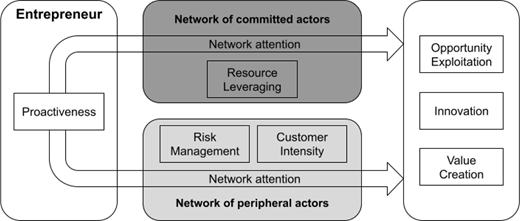
The committed actors in an entrepreneur’s immediate network are themselves a valuable resource (Yang and Gabrielsson, 2017). These are primarily engaged to leverage external resources (Engel et al., 2017), influencing innovation (Jones and Rowley, 2009). On the contrary, peripheral actors in the network could pose potential risks for entrepreneurs; for example, negative word of mouth and credit risk arise from peripheral actors. Kurgun et al. (2011) link the risk-managing propensity of entrepreneurs with being successful in innovation and opportunity exploitation. Thus, entrepreneurs direct their network attention to the network of committed actors to leverage resources and the network of peripheral actors to manage risks, ultimately exploiting opportunities and achieving innovation.
Value creation and customer intensity
Lubik and Garnsey (2014) propose that the innovation achieved through networks (as explained in the earlier section) plays a significant role in value creation. In light of current network categorization and literature, this paper posits that entrepreneurs use both networks for joint value creation (Gliga and Evers, 2023). For example, entrepreneurs make strategic alliances with their closely attached partners (from the network of committed actors) to innovate and cocreate value (Lubik and Garnsey, 2014), and, at the same time, entrepreneurs also obtain customer feedback (from the network of peripheral actor) for products or services to enhance the quality and create value (Lindman, 2004). Such attention on customers, i.e. customer intensity, assists entrepreneurs not only in the value creation process but also in exploiting market opportunities (Bhatli et al., 2012). Moreover, the knowledge gained from intense customer focus is also used for product and service innovations (Bhatli et al., 2012; Chaudhury et al., 2014). To conclude, Figure 1 illustrates how entrepreneurs direct network attention to each network to practice all dimensions of EM.
Network attention, legitimacy and the practice of entrepreneurial marketing
Legitimacy has several types, as introduced in various studies in the literature. Tornikoski and Newbert (2007) propose two types of legitimacy:
Confirming legitimacy, which is achieved when a nascent organization possesses characteristics considered credible or typical of a legitimate organization by society. It relies on passive attributes that conform to institutionalized expectations. For example, the lead entrepreneur’s education, experience and regulatory approvals/certifications.
Strategic legitimacy, which is acquired through active behaviors and calculated strategic actions aimed at manipulating the perceptions of external audiences.
It involves actively deploying evocative symbols to proactively garner acceptance from the environment. Examples of such behaviors include “acting-as-if” behaviors (improvising) to appear as a fully functioning organization. Based on Tornikoski and Newbert’s (2007) explanation, both types of legitimacy are built by directing network attention to peripheral actors, i.e. institutions/regulators (for confirming legitimacy), customers and media (for strategic legitimacy).
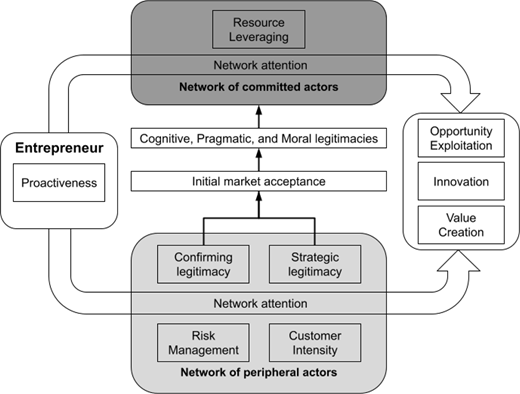
Once these two are built during start-up, they play a crucial role in fostering initial market acceptance (such as generating initial sales) (Tornikoski and Newbert, 2007), which results in enhancing three further and different types of legitimacies, particularly in the eyes of committed actors. First, cognitive legitimacy as the start-up appears to “make sense” to investors; second, pragmatic legitimacy as investors see a clear value proposition or return on investment; and third, moral legitimacy as the start-up appears to be doing “the right thing” based on social norms (Suchman, 1995). Hence, these three attract committed actors (such as investors and suppliers) to an entrepreneur’s network, which opens doors to vital resources. Therefore, it can be concluded that entrepreneurs build confirming and strategic legitimacies by directing network attention to peripheral actors, which serves as a prerequisite for initial market acceptance. Consequently, the initial market acceptance enhances cognitive, pragmatic and moral legitimacies, thereby attracting committed actors and opening doors to vital resources. Hence, failure to build legitimacy during start-up can hinder network expansion and access to vital resources, and consequently, make the operationalization challenging for many key dimensions of EM. Figure 2, building upon Figure 1, illustrates how network attention is linked with legitimacy and each dimension of EM.
Discussion
Much of the prior literature – from early work by Shaw (1999) and Hill et al. (1999) to recent empirical advances by Alqahtani et al. (2022) and Gliga and Evers (2023) – has underscored the central role of social networks in EM. However, the dominant discourse has remained largely outcome-focused, describing the importance of networks without detailing the mechanisms through which entrepreneurs deploy them to achieve marketing goals. For example, Shaw (1999) established networks as vital channels for information, advice and support, and Hill et al. (1999) introduced theoretical models of network evolution; these seminal works treated networks as relatively homogeneous entities. The current paper advances this understanding by proposing a binary classification of networks based on committed actors and peripheral actors, thereby providing theoretical precision that was previously absent in the literature.
This theoretical advancement also builds upon Alqahtani et al. (2022), who introduced the concept of “network attention” but did not differentiate between types of network actors requiring distinct attention strategies. By demonstrating that committed actors (entities benefiting from entrepreneurial success) and peripheral actors (entities not directly invested in entrepreneurial outcomes) necessitate different forms of network attention, this paper provides the granular mechanism that was identified as missing in prior research. Furthermore, this contribution operationalizes the abstract concept of network attention by linking it directly to Morris et al.’s (2002) seven dimensions of EM, thereby bridging the gap between broad conceptualizations and specific implementation strategies that scholars like Chaston (2000) and Gilmore et al. (2001) called for but did not fully address.
Thus, this contribution represents a theoretical advance in two key ways. First, it builds on the notion of network attention (Alqahtani et al., 2022) by operationalizing it in a structured, actor-specific framework. Second, by linking actor-specific attention to discrete EM dimensions, the current framework moves beyond broad generalizations to offer a detailed map of how entrepreneurs actually practice EM through network strategies. This level of granularity was previously missing; for instance, Robledo et al. (2023) and Torres et al. (2024) highlighted the impact of network strength and capabilities on performance, but have not specified how entrepreneurs engage different types of actors to enable specific EM behaviors.
Moving forward, the current literature is facing a deficiency in detailed discussions on how network attention specifically contributes to legitimacy acquisition, a fundamental aspect of new venture survival and growth. As recent studies have introduced “network attention” as a key EM dimension (Alqahtani et al., 2022) and explored its role in performance outcomes (McCartan, 2023) and effectual decision-making (Robledo et al., 2023), the legitimacy-building function of network attention has remained overlooked. This study addresses this gap by demonstrating how entrepreneurs strategically direct network attention to peripheral actors to build confirming and strategic legitimacies, which helps achieve initial market acceptance, consequently enhancing cognitive, pragmatic and moral legitimacies necessary for attracting committed actors.
In the past literature, while legitimacy has long been acknowledged as critical for new venture survival, it has rarely been positioned as a strategic tool within the EM process (Amjad et al., 2020). While Mort et al. (2012) and Whalen et al. (2016) have hinted the social embeddedness of EM for legitimacy, the current paper advances it by showing that entrepreneurs must build confirming and strategic legitimacies from the network peripheral actors; only after that, they can significantly access vital resources from the network of committed actors and practice core EM functions.
Hence, this paper offers an important theoretical extension by reconceptualizing legitimacy as a fundamental and critical dimension of EM. This redefines legitimacy beyond its common perception as merely an outcome of networking or a prerequisite for resource acquisition, as suggested by studies focusing on performance (McCartan, 2023) or competitive advantage (Felzensztein and Gimmon, 2009). This theoretical advancement also significantly extends the work of recent scholars such as Robledo et al. (2023) and Torres et al. (2024), who explored networking’s strategic implications and its influence on EM implementation. While these studies demonstrated correlational relationships between networking behaviors and marketing outcomes, they did not explain the underlying mechanism through which networking enables EM practice. The current paper fills this explanatory gap by positioning legitimacy as the critical mediating mechanism that transforms network attention into actionable EM capabilities. Thus, the paper substantially extends legitimacy theory within the EM domain.
Finally, the current paper addresses the theoretical limitations identified earlier in the literature review section, which shows that despite extensive research on networking’s strategic value (Presutti and Odorici, 2019; Gliga and Evers, 2023), scholars have not provided a comprehensive framework explaining how entrepreneurs operationalize EM dimensions through network attention. This paper establishes that legitimacy is a key prerequisite for accessing vital resources from the network of committed actors, and it explains the practice of each dimension of EM through network attention (Figure 2). This insight extends institutional theory by showing how legitimacy operates as an enabler of network expansion, resource acquisition and EM practice. Hence, the paper redefines the EM framework to include legitimacy as an eighth operational dimension, enhancing the comprehensiveness of Morris et al.’s (2002) model and aligning it with contemporary entrepreneurial realities (Amjad et al., 2020).
Together, these contributions provide a significant theoretical advancement by offering both conceptual precision and practical relevance. This paper shifts the focus of EM theory from broad descriptions of network utility toward a systematic, actor-level and legitimacy-sensitive understanding of how entrepreneurs leverage networks for EM success. It bridges previously siloed insights from social network theory and EM practice, resulting in a more holistic and actionable model.
Future research
Drawing from the theoretical advancements in this paper, several propositions await investigation by future researchers. First, narrowing down the focus from broad network categorization to specific types of actors, future researchers could empirically investigate the specific characteristics, communication strategies and relational tactics that constitute differentiated network attention, and how this attention varies in its application across all dimensions of EM. Hence, the following proposition requires attention by scholars working at the intersection of EM and EN:
Entrepreneurs’ allocation of network attention to different types of actors within two networks varies depending on the specific EM dimension being practiced.
In addition, the theoretical extension of “network attention” as an active, strategic capability, bridging the gap between conceptual EM frameworks and measurable business outcomes, requires elaboration. Thus, the second proposition needs investigation:
The ability to strategically allocate network attention between committed actors and peripheral actors is positively associated with network growth, accessing vital resources, and venture performance.
The current paper argues that entrepreneurs build confirming and strategic legitimacies by directing network attention to peripheral actors, which serves as a prerequisite for initial market acceptance. Consequently, this process enhances cognitive, pragmatic and moral legitimacies, thereby attracting committed actors and opening doors to vital resources. While initial market acceptance plays a central role in enhancing cognitive, pragmatic and moral legitimacies, it is likely not the sole driver of such legitimacy gains. Therefore, future researchers working on entrepreneurial legitimacy could investigate:
Other than initial market acceptance, nonmarket factors (such as strategic storytelling or sustainability initiatives) also independently contribute to enhancing cognitive, pragmatic and moral legitimacies in entrepreneurial ventures.
Besides P3, future research could investigate the potential thresholds of specific legitimacies required before entrepreneurs can successfully implement particular EM dimensions. This is because the current paper redefines legitimacy as a foundational EM dimension, and therefore, this causal link, as suggested in the fourth proposition, can be tested longitudinally:
Entrepreneurs with higher levels of legitimacy are more effective in practicing most of the EM dimensions.
Since legitimacy is gained through network attention (referring to P2 and P3), the paper argues that legitimacy is not only a foundational dimension of EM but also acts as a mediating mechanism between network attention and EM outcomes. Hence, the fifth proposition invites researchers to examine the mediating role of legitimacy:
Legitimacy mediates the relationship between network attention and EM effectiveness.
Practical implications
This paper offers several important practical implications for nascent entrepreneurs, particularly regarding how they build and manage their networks for EM. First, entrepreneurs should recognize that not all members of their networks play the same role in advancing their ventures. The distinction between committed actors – those who stand to benefit directly from the firm’s success (e.g. investors, suppliers, partners) – and peripheral actors – those who do not have a direct vested interest (e.g. customers, regulatory bodies, media) – is particularly useful for early-stage entrepreneurs. By strategically categorizing their network actors, entrepreneurs can more effectively plan how to engage with each category and align them with specific EM goals.
Second, the paper suggests that nascent entrepreneurs should tailor their network attention according to the category of network (committed vs peripheral) and the specific EM dimension being practiced. Since different networks contribute differently to various EM outcomes, entrepreneurs must develop targeted approaches rather than treating both uniformly. For example, customers and media (from the network of peripheral actors) are more useful in the early stages to validate products, enhance visibility and build confirming and strategic legitimacies; in contrast, suppliers and investors (from the network of committed actors) become critical as the firm begins to scale and requires strategic resources. Entrepreneurs who direct their network attention appropriately are better positioned to leverage networks and practice EM.
Third, and most critically, the paper highlights that legitimacy is not merely a reputational outcome of entrepreneurial activity but a necessary condition for attracting committed actors. For nascent entrepreneurs, this implies that building confirming and strategic legitimacies must occur early in the venture creation process to achieve initial market acceptance. Without this, entrepreneurs are likely to face resistance from committed actors who may doubt the credibility, viability or trustworthiness of the venture. The paper explains that the initial (confirming and strategic) legitimacy-building activities during start-up are carried out by directing network attention to peripheral actors. Examples include engaging with credible institutions, complying with regulations, meeting customer needs and showcasing early success (e.g. customer testimonials or media mentions). This helps achieve initial market acceptance, which enhances cognitive, pragmatic and moral legitimacies, and therefore builds committed actors’ confidence, consequently opening doors to vital resources.
Finally, the paper reconceptualizes legitimacy not as an external validation passively earned over time, but as an internal and active capability of the EM process. Entrepreneurs should treat legitimacy-building as a core marketing function, integrating it into their strategic planning alongside customer development, branding and market communication. By positioning legitimacy as a foundational and operational dimension of EM, entrepreneurs can proactively use it to unlock actor support, enhance network functionality and overcome the liability of newness. Thus, the paper encourages nascent entrepreneurs to think more strategically and systematically about the role of legitimacy in building and engaging in networks and effectively practicing EM.
Conclusion
Entrepreneurial failure during start-up is not uncommon because nascent entrepreneurs often face a liability of newness. To overcome this, institutional theory emphasizes the importance of legitimacy building, which nascent entrepreneurs can achieve through strategic network attention. However, many nascent entrepreneurs lack the understanding of using their networks to build legitimacy, hindering their ability to practice EM effectively and survive their start-ups. This pressing problem continues as the academic research on the intersection of EN, legitimacy and EM is also scant.
While addressing this issue, this paper offers crucial guidance for nascent entrepreneurs on strategically managing their networks for legitimacy and EM. It first advises differentiating network actors into “committed” (who stand to benefit directly from the firm’s success, e.g. investors, suppliers, partners) and “peripheral” (who do not have a direct vested interest, e.g. customers, regulatory bodies, media) to direct “network attention” based on actor categories and specific EM goals. Next, the paper underscores that building early confirming and strategic legitimacies through peripheral actors is a prerequisite for achieving initial market acceptance and gaining subsequent cognitive, pragmatic and moral legitimacies that attract committed actors and open doors to vital resources, thereby mitigating the liability of newness.
Thus, the paper reframes legitimacy as a foundational and operational dimension of EM that entrepreneurs should strategically build to unlock network support and thereby effectively practice other key dimensions of EM. Hence, contributing to the literature, this paper shifts the focus of EM theory from broad descriptions of network utility toward a systematic, actor-level and legitimacy-sensitive understanding of how entrepreneurs leverage networks for effective EM and venture success.