Skip to article sections
Purpose

This study aims to provide an overview of the trends in Czech entrepreneurial activity, focusing on its age and gender structure.

Design/methodology/approach

The study exploits quarterly data obtained from the Czech Ministry of Industry and Trade covering the years 2016–2023. In particular, the authors seek to study whether women’s participation in entrepreneurship has significantly increased over the studied period and whether the trend in the age structure has shifted in the post-pandemic development.

Findings

Based on the paired t-tests and regression analyses, the results show that the male-to-female entrepreneurs’ ratio has not significantly declined, staying at 1.8–2, depending on the indicator used. The obtained results, however, interestingly show that the proportions of entrepreneurs have significantly increased, especially in the age cohorts above 46 years and even above the age of 60 years, which is in line with the ongoing trends of population ageing and the ability of individuals to stay active on the labour market even in post-retirement age.

Originality/value

The study thus provides recommendations for Czech policymakers, discussing further possibilities of supporting female and senior entrepreneurship and avenues for future research.

Entrepreneurship researchers and scholars are continuously underlining the importance of studying entrepreneurship over time and across countries (Wennekers et al., 2002; Santos et al., 2017) as the development of entrepreneurial activity is subject to changes in external and internal factors, currently described within the entrepreneurial ecosystem framework (Stam, 2015; Wurth et al., 2022).

Recalling the recent global pandemic crisis (Žítek and Klímová, 2020; Galindo-Martín et al., 2021; Zemtsov et al., 2021; Behr and Storr, 2022; Monllor et al., 2024), followed by the Ukraine conflict and subsequent energy and oil crises (Zahra, 2022; Kuckertz et al., 2023; Shatila et al., 2025) serving as disruptive events or the ongoing adaptation of the United Nations’ sustainable development goals (SDGs) (United Nations, 2023), it is likely to assume that the order and the structure of entrepreneurial activity have been significantly affected and possibly changed due to these events and ongoing changes.

In response, the scholars began using the theoretical concept of polycrises and investigating how these disruptive events influence the structure and development of entrepreneurial activity (Tunçalp, 2025). Therefore, this study aimed to address this uncertainty by providing novel insights into the gender and age aspects of entrepreneurship, extending the current understanding of demographic shifts and gender dynamics in entrepreneurial activity. This goes hand in hand with the current call for scholars to better understand the heterogeneity of entrepreneurship, such as female and senior entrepreneurship, and their representations at the country level (Haataja et al., 2025; Martins et al., 2026).

The research efforts are focused on the Czech context, providing an example of development in a small Central European open economy with above-average European levels of entrepreneurship. It is a country with a significant gender gap in the proportions of males and females pursuing entrepreneurial careers (Večerník, 2011; Křížková et al., 2014; Dvouletý, 2019; Novosák et al., 2023). Yet, the previous studies relied more on cross-sectional survey results than on longitudinal population data, which did not provide information about the age and gender of entrepreneurs until recently. Furthermore, age and gender were identified by entrepreneurship scholars (Simoes et al., 2016) as significant determinants of entrepreneurial engagement. Notably, with the ongoing adaptation of the United Nations’ SDGs (United Nations, 2023), emphasis on achieving gender equality and decent careers promoting well-being across all ages, including the elderly population (SDGs 3, 5 and 10), it is a vital question, how and to what extent has the structure of the Czech entrepreneurial activity changed. Therefore, this study seeks to answer the following two research questions (RQs) related to Czech entrepreneurship development:

RQ1.

Has the gender gap decreased over the studied period?

RQ2.

To what extent has the age structure changed over the studied period?

The study answers these RQs by exploiting quarterly data from the Czech Ministry of Industry and Trade representing registered entrepreneurs and valid business licences for 2016–2023, i.e. the longest available period. The authors use statistical analysis (mainly paired t-tests) and demonstrate the development of the trend changes to explore whether women’s participation in entrepreneurship has significantly increased over the studied period and whether the age structure has shifted. Findings from this research provide value for the Czech policymakers and political representatives, as the promotion of achieving SDGs has received a lot of attention and political priority (Hájek et al., 2011; Květoň et al., 2014; Hojnik et al., 2022). Thus, it is relevant to examine what has changed over the last few years and to provide policy recommendations if the observed changes are insufficient.

Furthermore, the study provides insights into the development of Central European entrepreneurship, where the Czech Republic serves as an example, illustrating the post-pandemic and post-crisis entrepreneurship development within the population data, representing all physical entrepreneurs and business licences, serving thus as an example to follow by researchers from other Central European countries (Ghura et al., 2020), such as Poland (Fritsch et al., 2022), Slovakia (Pilková and Holienka, 2017) or Hungary (Tumiwa and Nagy, 2021).

A literature survey by Simoes et al. (2016) provides an extensive overview of the factors shaping entrepreneurial engagement, dividing those into several categories, including basic individual characteristics, family background, personality characteristics, human capital, health condition, nationality, ethnicity and access to financial resources. Each of these factors represents a significant source of heterogeneity determining the uniqueness of entrepreneurs and self-employed persons, extensively researched by prior literature, offering theoretical underpinnings for each category, mainly at the individual level (Cowling et al., 2019). Yet, much less is known about their role at the meso and macro levels of entrepreneurship analysis (Kim et al., 2016), which is crucial for entrepreneurship policymaking (Cieślik and van Stel, 2024). In this way, the decades of individual-level studies serve as a rich source of theoretical approaches suitable for understanding entrepreneurial activity at the meso and macro levels (Dvouletý, 2018), which differ over time and across regions, as Freytag and Thurik (2007) explain. The following subsections provide a literature review of the key established concepts related to the roles of age and gender as the two identified determinants of entrepreneurship that this study focuses on.

Simoes et al. (2016, p. 786) conclude that the relationship between age and entrepreneurship is the inverse U-shaped, with a threshold (peak) in the interval from 35 to 44 years, depending on the country, continent or time. Lévesque and Minniti (2011), together with Zhang and Acs (2018), explain that the low skewing of entrepreneurial activity toward young (left) and old (right) individuals can be associated with the labour market decisions described within the work–leisure decision model and by the resource-based view theory. Based these theoretical concepts, at a young age, the individuals willing to start a business have a substantial capacity for generating business ideas and starting a venture, yet they often lack a sufficient amount of human, financial and social capital while in the older cohorts, despite having sufficient amount of capital already, are becoming more risk averse and experience higher opportunity costs of leaving their secured jobs and stable incomes and pursuing more risky entrepreneurial journey (Lévesque and Minniti, 2011; Minola et al., 2016). In this matter, Zhang and Acs (2018) conclude that policymakers should be informed about the demographic structure of the entrepreneurial activity, monitor its skewness and, if the activity is skewed too much toward old or young cohorts, introduce adequate incentives. These can be used as remedies to reach the market equilibrium, i.e. the optimal number of entrepreneurs providing goods and services in the economy, for example, through incoming foreign entrepreneurs starting their ventures in the country (Malerba and Ferreira, 2020).

From the perspective of the gender gap, the proportion of females in entrepreneurship is significantly lower than that of their male counterparts (Dean et al., 2019). The theoretical underpinnings that aim to capture this gender gap focus on the role of women in the family (including caring responsibilities), their participation in the labour market and the overall cultural and societal factors that differ across countries (Ojong et al., 2021; Kyrgidou et al., 2021). The most prevailing concepts include the feminist, discrimination and career theories, yet according to the most recent literature review by Corrêa et al. (2022), the most crucial agenda for the policymakers now includes capacity building and enhancing the availability of training programmes for women, which could possibly mitigate the gender gap in entrepreneurship, as also highlighted recently by Dvouletý et al. (2022), who observed the situation in the Czech Republic. The most recent review of existing literature was elaborated by Corrêa et al. (2024). The authors conclude that the research agenda should start by analysing the context of country-level entrepreneurship and its development, understanding the family–work situation of females, i.e. the work–family conflicts, support and the role of broader family members (Xiong et al., 2020), and offering motivational and training programmes for those females who are willing to start a new business. The existing evidence in the literature is, according to these studies, not sufficient to bridge this knowledge gap, requiring more examples of good practices and successful training programmes to reach successful (measured through performance indicators) entrepreneurship. Such a lack of available literature still calls for a more structured theoretical framework describing female entrepreneurship (Corrêa et al., 2024).

The section starts by describing the availability of the data and the feasibility of answering the stated RQs. The study is based on the quarterly data obtained from the Czech Ministry of Industry and Trade (2023). The data cover the period of the years 2016–2023, starting with the fourth quarter of 2016 and ending with the third quarter of 2023. Unfortunately, no older data reflect the gender and age structure, so this is the longest available time range at the time this research was crafted.

The authors work with the indicators reflecting the number of entrepreneurs, i.e. natural/physical persons and the number of valid business/trade licences within the studied time period. Combining these two approaches is helpful, as the data on physical persons do not account for the legal entities included in the latter indicators. Yet, with these data, we cannot capture situations when physical persons and legal entities hold multiple valid business licences, which is a severe limitation of this approach. One also needs to mention that the data on age and gender structures were provided separately by the Czech Ministry of Industry and Trade (2023). They cannot be combined together, e.g. into cross-tabulations. There is no possible way how to connect these data or to extract all single records of registered entities from the Czech business register, i.e. Registr Ekonomických Subjektů (RES) (Czech Statistical Office, 2023), in a simple/automatic way.

Furthermore, we cannot fully ensure that all listed entities remain economically active despite their valid licences, which is an identified limitation of this approach towards measuring entrepreneurial activity (Dvouletý, 2021; Henrekson and Sanandaji, 2020). Some entrepreneurs and organisations might thus still be officially active, but their actual economic activity is already closed, so in this way, the provided official records overestimate the actual size of entrepreneurship. On the other hand, the available records do not include individuals starting their entrepreneurial careers, i.e. nascent entrepreneurs who have not registered their businesses officially yet. The official statistical records will be missing these individuals (Iversen et al., 2008); nevertheless, this is a limitation that we need to acknowledge.

In the first step, we present summary statistics (mean, standard deviation, minimum, maximum) for all collected data in Table 1, i.e. physical persons and licences across gender and age categories. On average, there were about 2,041,426 entrepreneurs and 2,964,426 licences registered. This is considerably higher than the findings of Dvouletý (2019), who studied Czech entrepreneurial activity over the years 2005–2017 and pointed out the significant differences between registered entities and those with verified economic activity.

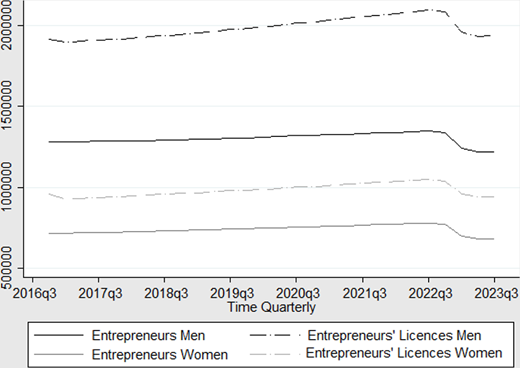
Using data from the European Union Labour Force Survey, Dvouletý (2019) concluded that the male-to-female ratio is 2.5 and that the highest representation of Czech entrepreneurs is in the age cohort of 40–44 years, representing 15.8% of all self-employed individuals. The records from the Czech Ministry of Industry and Trade (2023) align with these earlier findings. Figure 1 shows the development of entrepreneurial activity over time. We can observe a slightly increasing trend, proceeding even through the global COVID-19 pandemic (Dvouletý, 2021). The only significant decline is visible at the beginning of 2023, which might be associated with the compulsory set-up of digital communication with public sector authorities and offices, so-called data boxes (in Czech Datové schránky, c.f. Peníze.cz, 2023), that the Czech Ministry of Interior set-up for all registered organisations. This policy action, enhancing the digitalisation of the Czech public sector, is expected to at least partially clear out the business register for inactive entities (Rozczynski, 2022); however, it might also push out from the official activity some individuals lacking computer and digital skills (Kruncl, 2023).

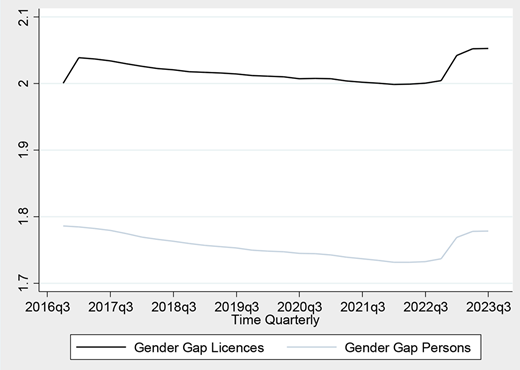
Figure 1 also clearly illustrates the gender differences, which we separately study in Figure 2, showing the gender gap, i.e. the ratio of male to female entrepreneurs (and licences) and its development over time. The gender gap was more or less stable over time, with a slight decreasing trend, which significantly changed its direction and rapidly grew into an increasing one at the beginning of 2023. Statistically speaking, the average ratio was lower compared with physical persons, i.e. 1.8 (1.8 in 2017, 1.7 in 2022), compared with the records of licences being 2.0 (2 in 2017, 2 in 2022), which means that the Czech entrepreneurial activity is still considerably male-driven (Procházka, 2016; Dvouletý, 2021; Hamplová et al., 2021).

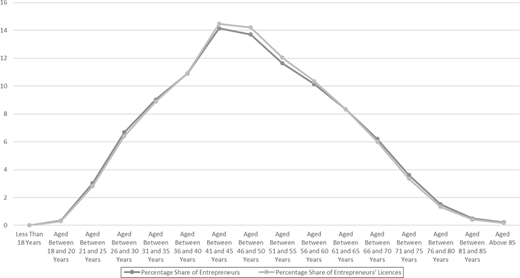
In Figure 3, we offer insights into the age structure of the Czech entrepreneurial activity. The picture is almost identical for physical persons and licences. Interestingly, the shape is very much in line with the entrepreneurship and age nexus, documented in the individual-level studies, summarised, for instance, in the literature review article written by Simoes et al. (2016) or in an extensive analysis by Cowling et al. (2019). The age proportions beyond the age of 18 are meagre (13 persons on average based on a particular legislation process), increasing with age up to a peak in the cohort 41–45, constituting a share of 14.1% (14.5% if we look at licences) and then it declines with the elder age up to the retirement and post-retirement lifetime. Surprisingly, we calculate the percentage shares of individuals engaged in entrepreneurship after the official retirement age, i.e. 65 years; we end up with a pretty significant number, making 12% of the entrepreneurial population, i.e. 11.3% of all licences, which illustrates the economic activity of the elderly population.

In the following analysis, we study whether women’s participation in entrepreneurship has significantly increased over the studied period and whether the trend in the age structure has shifted after the COVID-19 pandemic. Our methodology relies on two main parts. The first part relies on conducting a series of paired t-tests that allowed us to split the studied period into two similarly long time windows (Sachs, 2012). The initial period starts with the fourth quarter of 2016 and ends by the fourth quarter of 2019, and the latter one covers the first quarter of 2020 and ends in the third quarter of 2023. We chose the second period to be slightly longer to be able to mitigate significant changes beginning after the beginning of the year 2023, yet our research team notes that we tried to run the above-mentioned paired t-tests even by excluding the year 2023 as a possible outlier, i.e. the second period ended up by the fourth quarter of 2022 in this robustness check, and the provided results very similar to those presented in this section. In the second part of the analysis, we conduct a time-series regression analysis controlling for the trend and seasonal developments to further support the results provided by the t-tests and enhance the robustness of the analysis.

Given the relatively limited number of statistical observations, we chose to set the decision-making threshold at the 5% level of statistical significance to interpret the results. As explained in the article’s previous section, we test the indicators reflecting both physical entrepreneurs and valid licences to obtain the most conclusive findings. The results obtained from the statistical testing are presented in  Appendices 1,  2 and  3. Table 2 summarises all statistically significant results in a more structured, reader-friendly manner. Table 3 reports the regression results.

As already explained, in Table 2, one may follow a summary of the statistical testing, including results concerning the gender gap ratio. Given the nature of our research question, expecting the higher inclusivity of females in Czech entrepreneurship, we tested the difference between the two periods. By interpreting the test results (for details, see  Appendix 1), we find, at the 5% level of statistical significance, that in the second period, the ratio of female entrepreneurs (persons) was slightly lower compared with the first period, but we were unable to prove this for the proportion of male to female licences.

We further comment on the changes in the age structure of the Czech entrepreneurs and the valid licences. Unfortunately, the research team could not work with the age category continuously and merge some of the age categories. Instead, we had to work with the provided five-year categories, which resulted in very complex testing across all age categories, from less than 18 years old to the 85 years and above. The logic of statistical testing assumed changes between the two periods, and the detailed reporting shows all statistically significant changes in the proportions of entrepreneurs (and licences) in the age groups, thus shifting the business demography structure. In statistical testing, we followed a similar approach and relied on the 5% level of statistical significance, and we again highlighted those cases where both licences and physical entrepreneurs experienced a change. For more convenient information, we have crafted the summary in Table 2 with transformed signs, providing a more intuitive overview of the results. The detailed results are reported in  Appendices 2 and  3.

The most remarkable changes in the age structure of Czech entrepreneurial activity, measured via the size of the estimated difference, reflect the increase in the age cohort 46–50years (from 1.94 to 1.99 percentage points) at the expense of a decline in the age group 41–45years (from −1.76 to −1.88 percentage points). Related was also a significant decline in the cohort of 31–35years, constituting a decline of 1.3 percentage points, followed by a decline within the age category 26–30years (from −0.52 to −0.55 percentage points). There was also a similarly high shift between the age categories 56–60years (an increase from 0.76 to 0.84 percentage points) and 61–65years (a decline from −0.68 to −0.73 percentage points). However, one of the most interesting observations is the continuously significant increase in all categories above 71 years, totalling 1.3 percentage points.

Once we reviewed those results, we further enhanced the robustness of the findings that had already been provided through regression analysis. Given the limited number of statistical observations, we followed Tsay (2005) and estimated regression models with quarterly dummy variables, adjusting for the seasonality and linear trend. The key variable was (as in the previous case), a dummy variable, representing post-pandemic development of the Czech entrepreneurial activity, i.e. tracking changes in the activity over the years 2020–2023. We estimated four regression models, accounting for the changes in the male-to-female entrepreneurs’ ratio, number of entrepreneurs aged above 46, percentage share of entrepreneurs aged above 46 and percentage share of entrepreneurs’ licences above 46. In all econometric models reported, the variables representing the post-pandemic period were found to be statistically significant at the 5% significance level. Overall, it can be concluded that these results further expanded the statistical testing. While we observe only a decent decline in the male-to-female entrepreneurs’ ratio, the results show a significant increase in both the absolute and relative size of the 46+ entrepreneurship in the post-pandemic period.

The results obtained from the statistical analyses allow us to answer the stated RQs. The first sought to investigate whether the gender gap in entrepreneurship had decreased over the study period. The answer is no. It stays at about 1.8–2 male entrepreneurs for every female one, and with the recent implementation of data boxes, it has even increased, although this might be a temporary situation. Then, we wanted to know how much the age structure has changed to determine whether any new policies supporting the ongoing sustainability of Czech entrepreneurship are needed (Lévesque and Minniti, 2011). Our results are positive and document trend shifts in several age cohorts. The obtained findings show that the proportions of entrepreneurs have significantly increased, which might be favourably reflected in the positive outcomes of entrepreneurship on economic development (Dvouletý, 2017), especially in the age cohorts above 46 years and even above the age of 60 and above 71 years. These observations are in line with the ongoing demographic trends of population ageing and the ability of individuals to stay active in the labour market even in post-retirement age (Maalaoui et al., 2023; del Olmo García et al., 2023; Chee, 2025).

The implications of these findings are twofold. Firstly, it is apparent that female entrepreneurship in the Czech Republic requires ongoing attention, as noted recently by Křížková et al. (2014), Prabhu (2020) or Dvouletý (2021), highlighting that women need a specific way of encouragement for starting a business, for example, through networking in female entrepreneurship clubs [Business and Professional Women CR (2023) organising Entrepreneurship Academy courses] or sharing success stories of the women entrepreneurs serving as inspiration to overcome lack of confidence and fear of failure. Therefore, if policymakers are up to the task of mitigating the gender gap among the Czech entrepreneurial population and achieving higher gender equality, then additional policy actions encouraging female participation in entrepreneurship would need to occur. These might include further support of entrepreneurial training, i.e. delivering necessary skills and knowledge specifically personalised to women to build and empower the community (Idrus et al., 2014; Bauer, 2011; Brixiová et al., 2020) within a specific public support programme within the European Union Structural Investment Funds, guaranteed by the Czech Ministry of Labour and Social Affairs. In addition, inspired by the previous research efforts (Love et al., 2024; Sawy et al., 2025), we believe that there is a space for improvement in the female entrepreneurial culture, which could be further promoted by the public campaigns and social media posts of successful role models of female entrepreneurs, serving as inspiration for women, considering joining an entrepreneurial career pathway and improving their self-esteem.

Secondly, the ongoing trends of population ageing and increased life expectancy provide opportunities for some individuals to remain economically active in the labour market as skilled professionals, working on a solo basis, based upon valid business licences. This entrepreneurship segment is named in the international literature as senior entrepreneurship, and it offers elderly individuals an opportunity to broaden their incomes and utilise their lifetime experience and knowledge even in the post-retirement age (Isele and Rogoff, 2014; Pilkova et al., 2014; Ratten, 2019; Fañanás-Biescas et al., 2026). Yet, according to the authors’ best knowledge, there is no publicly funded initiative helping the elderly population start and manage their businesses despite the identified benefits. From the Czech perspective, it, however, needs to be acknowledged that the enhanced digitalisation and lack of computer-related skills could be an obstacle for some individuals to officially set up a business (Kruncl, 2023), which opens another possibility for a specific publicly funded training programme, promoting digital skills with a focus on the elderly population and entrepreneurship-related tools.

Both of these recommendations could be further developed in future research activities, studying closely industries and types of business where female and senior entrepreneurs are more represented, their income and well-being, concerning the current strive for accomplishing SDGs 3, 5 and 10 within the Czech context. To better understand the roles of policymakers in promoting engagement of both of these groups systematically at the regional or country levels, one can utilise lessons from the entrepreneurial ecosystem (EE) framework (Wurth et al., 2022; Kakeesh, 2024) and national systems of entrepreneurship perspective (Friske et al., 2025), where specific support of both studied groups requires a deeper understanding of particular institutions and specific elements that lead to the increase of the female/elderly activity, i.e. to outputs (in terms of EE terminology), and the aggregated value created by these entrepreneurs as an outcome indicator, operationalised for, instance, as through sum of personal incomes, sales or employment created. In light of this recommendation, there is an ongoing challenge in measuring and aggregating well-being as an outcome indicator for the whole women and senior entrepreneurship segments and monitoring it over time (Kibler et al., 2024; Baldacchino and Sassetti, 2025).

This research advances the current body of knowledge on the determinants of entrepreneurship with a specific focus on age and gender by offering a country-level perspective on entrepreneurship development within a specific context (Simoes et al., 2016; Monllor and Murphy, 2017; Cowling et al., 2019; Cieślik and van Stel, 2024). The study also enriches the existing discussion on post-pandemic and post-crisis entrepreneurship development by offering insights from the Czech Republic, a country experiencing post-transitional institutional development. The article provides findings on the development of Czech entrepreneurial activity over the years 2016–2023, based on the official population data representing all physical entrepreneurs and business licences. Furthermore, it expands the current state of knowledge on gender and age characteristics of Czech entrepreneurs, based often on the data obtained from surveys with a limited number of respondents, such as the European Union Labour Force Survey (Dvouletý, 2019) or Global Entrepreneurship Monitor (Lukeš and Zouhar, 2016), despite their statistical representativity. Recommendation to continuously monitor the age and gender structure of entrepreneurial activity enriches the body of knowledge on the gender and age aspects of entrepreneurship and allows a more targeted (policy) approach to further understanding of demographic shifts and gender differences in the current polycrises times (Tunçalp, 2025; Dvouletý et al., 2025).

Nevertheless, despite the efforts made, this research study has limitations that could also be overcome in future studies. The primary burden lies in the data provided by the Czech Ministry of Industry and Trade (2023), which is unable to create and combine data into additional sub-categories, i.e. cross-tabulations across age and gender, nor does it work with the microdata. Here, we see a space for improvement in the data processing of the publicly available data, i.e. making the current database more relevant and useful for research and establishing the link between individual-level data, regional conditions and country-level institutions as outlined by EE scholars (Stam, 2015). At the same time, we could not entirely exclude officially registered entrepreneurs from the database, but, per se, inactive business entities, which might, to some extent, influence the presented findings. On the other hand, our data do not include early-stage entrepreneurs who have not yet registered their businesses officially, which is a group missing in the current analysis. From a methodological perspective, our analysis is based on a series of statistical tests and time-series analyses; however, more suitable and empirically robust approaches would be estimation of the panel-data-based econometric models, as in recent analyses of city-level entrepreneurship by Asencio et al. (2022).
Asencio
,
H.D.
,
Prager
,
F.
,
Martínez
,
J.N.
and
Tamura
,
J.
(
2022
), “
The impact of local government economic development programs on city-level entrepreneurial activity: evidence from Southern California
”,
Journal of Entrepreneurship and Public Policy, Vo
, Vol.
11
Nos
2-3
, pp.
112
-
134
.
Baldacchino
,
L.
and
Sassetti
,
S.
(
2025
), “
The effects of coping strategies on entrepreneurs’ psychological well‐being under uncertainty
”,
Strategic Change
, Vol.
34
No.
2
, pp.
253
-
265
.
Bauer
,
K.
(
2011
), “
Training women for success: an evaluation of entrepreneurship training programs in Vermont, USA
”,
Journal of Entrepreneurship Education
, Vol.
14
, pp.
1
-
24
.
Behr
,
R.
and
Storr
,
V.H.
(
2022
), “
Understanding pandemic entrepreneurship as a unique form of crisis entrepreneurship
”,
Journal of Entrepreneurship and Public Policy
, Vol.
11
No.
4
, pp.
309
-
331
.
Brixiová
,
Z.
,
Kangoye
,
T.
and
Said
,
M.
(
2020
), “
Training, human capital, and gender gaps in entrepreneurial performance
”,
Economic Modelling
, Vol.
85
, pp.
367
-
380
.
Business and Professional Women CR
(
2023
), “
Entrepreneurship academy
”,
available at:
Link to Entrepreneurship academyLink to the cited article (
accessed
4 August 2025).
Chee
,
H.
(
2025
), “
Harnessing the silver tsunami: an investigation into the benefits and challenges of senior entrepreneurship in Singapore
”,
Entrepreneurship and Regional Development
, pp.
1
-
18
.
Cieślik
,
J.
and
van Stel
,
A.
(
2024
), “
Solo self‐employment––key policy challenges
”,
Journal of Economic Surveys
, Vol.
38
No.
3
, pp.
759
-
792
.
Corrêa
,
V.S.
,
Brito
,
F.R.D.S.
,
Lima
,
R.M.D.
and
Queiroz
,
M.M.
(
2022
), “
Female entrepreneurship in emerging and developing countries: a systematic literature review
”,
International Journal of Gender and Entrepreneurship
, Vol.
14
No.
3
, pp.
300
-
322
.
Corrêa
,
V.S.
,
Lima
,
R.M.D.
,
Brito
,
F.R.D.S.
,
Machado
,
M.C.
and
Nassif
,
V.M.J.
(
2024
), “
Female entrepreneurship in emerging and developing countries: a systematic review of practical and policy implications and suggestions for new studies
”,
Journal of Entrepreneurship in Emerging Economies
, Vol.
16
No.
2
, pp.
366
-
395
.
Cowling
,
M.
,
Millan
,
J.M.
and
Yue
,
W.
(
2019
), “
Two decades of European self-employment: is the answer to who becomes self-employed different over time and countries?
”,
Journal of Business Venturing Insights
, Vol.
12
, p.
e00138
.
Czech Ministry of Industry and Trade
(
2023
), “
Statistical data on entrepreneurs
”,
available at:
Link to Statistical data on entrepreneursLink to the cited article (
accessed
4 August 2025).
Czech Statistical Office
(
2023
), “
Business register
”,
available at:
Link to Business registerLink to the cited article (
accessed
4 August 2025).
Dean
,
H.
,
Larsen
,
G.
,
Ford
,
J.
and
Akram
,
M.
(
2019
), “
Female entrepreneurship and the metanarrative of economic growth: a critical review of underlying assumptions
”,
International Journal of Management Reviews
, Vol.
21
No.
1
, pp.
24
-
49
.
del Olmo García
,
F.
,
Crecente Romero
,
F.
,
Sarabia
,
M.
and
del Val
,
M.T.
(
2023
), “
Longevity trends in entrepreneurial activity. An analysis of the characteristics of senior entrepreneurship in Spain
”,
International Journal of Entrepreneurial Behavior and Research
, Vol.
29
No.
7
, pp.
1541
-
1567
.
Dvouletý
,
O.
(
2017
), “
Can policy makers count with positive impact of entrepreneurship on economic development of the Czech regions?
”,
Journal of Entrepreneurship in Emerging Economies
, Vol.
9
No.
3
, pp.
286
-
299
.
Dvouletý
,
O.
(
2018
), “
How to analyse determinants of entrepreneurship and self-employment at the country level? A methodological contribution
”,
Journal of Business Venturing Insights
, Vol.
9
, pp.
92
-
99
.
Dvouletý
,
O.
(
2019
), “
Development of entrepreneurial activity in the Czech Republic over the years 2005–2017
”,
Journal of Open Innovation: Technology, Market, and Complexity
, Vol.
5
No.
3
, p.
38
.
Dvouletý
,
O.
(
2021
), “
A first year’s impact of the pandemic on the Czech entrepreneurial activity
”,
Foresight and STI Governance
, Vol.
15
No.
4
, pp.
52
-
60
.
Dvouletý
,
O.
,
Jirásek
,
M.
,
Giglio
,
C.
and
Liguori
,
E.
(
2025
), “
Artificial intelligence, digitalization, and new technologies in shaping business and management research
”,
Cogent Business and Management
, Vol.
12
No.
1
, p.
2580126
.
Dvouletý
,
O.
,
Šebestová
,
J.D.
,
Svobodová
,
I.
,
Habrmanová
,
B.
and
Müllerová
,
J.
(
2022
), “
Analyzing determinants influencing female entrepreneurship engagement in the Czech Republic: What is the role of caring responsibilities?
”,
World Journal of Entrepreneurship, Management and Sustainable Development
, Vol.
18
No.
1
, pp.
1
-
19
.
Fañanás-Biescas
,
A.P.
,
Ključnikov
,
A.
,
Bargoni
,
A.
and
Ferraris
,
A.
(
2026
), “
Senior entrepreneurship and opportunity recognition: a systematic review of the literature
”,
International Journal of Entrepreneurial Behavior and Research
, Vol.
32
No.
4
, pp.
846
-
883
.
Freytag
,
A.
and
Thurik
,
R.
(
2007
), “
Entrepreneurship and its determinants in a cross-country setting
”,
Journal of Evolutionary Economics
, Vol.
17
No.
2
, pp.
117
-
131
.
Friske
,
W.
,
Yun
,
G.
and
Ozpolat
,
K.
(
2025
), “
The underappreciated role of logistics in national systems of entrepreneurship
”,
Journal of Research in Marketing and Entrepreneurship
, Vol.
27
No.
1
, pp.
83
-
109
.
Fritsch
,
M.
,
Pylak
,
K.
and
Wyrwich
,
M.
(
2022
), “
Historical roots of entrepreneurship in different regional contexts–the case of Poland
”,
Small Business Economics
, Vol.
59
No.
1
, pp.
397
-
412
.
Galindo-Martín
,
M.Á.
,
Castaño-Martínez
,
M.S.
and
Méndez-Picazo
,
M.T.
(
2021
), “
Effects of the pandemic crisis on entrepreneurship and sustainable development
”,
Journal of Business Research
, Vol.
137
, pp.
345
-
353
.
Ghura
,
H.
,
Harraf
,
A.
,
Li
,
X.
and
Hamdan
,
A.
(
2020
), “
The moderating effect of corruption on the relationship between formal institutions and entrepreneurial activity: evidence from post-communist countries
”,
Journal of Entrepreneurship in Emerging Economies
, Vol.
12
No.
1
, pp.
58
-
78
.
Haataja
,
V.
,
Kibler
,
E.
and
Wainwright
,
T.
(
2025
), “
I’m older but terribly independent’: women’s empowerment in late-career entrepreneurship
”,
Entrepreneurship and Regional Development
, pp.
1
-
24
, doi: .
Hájek
,
O.
,
Novosák
,
J.
and
Bednář
,
P.
(
2011
), “
Local agenda 21 and culture: lessons from the Czech Republic
”,
Culture and Local Governance
, Vol.
3
Nos
1-2
, pp.
83
-
94
.
Hamplová
,
E.
,
Bal-Domańska
,
B.
, and
Provazníková
,
K.
(
2021
), “Business activity and its concentration in the Czech Republic and Poland in the years 2018–2020”, in
Maci
,
J.
,
Maresova
,
P.
,
Firlej
,
K.
and
Soukal
,
I.
(Eds),
Hradec Economic Days
,
University of Hradec Králové, Hradec Králové
, pp.
217
-
224
.
Henrekson
,
M.
and
Sanandaji
,
T.
(
2020
), “
Measuring entrepreneurship: do established metrics capture Schumpeterian entrepreneurship?
”,
Entrepreneurship Theory and Practice
, Vol.
44
No.
4
, pp.
733
-
760
.
Hojnik
,
J.
,
Prokop
,
V.
and
Stejskal
,
J.
(
2022
), “
R&D as bridge to sustainable development? Case of Czech Republic and Slovenia
”,
Corporate Social Responsibility and Environmental Management
, Vol.
29
No.
1
, pp.
146
-
160
.
Idrus
,
S.
,
Pauzi
,
N.M.
and
Munir
,
Z.A.
(
2014
), “
The effectiveness of training model for women entrepreneurship program
”,
Procedia - Social and Behavioral Sciences
, Vol.
129
, pp.
82
-
89
.
Isele
,
E.
and
Rogoff
,
E.G.
(
2014
), “
Senior entrepreneurship: the new normal
”,
Public Policy and Aging Report
, Vol.
24
No.
4
, pp.
141
-
147
.
Iversen
,
J.
,
Jorgensen
,
R.
and
Malchow-Moller
,
N.
(
2008
), “
Measuring entrepreneurship
”,
Foundations and Trends in Entrepreneurship
, Vol.
4
No.
1
, pp.
17
-
17
.
Kakeesh
,
D.F.
(
2024
), “
Female entrepreneurship and entrepreneurial ecosystems
”,
Journal of Research in Marketing and Entrepreneurship
, Vol.
26
No.
3
, pp.
485
-
526
.
Kibler
,
E.
,
Sirén
,
C.
,
Maresch
,
D.
,
Salmivaara
,
V.
and
Fink
,
M.
(
2024
), “
Aging and entrepreneurs’ emotional exhaustion: the role of entrepreneurial strategy, psychological capital, and felt age gap
”,
Journal of Business Venturing
, Vol.
39
No.
5
, p.
106418
.
Kim
,
P.H.
,
Wennberg
,
K.
and
Croidieu
,
G.
(
2016
), “
Untapped riches of meso-level applications in multilevel entrepreneurship mechanisms
”,
Academy of Management Perspectives
, Vol.
30
No.
3
, pp.
273
-
291
.
Křížková
,
A.
,
Jurik
,
N.
, and
Dlouhá
,
M.
(
2014
), “The divisions of labour and responsibilities in business and home among women and men Copreneurs in the Czech Republic”, in
Lewis
,
K.
,
Watson
,
J.
,
Henry
,
C.
and
Gatewood
,
E.
(Eds),
Women’s Entrepreneurship in the 21st Century: An International Multi-Level Research Analysis
,
Edward Elgar
,
Cheltenham
, pp.
258
-
277
.
Kruncl
,
F.
(
2023
), “
Profesní zkušenost sociálního pracovníka s digitálním vyloučením
”,
Fórum Sociální Politiky
, No 2, pp.
41
-
43
.
Kuckertz
,
A.
,
Bernhard
,
A.
,
Berger
,
E.S.
,
Dvouletý
,
O.
,
Harms
,
R.
,
Jack
,
S.
and
Kibler
,
E.
(
2023
), “
Scaling the right answers–creating and maintaining hope through social entrepreneurship in light of humanitarian crises
”,
Journal of Business Venturing Insights
, Vol.
19
, p.
e00356
.
Květoň
,
V.
,
Louda
,
J.
,
Slavik
,
J.
and
Pělucha
,
M.
(
2014
), “
Contribution of local agenda 21 to practical implementation of sustainable development: the case of the Czech Republic
”,
European Planning Studies
, Vol.
22
No.
3
, pp.
515
-
536
.
Kyrgidou
,
L.
,
Mylonas
,
N.
,
Petridou
,
E.
and
Vacharoglou
,
E.
(
2021
), “
Entrepreneurs’ competencies and networking as determinants of women-owned ventures success in post-economic crisis era in Greece
”,
Journal of Research in Marketing and Entrepreneurship
, Vol.
23
No.
2
, pp.
211
-
234
.
Lévesque
,
M.
and
Minniti
,
M.
(
2011
), “
Age matters: How demographics influence aggregate entrepreneurship?
”,
Strategic Entrepreneurship Journal
, Vol.
5
No.
3
, pp.
269
-
284
.
Love
,
I.
,
Nikolaev
,
B.
and
Dhakal
,
C.
(
2024
), “
The well-being of women entrepreneurs: the role of gender inequality and gender roles
”,
Small Business Economics
, Vol.
62
No.
1
, pp.
325
-
352
.
Lukeš
,
M.
and
Zouhar
,
J.
(
2016
), “
The causes of early-stage entrepreneurial discontinuance
”,
Prague Economic Papers
, Vol.
2016
No.
1
, pp.
19
-
36
.
Maalaoui
,
A.
,
Partouche
,
J.
,
Safraou
,
I.
and
Viala
,
C.
(
2023
), “
Senior entrepreneurship: How subjective age affects seniors’ entrepreneurial intentions?
”,
Review of Managerial Science
, Vol.
17
No.
2
, pp.
443
-
465
.
Malerba
,
R.C.
and
Ferreira
,
J.J.
(
2020
), “
Immigrant entrepreneurship and strategy: a systematic literature review
”,
Journal of Small Business and Entrepreneurship
, Vol.
33
No.
2
, pp.
183
-
217
.
Martins
,
I.
,
Nunez
,
M.A.
,
Perez
,
J.P.
and
Villanueva
,
E.
(
2026
), “
Scrutinizing informal female entrepreneurship: a systematic review and research agenda
”,
Journal of Small Business and Enterprise Development
, Vol.
33
No.
2
, pp.
355
-
383
.
Minola
,
T.
,
Criaco
,
G.
and
Obschonka
,
M.
(
2016
), “
Age, culture, and self-employment motivation
”,
Small Business Economics
, Vol.
46
No.
2
, pp.
187
-
213
.
Monllor
,
J.
and
Murphy
,
P.J.
(
2017
), “
Natural disasters, entrepreneurship, and creation after destruction: a conceptual approach
”,
International Journal of Entrepreneurial Behavior and Research
, Vol.
23
No.
4
, pp.
618
-
637
.
Monllor
,
J.
,
Michels
,
N.
and
Adderley
,
S.
(
2024
), “
Pivoting an entrepreneurship experiential learning module online: applying a concrete experience framework
”,
Entrepreneurship Education and Pedagogy
, Vol.
7
No.
4
, pp.
416
-
438
.
Novosák
,
J.
,
Severová
,
L.
,
Novosáková
,
J.
,
Šrédl
,
K.
,
Hájek
,
O.
and
Spiesová
,
D.
(
2023
), “
Long-term persistence in entrepreneurship: the case of post-socialist Czechia (1930–2011)
”,
Regional Studies
, Vol.
57
No.
4
, pp.
712
-
721
.
Ojong
,
N.
,
Simba
,
A.
and
Dana
,
L.P.
(
2021
), “
Female entrepreneurship in Africa: a review, trends, and future research directions
”,
Journal of Business Research
, Vol.
132
, pp.
233
-
248
.
Peníze.cz
(
2023
), “
‘Lidé hromadně ruší živnosti
Nechtějí datové schránky
”,
available at:
Link to Lidé hromadně ruší živnostiLink to the cited article (
accessed
4 August 2025).
Pilková
,
A.
, and
Holienka
,
M.
(
2017
), “Entrepreneurship development in Slovakia”, in
Sauka
,
A.
and
Chepurenko
,
A.
(Eds),
Entrepreneurship in Transition Economies: diversity, Trends, and Perspectives
,
Springer
,
Cham
, pp.
225
-
241
.
Pilkova
,
A.
,
Holienka
,
M.
and
Rehak
,
J.
(
2014
), “
Senior entrepreneurship in the perspective of European entrepreneurial environment
”,
Procedia Economics and Finance
, Vol.
12
, pp.
523
-
532
.
Prabhu
,
J.J.
(
2020
), “
A study on women empowerment and entrepreneurial intention among small business of women entrepreneurs in the Czech Republic
”,
Quantitative Economics and Management Studies
, Vol.
1
No.
5
, pp.
312
-
318
.
Procházka
,
D.A.
(
2016
), “
Women entrepreneurs in regional development (behaviour in local environment)
”, in
Proceedings of the International Scientific Conference on Region in the Development of the Society
, pp.
751
-
754
.
Ratten
,
V.
(
2019
), “
Older entrepreneurship: a literature review and research agenda
”,
Journal of Enterprising Communities: People and Places in the Global Economy
, Vol.
13
Nos
1-2
, pp.
178
-
195
.
Rozczynski
,
B.
(
2022
), “
Simplification and electronisation of administrative procedure in the Visegrad Group countries—a sociological and legal approach
”,
Central European Public Administration Review
, Vol.
20
No.
2
, pp.
123
-
146
.
Sachs
,
L.
(
2012
),
Applied Statistics: A Handbook of Techniques
,
Springer Science and Business Media
,
Cham
.
Santos
,
S.C.
,
Caetano
,
A.
,
Spagnoli
,
P.
,
Costa
,
S.F.
and
Neumeyer
,
X.
(
2017
), “
Predictors of entrepreneurial activity before and during the European economic crisis
”,
International Entrepreneurship and Management Journal
, Vol.
13
No.
4
, pp.
1263
-
1288
.
Sawy
,
A.
,
Bögenhold
,
D.
,
O’Hagan-Luff
,
M.
and
van Stel
,
A.
(
2025
), “ ‘
I am my business’: solo entrepreneurs’ self-presentation on social media
”,
Journal of Management and Organization
, Vol.
31
No.
6
, pp.
2726
-
2747
.
Shatila
,
K.
,
Nigam
,
N.
and
Mbarek
,
S.
(
2025
), “
Entrepreneurial resilience in turbulent times: the role of entrepreneurial orientation and innovation in the Middle East
”,
Journal of Enterprising Communities: People and Places in the Global Economy
, Vol.
19
No.
5
, pp.
1255
-
1280
.
Simoes
,
N.
,
Crespo
,
N.
and
Moreira
,
S.B.
(
2016
), “
Individual determinants of self‐employment entry: What do we really know?
”,
Journal of Economic Surveys
, Vol.
30
No.
4
, pp.
783
-
806
.
Stam
,
E.
(
2015
), “
Entrepreneurial ecosystems and regional policy: a sympathetic critique
”,
European Planning Studies
, Vol.
23
No.
9
, pp.
1759
-
1769
.
Tsay
,
R.S.
(
2005
), “
Analysis of Financial Time Series
,”
John Wiley and Sons
,
Hoboken, NJ, United States
.
Tumiwa
,
J.
and
Nagy
,
A.
(
2021
), “
Micro, small, and medium enterprises in emerging economies and economic transition: a comparative study between Indonesia and Hungary
”,
International Journal of Entrepreneurship and Small Business
, Vol.
43
No.
1
, pp.
22
-
38
.
Tunçalp
,
D.
(
2025
), “
Entrepreneurial resilience in polycrisis: adaptation via improvizational action, institutional workarounds, and strategic reconfiguration
”,
Journal of Management and Organization, 1
, Vol.
32
No.
3
, -
23
, (ahead-of-print), doi: .
United Nations
(
2023
), “
Sustainable development goals
”,
available at:
Link to Sustainable development goalsLink to the cited article (
accessed
28 November 2023).
Večerník
,
J.
(
2011
), “
Self-employment in the Czech Republic and CEE countries: persons and households
”,
Post-Communist Economies
, Vol.
23
No.
3
, pp.
359
-
376
.
Wennekers
,
S.
,
Uhlaner
,
L.
and
Thurik
,
R.
(
2002
), “
Entrepreneurship and its conditions: a macro perspective
”,
International Journal of Entrepreneurship Education
, Vol.
1
No.
1
, pp.
25
-
64
.
Wurth
,
B.
,
Stam
,
E.
and
Spigel
,
B.
(
2022
), “
Toward an entrepreneurial ecosystem research program
”,
Entrepreneurship Theory and Practice
, Vol.
46
No.
3
, pp.
729
-
778
.
Xiong
,
L.
,
Ukanwa
,
I.
and
Anderson
,
A.R.
(
2020
), “
Institutional influence and the role of family in poor women’s micropreneurship
”,
International Journal of Entrepreneurial Behavior and Research
, Vol.
26
No.
1
, pp.
122
-
140
.
Zahra
,
S.A.
(
2022
), “
Institutional change and international entrepreneurship after the war in Ukraine
”,
British Journal of Management
, Vol.
33
No.
4
, pp.
1689
-
1693
.
Zemtsov
,
S.
,
Chepurenko
,
A.
and
Mikhailov
,
A.
(
2021
), “
Pandemic challenges for the technological startups in the Russian regions
”,
Foresight and STI Governance
, Vol.
15
No.
4
, pp.
61
-
77
.
Zhang
,
T.
and
Acs
,
Z.
(
2018
), “
Age and entrepreneurship: nuances from entrepreneur types and generation effects
”,
Small Business Economics
, Vol.
51
No.
4
, pp.
773
-
809
.
Žítek
,
V.
and
Klímová
,
V.
(
2020
), “
Regional resilience redefinition: postpandemic challenge
”,
Scientific Papers of the University of Pardubice, Series D, Faculty of Economics and Administration
, Vol.
28
No.
4
, p.
1158
.
Published by Emerald Publishing Limited. This article is published under the Creative Commons Attribution (CC BY 4.0) licence. Anyone may reproduce, distribute, translate and create derivative works of this article (for both commercial and non-commercial purposes), subject to full attribution to the original publication and authors. The full terms of this licence maybe seen at Link to the terms of the CC BY 4.0 licenceLink to the terms of the CC BY 4.0 licence.

Data & Figures

Figure 1.
Line chart compares male and female entrepreneurs and entrepreneur licences from 2016 q 3 to 2023 q 3.The line chart displays quarterly trends from 2016 q 3 through 2023 q 3 for four groups: Entrepreneurs Men, Entrepreneurs Women, Entrepreneurs’ Licences Men, and Entrepreneurs’ Licences Women. Men consistently outnumber women in both entrepreneurs and licenses throughout the period. The number of male entrepreneurs rises gradually from about 125,000 to around 135,000 before declining sharply after 2022 q 3. Female entrepreneurs increased from roughly 70,000 to 76,000 before a similar decline. Entrepreneur licence counts for men range from approximately 190,000 to just above 210,000 before dropping near the end of the series, while women’s licence counts increase from around 95,000 to 105,000 and then decline. All four series show a noticeable downturn after late 2022.

Number of female and male entrepreneurs and their licences over the years 2016–2023

Source: Own calculations based on the Czech Ministry of Industry and Trade (n.d.) data

Figure 1.
Line chart compares male and female entrepreneurs and entrepreneur licences from 2016 q 3 to 2023 q 3.The line chart displays quarterly trends from 2016 q 3 through 2023 q 3 for four groups: Entrepreneurs Men, Entrepreneurs Women, Entrepreneurs’ Licences Men, and Entrepreneurs’ Licences Women. Men consistently outnumber women in both entrepreneurs and licenses throughout the period. The number of male entrepreneurs rises gradually from about 125,000 to around 135,000 before declining sharply after 2022 q 3. Female entrepreneurs increased from roughly 70,000 to 76,000 before a similar decline. Entrepreneur licence counts for men range from approximately 190,000 to just above 210,000 before dropping near the end of the series, while women’s licence counts increase from around 95,000 to 105,000 and then decline. All four series show a noticeable downturn after late 2022.

Number of female and male entrepreneurs and their licences over the years 2016–2023

Source: Own calculations based on the Czech Ministry of Industry and Trade (n.d.) data

Close Figure 1.
Figure 2.
Line chart shows gender gaps in licences and persons over quarterly time from 2016 q 3 to 2023 q 3.The chart presents two quarterly time series from 2016 q 3 to 2023 q 3 labelled Gender Gap Licences and Gender Gap Persons. The black line representing licence gaps fluctuates slightly above 2.0 throughout the period, decreasing gradually until around 2022 and then rising again to about 2.05 by 2023 q 3. The lighter line representing person gaps declines steadily from approximately 1.79 to 1.73 before increasing slightly after 2022 q 3. Both measures remain relatively stable with only modest variation over time.

Entrepreneurship gender gap over the years 2016–2023

Source: Own calculations based on the Czech Ministry of Industry and Trade (n.d.) data

Figure 2.
Line chart shows gender gaps in licences and persons over quarterly time from 2016 q 3 to 2023 q 3.The chart presents two quarterly time series from 2016 q 3 to 2023 q 3 labelled Gender Gap Licences and Gender Gap Persons. The black line representing licence gaps fluctuates slightly above 2.0 throughout the period, decreasing gradually until around 2022 and then rising again to about 2.05 by 2023 q 3. The lighter line representing person gaps declines steadily from approximately 1.79 to 1.73 before increasing slightly after 2022 q 3. Both measures remain relatively stable with only modest variation over time.

Entrepreneurship gender gap over the years 2016–2023

Source: Own calculations based on the Czech Ministry of Industry and Trade (n.d.) data

Close Figure 2.
Figure 3.
Line graph compares age distribution percentages of entrepreneurs and entrepreneur licences.The graph compares Percentage Share of Entrepreneurs and Percentage Share of Entrepreneurs’ Licences across age groups from less than 18 years to above 85 years. Both curves closely overlap, showing very similar distributions. Shares are near zero for people younger than 18, then rise steadily through young and middle adulthood. The highest percentages occur between ages 41 and 50, peaking around 14 to 15 percent. After age 50, both distributions decline gradually through older age groups, falling below 1 percent for individuals older than 80 years.

Average age structure of the Czech entrepreneurs (and licences) over the years 2016–2023

Source: Own calculations based on the Czech Ministry of Industry and Trade (n.d.) data

Figure 3.
Line graph compares age distribution percentages of entrepreneurs and entrepreneur licences.The graph compares Percentage Share of Entrepreneurs and Percentage Share of Entrepreneurs’ Licences across age groups from less than 18 years to above 85 years. Both curves closely overlap, showing very similar distributions. Shares are near zero for people younger than 18, then rise steadily through young and middle adulthood. The highest percentages occur between ages 41 and 50, peaking around 14 to 15 percent. After age 50, both distributions decline gradually through older age groups, falling below 1 percent for individuals older than 80 years.

Average age structure of the Czech entrepreneurs (and licences) over the years 2016–2023

Source: Own calculations based on the Czech Ministry of Industry and Trade (n.d.) data

Close Figure 3.
Table 1.

Data summary statistics (28 observations, years 2016–2023)

VariableMeanSDMin.Max.
Number of entrepreneurs2,041,42660,004.21,902,6082,128,780
Number of entrepreneurs’ licences2,964,426100,485.52,822,3123,141,422
Number of male entrepreneurs1,300,60634,128.71,217,7221,349,743
Number of female entrepreneurs740,819.926,063.3684,886779,037
Number of male entrepreneurs’ licences1,981,82363,136.21,893,6472,094,399
Number of female entrepreneurs’ licences982,603.637,561.3928,6651,047,023
Percentage share of entrepreneurs aged less than 18 years0.0010.00400.001
Percentage share of entrepreneurs aged between 18 and 20 years0.340.100.190.56
Percentage share of entrepreneurs aged between 21 and 25 years3.030.302.543.70
Percentage share of entrepreneurs aged between 26 and 30 years6.680.345.947.17
Percentage share of entrepreneurs aged between 31 and 35 years9.030.318.7710.04
Percentage share of entrepreneurs aged between 36 and 40 years10.900.899.9613.19
Percentage share of entrepreneurs aged between 41 and 45 years14.141.0212.6115.25
Percentage share of entrepreneurs aged between 46 and 50 years13.711.1312.1315.75
Percentage share of entrepreneurs aged between 51 and 55 years11.640.2811.2512.19
Percentage share of entrepreneurs aged between 56 and 60 years10.140.419.5110.75
Percentage share of entrepreneurs aged between 61 and 65 years8.340.556.878.96
Percentage share of entrepreneurs aged between 66 and 70 years6.210.515.006.94
Percentage share of entrepreneurs aged between 71 and 75 years3.610.502.564.40
Percentage share of entrepreneurs aged between 76 and 80 years1.520.310.942.08
Percentage share of entrepreneurs aged between 81 and 85 years0.500.090.360.69
Percentage share of entrepreneurs aged above 85 years0.210.030.140.27
Percentage share of entrepreneurs’ licences aged less than 18 years0.0040.00500.001
Percentage share of entrepreneurs’ licences aged between 18 and 20 years0.300.090.170.49
Percentage share of entrepreneurs’ licences aged between 21 and 25 years2.810.292.363.57
Percentage share of entrepreneurs’ licences aged between 26 and 30 years6.400.355.687.04
Percentage share of entrepreneurs’ licences aged between 31 and 35 years8.890.288.629.75
Percentage share of entrepreneurs’ licences aged between 36 and 40 years10.930.8910.0313.29
Percentage share of entrepreneurs’ licences aged between 41 and 45 years14.481.1012.8415.65
Percentage share of entrepreneurs’ licences aged between 46 and 50 years14.211.1512.5616.23
Percentage share of entrepreneurs’ licences aged between 51 and 55 years12.040.2811.6612.64
Percentage share of entrepreneurs’ licences aged between 56 and 60 years10.350.459.6711.00
Percentage share of entrepreneurs’ licences aged between 61 and 65 years8.340.517.008.96
Percentage share of entrepreneurs’ licences aged between 66 and 70 years6.010.485.016.74
Percentage share of entrepreneurs’ licences aged between 71 and 75 years3.340.472.304.09
Percentage share of entrepreneurs’ licences aged between 76 and 80 years1.330.280.801.83
Percentage share of entrepreneurs’ licences aged between 81 and 85 years0.410.080.290.57
Percentage share of entrepreneurs’ licences aged above 85 years0.160.020.110.20
Source(s): Own calculations based on the Czech Ministry of Industry and Trade (n.d.) data
Table 2.

Overview of the statistical testing results

VariableStatistical difference
Male-to-female entrepreneurs’ ratio−0.021*
Male-to-female entrepreneurs’ licences ratio−0.009
Percentage share of entrepreneurs aged less than 18 years−0.0007
Percentage share of entrepreneurs’ licences aged less than 18 years0.0004*
Percentage share of entrepreneurs aged between 18 and 20 years0.059
Percentage share of entrepreneurs’ licences aged between 18 and 20 years0.051
Percentage share of entrepreneurs aged between 21 and 25 years−0.085
Percentage share of entrepreneurs’ licences aged between 21 and 25 years−0.138
Percentage share of entrepreneurs aged between 26 and 30 years−0.520*
Percentage share of entrepreneurs’ licences aged between 26 and 30 years−0.550*
Percentage share of entrepreneurs aged between 31 and 35 years0.193
Percentage share of entrepreneurs’ licences aged between 31 and 35 years0.211*
Percentage share of entrepreneurs aged between 36 and 40 years−1.314*
Percentage share of entrepreneurs’ licences aged between 36 and 40 years−1.316*
Percentage share of entrepreneurs aged between 41 and 45 years−1.755*
Percentage share of entrepreneurs’ licences aged between 41 and 45 years−1.880*
Percentage share of entrepreneurs aged between 46 and 50 years1.943*
Percentage share of entrepreneurs’ licences aged between 46 and 50 years1.992*
Percentage share of entrepreneurs aged between 51 and 55 years−0.209*
Percentage share of entrepreneurs’ licences aged between 51 and 55 years−0.209
Percentage share of entrepreneurs aged between 56 and 60 years0.764*
Percentage share of entrepreneurs’ licences aged between 56 and 60 years0.837*
Percentage share of entrepreneurs aged between 61 and 65 years−0.733*
Percentage share of entrepreneurs’ licences aged between 61 and 65 years−0.676*
Percentage share of entrepreneurs aged between 66 and 70 years0.346
Percentage share of entrepreneurs’ licences aged between 66 and 70 years0.405*
Percentage share of entrepreneurs aged between 71 and 75 years0.614*
Percentage share of entrepreneurs’ licences aged between 71 and 75 years0.616*
Percentage share of entrepreneurs aged between 76 and 80 years0.512*
Percentage share of entrepreneurs’ licences aged between 76 and 80 years0.463*
Percentage share of entrepreneurs aged between 81 and 85 years0.144*
Percentage share of entrepreneurs’ licences aged between 81 and 85 years0.126*
Percentage share of entrepreneurs aged above 85 years0.039*
Percentage share of entrepreneurs’ licences aged above 85 years0.031*
Note(s):

Changes are displayed as increases/decreases in the years 2020–2023 over the years 2016–2019; *denotes statistical significance at a 5% level

Source(s): Own calculations based on the Czech Ministry of Industry and Trade (n.d.) data
Table 3.

Regression analysis results

Model number(1)(2)(3)(4)
Independent/dependent variablesMale-to-female entrepreneurs’ ratioNumber of entrepreneurs aged above 46 yearsPercentage share of entrepreneurs aged above 46 yearsPercentage share of entrepreneurs’ licences above 46 years
Trend−0.000310 (0.000643)−15,913.1+ (8,509.9)−0.679 (0.579)−0.650 (0.437)
Quarter Q2−0.000131 (0.00420)3,902.7 (31,679.1)0.0915 (2.179)0.0603 (1.630)
Quarter Q3−0.00136 (0.00403)13,466.0 (59,859.3)0.270 (2.106)0.199 (1.668)
Quarter Q4−0.00512 (0.00546)−137,770.4* (67,261.0)−7.515** (2.443)−7.774+ (4.663)
Post-pandemic period (2020–2023)−0.0175* (0.00858)239,526.4* (111135.8)9.234* (4.515)8.971* (4.387)
Constant1.773*** (0.00775)1,290,177.5*** (96,060.4)63.06*** (6.054)63.08*** (5.709)
Number of observations28292929
Prob > chi-square0.000.000.000.00
R-squared (R2)0.3870.2000.2030.200
Akaike information criterion−152.5797.0219.6220.0
Bayesian information criterion−147.2802.5225.0225.5
Note(s):

Robust standard errors are in parentheses. Statistical significance is reported as follows: +p < 0.10, *p < 0.05, **p < 0.01, ***p < 0.001. The joint significance test for the quarterly dummy variables was found to be statistically significant (Prob > chi-square = 0.00). The reference group for quarterly dummy variables is Q1

Source(s): Source: STATA 19, own calculations based on the Czech Ministry of Industry and Trade (n.d.) data
Table A1.

Results of the paired t-tests comparing the gender ratio of the Czech entrepreneurs over time

Male-to-female entrepreneurs’ ratioMeanStandard errorNt-statistics
Male-to-female entrepreneurs’ ratio (2016–2019)1.7680.004133.89
Male-to-female entrepreneurs’ ratio (2020–2023)1.7460.00415p-value (H1: difference > 0)
Difference0.021*0.005280.00
Male-to-female entrepreneurs’ licences ratio
Male-to-female entrepreneurs’ licences ratio (2016–2019)2.0220.003131.46
Male-to-female entrepreneurs’ licences ratio (2020–2023)2.0130.00515p-value (H1: difference > 0)
Difference0.0090.006280.08
Note(s):

*Denominates statistical significance at a 5% level

Source(s): Own calculations based on the Czech Ministry of Industry and Trade (n.d.) data
Table A2.

Results of the paired t-tests comparing the age structure of the Czech entrepreneurs over time

Percentage share of entrepreneurs aged less than 18 yearsMeanStandard errorNt-statistics
Percentage share of entrepreneurs aged less than 18 years (2016–2019)0.00050.0001131.48
Percentage share of entrepreneurs aged less than 18 years (2020–2023)0.00080.000115p-value (H1: difference = 0)
Difference0.00070.0001280.15
Percentage share of entrepreneurs aged between 18 and 20 years    
Percentage share of entrepreneurs aged between 18 and 20 years (2016–2019)0.3070.023131.60
Percentage share of entrepreneurs aged between 18 and 20 years (2020–2023)0.3670.02815p-value (H1: difference = 0)
Difference−0.0590.019280.12
Percentage share of entrepreneurs aged between 21 and 25 years    
Percentage share of entrepreneurs aged between 21 and 25 years (2016–2019)3.0780.081130.74
Percentage share of entrepreneurs aged between 21 and 25 years (2020–2023)2.9930.08015p-value (H1: difference = 0)
Difference0.0850.115280.46
Percentage share of entrepreneurs aged between 26 and 30 years    
Percentage share of entrepreneurs aged between 26 and 30 years (2016–2019)6.9540.045136.33
Percentage share of entrepreneurs aged between 26 and 30 years (2020–2023)6.4340.06615p-value (H1: difference = 0)
Difference0.520*0.082280.00
Percentage share of entrepreneurs aged between 31 and 35 years    
Percentage share of entrepreneurs aged between 31 and 35 years (2016–2019)8.9310.024131.67
Percentage share of entrepreneurs aged between 31 and 35 years (2020–2023)9.1240.10515p-value (H1: difference = 0)
Difference−0.1930.115280.11
Percentage share of entrepreneurs aged between 36 and 40 years    
Percentage share of entrepreneurs aged between 36 and 40 years (2016–2019)11.6020.217135.80
Percentage share of entrepreneurs aged between 36 and 40 years (2020–2023)10.2880.09615p-value (H1: difference = 0)
Difference1.314*0.226280.00
Percentage share of entrepreneurs aged between 41 and 45 years    
Percentage share of entrepreneurs aged between 41 and 45 years (2016–2019)15.0840.046139.31
Percentage share of entrepreneurs aged between 41 and 45 years (2020–2023)13.3290.17015p-value (H1: difference = 0)
Difference1.755*0.189280.00
Percentage share of entrepreneurs aged between 46 and 50 years    
Percentage share of entrepreneurs aged between 46 and 50 years (2016–2019)12.6710.113139.26
Percentage share of entrepreneurs aged between 46 and 50 years (2020–2023)14.6130.16815p-value (H1: difference = 0)
Difference−1.943*0.210280.00
Percentage share of entrepreneurs aged between 51 and 55 years    
Percentage share of entrepreneurs aged between 51 and 55 years (2016–2019)11.7470.386132.08
Percentage share of entrepreneurs aged between 51 and 55 years (2020–2023)11.5380.86915p-value (H1: difference = 0)
Difference0.209*0.100280.05
Percentage share of entrepreneurs aged between 56 and 60 years    
Percentage share of entrepreneurs aged between 56 and 60 years (2016–2019)9.7280.0371313.78
Percentage share of entrepreneurs aged between 56 and 60 years (2020–2023)10.4930.04015p-value (H1: difference = 0)
Difference−0.764*0.055280.00
Percentage share of entrepreneurs aged between 61 and 65 years    
Percentage share of entrepreneurs aged between 61 and 65 years (2016–2019)8.7360.040134.71
Percentage share of entrepreneurs aged between 61 and 65 years (2020–2023)8.0030.14015p-value (H1: difference = 0)
Difference0.733*0.155280.00
Percentage share of entrepreneurs aged between 66 and 70 years    
Percentage share of entrepreneurs aged between 66 and 70 years (2016–2019)6.0280.070131.85
Percentage share of entrepreneurs aged between 66 and 70 years (2020–2023)6.3750.16315p-value (H1: difference = 0)
Difference−0.3460.187280.08
Percentage share of entrepreneurs aged between 71 and 75 years    
Percentage share of entrepreneurs aged between 71 and 75 years (2016–2019)3.2800.098134.06
Percentage share of entrepreneurs aged between 71 and 75 years (2020–2023)3.8950.11215p-value (H1: difference = 0)
Difference−0.614*0.151280.00
Percentage share of entrepreneurs aged between 76 and 80 years    
Percentage share of entrepreneurs aged between 76 and 80 years (2016–2019)1.2420.046137.63
Percentage share of entrepreneurs aged between 76 and 80 years (2020–2023)1.7550.04815p-value (H1: difference = 0)
Difference−0.512*0.067280.00
Percentage share of entrepreneurs aged between 81 and 85 years    
Percentage share of entrepreneurs aged between 81 and 85 years (2016–2019)0.4220.010136.85
Percentage share of entrepreneurs aged between 81 and 85 years (2020–2023)0.5670.01715p-value (H1: difference = 0)
Difference−0.144*0.021280.00
Percentage share of entrepreneurs aged above 85 years    
Percentage share of entrepreneurs aged above 85 (2016–2019)0.1880.006134.31
Percentage share of entrepreneurs aged above 85 (2020–2023)0.2270.00615p-value (H1: difference = 0)
Difference−0.039*0.009280.00
Note(s):

*Denominates statistical significance at a 5% level

Source(s): Own calculations based on the Czech Ministry of Industry and Trade (n.d.) data
Table A3.

Results of the paired t-tests comparing the age structure of the Czech entrepreneurs’ licences over time

Percentage share of entrepreneurs’ licences aged less than 18 yearsMeanStandard errorNt-Statistics
Percentage share of entrepreneurs’ licences aged less than 18 years (2016–2019)0.00020.0001132.04
Percentage share of entrepreneurs’ licences aged less than 18 years (2020–2023)0.00060.000115p-value (H1: difference = 0)
Difference−0.0004*0.0002280.05
Percentage share of entrepreneurs’ licences aged between 18 and 20 years    
Percentage share of entrepreneurs’ licences aged between 18 and 20 years (2016–2019)0.2740.021131.52
Percentage share of entrepreneurs’ licences aged between 18 and 20 years (2020–2023)0.3250.02515p-value (H1: difference = 0)
Difference−0.0510.017280.14
Percentage share of entrepreneurs’ licences aged between 21 and 25 years    
Percentage share of entrepreneurs’ licences aged between 21 and 25 years (2016–2019)2.8820.083131.29
Percentage share of entrepreneurs’ licences aged between 21 and 25 years (2020–2023)2.7430.06915p-value (H1: difference = 0)
Difference0.1380.054280.21
Percentage share of entrepreneurs’ licences aged between 26 and 30 years    
Percentage share of entrepreneurs’ licences aged between 26 and 30 years (2016–2019)6.6970.051136.54
Percentage share of entrepreneurs’ licences aged between 26 and 30 years (2020–2023)6.1450.06515p-value (H1: difference = 0)
Difference0.550*0.084280.00
Percentage share of entrepreneurs’ licences aged between 31 and 35 years    
Percentage share of entrepreneurs’ licences aged between 31 and 35 years (2016–2019)8.7790.031132.14
Percentage share of entrepreneurs’ licences aged between 31 and 35 years (2020–2023)8.9900.08715p-value (H1: difference= 0)
Difference−0.211*0.099280.04
Percentage share of entrepreneurs’ licences aged between 36 and 40 years    
Percentage share of entrepreneurs’ licences aged between 36 and 40 years (2016–2019)11.6350.222135.84
Percentage share of entrepreneurs’ licences aged between 36 and 40 years (2020–2023)10.3190.08315p-value (H1: difference= 0)
Difference1.316*0.225280.00
Percentage share of entrepreneurs’ licences aged between 41 and 45 years    
Percentage share of entrepreneurs’ licences aged between 41 and 45 years (2016–2019)15.4850.051139.07
Percentage share of entrepreneurs’ licences aged between 41 and 45 years (2020–2023)13.6040.18715p-value (H1: difference= 0)
Difference1.880*0.207280.00
Percentage share of entrepreneurs’ licences aged between 46 and 50 years    
Percentage share of entrepreneurs’ licences aged between 46 and 50 years (2016–2019)13.1390.119139.46
Percentage share of entrepreneurs’ licences aged between 46 and 50 years (2020–2023)15.1310.16615p-value (H1: difference= 0)
Difference−1.992*0.211280.00
Percentage share of entrepreneurs’ licences aged between 51 and 55 years    
Percentage share of entrepreneurs’ licences aged between 51 and 55 years (2016–2019)12.1280.040131.64
Percentage share of entrepreneurs’ licences aged between 51 and 55 years (2020–2023)11.9560.09115p-value (H1: difference= 0)
Difference0.2090.105280.11
Percentage share of entrepreneurs’ licences aged between 56 and 60 years    
Percentage share of entrepreneurs’ licences aged between 56 and 60 years (2016–2019)9.9000.0391313.85
Percentage share of entrepreneurs’ licences aged between 56 and 60 years (2020–2023)10.7370.04515p-value (H1: difference= 0)
Difference−0.837*0.060280.00
Percentage share of entrepreneurs’ licences aged between 61 and 65 years    
Percentage share of entrepreneurs’ licences aged between 61 and 65 years (2016–2019)8.7060.047134.69
Percentage share of entrepreneurs’ licences aged between 61 and 65 years (2020–2023)8.0300.12715p-value (H1: difference= 0)
Difference0.676*0.144280.00
Percentage share of entrepreneurs’ licences aged between 66 and 70 years    
Percentage share of entrepreneurs’ licences aged between 66 and 70 years (2016–2019)5.7940.074132.44
Percentage share of entrepreneurs’ licences aged between 66 and 70 years (2020–2023)6.1990.14015p-Value (H1: difference = 0)
Difference−0.405*0.166280.02
Percentage share of entrepreneurs’ licences aged between 71 and 75 years    
Percentage share of entrepreneurs’ licences aged between 71 and 75 years (2016–2019)3.0110.094134.59
Percentage share of entrepreneurs’ licences aged between 71 and 75 years (2020–2023)3.6260.09415p-value (H1: difference= 0)
Difference−0.616*0.134280.00
Percentage share of entrepreneurs’ licences aged between 76 and 80 years    
Percentage share of entrepreneurs’ licences aged between 76 and 80 years (2016–2019)1.0840.042137.98
Percentage share of entrepreneurs’ licences aged between 76 and 80 years (2020–2023)1.5460.04015p-value (H1: difference= 0)
Difference−0.463*0.058280.00
Percentage share of entrepreneurs’ licences aged between 81 and 85 years    
Percentage share of entrepreneurs’ licences aged between 81 and 85 years (2016–2019)0.3450.009137.11
Percentage share of entrepreneurs’ licences aged between 81 and 85 years (2020–2023)0.4710.01415p-value (H1: difference= 0)
Difference−0.126*0.018280.00
Percentage share of entrepreneurs’ licences aged above 85 years    
Percentage share of entrepreneurs’ licences aged above 85 (2016–2019)0.1430,005134.33
Percentage share of entrepreneurs’ licences aged above 85 (2020–2023)0.1740.00515p-value (H1: difference= 0)
Difference−0.031*0.007280.00
Note(s):

*Denominates statistical significance at a 5% level

Source(s): Own calculations based on the Czech Ministry of Industry and Trade (n.d.) data

Supplements

References

Asencio
,
H.D.
,
Prager
,
F.
,
Martínez
,
J.N.
and
Tamura
,
J.
(
2022
), “
The impact of local government economic development programs on city-level entrepreneurial activity: evidence from Southern California
”,
Journal of Entrepreneurship and Public Policy, Vo
, Vol.
11
Nos
2-3
, pp.
112
-
134
.
Baldacchino
,
L.
and
Sassetti
,
S.
(
2025
), “
The effects of coping strategies on entrepreneurs’ psychological well‐being under uncertainty
”,
Strategic Change
, Vol.
34
No.
2
, pp.
253
-
265
.
Bauer
,
K.
(
2011
), “
Training women for success: an evaluation of entrepreneurship training programs in Vermont, USA
”,
Journal of Entrepreneurship Education
, Vol.
14
, pp.
1
-
24
.
Behr
,
R.
and
Storr
,
V.H.
(
2022
), “
Understanding pandemic entrepreneurship as a unique form of crisis entrepreneurship
”,
Journal of Entrepreneurship and Public Policy
, Vol.
11
No.
4
, pp.
309
-
331
.
Brixiová
,
Z.
,
Kangoye
,
T.
and
Said
,
M.
(
2020
), “
Training, human capital, and gender gaps in entrepreneurial performance
”,
Economic Modelling
, Vol.
85
, pp.
367
-
380
.
Business and Professional Women CR
(
2023
), “
Entrepreneurship academy
”,
available at:
Link to Entrepreneurship academyLink to the cited article (
accessed
4 August 2025).
Chee
,
H.
(
2025
), “
Harnessing the silver tsunami: an investigation into the benefits and challenges of senior entrepreneurship in Singapore
”,
Entrepreneurship and Regional Development
, pp.
1
-
18
.
Cieślik
,
J.
and
van Stel
,
A.
(
2024
), “
Solo self‐employment––key policy challenges
”,
Journal of Economic Surveys
, Vol.
38
No.
3
, pp.
759
-
792
.
Corrêa
,
V.S.
,
Brito
,
F.R.D.S.
,
Lima
,
R.M.D.
and
Queiroz
,
M.M.
(
2022
), “
Female entrepreneurship in emerging and developing countries: a systematic literature review
”,
International Journal of Gender and Entrepreneurship
, Vol.
14
No.
3
, pp.
300
-
322
.
Corrêa
,
V.S.
,
Lima
,
R.M.D.
,
Brito
,
F.R.D.S.
,
Machado
,
M.C.
and
Nassif
,
V.M.J.
(
2024
), “
Female entrepreneurship in emerging and developing countries: a systematic review of practical and policy implications and suggestions for new studies
”,
Journal of Entrepreneurship in Emerging Economies
, Vol.
16
No.
2
, pp.
366
-
395
.
Cowling
,
M.
,
Millan
,
J.M.
and
Yue
,
W.
(
2019
), “
Two decades of European self-employment: is the answer to who becomes self-employed different over time and countries?
”,
Journal of Business Venturing Insights
, Vol.
12
, p.
e00138
.
Czech Ministry of Industry and Trade
(
2023
), “
Statistical data on entrepreneurs
”,
available at:
Link to Statistical data on entrepreneursLink to the cited article (
accessed
4 August 2025).
Czech Statistical Office
(
2023
), “
Business register
”,
available at:
Link to Business registerLink to the cited article (
accessed
4 August 2025).
Dean
,
H.
,
Larsen
,
G.
,
Ford
,
J.
and
Akram
,
M.
(
2019
), “
Female entrepreneurship and the metanarrative of economic growth: a critical review of underlying assumptions
”,
International Journal of Management Reviews
, Vol.
21
No.
1
, pp.
24
-
49
.
del Olmo García
,
F.
,
Crecente Romero
,
F.
,
Sarabia
,
M.
and
del Val
,
M.T.
(
2023
), “
Longevity trends in entrepreneurial activity. An analysis of the characteristics of senior entrepreneurship in Spain
”,
International Journal of Entrepreneurial Behavior and Research
, Vol.
29
No.
7
, pp.
1541
-
1567
.
Dvouletý
,
O.
(
2017
), “
Can policy makers count with positive impact of entrepreneurship on economic development of the Czech regions?
”,
Journal of Entrepreneurship in Emerging Economies
, Vol.
9
No.
3
, pp.
286
-
299
.
Dvouletý
,
O.
(
2018
), “
How to analyse determinants of entrepreneurship and self-employment at the country level? A methodological contribution
”,
Journal of Business Venturing Insights
, Vol.
9
, pp.
92
-
99
.
Dvouletý
,
O.
(
2019
), “
Development of entrepreneurial activity in the Czech Republic over the years 2005–2017
”,
Journal of Open Innovation: Technology, Market, and Complexity
, Vol.
5
No.
3
, p.
38
.
Dvouletý
,
O.
(
2021
), “
A first year’s impact of the pandemic on the Czech entrepreneurial activity
”,
Foresight and STI Governance
, Vol.
15
No.
4
, pp.
52
-
60
.
Dvouletý
,
O.
,
Jirásek
,
M.
,
Giglio
,
C.
and
Liguori
,
E.
(
2025
), “
Artificial intelligence, digitalization, and new technologies in shaping business and management research
”,
Cogent Business and Management
, Vol.
12
No.
1
, p.
2580126
.
Dvouletý
,
O.
,
Šebestová
,
J.D.
,
Svobodová
,
I.
,
Habrmanová
,
B.
and
Müllerová
,
J.
(
2022
), “
Analyzing determinants influencing female entrepreneurship engagement in the Czech Republic: What is the role of caring responsibilities?
”,
World Journal of Entrepreneurship, Management and Sustainable Development
, Vol.
18
No.
1
, pp.
1
-
19
.
Fañanás-Biescas
,
A.P.
,
Ključnikov
,
A.
,
Bargoni
,
A.
and
Ferraris
,
A.
(
2026
), “
Senior entrepreneurship and opportunity recognition: a systematic review of the literature
”,
International Journal of Entrepreneurial Behavior and Research
, Vol.
32
No.
4
, pp.
846
-
883
.
Freytag
,
A.
and
Thurik
,
R.
(
2007
), “
Entrepreneurship and its determinants in a cross-country setting
”,
Journal of Evolutionary Economics
, Vol.
17
No.
2
, pp.
117
-
131
.
Friske
,
W.
,
Yun
,
G.
and
Ozpolat
,
K.
(
2025
), “
The underappreciated role of logistics in national systems of entrepreneurship
”,
Journal of Research in Marketing and Entrepreneurship
, Vol.
27
No.
1
, pp.
83
-
109
.
Fritsch
,
M.
,
Pylak
,
K.
and
Wyrwich
,
M.
(
2022
), “
Historical roots of entrepreneurship in different regional contexts–the case of Poland
”,
Small Business Economics
, Vol.
59
No.
1
, pp.
397
-
412
.
Galindo-Martín
,
M.Á.
,
Castaño-Martínez
,
M.S.
and
Méndez-Picazo
,
M.T.
(
2021
), “
Effects of the pandemic crisis on entrepreneurship and sustainable development
”,
Journal of Business Research
, Vol.
137
, pp.
345
-
353
.
Ghura
,
H.
,
Harraf
,
A.
,
Li
,
X.
and
Hamdan
,
A.
(
2020
), “
The moderating effect of corruption on the relationship between formal institutions and entrepreneurial activity: evidence from post-communist countries
”,
Journal of Entrepreneurship in Emerging Economies
, Vol.
12
No.
1
, pp.
58
-
78
.
Haataja
,
V.
,
Kibler
,
E.
and
Wainwright
,
T.
(
2025
), “
I’m older but terribly independent’: women’s empowerment in late-career entrepreneurship
”,
Entrepreneurship and Regional Development
, pp.
1
-
24
, doi: .
Hájek
,
O.
,
Novosák
,
J.
and
Bednář
,
P.
(
2011
), “
Local agenda 21 and culture: lessons from the Czech Republic
”,
Culture and Local Governance
, Vol.
3
Nos
1-2
, pp.
83
-
94
.
Hamplová
,
E.
,
Bal-Domańska
,
B.
, and
Provazníková
,
K.
(
2021
), “Business activity and its concentration in the Czech Republic and Poland in the years 2018–2020”, in
Maci
,
J.
,
Maresova
,
P.
,
Firlej
,
K.
and
Soukal
,
I.
(Eds),
Hradec Economic Days
,
University of Hradec Králové, Hradec Králové
, pp.
217
-
224
.
Henrekson
,
M.
and
Sanandaji
,
T.
(
2020
), “
Measuring entrepreneurship: do established metrics capture Schumpeterian entrepreneurship?
”,
Entrepreneurship Theory and Practice
, Vol.
44
No.
4
, pp.
733
-
760
.
Hojnik
,
J.
,
Prokop
,
V.
and
Stejskal
,
J.
(
2022
), “
R&D as bridge to sustainable development? Case of Czech Republic and Slovenia
”,
Corporate Social Responsibility and Environmental Management
, Vol.
29
No.
1
, pp.
146
-
160
.
Idrus
,
S.
,
Pauzi
,
N.M.
and
Munir
,
Z.A.
(
2014
), “
The effectiveness of training model for women entrepreneurship program
”,
Procedia - Social and Behavioral Sciences
, Vol.
129
, pp.
82
-
89
.
Isele
,
E.
and
Rogoff
,
E.G.
(
2014
), “
Senior entrepreneurship: the new normal
”,
Public Policy and Aging Report
, Vol.
24
No.
4
, pp.
141
-
147
.
Iversen
,
J.
,
Jorgensen
,
R.
and
Malchow-Moller
,
N.
(
2008
), “
Measuring entrepreneurship
”,
Foundations and Trends in Entrepreneurship
, Vol.
4
No.
1
, pp.
17
-
17
.
Kakeesh
,
D.F.
(
2024
), “
Female entrepreneurship and entrepreneurial ecosystems
”,
Journal of Research in Marketing and Entrepreneurship
, Vol.
26
No.
3
, pp.
485
-
526
.
Kibler
,
E.
,
Sirén
,
C.
,
Maresch
,
D.
,
Salmivaara
,
V.
and
Fink
,
M.
(
2024
), “
Aging and entrepreneurs’ emotional exhaustion: the role of entrepreneurial strategy, psychological capital, and felt age gap
”,
Journal of Business Venturing
, Vol.
39
No.
5
, p.
106418
.
Kim
,
P.H.
,
Wennberg
,
K.
and
Croidieu
,
G.
(
2016
), “
Untapped riches of meso-level applications in multilevel entrepreneurship mechanisms
”,
Academy of Management Perspectives
, Vol.
30
No.
3
, pp.
273
-
291
.
Křížková
,
A.
,
Jurik
,
N.
, and
Dlouhá
,
M.
(
2014
), “The divisions of labour and responsibilities in business and home among women and men Copreneurs in the Czech Republic”, in
Lewis
,
K.
,
Watson
,
J.
,
Henry
,
C.
and
Gatewood
,
E.
(Eds),
Women’s Entrepreneurship in the 21st Century: An International Multi-Level Research Analysis
,
Edward Elgar
,
Cheltenham
, pp.
258
-
277
.
Kruncl
,
F.
(
2023
), “
Profesní zkušenost sociálního pracovníka s digitálním vyloučením
”,
Fórum Sociální Politiky
, No 2, pp.
41
-
43
.
Kuckertz
,
A.
,
Bernhard
,
A.
,
Berger
,
E.S.
,
Dvouletý
,
O.
,
Harms
,
R.
,
Jack
,
S.
and
Kibler
,
E.
(
2023
), “
Scaling the right answers–creating and maintaining hope through social entrepreneurship in light of humanitarian crises
”,
Journal of Business Venturing Insights
, Vol.
19
, p.
e00356
.
Květoň
,
V.
,
Louda
,
J.
,
Slavik
,
J.
and
Pělucha
,
M.
(
2014
), “
Contribution of local agenda 21 to practical implementation of sustainable development: the case of the Czech Republic
”,
European Planning Studies
, Vol.
22
No.
3
, pp.
515
-
536
.
Kyrgidou
,
L.
,
Mylonas
,
N.
,
Petridou
,
E.
and
Vacharoglou
,
E.
(
2021
), “
Entrepreneurs’ competencies and networking as determinants of women-owned ventures success in post-economic crisis era in Greece
”,
Journal of Research in Marketing and Entrepreneurship
, Vol.
23
No.
2
, pp.
211
-
234
.
Lévesque
,
M.
and
Minniti
,
M.
(
2011
), “
Age matters: How demographics influence aggregate entrepreneurship?
”,
Strategic Entrepreneurship Journal
, Vol.
5
No.
3
, pp.
269
-
284
.
Love
,
I.
,
Nikolaev
,
B.
and
Dhakal
,
C.
(
2024
), “
The well-being of women entrepreneurs: the role of gender inequality and gender roles
”,
Small Business Economics
, Vol.
62
No.
1
, pp.
325
-
352
.
Lukeš
,
M.
and
Zouhar
,
J.
(
2016
), “
The causes of early-stage entrepreneurial discontinuance
”,
Prague Economic Papers
, Vol.
2016
No.
1
, pp.
19
-
36
.
Maalaoui
,
A.
,
Partouche
,
J.
,
Safraou
,
I.
and
Viala
,
C.
(
2023
), “
Senior entrepreneurship: How subjective age affects seniors’ entrepreneurial intentions?
”,
Review of Managerial Science
, Vol.
17
No.
2
, pp.
443
-
465
.
Malerba
,
R.C.
and
Ferreira
,
J.J.
(
2020
), “
Immigrant entrepreneurship and strategy: a systematic literature review
”,
Journal of Small Business and Entrepreneurship
, Vol.
33
No.
2
, pp.
183
-
217
.
Martins
,
I.
,
Nunez
,
M.A.
,
Perez
,
J.P.
and
Villanueva
,
E.
(
2026
), “
Scrutinizing informal female entrepreneurship: a systematic review and research agenda
”,
Journal of Small Business and Enterprise Development
, Vol.
33
No.
2
, pp.
355
-
383
.
Minola
,
T.
,
Criaco
,
G.
and
Obschonka
,
M.
(
2016
), “
Age, culture, and self-employment motivation
”,
Small Business Economics
, Vol.
46
No.
2
, pp.
187
-
213
.
Monllor
,
J.
and
Murphy
,
P.J.
(
2017
), “
Natural disasters, entrepreneurship, and creation after destruction: a conceptual approach
”,
International Journal of Entrepreneurial Behavior and Research
, Vol.
23
No.
4
, pp.
618
-
637
.
Monllor
,
J.
,
Michels
,
N.
and
Adderley
,
S.
(
2024
), “
Pivoting an entrepreneurship experiential learning module online: applying a concrete experience framework
”,
Entrepreneurship Education and Pedagogy
, Vol.
7
No.
4
, pp.
416
-
438
.
Novosák
,
J.
,
Severová
,
L.
,
Novosáková
,
J.
,
Šrédl
,
K.
,
Hájek
,
O.
and
Spiesová
,
D.
(
2023
), “
Long-term persistence in entrepreneurship: the case of post-socialist Czechia (1930–2011)
”,
Regional Studies
, Vol.
57
No.
4
, pp.
712
-
721
.
Ojong
,
N.
,
Simba
,
A.
and
Dana
,
L.P.
(
2021
), “
Female entrepreneurship in Africa: a review, trends, and future research directions
”,
Journal of Business Research
, Vol.
132
, pp.
233
-
248
.
Peníze.cz
(
2023
), “
‘Lidé hromadně ruší živnosti
Nechtějí datové schránky
”,
available at:
Link to Lidé hromadně ruší živnostiLink to the cited article (
accessed
4 August 2025).
Pilková
,
A.
, and
Holienka
,
M.
(
2017
), “Entrepreneurship development in Slovakia”, in
Sauka
,
A.
and
Chepurenko
,
A.
(Eds),
Entrepreneurship in Transition Economies: diversity, Trends, and Perspectives
,
Springer
,
Cham
, pp.
225
-
241
.
Pilkova
,
A.
,
Holienka
,
M.
and
Rehak
,
J.
(
2014
), “
Senior entrepreneurship in the perspective of European entrepreneurial environment
”,
Procedia Economics and Finance
, Vol.
12
, pp.
523
-
532
.
Prabhu
,
J.J.
(
2020
), “
A study on women empowerment and entrepreneurial intention among small business of women entrepreneurs in the Czech Republic
”,
Quantitative Economics and Management Studies
, Vol.
1
No.
5
, pp.
312
-
318
.
Procházka
,
D.A.
(
2016
), “
Women entrepreneurs in regional development (behaviour in local environment)
”, in
Proceedings of the International Scientific Conference on Region in the Development of the Society
, pp.
751
-
754
.
Ratten
,
V.
(
2019
), “
Older entrepreneurship: a literature review and research agenda
”,
Journal of Enterprising Communities: People and Places in the Global Economy
, Vol.
13
Nos
1-2
, pp.
178
-
195
.
Rozczynski
,
B.
(
2022
), “
Simplification and electronisation of administrative procedure in the Visegrad Group countries—a sociological and legal approach
”,
Central European Public Administration Review
, Vol.
20
No.
2
, pp.
123
-
146
.
Sachs
,
L.
(
2012
),
Applied Statistics: A Handbook of Techniques
,
Springer Science and Business Media
,
Cham
.
Santos
,
S.C.
,
Caetano
,
A.
,
Spagnoli
,
P.
,
Costa
,
S.F.
and
Neumeyer
,
X.
(
2017
), “
Predictors of entrepreneurial activity before and during the European economic crisis
”,
International Entrepreneurship and Management Journal
, Vol.
13
No.
4
, pp.
1263
-
1288
.
Sawy
,
A.
,
Bögenhold
,
D.
,
O’Hagan-Luff
,
M.
and
van Stel
,
A.
(
2025
), “ ‘
I am my business’: solo entrepreneurs’ self-presentation on social media
”,
Journal of Management and Organization
, Vol.
31
No.
6
, pp.
2726
-
2747
.
Shatila
,
K.
,
Nigam
,
N.
and
Mbarek
,
S.
(
2025
), “
Entrepreneurial resilience in turbulent times: the role of entrepreneurial orientation and innovation in the Middle East
”,
Journal of Enterprising Communities: People and Places in the Global Economy
, Vol.
19
No.
5
, pp.
1255
-
1280
.
Simoes
,
N.
,
Crespo
,
N.
and
Moreira
,
S.B.
(
2016
), “
Individual determinants of self‐employment entry: What do we really know?
”,
Journal of Economic Surveys
, Vol.
30
No.
4
, pp.
783
-
806
.
Stam
,
E.
(
2015
), “
Entrepreneurial ecosystems and regional policy: a sympathetic critique
”,
European Planning Studies
, Vol.
23
No.
9
, pp.
1759
-
1769
.
Tsay
,
R.S.
(
2005
), “
Analysis of Financial Time Series
,”
John Wiley and Sons
,
Hoboken, NJ, United States
.
Tumiwa
,
J.
and
Nagy
,
A.
(
2021
), “
Micro, small, and medium enterprises in emerging economies and economic transition: a comparative study between Indonesia and Hungary
”,
International Journal of Entrepreneurship and Small Business
, Vol.
43
No.
1
, pp.
22
-
38
.
Tunçalp
,
D.
(
2025
), “
Entrepreneurial resilience in polycrisis: adaptation via improvizational action, institutional workarounds, and strategic reconfiguration
”,
Journal of Management and Organization, 1
, Vol.
32
No.
3
, -
23
, (ahead-of-print), doi: .
United Nations
(
2023
), “
Sustainable development goals
”,
available at:
Link to Sustainable development goalsLink to the cited article (
accessed
28 November 2023).
Večerník
,
J.
(
2011
), “
Self-employment in the Czech Republic and CEE countries: persons and households
”,
Post-Communist Economies
, Vol.
23
No.
3
, pp.
359
-
376
.
Wennekers
,
S.
,
Uhlaner
,
L.
and
Thurik
,
R.
(
2002
), “
Entrepreneurship and its conditions: a macro perspective
”,
International Journal of Entrepreneurship Education
, Vol.
1
No.
1
, pp.
25
-
64
.
Wurth
,
B.
,
Stam
,
E.
and
Spigel
,
B.
(
2022
), “
Toward an entrepreneurial ecosystem research program
”,
Entrepreneurship Theory and Practice
, Vol.
46
No.
3
, pp.
729
-
778
.
Xiong
,
L.
,
Ukanwa
,
I.
and
Anderson
,
A.R.
(
2020
), “
Institutional influence and the role of family in poor women’s micropreneurship
”,
International Journal of Entrepreneurial Behavior and Research
, Vol.
26
No.
1
, pp.
122
-
140
.
Zahra
,
S.A.
(
2022
), “
Institutional change and international entrepreneurship after the war in Ukraine
”,
British Journal of Management
, Vol.
33
No.
4
, pp.
1689
-
1693
.
Zemtsov
,
S.
,
Chepurenko
,
A.
and
Mikhailov
,
A.
(
2021
), “
Pandemic challenges for the technological startups in the Russian regions
”,
Foresight and STI Governance
, Vol.
15
No.
4
, pp.
61
-
77
.
Zhang
,
T.
and
Acs
,
Z.
(
2018
), “
Age and entrepreneurship: nuances from entrepreneur types and generation effects
”,
Small Business Economics
, Vol.
51
No.
4
, pp.
773
-
809
.
Žítek
,
V.
and
Klímová
,
V.
(
2020
), “
Regional resilience redefinition: postpandemic challenge
”,
Scientific Papers of the University of Pardubice, Series D, Faculty of Economics and Administration
, Vol.
28
No.
4
, p.
1158
.

Languages

or Create an Account

Close subscription notice
Close access options