The United Nations Educational, Scientific and Cultural Organization (UNESCO) Biosphere Reserve designation has emerged as an influential seal of approval and signal of sustainable management for natural sites. This study examines the extent to which the designation – formally part of UNESCO's Man and the Biosphere Programme – contributes to attracting visitors and whether its use reflects a genuine commitment to environmental protection.
The study employs a cross-country quantitative analysis using data from national tourism organization (NTO) websites, UNESCO, and the World Bank. It examines a sample of 136 countries (N = 136) to determine whether the UNESCO Biosphere designation impacts tourism and whether it is being used responsibly within a broader national commitment to sustainability and conservation balanced with human activity and economic development.
The results of the first analysis indicate that countries receiving their first Biosphere Reserve designation experience increased tourism. The second analysis found that countries actively promoting their UNESCO Biosphere Reserves had the highest observed mean Environmental Performance Index scores; however, the overall difference among the three tourism-promotion categories was not statistically significant. These findings do not establish a firm association between Biosphere Reserve promotion and broader national environmental performance, but the observed positive pattern warrants further investigation.
By using a cross-national sample, this study provides a more general analysis of trends across countries impacting the use of the UNESCO Biosphere designation. It provides cross-country insights into how the UNESCO Biosphere Reserve designation functions as both a place brand and a framework for managing natural reserves in a sustainable manner.
Introduction
Growing recognition that tourism in natural areas must balance environmental conservation with human activity has made sustainable tourism a central objective for governments, conservation organizations, and local stakeholders (UNESCO, 2024). Protected areas attract visitors because of their natural landscapes, clean waterways, forests, and wildlife, yet their long-term appeal depends on preservation rather than short-term exploitation (Nadalipour et al., 2019; Streimikiene et al., 2021). Although sustainable tourism is widely supported, debates continue over how it should be defined, implemented, and measured, with effective approaches requiring the integration of environmental, social, and economic dimensions of tourism development (Hall et al., 2015).
Within this context, many governments have adopted the UNESCO Biosphere Reserve designation as a framework for managing ecologically significant regions. UNESCO defines Biosphere Reserves as areas that promote “solutions reconciling the conservation of natural resources and biodiversity with sustainable use” (UNESCO, 2025a). The designation emphasizes scientific research to inform policy and management (Higham and Miller, 2018) while signalling to visitors that a site is managed according to internationally recognized sustainability principles, thereby supporting environmental protection and reducing resource overexploitation (Clements, 2025). Consequently, UNESCO Biosphere Reserves have become widely recognized indicators of environmental stewardship and sustainable management (Garanti et al., 2024).
Achieving UNESCO Biosphere Reserve status requires rigorous conservation measures and sustainable management practices that protect biodiversity while supporting human well-being (Clements, 2025; Ishwaran et al., 2008). Among international environmental designations, Biosphere Reserves are distinctive because of their high environmental standards and applicability across countries at all levels of economic development (Ryan et al., 2013). As sustainable tourism continues to expand, understanding how the UNESCO Biosphere Reserve designation influences destination management and tourism outcomes has become an increasingly important area of research.
Much like the UNESCO World Heritage site designation, the UNESCO Biosphere Reserve designation has become a sought-after seal of approval and ecolabel, especially for tourism and ecotourism (Ryan and Silvanto, 2014; Ryan et al., 2013). UNESCO designations also provide a collaborative framework for managing sites, whether natural or man-made, as they require local community involvement and coordination with national and international authorities (Dai Quang et al., 2023). Research suggests that conservation outcomes and community benefits are strengthened when local residents actively participate in tourism planning and protected area management (Bello et al., 2016). Touristic sites with the UNESCO Biosphere Reserve designation are not only emblems of national pride, but they are also locations used “for testing interdisciplinary approaches to understanding and managing changes and interactions between social and ecological systems, including conflict prevention and management of biodiversity (UNESCO, 2025a).” In that regard, the designation also contributes to the sustainability of locations in addition to the conservation of their unique natural features, such as biodiversity (Ishwaran et al., 2008).
Tourists today are increasingly aware of environmental issues and prefer destinations that demonstrate responsible practices. Sustainably managed destinations gain a positive reputation, attract higher-value visitors, and frequently benefit from repeat tourism (Rodríguez-Díaz and Pulido-Fernández, 2020). Preservation also reduces the costs of environmental degradation, such as erosion or loss of biodiversity, which can undermine tourism potential and appeal (Harris et al., 2012). There is a desire and need for models of sustainable tourism that promote human and societal well-being while containing their environmental costs (Aquino, 2019; Smith, 2017). In that regard, the UNESCO Biosphere Reserve designation is extremely valuable as it attests to a high standard of conservation and sustainable management (Ishwaran, 2012). It is also an effective framework for managing natural sites in a collaborative way as it involves local communities, private enterprises and national governments (Potage, 2024; UNESCO, 2024). The UNESCO Biosphere designation not only demonstrates sites are being managed collaboratively with local communities, but that they are also being managed strategically to keep sites appealing and functional over the long term, thereby enhancing their appeal as sustainably managed places in the international marketplace for travel (Potage, 2024; Stojanović et al., 2022).
The goal of this article is to explore whether the UNESCO Biosphere Reserve designation is helping attract visitors and whether it reflects improved stewardship of the environment, with a commitment to balancing sustainability and economic viability. To those ends, the article will first explore to what extent the UNESCO Biosphere Reserve designation is helping raise the profile of natural sites that earn the distinction and whether that does, in fact, result in an increase in visits. The study will then examine how extensively National Tourism Organisations (NTOs) are promoting the UNESCO Biosphere Reserve designation and whether its use reflects a genuine commitment to high environmental standards. Both are important factors for assessing how the UNESCO Biosphere Reserve designation impacts sites in terms of visitors and whether that impact is balanced with a commitment to sustainability and conservation. To accommodate tourism to natural sites, human activity must be managed in a sustainable manner (Aquino, 2019).
This paper will first discuss the requirements of the Man and Biosphere (MAB) programme and how it has increasingly become focused on sustainability over the decades (Hoppstadius and Sandell, 2018). It will then consider how those requirements enhance sustainability and sustainable human activity, especially in the growing field of nature or ecotourism (Stojanović et al., 2022). The paper will first examine the impact of the UNESCO Biosphere Reserve designation on tourism growth. After that, the article will empirically explore whether using the UNESCO Biosphere Reserve designation to promote tourism reflects responsible stewardship and conservation of the environment (Gohr et al., 2025).
What is MAB and how it functions
The United Nations Educational, Scientific, and Cultural Organisation (UNESCO) first established the Man and UNESCO Biosphere Reserve Programme in 1976 as part of the UNESCO Man and the Biosphere Programme (MAB) (UNESCO, 2025a). MAB was the outcome of an inter-governmental initiative started in 1971 to compile scientific research on the sustainable use and conservation of biodiversity and natural resources (UNESCO, 2025a). In 2021, the MAB programme marked its 50th anniversary. Since its inception, the goal of MAB has been to “seek to reconcile conservation of biological and cultural diversity and economic and social development through partnerships between people and nature” (UNESCO, 2025a). It encourages sustainable development that balances conservation with human economic activity (UNESCO, 2025a). To that end, it has three core functions: Conservation, Economic Development and Logistic Support (UNESCO, 2025a).
UNESCO Biosphere Reserves share many characteristics with other internationally recognised conservation designations, although they differ in their management objectives and emphasis on sustainable development. UNESCO Global Geoparks are perhaps the most comparable designation because they integrate conservation, education, community participation, and sustainable tourism; however, their primary focus is on protecting geological heritage and promoting geotourism, whereas Biosphere Reserves adopt a broader ecosystem-based approach that encompasses biodiversity conservation, sustainable livelihoods, and scientific research (UNESCO, 2021, 2026). Similarly, Natural UNESCO World Heritage Sites aim to conserve areas of Outstanding Universal Value and often attract significant tourism, but their principal objective is the protection of exceptional natural heritage rather than the integration of conservation with regional socio-economic development (UNESCO World Heritage Centre, 2023). Ramsar Sites also share similarities with Biosphere Reserves by promoting the wise use and conservation of internationally important wetlands through sustainable management practices (Ramsar Convention Secretariat, 2016). Nevertheless, their scope is restricted to wetland ecosystems and water resource management, whereas Biosphere Reserves encompass a wider range of terrestrial, freshwater, and marine ecosystems (UNESCO, 2021). Finally, the International Union for Conservation of Nature (IUCN) Category V (Protected Landscapes/Seascapes) and Category VI (Protected Areas with Sustainable Use of Natural Resources) designations recognise the importance of balancing conservation with sustainable resource use and local community involvement (Dudley, 2008). Unlike Biosphere Reserves, however, the IUCN categories provide a classification framework for protected area management rather than an international designation that explicitly integrates conservation, sustainable development, education, research, and stakeholder collaboration through the interconnected core, buffer, and transition zone model (Dudley, 2008; UNESCO, 2021). Consequently, while these four designations all support conservation and sustainable tourism, UNESCO Biosphere Reserves are distinctive in their holistic integration of biodiversity conservation, community development, research, education, and adaptive governance within a single internationally recognised framework (UNESCO, 2021, 2024).
The World Network of Biosphere Reserves (WNBR) currently consists of 784 UNESCO reserves in 142 countries, including 25 transboundary reserves (UNESCO, 2025a). UNESCO Biosphere Reserves include mountainous regions, arid regions, tropical forests, wetlands, marine areas, islands and coastal ecosystems and, increasingly, urban systems, such as Dublin Bay in Ireland (Dublin Bay Biosphere, 2024). To be granted UNESCO Biosphere Reserve status, a site or area must be nominated by a national government, which exercises exclusive sovereignty over the reserve (UNESCO, 2025a). Biosphere Reserves are designated under the intergovernmental MAB Programme by the Director-General of UNESCO following the decisions of the MAB International Coordinating Council (MAB-ICC). The Biosphere Reserve status is internationally recognized. Member States of UNESCO can submit sites using the designation process. Nominations are evaluated by an expert committee and referred to the MAB International Coordinating Council, a 34-member state body, elected by UNESCO's biennial General Conference for four years, for acceptance or rejection (UNESCO, 2024). Among the requirements imposed on sites is the conduct of regular evaluations. Over the years, 61 sites have been withdrawn from the World Network of Biosphere Reserves by 14 different countries (UNESCO, 2026).
The Biosphere Reserves, according to UNESCO, use both natural and social sciences to improve human livelihoods and safeguard natural and managed ecosystems, thus promoting innovative approaches to economic development that are locally acceptable and environmentally sustainable. (UNESCO, 2025a). They are regarded “as learning platforms for sustainable development, by encouraging the production and sharing of knowledge concerning biodiversity and ecosystem management, leveraging resources, improving coordination and promoting cross-cutting activities through a variety of partnerships” (UNESCO, 2009, pp. 1–2).
The focus on sustainability
The MAB programme has evolved in fundamental ways over the past five decades. Today, it strongly emphasizes sustainability (UNESCO, 1996; Nauber, 2005; Cartaxo, 2025). It also draws upon interdisciplinary knowledge from several sciences and social sciences (Dabard et al., 2024). This is in addition to its requirements that local communities be involved in the management of reserves (Potage, 2024). Initially, the Seville action plan, drawn up in 1995, was a significant realignment of MAB's objectives with those set forth in the Convention on Biodiversity signed at the ‘Earth Summit’ in Rio de Janeiro in June 1992 (Folch and Camarasa, 2000). The Rio Convention called not only for the conservation of biodiversity, but also for sustainability and a fairer division of natural resources between the developed nations and the global south (Folch and Camarasa, 2000).
This pledge outlined The Seville Action Plan in 1996, was reaffirmed and expanded up in the Madrid Action Plan in 2008 and in the Lima Action Plan 2016 (UNESCO, 2017). According to UNESCO (2017), the Lima Action Plan (LAP) or the Lima Strategy, as some call it, explicitly recognized that the MAB Programme and its World Network of Biosphere Reserves are key instruments for implementing the 2030 Agenda and achieving the Sustainable Development Goals (SDGs). The seventeen Sustainable Development Goals are a set of global goals adopted by all United Nations Member States in 2015 as part of the 2030 Agenda for Sustainable Development plan (United Nations, 2015). The plan emphasized that UNESCO Biosphere reserves are models and test labs for sustainable development and can help achieve the SDGs, especially as they bring together environmental conservation, sustainability, human well-being, education, science, governance, economic development and partnerships between stakeholders (United Nations, 2015).
The MAB Strategy (2015–2025), adopted before the Lima Action Plan, established the strategic direction of the MAB Programme and prioritized goals such as:
Conserving biodiversity, restoring and enhancing ecosystem services and fostering sustainable use of natural resources;
Building sustainable, healthy and equitable economies, societies and human settlements in harmony with the biosphere;
Facilitating biodiversity and sustainability, education for sustainable development and capacity building;
Empowering people to mitigate and adapt to climate change and other aspects of global environmental change (UNESCO, 2017).
The Lima Action Plan (2016–2025) was subsequently adopted as the principal implementation framework for the MAB Strategy (2015–2025), translating its strategic objectives into specific actions, outputs, responsibilities, and timeframes for the MAB Programme and the World Network of Biosphere Reserves (UNESCO, 2017).
Today, the WNBR spans a surface of more than 7,442,000 km2 in 134 countries. There are currently approximately 275 million people living in Biosphere Reserves worldwide (UNESCO, 2025a). As noted, the WNBR constitutes a vast laboratory for testing and observing sustainable development. For that purpose, the UNESCO Biosphere reserves are unique as they encompass vast territories and aquatic zones dedicated to conservation. They are an open-air laboratory for experimenting with new techniques and developing knowledge for a sustainable relationship between people and nature (UNESCO, 2017).
The Hangzhou Strategic Action Plan (2026–2035), adopted at the Fifth World Congress of Biosphere Reserves in Hangzhou, China, builds upon the Lima Action Plan by strengthening the connection between global sustainability objectives and local implementation. While the Sustainable Development Goals (SDGs) provide a global framework, UNESCO Biosphere Reserves serve as local and regional models for putting these goals into practice. The Hangzhou Plan positions Biosphere Reserves at the centre of a renewed vision for global sustainability and aligns the MAB Programme with the 2030 Agenda for Sustainable Development and beyond, the Paris Agreement, and the Kunming-Montreal Global Biodiversity Framework (UNESCO, 2025b).
The continued inclusion of Biosphere Reserves in urban areas and surrounding green belts, rather than only in remote landscapes, illustrates the significant evolution of the MAB Programme over the past five decades (Solecki and Rosenzweig, 2004; UNESCO, 2017; Price, 2019). Although the concept of a Biosphere Reserve is often associated with isolated natural areas, urban biospheres demonstrate how conservation and sustainable development can be integrated within landscapes characterized by substantial human activity (Dublin Bay Biosphere, 2024). This approach is consistent with the Hangzhou Plan's broader emphasis on Biosphere Reserves as models for addressing interconnected environmental and societal challenges (UNESCO, 2025b).
The Seville, Madrid, Lima, and now Hangzhou frameworks reflect an evolution from strict preservation toward the integration of conservation and sustainable human use. This approach recognizes that isolating large protected areas from human activity is neither practical nor necessarily effective, particularly where communities depend upon landscapes and natural resources for their livelihoods (UNESCO, 2001). The Hangzhou Strategic Action Plan reinforces this principle by seeking to conserve biodiversity, enhance ecosystem resilience, support a positive climate future, and promote just, equitable, and sustainable societies. Consequently, the MAB Programme seeks not simply to protect biodiversity but to demonstrate how ecological integrity, human well-being, and sustainable development can coexist (Folch and Camarasa, 2000; Price, 2019; UNESCO, 2025b).
Local community involvement remains a fundamental component of sustainable tourism and the effective management of UNESCO Biosphere Reserves. Research demonstrates that community participation can enhance conservation outcomes while creating socio-economic opportunities through employment, entrepreneurship, and improved livelihoods. Manyara and Jones (2007) argue that community-based tourism contributes to poverty reduction by generating local income and strengthening community participation, although its long-term sustainability depends on effective leadership, capacity building, market access, and institutional support. Similarly, Stronza and Gordillo (2008) find that ecotourism can improve local livelihoods, increase environmental awareness, and reduce dependence on extractive industries; however, inequitable benefit distribution and weak governance may reduce community support for conservation initiatives. These findings highlight that meaningful community participation extends beyond employment opportunities to include equitable decision-making, benefit-sharing, and local empowerment. This emphasis is reinforced by the Hangzhou Plan, which places Indigenous Peoples and Local Communities at the heart of implementation and calls for collaboration among local authorities, communities, and other stakeholders (UNESCO, 2025b).
UNESCO Biosphere Reserves provide an institutional framework that supports this participatory approach by integrating conservation, sustainable development, education, research, and knowledge exchange. Habibah et al. (2013) describe Biosphere Reserves as living laboratories that promote biodiversity conservation, environmental education, cultural heritage preservation, and sustainable resource management through active community engagement. This perspective is reinforced by the Hangzhou Strategic Action Plan, which explicitly strengthens the role of Biosphere Reserves as models and living laboratories for sustainable development and emphasizes research, knowledge sharing, and learning across the World Network. The MAB Programme's adaptive management approach across interconnected core, buffer, and transition zones further facilitates collaboration among diverse stakeholders (Ishwaran et al., 2008). At the regional level, tourism can stimulate economic development through visitor expenditure, employment creation, and increased regional income while enhancing the value of protected landscapes (Mayer et al., 2010). Likewise, Ruoss and Alfarè (2013) argue that sustainable tourism strengthens local economies by preserving cultural heritage, promoting local products, and complementing existing economic activities rather than replacing them. More recently, Amore et al. (2025) and Hoppstadius and Sandell (2018) emphasize that collaborative governance, continuous social learning, and stakeholder knowledge exchange are essential for building trust and enabling adaptive management in response to changing environmental and socio-economic conditions. Collectively, the literature indicates that successful tourism development in UNESCO Biosphere Reserves depends on community empowerment, participatory governance, education, research, and long-term collaboration, principles that are carried forward and strengthened under the Hangzhou Strategic Action Plan for 2026–2035 (UNESCO, 2025b).
Tourism in protected areas
Tourism in protected areas is increasingly recognised as both an opportunity and a challenge for sustainable development. Within UNESCO Biosphere Reserves, well-managed tourism can generate economic benefits while supporting conservation objectives (UN Tourism, 2025). Although tourism remains a contested use of protected landscapes, it can contribute to sustainable development when effectively planned and managed and can increase public awareness of UNESCO's Man and the Biosphere (MAB) Programme (Ryan et al., 2013; Hoppstadius and Dahlström, 2015). However, balancing tourism development with the management standards required by the MAB Programme remains a significant challenge (Bridgewater, 2002; Mitrofanenko et al., 2025).
Research consistently shows that sustainable tourism in UNESCO Biosphere Reserves is most effective when conservation is integrated with community participation, governance, education, and regional economic development, reflecting the Lima and Hangzhou Action Plans (UNESCO, 2017, 2025b). Community-based tourism can reduce poverty through employment and income generation but depends on strong leadership, institutional support, capacity building, and market access (Manyara and Jones, 2007). Similarly, ecotourism can improve livelihoods, enhance environmental awareness, and reduce reliance on extractive industries, although inequitable benefit sharing and weak governance may undermine community support (Stronza and Gordillo, 2008). Tourism also generates significant economic benefits for biosphere reserves through visitor spending, employment, and regional income while increasing the value of protected landscapes (Mayer et al., 2010). More broadly, sustainable tourism contributes to regional development by preserving cultural heritage, promoting local products, and complementing other economic activities (Ruoss and Alfarè, 2013).
Studies of protected areas further demonstrate that successful tourism depends on effective governance, stakeholder collaboration, and responsible visitor management. Sustainability should be assessed across ecological, economic, socio-cultural, and institutional dimensions, with the European Tourism Indicator System (ETIS) providing a useful framework for monitoring tourism performance in contexts similar to UNESCO Biosphere Reserves (Gasparini and Mariotti, 2023). Adaptive and participatory governance has also been shown to improve both conservation and local economic development (Amore et al., 2025), while ecosystem-based tourism planning strengthens environmental protection, resilience, and visitor experiences (Chiodo et al., 2019). Tourism can provide critical funding for protected area management, strengthen livelihoods, and increase environmental awareness when ecological impacts are carefully managed (Snyman and Bricker, 2019). Likewise, evidence from Lake Malawi National Park demonstrates that tourism supports biodiversity conservation and community livelihoods when benefits are equitably distributed and management remains sustainable (Phiri et al., 2025). Collectively, this research highlights integrated governance, sustainability assessment, and community participation as essential to balancing conservation with socio-economic development.
UNESCO Biosphere Reserves also function as living laboratories that integrate conservation, education, research, and sustainable development while promoting biodiversity conservation, cultural heritage, and community engagement (Habibah et al., 2013). This reflects the Biosphere Reserve model, which combines core, buffer, and transition zones to support adaptive management and stakeholder collaboration (Ishwaran et al., 2008). Achieving these objectives requires collaborative governance involving governments, communities, businesses, researchers, and non-governmental organisations. Governance quality has been shown to be more important than financial resources alone in determining tourism success (Amore et al., 2025), while continuous social learning and stakeholder collaboration strengthen adaptive management and trust (Hoppstadius and Sandell, 2018). Together, these studies suggest that tourism is most sustainable when supported by participatory governance, community empowerment, education, and long-term collaboration.
The MAB Programme aims to establish “sites of excellence where new and optimal practices to manage nature and human activities are tested and demonstrated” (UNESCO, 2025a). Whether tourism advances or compromises this objective remains an important question. Before assessing the compatibility of UNESCO Biosphere Reserve designation with tourism, it is first necessary to determine the extent to which the designation is actively used to promote reserves as tourism destinations (Plummer et al., 2013).
The growing relationship between UNESCO designations and tourism reflects broader changes in the global tourism economy. As with UNESCO World Heritage and Intangible Cultural Heritage designations, Biosphere Reserve status has increasingly been used to attract visitors (Shackley, 1998, 2001). This trend is particularly evident in developing countries, where UNESCO recognition can strengthen destination competitiveness by providing an internationally recognised brand (Ryan and Silvanto, 2011).
Ecotourism
In recent decades, alternative forms of tourism, such as ecotourism, have become increasingly popular (Hawkins and Lamoureux, 2001). The UNESCO Biosphere Reserve designation potentially lends itself to the promotion of ecotourism, a rapidly growing part of the overall tourism enterprise (Hawkins and Lamoureux, 2001; Ryan et al., 2013). The Ecotourism Society defines ecotourism as “responsible travel to natural areas that conserves the environment and improves the well-being of local people” (Western, 1993, p. 8).
The growth of ecotourism is predicated on an awareness of the frailty of the planet's ecosystems and a resulting desire to tread lightly when travelling (Buckley, 2001; UN Tourism, 2025). This is having an impact on the tourist industry. It makes the UNESCO Biosphere Reserve, or MAB, designation potentially much more valuable because it informs and reassures ecotourists and other types of visitors who may be concerned about sustainability. It makes it a coveted seal of approval or endorsement (Ryan et al., 2013). Buckley (2001) cautions that all forms of tourism can negatively affect natural environments and that ecotourism, although potentially less damaging than other forms of tourism, can concentrate impacts in environmentally sensitive, protected areas.
There is, however, debate among scholars whether the rise of ecotourism and the interest in sustainably managed sites is demand-led or supply-led (Sharpley, 2006). It is probably both (Hawkins and Lamoureux, 2001). Many countries are embracing the principles of sustainability and green marketing due to local political and social pressures to differentiate destinations and attract more free spending tourists interested in supporting local communities (Sharpley, 2001, 2006). Ecotourism, according to Hawkins and Lamoureux (2001), has been galvanized by the perception and belief that it reflects responsible behavior towards fragile environments. The MAB designation reinforces this notion (Ryan et al., 2013). Evidence further suggests that the demand for ecotourism is positively influenced by factors such as available leisure time, disposable income, and education (Hawkins and Lamoureux, 2001). Travel is now perceived not only as an occasion for rest and leisure, but as an opportunity to discover and educate oneself (Elias and Dunning, 1986).
There is an inevitable tension between conservation and development (Buckley, 2001). One of the dangers that concerns environmentalists is the need for more rigorous standards and certifications for defining ecotourism experiences and destinations (Hawkins and Lamoureux, 2001). To that end, it is essential to have reliable and trustworthy eco-labels. Chi (2021) finds that ecotourists are highly responsive to eco-brands. Lee (2001, p. 313) describes sustainable tourism as a development that has “the potential to stimulate the implementation of sustainable development through an interdisciplinary, holistic and integrative approach” to tourism. To realize its potential, it needs credible eco-brands (Lee, 2001). The development of ecotourism certifications and eco-brands attesting that environmental standards is an essential dimension of sustainable tourism and eco-tourism (Chi, 2021; Black and Crabtree, 2007). In that regard, having the MAB or UNESCO Biosphere designation can be essential for countries to differentiate themselves as destinations and to promote many of their natural sites (Ryan et al., 2013).
Impact as a seal of approval and endorsement
Effective destination branding is a key component of successful tourism strategies (Baker and Cameron, 2008). Place brands that emphasise sustainability also encourage repeat visitation and brand loyalty (Garanti et al., 2024). In this context, the UNESCO Biosphere Reserve designation can function as a valuable seal of approval, endorsement, or place brand (Ryan et al., 2013; Clements, 2025). It distinguishes biosphere reserves from competing destinations by signalling a commitment to sustainability and environmental protection, thereby establishing a recognised standard of quality (Kavaratzis and Kalandides, 2015; Clements, 2025).
Balancing environmental protection with sustainable use remains an ongoing challenge requiring continuous oversight by local and national authorities (UNESCO, 2001). The UNESCO Biosphere Reserve designation depends on active collaboration among stakeholders to achieve its objectives (Clements, 2025). Advocates argue that recognising the economic value of biosphere reserves encourages stronger conservation and management (Blangy and Wood, 1993), whereas critics contend that tourism is fundamentally incompatible with environmental preservation (Wall, 1997). The MAB Programme adopts the view that conservation and sustainable development can coexist, allowing the Biosphere Reserve designation to provide a competitive advantage by endorsing destinations that prioritise sustainability and biodiversity conservation.
This paper examines whether the UNESCO Biosphere Reserve designation is being used as a de facto brand or seal of approval to enhance destination competitiveness by signalling a commitment to sustainability and biodiversity conservation.
Data collection
The data used in this study were collected from the World Bank, UNESCO and a survey by the authors of 136 national tourism organization (NTO) websites. There are currently 136 countries with UNESCO Biosphere Reserves that also have NTO websites.
The first source of data for this study was the UNESCO Man and the Biosphere (MAB) website that lists all 784 UNESCO Biosphere Reserves around the world (UNESCO, 2024). The other two sources of secondary data were the World Bank's International Tourism receipts 1999–2020 (World Bank, 2025) and the World Bank's Tourism and Economic Tourism and Economic Impact Dataset (World Bank, 2025).
The data from the 136 national tourism organizations were collected manually in October 2025, by the authors by visiting their websites and conducting a content survey. Each national tourism organization website was assessed regarding whether it promoted travel to, mentioned only or did not mention the UNESCO Biosphere Reserves within its territory.
To examine whether NTO promotion of UNESCO Biosphere Reserves is associated with broader national environmental performance, the authors collected the most recent Environmental Performance Index (EPI) scores from the Yale Center for Environmental Law and Policy (Block et al., 2024). The EPI score provides a data informed overview of global sustainability in 180 countries, using 58 indicators across 11 categories to rank and rate countries on climate change, environmental health, and ecosystem vitality. These metrics assess how closely nations align with established environmental policy and sustainability targets. The EPI functions as a comparative scorecard, identifying top performers and underperformers while offering practical insights for countries seeking to advance toward greater sustainability (Block et al., 2024).
Methods
In the first analysis, each designation event between 2004 and 2018 was examined using a target window of up to five years before and five years after designation. Tourism data were available for the period 1999–2020. The unit of analysis was the individual Biosphere Reserve designation event; therefore, countries receiving multiple designations could contribute more than one observation. To retain events with incomplete tourism data while maintaining adequate temporal coverage, a minimum of two non-missing years was required within each pre- and post-designation window. Because the tourism data end in 2020, post-designation windows for events occurring from 2016 onward were truncated at the 2020 data ceiling in accordance with this minimum two-year criterion. The pre-designation window contained five years of data for 227 of the 231 designation events. The post-designation window contained five years for 176 events, four years for 13 events, three years for 24 events, and two years for 18 events. Mean tourist arrivals, and tourism receipts where available, were calculated from the available observations within each window, and percentage changes between the pre- and post-designation means were then derived. This flexible windowing approach preserved substantially more designation events than a rigid five-year requirement while maintaining a minimum level of data availability for each comparison. The events were subsequently grouped into tiers based on the number of reserves a country held at the time of designation (first reserve; second–third; fourth–ninth; tenth or more), and median percentage changes were computed for each tier.
The year 2020 was retained in the primary analysis despite the substantial disruption to international tourism associated with the COVID-19 pandemic. Because 2020 falls within the post-designation window for some of the more recent designation events, its inclusion is expected to reduce, rather than inflate, estimated post-designation tourism growth. To assess the robustness of the findings to this potential influence, a sensitivity analysis was also conducted using designation events through 2014, thereby ensuring that the corresponding post-designation windows ended by 2019 and excluded the pandemic period.
The authors examined the websites of 136 national tourism organizations (NTOs) or national tourism boards to determine whether and to what extent they promote UNESCO Biosphere Reserves within their respective countries, particularly whether they actively encourage travel to and within these reserves. Based on website content, countries were classified into three operational categories. Tourism Infrastructure and Promotion included 58 countries whose NTOs actively encouraged visitation by providing practical tourism information, such as access, amenities, activities, accommodation, tours, or other visitor services associated with Biosphere Reserves. General/Attractions Combined included 61 countries whose NTOs mentioned or described Biosphere Reserves as natural or tourism attractions but provided limited evidence of active promotion or travel facilitation. Missing Information included 17 countries whose NTO websites made no reference to their Biosphere Reserves or provided insufficient information to establish meaningful tourism promotion. A one-way analysis of variance (ANOVA) was then used to examine differences in Environmental Performance Index (EPI) scores and 10-year changes in EPI scores across the three categories. The 10-year change in EPI scores was obtained from the results tables in Block et al. (2024).
A one-way ANOVA is an appropriate statistical technique because it compares the mean values of a continuous dependent variable across independent groups, allowing researchers to determine whether observed differences are statistically significant rather than the result of random variation. In this study, the independent variable is the level of tourism promotion by national tourism organizations, represented by the three promotion categories, while the dependent variables are countries' EPI scores and the ten-year change in those scores. Because the study seeks to compare mean environmental performance across multiple independent groups, ANOVA provides a robust and widely accepted method for testing whether tourism promotion is associated with differences in environmental performance. Unlike multiple independent-samples t-tests, which would require several pairwise comparisons and substantially increase the probability of committing a Type I error (incorrectly concluding that a difference exists), ANOVA evaluates all three groups simultaneously while maintaining the overall significance level.
Shapiro–Wilk tests were performed individually for each category in the ANOVA to assess the assumption of normality. The Tourism Infrastructure and Promotion and Missing Information groups did not significantly depart from normality; only the General/Attractions Combined group showed a statistically significant departure from normality (W = 0.921, p < 0.001). This isolated departure is unlikely to substantially compromise the validity of the overall ANOVA results because one-way ANOVA is generally robust to moderate violations of normality, particularly when group sample sizes are reasonably large, as they were in this analysis. Moreover, Levene's test indicated that the assumption of homogeneity of variance was satisfied (p > 0.05). This finding suggest that the departure from normality in the General/Attractions Combined group does not materially alter the interpretation or validity of the overall ANOVA results.
Results
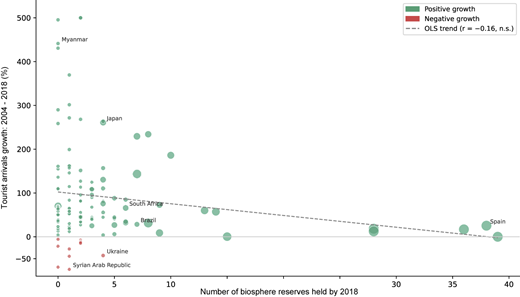
In the analysis, the descriptive pattern across reserve-count categories is noteworthy. This can be seen in Figure 1. Countries receiving their first reserve designation experienced the strongest post-designation growth (median +44%), whereas those adding a fourth or subsequent reserve saw much weaker effects (median +10%). The largest observed post-designation increase occurs among countries receiving their first Biosphere Reserve designation. By the time a country reaches its tenth reserve or beyond, the marginal publicity benefit remains detectable but small. The association between reserve count and overall tourism growth was weak and negative but not statistically significant, Pearson r = −0.156, n = 122, p = 0.087, 95% CI [−0.325, 0.023]. Because the confidence interval includes zero, the results do not provide evidence of a statistically significant linear association between reserve count and tourism growth. A Spearman rank-order correlation produced a similar result, ρ = −0.10, p = 0.27, providing a distribution-free robustness check. Spain, with 51 reserves, shows only modest growth, while Kyrgyzstan, with just two, exhibits rapid expansion—largely driven by the rise of adventure tourism in Central Asia. This aligns with existing literature: the designation itself does not generate tourism demand, but it can help direct and promote it.
In the second analysis, the authors found that 58 (42.6%) of NTOs promote their UNESCO Biosphere Reserves by providing information regarding how to access the site amenities on their national tourism organization (NTO) website. A further 61 (44.8%) countries out of 136 mention their UNESCO Biosphere Reserves as general attractions but do not promote travel to them. A further 17 (12.5%) countries do not mention UNESCO Biosphere Reserves on their NTO websites. In all, 119 (87.5%) out of 136 countries surveyed either promote or cite their UNESCO Biosphere Reserves (Please see Table 1). These results suggest that the UNESCO Biosphere Reserve designation is perceived as important for tourism. The mean EPI score for the countries that promote their UNESCO Biospheres as destinations by citing how to get there was 46.36. This contrasts with countries that cite their UNESCO Biosphere Reserves without promoting travel to them, which had an average EPI Score of 41.88. This average was quite close to the EPI scores of countries that do not cite their UNESCO Biospheres on their websites.
The results of the second analysis indicate that countries that actively promote their UNESCO Biosphere Reserves had the highest observed mean EPI scores. (The data from the Yale Center for Environmental Law and Policy (Block et al., 2024) indicates that the average EPI score for all 136 countries in the sample is 43.7). The results in Table 2 indicate that countries that actively promote their UNESCO Biosphere Reserves by providing information about amenities and infrastructure had the highest observed mean EPI score. However, the overall difference in EPI scores among the three tourism-promotion categories was not statistically significant, F(2, 131) = 1.98, p = 0.142, ω2 = 0.014. No post hoc pairwise comparisons were conducted. Accordingly, the observed differences among group means are interpreted descriptively and do not provide evidence of statistically significant differences among the tourism-promotion categories. For the 10-year EPI change, the overall difference among categories is not statistically significant, F(2, 130) = 2.09, p = 0.128, ω2 = 0.016.
Discussion
This study provides evidence that the UNESCO Biosphere Reserve designation can contribute to increased tourism, particularly when countries receive their first designation. The largest tourism gains occurred in countries with few or no existing Biosphere Reserves, suggesting that the designation has its greatest promotional value when it is a novel addition to a country's tourism portfolio. This finding supports research showing that internationally recognised sustainability designations function as destination brands by enhancing visibility, credibility, and perceived quality (Ryan et al., 2013; Ryan and Silvanto, 2014).
The second analysis revealed a descriptive pattern in which countries that actively promote their UNESCO Biosphere Reserves through national tourism organizations had the highest observed mean EPI scores. However, the overall difference in EPI scores among the three tourism-promotion categories was not statistically significant, and the effect size was small. The findings therefore do not provide sufficient statistical evidence that countries actively promoting their Biosphere Reserves have higher environmental performance than countries that merely mention or do not reference their reserves. Nevertheless, the observed pattern raises an important question for future research concerning whether the promotion of Biosphere Reserves is associated with broader commitments to environmental stewardship and governance rather than simply the use of the designation as a marketing tool (Plummer et al., 2013).
Together, these findings indicate that the UNESCO Biosphere Reserve designation performs two complementary functions. It serves as both an internationally recognised place brand that enhances destination visibility and a governance framework signalling a commitment to biodiversity conservation and sustainable development. Unlike many destination brands, its credibility is reinforced by international standards, periodic evaluations, stakeholder participation, and adaptive management.
The results also support research showing that conservation and tourism can be mutually reinforcing when supported by effective governance, community participation, adaptive management, and transparent environmental standards (Mayer et al., 2010; Gössling and Hall, 2006). This is consistent with the objectives of UNESCO's Man and the Biosphere (MAB) Programme (UNESCO, 2021). Although countries actively promoting their Biosphere Reserves had the highest observed mean EPI scores, the absence of a statistically significant overall difference between the averages means that this descriptive pattern should not be interpreted as evidence that UNESCO Biosphere Reserve promotion is indicative of higher national environmental performance.
These findings should be interpreted within the study's limitations. Although the analyses identified descriptive relationships among Biosphere Reserve promotion, tourism growth, and environmental performance, several of these relationships were not statistically significant and the analyses do not establish causality. Countries with stronger environmental governance may be more likely to obtain UNESCO designation and promote their reserves, while tourism growth is also influenced by factors such as infrastructure, political stability, economic conditions, exchange rates, and broader marketing strategies. It should also be noted that the EPI is a national-level measure and therefore should not be interpreted as a direct assessment of environmental management at individual Biosphere Reserves or of the environmental credibility of specific NTO promotional practices. Nevertheless, the large cross-national sample provides robust evidence that complements previous qualitative and case-study research.
The findings also underscore the importance of maintaining the credibility of the UNESCO Biosphere Reserve designation. As sustainability labels become more common, visitors increasingly expect transparency regarding environmental standards and management outcomes (Buckley, 2001). The long-term value of the designation therefore depends on maintaining rigorous evaluation standards while balancing tourism development with biodiversity conservation and stakeholder participation. The requirements of the UNESCO Biosphere programme suggest that the designation continues to represent genuine commitments to sustainable development rather than simply functioning as a promotional label.
Future research should examine tourism before and after Biosphere Reserve designation to better assess causality. Comparative studies with other international conservation designations, including UNESCO World Heritage Sites, UNESCO Global Geoparks, Ramsar Sites, and IUCN protected areas, would clarify their relative branding and governance value. Additional research should also investigate how destination marketing strategies and visitor perceptions influence the effectiveness of the UNESCO Biosphere Reserve designation as a sustainability label.
Theoretical implications
This study contributes to the literature on sustainable tourism, place branding, and protected area management by demonstrating that the UNESCO Biosphere Reserve designation functions as both a conservation designation and an internationally recognised place brand. The findings extend signaling and destination branding theory by suggesting that sustainability designations may influence tourism demand while raising important questions about their relationship with broader national commitments to environmental governance. Using cross-national evidence from 136 countries, the study contributes to understanding how internationally recognised sustainability designations may enhance destination visibility while operating within broader frameworks of sustainable development, governance standards, and stakeholder trust.
Practical implications
The findings have several implications for policymakers, destination management organizations (DMOs), protected area managers, and UNESCO. Governments, particularly those with relatively few Biosphere Reserves, should recognise that UNESCO designation can increase international visibility when supported by effective destination marketing. National tourism organizations should incorporate Biosphere Reserves into destination branding while remaining consistent with the conservation and community objectives of UNESCO's Man and the Biosphere (MAB) Programme. Protected area managers should continue to prioritise stakeholder participation, transparent governance, and environmental monitoring, while UNESCO and national governments should strengthen communication about the designation's environmental standards and management requirements. Greater transparency will reinforce public trust, distinguish the designation from less rigorous sustainability labels, and reduce perceptions of greenwashing.