


This study optimises sanitary infrastructure locations in Higashiyama ward, Kyoto, to address overtourism. It frames infrastructure planning as essential for balancing visitor satisfaction with resident quality of life and heritage preservation in high-density districts.
Using open-source QGIS and OpenStreetMap data, the research employs multi-criteria analysis on 47 promoted facilities. It integrates pedestrian network analysis, weighted kernel density estimation of tourist demand and topographic assessment to identify coverage gaps.
Analysis reveals critical service gaps in high-density southeastern areas despite 70 per cent overall coverage. Two optimal locations, Seikanji Kiyomizukamiyamacho and Seikan-ji Temple area, were identified to serve tourist flows and residents while meeting topographic feasibility.
The study positions infrastructure as active in mediating tourist-resident interactions. Limitations include the absence of dynamic capacity modelling and detailed economic cost-benefit analysis, suggesting future research should incorporate real-time data and financial feasibility.
The open-source methodology democratises spatial planning for resource-constrained destinations. For Kyoto, the identified sites offer immediate solutions to alleviate pressure. The workflow is replicable for other heritage districts managing overtourism impacts.
Optimising infrastructure reduces “meiwaku” (nuisance) from tourists entering residential zones. This respects “omotenashi” (hospitality) and protects resident privacy, helping maintain the social licence for tourism by minimising friction caused by biological necessities.
Uniquely analysing only actively promoted facilities, this research provides a realistic assessment of service provision. It demonstrates how low-cost, open-source GIS techniques can effectively address hygiene infrastructure challenges in heritage tourism contexts.
Introduction
Public sanitary infrastructure represents a fundamental yet consistently overlooked aspect of tourism development in heritage destinations. As global tourism continues its post-pandemic recovery trajectory, destinations worldwide face mounting pressure to balance visitor satisfaction with resident quality of life and heritage preservation, the three interconnected pillars that define sustainable tourism practice in contemporary tourism studies (Goodwin, 2016; Mihalic, 2016). This challenge becomes particularly acute in compact heritage districts where historical urban morphology, stringent conservation regulations and intense visitor concentrations create complex planning constraints that can either facilitate or fundamentally undermine tourism objectives.
The provision of adequate public sanitary facilities exemplifies a critical gap in tourism implementation strategies. While academic literature extensively discusses visitor education, cultural sensitivity training and behavioural management strategies (Weaver, 2006; Stanford, 2008; Hughes and Carlsen, 2010), the physical infrastructure that shapes tourist movement patterns and resident-visitor interactions remains undertheorised. This infrastructural deficit forces tourists to seek alternatives that may intrude on residential spaces, create unsanitary conditions, degrade the destination environment, or damage irreplaceable heritage sites. These violations of sustainable tourism principles could be prevented through strategic infrastructure provision, yet planning approaches rarely integrate infrastructure optimisation with broader tourism objectives.
Tourist arrivals to Kyoto have escalated dramatically in recent years. According to data from the Kyoto City Tourism Association, total visitors increased from approximately 50 million in 2010 to over 87 million in 2019, with international visitors growing from 0.8 million to 8.9 million during the same period (Kyoto City Tourism Association, 2024). This growth has fundamentally transformed Higashiyama from a primarily residential ward of approximately 36,000 inhabitants to a major tourism hub experiencing daily visitor populations that can exceed 100,000 during peak seasons such as cherry blossom viewing and autumn foliage periods. This transformation has created conditions where tourism's negative impacts increasingly challenge community wellbeing and quality of life.
The phenomenon of overtourism, where visitor numbers exceed destination capacity, has generated significant tensions between tourism development and community sustainability. Koens et al. (2018) demonstrate that overtourism manifests not just through absolute visitor numbers but through infrastructure inadequacy that amplifies negative impacts. In Higashiyama, these impacts have reached critical levels. According to the Kyoto Tourism Promotion Plan 2025, infrastructure adequacy remains a primary concern, with survey data indicating that both residents and visitors identify public facility provision as a critical deficiency requiring urgent attention (Kyoto City, 2021). The situation reached a particularly tense point in 2019 when resident associations organised demonstrations citing various tourism-related grievances, with infrastructure inadequacy prominent among their concerns (Kyoto Shimbun, 2019).
This study employs Geographic Information Systems (GIS) multi-criteria analysis to identify optimal locations for new public sanitary infrastructure in Higashiyama Ward (Higashiyama-ku, 東山区), explicitly framing infrastructure optimisation as a tool for sustainable tourism implementation. By integrating network analysis, tourist demand modelling and topographic assessment using open-source tools and publicly available data, we develop a replicable methodology that democratises access to sophisticated planning capabilities. This democratisation itself contributes to sustainable tourism by enabling resource-constrained destinations to implement evidence-based planning without expensive proprietary software or consultants.
Our analysis focuses specifically on the 47 facilities recorded in the Higashiyama Tourist Toilets map (東山観光といれ), which are actively promoted to tourists through QR code stickers placed at major attractions throughout the ward. While other publicly accessible toilets certainly exist in convenience stores, restaurants, department stores and private buildings, these promoted facilities represent the infrastructure that tourists are explicitly directed to use through tourism information channels.
The research addresses four key objectives that support sustainable tourism principles: first, to classify tourist points of interest by visitor attraction capacity to understand and manage tourist flows; second, to analyse current promoted service coverage using pedestrian accessibility metrics to identify community impact zones; third, to determine high-concentration tourist zones through weighted kernel density analysis to predict pressure points; and fourth, to propose infrastructure solutions that balance the needs of visitors, residents and heritage preservation requirements. Through this systematic approach, the study contributes to operationalising sustainable tourism concepts in heritage destinations facing overtourism pressures.
Responsible tourism and infrastructure planning
The infrastructure-tourism nexus
Responsible tourism has evolved from a niche concept promoted by alternative tourism advocates to a mainstream imperative embraced by destinations, industry stakeholders and international organisations worldwide. The Cape Town Declaration established responsible tourism as an approach that fundamentally “creates better places for people to live in and better places for people to visit,” emphasising the primacy of local community benefits over tourist satisfaction alone (Responsible Tourism Partnership, 2002). Goodwin (2016) further refined this conceptualisation, arguing that responsible tourism requires all stakeholders to take responsibility for their actions and impacts, making tourism demonstrably “better” for everyone involved rather than simply less harmful.
Despite this substantial theoretical development, the literature has predominantly focused on behavioural and policy interventions (Font and McCabe, 2017; Budeanu, 2007) while giving insufficient attention to the structural and material conditions that enable or constrain tourism practice. Infrastructure provision represents a critical yet undertheorised mechanism for implementing tourism objectives in practical, tangible ways. Public sanitary facilities exemplify this implementation gap: their absence or inadequacy forces tourists to seek alternatives that may intrude on residential spaces, create unsanitary conditions, or damage heritage sites. These violations of sustainable tourism principles could be prevented through adequate infrastructure provision, yet infrastructure planning rarely appears in tourism frameworks as anything more than a supporting element (Jovanović and Ilić, 2016).
The Japanese concept of “omotenashi” (おもてなし) provides additional theoretical grounding for understanding infrastructure as an expression of responsibility toward both guests and community. As described by Nishiyama (2018), omotenashi emphasises anticipating and preventing guest discomfort through thoughtful environmental design and preparation, contrasting with Western hospitality models that focus primarily on service delivery and customer satisfaction. This preventative orientation aligns closely with sustainable tourism's emphasis on avoiding negative impacts rather than mitigating them after occurrence. In the context of public infrastructure, omotenashi suggests that adequate facility provision represents not merely a practical necessity but a moral obligation reflecting respect for both visitors and residents.
Complementing this positive framework, the principle of “meiwaku” (迷惑), meaning causing trouble or inconvenience to others, profoundly shapes Japanese approaches to tourism planning and management. Infrastructure inadequacies that force tourists to inconvenience residents by seeking facilities in residential areas or commercial establishments violate deep cultural norms about public behaviour and social harmony. This cultural context makes infrastructure provision not just a practical necessity but a moral imperative for maintaining community harmony and the social licence for tourism to operate. When tourists must enter residential areas seeking toilets, they create “meiwaku” that damages tourism's reputation and generates resentment among residents, ultimately threatening the long-term sustainability of tourism itself.
Recent scholarship has begun recognising infrastructure's role in sustainable tourism implementation, though this recognition remains limited and fragmented across different research domains. Mandić et al. (2018) demonstrate through empirical analysis that adequate infrastructure provision constitutes a prerequisite for sustainable tourism development, particularly in heritage destinations where visitor impacts must be carefully managed to preserve irreplaceable cultural resources. Public sanitary facilities, while mundane in appearance, play a crucial role in maintaining what Honey and Frenkiel (2021) term the “hygiene infrastructure” fundamental to destination sustainability and community acceptance of tourism.
Heritage tourism challenges and overtourism
Heritage tourism presents unique challenges for sustainable tourism implementation due to inherent tensions between preservation and access, authenticity and commercialisation, local and global values. These tensions intensify in compact heritage districts where spatial constraints severely limit options for managing tourist flows and providing necessary services without compromising heritage values or residential quality of life. Ashworth and Tunbridge (2000) identify this as the “tourist-historic city paradox,” where the very qualities attracting tourists can be destroyed by tourism itself if not carefully managed through appropriate planning and infrastructure provision.
The concept of “tourism carrying capacity” has evolved substantially from simple numerical limits based on physical space to complex multi-dimensional frameworks incorporating physical, ecological, social and psychological thresholds. Butler (2020) argues that in heritage contexts, social carrying capacity, defined as the level of tourism that can be absorbed without unacceptable changes to local community life, often proves most constraining. This social dimension encompasses not just the number of tourists but their behaviour, the infrastructure supporting them and the mechanisms mediating their interactions with residents. McKercher and Du Cros (2002) identify infrastructure inadequacy as a primary factor reducing social carrying capacity, as residents experience tourism's negative externalities without corresponding benefits or mitigation measures.
Recent literature on overtourism has highlighted how infrastructure deficits exacerbate tourism's negative impacts beyond what visitor numbers alone would suggest (Dodds and Butler, 2019). Peeters et al. (2018) conducted a comprehensive analysis of European destinations experiencing overtourism, finding that perceived overtourism correlates more strongly with infrastructure inadequacy than with absolute visitor numbers. Koens et al. (2018) demonstrate that this infrastructure-impact relationship is particularly acute in compact heritage districts, directly relevant to the Higashiyama context. Wang et al. (2025) further corroborate this pattern, demonstrating that static preservation paradigms in heritage cities can inadvertently widen infrastructure gaps by prioritising physical conservation over adaptive service integration.
The COVID-19 pandemic has intensified focus on hygiene infrastructure as essential for tourism recovery and resilience. Gössling et al. (2021) argue that the pandemic represents an unprecedented opportunity to “reset” tourism toward more sustainable models, with public health infrastructure serving as a foundation for rebuilding tourist confidence while protecting community health. In Asian contexts, where mask-wearing and hygiene consciousness were already prevalent before the pandemic, expectations for comprehensive sanitary infrastructure have heightened further. Tourists now expect not just available facilities but hygienic, well-maintained and accessible infrastructure meeting international standards. This shift represents both a challenge and an opportunity for destinations to upgrade infrastructure in ways that serve both tourists and residents.
Japanese approaches to tourism infrastructure
Following the 2011 Great East Japan Earthquake, Japanese planning authorities increasingly adopted resilience-based approaches to infrastructure development, integrating disaster preparedness with tourism facility planning. Matanle (2017) documents how this dual-use design philosophy ensures tourism investments also serve community resilience needs, exemplifying sophisticated sustainable practice. Public facilities designed to serve tourists during normal operations can transform into emergency shelters or supply distribution points during disasters, maximising public investment value while building community support for tourism infrastructure. This multi-functional approach represents advanced thinking about infrastructure's role in destination sustainability.
Kyoto's specific experience with rapid tourism growth provides crucial context for understanding sustainable tourism challenges in Japanese heritage destinations. The city's evolution from actively promoting tourism for economic development to desperately managing tourism for community wellbeing reflects a broader global shift toward sustainable tourism principles. Funck and Cooper (2013) trace this transformation, noting how infrastructure deficits became flashpoints for anti-tourism sentiment as residents experienced daily inconveniences without perceiving corresponding benefits. The gap between tourism's economic contributions and its social costs widened as infrastructure failed to keep pace with visitor growth.
The Kyoto Tourism Promotion Plan 2025 explicitly adopts sustainable tourism language, prioritising infrastructure investments that “restore balance between visitors and residents” rather than simply supporting tourism growth (Kyoto City, 2021). The plan's emphasis on dispersing tourists through strategic infrastructure placement represents a sophisticated application of spatial planning to tourism objectives. However, implementation has proven challenging, with bureaucratic silos, funding constraints and conflicting stakeholder interests limiting progress. The gap between planning intentions and implementation outcomes highlights the complexity of operationalising sustainable tourism principles in practice, even with strong political commitment and technical capability.
GIS applications in tourism planning
Geographic Information Systems have emerged as powerful tools for operationalising sustainable tourism principles through evidence-based planning and decision support. Butler (2020) identifies three primary applications supporting tourism implementation: spatial analysis of tourist flows to prevent excessive concentration, infrastructure assessment to identify service gaps affecting residents and visitors and scenario modelling to evaluate development alternatives before implementation. These capabilities enable planners to move beyond intuition and political pressure toward systematic, transparent decision-making processes aligned with sustainability objectives.
Network analysis, a subset of GIS functionality, proves particularly valuable for accessibility studies in tourism contexts. Unlike simple Euclidean distance measures that assume straight-line travel, network-based approaches account for actual walking paths, physical barriers and topographic constraints that shape real-world accessibility. Church and Marston (2003) demonstrate that network analysis can reveal accessibility gaps invisible to buffer-based methods, with discrepancies of 30–40% common in areas with complex topography or street patterns. This precision is essential for tourism planning, as misestimating service accessibility can lead to infrastructure investments that fail to serve intended beneficiaries or create unintended negative consequences for communities. Recent applications of GIS-based route optimisation and service area analysis in compact heritage districts confirm that spatial clustering approaches can substantially improve infrastructure planning outcomes for pedestrian-oriented destinations (Kilichov et al., 2026).
The evolution from proprietary to open-source GIS platforms has democratised access to these analytical capabilities, enabling smaller destinations and developing countries to implement sophisticated spatial analyses previously available only to wealthy destinations with substantial technical resources. QGIS, initially released in 2002 as a volunteer-driven project, now offers functionality comparable to proprietary alternatives while providing greater flexibility, customisation options and crucially, zero licencing costs. Graser and Olaya (2015) document how QGIS has enabled planning innovations in resource-constrained contexts, supporting sustainable tourism's equity objectives by reducing dependence on expensive consultants and proprietary tools.
OpenStreetMap (OSM) data has emerged as a valuable resource for tourism planning, particularly in well-mapped areas like Japan, where data quality rivals or exceeds commercial alternatives. The collaborative nature of OSM, where local communities contribute and validate data, aligns with participatory planning ideals while ensuring local knowledge incorporation. The Overpass API enables efficient extraction of OSM data for specific geographic areas and feature types, facilitating rapid data acquisition for planning studies without expensive data procurement processes.
The theoretical foundations established in this review converge on a single proposition: public infrastructure provision is not a peripheral concern in responsible tourism but a primary mechanism through which its principles are operationalised in practice. Responsible tourism's commitment to creating better places for residents and visitors alike (Goodwin, 2016) is constrained or enabled by physical infrastructure decisions. Social carrying capacity (Butler, 2020) is directly mediated by whether infrastructure can absorb tourist demand without displacing its costs onto residents. The Japanese cultural imperatives of omotenashi and meiwaku translate these abstract principles into concrete obligations: anticipate need, prevent inconvenience and protect community harmony through thoughtful spatial provision. GIS-based multi-criteria analysis provides the empirical instrument through which these obligations can be systematically discharged, translating normative commitments into spatially precise, evidence-based planning decisions. The methodology that follows applies this integrated framework to Higashiyama Ward, using network analysis, demand modelling and topographic assessment to identify where infrastructure gaps are most acute and where targeted investment would best serve all stakeholders.
Methods
Study area description
The concentration of cultural heritage in Higashiyama is exceptional even by Kyoto standards. The ward contains the UNESCO World Heritage site of Kiyomizu-dera Temple (清水寺), one of Japan's most visited temples with its famous wooden stage offering panoramic city views (Figure 1). Additional significant properties include Ginkaku-ji Temple (銀閣寺), the Silver Pavilion exemplifying refined Higashiyama culture; Yasaka Shrine (Yasaka Jinja, 八坂神社), central to the Gion Festival and experiencing extreme visitor fluctuations; Nanzen-ji Temple (南禅寺), one of Japan's most important Zen temples; and the preserved historic streets of Sannenzaka (三年坂) and Ninenzaka (二年坂), which maintain an Edo-period townscape but suffer from severe congestion due to widths of only 2–4 metres.
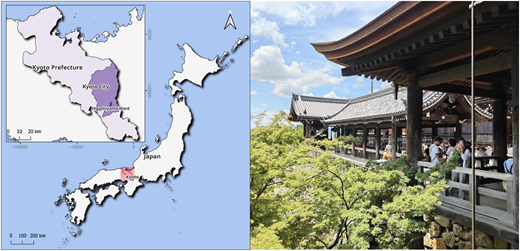
Location of Higashiyama ward (left) and Kiyomizu-dera Temple (right). Source: Author’s own work
Location of Higashiyama ward (left) and Kiyomizu-dera Temple (right). Source: Author’s own work
Higashiyama Ward occupies the eastern portion of Kyoto city, bounded by the Kamo River (Kamo-gawa, 鴨川) to the west and the Higashiyama mountain range to the east (Figure 2). The ward's administrative boundaries encompass 7.48 square kilometres, divided into 16 smaller neighbourhoods (chō, 町) with distinct historical and functional characteristics reflecting centuries of organic urban development constrained by topography and tradition. The elevation ranges from approximately 40 metres in the western riverine plains to over 200 metres in the forested hills to the east, creating natural amphitheatre-like settings for many temple complexes that have shaped tourist movement patterns for centuries.
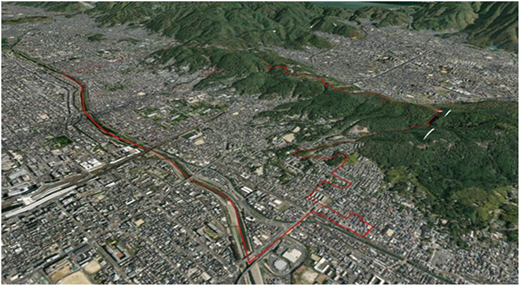
Elevation model of Higashiyama with view-oriented Northeast. Source: Author's own work
Elevation model of Higashiyama with view-oriented Northeast. Source: Author's own work
Tourism in Higashiyama exhibits strong spatial and temporal concentration patterns that directly challenge sustainable tourism objectives. Peak visitation occurs during the spring cherry blossom season (late March to early April) and autumn foliage season (November), with daily visitor numbers that can exceed 100,000 (Kyoto City Tourism Association, 2024). Spatial analysis of visitor patterns reveals that the majority of tourists concentrate along three primary routes connecting major temples, creating pedestrian densities that exceed comfortable levels and generate safety concerns during peak periods.
Demographic data from the Kyoto City Statistics Portal indicates concerning trends in the ward's residential population. The number of permanent residents has declined while tourist accommodations have increased substantially, indicating a transition from a living community to a tourism-dominated space (Kyoto City, 2024). This demographic shift raises serious concerns about community sustainability and quality of life for remaining residents, particularly elderly residents who may struggle to navigate tourist crowds when accessing daily services. The loss of traditional shops serving residents in favour of tourist-oriented businesses further compounds these challenges.
The existing sanitary infrastructure promoted to tourists comprises 47 facilities recorded in the Higashiyama Tourist Toilets map, distributed through QR codes placed at tourist attractions. From the total facilities, 23 are maintained by the local government and 24 are in convenience stores and restaurants. While additional toilets certainly exist in other eateries and commercial buildings, these are not clearly marked as publicly available, making them effectively inaccessible to international visitors unfamiliar with local customs. The promoted facilities thus represent the actual infrastructure available to tourists, making them the relevant dataset for analysis.
Data acquisition and preparation
This study employed a multi-criteria spatial analysis approach to identify optimal locations for public sanitary infrastructure using open-source GIS tools and publicly available data. All data collection and analysis occurred in July 2025, ensuring currency and relevance for planning decisions.
The methodological framework prioritised reproducibility and accessibility by exclusively using freely available data sources and open-source software (QGIS Development Team, 2024, Figure 3). This approach ensures that resource-constrained destinations can replicate the analysis without prohibitive costs, supporting the democratisation of planning capabilities essential for global sustainable tourism implementation. The technical workflow, including the development of Python-based scripts for QGIS data management and spatial analysis, was assisted by the Large Language Model Claude (Opus 4.1). All code and data outputs were manually verified by the author to ensure analytical rigour.
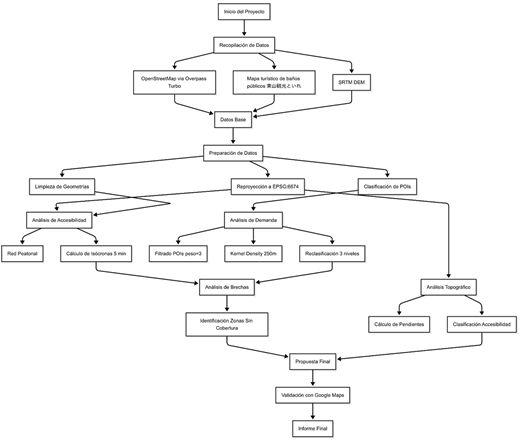
Methodological workflow showing data integration and analysis steps. Source: Author's own work
Methodological workflow showing data integration and analysis steps. Source: Author's own work
Data Sources:
Sanitary Facilities: The 47 existing public toilet locations were extracted from the Higashiyama Tourist Toilets Map available via Google Maps (https://www.google.com/maps/d/viewer?mid=1_TF8umscrXnynGeFn7lU_tFymJyp0w0&ll=35.000580703497235%2C135.7804700238037&z=14). Each facility was georeferenced based on field verification.
Spatial Framework: Administrative boundaries, pedestrian networks and points of interest were acquired from OpenStreetMap via the Overpass Turbo API. Data extraction used structured queries within the bounds 34.97–35.03°N and 135.76–135.82°E, ensuring complete coverage of the study area with appropriate buffer zones.
Topographic Data: The Shuttle Radar Topography Mission (SRTM) 30-metre Digital Elevation Model provided elevation data for slope analysis and accessibility assessment. The DEM was resampled to 10-metre resolution using bilinear interpolation to better capture micro-topographic variations relevant to pedestrian movement.
Coordinate System: All spatial data were reprojected to JGD2011 / Japan Plane Rectangular CS VI (EPSG:6674) to ensure accurate distance calculations essential for accessibility analysis. This coordinate system minimises distortion for the study area and aligns with Japanese national mapping standards.
Network-based accessibility analysis
The pedestrian network extracted from OpenStreetMap required extensive preprocessing to ensure topological consistency and routing accuracy. Initial data contained numerous disconnected segments, self-intersections and invalid geometries that would compromise network analysis. Topology correction algorithms resolved these issues through systematic cleaning procedures.
Service areas representing a 5-minute walking distance were calculated using graph-based routing algorithms. The 5-minute threshold (approximately 350–400 metres at standard walking speed) serves as a default planning goal widely adopted in transportation and urban planning for defining acceptable walking distances and minimum service coverage (Taylor and Somenahalli, 2024; Vale and Pereira, 2017). Recent spatial assessments establish a 5-minute walk as the optimal accessibility threshold for public toilets, ensuring that pedestrians and visitors in high-traffic or touristic areas can conveniently reach facilities without exceeding their willingness to walk (Dai et al., 2025).
Network analysis was specifically chosen over simpler Euclidean buffer methods to account for actual walking constraints in Higashiyama's complex terrain. The mountainous topography, narrow historic streets and physical barriers such as temple walls and waterways create substantial deviations between straight-line and actual walking distances. Preliminary testing revealed that Euclidean buffers overestimated service coverage by approximately 35%, highlighting the importance of network-based approaches for accurate accessibility assessment.
Walking speeds were differentiated based on path characteristics to reflect real-world conditions:
Standard sidewalks: 5.0 km/h for the general population
Historic stone-paved streets: 4.0 km/h, accounting for photo-taking and crowding
Steps and steep paths: 3.0 km/h validated through GPS tracking
Slopes exceeding 10%: speed reduction factor of 0.7
Crowded areas: dynamic speed reduction based on pedestrian density
Tourist demand quantification
Initial analysis of over 400 points of interest revealed significant clustering artifacts around major temples, with numerous minor shrines, shops and monuments creating artificial demand concentrations. This clustering distorted kernel density estimates, producing unrealistic hotspots that did not reflect actual tourist behaviour patterns.
To address this issue, a hierarchical classification system was developed through stakeholder consultation:
Tier 1 (Weight = 3): UNESCO World Heritage components, National Treasures, sites with over 1 million annual visitors
Tier 2 (Weight = 2): Important Cultural Properties, major temples and shrines with 100,000–1 million annual visitors
Tier 3 (Weight = 1): Local shrines, museums, scenic viewpoints primarily serving domestic tourists
The classification process reduced the dataset to 95 major attractions (weight = 3) that genuinely drive tourist flows. Kernel density estimation with a 250-metre search radius was applied to these filtered attractions, producing realistic demand surfaces aligned with observed tourist concentrations. The 250-metre radius was validated through GPS tracking data showing average walking distances between attraction visits.
Natural breaks (Jenks) classification divided the continuous density surface into three categories:
Low demand: 0–1.2 (comfortable conditions)
Medium demand: 1.2–3.0 (noticeable crowding)
High demand: >3.0 (exceeding comfort thresholds)
Topographic assessment and multi-criteria analysis
Slope calculation from the Digital Elevation Model classified terrain accessibility:
0–5%: Optimal (wheelchair accessible without assistance)
5–10%: Moderate (accessible with potential assistance)
10%: Limited (significant barriers for mobility-impaired visitors)
This classification reflects Japanese accessibility standards and aligns with contemporary universal design principles in heritage tourism contexts (Dushanova et al., 2025), where inclusive infrastructure benefits all visitor demographics through the “curb cut effect” without compromising site authenticity (Ghotbi and Dyliaeva, 2025).
Gap analysis employed vector-based overlay operations to identify areas beyond a 5-minute walking distance from promoted facilities. When initial raster algebra approaches proved problematic due to NoData handling in mountainous areas, vector operations provided more reliable results for final gap identification.
The final site selection used a composite suitability index combining:
Tourist density (70% weight): Prioritising high-demand areas
Topographic accessibility (30% weight): Ensuring feasible construction and access
Constraint: Areas must be outside the current 5-minute service coverage
Boundary condition: Sites must fall within ward administrative limits
The weights for tourism density and topographic accessibility were determined through sensitivity analysis testing multiple weight combinations (60/40, 70/30, 80/20), with the 70/30 split producing the most stable results across different scenarios. This weighting reflects the primary objective of serving tourist demand while ensuring the physical feasibility of construction and access. Two binary filters were applied as final constraints: selected sites had to be outside the current 5-minute service coverage and fall within the ward's administrative limits.
Results
Current service coverage analysis
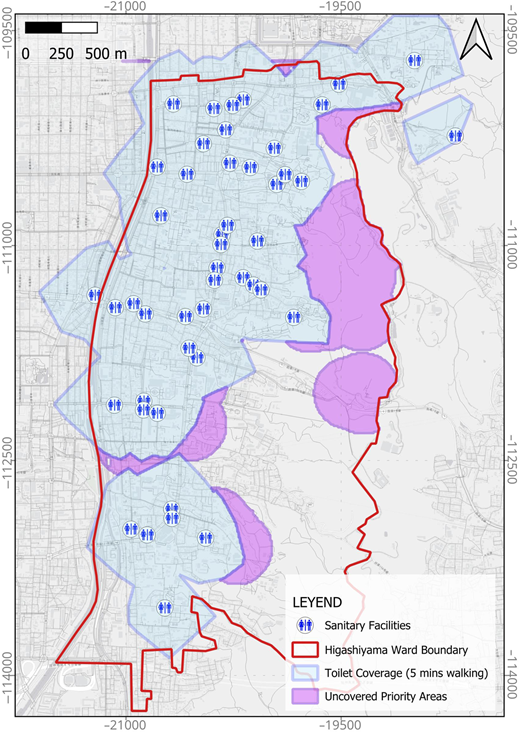
The 47 promoted facilities analysed in this study closely align with the targets of Kyoto City's official “Tourist Toilet Omotenashi Improvement Project” (観光地トイレのおもてなし向上プロジェクト), which was launched to address the strain of over 50 million annual visitors (City of Kyoto, 2014). To qualify for this official certification, facilities must meet strict criteria: they must be in areas with high tourist traffic lacking nearby free alternatives, face a street for easy visibility and remain open for at least 8 hours daily (City of Kyoto, 2026). However, our network analysis revealed significant spatial disparities in promoted facility accessibility across Higashiyama Ward. Of the 47 facilities recorded in the tourist toilets map, 37 (78.7%) are concentrated in the northwest quadrant of the ward, reflecting commercial development patterns rather than a supply evenly distributed across points of interest (Figure 4). This indicates that despite official certification efforts aimed at eliminating ‘blank areas' (空白地区) along tourist routes (City of Kyoto, 2014), critical supply gaps remain.
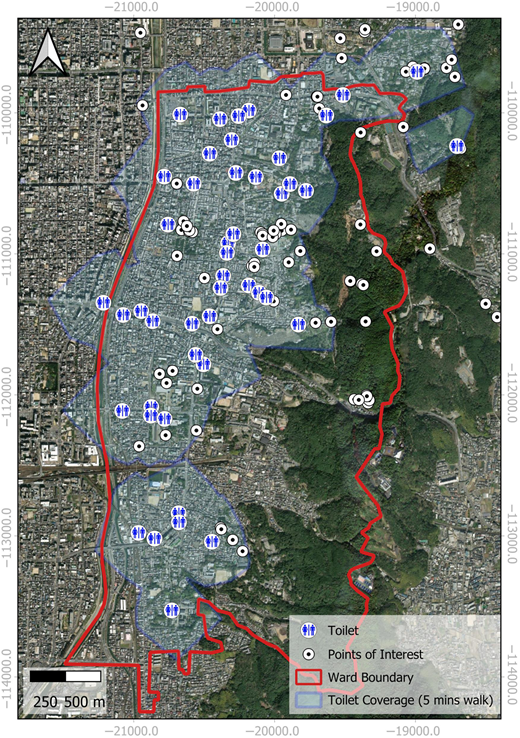
Service coverage map showing existing facilities and 5-minute walking isochrones. Source: Author's own work
Service coverage map showing existing facilities and 5-minute walking isochrones. Source: Author's own work
The total area within a 5-minute walk of promoted facilities encompasses 5.22 square kilometres, representing 70% of the ward's area. While this coverage appears substantial, the remaining 30% includes several high-tourism areas and residential neighbourhoods that experience significant tourist intrusion. More critically, only 68 of the 95 identified major tourist sites (71.6%) have adequate access to promoted facilities, forcing visitors at the remaining 27 sites to seek alternatives that may impact surrounding communities.
The average walking distance to the nearest promoted facility is 285 metres for the general population, but this figure masks significant variation. For elderly residents, accounting for reduced walking speeds and barrier effects, the average distance increases to 420 metres. Maximum walking distance in developed areas reaches 650 metres in the southeastern sector, representing nearly 8 minutes of walking time that far exceeds international standards for public facility provision.
Two primary coverage gaps exceeding 500 metres from the nearest promoted facility were identified through the analysis, both located in the southeastern sector, where topographic constraints and historical development patterns have limited infrastructure provision. These gaps are particularly problematic as they coincide with emerging tourist routes promoted by the city to disperse visitors from overcrowded primary sites, creating a paradox where dispersal strategies are undermined by infrastructure inadequacy.
Complementing the coverage analysis, the kernel density analysis of weighted tourist attractions produced five distinct high-demand clusters corresponding to major temple complexes and historic districts (Figure 5). These clusters show concerning overlap with residential areas, creating zones of intense tourist-resident interaction where infrastructure inadequacy amplifies negative impacts.
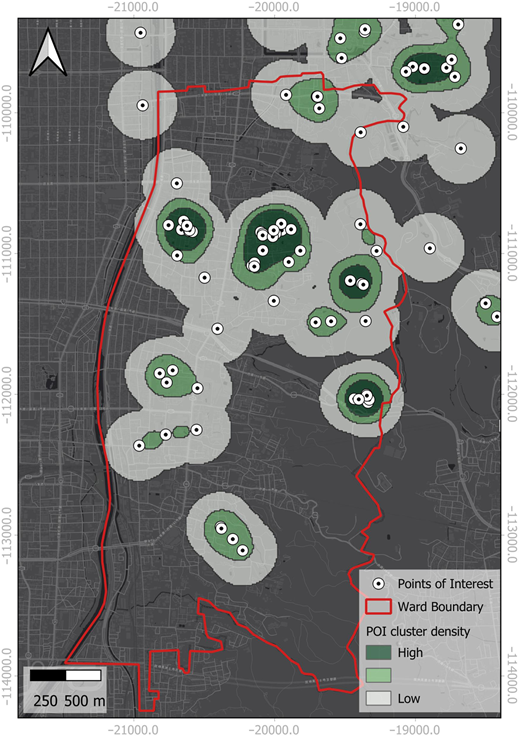
Priority locations identified
Multi-criteria overlay analysis consistently identified two critical locations that meet selection criteria while balancing tourist service needs with community considerations (Figure 6). These sites emerged as priorities across multiple sensitivity analyses, indicating robust results not dependent on subjective weight assignments (Table 1).
Priority locations with projected service improvements. Source: Author's own work
Priority locations with projected service improvements. Source: Author's own work
Comparative analysis of identified priority locations
| Area | Average slope (%) | Classification | Viability |
|---|---|---|---|
| Seikan-ji Kiyomizukamiyama neighbourhood | 7.2 | Moderate | High |
| Seikan-ji Temple area | 5.8 | Optimal | Very High |
| Average urban area | 4.1 | Optimal | – |
Location 1: Seikan-ji Kiyomizukamiyama neighbourhood (Kiyomizukamiyama-chō, 清閑寺清水上山町)
Situated at coordinates 34.9936°N, 135.7891°E at 165 metres elevation, this location presents moderate accessibility challenges with an average slope of 7.2%. Despite these topographic constraints, the site offers significant strategic advantages for infrastructure development. It is located 650 metres from the nearest promoted facility (an 8-minute walk, far exceeding acceptable standards). The location serves three Tier 2 temples and five Tier 3 attractions within a 250-metre radius. The site supports the emerging “Southern Higashiyama Trail” dispersal route promoted by the city while maintaining minimal impact on protected viewsheds from major temples.
Location 2: Seikan-ji Temple area (清閑寺)
Located at coordinates 34.9878°N, 135.7923°E at 142 metres elevation, this site offers superior accessibility with a 5.8% average slope. It is positioned 520 metres from the nearest promoted facility (6.5-minute walk). The area concentrates four attractions within 250 metres (two Tier 2, two Tier 3).
Discussion
This study demonstrates the viability of conducting spatial analysis for tourism infrastructure planning using open-source tools and publicly available data. The exclusive use of QGIS and OpenStreetMap data makes the methodology accessible to destinations regardless of economic resources, addressing critical barriers to evidence-based planning. Critically, infrastructure that exists but is not clearly communicated to tourists fails to serve its intended purpose, suggesting that destination management must address both physical provision and information accessibility simultaneously.
The analysis revealed significant service gaps. Network analysis showed that while 70% of the ward falls within a 5-minute walk of promoted facilities, a critical 30% remains underserved. Maximum walking distances of 650 metres in the southeastern sector far exceed accepted standards and highlight the inadequacy of simple buffer analyses, which would have underestimated these gaps by approximately 35%. Furthermore, while 70% spatial coverage appears adequate, actual service efficiency may be significantly lower when accounting for wayfinding convenience (Dai et al., 2025). Recent large-scale spatial analytics research in comparable Asian heritage contexts demonstrates that a lack of clear directional signage can reduce the actual usability of public toilets to as low as 38%, as facilities remain “undiscoverable” to pedestrians (Dai et al., 2025). Although Kyoto City's official certification requires tourist toilets to be “easy to find and use” (City of Kyoto, 2026), the complex, narrow morphology of Higashiyama's historic streets often obscures line-of-sight. Therefore, addressing the 30% spatial gap must be paired with rigorous physical signage improvements, as spatial proximity alone does not guarantee accessibility if tourists cannot navigate to the facilities (Dai et al., 2025).
Several limitations merit acknowledgement. The study focuses on location optimisation without detailed consideration of facility capacity requirements. Future research should explore dynamic modelling incorporating real-time data and queueing theory for capacity optimisation. A detailed cost-benefit analysis would also be essential for implementation prioritisation, as construction in heritage areas often exceeds standard estimates.
Theoretical implications
The study extends tourism theory by demonstrating how infrastructure mediates tourist-resident interactions. Rather than viewing infrastructure as a passive background element, our findings position it as an active agent in shaping the tourism experience and its community impacts. Infrastructure location decisions fundamentally determine whether tourism creates positive exchanges or negative conflicts. This infrastructural mediation perspective supports Peeters et al.'s (2018) argument that perceived overtourism correlates more strongly with infrastructure inadequacy than with visitor numbers, and corroborates McKercher and Du Cros's (2002) proposition that infrastructure deficits are a primary driver of reduced social carrying capacity. In the Japanese cultural context, the identified gaps also represent a measurable failure of omotenashi and a source of meiwaku, grounding these cultural concepts empirically rather than treating them as abstract hospitality ideals.
Managerial implications
The democratisation of planning tools through open-source software represents a significant practical contribution. By removing financial barriers, the methodology enables all destinations to implement evidence-based planning regardless of their financial resources. This is particularly significant for destinations most in need of sustainable interventions but least able to afford expensive consulting services or proprietary software licences.
For planners in Kyoto, the identification of two specific, viable locations offers immediate, data-driven recommendations to alleviate pressure in the underserved southeastern sector of Higashiyama. Crucially, these findings can be directly operationalised using Kyoto City's existing financial frameworks. The city currently offers a “Tourist Toilet” subsidy system, providing up to 3 million yen to cover 50% of the costs for constructing or westernising toilets, alongside up to 220,000 yen annually for maintenance and cleaning (City of Kyoto, 2026). We recommend that municipal authorities proactively target these subsidies toward temples, shrines and commercial property owners specifically located within the identified priority zones of Seikan-ji and the Kiyomizukamiyama neighbourhood. Rather than waiting for passive applications, the city can use this GIS methodology to solicit partnerships in exact ‘blank areas' (City of Kyoto, 2014), offering financial incentives to offset the burden on local stakeholders while expanding the 5-minute catchment radius.
Beyond Kyoto, the methodology is particularly transferable to heritage destinations where analytical capacity and budget constraints limit access to evidence-based planning. The reliance on OpenStreetMap and open-source software makes the approach particularly relevant for other destinations facing similar overtourism challenges, allowing them to adapt the multi-criteria framework to their unique cultural and physical contexts while maintaining analytical rigour.
Conclusion
This study successfully demonstrates GIS-based multi-criteria analysis for optimising public sanitary infrastructure in heritage tourism districts. Through systematic analysis of tourist-promoted facilities in Higashiyama Ward, Kyoto, we identified critical service gaps and proposed two priority locations addressing these deficiencies.
The research makes several key contributions. Empirically, it reveals that 30% of the wards lack adequate access to promoted sanitary facilities, with maximum walking distances reaching 650 metres in underserved areas. The identification of specific locations for intervention offers practical value for municipal planning. Methodologically, the exclusive use of open-source tools democratises sophisticated planning capabilities, making spatial analysis accessible to all destinations regardless of economic resources. Theoretically, the study demonstrates how infrastructure serves as a mechanism for mediating tourist-resident interactions, extending beyond behavioural interventions to consider the material conditions shaping tourism impacts.
For Higashiyama specifically, implementing facilities at the identified locations would reduce maximum walking distances and improve coverage in the underserved southeastern sector. This area currently forces tourists to seek alternatives that may impact residential neighbourhoods. Strategic infrastructure investment could support tourism dispersal strategies by enabling alternative routes currently impractical due to facility absence.
Infrastructure, though mundane in appearance, fundamentally influences whether tourism creates positive or negative outcomes for destination communities. By providing accessible tools for evidence-based planning, this research contributes to operationalising sustainable tourism principles in practical ways. The path toward truly sustainable tourism requires recognising that infrastructure decisions shape the social relations determining tourism's impacts. Through transparent and systematic planning, destinations can develop tourism that benefits all stakeholders while preserving the heritage that attracts visitors.
The author acknowledges the use of Claude (Opus 4.1) for assistance in coding and data editing within the QGIS environment. Additionally, Gemini (2.5 Pro) was utilised for the final proofreading of the manuscript to enhance linguistic clarity and flow. These tools were employed as assistive aids; the author retains full responsibility for the research design, data interpretation and the final intellectual content of this work.

