


The purpose of this study is to investigate the effect of national identity on resident's willingness to travel domestically and determine the role of psychological ownership (PO) and tourism ethnocentrism (TE) as a mediator in this relationship.
The study used a quantitative approach and collected primary data from 427 Indian residents were surveyed online. The hypothesis in the present research was investigated using the partial least squares (PLS) method.
The findings reveal that stronger national identity increases residents' willingness to travel domestically. Further, national identity influences PO and TE which in turn significantly influences resident's willingness to travel domestically. Moreover, the results reveal the mediating role of PO and TE between national identity and resident's willingness to travel domestically.
This study provides valuable insights for tourism policymakers. National identity's strong effect on domestic travel highlights the need for identity or pride based promotional campaigns. PO emphasizes the importance of community participation in developing a sense of belonging. The role of TE implies highlighting the social and economic advantages of promoting domestic travel.
The study's novelty stems from its association between national identity and outcomes as resident's willingness to travel domestically. The model implies that enhancing national identity among residents can lead to significant benefits for their willingness to travel domestically.
Introduction
Tourism is a rapidly increasing economic sector that creates jobs, boosts regional development and multiplies the activity of other sectors (Ministry of Tourism, 2024). The increasing influence of the tourism industry as a major economic force and its promise as a development tool are undeniable (Ministry of Tourism, 2024). The literature on tourism has mostly focused on foreign visitors, giving little consideration to domestic tourism (Sahoo et al., 2022). Domestic tourism is essential to economic success, because it stimulates local economies, creates jobs, preserves culture and promotes tourism development (David, 2025). Acknowledging the importance of domestic travel, nations such as China, South Africa, Turkey and Kenya have put policies in place to increase it (David, 2025; Melubo and Kisasembe, 2022). Similarly, India, in January 2020, started the Dekho Apna Desh campaign to encourage domestic travel within India. With its ability to provide a wide range of jobs, the tourism industry not only drives growth but also enhances people's quality of life (Ministry of Tourism, 2024).
Given the advantages domestic travel offers a nation, it's critical to identify the reasons why tourists choose domestic travel locations in order to give them a much-needed competitive edge (Todorović et al., 2024). In their research Kumar and Kaushik (2017) found that destination loyalty is influenced by destination brand identification regarding one's sense of belonging with a place or nation. Moreover, Qu et al. (2021) discovered that tourists' national identity positively impacts the willingness to engage in civilized tourism behaviours. Although research on national identity is found in the literature, such as destination loyalty, civilized tourism behaviours (Kumar and Kaushik, 2017; Qu et al., 2021), it has received less attention in the residents willingness to travel domestically context (David, 2025). However, domestic tourism is essential to the travel industry's increasing optimism (Sahoo et al., 2022). This emphasises the critical need for efforts to increase local engagement in the domestic tourism industry (David, 2025).
Moreover, other factors, such as a resident's psychological ownership (PO) to their country as a tourist destination or a sense of responsibility to assist the local tourism industry, have been disregarded. Residents with a strong PO to their hometown locations are more likely to engage in beneficial actions that benefit it (Gupta and Singh, 2025); has gotten less consideration when it comes to their willingness to travel domestically context (David, 2025). In the same way, tourism ethnocentrism (TE) examines locals' preferences and support for their local tourism industry (Stepchenkova, 2022). This study examines how residents PO and TE influence the relationship between national identity and their willingness to travel domestically.
The main purpose of this research is to uncover the factors driving residents' intentions to engage in domestic tourism. Using social identity theory as a framework makes it easier to comprehend how social relationships influence people's willingness to travel within their own nation. People who feel a stronger sense of belonging to their nation are more likely to have a positive willingness to travel within their own country. This feeling of belonging, known as national identity (Lever et al., 2023), may affect their willingness to travel domestically. The three primary objectives of the study are: (1) To apply national identity from the literature to residents willingness to travel domestically scenario, (2) Investigate how residents' national identity affects their willingness to travel domestically, (3) to assess the impact of PO and TE on national identity – willingness to travel domestically relationship. The study adds to the literature by identifying national identity as a direct influence, as well as PO and TE as both direct and indirect influences on residents' willingness to travel domestically. This provides a more comprehensive understanding of the factors that influence residents' travel behaviour.
Literature review and hypotheses development
National identity
National identity refers to a person's emotional need and favourable sense of belonging to the nation as influenced by collective culture (Deng et al., 2023; Zhang et al., 2019). According to Palmer (1999), national identity is a very personal notion in which individuals use their unique identities to shape their self-awareness. National identity is the personal feeling of belonging to a specific nation (Qu et al., 2021). A nation's membership is determined by more than just ethnic ancestry; it also takes into account identity markers, which are interpreted as social traits and objective aspects of existence (Lin et al., 2024). The foundation of one's national identity is their home country, which reflects “a sense of belonging, memory and attachment by the members of the community to an ancestral or historic territory regarded as uniquely ‘theirs’” (Smith, 2009, p. 63).
National identity is formed by factors such as homeland or historical area, shared myths and traditions, culture and legal rights or duties for all other members (Li et al., 2025). Tourism can help develop a national identity by highlighting a location's unique characteristics and defining a nation (Li et al., 2025; Shaffer, 2001). Lever et al. (2023) found that residents' national identification has a favourable impact on their destination advocacy. Residents frequently indulge in tourist-related activities in their native country, such as dining out and seeing monuments and attractions (Lever et al., 2023). Local residents who identify with a location are more likely to commit to it and participate in efforts to promote its growth (Chao, 2024), and positively affects their willingness to travel domestically, which is a behavioural outcome (Todorović et al., 2024).
Willingness to travel domestically
The UNWTO defines domestic tourism as travel by citizens who are engaged in tourism-related activities “within the country of residence” (Libreros, 2009, p. 5). Domestic tourism and inbound tourism are considered “internal tourism” since both types of tourism are consumed within the country (Morupisi and Mokgalo, 2017). Domestic tourism plays a significant role to benefits local economies, creates jobs, preserves culture and promotes tourism development (David, 2025). One important way to boost tourism is through domestic travel (Aburumman et al., 2025). It boosts economic stability by increasing tourism and assisting small enterprises or local businesses (David, 2025). Domestic tourism is a key driver of tourism growth in economically advanced states. It can help conserve cultural and natural heritage and contribute to sustainable development goals (Ministry of Tourism, 2024).
Many studies have been conducted recently in an effort to comprehend tourists' travel intentions and the variables influencing their decisions (Seyfi et al., 2025). Such studies look into the factors that influence tourists' decisions to visit particular locations (Seyfi et al., 2025), and motivate them to travel domestically. Individuals are motivated to perform in a particular way when they identify with a social unit or nation (Dutton and Dukerich, 1991). National identity has been found to impact individual consumption behaviour (travel intention) as a particular type of collective identity (Qu et al., 2021). For instance, consumer willingness to purchase domestic goods is positively correlated with their sense of national identity (Verlegh, 2007). The findings of Qu et al. (2021) suggest that the national identity of tourists influences their intention to travel in a civilized manner. The results of the study of Dandotiya and Aggarwal (2023) indicate that a significant factor in both keeping tourists at a place and strengthening their bond with it is their sense of national identity. Thus:
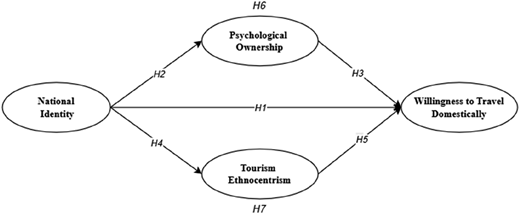
A resident's national identity positively influences their willingness to travel domestically.
Psychological ownership
PO, which is frequently expressed by the sentiment “mine,” is an emotional condition in which a person believes they own a certain object (Park and Kim, 2025). The sense that something “is mine” is known as PO, and it is necessary to respond to the basic query, “What do I own?” Ownership sentiments appear in a variety of circumstances and entities (Rao and Leonhardt, 2025). Ownership-related attitudes and actions permeate every aspect of our lives and have been researched in a variety of fields, including management, marketing, psychology and biology (Rao and Leonhardt, 2025). Three basic human needs are the foundation of PO: self-identity (the desire to create and preserve one's self-concept), efficacy and effectence (the need to influence or start change) and having a place (the need for belonging) (Chung, 2025; Pierce and Jussila, 2011). PO requires a feeling of social identity, where individuals regard themselves as part of a group (Chung, 2025).
PO is a state that is by essence possessive, where a person believes that a tangible or intangible item is “mine” or “ours” (Pierce et al., 2001). PO's “target object” can range from a single seat to an tourist destination or entire nation (Kumar and Nayak, 2019). The idea of PO in this paper relates to the degree to which individuals believe that their nation is theirs or their internal group's (Brylka et al., 2015). Self-concept, which originates from a person's feelings of belonging to a social group, is strongly linked to PO (Tajfel and Turner, 1986). A person's self-concept may grow as a result of identifying with an object and seeing it as an extension of themselves (Qu et al., 2021). There is proof that a person's self-concept can encompass locations or destinations (Belk, 1988). Additionally, research on tourism has shown that destination identification can strengthen travellers' emotional bond with a place, which in turn influences travellers' perceptions of that place (Kumar and Nayak, 2019). When a person views themselves as a part of a nation, their PO towards that nation develops (Brylka et al., 2015). The drive to show one's identity and maintain a strong sense of self via possessions is the root cause of ownership feelings (Park and Kim, 2025). In their study Qu et al. (2021) found that tourists' sense of national identity positively impact their PO. Moreover, Amani (2022) found that identification positively correlates with destination PO. Thus:
A resident's national identity positively influences their psychological ownership towards the nation.
PO affects perceptions and behaviours by instilling a sense of connection between the target and oneself (Yoon et al., 2025). Numerous studies have focused on PO a significant predictor of people's attitudes and behaviours (Farzinfar et al., 2024). Recently, Gupta and Singh (2025) found that PO positively effect residents destination advocacy behaviour. The literature study indicates that research on PO in management has primarily concentrated on internal organisational areas, with limited focus on consumers, notably tourists (Farzinfar et al., 2024). Moreover, travellers' PO of a place might affect their civilised tourism behaviour (Qu et al., 2021), citizenship behaviour (Singh and Gupta, 2025; Zhang and Xu, 2019) and higher willingness to return and recommend (Kumar and Nayak, 2019). Thus:
A resident's psychological ownership towards the nation positively influences their willingness to travel domestically.
Tourism ethnocentrism
The original conceptualization of consumer ethnocentrism and the development of the CETSCALE by Shimp and Sharma (1987) highlight that ethnocentric tendencies may also involve out-group bias and resistance toward foreign alternatives. In the tourism domain, Kock et al. (2019) adapted the construct to capture tourism specific ethnocentrism, emphasizing its motivational role in domestic travel decisions. However, acknowledging both its constructive and restrictive dimensions provides a more theoretically balanced understanding. The present study positions TE not merely as a positive force but as a psychologically embedded mechanism influencing domestic travel intention through identity based processes.
Ethnocentrism, which has been characterised as a prescriptive belief coupled with sentiments of duty to support the home tourism sector, has recently been used to the tourism industry (Lever et al., 2023; Rukiko and Amani, 2025; Todorović et al., 2024). Ethnocentrism, the idea in one's own culture's superiority, can drive tourists to favour experiences that are familiar, resulting in biassed perceptions of host cultures (Cucato et al., 2025). TE is an individual's belief and ethical responsibility to support their country's tourism business (Amani et al., 2025; Boukamba, 2020). From the standpoint of tourists, ethnocentrism is defined as “an individual's prescriptive beliefs and felt moral obligation to support the domestic tourism economy” (Kock et al., 2019). Tourists with strong ethnocentrism tend to seek domestic places or travel experiences that reflect their cultural values and customs (Cucato et al., 2025). TE encourages locals to support the domestic tourism economy by buying and using goods and services that come from their own places (Amani et al., 2025). Support for tourism has broadened to encompass TE, which holds that locals should actively participate in tourism as beneficiaries who directly engage in its activities, in addition to supporting it as hosts (Rukiko and Amani, 2025; Todorović et al., 2024).
National identification and TE are conceptually and empirically distinct from one another (Verlegh, 2007). The former relates to a person's overall sense of belonging to their country, whereas the latter is mainly focused on the sense of obligation and support to travel within one's place (Kock et al., 2019; Lever et al., 2023). In their study, Lever et al. (2023) found that national identity positively impacts their TE. Moreover, the findings of Amani (2025), suggests that destination identification significantly impacts TE. Thus:
A resident's national identity positively influences their tourism ethnocentrism.
Ethnocentrism is crucial for identifying tourism consumers, since it displays a preference for one's own culture and scepticism towards foreign cultures (Cucato et al., 2025). Tourism marketers can design their offers to appeal to consumers who value local authenticity and cultural familiarity, while also promoting national pride (Cucato et al., 2025). Within the framework of TE, locals' enthusiasm and love for the travel industry and the communities that rely on it fuel support for domestic travel (Lever et al., 2023; Rukiko and Amani, 2025). Recently, the results of Cucato et al. (2025) show that consumer ethnocentrism positively correlates with purchasing domestic tourism destinations. Further, Lever et al. (2023) found that residents' TE has a favourable impact on their destination advocacy. Moreover, Todorović et al. (2024) found that TE has a beneficial impact on willingness to travel domestically. Thus:
A resident's level of tourism ethnocentrism positively influences their willingness to travel domestically.
National identity creates a bond between individuals and their country (Qu et al., 2021). PO has been shown to affect people's attitudes and actions in a variety of situations. When people express an ideology that they think their country is better than other others, it is known as TE (Lever et al., 2023; Rukiko and Amani, 2025; Todorović et al., 2024). The results of Liu et al. (2021) shows that PO serves as a mediator between perceived justice and environmentally friendly behaviour intentions. The findings of Deng et al. (2020) shows that PO may influence tourist value co-creation and the perceived value of souvenirs. The findings of Lever et al. (2023) suggest that the TE mediated the connection between national identification and destination advocacy. The results of Amani (2025) shows that the association between destination identity and responsible behaviour is mediated by TE. Thus:
Psychological ownership mediates the relationship between national identity and willingness to travel domestically.
Tourism ethnocentrism mediates the relationship between national identity and willingness to travel domestically.
The proposed research model is shown in Figure 1.
Research methodology
Methods
The constructs used in the present study were modified from earlier research. We created a formal scale by rephrasing and modifying some items to make them more relevant to the Indian context. Every item was rated on a 5-point Likert scale, with 1 denoting “strongly disagree” and 5 denoting “strongly agree.” To evaluate national identity and PO, three items were extracted for each from Qu et al. (2021). TE measured using four items taken from Lever et al. (2023). Willingness to travel domestically was assessed using four items adapted from Todorović et al. (2024). There were two primary sections of the questionnaire. While the first section focused on gathering demographic information from the participants, the second section examined a wide range of essential to the national identity, PO, TE and willingness to travel domestically. A working group of two research scholars and two faculty members examined and pilot tested the questionnaire. The final version of the questionnaire was a little amended in response to their recommendations.
This study follows all applicable national and international ethical standards and regulations for investigations involving human participants. No personally identifiable information was taken; just demographic information (age, gender, education, country of birth and trips within India in the last six months) were obtained. In relation to our institutions' policies, this kind of survey-based, non-invasive, anonymised research does not require ethics committee permission. Participants were promised that their responses would be kept strictly secret and used only for research purposes.
Sample
India and Indian residents were chosen as the study population and environment due to the significance of domestic tourism, their preference for India as a travel destination and the author's knowledge with the nation. For the present study Google Forms was used to create an online survey, because it allows for quick and affordable data gathering from a wide range of Indian residents with high internet penetration. Online survey ensures anonymity, which reduces social desirability bias in sensitive constructs like national identity, PO and TE. As the study incorporates numerous attitudinal measures that require a large sample, online surveying offers adequate reach, data accuracy and respondent convenience. After the screening questions about nation of residence and age (must be Indian residents aged 18 or older), eligible participants were briefed on the purpose of the study and requested to consent to participate. Data collection began in February 2025 and lasted until mid May 2025. A total of 850 residents were reached, and 465 agreed to participate. After filtering the data, we kept 427 replies for the final analysis, excluding incomplete responses. Descriptive evaluations show that 44.03% of the responses were women and 55.97% were men (see Table 1).
Demographic characteristics of the respondents (n = 427)
| Characteristics | Frequency | % |
|---|---|---|
| Gender | ||
| Male | 239 | 55.97 |
| Female | 188 | 44.03 |
| Age between | ||
| 18 and 30 | 196 | 45.91 |
| 31 and 40 | 167 | 39.11 |
| 41 and 50 | 64 | 14.98 |
| 51 and 60 | – | – |
| Education | ||
| Undergraduate | 60 | 14.05 |
| Graduate | 211 | 49.41 |
| Post-graduate and above | 156 | 36.54 |
| Country of birth | ||
| India | 427 | 100 |
| Trips within India (past 6 months) | ||
| None | 29 | 6.79 |
| 1 | 92 | 21.54 |
| 2–3 | 167 | 39.11 |
| 4–5 | 102 | 23.88 |
| More than 5 | 37 | 8.68 |
| Total | 427 | 100 |
Data analysis
Partial least squares structural equation modelling (PLS-SEM), a powerful statistical tool for social sciences, has been widely used in tourism research (Hair et al., 2017). Unlike covariance-based SEM (CB-SEM), which primarily focuses on model fit and theory confirmation, PLS-SEM is particularly appropriate when the objective is to maximize the explained variance of endogenous constructs and examine predictive relationships (Hair et al., 2017). PLS-SEM analysis combined factor analysis and using regression to look for correlations between latent factors simultaneously. This study expands the national identity scale in a novel context, which is a strong reason to embrace the approach (Hair et al., 2011). PLS-SEM was chosen for its capacity for performing complex modelling, prediction and mediation impacts (Le and Sutrisna, 2024). Because of these characteristics, PLS-SEM is particularly helpful for researchers in the realm of tourism and can be more effectively employed as a research instrument by tourism scholars (Do Assaker and Valle, 2016).
Results
Measurement model
The measurement model describes the link among the latent variable and its indicators (Aburumman et al., 2025). During the data analysis phase, we looked at the three primary aspects. First, convergent validity measured through factor loading (FL) where all values above 0.7 or more and average variance extracted (AVE) where all values were more than 0.5 (Fornell and Larcker, 1981), see Table 2. Second, internal consistency was assessed via two tests – Cronbach's alpha (CA) and composite reliability (CR), where all the values above than 0.70 (Hew et al., 2018), see Table 3. Third, discriminant validity evaluated and the results meet the Fornell and Larcker (1981) standards see Table 4.
Measurement items (convergent validity)
| Constructs | Measurement items | Loadings | AVE |
|---|---|---|---|
| National identity (NID) | NID1 – I am very happy to be Indian | 0.925 | 0.761 |
| NID2 – If there's life after this, I would like to be Indian again | 0.886 | ||
| NID3 – No matter what happens in India, I will stay in India, even if there is a chance to leave | 0.801 | ||
| Psychological ownership (PO) | PO1 – India is my country | 0.947 | 0.806 |
| PO2 – India is our country | 0.920 | ||
| PO3 – I feel a very high degree of personal ownership for India | 0.822 | ||
| Tourism ethnocentrism (TE) | TE1 – Every time an Indian decides to spend their holiday in India, it makes India's future a little bit brighter | 0.873 | 0.754 |
| TE2 – Everyone should support the Indian economy by spending their holiday in India | 0.833 | ||
| TE3 – Indians should spend their holiday in India because this secures jobs in the Indian tourism industry | 0.906 | ||
| TE4 – Indians should feel a duty and responsibility to travel within India on national holidays | 0.858 | ||
| Willingness to travel domestically (WTD) | WTD1 – I intend to spend my holidays this year in an Indian destination | 0.937 | 0.858 |
| WTD2 – I will probably choose an Indian destination for my holidays this year | 0.939 | ||
| WTD3 – I am going to spend my holidays this year in India | 0.903 |
Note(s): All items are answered with 5-point Likert Scale. The scale used for each item measures “Strongly Disagree” to “Strongly Agree”
Internal consistency reliability
| Construct | Cronbach's alpha | Composite reliability |
|---|---|---|
| NID | 0.840 | 0.905 |
| PO | 0.878 | 0.926 |
| TE | 0.891 | 0.926 |
| WTD | 0.917 | 0.948 |
Note(s): NID: national identity; PO: psychological ownership; TE: tourism ethnocentrism; WTD: willingness to travel domestically
Discriminant validity
| NID | PO | TE | WTD | |
|---|---|---|---|---|
| NID | 0.872 | |||
| PO | 0.732 | 0.898 | ||
| TE | 0.680 | 0.643 | 0.868 | |
| WTD | 0.747 | 0.637 | 0.650 | 0.926 |
Note(s): NID: national identity; PO: psychological ownership; TE: tourism ethnocentrism; WTD: willingness to travel domestically
Structural model
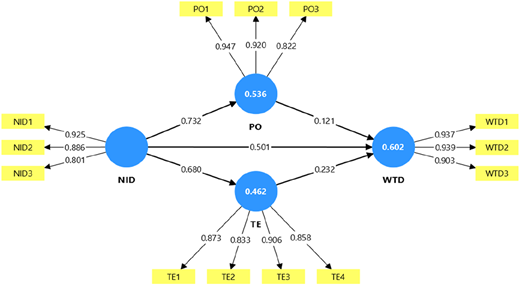
In this study coefficient of determination, R2, shows that the three exogenous constructs (national identity, PO and TE) represent 60.2% of the variance in residents willingness to travel domestically, as shown in Figure 2. Our results shows that national identity has a favourable impact on willingness to travel domestically with a path coefficient of (β = 0.501, p = 0.000), supports H1, which states that national identity has a favourable impact on willingness to travel domestically. The findings also support H2 with a path coefficient of (β = 0.732, p = 0.000), associations between national identity and PO. PO has an effect on willingness to travel domestically (β = 0.121, p = 0.030), confirming H3. Further, national identity has an effect on TE (β = 0.680, p = 0.000), supporting H4. Moreover, TE has an effect on willingness to travel domestically (β = 0.232, p = 0.000), confirming H5. Therefore, findings (see Table 5) show that all hypotheses were supported.
Results of the structural model
| Hypothesis | Path | Standardized path coefficient | p-values | Result | R-squared |
|---|---|---|---|---|---|
| H1 | NID → WTD | 0.501 | 0.000 | Supported | 0.602 |
| H2 | NID → PO | 0.732 | 0.000 | Supported | 0.536 |
| H3 | PO → WTD | 0.121 | 0.000 | Supported | |
| H4 | NID → TE | 0.680 | 0.000 | Supported | 0.462 |
| H5 | TE → WTD | 0.232 | 0.000 | Supported |
Note(s): NID: national identity; PO: psychological ownership; TE: tourism ethnocentrism; WTD: willingness to travel domestically
Mediation effect
The mediating effect of PO and TE on the connection between national identity and willingness to travel domestically was explored. The results (see Table 6) shows a significant indirect effect of national identity on willingness to travel domestically through PO (H6: β = 0.088, p = 0.029, 95% CI = [0.007, 0.164]), and TE (H7: β = 0.158, p = 0.000, 95% CI = [0.090, 0.233]). Hence, H6 and H7 were supported.
Discussion and conclusion
This study investigated how national identity affected residents willingness to travel domestically. The study demonstrates the importance of national identity in affecting people's preferences for domestic tourism. The findings show that when people identify themselves to their country, they are not only more likely to travel within it, but they also create two essential psychological mechanisms, PO and TE, which strengthen their willingness to travel domestically. The results showed that the primary determinants of willingness to travel domestically are PO and TE. They also partially fully mediated the association between national identity and willingness to travel domestically. There were three key conclusions from this study. First, willingness to travel domestically intention was positively affected by national identity. This strengthens the argument made by Qu et al. (2021) that a person's national identity might make them more attached to their nation and encourage them to prioritise national interests over their own (Feshbach, 1990); this may promote their willingness to travel domestically (Todorović et al., 2024). Therefore, people may become more conscious of the significance of visitors' willingness to travel domestically and preserving the national identity as a result of their in-group identity and affection for their country.
Second, national identity had a positive effect on PO, TE and willingness to travel domestically. National identity fosters PO, making people feel as if the country and its destinations individually belong to them, increasing their willingness to explore and encourage domestic travel. Similarly, a strong sense of national identity encourages TE, which pushes people to prioritise domestic travel because they see it as beneficial to their country's local communities, economy and culture. This suggests that when cultural symbols and values expressed by the national identity resonate with the general people, a strong sense of PO and TE emerges, which is consistent with earlier research (Lever et al., 2023; Qu et al., 2021). PO implies a sequential pathway in which a sense of “mine-ness” towards the country leads to stronger sentiments favouring domestic tourism. According to earlier research, a destination's PO may result from a sense of identity associated with it (Kumar and Nayak, 2019). Furthermore, while prior research has shown that TE influences individual willingness to travel domestically intention (Todorović et al., 2024), this is the first study to examine how national identity influences residents' intentions to engage in domestic travel.
Our study also demonstrated that residents were able to integrate their country into their self-concept when they had a positive emotional state and a sense of identity towards their own nation. Lastly, sustaining national identity and visitors' willingness to travel domestically may be significantly influenced by PO and TE. Tourists who view their nation as an extension of themselves could focus more on willingness to travel domestically. Strengthening national identity, establishing emotional belonging and spreading good narratives about supporting local tourism may significantly boost individuals' desire to travel domestically. The study shows that fostering a stronger psychological bond between residents and their country is just as important as developing infrastructure to promote domestic tourism.
Theoretical contributions
This study has several significant theoretical implications by expanding our knowledge of how national identity, PO and TE influence residents willingness to travel domestically. This research set out to determine the relationship between a resident's national identity and their willingness to travel within their home country, along with the mediating roles of PO and TE. Thinking of one's social identity and concept of place, this study explored the concept of national identity in relation to one's willingness to travel within the country, which has been overlooked in the past. Residents' willingness to travel within their own country is positively influenced by national identity, and this study further extends the existing body of knowledge. The model contributes to the literature on national identity by highlighting its multifaceted significance not only as a direct predictor of domestic travel intention, but also as a precursor of deeper psychological mechanisms such as PO and TE. This expands on current theoretical frameworks by establishing national identity as a fundamental motivator of residents' willingness to travel domestically.
Exploring the resident's emotional connection to their country as determined by their willingness to travel domestically on its behalf and encouraging others to explore its touristic offerings, this study contributes to social identity theory by expanding our understanding of national identity and its influence in a tourism context. This research expands on social identity theory by analysing roles and interactions within a community or country (Jones and Volpe, 2011). The study adds to the notion of PO in the travel industry by demonstrating that domestic tourism attitudes and actions are strongly influenced by sentiments of territorial “mine-ness” towards the country. Incorporating TE with residents willingness to travel domestically offers fresh perspectives on how moral preferences and value judgements combine with emotional connection to shape travel choices. The model enhances theoretical discourse by putting out a more comprehensive and integrated framework that encompasses the normative, cognitive and emotional aspects of domestic tourism behaviour.
Managerial implications
This study provides several meaningful insights for tourism policymakers, destination managers and marketing agencies. First, the strong influence of national identity on domestic travel intentions suggests that destination authorities should design campaigns that evoke national pride, cultural belongingness and emotional connection to the country's tourist destinations or heritage. It's important to align with national narratives (such as Dekho Apna Desh, Vikshit Bharat) can activate identity driven motivations to choose domestic destinations. Destination authorities may decide to publish more patriotic images (such as a waving flag, national anthem, etc) to strengthen people's commitment to national ideals because they are aware that higher national identity is associated with stronger willingness to travel domestically.
Second, the significant role of PO highlights the need for destination authorities to create participatory and community-focused initiatives that make residents feel responsible for and connected to destinations. Strategies such as resident's engagement programs, “adopt a heritage” projects and local stewardship activities can strengthen residents' sense that the country's destinations are “theirs.” When residents psychologically own a place they are more willing to travel with in the country. Third, the finding that TE enhances domestic travel behaviour suggests that promoting the economic and social benefits of supporting local tourism such as job creation, preservation of cultural assets and community development can positively shape residents' travel choices. Destination authorities can therefore emphasize how domestic travel contributes to the national economy, sustainable development and rural upliftment to increase domestic travel demand. Moreover, destination authorities can also using ethnocentric cues in messaging to encourage domestic travel. For instance, destination authorities can emphasize to locals the value of going domestically rather than outside. If authorities did well, this can take advantage of locals' ethnocentric views and aspirations to encourage others to travel within India.
Limitations and future research
Even though this study makes significant contributions, a number of limitations must be acknowledged to guide future research. First, the model mostly concentrates on psychological concepts like national identity, PO and TE, which might not adequately account for other significant factors that influence domestic travel behaviour, like social influence, economic constraints, destination image and safety perception. To provide a more thorough framework, future research should incorporate more variables. Second, because national identity, PO and ethnocentrism may function differently in different cultures, geographical areas or demographic groupings, the research is probably constrained by its contextual focus.
Therefore, comparative research conducted in many states or nations would support the validity of these findings' generalisability. Third, drawing conclusions about causality is limited by the model's cross-sectional design. Deeper understanding of the evolution of ethnocentrism and PO may be possible through longitudinal or experimental approaches. Fourth, the sample was taken from younger and relatively highly educated respondents, likely due to the use of online data collection through Google Forms. Therefore, future research should employ more diverse and stratified sampling approaches to enhance representativeness. Furthermore, social desirability bias may have an impact on the self-reported data used in this study, particularly when it comes to nationalism and patriotism. To obtain more nuanced insights, future study should take into account mixed methodologies, behavioural data or qualitative approaches.

