


Purpose
The investigation of organization's ambidextrous innovation is a challenge in the research studies of management sciences. As existent literature showed a positive relation between dynamic capability (DC) and innovation, few empirical studies are conducted to explain how DC impacts on the balanced and combined dimension of ambidexterity and still less on how social network moderates this relation. As a result, this paper aims to investigate and provide empirical evidence on DC’s influence on ambidexterity in the context of China.
Design/methodology/approach
By a relational model of DC, ambidextrous innovation and social network, this study has conducted multiple regression analysis on the data collected from 350 small and medium enterprises (SMEs) in mainland China.
Findings
The results show that, DC has positive influence on both the combined and balanced dimension of ambidexterity; and both the relational network and structural network play an inverted U moderating role, where the moderation of relational network is stronger than that of structural network.
Originality/value
This study provides empirical support on DC's influence on ambidexterity together with the moderation of social network.
1. Introduction
In the turbulent business environment nowadays, firms are obliged to engage in both exploratory and exploitative behavior to establish sustained competitive advantage, that is, organization's ambidextrous innovation. Danneels (2002) argues that there is both exploratory and exploitative innovation in the field of technological innovation. Meanwhile, these two types of innovation are of quite distinctive nature, where exploratory innovation seeks for completely new measures from current technology and practice, while exploitative innovation realizes gradual improvement based on current technology and practice. As a result, how to coordinate these two forms of innovation is becoming a research theme. Based on the approach of dynamic capabilities (DCs), Teece and others (Teece et al., 1997) consider that DC can not only allocate the resources in a valued manner to realize product innovation, but also can help firms to adapt to the changing competitive environment through flexible internal process by way of integrating and restructuring of both internal and external resources. However, the existent empirical studies have focused on DC's respective influence either on exploratory and exploitative innovation (Sheng, 2017), but very few on the joint influence of the two. Hence, it is of both academic and practical value to deepen our understanding of DC's influence on the balanced dimension and the combined dimension of ambidextrous innovation.
As innovation is a collective and societal behavior, firms need social network to acquire necessary resources, knowledge, ideas and information for innovation. In the business and research context of China, social network is often regarded as an informal “guanxi (relation)” network based on trust and reputation, where this “guanxi” is indispensable in innovation and technological development. So far, researchers opinions are rather divergent concerning social network’ influence on innovation. On one hand, the establishment of social network is an important strategy to acquire key technological knowledge to promote innovation (Ho et al., 2018). On the other hand, social network can also limit the innovation of its members, thus constraining innovative activities. And because of these, the influence of social network on innovation may not be effective in a linear manner, where when social network, at a medium level, may have the most positive influence on innovation, while the intensity and concentration of social network is intensified, the relative cost (the time, energy and other resources necessary for developing and maintaining the social network) may also increase, leading to the exhaustion of payoffs gained by increased cost and thus hindering further innovative activities (Wang et al., 2017). Taking into account the important influence of social network on innovation, this study supposes that social network can also play a significant moderating role in the DC-ambidextrous-innovation relation. Thus, the second objective of this study is to investigate how social network can moderate the DC-ambidextrous-innovation relation with empirical evidence.
Firms, small or big, are all faced with problems originated from the ambidextrous innovation. However, most of ambidextrous innovation studies have focused on larger corporations (Li et al., 2014). Existent studies have shown that, as small and medium enterprises (SMEs) are characteristically different from these big firms in terms of resource, management experiences, R&D input, etc. they will take different strategic approaches in terms of innovation, where SMEs are inclined to improve their performance by the balance of exploratory and exploitative innovation, while the larger corporations will lay emphasis on the combination of the two (Mcdermott and Prajogo, 2012). As the two types of firms are distinctive in terms of ambidextrous innovation, this study focuses on SMEs to understand how SMEs use their DC, together with their social network, to realize the balanced development and mutual promotion of both exploratory and exploitative innovation.
In summary, based on the existent contributions, and by building a moderated research model, this study aims to explore the functional mechanism of the influence of SMEs' DC on the balanced and combined dimension of ambidextrous innovation and also the moderation of social network on this. This is for the purpose of enriching and supporting the theories of DC and ambidextrous innovation and to provide guidance in how SME can use DC to break through the dilemma of ambidextrous innovation. And as the samples are all from the SMEs of mainland China, it is expected that this research can be of reference value for those SMEs in the emerging economies.
2. Theoretical foundation and research hypotheses
2.1 Ambidexterity, dynamic capability and the main effect of the two
Research studies have proven that exploration and exploitation are two types of innovation of quite distinct nature (Koryak et al., 2018), where they need specific context, organizational structure and background. The exploratory innovation is for the purpose to meet the needs of new customers' and markets by way of breaking away from current technology to innovate completely new product or service. For those firms engaging in exploratory innovation, they are often more flexible to adapt to the changing environment for success. The exploitative innovation, for its part, aims to meet current customer and market needs by way of utilizing and perfecting current available knowledge and techniques, improving current product or service, which will make the current production process more effective (Jansen et al., 2006). Some studies support this with the argument that, firms should simultaneously engage in both exploratory and exploitative innovation to establish sustained competitive advantage.
Cao and his colleagues (Cao et al., 2009) have provided a categorization of balanced dimension and combined dimension of ambidextrous innovation, where the balanced dimension signifies the relative balance of the two, while the combined dimension means that the exploratory innovation and exploitative innovation should mutually supplement and promote each other so as to make up deficiencies of each other and to amplify the value created by each one. The ideal status will then be that, the protocols developed through exploitative innovation can be integrated into those necessary for exploratory innovation and thus provide a resource base for exploitative innovation. In the same manner, high-level of exploitative innovation can effectively improve the new products developed through exploratory innovation, which will help its commercialization. However, because the two innovations have, by nature, different requirements in structure, process, strategy and ability, and this is rather challenging and demanding for SMEs, which are lack of resources and operational experiences to engage simultaneously in both of these two innovations (Kammerlander et al., 2015). As a result, it will be conditional that, SME could realize both the combined and balanced dimension of ambidextrous innovation.
Then, DC can be defined as firm's capability to integrate, construct and reallocate resources, assets and abilities to respond to (or bring about) market changes (Teece et al., 1997; Teece, 2017). It is also considered to be able to realize sustained innovation and change through integration and reallocation of resources (Teece, 2017). The existent studies have shown that, DC has positive influences on both exploratory and exploitative innovation (Jurksiene and Pundziene, 2018). In his review discussing the antecedents of ambidexterity, Asif et al. (2017) classified DC as one of the antecedents of ambidextrous innovation, arguing that DC can not only trigger, but also orchestrate ambidextrous innovation. In a case study, Carrick (2016) also demonstrated how life sciences firms can use DC to develop R&D resources.
In the extension of above studies and evidences, we think that DC has significant positive influence on SME's exploratory innovation and exploitative innovation as well, and it can also have positive influence on the balanced dimension and combined dimension of ambidextrous innovation. Following are our research hypotheses:
There is a positive relation between DC and the balanced dimension of ambidextrous innovation.
There is a positive relation between DC and the combined dimension of ambidextrous innovation.
2.2 Social network and its influence on the main effect
2.2.1 Social network
As an informal social structure (Mcevily et al., 2014), social network refers to the informal relation network between firms and their business partners, friends and relatives so as to make up the insufficiency of formal business interactions in promoting business exchanges. These network members can be government departments, supervision institutions, clients, suppliers, sales agents, mother companies, higher education institutions and research institutions (Ioanida et al., 2018). Their cooperation can be voluntary, non-contractual and very close. Social network can normally be divided into relational and structural types (Granovetter, 1992). Relational network emphasizes the relation quality among the network members, reflecting the high-quality cohesive informal social interaction of the network members of a certain organization. While the structural network places emphasis on the overall structure of the network, reflecting mainly the positional influence of the network members.
2.2.2 Relational network's influence on main effect
Relational network can often be measured in terms of relational intensity, i.e. the intensity of relation closeness of social network members (Villaverde et al., 2018). In our study, we suppose that the moderation of relational network on the DC-ambidextrous-innovation relation can be both positive and negative.
From the positive side, closer relational network can be helpful for SMEs' DC to promote ambidextrous innovation. The reasons are as the following: (1) an atmosphere of trust can enhance a firm's ability to sense and size the opportunities in the environment and can also reallocate its resource basis in a more effective manner (Fainshmidt and Frazier, 2016). Trust can also significantly upgrade the diffusion and flow of explicit knowledge as well as the more complicated implicit knowledge, so that firms can continuously acquire the abilities to obtain, integrate and reallocate resources, and the speed of resource transformation can also be accelerated with the mutual trust and frequent interaction among the network members. (2) Close network can control, at a certain level, the behavior of the network members, which will reduce the threats of opportunism (Rivera et al., 2010). To avoid risks, SMEs are more inclined to engage in exploitative innovation, and this is because the exploitative innovation is often characterized as with high risk and market uncertainty, where decision-making errors will lead to immediate failure or survival crisis. However, once the network members establish solid relationships, this can reduce the risks of opportunism-related risks. From this, it can be relatively easier for SMEs to control their coordination relationship with each other and thus the risks and costs together. From our prospective, under the same level promotion of DC, high-quality relational network can reduce the risks of exploratory innovation and thus realize the balanced development of both exploratory and exploitative innovation in SMEs. And at the same time, the upgrading of exploratory innovation can provide a larger vision for exploitative innovation and thus in turn helps to realize the combined dimension of ambidextrous innovation.
From the negative side, closer relational network may also negate the positive effect of DC on both the combined and balanced dimension of ambidextrous innovation. The reasons are as the following: (1) the information and resources obtained from too frequent interactions can be repetitive and redundant (Granovetter, 1973). For some scholars, the combined effectiveness of resources has its upper limit. Then, if the firms integrated and reallocate those repetitive and redundant information, the values created on innovation can thus be very limited and even disappear. And except those extra costs caused by identifying and sorting out redundancy, this also occupies the resources for exploratory innovation, which will make it harder to realize the balanced dimension and combined dimension. (2) The establishment and maintenance of relations with the network members creates also costs (Eitan and Renana, 2018). Over time, it will consume more of SMEs' limited time and energy to amend and enforce this interaction mode, thus exhausting the firm's time and energy to integrate or experiment more innovative ideas, which will eventually constrain innovative activities in this firm. (3) A too close relation will result in rigidity of the network (Villena et al., 2011). Often, the more solid relationship of the network member is, the stronger the conformist mentality will be. And this will limit the members to seek heterogenous resources necessary for innovation and also will limit such innovative activities as environment scanning, problem-identifying and innovative problem-solving (Wang et al., 2017).
From the synthesis of the above two contradictory influences, we suppose that, if the closeness of relational network is under the critical value, it will reinforce DC's promotion in SMEs of balanced dimension and combined dimension of ambidextrous innovation; and with the closeness of relational network reaches and surpasses the critical value, the moderate effect of relational network will be reverted to reduce such promotion. The research hypotheses are as the following:
Relational network plays an inverted U moderation role in the DC-balanced-dimension relation.
Relational network plays an inverted U moderation role in the DC-combined-dimension relation.
2.2.3 Structural network's influence on main effect
It is suggested by scholars that structural network is for the purpose of observing the location and distribution of information flows in the network (Gulati, 1998), and while a firm is in an ideal position, it can obtain more diversified and richer information. In this study, the meaning of the structural network is mainly its “location”, which include, the distance and speed that this firm can obtain resources and the influence of this firm has on other members of the network. In the same manner, we think that, the moderation of structural network on the relation of DC and the balanced dimension and the combined dimension of ambidextrous innovation, can be both positive and negative.
From the positive side, those firms in the relative central position of the network may strengthen DC's influence on ambidextrous innovation. The reasons are as the following: (1) one of the strengths of the central firms is that they can obtain more resources and diversified knowledge from multiple partners (Zang, 2018). Those firms that are closer to the center can use less links to access other members of the network, where this distance advantage can help them to access a larger part of heterogenous resources of the network and can help them to master, in a more punctual manner, the changes of the industry in question. In this process, firms can continuously improve their ability to sense the environmental changes and can also help them to better give full play of their resource integration and transformation capabilities, which will eventually promote the ambidextrous innovation. (2) Those firms in a more central position can develop new, non-redundant network relations through their influences and can thus acquire new business opportunities and supplemental resources. In accordance with their rising central position, they are given higher criteria by other members of the network (Perry-Smith and Shalley, 2003), which will help them to fully absorb and reallocate the innovative factors obtained and thus to promote the development of ambidextrous innovation.
From the negative side, those firms situated too close to the center may reduce DC's influence on ambidextrous innovation. The reasons are as the following: (1) From a cognitive point of view, too many relations may reduce a firm's potential to absorb new things (Gilsing et al., 2008). In comparison to those firms not in the central positions, these firms must deal with a larger quantity of information coming from more diversified fields, where the information may come at a greater speed. With the increasing number of these diversified informations, SMEs may have difficulty in absorbing and integrating innovative factors thus obtained, which will certainly reduce the positive influence of DC on ambidextrous innovation. (2) The centrality that surpasses the appropriate level may signify more conflicting views or redundancy (Ruiz-Ortega et al., 2018). The too central position may receive more conflicting views, which will in turn bring about more pressures that constrains creativity. Furthermore, the central position, too much, will also cause the burden of the increased redundant information and resources, where the innovative factors, if too repetitive, will reduce the marginal benefit of innovation (Mcevily et al., 2014).
From these conflicting influences, we suppose that, if a firm's central position in the structural network is inferior to the critical value, this will enhance DC's promotion of the balanced dimension and the combined dimension of ambidextrous innovation; and if its central position in the structural network reaches and surpasses the critical value, the moderation of the structural network will be inverted, reducing such correlation. The research hypotheses are as the following.
Structural network plays an inverted U moderation role in the DC-balanced-dimension relation.
Structural network plays an inverted U moderation role in the DC-combined-dimension relation.
By synthesizing all the above hypotheses, the theoretical model of this study is drawn as Figure 1.
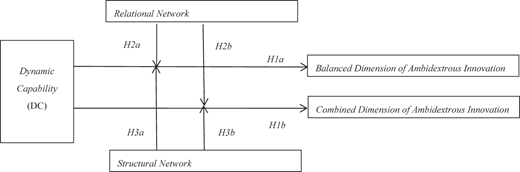
Relational model of dynamic capabilities, ambidextrous innovation and social network
Relational model of dynamic capabilities, ambidextrous innovation and social network
3. Research design
3.1 Sample and data
As this study focuses on the ambidextrous innovation in SMEs, the research has selected its sample in line with Rules of SME Classification published in 2011 in mainland China, which is composed of the following 8 industries, where the firms total annual operating revenues (RMB) are between: (1) agriculture, 0.5–200 million; (2) industry, 3–400 million; (3) construction and real estate, 3–800 million; (4) wholesale and retailing, 1–400 million; (5) transport and logistics, 2–300 million; (6) hotel and restaurant, 1–100 million; (7) software and IT, 0.5–100 million; and (8) all the other industries where the number of employees is between 10 and 300.
A questionnaire has been used to collect data. The sample list has been drawn with the help of alumni and students of a national key university's MBA programs. A total of 500 copies have been sent, and 384 have been collected. By a still more careful selection, 34 questionnaires not from SMEs have been eliminated, and the final valid sample consists of 350 questionnaire answers. Before the final survey, 5 SMEs have been chosen to conduct an initial test, where their feedback has been used to realize corrections in the questionnaire, rending the questionnaire more adapted to the context of the current study. The final sample has included 3 regions of China, east, west and south. And 51% of the correspondents are executives, and 49% are middle-level managers. The sample characteristics are provided in Table 1.
Sample characteristics (N = 350)
| Characteristics | No(%) | ||
|---|---|---|---|
| # of employees | <10 | 46 | 13.1% |
| 10–100 | 203 | 58.0% | |
| 100–300 | 78 | 22.3% | |
| >300 | 23 | 6.6% | |
| Type of business | State-owned enterprise | 31 | 8.9% |
| Collectively-owned enterprise | 3 | 0.9% | |
| Private enterprise | 266 | 76.0% | |
| Joint-venture enterprise | 6 | 1.7% | |
| Hong Kong-Macao-Taiwan invested enterprises | 4 | 1.1% | |
| Foreign enterprises | 17 | 4.9% | |
| Other types | 23 | 6.6% | |
| Firm age | <3 | 48 | 13.7% |
| 3–8 | 138 | 39.4% | |
| 9–15 | 105 | 30.0% | |
| >16 | 59 | 16.9% | |
| Total | 350 | 100 | |
3.2 Measurement
The measurements of DC, ambidextrous innovation and social network have all been conducted with mature instruments, where a 7-point Likert scale has been utilized. 1–7 signify respectively “total noncompliance” and “full compliance”. All the instruments have undergone minor adjustments for readability after the initial test survey.
Dynamic capability (DC): It is accepted to include 3 dimensions of sensing, seizing and re-configuring opportunities. The measurement of DC in this study has taken into account the contributions of Teece (Shuen et al., 2014). Each dimension includes finally 5 items, with 15 items in all.
Ambidextrous innovation: The measurement of exploratory innovation and exploitative innovation have utilized the instrument developed by Jansen (Jansen et al., 2006), where, in line with SMEs characteristics, some items have been eliminated. And each of them has 6 items, with 12 items for ambidextrous innovation.
The balanced dimension and combined dimension of ambidextrous innovation is evaluated in term of level, where the combined dimension is calculated by the product of the two, in line with the paper of He and Wong (2004), and the balanced dimension is assessed by formula 1−|x−y|/(x + y) proposed by Wang and others (Wang et al., 2012).
Social network: In accordance with Granovetter's classification of firms' network into two types of relational network and structural network, we have chosen the following instruments. The relational network is constructed through the studies of Kale et al. (2000) with 5 items in all. And the structural network is developed by taking the reference of Eisingerich et al. (2010), also with 5 items in all.
Control variables: In this study, such variables having major impact of SMEs' ambidextrous innovation have been chosen as control variables, which are firm size and firm age. In line with the general practice, the number of employees and the age of firm have been, respectively, used to evaluate these two control variables.
3.3 Validity
First, this study has conducted validity analysis on all the measurements by SPSS25.0. The Cronbach’ α coefficients of DC, exploratory innovation, exploitative innovation, structural network and relational network are respectively 0.960, 0.852, 0.854, 0.880 and 0.827, and the total coefficient is 0.944, all superior to 0.7, showing that the measurements have good validity.
Second, by Lisrel 8.70, a confirmatory factor analysis (CFA) has been realized, where KMO value is 0.956 >0.7, Sig of Bartlett is 0.000. The in the test of CFA, five indexes of , SRMR, CFI, TLI and RMSEA have been assessed, where only the fitting indexes of the five-factor model reached the recommended values and the model fitting degree of the combined variables all decreased to different degrees. This has shown the measurements have good discrimination validity (Table 2).
Fit indices for measurement models
| CFA models | χ2 | df | χ2/df | SRMR | CFI | TLI | RMSEA |
|---|---|---|---|---|---|---|---|
| Five-factor model | 1036.57 | 619 | 1.67 | 0.046 | 0.99 | 0.99 | 0.044 |
| Four-factor modela | 1152.04 | 623 | 1.84 | 0.049 | 0.98 | 0.98 | 0.049 |
| Four-factor modelb | 1179.07 | 623 | 1.89 | 0.048 | 0.98 | 0.98 | 0.051 |
| Three-factor model | 2303.39 | 626 | 3.68 | 0.065 | 0.97 | 0.97 | 0.088 |
| Two-factor model | 2446.17 | 628 | 3.90 | 0.066 | 0.97 | 0.96 | 0.091 |
| One-factor model | 5854.45 | 629 | 9.30 | 0.13 | 0.92 | 0.92 | 0.15 |
Note(s): Five-Factor Model: Dynamic capability, exploratory innovation, exploitative innovation, relational network, structural network; Four-Factor Modela: Dynamic capability, exploratory innovation + exploitative innovation, relational network, structural network; Four-Factor Modelb: Dynamic capability, exploration innovation, exploitative innovation, relationship network + structure network; Three-Factor Model: Dynamic capability + exploration innovation + exploitative innovation, relational network, structural network; Two-Factor Model: Dynamic capability + exploratory innovation + exploitative innovation, relational network + structural network; One-Factor Model: dynamic capability + exploratory innovation + exploitative innovation + relational network + structural network
We also examined the average variance extracted (AVE) for each construct. The AVE values of DC (0.617), exploratory innovation (0.492), exploitative innovation (0.501), relational network (0.601) and structural network (0.490) are within the acceptable range. The convergent validity, therefore, held.
3.4 Common method bias
When all the items of the questionnaire have been answered by one individual correspondent, due to individual tendency, the correspondent may maintain identical answers to all the similar questions. To test this common method bias, the Harman single factor analysis has been applied in this study. The results show that, in the non-rotated condition, 5 factors have been extracted, and the first factor variance contribution is 37.4%<40%. The results of CFA of one factor further show that the model fit in a one-factor model is poor (χ2 = 5854.45, df = 629, χ2/df = 9.30, SRMR = 0.13, CFI = 0.92, TLI = 0.92, RMSEA = 0.15). This provides the evidence that this study has no serious concern of common method bias.
4. Empirical analysis
4.1 Descriptive and correlation analysis
Table 3 summarizes the mean, standard deviation and correlation coefficients of each factor. As illustrated in Table 3, DC is shown in significant positive correlation with the combined dimension (r = 0.671, p < 0.01) and the balanced dimension of ambidextrous innovation (r = 0.128, p < 0.05). It can be deduced that our model has relatively good rationality. And the results can undergo further tests.
Descriptive analysis and correlation coefficients
| Variable | Mean | SD | 1 | 2 | 5 | 6 | 7 | 8 | 9 | 10 | 11 |
|---|---|---|---|---|---|---|---|---|---|---|---|
| 1. Size | 2.22 | 0.75 | 1 | ||||||||
| 2. Age | 2.50 | 0.93 | 0.425** | 1 | |||||||
| 3. DC | 4.52 | 1.21 | 0.024 | −0.035 | 1 | ||||||
| 4. Exploratory innovation | 4.08 | 1.34 | 0.048 | −0.010 | 0.717** | 1 | |||||
| 5. Exploitative innovation | 3.76 | 1.32 | −0.020 | −0.012 | 0.613** | 0.725** | 1 | ||||
| 6. Combined dimension | 16.62 | 9.26 | −0.020 | −0.009 | 0.671** | 0.899** | 0.925** | 1 | |||
| 7. Balanced dimension | 0.89 | 0.10 | −0.034 | 0.011 | 0.128* | 0.089 | 0.373** | 0.304** | 1 | ||
| 8. Relational network | 3.76 | 1.26 | −0.005 | 0.050 | 0.170** | 0.111* | 0.079 | 0.126* | 0.008 | 1 | |
| 9. Structural network | 3.81 | 1.27 | 0.060 | 0.073 | 0.147** | 0.116** | 0.108* | 0.148** | 0.056 | 0.681** | 1 |
Note(s): *, ** and *** represent respectively p < 0.05, p < 0.01 and p < 0.001, the following tables are the same
4.2 Multiple regression analysis
SPSS25.0 has been utilized to conduct multiple regression analysis to test the relation between DC, ambidextrous innovation and social network. To reduce the issue of high-correlation of interaction item with its constituting variables, the independent and moderation variables have been centralized.
Data show the positive relation of DC with exploratory innovation and exploitative innovation, and as this has been in line with the existent research studies, this will not be further discussed. The regression results have also confirmed the positive influence of DC on the combined dimension and balanced dimension of ambidextrous innovation. From the model 2a of Table 4, and model 2 b from Table 5, it can be observed that DC has positive influence on both the balanced dimension (β = 0.011, p < 0.05) and combined dimension (β = 5.140, p < 0.001). Hence hypotheses H1a and H1b are supported in our study.
Regression of DC and combined dimension of ambidextrous innovation
| 1a | 2a | 3a | 4a | 5a | 6a | 7a | |
|---|---|---|---|---|---|---|---|
| 1. Control variable | |||||||
| Size | 0.094 | −0.230 | −0.227 | −0.280 | −0.252 | −0.21 | −0.302 |
| Age | −0.051 | 0.271 | 0.268 | 0.156 | 0.237 | 0.234 | 0.172 |
| 2. Independent variable | |||||||
| DC | 5.075*** | 5.076*** | 8.335*** | 5.035*** | 8.638*** | 8.847*** | |
| 3. Moderation variable | |||||||
| Relational network (RN) | 0.015 | 0.530 | 0.855* | ||||
| Structural network (STN) | 0.288 | 0.840*** | 0.093 | ||||
| RN2 | 0.401* | 0.05 | |||||
| STN2 | 0.389* | 0.292 | |||||
| 4. Interaction items | |||||||
| DC × RN | 0.124 | 0.088 | 0.133 | ||||
| DC × STN | 0.162 | 0.027 | 0.042 | ||||
| DC × RN2 | −0.391*** | −0.801** | |||||
| DC × STN2 | −0.555*** | −0.840** | |||||
| F | 0.089 | 48.429** | 41.49*** | 57.633*** | 41.787*** | 60.085*** | 43.653*** |
| R2 | 0.023 | 0.459 | 0.459 | 0.604 | 0.461 | 0.614 | 0.628 |
| AR2 | 0.012 | 0.451 | 0.448 | 0.594 | 0.450 | 0.604 | 0.614 |
| ΔR2 | 0.436 | 0.000 | 0.145 | 0.002 | 0.153 | 0.014 | |
Note(s): *, ** and *** represent respectively p < 0.05, p < 0.01 and p < 0.001
Regression results of DC and balanced dimension of ambidextrous innovation
| 1a | 2a | 3a | 4a | 6a | 7a | 8a | |
|---|---|---|---|---|---|---|---|
| 1. Control variable | |||||||
| Size | −0.006 | −0.007 | −0.007 | −0.006 | −0.007 | −0.008 | −0.007 |
| Age | 0.001 | 0.002 | 0.002 | −0.003 | 0.002 | 0.001 | −0.002 |
| 2. Independent variable | |||||||
| DC | 0.012** | 0.012** | 0.045*** | 0.011* | 0.046*** | 0.050*** | |
| 3. Moderation variable | |||||||
| Relational network (RN) | 0.000 | 0.005 | −0.001 | ||||
| Structural network (STN) | 0.005 | 0.009* | 0.012* | ||||
| RN2 | −0.015*** | −0.011** | |||||
| STN2 | −0.012*** | −0.006 | |||||
| 4. Interaction item | |||||||
| DC × RN | 0.000 | 0.004 | 0.003 | ||||
| DC × STN | 0.000 | 0.002 | 0.002 | ||||
| DC × RN2 | −0.015*** | −0.010** | |||||
| DC × STN2 | −0.016*** | −0.008* | |||||
| F | 1.526 | 2.658* | 1.888 | 11.450*** | 2.055* | 10.972*** | 9.605*** |
| R2 | 0.017 | 0.037 | 0.037 | 0.233 | 0.040 | 0.225 | 0.271 |
| AR2 | 0.006 | 0.023 | 0.018 | 0.212 | 0.021 | 0.205 | 0.243 |
| ΔR2 | 0.02 | 0.000 | 0.196 | 0.003 | 0.02 | 0.046 | |
Note(s): *, ** and *** represent respectively p < 0.05, p < 0.01 and p < 0.001
Consequently, in models 4a and 6a, by way of non-linear moderation, the squared items and their second-order interactions of relational network and structural network have been analyzed for the inverted U moderation. As shown in model 7a, hypotheses H2a and H3a have been supported, where relational network (β = −0.821, p < 0.001) and structural network (β = −0.814, p < 0.001) have been proven to have an inverted U moderation on the positive influence of DC on the combined dimension of ambidextrous innovation, which is, with an appropriate social network level, the SME's DC have a significant positive impact on the combined dimension of ambidextrous innovation, and while social network level has passed the threshold, the influence of DCs on the combined dimension will decrease and even turn to negative.
The regression results of DC, relational network and balanced dimension of ambidextrous innovation are shown in Table 5. As shown in model 7 b, the interaction items of “DC × Relational network” and “DC × Structural network” are not significant (p > 0.05), non-linear moderation has been analyzed. As the interaction item of squared independent variable and relational network (β = −0.01, p < 0.01) and structural network (β = −0.008, p < 0.05) are all significant, H2b and H3b have been supported, i.e. relational network and structural network all play an inverted U moderation on the positive influence of DC on the balanced dimension of ambidextrous innovation. In other words, with an appropriate social network level, the SME's DCs have a significant positive impact on the balanced dimension of ambidextrous innovation, and while social network level has passed the threshold, the influence of DCs on the balanced dimension will decrease and then turn to negative.
To better illustrate the positive moderation of social network on the DC-ambidextrous-innovation relation, in a more readable manner, this study has drawn slope analysis charts, where the abscissa represents the level of social network, while the ordinate represents the regression coefficients of DC on ambidextrous innovation. Figure 2 is the slope change chart of relational network and structural network on the combined dimension of DC-ambidextrous-innovation relation, and Figure 3 is the slope of relational network and structural network on the balanced dimension of DC-ambidextrous-innovation relation. As shown in Figures 2 and 3, within the critical point range, DC's positive relation with ambidextrous innovation is shown in an uptrend, but once surpasses the critical point, this positive relation is then in a down trend and even have negative influence. At the same time, it can be observed that, the moderation slope of relational network is situated above the structural network, which signifies that, under the moderation of relational network, DC's positive influence on ambidextrous innovation is stronger than that of structural network, and that relational network has more moderation space than that of structural network.
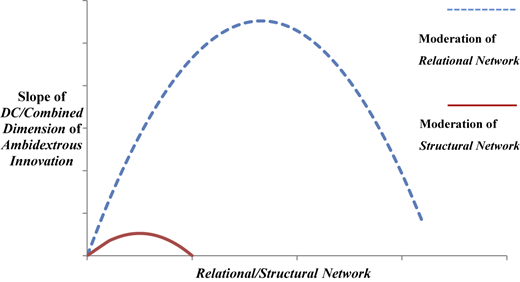
Social network's moderation slope of DC-ambidextrous-innovation (combined dimension)
Social network's moderation slope of DC-ambidextrous-innovation (combined dimension)
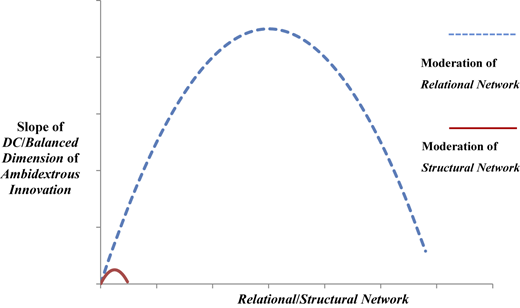
Social network's moderation slope of DC-ambidextrous-innovation (balanced dimension)
Social network's moderation slope of DC-ambidextrous-innovation (balanced dimension)
5. Discussion
Taking the SMEs as study object, this study has constructed an effect model of DC and ambidextrous innovation, has discussed the moderation of social network on this relation and has tested the functional mechanism of variables through multiple regression. The research results show that:
DC is in significant positive relation with both the balanced and combined dimension of ambidextrous innovation;
The two dimensions of social network, i.e. relational network and structural network all have an inverted U moderation on the correlation between DC and ambidextrous innovation, that is to say, when SMEs are embedded, at a certain level, in the relational and structural network, the intensity of these networks may enforce the positive relation between DC and ambidextrous innovation, and once the embeddedness of the relational and structural network has passed the critical value, the increasing intensity of the two network will reduce DC's positive influence on ambidextrous innovation;
Relational network has a stronger moderation than that of structural network on the DC-ambidextrous-innovation relation, and relational network has a larger moderation space than that of structural network.
5.1 Theoretical implications
The study has deepened the DC-ambidexterity research studies by offering new evidence of DC's benefits to both the balanced and combined dimension of ambidextrous innovation and also providing new micro basis for DC's improvements on organizational performance.
Although the existent research studies have reached certain consensus on DC's contribution to the establishment of balance mechanism on ambidextrous innovation, but subsequent empirical studies on ambidexterity has two limitations. First, these studies have deviated from basic ideas of Teece, i.e. DC is the superpower to guide practice and generalize competence (Teece and Leih, 2016). What distinguishes DC from other generic capabilities is that, those firms with DC can flexibly coordinate and regroup those resource/asset and business activities, while reducing, to minimum, the cost of ambidextrous innovation, and balancing, at top management level, ambidextrous innovation and efficiency. However, some scholars have identified DC itself as ambidextrous innovation (Kriz et al., 2014), considering ambidexterity as a dimension of DC. This confusion is not helping the construction and deepening of the current theory system. Second, the existent studies have been limited themselves on the specific innovation types, which is lack of integrated consideration on the balanced or supplemental mechanism of both exploratory and exploitative innovation (Raisch et al., 2009).
This study has developed its model in the logic of competence (DC) guiding conduct (ambidextrous innovation), has returned to the very essence of Teece's definition of DC and has thus proven that, DC can guide and promote the flexible adjustments and reconfiguration as well as resources necessary for both exploratory innovation and exploitative innovation, reaching the balance of and pushing the joint development of the two.
The study has integrated DC, social network and ambidextrous innovation into one model, where by the two dimensions of social network (relational network and structural network) as the moderation of the main effect, the analysis and discussion has help to complete the relational model of DC and ambidextrous innovation.
The above theoretical and data analysis has demonstrated that, the introduction of social network, as an important external factor, into the relation of DC and ambidextrous innovation has significantly improved the effectiveness of the model. Not only the moderation of relational network and structural network on the balanced dimension and combined dimension of ambidextrous innovation are significant, and these moderations are also proven to be effective in an inverted U shape non-linear slope. This shows that both the positive and negative conditions of relational network and structural network should be discussed simultaneously; otherwise, the relative studies will lose its validity.
In the DC-ambidextrous-innovation model, as the moderation of relational network is stronger that of structural network, this has provided new approaches and evidence for the importance of relational network and structural network as external factors.
The slope comparison of Figures 2 and 3 have shown that, the U slope of structural network is more declined, indicating that the moderation of structural network is not continuous, while relational network has a stronger moderation and is more continued. The authors of this paper have not found other research conclusions and theories to explain this. This is expected to be explored in future studies. The initial explanation of this paper is that, as mainland China is a “guanxi” dominated society, and against this background, relational network involves mainly the mutual trust, knowledge and information exchange and intimate individual interaction, which are closely related to firms to acquire new knowledge and expand learning channels. And as the knowledge acquirement and extension of learning channels are helpful to the development of DC (He et al., 2018), they will also be beneficial to innovation. In this way, firms can harvest gains, punctually, from the establishment of relational network. Similarly, the damage to DC and the constrains of innovation caused by too complicated network and too much redundant information will also be remarkable.
This study has provided evidence that DC can help SMEs to overcome the path dependence on exploitative innovation, where they can also realize the balance and complementation of exploratory and exploitative innovation by engaging in exploratory innovation. This has further supported the application of DC theories in the context of SMEs' innovation management.
5.2 Managerial implications
The research conclusions of this study have some insights on SMEs' ambidextrous innovation.
DC theories can be used by SMEs to balance and coordinate their internal ambidexterity. As DC is regarded as a kind of high-level capability, which is superior to common managerial abilities, it can guide and control their behavior to upgrade their capability to confront environmental uncertainty. It can also be treated as a dynamic process to sense, seize and reconfigure opportunities as well as develop unique resources. If the mangers in SMEs can effectively utilize DC, they can be more sensitive to market opportunities, quicker to integrate external knowledge and to provide technical solutions, which will promote the exploratory innovation. And the business process formed in the exploratory innovation can be configured and upgraded to those routine procedures and internal knowledge system of exploitative innovation. Meanwhile, DC can also improve the quality of exploitative innovation, which will help to support exploratory innovation with procedures and protocols developed through exploitative innovation. And this will eventually help the balance and combination of exploratory and exploitative innovation.
SMEs should maintain an appropriate position in the social network. Their strategies should be avoiding the marginalization and as the center as well. On one hand, they should get closer to the center of social network to develop high-level cooperation and to acquire best practice, new and innovative ideas necessary for exploratory innovation; and on the other hand, they should keep clear of high structural embeddedness. They should systematically monitor the changes of their positional advantage and punctually upgrade the configuration information. These behaviors can help them to be aware of competence and position changes of other members of the network, and this will give them clearer idea of their position in the network and help them to better react to threats and uncertainties.
SMEs should maintain an appropriate level of connections with the members of the social network. For one thing, they should actively introduce new partners and reinforce their cooperation with informal relation with other firms, universities and research centers, the keeping of sound relation with them will help SMEs to enter larger and wider markets, to acquire sufficient key resources and to promote the exploratory innovation. For the other, too close social network will consume SMEs' limited time and energy to deal with redundancy, as with only limited competence, it will become difficult for them integrate these innovative factors into their internal system, which will then hinder innovation. As a result, SMEs should keep suitable relation with other members of the social network, but not with too much time and energy.
It is noteworthy that the impact of changes in SMEs' relational network on the DC-Ambidextrous-innovation relation will be more remarkable. In business practice, there will arise a dilemma of “guanxi”, the effective utilization of relational network will promote DC's coordination on ambidextrous innovation, while too complicated relational network will destroy or reduce this positive influence.
5.3 Further research and limitations
As this study has collected only cross-section data, the causal relation between DC and ambidextrous innovation will be limited. A further vertical study may provide more insights on the basic model. Future studies can be organized in a time-line, where mechanism of influence can be investigated for different periods. Besides, as this research has found remarkable differences of moderation in relational network and structural network and has explained this difference in the context of mainland China, will this difference be observed in different countries, cultures and contexts remain an interesting domain to explore more.
The authors of this paper would like to express their sincere thanks for the support of National Natural Science Foundation of China (Grant No. 71972094; Grant No. 71472078), for the valuable insights on an earlier presentation of this paper in Hawaii International Conference on System Sciences 2020 and for the useful comments and help from the anonymous viewers as well as editors of JSBED.

