


Purpose
This paper investigates the effect of entrepreneurial orientation (EO) on small- and medium-sized enterprises' (SMEs) access to credit. Starting with the idea that SMEs' strategy-making process, structures and behaviour can favour credit access, the authors also explore the moderating role of bank lending technologies in shaping this relationship.
Design/methodology/approach
This study relies on a unique survey of Austrian and Italian SMEs which contains detailed information on access to credit, EO dimensions, relationship lending and firm-level characteristics. The authors perform stepwise logistic regressions to assess whether EO interacts with SME's access to finance, and how relationship lending enhances this relationship.
Findings
Proactiveness, autonomy and competitive aggressiveness are important constructs for improving access to bank financing. Those dimensions became more important when a relationship bank is involved, suggesting a role for relationship lending in overcoming SMEs' opaqueness. In addition, relationship lending is crucial for innovative SMEs in overcoming credit denial rates.
Research limitations/implications
The small sample did not allow to analyse the effect of EO on discouraged borrowers. Furthermore, alternative measures of relationship lending (such as geographical proximity or the length of the relationship) and the share of credit granted by the relationship bank would have been interesting to further validate our results.
Practical implications
This study shows that EO dimensions and the type of lending technology are relevant for the financial success of SMEs. More precisely, the authors show that diversity within the banking system helps innovative, autonomous, proactive and competitive SMEs. These important pieces of soft information are injected into the final lending decision when a relationship bank is involved. The evidence suggests the need for SMEs to interact with local banks to fully exploit their EO posture.
Originality/value
To the authors' knowledge, this paper is the first attempt to analyse whether relationship lending can affect the EO–credit access relation.
1. Introduction
In this paper, we analyse whether bank lending technologies shape the effect of entrepreneurial orientation (EO, hereafter) on small- and medium-sized enterprises' (SMEs) access to credit.
It is widely recognized that SMEs face obstacles in accessing external financing due to their financial structure, asymmetric information problems, agency risk and limited availability of collateral (Stiglitz and Weiss, 1981). Imperfections in credit markets arises because of asymmetric information – i.e. the situation in which insiders (SMEs) are better informed about themselves than outsiders (banks, suppliers and investors, among others). Adverse selection and/or moral hazard may result as a consequence of information asymmetries. The first indicate, an ex ante situation in which lenders find difficulties to sort good borrowers from bad ones. While moral hazard indicates an ex-post situation in which firms take on a behaviour that is in contrast to the lender interest.
Banks use credit screening processes to obtain information about borrower's quality, which is indicated by a set of firm characteristics. Moreover, once the loan is granted banks exert costly monitoring to ensure that borrowers use properly their cash flows to repay the debt. However, insiders often have no incentive to provide information to outsiders and monitoring is costly for banks and strictly dependent on the lending technology adopted (Baas and Schrooten, 2006). Since information on SMEs is rare and costly, relationship lending is often considered as the most appropriate technique for collecting information on SMEs: the firm and the bank enter in a long-term relationship that allow the firm to access to credit (Berger et al., 2014; Carletti, 2004; Elsas and Krahnen, 1998; Howorth et al., 2003; Lehmann and Neuberger, 2001; Cosci et al., 2016; Cucculelli et al., 2019) and to obtain better loan conditions through the long relationship (Berger et al., 2014). In exchange the bank acquires soft information, which is constituted by non-numerical information (such as, for example, strategy, quality of managers or products and future business development) that do not appear in a purely financial statement analysis. Among the set of soft information that a bank can acquire, EO can play a crucial role. EO – i.e. a firm level strategical orientation towards many dimensions, such as, for example, proactiveness, aggressiveness and innovativeness – can be transmitted from firms to banks (Beltrame et al., 2019), leading to an improvement in credit access.
Starting from the idea that SMEs' strategic-making process, structures and behaviour can improve access to external bank financing, this paper explores whether this information is important for access to finance and how banks that use different lending technologies – transaction or relationship lending – can process and incorporate such kind of information in their credit decisions. More precisely, in this paper we tackle the question on how EO affects the probability of applying for bank credit and the outcome of the application: the probability of being credit rationed or denied; and whether the outcomes are influenced by the lending technology employed in the bank–firm relationship.
Previous empirical works have shown that EO has a positive direct effect (Fatoki, 2012) and an indirect effect through cash flows, profit and retained earnings (Aminu and Sharif, 2015) on access to credit. However, despite their compelling evidence, the relationship between EO access to finance deserves further investigation for at least three reasons.
First, in the banking literature, little space is devoted in analysing the type of soft information and how this can be incorporated in the lending decision process. Two relevant exceptions are the studies of Chen et al. (2015) and Cornée (2019). The former highlights the influence of some types of soft information, such as information on leadership and firms' customers, on firm credit default. Cornée (2019) specifically focuses on the quality of management and projects to explain default. However, despite the strict connection between EO and entrepreneurs' and managers' characteristics, previous works do not analyse EO dimensions as a type of soft information.
Second, from the management studies perspective, previous works (Aminu and Sharif, 2015; Fatoki, 2012; Ibrahim and Sharif, 2016; Sidek et al., 2016, 2019; Zampetakis et al., 2011) neglect to investigate the effect of EO dimension on specific borrower status (i.e. applicant, partial credit rationed and denied SMEs).
Third, although it has been highlighted that the combined effect of soft information and lending technology can be significant in the bank–firm relationship (Ferri et al., 2019), no conceptual and empirical work about credit access has been devoted to analysing how a relationship lending or a transaction lending style (Berger and Udell, 2006) can interact with each EO dimension.
To carry out the analysis, we make use of a questionnaire distributed among 328 north-eastern Italian and southern Austrian SMEs. The questionnaire contains detailed information on EO dimensions, access to finance, firm risk, performance and bank–firm relationships. Using questionnaire information on loan application demand and loan application results (credit constraints proxies), we estimate a stepwise logistic regression model using EO dimensions interacted with a relationship lending proxy.
The geographic area covered is the north-east of Italy (Friuli Venezia Giulia region) and southern Austria (Carinthia region). For the purpose of our analysis, the area represents an ideal laboratory for at least two reasons. First, bank lending is by far the most important type of debt for small business in the sample. Second, there is substantial heterogeneity in the banks' use of soft information. The area is covered by many local small banks that attach a higher weight, in lending decisions, to qualitative information and direct knowledge of the borrower. Together with small banks, dislocated branches of large banks also operate in this area by attaching higher weight, in lending decisions, to quantitative information [1] (Del Prete et al., 2017).
Our findings show that EO dimensions are important in bank–firm relationships. More precisely, proactiveness, autonomy and competitive aggressiveness reduce the probability of being credit rationed or credit denied, while innovativeness increase credit denial rates. In addition, we show that relationship lending allows banks to codify EO dimensions and incorporate such information into their lending decisions. In other words, relationship lending allows banks to overcome SME opaqueness and incorporate subjective information on EO dimensions into their credit relationships, leading to lower credit constraints.
Our results are important in two ways. First, access to finance is a significant factor in the performance of the economy, as financially constrained firms tend to lower investments and employment. Accordingly, in the paper we examine the extent to which EO dimensions reduce the probability of facing credit constraints. Second, the study contributes to the debate on the efficiency of relationship lending. In the last decade, hard information has played an increasingly important role in lending practices owing both to regulatory pressure and the intensive use of information technology. Here, we show how an important piece of soft information (EO construct) can be incorporated in lending relationships and mitigate the possible negative effects of credit constraints, constituting a valuable resource for banks and entrepreneurs in times of uncertainty.
2. Literature review and hypotheses development
2.1 EO and credit access
The concept of EO was originally defined by Miller (1983) as follows: “an entrepreneurial firm is one that engages in product-market innovation, undertakes somewhat risky ventures, and is first to come up with ‘proactive’ innovations, beating competitors to the punch”. The author suggested three dimensions to characterize and test EO: innovativeness, proactiveness and risk-taking. The dimensions of EO were further expanded by incorporating other important dimensions. In this paper, we rely on the EO dimensions defined in Lumpkin and Dess (1996) in which competitive aggressiveness and autonomy are added to the three original dimensions.
Most of the empirical studies are focused on the relationship between EO and firm performance, with only a few studies devoted their attention on how credit constraints have influence on the relationship. Zampetakis et al. (2011) and Fatoki (2012) find an indirect relationship between EO, and firm performance shaped by the availability of external financing: improved access to finance has a positive effect on the relationship between EO and performance.
A few studies have also analysed the effect of a particular dimension on credit constraints, finding mixed results. Sidek et al. (2016) find a positive effect of risk-taking and competitive aggressiveness on credit access, while innovativeness is not significant. On the contrary, Sidek et al. (2019) find that innovativeness and risk-taking are significant, while competitive aggressiveness is not. Focusing on innovative SMEs, Lee et al. (2015) shows that innovation could lead to higher credit constraints. Risk taking dimension can theoretically lead to difficulties in obtaining credit, since high-levered investments to seize new investment projects raises default risk (Linton, 2019; Khim and Kamal, 2020).
In this paper, we separately analyse the effect of each dimension of EO on firm loan demand and loan outcome and how the use of relationship lending technologies can interact inside the EO – external financing relationship. In the following subparagraphs, we formulate the underlying hypothesis on the effect of each of the five dimensions of EO defined in Lumpkin and Dess (1996) on access to finance.
2.1.1 Innovativeness
Innovativeness measure the firm's predisposition to introduce new products/services or new processes (Li et al., 2008) and go beyond the status quo (Baker and Sinkula, 2009; Linton, 2019). This is made possible by embracing new technologies, practices and solutions through new and creative ideas, novelty and experimentations (Lumpkin and Dess, 1996).
Among EO dimensions, and from a broader perspective, innovativeness gains the most attention from academics due to the importance of supporting innovative SMEs in the economic scenario (Lee et al., 2015). Innovative SMEs have structural problems in accessing finances due to uncertainty of future trends (Hall, 2002; Coad and Rao, 2008; Mazzucato, 2013), the difficulty of investing in a diversified projects portfolio and of finding at least one profitable innovation (Freel, 2007), and the high level of information asymmetry that causes credit constrained (Backes-Gellner and Werner, 2007; O'Sullivan, 2005). In addition, criticalities in accessing finance are present for all the types of innovation: product, process and organizational (van der Zwan, 2016). The above pieces of evidence allow us to predict a positive effect of innovativeness on credit access difficulties.
Innovativeness leads to an increase in credit constraints.
2.1.2 Risk-taking
Business can be associated with several kinds of risk, such as exploring and venturing into the unknown, investing and financing heavily, and facing a high probability of default (Linton, 2019). Entrepreneurs who exhibit risk-taking behaviour tend to show a willingness to take on risky investment projects. This dimension is related to the propensity to commit large amounts of resources to seize market opportunities and secure high and uncertain future returns (Huang et al., 2011).
Although managers with high preferences for risk can favour innovation and success, risk-taking usually implies a high level of idiosyncratic risk (Khim and Kamal, 2020). Moreover, it is associated with high investments with a significant probability of failure (García-Granero et al., 2015). Since the effective value generated by risky investment projects is usually not observable by a third-party financier, moral hazard arises and lenders might opt for credit rationing. This argument leads to predict a positive effect of risk-taking on credit constraints.
Risk-taking leads to an increase in credit constraints.
2.1.3 Proactiveness
Proactiveness is the ability of management to act in anticipation of the future demand for a product or service (Miller, 1983). In general, proactive entrepreneurs can seize opportunities that enable them to improve or explore new products or services (Vantilborgh et al., 2015). Rather than reacting to the environment, proactiveness shapes the environment through new products, technologies and administrative process (Miller and Friesen, 1978), being in strict connection with the speed of innovating and introducing products and services (Miller, 1983).
Proactive behaviour can contribute to obtaining additional financial sources from the credit market. On the one hand, proactiveness is associated with greater profitability that puts firms in a better position to be financed by credit institutions. On the other hand, links and networks with different sources of finance can be promoted by proactiveness (Fatoki, 2012).
Thus, we expect a negative effect of proactiveness on credit access difficulties.
Proactiveness leads to lower credit constraints.
2.1.4 Competitive aggressiveness
Competitive aggressiveness is related to the intensity of a firm's efforts to outperform industry competitors (Lumpkin and Dess, 1996). Concretely, aggressive behaviour brings firms to cut prices, adopt aggressive marketing strategies and increase product capabilities (Linton, 2019).
Moss et al. (2015) find that banks likely finance micro-firms because they are, in general, able to signal their competitive aggressiveness posture to the market. For this reason, banks can increase the funding level of a competitive aggressive firm, ensuring an easy access to finance (Linton, 2019). This argument, leads to our fourth hypothesis.
Competitive aggressiveness leads to lower credit constraints.
2.1.5 Autonomy
Autonomy reflects the “independent spirit” (Lumpkin and Dess, 1996), including the concept of free and independent action and decision-making (Callaghan and Venter, 2011). More specifically, autonomy refers to the freedom of employees to be creative, develop new ideas, have open communication and focus on customer interaction and orientation (Hughes and Morgan, 2007; Lumpkin and Dess, 1996; Lumpkin et al., 2009). Autonomy brings flexibility that is important for reacting promptly to customers' needs and creativity that drives innovation and uniqueness (Hughes and Morgan, 2007).
Following Nordqvist et al. (2008), autonomy can be split into internal and external dimensions. The external dimensions are related to the independence from external stakeholders (banks, suppliers, customers and financial markets). At the same time, the internal perspective regards the individuals and teams within the firm organisation.
In the context of SMEs, external financial independence is usually linked to a strong support in terms of equity capital, given by entrepreneurs and/or to a significant cash flow generation. Both leads to lower credit constraints. For this reason, and in line with Moss et al. (2015) we hypothesize that the autonomy dimension lowers credit constraints.
Autonomy leads to lower credit constraints.
2.2 Relationship lending in the EO-credit access relation
The effect of EO on access to finance can change when additional information emerges in the bank–firm relationship, potentially interacting with each single dimension. Backes-Gellner and Werner (2007) document that being innovative changes the effect on credit access availability from negative to positive when the EO dimension is connected with the speed of obtaining a university degree. The signalling mechanism (speed) reduces the asymmetric information problems and makes innovativeness appreciable to lenders.
The lending technology adopted, transaction or relationship, can potentially interact with EO. A relationship lending technology makes substantial use of soft information, while transaction lending predominantly relies on numerical hard information (Berger and Udell, 2006). Soft information is the subjective knowledge accumulated over time by loan officers in the course of repeated face-to-face interactions with borrowers. The injection of soft information generated through the course of the lending relationship involves the transformation of this subjective information into a quantifiable input. A typical example of soft information is the entrepreneurial strategy and the characteristics of the entrepreneur.
Relationship lending technology might be a tool through which EO dimensions are transmitted from entrepreneurs to banks. Therefore, the interaction between each dimension (innovativeness, risk-taking, autonomy, competitive aggressiveness and proactiveness) and the level of relationship lending can have a significant effect on access to bank financing. The injection of soft information into a lending relationship is easier when the banking organization is smaller. Transmitting subjective soft information through the hierarchical layers of large banking organization is a difficult task (Filomeni et al., 2021), for that reason in large banks much of the credit score will depend on hard information (numerical information), which can be communicated at distance without any material loss of content.
Therefore, large banks typically rely on transaction lending while small/local banks tend to rely on relationship lending (Bartoli et al., 2013; Stein, 2002) making effective use of soft information (Hussain et al., 2020). Given this difference across large and smaller banks, we measure relationship lending by looking at the share of local banks that provide external finance to a firm. In particular, the number of local banks financing the firm divided by the total number of banks constitutes the relationship lending ratio (RLR), as a variable that interacts with each EO dimension. We postulate that the higher the RLR, the more the EO dimensions are readable, leading to a reduction in credit constraints. In other words, we expect that relationship lending amplifies the positive effect of EO dimensions (innovativeness, risk-taking, proactiveness, competitive aggressiveness and autonomy) in terms of lowering credit constraints.
The interaction between each EO dimension (innovativeness, risk-taking, proactiveness, competitive aggressiveness and autonomy) and RLR ratio leads to lower credit constraints.
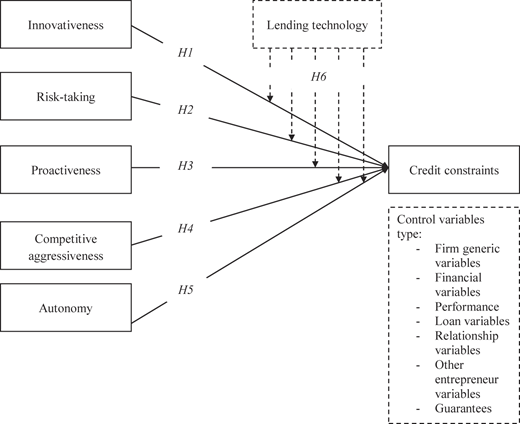
In Figure 1 we provide a visual schematisation of the hypotheses formulated.
3. Firm level data, dependent variables and EO measurement
3.1 Data and sample
To investigate our hypotheses, we rely on a questionnaire submitted on a sample of SMEs [2] based in north-eastern Italy and southern Austria. The questionnaire was part of the European Interreg Italia-Austria research project. Firms in the sample were randomly selected within the specific geographic area and are stratified by country (Italy or Austria), activity, size class and province population of firms. The sample gives a general representation of the Italian and Austrian economies, thanks to the heterogeneity of firms in terms of legal status and sectoral representation. Out of the 3,950 questionnaires submitted within one year (2013), we received answers from 328 firms, after having minimised the lack of technical comprehension, errors and missing data.
3.2 Dependent variables
Our main target is to evaluate how EO affects SMEs' access to finance and whether the lending technology shapes the underlying relationship. To do so, we make use of specific questions that ask whether a firm applied for a loan, as well as the reasons why it did not. More specifically, we rely on the following questionnaire items:
In the last six months did you obtain bank debt among your financial sources? YES/NO
What is the reason for your eventual credit access difficulties?
Insufficient firm collateral YES/NO
Insufficient personal collateral YES/NO
Too high leverage ratio YES/NO
Business plan is missing YES/NO
Scarce economic margins YES/NO
Lack of business opportunities in the firm sector YES/NO
Firm revenues decreasing YES/NO
Too high interest expense YES/NO
No true reason, expected rejection due to the general bank credit policy YES/NO
Mixing the answers of the responders to the two questions, we identify several subsamples, corresponding to different dummy measures of credit access (logit models), namely:
Firms that desire bank credit (WANT) – we include all the firms that respond “YES” to the first question and firms that respond “NO” to the same question but have at least one difficulty from I to IX (WANT = 1). Dummy variable switches to one for all firms that desire bank credit, zero otherwise (WANT = 0).
Firms that apply for credit (APPLY) – we include all the firms that respond “YES” to the first question and firms that respond “NO” to the same question but have at least one difficulty from I to VIII (APPLY = 1). With regard to the first subsample (WANT), we do not consider all firms that respond “YES” only to reason IX (discouraged borrowers), which are not likely to apply for credit. The rest of the observations is related to firms that did not apply for bank credit (APPLY = 0).
Firms that are rationed (RATIONED) – In accordance with the entrepreneurs interviewed, “credit difficulties” include rationed and denied. The limited number of observed discouraged borrowers does not allow us to run an ad hoc model to analyse the characteristics of these firms. For this reason, we treat discouraged borrowers in two alternative ways in order to build the “RATIONED” dummy: in the first model, we include all the firms that respond “YES” to the second question and that have at least one difficulty from I to VIII (RATIONED_1 = 1, in line with Kon and Storey, 2003), and zero for the rest of the firms in the sample (RATIONED_1 = 0). In the second model, we include all the firms that respond “YES” to the second question and that have at least one difficulty from I to IX (RATIONED_2 = 1, in line with Cox and Jappelli (1993) and Duca and Rosenthal (1993)), zero for the rest of the firms surveyed (RATIONED_2 = 0).
Firms that are denied by banks (DENIED) – we include all firms that respond “NO” to the first question and “YES” to the second with at least one difficulty from I to VIII (DENIED = 1, in line with Lee et al., 2015), zero for the rest of the sample.
Since the difference between the firms that desire credit (WANT) and firms that apply for credit (APPLY) – represented by the discouraged borrowers – is rather small (2%, equal to 7 observations), we exclude the variable WANT. However, the results do not change by replacing the dependent variable “APPLY” with “WANT”. Regarding the “RATIONED” sub-sample, we add a model in which discouraged borrowers are removed from the sample to avoid any potential distortion (RATIONED_SUB = 1, otherwise RATIONED_SUB = 0) [3].
Table 1 presents the observation frequencies for the key dependent variables and show that 21% of the survey respondents did not apply for a bank loan, 2% are discouraged borrowers and 77% apply for a bank loan in the last six months.
Bank loan application and bank loan results: observations and frequencies
| Q1 and Q2 response | Obs | Frequency (%) | |
|---|---|---|---|
| Firms that did not desire bank credit | Q1 = NO and Q2 = NO for each item | 68 | 21 |
| Firms that desire bank credit but are discouraged | Q1 = NO and Q2 (IX) = YES | 7 | 2 |
| Firms that apply for bank credit | Q1 = YES; Q1 = NO AND Q2 (from I to VIII) = YES | 253 | 77 |
| Firms that receive everything requested | Q1 = YES and Q2 = NO | 122 | 48 |
| Firms that are credit rationed | Q1 = YES and Q2 (from I to VIII) = YES | 107 | 42 |
| Firms that are credit denied | Q1 = NO and Q2 (from I to VIII) = YES | 24 | 10 |
| Total | 328 | 100 |
Note(s): This table shows the number of observations and the frequency of dependent variables
Among the applicant firms, 48% received everything requested, 42% received a lower amount of that requested (credit rationed) and 10% are credit denied.
3.3 EO measurement
We measure the five EO dimensions through 5 multi-items Likert scales: risk-taking (RISK, six items taken from Hornsby et al. (2002), Morgan and Strong (2003) and Acedo and Jones (2007)); innovativeness (INNOV, four items taken from Calantone et al., 2002); proactiveness (PROAC, ten items taken from Acedo and Jones, 2007; Hult and Ketchen, 2001 and Morgan and Strong, 2003); competitive aggressiveness (AGRESS, six items taken from Lumpkin and Dess, 2001) and autonomy (AUTON, nine items taken from Engel (1970), Hornsby et al. (2002) and Spreitzer (1995)). The items used to measure constructs were all assessed on “Strongly disagree” (1) to “Strongly agree” (7) seven points Likert-type scales, following prominent studies. The EO dimensions are measured at the entrepreneurial level (the questionnaire respondent). Since all the surveyed firms are managed by the entrepreneur and not by delegated managers, this measure is unique for each firm.
The analysis of the EO dimensions is based on the following three steps: (1) preliminary scale reliability test, (2) explanatory factor analysis and (3) final scale reliability test based on the results of the factor analysis. As regards to the first step, we validate our EO variables through the Cronbach's α scale reliability test. The results of the test for four EO dimensions (AGGRESS, AUTON, INNOV and PROAC scales) ranges from 0.701 to 0.877, confirming the validity of the scale adopted. A smaller value is observed for RISK scale (0.457) that deserved further attention. The Cronbach's α and Kaiser–Meyer–Olkin statistics suggested that some items should be dropped to obtain more reliable scales. In particular, items 5 and 6 can be dropped from the risk scale, items 1 and 5 can be removed from the competitive aggressiveness scale, and items 1 and 6 can be excluded from the autonomy scale.
After this preliminary test, we run the explorative factor analysis to reduce the items to a unique reference construct. The results of the analysis are reported in Table 2. As one can see, 26 items are relevant in the analysis of EO construct with a global Cronbach's α of (0.84). The estimation of the five latent dimensions shows that the cumulative proportion of variance included in the factors is 47.5%. The proportion of variance explained by each five factors are 0.135, 0.116, 0.106, 0.079 and 0.041 for proactiveness, autonomy, innovativeness and aggressiveness and risk-taking scales. The factor loadings are obtained considering the varimax rotation and the relative scores were used in the regression models. The threshold for the factor loadings is fixed at 0.4 (except for the coefficient for the first item of the risk-taking scale). Only four items show Hoffman's index of complexity larger than 1.5. The analysis of uniqueness measures shows that the proportion of explained variance in the items ranged from 0.21 for the second item of aggressiveness scale to 0.81 for the first item in risk-taking scale. The reliability of the explorative factor analysis can be evaluated by considering the standard measures. The root mean square of residuals (RMSR) value is 0.040 and its corrected value is 0.050. The Tucker–Lewis Index (TLI) is 0.832 and the root mean square error of approximation (RMSEA) value is 0.073. The RMSR and TLI values are acceptable, while the RMSEA value is slightly larger than the suggested limit. Even better results are obtained considering a confirmatory factor analysis approach on the set of selected items. In general, the estimation results are coherent with the original scale specification.
Factor analysis results
| Items | Proactiveness | Autonomy | Innovativeness | Aggressiveness | Risk | Communality | Complexity |
|---|---|---|---|---|---|---|---|
| INNOV1 | 0.773 | 0.63 | 1.1 | ||||
| INNOV2 | 0.737 | 0.56 | 1.1 | ||||
| INNOV3 | 0.813 | 0.74 | 1.2 | ||||
| INNOV4 | 0.748 | 0.66 | 1.4 | ||||
| PROAC1 | 0.569 | 0.40 | 1.5 | ||||
| PROAC2 | 0.579 | 0.42 | 1.5 | ||||
| PROAC4 | 0.522 | 0.40 | 1.8 | ||||
| PROAC5 | 0.622 | 0.47 | 1.5 | ||||
| PROAC7 | 0.684 | 0.52 | 1.2 | ||||
| PROAC8 | 0.649 | 0.48 | 1.3 | ||||
| PROAC9 | 0.682 | 0.50 | 1.1 | ||||
| PROAC10 | 0.674 | 0.52 | 1.3 | ||||
| AGGRESS2 | 0.874 | 0.79 | 1.1 | ||||
| AGGRESS3 | 0.807 | 0.68 | 1.1 | ||||
| AGGRESS4 | 0.412 | 0.443 | 0.40 | 2.4 | |||
| AGGRESS6 | 0.432 | 0.25 | 1.7 | ||||
| AUTON2 | 0.598 | 0.39 | 1.2 | ||||
| AUTON3 | 0.630 | 0.43 | 1.2 | ||||
| AUTON4 | 0.497 | 0.29 | 1.4 | ||||
| AUTON5 | 0.753 | 0.61 | 1.1 | ||||
| AUTON8 | 0.648 | 0.51 | 1.4 | ||||
| AUTON9 | 0.481 | 0.24 | 1.1 | ||||
| AUTON10 | 0.610 | 0.45 | 1.4 | ||||
| RISK1* | 0.208 | 0.294 | 0.19 | 3.4 | |||
| RISK2 | 0.569 | 0.33 | 1.0 | ||||
| RISK3 | 0.681 | 0.49 | 1.1 |
Note(s): This table shows the results of the factor analysis for the five EO dimensions measured: proactiveness, autonomy, innovativeness, aggressiveness, risk
As a third and final step, we performed a scale reliability analysis to validate the performance multiple items scale. The study of Cronbach's α (0.897) and the Kaiser–Meyer–Olkin (0.882) shows that the scale can be considered reliable. However, reliability can be improved by dropping the third item on the scale, but the gain is irrelevant (α = 0.903). The factor analysis results confirm the scale's unidimensionality, and the proportion of total variance explained is 0.54 [4].
Summary statistics of EO dimensions (Table 3) reveal that firms are on average characterized by higher scores of innovativeness, proactiveness and autonomy. Those scores are on average higher than those observed for risk-taking and competitive aggressiveness.
Firm level control variables: summary statistics and definition
| Variable | Definition | Unit | Mean | Std |
|---|---|---|---|---|
| Dependent variables | ||||
| APPLY | Dummy variable indicating whether the firm applied for credit (= 1) or not (= 0) | 0,1 | 0.787 | 0.410 |
| RATIONED_1 | Dummy variable indicating whether the firm is credit rationed or denied (= 1) or not (= 0); discouraged borrowers are considered as credit-unconstrained borrowers | 0,1 | 0.371 | 0.484 |
| RATIONED_2 | Dummy variable indicating whether the firm is credit rationed or denied (= 1) or not (= 0); discouraged borrowers are considered credit-constrained borrowers | 0,1 | 0.393 | 0.489 |
| DENIED | Dummy variable indicating whether the firm is denied (= 1) or not (= 0) | 0,1 | 0.063 | 0.243 |
| Independent variables | ||||
| GEO | Dummy variable indicating whether the firm is Italian (= 1) or Austrian (= 0) | 0,1 | 0.665 | 0.473 |
| SEC (=IND) | Dummy variable indicating whether the firm is an industrial firm (= 1) or not (= 0) | 0,1 | 0.533 | 0.500 |
| SEC (=SERV) | Dummy variable indicating whether the firm is a services firm (= 1) or not (= 0) | 0,1 | 0.375 | 0.485 |
| SEC (=COMM) | Dummy variable indicating whether the firm is a commercial firm (= 1) or not (= 0) | 0,1 | 0.092 | 0.289 |
| SIZE | Total number of full-time employees | Quantity | 26.851 | 72.753 |
| FIRM_AGE | Age of the firm (measured in years) | Years | 26.482 | 27.753 |
| SOL-OWNER | Dummy variable indicating whether the firm is owned by a sole owner (= 1) or not (= 0) | 0,1 | 0.500 | 0.500 |
| EXPORT | Percentage indicating the share of export sales [ = Export sales/Total sales] | Ratio | 0.120 | 0.245 |
| CAP | Equity per sources of the firm [ = Equity/(Equity + Financial debts)] | Ratio | 0.513 | 0.367 |
| OUT | Dummy variable indicating whether the firm presents outstanding receivables (= 1) or not (= 0) | 0,1 | 0.449 | 0.498 |
| PERF | Factorial measure of subjective performance | Quantity | 34.765 | 8.225 |
| LOAN_COST | Cost of financial sources [ = Interest expenses/Bank debts] | Ratio | 0.043 | 0.033 |
| SHORT_DEBT | Dummy variable indicating short-term debt bank has used (= 1) or not (= 0) | 0,1 | 0.625 | 0.485 |
| LONG_DEBT | Dummy variable indicating long-term debt bank has used (= 1) or not (= 0) | 0,1 | 0.577 | 0.495 |
| LEND | Number of banks or other financial intermediaries that finance the firm | Quantity | 2.904 | 2.803 |
| RLR | Number of cooperative local banks out of total banks financing the firm [ = Nr. Local cooperative banks/Nr. of banks] | Ratio | 0.160 | 0.275 |
| RISK | Factorial measure of risk taking | Quantity | 8.562 | 2.846 |
| INNOV | Factorial measure of innovativeness | Quantity | 9.948 | 4.700 |
| PROAC | Factorial measure of proactiveness | Quantity | 29.777 | 6.599 |
| AGRESS | Factorial measure of competitive aggressiveness | Quantity | 10.239 | 4.867 |
| AUTON | Factorial measure of autonomy | Quantity | 19.222 | 4.135 |
| COMP_EN | Factorial measure of competitive energy | Quantity | 4.590 | 1.575 |
| STRAT | Factorial measure of strategic firm | Quantity | 4.579 | 1.572 |
| FIN | Dummy variable indicating whether the firm has systematic control of financial sources (= 1) or not (= 0) | 0,1 | 0.618 | 0.4875 |
| BDG | Score (1–7) to measure the entrepreneurial attitude in exploiting forecasting techniques | Scaled [1,7] | 4.643 | 2.169 |
| COST_CONTROL | Score (1–7) to measure the entrepreneurial attitude in exploiting cost-control techniques | Scaled [1,7] | 4.368 | 2.295 |
| GUA | Dummy variable indicating whether collateral or a personal guarantee has been used (= 1) or not (= 0) | 0,1 | 0.636 | 0.482 |
| MG | Dummy variable indicating whether bank guarantees have been used (= 1) or not (= 0) | 0,1 | 0.221 | 0.415 |
| BG | Dummy variable indicating whether mutual guarantees have been used (= 1) or not (= 0) | 0,1 | 0.184 | 0.388 |
| PG | Dummy variable indicating whether public guarantees have been used (= 1) or not (= 0) | 0,1 | 0.227 | 0.420 |
Note(s): This table shows the descriptive statistics for the variables used, together with their definitions and acronyms
3.4 Firm level control variables
We rely on a large set of firm specific controls to account for firm's creditworthiness. More specifically firm level control variables can be divided into seven groups:
Firm generic variables. Firm generic information refers to its geographical location (GEO, Italy or Austria), sector (SEC, services, commercial or industrial sector), size (SIZE, calculated with the number of full-time employees), age (FIRM_AGE), the presence of a single owner (SOLEOWNER, a dummy variable that equals one if the firm has a sole owner and zero otherwise) and the percentage of export (EXPORT). Table 3 shows that the sample is mainly composed of Italian (the variable GEO shows 66.5% Italian and 43.5% Austrian firms) reflecting the higher representativity of firms in the north-east of Italy compared to south Austria. In terms of sectoral stratification most of the firms are industrial (53.3%) and service firms (37.5%), with a small presence of commercial firms (9.2%). Half of the firms surveyed are conducted by one owner and have on average 27 employees (SIZE) and were established 26 years ago (AGE). Only a small portion (12%) of SMEs surveyed exports goods and/or services abroad.
Financial variables. The first financial variable is the ratio of the amount of equity to total funding sources [capitalization (CAP)] that strongly affect SMEs' probability of defaults and credit constraints overall (Cathcart et al., 2020). Unlike previous studies, the non-observance of state credit for each loan does not allow us to obtain data on, for example, overdrafts, the occurrence of default and credit rating scores. In place of these quantities, we use a dummy variable indicating the presence of outstanding receivables (OUT, a dummy variable that equals one if the firm has outstanding receivables and zero otherwise). Those kinds of information are essential in the creditworthiness definition of SMEs (Altman et al., 2013). The average firm has a high CAP (CAP shows that 50% of capital employed is constituted by equity) and exhibits a higher use of outstanding receivables (OUT).
Subjective performance. The performance can be first-order important in the credit access availability since the ability to repay debts is strongly affected by economic returns. The lack of balance sheet data for 36% of the sample implies using subjective firm performance measures (PERF, eight items), instead of the performance calculated on financial statements. Using non-financial indicators and following Koe's (2013) approach, we examine performance through the results of the factorial analysis in terms of sales growth, employee growth, market share growth and the growth of general economic ratios, namely the return on equity (ROE, or net earnings on equity), the return on investment (ROI, or the ratio of operating profits on capital invested), the return on sales (ROS, or the ratio of operating profits on sales) and the self-financing capacity with earnings retention.
Loan variables. These variables capture the characteristics of bank debt. We use loan cost (LOAN_COST, only in the credit access models) and loan duration. To overcome the unavailability of the loan amounts for many of the firms, we use two dummy variables to capture the reliance of short-term debt (SHORT_DEBT) and long-term debt (LONG_DEBT), respectively, instead of the time variable of loan duration. Bank financing is particularly important as 78.7% of SMEs surveyed applied for a loan. Loan duration is lower as firm largely rely on short-term debt financing (SHORT_DEBT is on average 62.5%, while LONG_DEBT is on average 57.7%). The mixed use of short and long-term debt brings to an average loan interest rate of 4.3% (LOAN_COST).
Relationship lending variables. This group of variables capture the length of bank–firm relationships, the number of banks and the type of bank involved in the loan financing operation. Following the approach of Behr et al. (2011) and Ferri et al. (2019), we construct two types of relationship lending variables: the first is the number of financial intermediaries that provide payday loans; the second is the fraction of local banks out of the total of local and non-local banks (RLR) to which a firm has a relationship. We use this latter measure as a proxy for the level of relationship lending technology because small local banks usually adopt this kind of lending relationship. The average firm in our sample usually have relationships with three banks and roughly one out of three of those banks use a relationship lending technology.
Other entrepreneur variables. In order to check the determinants of access to finance in a wide strategic perspective, we insert other variables related to strategies, financial control, cost control and the use of forecasting techniques. Entrepreneurial strategies are measured by seven items (STRAT). We add competitive energy (COMP_EN, seven items), based on the work of Felício et al. (2012) since this variable can complete the variables related to EO, giving a complete view of firm's access to credit determinants. Using factorial analysis, we synthesise COMP_EN item in a single dimension. Management and financial control are measured by a dummy variable indicating whether the firm systematically controls for financing sources (FIN), by a variable that measures the use of forecasting techniques (BDG, scored from one to seven) and by a variable measuring the use of cost–control techniques (COST_CONTROL, scored from one to seven). In this way, all the possible determinants can be compounded in the present analysis.
Collateral. We include four different variables that capture the presence of collateral or third-party guarantees (dichotomous variable) for the main firm-bank financing relationship: the first indicates the presence of collateral (GUA); the second signal the use of a guarantee from a financial institution (BG) or a mutual guarantee (MG); the third measure the presence of a public guarantee (PG). 63% of the firms in our sample use collateral (GUA), while only a small portion use guarantees from financial institutions (22%), mutual guarantee funds (18%) and public guarantees (22%).
4. Results
In this section, we present the empirical results of our estimations of the effects of EO on bank loan applications and the related outcomes (rationed or denied). In Table 4, we report the results for four credit access variables, while in Table 5 we repeat the estimations of models 4 and 5 on a subsample of SMEs that had applied for credit in the last six months [5]. We run basic models (a) in which EO dimensions are not include, and then we further saturate the regressions with the EO dimensions: in models (b) we add the EO dimensions, and in models (c) EO dimensions are interacted with the relationship lending proxy. We implement stepwise logistic regression models, which consists of automatically selecting a reduced number of dependent variables for running the best performing regression model.
Main results
| (1a) | (1b) | (1c) | (2a) | (2b) | (2c) | (3a) | (3b) | (3c) | (4a) | (4b) | (4c) | (5a) | (5b) | (5c) | |
|---|---|---|---|---|---|---|---|---|---|---|---|---|---|---|---|
| APPLY | RATIONED_1 | RATIONED_2 | RATIONED_SUB | DENIED | |||||||||||
| GEO | 1.188*** (0.456) | 1.249*** (0.457) | 1.213** (0.511) | 1.088** (0.457) | 1.340*** (0.482) | 0.782 (0.513) | 1.040** (0.479) | 1.182** (0.519) | 0.772 (0.536) | −3.794** (1.586) | −3.794** (1.586) | ||||
| SEC (=IND) | 0.622 (0.555) | 0.778 (0.567) | 1.156* (0.594) | 0.648 (0.540) | 0.772 (0.555) | 1.180** (0.599) | 0.645 (0.570) | 0.849 (0.5811) | 1.236** (0.6162) | ||||||
| SEC (=SERV) | −0.193 (0.583) | −0.119 (0.586) | 0.218 (0.611) | −0.129 (0.566) | −0.140 (0.575) | 0.153 (0.605) | −0.116 (0.596) | −0.095 (0.603) | 0.133 (0.621) | ||||||
| SOL-OWNER | −0.669 (0.435) | −0.713 (0.441) | - 0.713 (0.441) | −0.543* (0.321) | −0.601* (0.330) | −0.654* (0.349) | −0.514 (0.348) | −0.628* (0.362) | −1.695 (1.048) | −1.695 (1.048) | |||||
| AGE | −0.014* (0.007) | −0.015* (0.008) | −0.018** (0.008) | −0.009 (0.006) | −0.011* (0.006) | −0.015** (0.007) | −0.014* (0.008) | −0.015** (0.007) | −0.018** (0.008) | 0.032** (0.015) | 0.032** (0.015) | ||||
| SIZE | −0.065* (0.038) | −0.126** (0.054) | −0.126** (0.055) | ||||||||||||
| PERF | −0.111*** (0.023) | −0.107*** (0.024) | −0.118*** (0.025) | −0.102 (0.022) | −0.104*** (0.023) | −0.111*** (0.026) | −0.109*** (0.023) | −0.110*** (0.024) | −0.120*** (0.027) | −0.0671 (0.042) | −0.1034* (0.0578) | −0.103* (0.057) | |||
| CAP | −1.239** (0.620) | −1.341** (0.631) | −1.341** (0.631) | 3.375*** (1.307) | 6.504*** (2.259) | 6.504*** (2.259) | |||||||||
| OUT | 0.720** (0.332) | 0.703** (0.340) | 0.679* (0.358) | 0.543 (0.354) | 0.621* (0.356) | 0.625* (0.376) | 2.657** (1.048) | 2.657** (1.048) | |||||||
| LO-COST | 1.107** (0.494) | 1.263** (0.5087) | 1.352*** (0.5216) | 1.4014*** (0.484) | 1.629*** (0.504) | 1.834*** (0.527) | 1.314*** (0.501) | 1.604*** (0.525) | 1.741*** (0.542) | 1.691** (0.733) | 3.708*** (1.255) | 3.708*** (1.253) | |||
| LT-DEBT | 2.845*** (0.591) | 2.885*** (0.595) | 2.885*** (0.595) | −1.923** (0.867) | −2.246* (1.151) | −2.246* (1.151) | |||||||||
| ST-DEBT | 1.500*** (0.456) | 1.518*** (0.461) | 1.518*** (0.461) | −2.150** (0.843) | −4.827*** (1.695) | −4.827*** (1.695) | |||||||||
| EXPORT | 1.129* (0.667) | 1.970** (0.792) | 1.773** (0.808) | 1.376** (0.658) | 2.188*** (0.799) | 2.013** (0.821) | 1.240* (0.682) | 2.210*** (0.820) | 2.065** (0.842) | 2.607** (1.246) | 3.971** (1.605) | 3.971** (1.605) | |||
| INNOV | 0.500*** (0.168) | 0.500*** (0.168) | |||||||||||||
| PROAC | −0.044 (0.029) | −0.044 (0.029) | 0.039 (0.035) | 0.045 (0.036) | −0.202*** (0.071) | −0.202*** (0.071) | |||||||||
| AGRESS | −0.084** (0.042) | −0.037 (0.051) | −0.102** (0.043) | −0.045 (0.053) | −0.109** (0.045) | −0.056 (0.056) | |||||||||
| AUTON | 0.099 (0.063) | −0.353*** (0.134) | −0.353*** (0.134) | ||||||||||||
| BDG | 0.137 (0.093) | 0.487** (0.240) | 0.487** (0.240) | ||||||||||||
| COST_CONTROL | 0.215 (0.151) | ||||||||||||||
| FIN | −1.618 (0.994) | −1.618 (0.994) | |||||||||||||
| LEND | 0.298* (0.158) | 0.299* (0.159) | 0.299* (0.159) | 0.118* (0.066) | 0.120* (0.067) | 0.121* (0.068) | 0.097 (0.067) | 0.299** (0.119) | 0.727*** (0.239) | 0.727*** (0.239) | |||||
| RLR | 8.755** (3.555) | 7.833*** (2.677) | 7.516*** (2.622) | ||||||||||||
| GUA | 0.799** (0.361) | 0.859** (0.368) | 0.969** (0.383) | 1.069*** (0.388) | 1.157*** (0.365) | 1.216*** (0.382) | 0.876** (0.368) | 1.109*** (0.378) | 1.189*** (0.389) | ||||||
| MG | 0.734* (0.400) | 0.936** (0.418) | 0.998** (0.433) | 0.821** (0.388) | 0.995** (0.411) | 1.099** (0.426) | 0.722* (0.410) | 1.111*** (0.425) | 1.220*** (0.438) | ||||||
| BG | 0.785* (0.419) | 0.850** (0.425) | 0.744* (0.441) | 0.698 (0.438) | 0.677 (0.426) | 0.679 (0.433) | 0.827* (0.446) | ||||||||
| PROAC × RLR | −0.168** (0.085) | −0.169** (0.083) | |||||||||||||
| AGRESS × RLR | −0.224* (0.127) | −0.240** (0.119) | −0.227* (0.121) | ||||||||||||
| AUTON × RLR | −0.327* (0.185) | ||||||||||||||
| Observations | 271 | 271 | 271 | 271 | 271 | 271 | 271 | 271 | 271 | 265 | 265 | 265 | 271 | 271 | 271 |
| Pseudo R2 | 0.466 | 0.474 | 0.474 | 0.327 | 0.338 | 0.363 | 0.315 | 0.333 | 0.365 | 0.336 | 0.354 | 0.376 | 0.361 | 0.561 | 0.561 |
Note(s): This table shows the stepwise logistic regression results using as dependent variables: Apply (all firms that respond “YES” to the first question and firms that respond “NO” to the same question but have at least one difficulty from I to VIII), Rationed_1 (dummy variable equal to one for firms that apply for credit and have at least one difficulty from I to VIII, zero for the rest of the surveyed firms), Rationed_2 (dummy variable equal to one for firms that have at least one difficulty in obtaining credit from I to IX, zero for the rest of the sample of firms), Rationed_sub (same as Rationed_1, excluding discouraged borrowers from the sample of firms) and credit denied (dummy variable that switches to one for firms that receive a credit denial, zero otherwise). Models (a) do not contain EO controls. Models (b) add the EO dimensions, while in models (c) we EO dimensions are also interacted with the relationship lending proxy. See Table 3 for the definition of the independent variables. *** indicates significance at the 1% level, ** at the 5% level, * at the 10% level
Determinants of credit access difficulties of firms that applied for credit (subsample)
| (4a) | (4b) | (4c) | (5a) | (5b) | (5c) | |
|---|---|---|---|---|---|---|
| RATIONED (ON APPLY) | DENIED (ON APPLY) | |||||
| GEO | 1.859*** (0.515) | 1.7297*** (0.5581) | 1.837*** (0.5897) | −3.046 (1.946) | −3.657* (2.090) | −2.800 (2.142) |
| SEC (=IND) | 0.597 (0.608) | 1.005 (0.672) | 1.089* (0.660) | |||
| SEC (=SERV) | −0.534 (0.632) | −0.341 (0.679) | −0.240 (0.671) | |||
| SOLEOWNER | −0.747* (0.389) | 3.307* (1.797) | ||||
| FIRM_AGE | −0.017** (0.008) | −0.016** (0.008) | −0.0218** (0.009) | |||
| SIZE | 0.153* (0.082) | −0.162** (0.079) | ||||
| PERF | −0.114*** (0.026) | −0.103*** (0.026) | −0.126*** (0.028) | |||
| CAP | 6.899*** (2.659) | 7.318*** (2.804) | 7.807*** (2.945) | |||
| OUT | 0.713* (0.387) | 0.761* (0.411) | 0.755* (0.406) | 1.846 (1.331) | ||
| LOAN_COST | 1.099* (0.620) | 1.452** (0.679) | 1.753** (0.700) | 3.323 (2.536) | ||
| LONG_DEBT | −0.685 (0.438) | −5.183*** (1.933) | −6.321** (2.456) | 5.801** (2.547) | ||
| SHORT_DEBT | −4.689** (1.846) | −5.043** (2.032) | −5.151** (2.011) | |||
| EXPORT | 1.142 (0.775) | 2.302** (0.954) | 1.824** (0.914) | |||
| INNOV | 0.280** (0.138) | 0.395** (0.199) | ||||
| RISK | 1.015** | |||||
| PROAC | 0.035 (0.042) | |||||
| AGGRESS | −0.122** (0.125) | −0.043 (0.057) | −0.300* (0.181) | −0.267* (0.160) | ||
| BDG | 0.178 (0.098) | 0.250** (0.110) | 0.208* (0.107) | 0.517 (0.361) | 0.888* (0.511) | |
| FIN | −0.573 (0.403) | −0.722* (0.432) | −2.770** (1.318) | −3.366** (1.615) | −6.097** (2.498) | |
| COST_CONTROL | 0.542** (0.319) | 0.998** (0.452) | ||||
| STRAT | −0.209 (0.132) | −1.152** (0.492) | −1.185** (0.654) | −1.399** (0.674) | ||
| LEND | 0.400* (0.230) | 0.464** (0.209) | ||||
| RLR | 0.839** (0.365) | 1.468* (0.807) | ||||
| GUA | 0.594 (0.402) | 0.834* (0.432) | 0.802* (0.426) | −2.804* (1.581) | −3.760** (1.845) | |
| MG | 0.738 (0.464) | |||||
| BG | 0.681 (0.484) | |||||
| PROAC × RLR | −0.185* (0.112) | |||||
| AGGRESS × RLR | −0.288** (0.146) | |||||
| INNOV × RLR | −2.050** (0.994) | |||||
| Observations | 213 | 213 | 213 | 213 | 213 | 213 |
| Pseudo R2 | 0.312 | 0.353 | 0.360 | 0.715 | 0.748 | 0.730 |
Note(s): This table shows the stepwise logistic regression results using as dependent variables: Rationed (dummy variable equal to one for firms that are rationed, zero for firms that apply for credit and receive everything requested), Denied (dummy variable equal to one for firms that are credit denied, zero for firms that apply for credit and receive everything requested). Models (a) do not contain EO controls. Models (b) add the EO dimensions, while in models (c) we EO dimensions are also interacted with the relationship lending proxy. See Table 3 for the definition of the independent variables. *** indicates significance at the 1% level, ** at the 5% level, * at the 10% level
Starting from non EO variables, the results show that Italian (GEO = 1), sole owner (SOL-OWN = 1) and younger SMEs (AGE) are more likely to be credit rationed (Models 2, 3, 4). Performance (PERF) reduces the probability of being credit rationed or denied, while loan costs (LO-COST) and outstanding receivables (OUT) exhibit a positive correlation, probably because underperforming firms that applied for credit are characterised by less financial control on credit risk.
Moving on credit denied firms (Model 5), Austrian (GEO = 0), sole owner (SOL-OWN = 1) and smaller firms (SIZE) tend to be more likely to be credit denied. The coefficients of the covariates are in line to those observed in Cowling et al. (2012) on a sample of UK SMEs during the global financial crisis. Furthermore, credit denied firms are characterised by a higher level of outstanding receivables (OUT) and cheaper loan conditions (LO-COST), compared to credit rationed firms. Denied SMEs are characterised by higher exports (EXPORT) and guarantees (GUA, MG and BG) in all of the considered models. The search for an international route and the use of guarantees are ways to compensate for the difficulties of access to credit. However, analysing the subsample of firms that apply for credit, denied firms lack collateral (GUA).
As one can see EO variables improves the explanatory power of the models (model a compared to model b), especially for those with the interaction terms (model c). As regard to bank loan applications (Model 1), firms that apply for credit have a similar EO profile than firms that did not apply. This result suggests that loan demand (the probability of applying for a loan) is not related to the EO profile. The relationship is different for firms that experiences difficulties in accessing external financing. Strategic orientation (STRAT) reduces the probability of being credit denied (Model 5 in Table 5).
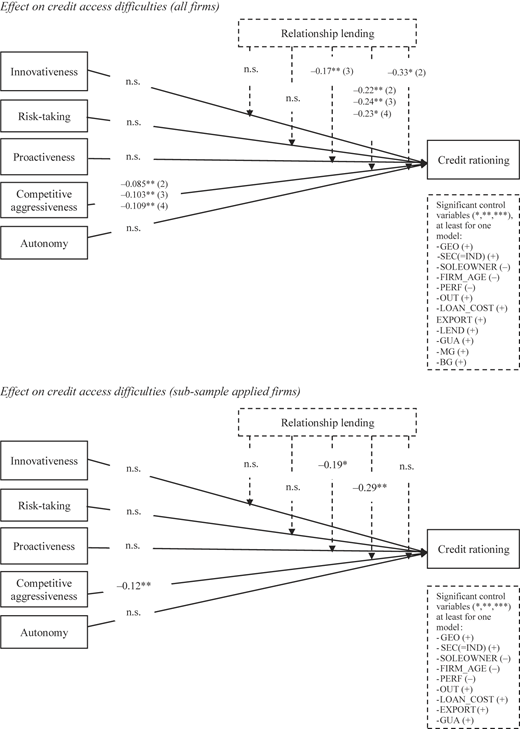
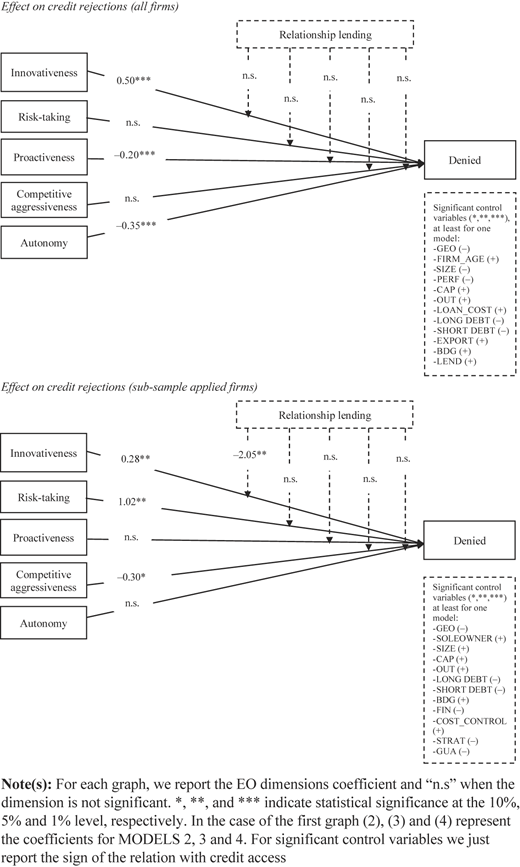
Focusing on the effect of EO on credit constraints, the dimension enters into the relationship with different effects. In line with hypothesis 1, credit denied firms are usually characterized by an higher innovativeness. This result is in line with previous empirical evidence (Backes-Gellner and Werner, 2007; Lee et al., 2015; O'Sullivan, 2005) on access to finance for innovative firms. Risk taking dimension has a similar positive effect on credit constraints, as risk-taking (RISK) dimension increases the probability of being credit constrained (in line with hypothesis 2). Hypotheses 3, 4 and 5 are also confirmed as Autonomy (AUTON), proactiveness (PROAC) and competitive aggressiveness (AGRESS) affect credit constraints. More precisely, autonomy (AUTON) is of first-order importance in avoiding credit rejections with a coefficient of −0.353 (Model 5); Proactiveness (PROAC) is mainly related to loan rejections and has a negative and statistically significant coefficient of −0.202 (Model 5); aggressiveness (AGRESS) is important for avoiding both credit rationing and credit denial (Models 2b, 3b, 4b, 5b and 5c). The coefficients of competitive aggressiveness are in line with Moss et al. (2015) and Sideck et al. (2016), supporting hypothesis 6 for autonomy, proactiveness, competitive aggressiveness and innovativeness.
Models (c) in Tables 4 and 5 introduce the interactions between EO dimensions and the relationship lending proxy. The interactions have a significant effect on banks perception of EO dimensions, confirming our expectations that EO dimensions are better incorporated in bank–firm relationships when a relationship lending technology is adopted. Looking into the relationship in detail, proactiveness (RLR × PROAC), autonomy (RLR × AUTON) and aggressiveness (AGRESS) are crucially important since are both negatively related to credit constraints (Models 2c, 3c, 4c). Interestingly, the interaction of innovativeness (RLR × INNOV) is negative and statistically significant (model 5c), suggesting a role of relationship lending in reducing credit denials for innovative firms.
Figure 2 provides a visual representation of our findings. To wrap up our results, we find that each dimension of EO interact with access to credit. Proactiveness and aggressiveness reduce the probability of being credit rationed, on the contrary innovativeness increases the likelihood of being credit denied. When interacted with relationship lending, EO dimension increases their relevance. In particular, proactiveness, aggressiveness and autonomous dimensions are embedded in relationship lending technologies leading to lower credit constraints for firms. This evidence further corroborates the standard view that small and local banks had an advantage in comparison to large banks in overcoming SMEs opaqueness through the use of relationship lending technology (Kautonen et al., 2020). Within this regard, information on EO is injected into credit scoring models and further incorporated in bank–firm relationships.
5. Conclusions
This paper investigates the effect of EO dimensions on SMEs' access to finance and whether relationship lending can shape the relationship. So far, to our knowledge, the related literature has not devoted much attention on how EO dimensions impacts on SMEs' availability of bank credit, and how this important information can be embedded in bank–firm relationship through the adoption of a relationship lending technology. This paper tries to fill this gap by using a unique questionnaire with detailed information on access to finance, EO dimensions and bank–firm relationships. Two main findings emerge from this study.
First, we find robust evidence that EO dimension are important determinants of bank financing. By looking at each dimension in detail, we find that competitive aggressiveness allows to reduce credit constraints. Alongside the dimensions analysed, autonomy is the most important dimension in avoiding credit rejections. Proactiveness is also important, but with a weaker effect in comparison to autonomy, in reducing credit rejection rates.
Second, we show that EO dimensions are embedded in relationship lending techniques leading to improved access to finance for firms that engage in such bank-firm relationships. Proactive, autonomous and competitive dimensions are embedded in bank–firm relationships when a relationship lending technology is employed, leading to a reduction of credit constraints for firms. This result highlights the ability of small banks in overcoming SMEs opaqueness, given their ability to inject soft information in their credit scoring systems. Both EO dimensions (the signal) and the type of lending technology (the means) are relevant for the financial success of SMEs (through the reduction of credit constraints), highlighting the importance for SMEs to interact with local and small banks that have an advantage in valuing EO dimensions.
We believe that our results are relevant for policymakers and firms. Based on our results, EO leads to lower credit constraints for SMEs, especially when a relationship lending technology is adopted. Diversity within banking system helps innovative, autonomous, proactive and competitive SMEs. Given the importance of bank credit for the growth of SMEs, credit constraints might lead to real effects such as lower employment and investments.
From the banks side, beyond the promotion of microfinance institutions described by Fombang and Adjasi (2018), the general support of small and local banks is fundamental to guarantee a continuous amount of financing to promote the existence and growth of EO SMEs. Otherwise, firms can be deterred from introducing new, be autonomous, proactive and competitive, resulting in a long-term drag on the economy.
The paper is not free from limitations. The main limitation is related to the small sample of firms. Although it is representative of the two geographic regions it does not allow us to include in the empirical analysis the effect of EO on self-constrained borrowers (discouraged borrowers). Furthermore, the analysis is not expanded in the cross-section limiting the possibility to link the positive effect of the interaction between EO and relationship lending through the business cycle. Second, alternative measures of relationship lending (such as geographical proximity or the length of the relationship) would have been interesting to further validate our main results. Third, we do not measure the share of credit granted by the different type of banks (small and large), which could bias upward or downward the main results.
We believe that more research should be done on the topic. On our opinion, it would be interesting to analyse whether the interactions between relationship lending and EO varies across the business cycle and how EO dimensions affects the choice among the funding sources (bank debt, trade credit, equity and retained earnings) for SMEs.
The authors thank David Storey and the participants at the 2019 BAMDE Conference (Varna) for helpful suggestions and comments. The views expressed in this paper are those of the authors only.
Notes
For an in deep discussion on lending technologies and their impact on the credit market in Italy see Del Prete et al. (2017).
We refer to an SME by the standard European commission definition (https://ec.europa.eu/growth/smes/sme-definition_en).
We do not find evidence of firms that refused the loan offer because the price was too high. For this reason, we do not construct an ad hoc model for this type of borrowers.
All the analyses are developed in R (R Core Team, 2021 ) using psych library (Revelle, 2020). fa and alpha functions are used for the exploratory factor and the reliability analyses, respectively. The confirmatory factor analysis (CFA) is developed using functions from lavaan library (Rosseel, 2012).
In this second specification, firms that did not apply for bank credit were removed.

