Chatbots are increasingly deployed in services and marketing applications, although they are often met with scepticism. To explore how such scepticism can be reduced, this study aims to examine how materialism and social judgment influence human–chatbot interactions.
The authors conduct one pre-test, two laboratory experiments and one simulated study conducted in the field, to test the premises.
The studies show that when material pursuit is guided by positive (negative) values, subjects prefer a chatbot that is perceived warm (competent) versus perceived competent (warm). This, in turn, leads to favourable purchase decisions for services with perceived homophily mediating this effect.
The work addresses the call for more research on how human–robot interactions can be improved applied to a services context. While the findings are novel, they are not without limitations which in turn lay a path for future research.
The findings have implications for driving more strategic value out of how marketing and service managers can improve the interface design in human–chatbot interactions.
The propositions demonstrate a novel framing in suggesting that positive (vs negative) values underpinning material pursuit can lead to a preference for perceived warm (vs competent) chatbots, which further guide favourable decision-making.
1. Introduction
Chatbots are increasingly being deployed in services contexts (Grewal et al., 2020), with consumers now able to execute a multitude of consumption tasks through chatbot interactions. These encompass instances such as in tourism services (e.g. booking air tickets), health care services (e.g. scheduling telehealth appointments) and financial services (e.g. applying for a credit card), amongst others (Wallis and Santiago, 2017; Davenport et al., 2020). The literature is mostly bullish on the use of chatbots, especially given the commercial benefits involved with the deployment of such technologies (Tong et al., 2020). For example, in a service retailing context, Grewal et al. (2017) predict that such technologies can increase customer confidence and satisfaction by assisting with decisions in an online context. In support of this, examples such as “Eno” from Capital One (Wallis and Santiago, 2017), the airline KLM’s BlueBot (Tyagi, 2024) and automotive chatbots (Buvanendran, 2024) have been suggested to enhance quality of interactions with customers. Yet, on the flip side, studies have also indicated that there can be consumer scepticism towards chatbots due to discomfort experienced during interacting (e.g. Ajayi et al., 2022).
A major focus of the chatbot literature has stressed the need for chatbots to mimic human-like behaviour to ensure effective human interactions (Caić et al., 2018). Strategies to enhance “humanness” may involve the act of anthropomorphising chat agents with human-like attributes such as images, identities and conversation styles (Go and Sundar, 2019; Roy and Naidoo, 2021; Grazzi et al., 2023). The ultimate objective behind anthropomorphising strategies is to increase the effectiveness of human–chatbot interactions (Roy and Naidoo, 2021). Ostrom et al. (2021) identify this need for “humanness” in chatbots as a service research priority.
Extant literature on human–chatbot interactions largely points to two dimensions of social judgment – perceived warmth and competence – to help frame human–chatbot interactions (e.g. Caić et al., 2018). The social judgment literature defines perceived warmth as the intention to help versus harm others, while perceived competence is the ability to execute such intentions (Fiske et al., 2002, 2007). These two dimensions are particularly salient in a service context (Güntürkün et al., 2020). We build and extend this literature by examining whether social dimensions of a chatbot and the ensuing interaction will be influenced by material pursuit undertaken by an individual.
Materialism is an important consumer lifestyle factor that impacts social interaction (Lee et al., 2022). Yet its examination in digital domains remains surprisingly scant (Colella et al., 2021). Similarly, researchers have called for more work to understand how humanness in chatbots can be enhanced by exploring additional moderators (Grazzi et al., 2023). We address these research gaps in the current paper by advocating that a better understanding of the role of materialism in human–chatbot interactions can reveal deeper insights into how individuals’ values and beliefs shape their interaction with the technology. Similarly, from a managerial perspective, we advocate that understanding how materialism affects interactions with chatbots can lead to more effective marketing strategies. For instance, service providers can use these insights to tailor their chatbot messages, and customer service interactions to better meet the needs and desires of their target audience, potentially leading to increased sales and customer satisfaction.
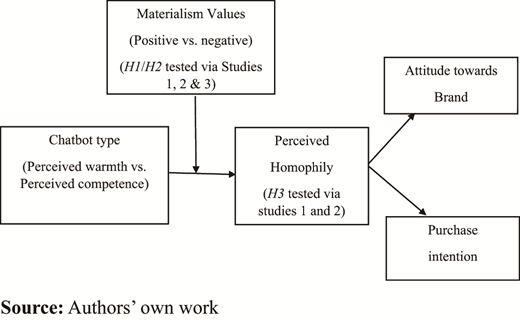
Our theorisation is centred around recent findings that suggest that personal values can become salient in human–robot interactions (Caić et al., 2018). Prior literature has defined materialism as a personal value that underpins the importance of owning material possessions (Richins, 1994; Richins and Dawson, 1992). We know based on previous findings that materialistic pursuit can be guided by positive (e.g. family support and measure life’s achievements) as well as negative values such as showing off and social comparisons (Roy et al., 2020; Rose and DeJesus, 2007). We extend these findings by examining how positive and negative values underpinning material pursuit can encourage human actors to engage with warm vs competent chatbots. As outlined in Table 1, our propositions demonstrate a novel framing in suggesting that positive (vs negative) values underpinning material pursuit can lead to a preference for perceived warm (vs competent) chatbots, which further guide favourable decision-making. We also hypothesise that the joint effect of materialistic values and type of chatbots on decision-making is further mediated by perceived homophily (see Figure 1). This is based on the literature that argues matching a chatbot type with a specific materialistic value can lead to congruence between the chatbot and human actor, thereby leading to favourable attitudes and intentions.
Recent studies on social judgment and chatbot anthropomorphism
| Studies | Independent variables | Dependent variables | Mediating/moderating variables | Contribution |
|---|---|---|---|---|
| Yu and Zhao (2024) | Emojis | Engagement | Hedonic vs autonomous chatbots | Emojis heighten chatbot’s perceived warmth but do not necessarily augment their perceived competence. The perceived warmth promoting effect is more pronounced when chatbots serve hedonic purposes |
| Kallel et al. (2023) | Chatbot perceived competence | Satisfaction | Uniqueness neglect | Chatbot perceived competence affects satisfaction with this effect being stronger (weaker) when uniqueness neglect is low(high). Perceived warmth has no effect |
| Xu et al. (2023) | Temporal and conversational cues | Satisfaction | Product attribute type | Temporal and conversational cues interacted to affect satisfaction, with this effect being mediated through perceived warmth and perceived competence. Product attribute further moderated these relationships |
| Maar et al. (2022) | Communication style | Attitude | Customer generation, service context | GenZ shows more positive attitudes toward chatbots than GenX, due to higher perceptions of perceived warmth and perceived competence. While GenZ has similar attitudes toward chatbots with a communication style that is high or low in social orientation, GenX perceives chatbots with a high social orientation as warmer and has more favourable attitudes toward chatbots |
| Haupt et al. (2023) | Chatbot recovery message | Post recovery satisfaction and chatbot re-use intentions | Perceived warmth and perceived competence | Chatbot recovery messages have a positive effect on recovery responses, with solution-oriented message elicits stronger perceived competence evaluations, whereas an empathy-seeking message leads to stronger perceived warmth evaluations |
| Kim and Hur (2023) | Personalisation and anthropomorphism | Willingness to use AI | Need for interaction | Personalisation led to higher perceived warmth and perceived competence leading to empathy, which in turn positively affected willingness to use AI. This was further moderated by need for interaction |
| Pizzi et al. (2023) | Gaze direction, anthropomorphism | Trust | Perceived warmth and perceived competence | Perceived warmth perceptions are affected by gaze direction, whereas perceived competence perceptions are affected by anthropomorphism, which in turn drives consumer scepticism and trust towards the service provider |
| Cheng et al. (2022) | Anthropomorphic attributes (perceived warmth and perceived competence), communication delay | Trust | Relationship norms | Anthropomorphic attributes of perceived warmth and perceived competence positively affect consumers’ perceived trust in chatbots, whereas communication delay negatively affects it. Relationship norms are found to moderate some of these effects such that exchange relationships strengthen the importance of perceived competence on trust, although communal relationships do not moderate the effects of perceived warmth on trust. Trust in chatbots negatively affects consumers’ intention to switch to a human agent |
| Roy and Naidoo (2021) | Anthropomorphism | Product decisions | Time orientation | Present-oriented subjects prefer a warm versus competent chatbot conversation, leading to favourable product decisions. Their counterparts, future-oriented subjects, prefer a competent vs. warm conversation. Brabd perceptions mediate these effects |
| Kull, Romero and Monahan (2021) | Communication style | Brand engagement | Brand self-distance, brand affiliation | When chatbots initiate a conversation using a warm (vs competent) message, brand engagement increases. Brand–self distance mediates this effect, such that a warm (vs competent) chatbot message makes consumers feel closer to the brand |
| Jin and Youn (2021) | Anthropomorphism | Brand engagement | Social phobia | Competent/warm AI for less conscientious/less agreeable, social phobic consumers helps |
| Borau et al. (2021) | Anthropomorphism | Attitude | n/a | Injecting women’s humanity into AI objects makes these objects seem more human and acceptable |
| Toader et al. (2020) | Anthropomorphism | Trust | Social presence, perceived competence | Social presence and perceived competence mediate the relationships between anthropomorphic design cues and trust |
| This paper | Chatbot type, materialism | Attitude and purchase intention for services | Perceived homophily | When material pursuit is guided by positive (negative) values, subjects prefer a chatbot which is warm (competent) vs competent (warm). this in turn leads to favourable purchase decisions with perceived homophily underpinning this effect |
2. Theoretical background
2.1 Humanising chatbots
A chatbot is defined as “[…] a computer program, which simulates human language with the aid of a text-based dialogue system” (Zumstein and Hundertmark, 2017, p. 98). Increasingly, scholars and designers have focused on making chat agents more humanlike. Several ways have been engaged to do this; the easiest way being the usage of human visual cues. The mere usage of such cues can motivate users to behave more socially towards chatbots (Kim and Sundar, 2012). Other ways to instil humanness in chatbots are to engage human names or identities (Sundar, 2008). Providing designations or labels can trigger category-based perceptions and elicit human (vs machine) heuristics based on anthropomorphic perceptions. For example, if a chatbot is perceived as human (vs robot), users are more likely to evaluate the quality of the chatbot’s performance based on their expectations of a human (Sundar, 2008).
Previous research has shown that social reactions to chat agents tend to increase when more social cues such as human-like behaviours are provided (Romero et al., 2021). Similarly, anthropomorphic perceptions can be evoked by the way a chat agent carries out the conversation or a specific type of communicative framing. Supporting this argument, Corti and Gillespie (2016) showed that based on communication styles, users could be primed to believe that they are engaging with a real person, when in reality, they are interacting with a chat agent. Related research shows that personalisation and responsiveness can be essential aspects of interactivity with chatbots (Vendemia, 2017). Next, we turn to discuss how social processes can influence human–chatbot interactions.
2.2 Social process underpinning human–chatbot interactions
As suggested above, anthropomorphising robots (e.g. chatbots) can replicate social interactions. In human–human interactions, different elements such as speech, facial interactions and body posture can allow people to form social cognitions leading to impression of others (Adolphs, 1999). Furthermore, social judgment literature (Fiske et al., 2007) suggests that while interacting with others, humans tend to evaluate whether the others are friends or enemies (perceived warmth dimension) and the intention to act on such hostile or friendly intentions (perceived competence dimension). In the context of service robots, the literature suggests that as the social dexterity of robots increase (e.g. listening, conversation styles), humans’ expectations of a chatbot’s social cognitions (e.g. perceived warmth and competence) should increase as well (Caić et al., 2018).
Past studies argue that human-like service robots can potentially offer meaningful context to activate human social cognitions (Wiese et al., 2017). In other words, when humans encounter cognitively and affectively endowed robots, they may judge them as social partners. Supporting this, past studies of human–robot interaction demonstrate that service robots can be judged like human partners according to their perceived warmth (caring, friendliness) and perceived competence (skilful, efficacy) despite their status as non-human actors (Roy and Naidoo, 2021; Caić et al., 2018). Huang and Rust (2021) argue that low feeling artificial intelligence (such as chatbots) can emulate social interactions, with past work demonstrating that such interactions can be further shaped by personal values of human agents (Caić et al., 2018). For example, Roy and Naidoo (2021) demonstrated that chatbots can be evaluated based on social dimensions of perceived warmth and perceived competence, with this evaluation being further contingent on one’s time orientation. To elaborate further, we discuss next the social judgment literature of perceived warmth and perceived competence.
2.3 Perceived warmth and competence
The stereotype content model (SCM) was developed by Fiske et al. (2002). SCM suggests that in an interpersonal context, people evaluate each other based on two primary dimensions: perceived warmth and perceived competence (Fiske et al., 2002, 2007). It is to be noted that while the extant literature uses the terms “perceived warmth”, “perceived competence” with “warmth” and “competence” interchangeably (Cuddy et al., 2008; Güntürkün et al., 2020), we have adopted Fiske’s original taxonomy of perceived warmth and perceived competence in this paper.
The social judgment literature posits that to survive and propagate, humans have an inherent need to determine other people’s perceived intention to harm or help, and their perceived ability to execute such intentions (Fiske et al., 2002). According to Fiske et al. (2007), the perceived warmth dimension captures perceptions of friendliness, helpfulness and trustworthiness. On the other hand, perceived competence is defined by perceptions of intelligence, skilfulness, capability, efficiency, assertiveness and confidence (Fiske, 2018). The SCM model has been applied to the context of social interactions such as partner choices, picking up in-group members and in hiring decisions (Cuddy et al., 2007; Wang et al., 2017). Furthermore, such social judgment evaluations can even be undertaken in prompt decisions and without much thinking (Ybarra et al., 2001).
Previous evidence shows that these dimensions of perceived warmth and perceived competence can be relatively orthogonal and traits like carefree and easy-going that underlie perceived warmth can be directly at odds with associated features for perceived competence (e.g. determination, foresightedness and seriousness – Fiske et al., 2007). Furthermore, perceived warmth and perceived competence are conceptualised as orthogonal since these dimensions differ in their relative importance for different decision categories (Fiske et al., 2007). Supporting this line of thinking, previous findings have shown that perceived competence is more valued than perceived warmth in judgment of service encounters (e.g. Aaker et al., 2012; Kirmani et al., 2017).
On the flip side, studies in the context of advertising and branding have reported perceived warmth to be more important than perceived competence (Kolbl et al., 2019; Infanger and Sczesny, 2015). Güntürkün et al. (2020) demonstrated that perceived warmth is more important for capturing relational aspects (e.g. customer–company identification), while perceived competence captures transactional aspect of customer–service provider relationship (e.g. share of wallet). Given this contextual background, the key premise we advocate in the current paper is perceived warmth and perceived competence are differentially effective for interaction with chatbots while material pursuit is guided by positive and negative values.
2.4 Materialism
Materialism has been described in the literature as a “set of centrally held beliefs about the importance of possessions in one’s life” (Richins and Dawson, 1992, p. 308). Other scholars like Belk (1985) described materialism as the importance people attach to worldly possessions. Materialism has also been conceptualised as a value orientation, that can stress the importance of success, enjoyment, status; all organised around palpable properties of material possession (Ahuvia and Wong, 2002). Reinforcing this, Richins describes materialism as a system of personal values i.e. what people want for themselves; (Richins and Dawson, 1992, Richins, 1994).
Past literature on materialism also suggests that different values can guide materialistic pursuit. A person could attach importance to materialism as this could be instrumental in fulfilling practical needs in life (e.g. providing for the family; Carver and Baird, 1998). According to Srivastava et al. (2001), people embrace a range of positive (e.g. measuring life achievements, supporting family), as well as negative (e.g. overcoming self-doubt, showing off) values for material pursuit. Supporting this, Csikszentmihalyi and Rochberg-Halton (1981) demonstrated that materialism can be indeed encouraged by positive (e.g. addressing life’s goals) or negative (e.g. evoking envy and social comparison) values. Prioritising values like belongingness can also encourage materialistic pursuit (Rose and DeJesus, 2007). Recent research also suggests that material pursuits can be underpinned by positive and negative values. For example, scholars (Roy et al., 2020) discuss the dual model of materialism encompassing a negative or positive path with implications for life satisfaction. Thus, past literature suggests that positive and negative values can underpin material pursuits.
2.5 Hypotheses
The key foundation of this work is based on the premise that personal values can guide human–chatbot interactions. In the case of our work, personal values are guided by the positive and negative values underpinning material pursuit. We argue that depending on whether a person pursues positive (vs negative) material values, the importance of perceived warmth (vs perceived competence) would be different in human–chatbot interactions. We suggest that human beings guided by positive values during material pursuit will prefer a warm over competent social dimension. This is based on the following reasoning.
Past research shows that when people achieve success, they experience a “warm glow” effect (Isen, 1970). If life’s achievements are measured by material success (Srivastava et al., 2001), it is possible that people might experience such “warm glow” effect. Secondly, extant research shows that materialism can be motivated by buying-is-for-belonging beliefs (Rose and DeJesus, 2007). If such underlying beliefs are at play, people can pursue materialistic goals (building luxury homes, purchasing expensive gifts) to express love and affection for close ones. Such caring for loved ones (e.g. luxury home for one’s family), in turn, can also trigger interpersonal warmth. Past research has indeed shown that social closeness can trigger perceptions of warmth (Fay and Maner, 2012). In a related manner, previous research shows that showering children with material gifts can signal parental warmth (Richins, 2017). Thus, extant evidence points to the argument that positive materialism pursuit can indeed motivate preference for the warmth social dimension.
On the other hand, competence dimension could be preferred by subjects who pursue materialism for negative reasons. Past research shows that when the “self” is threatened, people seek to purchase materialistic products with high identity expressive potential (Richins, 2017). Such self-interest-driven pursuit of wealth (e.g. to show off, overcome self-doubt) has been found to be based on higher levels of performance and competency inferences (Scott et al., 2013). Similarly, the concept of amassing wealth has been linked to traits like discipline and intelligence which underpins the perceived competence dimension (Christopher and Schlenker, 2000). In a related manner, very wealthy persons have been evaluated as less considerate of others but having more personal abilities such as pragmatic, skilful, which, once again, can be perceived as competence driven (Christopher and Schlenker, 2000). Thus, for people who pursue materialism for negative reasons, the social dimension of competence could be more appealing.
In our case, we anthropomorphise chatbots by imbuing these agents with social dimensions of warmth and competence. If people who pursue positive (vs negative) material values have differential preferences for warmth (vs competence), they should prefer chatbots with these social dimensions. This congruency between material values and social dimension of the chatbot will in led to more favourable interactions. Past research has shown that favourable interactions with chatbots can promote positive product and service decisions (Go and Sundar, 2019). We, therefore, propose the following:
When positive values guide material pursuit, consumers will express (a) higher attitude and (b) purchase intention for a service, while interacting with a chatbot that is perceived as warm versus competent.
When negative values guide material pursuit, consumers will express (a) higher attitude and (b) purchase intention for a service, while interacting with a chatbot that is perceived as competent versus warm.
2.6 Perceived homophily as mediator
Rocca and McCroskey (1999: p. 309) define perceived homophily as “the amount of similarity two people perceive themselves as having”. In general, perceived homophily propagates the idea that “similarity breeds connection” (McPherson et al., 2001, p.415). Perceived homophily is based on the principle that similarities between people can encourage higher connectedness and is pervasive in society (McPherson et al., 2001). Perceived homophily seems to exist across a wide range of relationships ranging from closest ties of marriage and friendship to knowing about someone (Hampton and Wellman, 2001). Researchers as early as Lazarsfeld and Merton (1954) have argued that individuals tend to associate with others who are like themselves. Researchers have since stressed the importance of this law-like feature of social networks, which can be driven by numerous types of attributes, socio-demographic characteristics, behaviours, attitudes and psychological traits (McPherson et al., 2001).
Previously we had argued that depending on the type of material pursuit, an individual will experience congruence with a specific chatbot type (e.g. positive materialism and perceived warmth). In other words, people will feel more similar to the chatbot when material values are congruent with the chatbot type. Past research shows that social presence of a digital agent (e.g. avatar) can further promote connectedness (Bente et al., 2008). Therefore, when human agents pursuing a specific material value interacts with a specific chatbot type, they will feel connected. Perceived homophily, as discussed above, propagates the notion that similarity breeds connections and drives favourable behaviour (Hampton and Wellman, 2001). In the particular case of chatbots, past research shows that perceived homophily between human agent and chatbot can drive favourable attitudes and intentions (Go and Sundar, 2019). Based on this, we posit that:
Congruence between the type of material value and chatbot type (positive and perceived warmth, negative and perceived competence) will lead to higher perceived homophily, thereby leading to higher attitude and purchase intention for the service
Table 2 further summarises the key contributions of our proposed hypotheses (H1, H2 and H3) with regards to the extant literature in the discipline.
Contributions of the proposed hypotheses to the literature
| Construct | Key contributions | Authors | Identified research gaps addressed |
|---|---|---|---|
| Humanising chatbots | Chatbots use human visual cues, names and communication styles to evoke anthropomorphic perceptions, improving user interaction and performance evaluation. Personalisation and responsiveness are key for better interactivity | Zumstein and Hundertmark (2017); Sundar (2008); Kim and Sundar (2012); Vendemia (2017); Romero et al. (2021) | Lack of understanding of the effects of anthropomorphised chatbots for service consumption behaviour. This gap links to H1 and H2, focusing on user attitude and purchase intention |
| Social process | Social cues like speech, body posture and facial expressions allow people to form social cognitions about chatbots. Human-like chatbots can replicate social interactions, invoking perceptions of warmth (friendliness) and competence (skills) | Adolphs (1999); Fiske et al. (2007); Caić et al. (2018); Wiese et al. (2017); Roy and Naidoo (2021); Huang and Rust (2021) | Limited exploration of the impact of chatbot design (e.g. voice, text, visuals) on users. This gap ties into H1 and H2, as design elements (warm vs competent chatbots) can affect users interaction with chatbots |
| Perceived warmth and competence | Stereotype content model (SCM) explains that users evaluate chatbots based on two dimensions: perceived warmth (friendliness, helpfulness) and competence (intelligence, efficacy). context-dependent prioritisation occurs (e.g. warmth in advertising, competence in service) | Fiske et al. (2002); Aaker et al. (2012); Güntürkün et al. (2020); Kirmani et al. (2017); Kolbl et al. (2019); Cuddy et al. (2007) | Limited exploration of how perceived warmth and competence in chatbots can affect service consumption based on material value pursuit (H1 and H2) |
| Materialism | Materialism is conceptualised as a value orientation towards possessions and can be underpinned by positive (belongingness, family needs) or negative (envy, self-interest) values. These values influence how users interact with and evaluate chatbots | Richins and Dawson (1992); Belk (1985); Srivastava et al. (2001); Csikszentmihalyi & Rochberg-Halton (1981); Roy et al. (2020) | More research is needed on how materialistic values influence chatbot interactions, particularly in customer service. This is linked to H1 and H2, as material values (positive/negative) influence chatbot evaluation |
| Perceived homophily | Perceived homophily refers to perceived similarity between humans and chatbots, which fosters connection and favourable behaviours. Similarity between users’ material values and chatbot traits (e.g. warmth or competence) increases perceived homophily | Rocca and McCroskey (1999); Lazarsfeld and Merton (1954); McPherson et al. (2001); Go and Sundar (2019) | Lack of empirical studies measuring how specific chatbot designs (warmth/competence) combined with material values impact perceived homophily and the resulting purchase behaviours of services. This gap connects to H3, as the mediation role of perceived homophily is underexplored |
In the next section, we report on one pre-test, two laboratory experiments and a study conducted in the field we designed to test the critical premises of this work.
3. Methods
3.1 Pre-test
We adopted an existing scenario-based approach from the literature to manipulate the type of values underlying materialism (Srivastava et al., 2001; Roy et al., 2020). In this approach, participants read a scenario where they were supposedly working towards an academic degree to achieve material success. In the positive (vs negative) condition, participants learned they were pursuing materialism to cater for their family needs (vs show-off to peers). Following this, they completed two manipulation check questions (“Material success can be used to support family needs” and “Material success can be used to show-off to others”) for positive and negative values; both were measured on a seven-point Likert scale. After this, they rated how several vital traits linked to perceived warmth (exemplars like kind, likeable, friendly and helpful, amongst others) and perceived competence (effective, intelligent, powerful and capable, amongst others) were on a scale of 1 = strongly disagree and 7 = strongly agree. Finally, they indicated their gender and age.
Seventy-five undergraduate students (mean age = 23.1, 37 females) were recruited from a Pacific Coast University. These students did not take part in the subsequent lab experiments and only participated in the pre-test. Results of one-way ANOVA using the manipulation check items showed that people pursuing positive (vs negative) materialism believed that materialism could be engaged to support the family (Ms of 4.78 vs 3.1; p < 0.001). Similarly, people pursuing negative (vs positive) materialism believed that materialism could be used to show-off (Ms of 4.8 vs 2.91 p < 0.001). Based on the results, the manipulation of values underlying materialism was deemed successful. More importantly, people in positive (vs negative) materialism had higher evaluations of traits like “kind” (Ms of 4.50 vs 2.85), “likeable” (Ms of 4.47 vs 3.32), “friendly” (Ms of 4.47 vs 2.07) and “helpful” (Ms of 4.34 vs 3.05), with all mean comparisons significant (all ps < 0.01). On the other hand, people pursuing negative (vs positive) materialism showed higher evaluations of traits like “effective” (Ms of 4.62 vs 2.87), “intelligent” (Ms of 4.60 vs 3.09), “powerful” (Ms of 4.4 vs 3.06) and “capable” (Ms of 4.42 vs 2.90); once again all mean comparisons were significant (all ps< 0.01). Thus, it seems that people who pursue materialism for positive (vs negative) values evaluate perceived warmth and perceived competence attributes differentially. This provides preliminary evidence that materialism can influence evaluation of social judgment dimensions.
4. Study 1
Study 1 was designed as a lab experiment to test H1, H2 and H3. A 2 (materialism values: positive versus negative) × 2 (chatbot type: perceived warmth vs perceived competence) design was engaged. Two hundred 69 post graduate students (females = 151; Mage = 36.2) from a Pacific Coast university participated in this study. Subjects were randomly allocated to the experimental conditions.
4.1 Procedure
The study took part in two seemingly unrelated parts. In the first part, values underpinning materialism pursuit was manipulated by using vignettes (see Appendix 1). Subjects were asked to imagine that they were working towards a prestigious degree to achieve material success. The values underpinning materialism was based on family support (vs show-off). We used the same scenarios from our pre-test, followed by the same manipulation check questions, which were measured after the key dependent variables. In the second part of the study, subjects were involved in a shopping exercise. Students were asked to shop for a premium credit card (i.e. financial services). The credit card was called ABC for the study purpose.
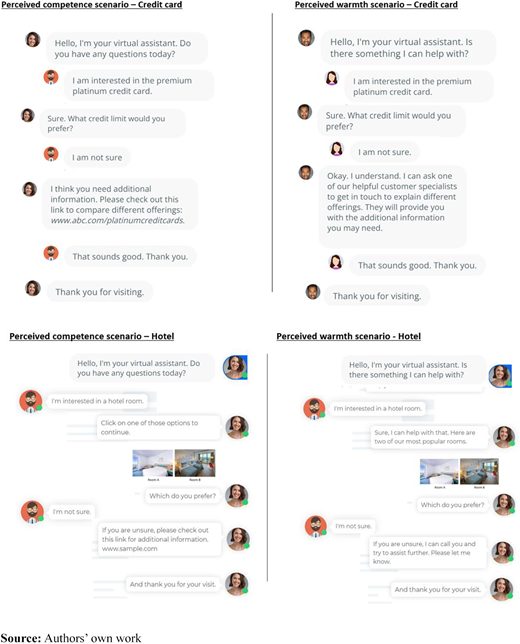
Chatbot type manipulation was introduced at this stage. Two different types of chatbot (with perceived warmth vs perceived competence attributes) were introduced to the subjects (see Appendix 2). Both these conditions involved providing chatbot help with regards to the purchase decision. Following this, the key dependent variables (attitude and intention) were measured. Both the dependent variables were measured on a seven-point Likert scale with endpoints 1 = strongly disagree and 7 = strongly agree. Attitude was measured with six questions: “I think ABC is a………credit card” with the adjectives “attractive”, “desirable”, “quality”, “valuable”, “interesting” and “good” (Cronbach of 0.70). Attitude measures were adapted from the extant literature (e.g. Roy and Naidoo, 2021). Purchase intention was measured with a single item “I am willing to purchase a credit card from ABC” based on past research supporting the use of single-item measures (e.g. Bergkvist and Rossiter, 2007; Das and Roy, 2019). Following these measures, perceived homophily was measured on a seven-point scale (1 = strongly disagree and 7 = strongly agree) and used items like “The online chat agent is very similar to me”, “The online chat agent thinks a lot like me”, “The online chat agent behaves a lot like me” and “The online chat agent is very much like me”. This measure was taken from the literature (Go and Sundar, 2019) and showed good reliability (Cronbach’s alpha = 0.84).
The manipulation check items were placed after the dependent variables. To measure chatbot type, four questions, namely, “The chatbot was warm during the conversation”, “The chatbot was friendly during the conversation”, “The chatbot was competent during the conversation” and “The chatbot was capable during the conversation” were used. To check for materialism manipulation, two questions, namely, “Material success can be used to support family needs” and “Material success can be used to show-off to others” were used. Finally, a single item “I think the above scenarios are realistic” was used to check for realism across the different scenarios engaged in the experiment. Towards the end, subjects reported demographics such as age, gender and income. Finally, participants were thanked for their contribution.
4.2 Analysis and results
4.2.1 Attitude and purchase intention
We subjected both dependent variables to a two-way MANOVA. The findings showed a significant interaction for both dependent variables [F (2, 264) = 420.78, p < 0.001, Wilks’ Λ = 0.23; η2 = 0.76]. Furthermore, the main effects for materialism [F (2, 264) = 0.15, p = 0.85] and chatbot [F (2, 264) = 1.45, p = 0.23] were non-significant. The two-way interaction was also significant after controlling for demographics, i.e. age, gender and income [F (2, 261) = 419.32, p < 0.001, Wilks’ Λ = 0.23; η2 = 0.76]. This was followed by contrast analyses for attitude and purchase intention. Results of contrast analyses showed that subjects who pursued positive material values were more favourable towards the ABC credit card when the chatbot was perceived warm (vs perceived as competent) [Ms of 4.46 vs 2.99, t (265) = 15.78, p < 0.001]. On the other hand, subjects who pursued negative material values favoured the credit card when the chatbot was perceived competent vs perceived warm [Ms of 4.52 vs 2.88, t (265) = −17.50, p < 0.001].
The findings for purchase intention mirrored the results from attitude. Subjects were more willing to purchase the credit card when they pursued positive material values and were exposed to the perceived warm (vs perceived competent) chatbot [Ms of 5.16 vs 2.71, t (265) = 12.49, p < 0.001]. Similarly, for negative material values, subjects were more willing to purchase the credit card when they were introduced to the perceived competent (vs perceived warm) chatbot [Ms of 5.37 vs 2.58, t (265) = −14.20, p < 0.01]. Based on the findings, both H1 and H2 were supported. The means for both our dependent variables are reported in Table 3.
Attitude and purchase intention as a function of materialism values and chatbot type
| Materialism | DV = attitude | DV = purchase intention | ||
|---|---|---|---|---|
| Warm | Competent | Warm | Competent | |
| Positive | 4.46 (0.59) n = 68 | 2.99 (0.41) n = 67 | 5.16 (1.17) n = 68 | 2.71 (1.12) n = 67 |
| Negative | 2.88 (0.51) n = 65 | 4.52 (0.61) n = 69 | 2.58 (1.15) n = 65 | 5.37 (1.08) n = 69 |
Note:
Figures in parentheses represent standard deviation
4.2.2 Manipulation checks
For materialism manipulation, subjects primed with positive (vs negative) values believed in providing support to family [Mpositive = 4.98 vs Mnegative = 2.72, F (1, 267) = 185.57, p < 0.001]. Similarly, the participants believed that materialism can be used to show-off in the negative (vs positive) condition [Mnegative = 5.09 vs Mpositive = 2.61, F (1, 267) = 278.16, p < 0.001]. For chatbot type manipulation, subjects exposed to warm (vs competent) conditions perceived the chatbot to be warmer [MWarm = 4.90 vs MCompetent = 2.70, F (1, 267) = 184.28, p < 0.001] and friendlier [MWarm = 5.06 vs MCompetent = 2.53F (1, 267) = 246.67, p < 0.001]. On the other hand, the chatbot was perceived to be more competent [MCompetent = 4.84 vs MWarm = 2.29, F (1, 267) = 247.10, p < 0.001] and capable [MCompetent = 4.81 vs MWarm = 2.55, F (1, 267) = 190.51, p < 0.001] when subjects were introduced to the competent (vs warm) chatbot type. Finally, with the realism manipulation, no significant differences were obtained across the materialism (p = 0.39) and chatbot (p = 0.76) conditions, suggesting that all scenarios were perceived as realistic. Based on the findings, the manipulation for both materialism and chatbot type was successful.
4.2.3 Underlying process: a moderated mediation
To test for H3, we engaged Hayes (2013) Model 7 with 5,000 bootstrap analyses. In the first model, we used attitude as the dependent variable while chatbot type and materialism were used as the independent variables. Furthermore, perceived homophily served as the mediator. The second model used purchase intention as the dependent variable. The two-way interaction between materialism and chatbot type had a positive effect on perceived homophily (CI95% = 4.69–5.48). Perceived homophily had a further positive effect on attitude (CI95% = 0.48–0.57). A look at the conditional indirect effect on attitude showed that under negative materialism, the perceived warm (vs perceived competent) chatbot reduced the effect of perceived homophily on attitude (CI95% = −1.47 to −1.17). On the other hand, under positive materialism, the perceived warm (vs perceived competent) chatbot enhanced the influence of perceived homophily on attitude (CI95% = 1.21–1.53). The index of moderated mediation was 2.68 (CI95% = 2.45–2.92).
The observed results were similar for purchase intention. Once again, the two-way interaction between chatbot and materialism had a positive impact on perceived homophily (CI95% = 4.69–5.48), while perceived homophily had a further positive influence on purchase intention (CI95% = 0.67–0.87). Under negative materialism, perceived warmth (vs competence) reduced the effect of perceived homophily on purchase intention (CI95% = −2.25 to −1.60). In contrast, for positive materialism, perceived warm (vs perceived competent) chatbot enhanced the impact of homophily on purchase intention (CI95% = 1.68–2.32). The index of moderated mediation was significant (3.92; CI95% = 3.36–4.52). The findings, therefore, support H3.
We had earlier reported the findings of process Model 7 to test our moderated mediation H3, which was based on the relevant theory. However, we also ran additional analyses to see if material values moderated the path between our mediator (perceived homophily) and the dependent variables (attitude and purchase intention). Results of process Model 58 showed that the two-way interaction between perceived homophily and materialism did not affect attitude (CI95% = −0.34 to –0.04) and purchase intention (CI95% = −0.23 to –0.29). The moderated mediation effect as posited in H3 remained significant though.
4.3 Discussion
Study 1 was designed to test the fundamental hypothesis that when material pursuit values were positive (e.g. to support the family), people are more likely to prefer a perceived warm versus perceived competent chatbot during purchase decisions. Similarly, for negative material values (e.g. show-off), people preferred a perceived competent vs perceived warm chatbot while undertaking purchase decisions. Consistent with this hypothesis, we only obtained an interaction effect. Pitching the appropriate chatbot type while people were pursuing different types of materialism led to a better attitude and purchase intention for the showcased financial service (i.e. a credit card). Furthermore, the interactive effect of material values and chatbot type influenced attitude and purchase intention for the financial service through perceived homophily. The findings from our Study 1, therefore, supported H1, H2 and H3.
5. Study 2
Study 2 was designed as a lab experiment with a different stimulus for the materialism manipulation and in the context of a hotel (i.e. hospitality services). Study 2, therefore, re-tested H1, H2 and H3 to explore the robustness of our findings from the first study while enhancing generalisability. A 2 (materialism values: positive versus negative) × 2 (chatbot type: perceived warm vs perceived competent) design was engaged. Two hundred seventy-eight subjects from the general public (females = 138; Mage = 47.7) were recruited through an advertisement to participate in this study. On arrival, the subjects were randomly allocated to the experimental conditions.
5.1 Procedure
The second study replicated the procedure for Study 1. The second study also took part in two seemingly unrelated parts. The first part of the study conducted the manipulation for materialism, while the second part presented the purchase scenario. For this study, we engaged a different manipulation for positive and negative materialism. Following the literature (Srivastava et al., 2001), the positive materialism involved materialistic pursuit to measure life’s achievements. The negative materialism, on the other hand, involved material pursuit to overcome self-doubt. The manipulation can be found in the Appendix 1.
Following the materialism manipulation in the first part, the second part involved a shopping scenario where subjects were asked to shop for a room from ABC hotel. Like Study 1, chatbot type manipulation was introduced at this stage. Two different types of chatbot, i.e. with perceived warmth (vs perceived competent attributes) were introduced to the subjects. Participants in both positive and negative materialism conditions were greeted by chatbots (perceived warmth vs perceived competent) to carry out a conversation about room booking. Following this, the key dependent variables (attitude and purchase intention) and the mediator were measured. Similar to Study 1, attitude was measured with items like “attractive”, “desirable”, “quality”, “valuable”, “interesting” and “good” (Cronbach of 0.70). Purchase intention was measured with the item “I am willing to purchase a room from ABC”. Perceived homophily was measured with the item “The online chat agent is very similar to me”.
Like Study 1, we measured the manipulation check items after the dependent variables. The manipulation check for materialism involved two items, namely, “Material success can be used to measure life achievements” and “Material success can be used to overcome self-doubt”. Chatbot manipulation was measured with the items “The chatbot was warm during the conversation”, “The chatbot was friendly during the conversation”, “The chatbot was competent during the conversation” and “The chatbot was capable during the conversation”. Scenario realism was measured with “I think the above scenarios are realistic”. Towards the end, subjects reported their demographics and were thanked for their contributions.
5.2 Analysis and results
5.2.1 Attitude and purchase intention
The dependent variables were subjected to a two-way MANOVA. Findings showed a significant interaction for both dependent variables [F (2, 273) = 335.24, p < 0.001, Wilks’ Λ = 0.29; η2 = 0.71]. Furthermore, a main effect was obtained for materialism [F (2, 273) = 22.52, p < 0.001, Wilks’ Λ = 0.85 η2 = 0.14], with subjects demonstrating different attitudes (Mnegative = 4.36 vs Mpositive = 3.91) and intention (Mnegative = 4.05 vs Mpositive = 4.16) under different materialism conditions. The two-way interaction was also significant after controlling for demographics, i.e. age, gender and income [F (2, 270) = 335.87, p < 0.001, Wilks’ Λ = 0.29; η2 = 0.71]. This was followed by contrast analyses for attitude and purchase intention.
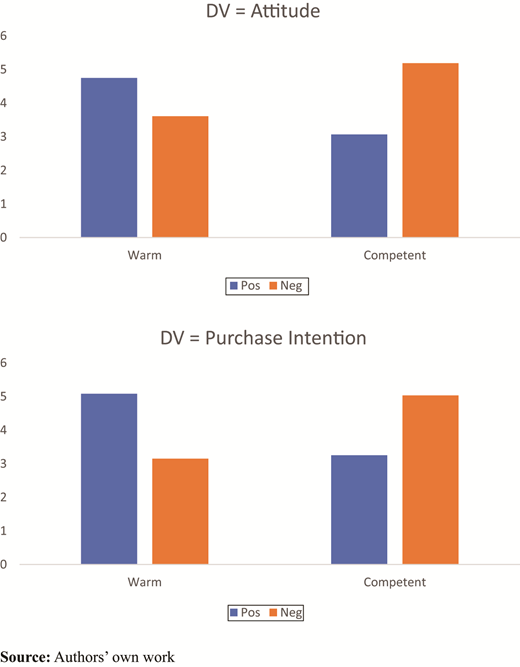
Findings from contrast analyses showed that people pursuing positive materialism showed higher attitude [Ms of 4.75 vs 3.07, t (274) = 16.45, p < 0.001] and purchase intention [Ms of 5.08 vs 3.25, t (274) = 7.34, p < 0.001] for the ABC hotel while engaging with the perceived warm versus perceived competent chatbot. On other hand, subjects in the negative materialism preferred the perceived competent versus perceived warm chatbot in terms of attitude [Ms of 5.19 vs 3.62, t (265) = −15.09, p < 0.001] and purchase intention [Ms of 5.03 vs 3.15, t (274) = −7.35, p < 0.001]. These findings supported H1 and H2. The means are reported in Table 4 while Figure 2 captures the two-way interaction.
Attitude and purchase intention as a function of materialism values and chatbot type
| Materialism | DV = attitude | DV = purchase intention | ||
|---|---|---|---|---|
| Warm | Competent | Warm | Competent | |
| Positive | 4.75 (0.66) n = 71 | 3.07 (0.56) n = 71 | 5.08 (1.36) n = 71 | 3.25 (1.61) n = 71 |
| Negative | 3.62 (0.65) n = 71 | 5.19 (0.55) n = 65 | 3.15 (1.63) n = 71 | 5.03 (1.28) n = 65 |
Note:
Figures in parentheses represent standard deviation
5.2.2 Manipulation checks
For materialism manipulation, subjects primed with positive (vs negative) values believed that materialism could measure life’s achievements [Mpositive = 5.02 vs Mnegative = 3.58, F (1, 277) = 66.48, p < 0.001]. Similarly, people believed that materialism can be used to overcome self-doubt [Mnegative = 4.74 vs Mpositive = 2.84, F (1, 277) = 139.31, p < 0.001]. For the chatbot manipulation, subjects exposed to warm (vs competent) conditions perceived the chatbot to be warmer [MWarm = 5.02 vs MCompetent = 3.50, F (1, 277) = 66.44, p < 0.001] and friendlier [MWarm = 4.84 vs MCompetent = 3.23, F (1, 277) = 81.04, p < 0.001]. On the other hand, the chatbot was perceived to be more competent [MCompetent vs MWarm = 5.12 vs 3.51, F (1, 277) = 79.94, p < 0.001] and capable [MCompetent vs MWarm = 5.17 vs 3.48, F (1, 277) = 88.37, p < 0.001] when subjects were introduced to the competent (vs warm) chatbot type. The manipulation for both materialism and chatbot were successful. Finally, with the realism manipulation, no significant differences were obtained across the materialism (p = 0.25) and chatbot (p = 0.71) conditions, suggesting that all scenarios were perceived as realistic.
5.2.3 Underlying process: a moderated mediation
To test for H3, we engaged Hayes (2013) Model 7 with 5,000 bootstrap analyses. In the first model, we used attitude as the dependent variable while chatbot type and materialism were used as the independent variables. Furthermore, perceived homophily served as the mediator. The second model used purchase intention as the dependent variable. The two-way interaction between materialism and chatbot type had a positive effect on perceived homophily (CI95% = 0.18–0.31). Perceived homophily had a further positive effect on attitude (CI95% = 0.74–0.94). A look at the conditional indirect effect on attitude showed that under negative materialism, perceived warm (vs perceived competent) chatbot reduced the effect of perceived homophily on attitude (CI95% = −0.66 to −0.31). On the other hand, under positive materialism, perceived warm (vs perceived competent) chatbot enhanced the influence of perceived homophily on attitude (CI95% = 0.19–0.53). The index of moderated mediation was significant (0.82, CI95% = 0.54–1.13).
The observed results were similar for purchase intention. Once again, the two-way interaction between chatbot and materialism had a positive impact on perceived homophily (CI95% = 2.69–4.12), while perceived homophily had a further positive influence on purchase intention (CI95% = 0.14–0.37). Under negative materialism, a perceived warm (vs perceived competent) chatbot reduced the effect of perceived homophily on purchase intention (CI95% = −0.78 to −0.25). In contrast, for positive materialism, a perceived warm (vs perceived competent) chatbot enhanced the impact of perceived homophily on purchase intention (CI95% = 0.17–0.61). The index of moderated mediation was significant (0.86, CI95% = 0.44–1.34). The findings, therefore, supported H3.
Similar to Study 1, we also conducted additional analyses for Study 2 to see if material values moderated the path between our mediator (perceived homophily) and the dependent variables (attitude and purchase intention). Results of process Model 58 showed that the two-way interaction between perceived homophily and materialism did not affect attitude (CI95% = −0.01 to –0.49) and purchase intention (CI95% = −0.24 to –0.39). The effect of moderated mediation (as posited in H3) remained significant though.
5.3 Discussion
Study 2 engaged a different manipulation for positive and negative materialism. Furthermore, the purchase scenario involving chatbot manipulation (perceived warmth vs perceived competent) engaged a hotel room. Similar to Study 1, we measured our dependent variables and the mediator first, followed by manipulation check items. The findings provided further support for our three hypotheses. Once again, while pursuing positive material values subjects preferred perceived warm (vs perceived competent) chatbots leading to positive purchase decisions (attitude and purchase intention). This finding was reversed for negative materialism.
We also obtained a main effect for materialism suggesting that people may express different attitudes and purchase intention for the hotel, depending on the type of material values they pursue. The two-way interaction between materialism and chatbot type was further mediated by perceived homophily. The underlying process showed that subjects who pursued positive materialism felt similar to the chat agents while engaging with a perceived warm (vs perceived competent) chatbot. Similarly, under negative materialism, subjects felt more similar to the chat agent when dealing with a perceived competent (vs perceived warm) chatbot. The overall findings, therefore, indicate that congruence between material values and chatbot type led to better customer outcomes, such as higher attitude and purchase intention for the showcased brand (ABC hotel).
6. Study 3
To enhance the ecological validity of our findings observed from the previous laboratory experiments, we conducted a simulated Study 3 in the field. In this study, we measured our subjects’ underlying values to pursue materialism rather than manipulating this variable. To keep our chatbot manipulation more realistic, we engaged the participants in a live interactive chatbot conversation, rather than the scenario-based manipulations used in Studies 1 and 2. Acknowledging the challenges that often accompany pure field studies, the existing literature has proposed a way forward by suggesting the integration of varying degrees of realism for independent and dependent variables during the research process (e.g. Morales et al., 2017). In our case, we kept the key independent variable of chatbot manipulation realistic while our dependent variables were measured.
We conducted Study 3 in two separate phases. Firstly, 181 (females = 97, Mage = 22.8) students were asked to complete a survey on their underlying values to pursue materialism. We grounded our scale in the relevant literature on material values (Xhang et al., 2013). We developed five items each to measure underlying values for pursuing negative and positive materialism, with endpoints 1 = strongly disagree and 7 = strongly agree. The items used for negative values included “For the recognition, I’ll get from others”, “To be well regarded by my friends”, “To impress other people”, “To have material possessions (house, car) better than others” and “To allow other people think highly of me”. The items for positive values included “To have a feeling of security”, “To be able to support my family”, “To get just compensation for my efforts”, “To feel proud of me” and “To have material possessions (house, car) that will make my family comfortable”. Both scales showed good reliability (Cronbach’s alpha for positive and negative values were 0.91 and 0.90, respectively).
These 181 subjects were contacted two weeks after they had completed the material values scale, to take part in a seemingly unrelated consumer behaviour study on chatbots. The subjects were randomly allocated to either perceived warmth or perceived competence chatbot conditions. For this study, we created a fictitious website for a tailoring service provider of business suits called ABC. The study participants were asked to engage with a live chatbot conversation to purchase a business suit from the fictitious website. They were exposed to similar perceived warmth vs perceived competence style interactions used in our previous studies, albeit in the form of a live chat.
The chatbot exposure engaged the format of Q&As following extant procedure (e.g. Go and Sundar, 2019; Roy and Naidoo, 2021). The questions were primarily focused on the subject’s preference for a specific type of business suit. This was done to maintain consistency with our previous studies where the chatbot conversations were designed around the preference for a credit card service and a hotel room. The researchers carefully managed the chatbot conversations through script prompting to ensure that the interactive Q&As between the subject and the chat agent focused on the buying scenario (Go and Sunder, 2019). At the end of the live sessions, the participants were asked to fill in a brief version of a questionnaire measuring attitude and purchase intention, engaging the same items from studies 1 and 2. The time spent by subjects were also recorded as a measure of behaviour (i.e. as a proxy for how engaged subjects were while interacting with the chatbots). This approach of measuring the dependent variables after engaging independent variables that simulate real-life experiences is an accepted methodology of field experimentation (Morales et al., 2017). Particularly, we kept the independent variable for the study (e.g. chatbot type manipulation) realistic, something that would take place in everyday life.
6.1 Analysis and results
In this experiment we had recorded subjects positive and negative material values through scales, while chatbot type was manipulated. To analyse the data, we engaged Hayes Model 1, with the dependent variables attitude, purchase intention and time spent. We further used separate models to test these dependent variables. In all models, materialism (positive and negative) and chatbot type served as the independent variables. Firstly, we analysed the data with positive materialism, chatbot type and all three dependent variables. This was followed by negative materialism, chatbot type and once again the three dependent variables.
The findings showed a significant two-way interaction between positive value and chatbot type for attitude (β = 1.37, t = 22.53, p < 0.001), purchase intention (β = 1.43, t = 12.84, p < 0.001) and time spent (β = 1.47, t = 4.19, p < 0.001). Furthermore, for perceived warm chatbot type, positive materialism enhanced attitude (conditional indirect effect = 0.65, LLCI = 0.57 ULCI= 0.74), purchase intention (conditional indirect effect = 0.72, LLCI = 0.55 ULCI= 0.86) and time spent (conditional indirect effect = 1.07, LLCI = 0.56 ULCI = 1.58). For perceived competent chatbot type, positive materialism decreased attitude (conditional indirect effect = −0.72, LLCI = −0.79 ULCI = −0.63) and purchase intention (conditional indirect effect = −0.71, LLCI = −0.86 ULCI= −0.56), but not time spent (conditional indirect effect = −0.40, LLCI = −0.87 ULCI = 0.07). The above findings remained significant even after controlling for gender, age and income.
The findings for negative materialism showed a significant two-way interaction between materialism and chatbot type for attitude (β = −1.37, t = −23.02, p < 0.001), purchase intention (β = −1.467, t = −13.64, p < 0.001) and time spent (β = −1.67, t = −4.89, p < 0.001). However, this time around, for the perceived competent chatbot, negative materialism increased attitude (conditional indirect effect = 0.74, LLCI = 0.66 ULCI = 0.83) and purchase intention (conditional indirect effect = 0.77, LLCI = 0.63 ULCI = 0.92), but not time spent (conditional indirect effect = 0.43, LLCI = −0.04 ULCI = 0.91). For the perceived warm chatbot type, negative materialism decreased attitude (conditional indirect effect = −0.62, LLCI = −0.70 ULCI = −0.54), purchase intention (conditional indirect effect = −0.69, LLCI = −0.84 ULCI = −0.54) and time spent (conditional indirect effect = −1.24, LLCI = −1.71 ULCI = −0.76). These findings remained significant even after controlling for demographics (age, gender and income).
6.2 Discussion
Extant researchers (Morales et al., 2017) recommend that field studies can engage different degrees of realism (i.e. realistic independent variables, realistic dependent variables or both independent and dependent variables can engage realistic stimuli). Following this, for our simulated third study conducted in the field, we engaged realistic independent variable. For our dependent variables, we measured attitude and purchase intention, while we recorded the amount of time (in minutes) subjects engaged with the chatbots. Recording duration of the interaction with the chatbot should reflect real life behaviour. Consistent with our previous studies, we once again found that contingent on material pursuit values (positive versus negative), subjects preferred different chatbot types (e.g. perceived warmth vs perceived competence). Furthermore, when a specific type of material pursuit was congruent with a chatbot type, people spent more time interacting with the chatbot.
7. Overall discussion
The current study explores an exciting avenue of research focussing on how to make chatbots more effective in customer service. While chatbots have been engaged in the past to provide quick and convenient support to consumers, it is currently dealt with scepticism. The current literature on chatbot argues that anthropomorphising chatbots can enhance human connectedness, and several ways have been engaged. Past research has looked at how applying human attributes like names, identities and conversation styles to chatbots can increase effectiveness and better interaction with the consumers (Kim and Sundar, 2012).
Similarly, service research has highlighted the significance of perceived warmth and perceived competence in customer service provider relationships (Güntürkün et al., 2020), while stressing the need to mimic human behaviour for chatbots in services (Caić et al., 2018). Building on previous work, the current study shows that the dimensions of social judgment (perceived warmth and perceived competence) can be applied to make chatbots more human-like. However, we show that consumers’ preference for a specific type of chatbot (perceived warmth vs perceived competence) can be further contingent on values underlying material pursuit. Past literature on materialism shows that humans can engage materialism for positive (e.g. to provide for the family) vs negative values like showing-off (Roy et al., 2020). The current work shows that these underlying values can drive the preference for a specific chatbot type.
We find robust support for our hypotheses across one pre-test, two laboratory experiments and one simulated study conducted in the field (Table 5). The two laboratory experiments further engaged different services (financial services and hospitality) to provide causal evidence. Furthermore, the simulated study conducted in the field engaged a tailoring service scenario (business suit) and used a naturalistic setting to replicate real life behaviours. The laboratory experiments also elaborated on the underlying process leading to our posited effects. The overall findings across the studies are reported in Table 5.
Findings across studies in the current research
| Hypothesis | Pre-test | Study 1 | Study 2 | Study 3 |
|---|---|---|---|---|
| H1: Positive values → Warm chatbot → higher attitude and purchase intention for a service | Not tested | Tested, supported | Tested, supported | Tested, supported |
| H2: Negative values → competent chatbot → higher attitude and purchase intention for a service | Not tested | Tested, supported | Tested, supported | Tested, supported |
| H3: Congruence between material values and chatbot type → perceived homophily → higher attitude and purchase intention for the service | Preliminary evidence supports (via manipulation of warmth and competence) | Tested, supported | Tested, supported | Not tested |
For the current work, we had argued that people tend to associate with others who are like themselves, a feature of social network referred to as perceived homophily. We found evidence of this process, albeit in the context of human–chatbot connectedness. Imbuing chatbots with human qualities (e.g. perceived warmth and perceived competence) led to higher connectedness with subjects pursuing materialism for positive versus negative values, resulting in positive outcomes for the showcased brand (i.e. attitude and purchase intention). The study of perceived homophily in the context of materialism and social dimension is original. It corroborates past studies that have argued that humans can indeed identify with inanimate objects if they have human-like attributes (e.g. Kim and Sundar, 2012), which in turn informs the design of effective interactions between chatbots and human agents.
7.1 Theoretical contributions
The current work makes critical conceptual contributions. Firstly, the service literature recommends examining how the social judgment dimensions of perceived warmth and perceived competence may influence customer-service provider relationships (Güntürkün et al., 2020). Indeed, Güntürkün et al. (2020) demonstrate that the effect of perceived warmth and perceived competence can be contingent on relational versus transactional aspect of customer-service provider relationship. We contribute to this literature by demonstrating that the differential effects of perceived warmth and perceived competence can be contingent on values underpinning material pursuit. Our work demonstrates this by imbuing chatbots with perceived warmth and perceived competence in situations where humans are interacting with the technology to make purchase decisions.
Our work also addresses the call for more research in investigating how mimicking human behaviour can lead to effective human–robot interactions (Caić et al., 2018). Scholars who have studied chatbots also encourage more work to understand how humanness of chatbots can be further enhanced (Roy and Naidoo, 2021). Similarly, Grazzi et al. (2023) advocate for additional research to address other possible moderating factors that might affect human–robot interactions. In this context, the role of our moderator “materialism values”, can drive evaluations about perceived warmth and competent chatbots, and in the process, humans feel closer to chatbots during interactions. This in turn makes human–robot interactions more effective. Based on our findings, matching the material pursuit value with a specific type of chatbot leads to more favourable consumer decisions for services.
Furthermore, while social judgment dimensions have been recently applied to chatbots (e.g. Roy and Naidoo, 2021), it has not been explained in terms of materialism. Our study shows a specific way to enhance human–chatbot connectedness, contingent on social judgment and materialism. Consistent with the literature on different types of materialism (Csikszentmihalyi and Rochberg-Halton, 1981; Srivastava et al, 2001), the current study focuses on positive and negative values underpinning material pursuit. Past literature supports such dual model of materialism (Dittmar et al., 2014; Roy et al., 2020). The current research contributes to a more nuanced understanding of how different types of materialistic pursuit can lead to more positive consumer judgments and decisions. Interestingly, both positive and negative values guiding material pursuit can influence human interaction with chatbots, leading to positive decision outcomes, a finding that informs the marketing literature.
In terms of materialism, a thin body of literature has studied how materialistic pursuit can provide consumers with a lens to observe and interpret people and events in everyday lives, mainly driven by social cognition (Scott et al., 2013). Furthermore, these social cognitions can be used to form impressions and judgments of others. The current work extends this stream of literature by showing that social perceptions (perceived warmth and perceived competence) could be driven by materialistic values (positive or negative), something which has not been proposed and studied before. We also highlight that materialistically motivated social perceptions can influence subsequent interactions with anthropomorphised chatbots, based on perceived homophily. The findings on underlying process also provides a novel contribution to the literature.
7.2 Managerial implications
Our findings have implications for driving more strategic value out of how to engage chatbots in services. It is well noted that digital technologies are increasingly crucial to achieving competitive advantage (Foroudi et al., 2017). Yet, as noted above, marketing and service managers also need to understand the pathway to further develop chatbot technologies to provide better interaction between chatbots and customers. The empirical findings observed in this paper add to a more nuanced understanding of how marketers can improve interface design in human–chatbot interaction.
For example, prestigious brands can engage different versions of chatbots while helping consumers with their shopping decisions. A simple probing question on the specific purpose of the transaction (e.g. booking a luxury hotel to celebrate a life achievement) can hint at a positive value underlying materialism. Recent work shows that such probing questions can help to understand consumer motivations underpinning decision-making in the context of chatbots (Zhu et al., 2022). Furthermore, it is also possible to analyse past customer purchase data from luxury brands to analyse underpinning material pursuit motivations (e.g. buying multiple items from a luxury brand may indicate a desire to show-off). Under such situations when the value underpinning materialism is positive (vs negative), a perceived warm (vs perceived competent) chatbot would seemingly provide better customer service.
Furthermore, the nature of luxury or conspicuous consumption can guide chatbot customisation in an omnichannel context. For example, in the luxury mobility-as-a-service market (e.g. Audi on Demand, Access by BMW and Mercedes-Benz collection), sales representatives are often trained to identify cues underpinning customers’ intention to hire a car for status or social recognition. As such, a potential customer who has had initial discussions at a dealership may have further online queries at later stage, as part of their decision-making process. If the customer information obtained at the dealership level is captured by the car manufacturer, then subsequent interactions through chatbots can be customised based on the original customer profiling data to enhance the quality-of-service interactions. The type of luxury product/service enquiry while engaging with a chatbot may also indicate intentions for different types of material pursuit.
For example, it may be safe to assume that the most expensive car (e.g. Mercedes-Maybach) would be purchased to show off status and wealth. Similarly, the range of Mercedes SUVs (e.g. GLA, GLB) may be more suited for family needs. This is based on the company’s positioning strategy for these different luxury models. For example, a Maybach advertisement may focus on an individual driver and opulent interiors, while a GLB advertisement may show family and children. Consequently, a potential customer making specific enquiries (Maybach or GLB) could be greeted by different types of chatbots. The present study, therefore, adds a more nuanced understanding of how marketing managers and service providers can augment their services through the application of chatbot technologies.
8. Limitations and future research
The current research is not without limitations, some of these laying the path for future research. Firstly, we had controlled for visual cues for our chatbot by only giving it a human figure. Future studies can explore this further by providing non-human chat agents (like a bubble versus human figure) to compare if our findings hold. Secondly, we had tried different service categories (e.g. hotel, credit card and tailoring service) to test our hypotheses. Future studies can extend our results to product categories to enhance generalisability. Furthermore, we have used both student and general public samples from a single Pacific Coast country to test our hypotheses. Extant work supports the use of a student sample in consumer behaviour research, especially when the product and service categories being investigated are of relevance to students (Peterson and Merunka, 2014; Roy and Naidoo, 2021). Future studies can extend data collection across multiple countries to test the generalizability of the current findings.
From 2025, Prof. Naidoo is affiliated with the SP Jain School of Global Management, Sydney Campus, Australia.
References
Further reading
Appendix 1
Materialism manipulation (positive): Study 1
Imagine you are working towards a prestigious degree and hope to reap future benefits such as achieving material success. Research shows that people want to achieve material success to support their family (e.g. provide comfortable and secured life to family members by owning luxury products). In a few sentences below, can you kindly elaborate how material success (e.g. making money, buying material things like expensive cars, houses and luxury products) can help one to support family:
I think material success can help to support family by:
Materialism manipulation (negative): Study 1
Imagine you are working towards a prestigious degree and hope to reap future benefits such as achieving material success. Research shows that people want to achieve material success to enable social comparison (e.g. showing off superiority by owning more expensive luxury products than others). In a few sentences below, can you kindly elaborate how material success (e.g. making money, buying material things like expensive cars, houses, luxury products) can help undertake social comparison below:
I think material success can enable social comparison (showing off) by:
Materialism manipulation (positive): Study 2
Research shows that people want to achieve material success to measure their life achievements (e.g. buying an expensive house, luxury car can signify milestones). In a few sentences below, can you kindly elaborate how material success (e.g. making money, buying material things like expensive cars, houses, luxury products) can help one to measure their achievements in life.
I think material success can help to measure one’s achievements in life by:
Materialism manipulation (negative): Study 2
Research shows that people want to achieve material success to overcome self-doubt (e.g. buying an expensive house, luxury car can receive external validation). In a few sentences below, can you kindly elaborate how material success (e.g. making money, buying material things like expensive cars, houses, luxury products) can help one to overcome self-doubt.
I think material success can help to overcome self-doubt by: