


This study investigates how technological capabilities and green organizational culture influence firms’ sustainable performance using green knowledge management as a conversion mechanism in the context of Ethiopian industrial parks. It also examines the conditional role of government support in the relationship between technological capabilities and sustainable performance.
A quantitative cross-sectional survey was conducted among 331 managerial-level employees of firms operating in selected Ethiopian industrial parks. Structural equation modeling was employed to test the proposed relationships and evaluate mediating and moderating effects.
The results support the positive and significant effects of technological capabilities and green organizational culture on sustainable performance. Green knowledge management significantly mediates these relationships, indicating its central role in translating technological and cultural capabilities into sustainable outcomes. Government support, while positively associated, shows an insignificant moderating effect on the link between technological capabilities and sustainable performance.
This study contributes to the literature by empirically integrating the resource-based view, knowledge-based view, and dynamic capability theory to explain the mechanisms through which green knowledge management fosters sustainability. The cross-sectional design limits causal inference, suggesting opportunities for longitudinal research.
This research advances the understanding of the interplay between technological capabilities, organizational culture, and sustainability by clarifying the mediating role of green knowledge management and assessing the contextual influence of government support in a low-income economy.
1. Introduction
Companies today – especially those with a high level of environmental and social impact – need to implement sustainable practices to move toward more environmentally friendly business operations (Damiano and Valenza, 2025). Accordingly, businesses have been increasingly investing in sustainability initiatives, but the main strategic challenge is how firms turn this investment and internal capabilities into improved competitiveness and sustainable performance (SP) in a dynamic and resource-constrained environment (Pizzi et al., 2020; Rodaro et al., 2026). It is highlighted that the extent to which firms achieve sustainable competitiveness and successful performance depends primarily on how they deploy and configure internal capabilities. Ethiopia launched industrial parks as a strategic development initiative to pursue sustainable industrialization and catalyze structural economic transformation through enhancing FDI, promoting exports, creating jobs, and installing and diffusing new technologies, despite their potential social, economic, and environmental challenges (Guteta and Worku, 2023). However, the performance of firms operating in the parks is significantly hindered by limited resources and capabilities, inconsistent regulatory enforcement, and ineffective environmental management (Tesfaye, 2021; Guteta and Worku, 2024; Troise et al., 2024). Ethiopia, with its social, economic, and environmental challenges and an emerging industrial sector with limited resources and weak policy enforcement, provides a distinct context for examining the relationship between firm-level internal capabilities and sustainable outcomes (Tesfaye, 2021; Shiferaw et al., 2025).
Previous studies on sustainability have demonstrated that developing and deploying technological capabilities (TC) and a green organizational culture (GOC) positively impact firms’ SP and competitiveness by enabling process adaptation, reducing waste, and improving operations and environmental innovation (Shiferaw et al., 2025; Hammerschmidt et al., 2026). Within the KBV and dynamic capabilities frameworks, the successful use of technological and cultural capabilities for strategic benefit depends on how effectively organizations generate, integrate, and apply green knowledge within their internal processes (Bresciani et al., 2024). TC, for instance, may enable a firm to acquire, retain, and apply environmentally relevant knowledge through data collection, process monitoring, and trials with clean technologies and processes (Bresciani et al., 2024). Similarly, GOC facilitates knowledge transfer and develops sustainability-oriented routines in the decision-making process by establishing shared values, norms, and behavioral expectations that support environmental knowledge (Perotti et al., 2025; Kraus et al., 2022). When an organization has a supportive cultural context, employees are more willing to create, transfer, and use green knowledge across functional areas, thus increasing the organizational learning associated with sustainable practices (Cai et al., 2023). However, firms in low-income settings face constraints in finance, management, and resources, often defaulting to lower-risk strategies (Kar et al., 2026; Scartozzi et al., 2025; Sarfo et al., 2026). Recent strategy literature indicates that government support (GS) substantially influences firms’ opportunity structures by reducing uncertainty and facilitating access to complementary resources (Caputo et al., 2022). However, Leonidou et al. (2025) argue that, unlike firms in well-developed institutional settings, those in weak or developing institutional environments must rely primarily on their internal capabilities and resources to mitigate uncertainty and achieve more sustainable outcomes.
Despite growing evidence that internal capabilities improve sustainable outcomes, the mechanism by which those capabilities translate into sustained performance remains underspecified. Prior work has often examined technological capabilities and green organizational culture as separate predictors, leaving unclear whether firms perform better because they possess green resources or because they convert those resources into usable environmental knowledge. This study addresses that unresolved issue by positioning green knowledge management as the conversion mechanism and by testing that logic in Ethiopian industrial parks, where resource scarcity, institutional weakness, and sustainability pressure make capability deployment especially consequential (Bresciani et al., 2024; Leonidou et al., 2025; Takyi et al., 2024a; Skare et al., 2024; Arilla-Llorente et al., 2024; Puffer et al., 2022; Shiferaw et al., 2025).
Grounded in RBV, KBV, and the dynamic capabilities theory (DCT), the proposed model conceptualizes GKM as a key mechanism for converting technological and cultural capabilities into sustainable outcomes, whereas GS is viewed as a contextual boundary condition between TC and SP from the institutional theory perspective. This combined model provides a systematic framework for studying how internal capabilities, knowledge processes, and institutional support influence SP in Ethiopian industrial parks. Accordingly, this study seeks to answer these questions: (1) How do green organizational culture and technological capabilities influence sustainable performance? (2) Does green knowledge management mediate the relationship between internal capabilities and sustainable performance? and (3) How does government support moderate the relationship between technological capabilities and sustainable performance?
This study contributes in three ways. First, it moves beyond presenting RBV, KBV, DCT, and institutional theory as parallel lenses by arranging them into a causal chain in which technological and cultural capabilities form the internal resource base, green knowledge management converts that base into action, and government support operates as the external contextual condition. Second, it clarifies why Ethiopian industrial parks matter theoretically, because this setting reveals whether capability-based sustainability logic still holds under low-income institutional fragility. Third, it specifies partial mediation from the outset, expecting technological capabilities and green organizational culture to retain direct effects on sustainable performance while also operating through green knowledge management (Grant, 1996; Teece, 2018; Schilke et al., 2018; Puffer et al., 2022).
2. Theoretical framework
This study integrates four complementary theoretical perspectives to explain how technological capabilities (TC) and green organizational culture (GOC) influence sustainable performance (SP) through green knowledge management (GKM), and how government support (GS) moderates these relationships. The resource-based view (RBV) posits that when a firm possesses valuable, rare, inimitable, and organizationally embedded resources and capabilities, its performance is differentiated (Barney, 1991). Resources are tangible and intangible assets of a firm, including technologies, equipment, data, and knowledge stocks that increase its potential, but they do not guarantee the firm’s performance (Barney, 1991), while capabilities represent a firm’s capacity to combine, integrate, and reconfigure these resources using organizational routines and processes to attain desired outcomes (Teece, 2018). The RBV helps us understand the existence of resources and capabilities, but it does not explain how they can be transformed into sustainable outcomes, particularly in a rapid and uncertain environment. Extending the RBV, the Dynamic Capability Theory (DCT) addresses this gap by highlighting that firms must reconfigure and align their internal capabilities in response to changes in the market and business environment to ensure long-term performance (Winter, 2003). From this perspective, technology and culture represent valuable resources, but their impact depends on a firm’s capabilities to apply, assimilate, and embed them within organizational routines, which thereby continuously enhance performance (Schilke et al., 2018; Perotti et al., 2025).
In this study, technological capabilities and green organizational culture are treated as internal capabilities at the resource level, whereas green knowledge management is treated as the process layer that mobilizes those capabilities. Technological capabilities capture the firm’s ability to deploy green technologies, systems, and technical know-how. A green organizational culture reflects shared environmental values and behavioral expectations. Green knowledge management, by contrast, refers to the acquisition, sharing, codification, and application of environmental knowledge. This distinction is central because firms may own green technologies or endorse green values without converting either into routines that improve sustainable performance (Grant, 1996; Teece, 2018; Wang, 2019; Abbas and Dogan, 2022).
3. Literature review and hypothesis development
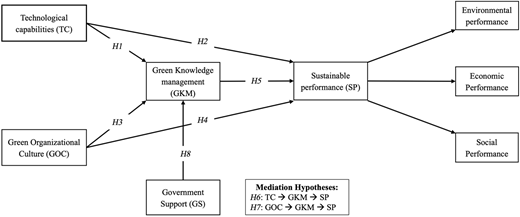
Building on this logic, the hypotheses are organized in a directional sequence from capability antecedents to process mechanism to performance outcome, followed by the contextual condition. We first assess whether technological capabilities and a green organizational culture directly strengthen green knowledge management and sustainable performance. We then examine whether green knowledge management enhances sustainable performance and partially mediates both the capability-performance relationships. Finally, we test whether government support strengthens the link between technological capabilities and sustainable performance in the Ethiopian institutional context.
3.1 Technological capabilities and sustainable performance
Technological capabilities refer to the firm’s ability to adopt, adapt, and deploy technologies that improve environmental and operational outcomes. These capabilities can affect sustainable performance directly through cleaner production, waste reduction, and efficiency gains. They can also enrich the firm’s stock of environmental data, technical experience, and problem-solving routines, which later feed green knowledge management. For that reason, technological capabilities and green knowledge management are conceptually distinct: the former concerns the technological resource base, whereas the latter concerns the organizational routines that capture and circulate what the firm learns from that base (Cai and Li, 2018; Almaqtari et al., 2025; Takyi et al., 2024b).
Technological capabilities positively influence green knowledge management
Technological capabilities positively influence sustainable performance
3.2 Green organizational culture and sustainable performance
Green organizational culture reflects shared environmental values, norms, and expectations that legitimize sustainability-oriented behavior across the firm. We treat this construct as a cultural capability rather than as a knowledge process. Its role is to increase employees’ willingness to notice, discuss, and use environmental information, thereby supporting both green knowledge management and sustainable performance. In that sense, culture creates the social context for knowledge exchange, but it is not itself the mechanism of exchange. This distinction also helps explain why prior studies often examined green culture and technological capabilities separately, as they represent different inputs that converge only when firms institutionalize green knowledge routines (Wang, 2019; Abbas and Dogan, 2022; Wang et al., 2025; Siwiec et al., 2024; Zvaríková et al., 2024).
Green organizational culture positively influences green knowledge management
Green organizational culture positively influences sustainable performance
3.3 Mediating role of green knowledge management
Green knowledge management occupies the process layer of the model. Whereas technological capabilities provide technical inputs and a green organizational culture provides a normative orientation, green knowledge management captures how firms acquire, store, share, and apply environmental knowledge in operational decision-making. The mediation claim is therefore not a relabelling of capabilities, but a conversion argument. Firms perform more sustainably when technological and cultural capabilities are translated into usable green knowledge. Because those capabilities may still influence sustainable performance directly, the model predicts partial rather than full mediation (Grant, 1996; Teece, 2018; Abbas and Dogan, 2022).
Technologically capable firms generate codifiable environmental know-how through cleaner equipment, process monitoring, and problem-solving routines. Once that know-how is captured and circulated, it improves environmental, social, and economic outcomes, creating an indirect path from technological capabilities to sustainable performance through green knowledge management. At the same time, technological capabilities may continue to have a direct effect on performance through efficiency and process improvements. Accordingly, green knowledge management is expected to partially mediate the relationship between technological capabilities and sustainable performance (Bresciani et al., 2024; Almaqtari et al., 2025).
Likewise, green organizational culture encourages employees to discuss environmental issues, share lessons, and apply sustainability principles consistently across units. This cultural openness supports the acquisition and diffusion of green knowledge, thereby improving sustainable performance. Yet green organizational culture can also influence performance directly by aligning behaviors and decisions with environmental priorities. Accordingly, green knowledge management is expected to partially mediate the green organizational culture to sustainable performance relationship (Wang, 2019; Abbas and Dogan, 2022; Wang et al., 2025).
Green knowledge management positively influences sustainable performance
GKM partially mediates the relationship between TC and SP.
GKM partially mediates the relationship between GOC and SP.
3.4 Moderating effect of government support
Government support is included as the contextual condition because institutional theory suggests that external policy support can strengthen or weaken the returns firms obtain from internal capabilities. In industrial parks, such support may involve regulatory guidance, technical assistance, training, infrastructure facilitation, and administrative incentives. We focus on government support as the moderator of the relationship between technological capabilities and sustainable performance because technological upgrading is the capability most directly exposed to policy instruments such as standards, infrastructure, and technical assistance. Ethiopian industrial parks, therefore, offer a strong setting for examining whether formal support actually amplifies capability-based sustainability outcomes under institutional fragility (Joo and Suh, 2017; Greenwood and Hinings, 1996; Puffer et al., 2022; Shiferaw et al., 2025; Batlles-delaFuente et al., 2024).
Government support positively moderates the relationship between technological capabilities and sustainable performance, such that the relationship becomes stronger when government support is higher.
In this context, Figure 1 shows the hypothesized model integrating the previously discussed hypothesis.
4. Methods
This study used a cross-sectional survey of manufacturing firms operating in Ethiopian industrial parks. Of the 46 active firms, 32 were selected using simple random sampling across seven industrial parks. Within those firms, questionnaires were distributed to managerial-level employees, as they were expected to have direct knowledge of technological capabilities, organizational culture, government support, green knowledge management, and sustainability outcomes. A total of 342 questionnaires were distributed, 337 were returned, and 331 usable responses were retained after screening, yielding a 96.8% usable response rate. Managerial participation is verified by the respondent profile in Table 1, which shows that all retained respondents occupied supervisory, middle management, or top management roles.
Demographic profile of respondents
| Item | Frequency | Percent | |
|---|---|---|---|
| Gender | Male | 208 | 62.8 |
| Female | 123 | 37.2 | |
| Age | 20–25 | 48 | 14.5 |
| 26–30 | 116 | 35.0 | |
| 31–35 | 86 | 26.0 | |
| 36–40 | 59 | 17.8 | |
| Above 40 | 22 | 6.6 | |
| Marital Status | Single | 72 | 21.8 |
| Married | 259 | 78.2 | |
| Edu_Level | Diploma | 54 | 16.3 |
| Batchlor | 150 | 45.3 | |
| Masters | 127 | 38.4 | |
| Position | First-Level manager | 134 | 40.5 |
| Middle-Level manager | 115 | 34.7 | |
| Top-Level manager | 82 | 24.8 | |
| Duration of Work | >1 year | 46 | 13.9 |
| 1–3 years | 107 | 32.3 | |
| 4–6 Years | 84 | 25.4 | |
| 7–9 years | 57 | 17.2 | |
| 10 and above years | 37 | 11.2 | |
Note(s): N = 331
The scales used for all constructs were adapted from established prior studies and aligned to the manufacturing and industrial park context of the present study, namely TC (Cai and Li, 2018), GOC (Wang, 2019), GKM (Cai and Li, 2018), GS (Joo and Suh, 2017), and the SP dimensions of economic, social, and environmental performance (Cai and Li, 2018; Paulraj, 2011; Wang, 2019). All items were measured on five-point Likert scales. At the same time, a separately documented local pilot and formal translation record were not available in the final survey archive. For that reason, the study relies on subsequent CFA, reliability, and validity tests to demonstrate measurement adequacy and returns to local validation, while noting that this approach is a limitation in the conclusion.
Data were analyzed using covariance-based SEM in AMOS because the study tests a theoretically specified model containing direct, mediating, and moderating relationships among several latent constructs (Kline, 2023; Hair et al., 2022). Diagnostic checks indicated acceptable data quality, with VIF values below 5.0 and skewness and kurtosis within recommended ranges. To address common method concerns, the study combined procedural and statistical remedies. Procedurally, respondents were assured of anonymity, and the questionnaire used multiple items for each construct. Statistically, Harman’s single factor accounted for 33% of the variance, below the 50% threshold, and the common latent factor method produced only a slight improvement in fit, suggesting that common method bias was unlikely to dominate the findings (Podsakoff et al., 2012; Wang et al., 2025). Because the data remain cross-sectional and single-informant, however, reverse causality and endogeneity cannot be fully ruled out, and causal claims should be interpreted with due caution.
Table 2 summarizes the retained indicators after measurement purification. The final solution retained four items for GKM, five for TC, six for GOC, five for GS, six for social performance, five for environmental performance, and five for economic performance. One GKM item and three economic performance items were removed because their standardized loadings weakened convergent validity. After purification, all retained loadings ranged from 0.647 to 0.868, composite reliability ranged from 0.845 to 0.908, and AVE ranged from 0.509 to 0.664. Together as shown in Table 3 with the satisfactory second-order model in Table 4, these results indicate that the measurement model is stable rather than dependent on a single specification.
Factor loading, Validity, and Reliability of the first-order model
| Items | LOC | Loadings | Alpha | CR. | AVE | |
|---|---|---|---|---|---|---|
| GKM5 | ← | GKM | 0.811 | 0.860 | ||
| GKM4 | ← | GKM | 0.746 | 0.861 | 0.608 | |
| GKM2 | ← | GKM | 0.745 | |||
| GKM1 | ← | GKM | 0.815 | |||
| TC5 | ← | TC | 0.802 | |||
| TC4 | ← | TC | 0.730 | 0.860 | 0.860 | 0.553 |
| TC3 | ← | TC | 0.670 | |||
| TC2 | ← | TC | 0.712 | |||
| TC1 | ← | TC | 0.797 | |||
| SoP6 | ← | SoP | 0.786 | 0.860 | 0.861 | 0.509 |
| SoP5 | ← | SoP | 0.753 | |||
| SoP4 | ← | SoP | 0.708 | |||
| SoP3 | ← | SoP | 0.673 | |||
| SoP2 | ← | SoP | 0.705 | |||
| SoP1 | ← | SoP | 0.648 | |||
| GS5 | ← | GS | 0.868 | |||
| GS4 | ← | GS | 0.758 | 0.906 | 0.905 | 0.662 |
| GS3 | ← | GS | 0.757 | |||
| GS2 | ← | GS | 0.835 | |||
| GS1 | ← | GS | 0.843 | |||
| EcP8 | ← | EcP | 0.779 | |||
| EcP7 | ← | EcP | 0.790 | 0.845 | 0.848 | 0.528 |
| EcP6 | ← | EcP | 0.694 | |||
| EcP5 | ← | EcP | 0.685 | |||
| EcP4 | ← | EcP | 0.676 | |||
| EP5 | ← | EP | 0.821 | |||
| EP4 | ← | EP | 0.791 | 0.907 | 0.908 | 0.664 |
| EP3 | ← | EP | 0.778 | |||
| EP2 | ← | EP | 0.842 | |||
| EP1 | ← | EP | 0.841 | |||
| GOC6 | ← | GOC | 0.770 | |||
| GOC5 | ← | GOC | 0.744 | 0.863 | 0.864 | 0.516 |
| GOC4 | ← | GOC | 0.683 | |||
| GOC3 | ← | GOC | 0.682 | |||
| GOC2 | ← | GOC | 0.714 | |||
| GOC1 | ← | GOC | 0.711 |
5. Results
The structural model was estimated in AMOS to test the direct, indirect, and moderating paths linking TC, GOC, GKM, GS, and SP. Moderation was assessed by entering the observed interaction term INTERTCXGS into the structural model alongside the relevant main effects. This specification allows a direct test of whether government support changes the slope of the relationship between technological capabilities and sustainable performance (see Tables 5 and 6).
Hypothesis testing
| Estimate | C.R. | p | |||
|---|---|---|---|---|---|
| GKM | ← | TC | 0.294 | 4.708 | *** |
| GKM | ← | GOC | 0.310 | 4.855 | *** |
| SP | ← | GKM | 0.316 | 4.257 | *** |
| SP | ← | TC | 0.194 | 2.873 | 0.004 |
| SP | ← | GOC | 0.140 | 2.076 | 0.038 |
| SP | ← | INTERTCXGS | 0.031 | 0.624 | 0.532 – Moderation |
Mediation analysis
| Parameter | Estimate | Lower | Upper | p |
|---|---|---|---|---|
| IE_TC_GKM_SP | 0.063 | 0.022 | 0.139 | 0.000 |
| IE_GOC_GKM_SP | 0.080 | 0.039 | 0.161 | 0.000 |
As hypothesized, TC had a direct positive impact on both GKM (β = 0.294, p < 0.001, H1 supported) and SP (β = 0.194, p = 0.004, H2 supported). GOC also had a significant positive effect on GKM (β = 0.310, p < 0.001, supporting H3) and SP (β = 0.140, p = 0.038, supporting H4). GKM had a significant positive effect on SP (β = 0.316, p < 0.001, supporting H5).
Using bootstrapping with 5,000 samples and a 95% confidence interval, the mediation analysis shows that green knowledge management plays a substantively meaningful role in the model. The indirect effect from TC to SP through GKM was 0.063 and significant, while the indirect effect from GOC to SP through GKM was 0.080 and significant. Because the corresponding direct paths from TC to SP and GOC to SP also remained significant, the evidence supports partial rather than full mediation. In practical terms, firms benefit not only from possessing green capabilities but also from converting those capabilities into shared and applied environmental knowledge.
The moderation result was positive but nonsignificant, with the interaction term INTERTCXGS showing a small coefficient of 0.031 and a p-value of 0.532. This indicates that government support did not materially alter the slope of the relationship between technological capabilities and sustainable performance in the present sample. By contrast, the direct effect sizes indicate that GKM has the strongest direct association with SP, followed by TC and then GOC, underscoring the central role of knowledge processes. The model explains 23% of the variance in GKM and 25% of the variance in SP. These are meaningful but still modest levels of explained variance, suggesting that important contextual and operational factors beyond the present model also shape sustainability outcomes, as shown in Tables 5 and 6 (Suksanchananun et al., 2024).
6. Discussion
6.1 Discussion of results and theoretical implications
The discussion now sharpens the study’s main theoretical point. The results support a capability-to-knowledge-to-performance logic rather than a simple capabilities-to-performance model. Technological capabilities and green organizational culture do not operate as merely parallel predictors. Instead, they create the technical and normative conditions under which green knowledge management becomes effective, and that process then carries part of their influence to sustainable performance. This is the manuscript’s core theoretical contribution.
The positive relationship between GOC and GKM further clarifies why culture and technology should not be collapsed conceptually. Culture does not substitute for green knowledge management. Rather, it legitimizes the behaviors that make environmental knowledge capture, sharing, and application possible. This helps explain why prior studies frequently examined green culture and technological capabilities separately. They represent different capability domains, and their effects converge only when firms institutionalize green knowledge routines.
The direct effects of TC and GOC on SP, together with the significant indirect effects through GKM, support a partial mediation interpretation from the outset. Substantively, this means that firms can improve sustainable performance in two related ways. They can gain direct benefits from cleaner technologies and stronger green norms, and additional benefits when those inputs are converted into routines for acquiring, sharing, and applying environmental knowledge. This dual pathway gives the mediation result a clearer theoretical meaning than a simple statement that GKM is significant.
GKM also shows the largest direct coefficient in the structural model, reinforcing its role as the immediate organizational mechanism through which sustainability intentions become operational outcomes. The finding goes beyond a confirmatory KBV claim by showing that, in Ethiopian industrial parks, the strongest lever is not capability possession alone but the disciplined circulation and use of green knowledge. Structured learning routines, therefore, matter more than symbolic commitment or isolated technical investment.
The weak moderating effect of government support is also theoretically informative. A positive but nonsignificant interaction suggests that public support may exist at a formal level without being sufficiently timely, targeted, or consistently implemented to strengthen firm-level technological capabilities in practice. In other words, the issue may be uneven policy execution or delayed institutional influence rather than the total absence of government intent. This interpretation fits the Ethiopian industrial park context more closely than treating the result as a simple null effect (Batlles-delaFuente et al., 2024).
The findings refine the use of the RBV, KBV, DCT, and institutional theory in combination. Internal resources matter, but they do not speak for themselves. They produce stronger sustainability outcomes when organizations convert them into green knowledge routines, while external support plays a more contingent role that depends on implementation quality. This integrated reading offers a clearer and more context-sensitive explanation than presenting the four theories as parallel narratives.
6.2 Managerial and practical implications
For managers, the results translate into a clear operational message. Sustainable performance is unlikely to improve through green technologies or pro environmental values alone unless firms embed them in recurring knowledge routines. Managers should therefore formalize post-implementation reviews of green technologies, document environmental problem-solving episodes, create cross-functional knowledge-sharing meetings, provide regular training on waste, energy, and compliance issues, and align performance evaluation with the use and diffusion of green practices. These steps make green knowledge management concrete rather than symbolic (Vrtana et al., 2025; Chatzoudes et al., 2024).
For policymakers and industrial park administrators, the weak moderation result suggests that support mechanisms may be overly generic or unevenly implemented, failing to consistently amplify firm-level technological capabilities. More effective support is likely to come from implementation-focused interventions such as technical advisory services, shared training platforms, predictable environmental guidance, and faster administrative coordination across parks. In this context, the problem appears to be less the absence of policy intent than the inconsistency with which firms can convert policy into operational support.
7. Conclusion
This study shows that sustainable performance in Ethiopian industrial parks depends not only on possessing technological and cultural capabilities, but also on converting them into green knowledge routines. Technological capabilities and a green organizational culture strengthen green knowledge management, which in turn improves sustainable performance, and the mediation results are partial rather than full. Government support does not significantly strengthen the link between technological capabilities and sustainable performance in this sample, suggesting that internal capability deployment currently matters more than formal external support. The central takeaway is both theoretical and practical: firms are more likely to sustain performance when green technologies and green values are translated into structured knowledge sharing and application (Matuszewska-Pierzynka and Pieloch-Babiarz, 2025).
7.1 Limitations and scope of future study
This study has several limitations that also define future research. First, the cross-sectional design limits strong causal inference, so longitudinal research would be valuable for tracing how capabilities, knowledge routines, and performance coevolve over time. Second, the use of single informants and perceptual data calls for multi-source designs that combine survey, archival, and operational indicators. Third, the focus on Ethiopian industrial parks offers contextual depth but limits broader generalization, so cross-country comparisons across low-income institutional environments would be especially useful. Finally, future work could examine additional contingencies, such as buyer pressure, park governance quality, and supply chain integration, to explain the moderate unexplained variance in sustainable performance.

