Papers published in Structures and Buildings are eligible for awards from the Institution of Civil Engineers. Papers from any of the ICE journals can be nominated for several awards. In addition, each journal has awards dedicated to their specific subject area.
On Friday 8 October 2010, ICE president Paul Jowitt presented awards to the following papers published in Structures and Buildings in 2009. The editorial panel nominated their best papers and an awards committee chaired by Barry Clarke allocated the award.
The Frederick Palmer Prize, presented for the best paper on structures or buildings, was awarded to: Ma H, Su C and Huang Z (2009) A new approach to aerostatic analysis of long-span bridges. Proceedings of the Institution of Civil Engineers, Structures and Buildings, 162(2): 129–135.
ABSTRACT
Long-span bridges are prone to wind-induced response, and aerostatic analysis is a very important tool for predicting their behaviours under strong wind conditions. While there are many powerful commercial finite-element analysis software packages, the aerostatic stability analysis of long-span bridges cannot be conducted by using these packages because of the dependency of wind loading on the deformation of the bridge structure. To obtain accurate aerostatic analysis results, the effect of this type of ‘load non-linearity' must be taken into account, and therefore special in-house computer programs are often required. This paper introduces a novel approach to the aerostatic stability analysis of bridge structures and presents a new algorithm based on the new approach. A commercial software package is chosen as the analysis engine and is integrated with new modules developed through application program interface (API). The aerostatic stability analysis of Hong Kong Ting Kau Bridge is conducted using this algorithm, illustrating the effectiveness of this approach. The new approach is expected to be applicable to other types of advanced analyses of structures.
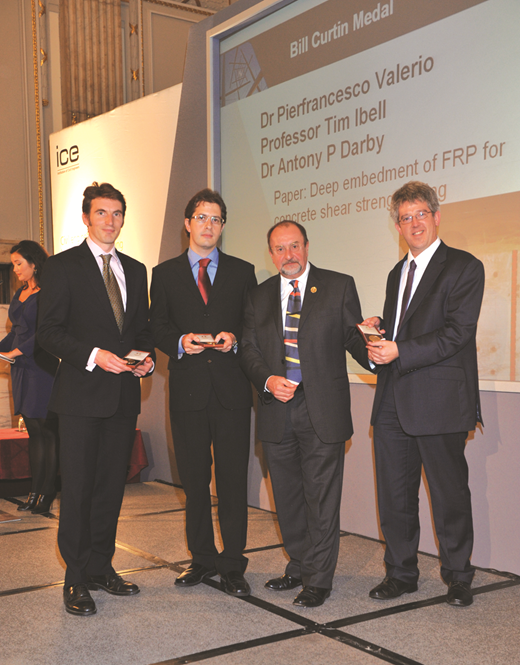
The Bill Curtin Medal, presented for the best paper on innovation, was awarded to: Valerio P, Ibell TJ and Darby AP (2009) Deep embedment of FRP for concrete shear strengthening. Proceedings of the Institution of Civil Engineers, Structures and Buildings, 162(5): 311–321.Fig. 1
ABSTRACT
The shear capacity of existing concrete structures is often unable to meet current standards requirements. This may be attributable to increased load requirements, inadequate shear provisions in the original design, deterioration of materials or an increased demand in shear capacity owing to flexural strengthening. There are various approaches to the repair and strengthening of existing concrete structures in shear using fibre-reinforced polymer (FRP), involving the use of plates or fabrics externally bonded to the web, prestressed straps wrapped around the beam or the use of bars mounted near the surfaces of the web. However, when only the top or bottom faces of the concrete member are accessible, as in the case of bridge beams made contiguous within a deck or for corbels, a different approach is proposed, called the deep embedment technique: vertical holes are drilled into concrete upwards from the soffit in the shear zones, high-viscosity epoxy resin is injected and then FRP or steel bars are embedded into place. In this paper, the results of a series of tests on unstrengthened and strengthened small-scale and large-scale reinforced concrete and prestressed concrete specimens with and without stirrups are presented. The proposed technique is shown to be feasible, successful and potentially more effective than other shear strengthening approaches. A simple model derived from the truss analogy is shown to be able to predict the capacity of the strengthened beams and can therefore be used as a design tool for the scheme.