

Contribution by G. Kaklauskas, V. Gribniak and D. Bacinskas
Cracking and tension stiffening are considered to be among the most complex phenomena in the theory of reinforced concrete (RC). To model tension stiffening, a variety of approaches, techniques and constitutive laws have been proposed. Two of the approaches were applied by Ng et al. (2010) in a unified manner. Using the results of the finite-element analysis of RC beams based on the discrete crack model and the CEB-FIP MC 90 bond stress–slip law, they have derived average stress–average strain tension–stiffening relationships. In the latter, a fictitious descending branch was obtained by averaging stresses along the RC member.
The authors are to be congratulated on some novel findings. By introducing the term ‘shearing action on curvature', they have shown that average stress–average strain tension–stiffening laws differ for tensile and bending members and depend on a loading scheme.
Another interesting point is the conclusion that two different stress–strain tension–stiffening diagrams should be accepted for the non-cracked and the cracked stages. For the latter stage, the average stresses for different loading cases do not exceed 50% of the tensile strength of concrete. For simplicity, the authors have suggested using the same stress block for both the elastic and the cracked stages, indicating that the errors owing to such an assumption should be small.
To verify the proposed constitutive laws, the discussers have performed a statistical analysis of deflection predictions using the layer section model (Kaklauskas, 2004). The analysis was based on the collected experimental data (Gribniak, 2009) consisting of nine test programmes and 80 beams/slabs subjected to four-point bending. The reinforcement ratio varied from 0·2 to 2·4%.
The deflection analysis was performed in relative terms Δ = xcalc/xobs, where xcalc and xobs are the calculated and the measured mid-point deflections/curvatures, respectively. As shown in Figure 10, Δ was calculated for each of the element at 11 loading levels between the cracking (M′ = 0) and the ultimate (M′ = 1) bending moments also expressed in relative terms. As accuracy of deflection predictions was found to be dependent on the reinforcement ratio p (Gribniak, 2009; Kaklauskas, 2004), the experimental data were split into two groups: p ≤ 0·7% and p > 0·7%. Variation of Δ characterises the accuracy of a prediction model and can be assessed by the width of the 95% confidence intervals. The calculation method is assumed to be consistent (with 95% probability), if the confidence interval covers unity.
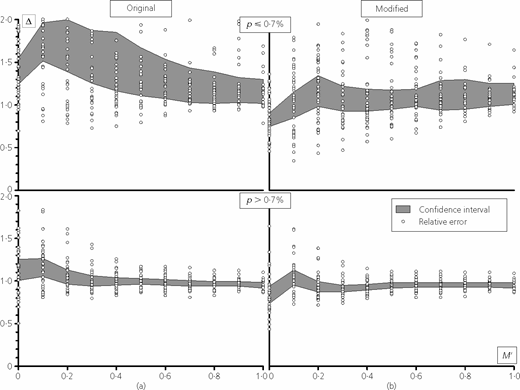
Results of deflection accuracy analysis: (a) original; (b) modified
Results of deflection accuracy analysis: (a) original; (b) modified
The analysis results using the constitutive model proposed by the authors (consisting of two stress blocks) are shown in Figure 10(a). Considerably different results were obtained for the two reinforcement ratio groups. Very good agreement between the calculated and the experimental deflections was achieved for the members with higher reinforcement ratio (p > 0·7%). However, the deflections were significantly overestimated for the lightly reinforced members (p ≤ 0·7%), particularly at the load close to cracking (M' = 0). Variation of the latter deflections was also very high.
The experience of the discussers has shown (Gribniak, 2009) that the tensile strength of concrete is underestimated using the provisions of the CEB-FIP MC 90. A small modification in the latter technique by assuming fck = fcm (instead of fck = fcm – 8 MPa) may improve the results for the lightly reinforced members (p ≤ 0·7%, Figure 10(b)). However, the response of the members with p > 0·7% has become slightly too stiff. In support of the authors' statement, the analysis results were quite similar for the cases when a single and two stress blocks were used.
In conclusion, the discussers would like to raise two more points. First, the stress–strain tension–stiffening laws were obtained on the basis of the CEB-FIP MC 90 bond–slip law proposed by Eligehausen et al. (1983). It was developed from the pull-out tests. However, the applicability of this law to the deformation analysis of RC members has not been proved. On the contrary, investigations of tensile RC members by Wu and Gilbert (2009) have shown that application of the CEB-FIP MC 90 bond model leads to a significantly overestimated tension–stiffening behaviour, showing no degradation with increasing load. Moreover, the reduction of bond-stresses in the vicinity of cracks, confinement and other bond-related effects should be taken into account. Second, a sound model has to include the shrinkage effect (Gribniak et al., 2008; Kaklauskas et al., 2009) which reduces the cracking resistance of the member.
Authors' reply
The discussers have compared the theoretical predictions of beam and slab deflections based on the authors' constitutive model with the experimental results that they have obtained. Very good agreement between the theoretical predictions and the experimental results was achieved for members with reinforcement ratio > 0·7%. However, the theoretical predictions for members with reinforcement ratio ≤ 0·7% were significantly overestimated, particularly at load close to cracking.
When comparing theoretical predictions with experimental results, appropriate Young's modulus and tensile strength of the concrete should be adopted in the theoretical analysis. The discussers seem to have used the formulae given in the CEB-FIP MC 90 to determine these mechanical properties. However, from the authors' own experience, the formulae given in the codes are not necessarily accurate because the Young's modulus and tensile strength could vary from place to place, depending on the type of rock aggregate used. Hence, these mechanical properties should better be measured during the tests using the same concrete of the beam or slab tested. Nevertheless, one simple way of determining the Young's modulus of the concrete is to back calculate from the measured elastic deflection of the beam or slab tested. If the discussers had done so, then any possible errors owing to inaccuracy of the Young's modulus could be eliminated.
From Figure 10 of the discussion, it appears that for members with reinforcement ratio ≤ 0·7%, the theoretically predicted deflection was often substantially larger than the experimentally measured value. More importantly, near or at the ultimate state, when the tension stiffening effect should be relatively small, the theoretically predicted deflection was still much too large compared with the experimentally measured value. Such discrepancy between the theoretical predictions and the experimental results could not be attributed entirely to inaccuracy of the tension stiffening stress block. Part of the overestimation of deflection might be due to errors in Young's modulus and tensile strength. The discussers have studied the effect of varying the tensile strength and demonstrated that the adoption of a more realistic tensile strength value in the theoretical analysis could improve the accuracy of the theoretical predictions.
The authors are in full agreement with the points raised by the discussers that the bond–slip behaviour of the steel reinforcing bars and the shrinkage of the concrete should have significant effects on the tension stiffening of concrete beams. In addition the authors would like to add that the creep of the concrete, which has so far been ignored, might also have a certain effect. Further research along these lines is highly recommended.

