fib-news is produced as an integral part of the fib Journal Structural Concrete. Larger quantities of offprints are made available to National Members Groups on request.
An integrated computational system of mass/energy generation, transport and mechanics of materials and structures
Overall framework proposed in the PhD thesis
For sustainable development in the coming century, it is necessary that infrastructures retain their required performances over the long term. In order to construct a durable and reliable structure, it is necessary to evaluate the lifecycle cost and benefits of the structure, as well as the initial cost of construction. On the other hand, for an already deteriorated structure, a rational maintenance and repair plan should be implemented in accordance with the condition of the structure. Considering these points, it is therefore indispensable to know the structural performances under the expected environmental and load conditions during the service life of a structure.
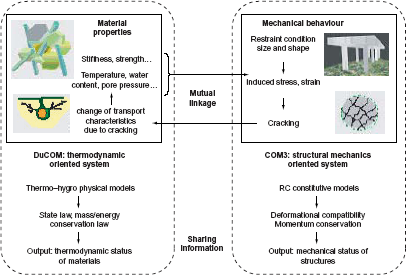
The objective of the PhD thesis was to develop a so-called lifespan simulator capable of predicting structural behaviour under arbitrary environmental/weather conditions and external forces. Figure 1 shows the schematic representation of the proposed lifespan simulator of material science and mechanics of structures, which consists of two computational subsystems; one is the thermo–hygro system that describes developments and deteriorations of cementitious materials,1 and the other is the numerical simulation system for predicting structural behaviours under arbitrary mechanical actions.2

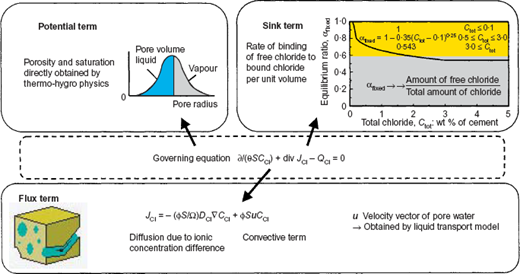
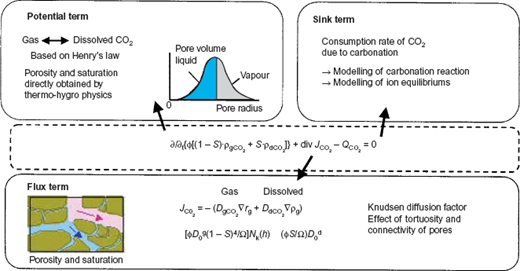
The initial purpose of this research was to develop a computational evaluation method that could predict the long-term deterioration phenomena of materials and the reduction of structural performances under various environmental and weather actions. This technology was successfully embodied by extending the thermo–hygro system named DuCOM, whose targets were originally limited to the early development processes of cementitious materials.3 In this research, equilibrium, adsorption, desorption, the transport phenomena of gas and ion, and the corrosion of reinforcing bars in concrete, were modelled based on thermodynamics and electrochemistry. Furthermore, as the degrees of freedom were solved in the system, concentrations of chloride ion, oxide, and carbon dioxide were added to the overall framework, as well as temperature and pore pressure necessary for the early age development computation (Figure 2). Each physical variable should satisfy the law of mass/energy conservation shown in Figure 2. Potential term S(θ), flux term J(θ), and sink term Q(θ), constituting the governing equations, are formulated as a non-linear function of variables θj based on thermodynamic theory. The obtained material properties are shared through common variables beyond each subsystem, therefore an interactive problem, such as corrosion due to the simultaneous attack of chloride ions and carbon dioxide, can be simulated in a natural way. In addition, it is noted that the simple micro-based modelling is applied without any empirical formulae and/or variable fittings. This methodology means that early development processes and deterioration phenomena during the service period can be evaluated for arbitrary materials, curing and environmental conditions in a unified manner.

The second goal of the research was the unification of mechanics and thermodynamics of materials and structures (Figure 3). In most previous design procedures, structure serviceability and material performance have been treated separately. However, it has to be noted that structural deformations and capacity are really linked, with both micro-pore based deterioration and large-scale mechanical defects represented by cracking, yielding and damage of materials with respect to control volume. In turn, the progress in macro-scale material damage and defects are also dependent on both the structural deformation and environmental boundary conditions. Here, the non-linearly accelerated change of material and structural performances takes place simultaneously. For example, at an early age, cementitious materials change in volume as a result of material-related factors, such as heat generation, autogenous shrinkage, and shrinkage due to drying. These volume changes cause internal stresses in a restrained reinforced concrete (RC) member and sometimes induce cracking, which accelerates the migration of moisture and ions. This results in accelerated steel corrosion and hence reduced durability performance of RC structures. Consequently, in order to evaluate various measures of structural performance over time, it is necessary to quantify the magnitude of these volume changes, the amount of internal stress and damage that results in RC members, and the characteristics of mass transport in the cracked concrete. The thesis shows that a unified approach to the mechanics governing stress and strain fields and the thermo–hygro physics can serve as a technique for ensuring overall concrete structural performance, and the proposed system can be used for the simultaneous evaluation of overall structural and material performances without distinguishing between structure and durability.
Modelling of deterioration and degradation phenomena of cementitious materials
Chloride transport and equilibrium formulation
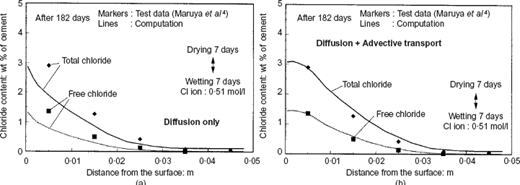
Chloride transport in cementitious materials under usual conditions is an advective–diffusive phenomenon. In the modelling, the advective transport due to the bulk movement of pore solution phase is considered, as well as the ionic diffusion due to the concentration differences (Figure 4). Regarding the relationship between free and bound components of chlorides, the equilibrium conditions are expressed by the empirical equation.4 Assuming local equilibrium, the rate of binding or the change of free chloride to bound chloride per unit volume is obtained. Using these formulae, the distribution of bounded and free chloride ions can be obtained without any empirical equations and/or intentional fittings, once mix proportions, powder materials, curing and environmental conditions are given in the analytical system. As shown in the analytical results (Figure 5), the distribution of bound and free chlorides can be reasonably simulated with advective transport due to the rapid suction of pore water under the wetting phase.
Modelling of carbonation
To simulate the carbonation phenomena in concrete, the equilibrium of gaseous and dissolved carbon dioxide, their transport, ionic equilibriums, and carbonation reaction process, are formulated based on thermodynamics and chemical equilibrium theory. The equilibrium between gas and dissolved carbon dioxide is described based on Henry's law, whereas transport characteristics are formulated by considering the effects of Knudsen diffusion, tortuosity, and connectivity of pores on the diffusivity (Figure 6). Since carbonation is an acid-base reaction and the solubility of precipitations depends on the pH in pore solutions, equilibrium equations with respect to protons are formulated based on the basic principles—the law of mass action, mass conservation, and proton balance (Figure 7). By means of this methodology, the proposed system can be applied not only for carbonation phenomenon, but also for predictions of pH profile in pore solutions attacked by other acids, such as sulphuric acid, nitric acid, etc.

Through various numerical simulations, it is shown that the proposed modelling can roughly predict the carbonation progress and pH fluctuation for different mix proportions, curing, and environmental conditions. Figure 8 shows the comparison of analytical results and empirical formulae that were regressed with the square root t equation. All of the input values in the analysis corresponded to the experimental conditions. Analytical results show the relationship between the depths of concrete in which pH in pore water becomes less than 10.0 and the exposure time. Figure 9 shows the distribution of pH in pore water, carbon dioxide, calcium hydroxide, and calcium carbonate inside concrete, exposed to a carbon dioxide concentration of 3%. Two different water to powder ratios, w/c = 25% and 50%, were analysed. It can be shown that higher resistance for the carbonic acid action is achieved in the case of low w/c ratios.
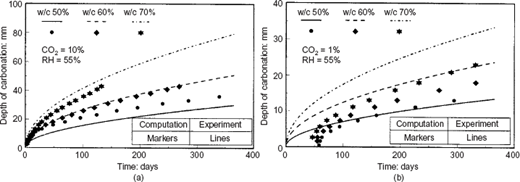
Carbonation phenomena for different carbon dioxide concentrations and w/c ratios
Carbonation phenomena for different carbon dioxide concentrations and w/c ratios

Distributin of pH, calcium hydroxide and calcium carbonate under the action of carbonic acid
Distributin of pH, calcium hydroxide and calcium carbonate under the action of carbonic acid
Micro-cell based corrosion model
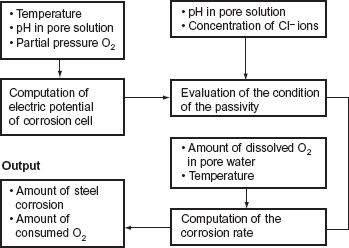
Based on the theories of thermodynamics and electro-chemistry, a micro-cell oriented corrosion model is presented. In the modelling, it is assumed that the corrosion would occur uniformly over the surface areas of the reinforcing bars in a finite volume, whereas the formation of pits due to the localised attack of chlorides and the corrosion with a macro cell remains for future study. Figure 10 shows the flow of the computation of corrosion rate. First, the electric potential of the corrosion cell is obtained from the ambient temperature, the pH in pore solution and the partial pressure of oxide, which are calculated by other subroutines in the system. Next, based on the thermodynamic conditions, the condition of the passive layers is evaluated by the Pourbaix diagram, depending upon the pH and the potential of the steel. From the electric potential and the formation of passive layers, electric current that involves chemical reaction can be calculated so that the conservation law of electric charge should be satisfied in a local area. When the amount of oxygen is not enough for the reaction, the rate of corrosion will be controlled by the diffusion process of oxygen. Finally, using Faraday's law, electric current of corrosion is converted to the rate of steel corrosion. Figure 11 shows an example of corrosion analysis in concrete due to the simultaneous attack of chloride ions and carbon dioxide. One-dimensional concrete members that have three different water to powder ratios, w/c = 40, 50, and 60%, with only one face exposed to the environment, were considered. In this analysis, the stage where concrete cracking occurs was defined as a limit state with respect to the steel corrosion. It can be seen that the concrete nearer to the exposure surface would show early signs of corrosion-induced cracking, while low w/c concrete has a higher resistance against corrosion.

Time until first signs of cracking due to corrosion exposed to carbon dioxide gas and seawater
Time until first signs of cracking due to corrosion exposed to carbon dioxide gas and seawater
Unification of mechanics and thermodynamics of materials and structures
Micro-physical approach to coupled autogenous and dry shrinkage of concrete.
The volumetric change of cementitious materials at an early age is caused by hydration, heat, self-desiccation, and drying associated with water migration, which are dependent on the mix proportion, powder composition, curing, and environmental conditions. In the proposed system, in order to develop a comprehensive predictive method, the volume change focused on shrinkage behaviour is modelled from material parameters related to hydration, moisture, and pore structure development using a thermo–hygro system.
Past research has often introduced capillary tension theory to explain drying shrinkage behaviour.5 Under this assumption, the volume change and deformation of cement paste occurs due to the surface tension force of capillary water across a curved meniscus. In the thesis also, it is assumed that capillary tension force caused by a drop in relative humidity in pore structures leads to shrinkage stress, and also that this mechanism causes autogenous shrinkage, as well as the shrinkage caused by concrete drying associated with water migration.
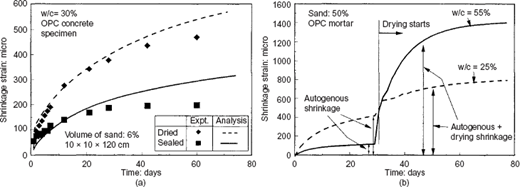
Shrinkage stress is determined by pore pressure, pore distribution, and the water content of the hydrated cement paste based on thermodynamics (Figure 12). The deformability of the microstructure in response to shrinkage stress is modelled based on the computationally evaluated porosity of hydrated cement paste. Regarding the constitutive law describing the stress–strain relationship in terms of shrinkage behaviour, the model proposed by Shimomura's research5 was applied in principle. In the system, autogenous shrinkage need not be distinguished from dry shrinkage caused by water loss. Only atmospheric conditions are necessary for the computation as initial inputs, and the volumetric change can be automatically obtained according to the moisture profile and achieved microstructure in cementitious materials. Through various verifications with experimental data, it is shown that the volumetric changes of concrete can be satisfactorily predicted for different w/c ratios, mix proportions, curing, and boundary conditions. Figure 13 shows several examples of the shrinkage analysis. Figure 13(a) is a verification of combined autogenous and dry shrinkage in concrete with similar mix proportions and curing conditions. One specimen was kept sealed and the other was dried. Figure 13(b) shows numerical simulations for quite different w/c ratios. It has been reported that the shrinkage behaviour of ordinary concrete is quite different from that of low w/c ratio concrete. The analytical results accurately reflect this qualitative tendency.

Development of an integrated computational system of thermo-physics and structural mechanics
For numerical evaluation of overall structural and material performance, parallel processing of two coupled subsystems is proposed, as shown in Figure 14. The main feature of this system is that perfect two-way communication is available between the structural mechanics and material characteristics, whereas in conventional thermal stress analysis, material parameters, such as temperature rise, are passed to the structural analysis in only a one-way transfer.
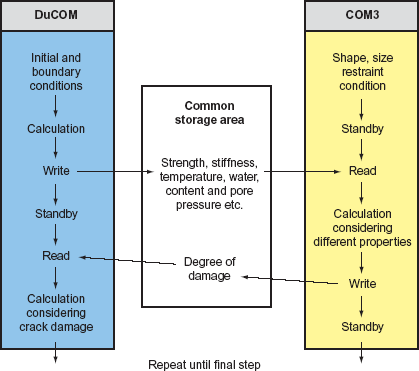
This system can be embodied in a multi-tasking operating system, such as UNIX or Windows. In this framework, constituent subsystems with different schemes for solving the various governing equations do not have to be combined into a single process. The operating system manages the tasks of each system, and the two subsystems are connected by a high-speed signal bus or network to share the common data.
First, material properties are calculated by DuCOM. After one execution, the calculated results for temperature, water content, pore pressure, pore structure, stiffness, and strength are stored in the common data area. A signal to begin the next execution is then sent to the sleeping process (COM3). COM3 becomes active and reads the information from the common data area, using it to perform the stress computation. In this analysis, the damage level of the RC member is obtained, and the calculated results are written to the common area after execution. These steps are continued until one of the processes completes its computation. Following this procedure, each finite element program can share computational results between the two systems at each Gauss point in each finite element.
The main advantage of unifying the material and structural analysis processes in this manner is the numerical stability of an explicit scheme. Furthermore, this multi-tasking method enables engineers to easily link independently developed computer codes, even if they are in different computer languages and based on different algorithms. As a matter of fact, only slight modification is required for data exchange with the common memory space through a high-speed bus, and only a short-system management program is needed. Using the proposed computational system, numerical simulations of moisture loss in cracked concrete were carried out (Figure 15). The target structure in this analysis was a concrete slab, which had a 30% water to powder ratio. After three days of sealed curing, the specimen was exposed to drying. Figure 15 shows the cracked elements, the distribution of moisture, and the normalised tensile stress at each point from the boundary surface exposed to drying conditions. The moisture distribution calculated without stress analysis is also shown in Figure 15 (noted as single calculation). Since moisture conductivity is dependent on the crack width or the continuity of each crack, the conductivity after cracking is modelled by cracking properties as well as by material properties. As these results show, cracking begins from an element near the surface and the crack progresses internally as drying progresses. It is also clear that the moisture loss rises due to cracking.
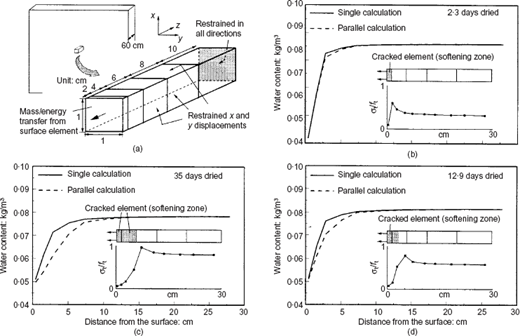
Moisture and internal stress distribution in concrete exposed to drying conditions
Moisture and internal stress distribution in concrete exposed to drying conditions
The author is the winner of the fib 2001 Diploma to Younger Engineers, category Research (see report in fib-news, 2001, 2, No. 4). Following an invitation by the jury, this contribution summarises the achievements of his PhD thesis as presented during the Berlin Technical Activities Workshop on Tuesday 2 October 2001.
References
Steering committee and council meetings, Berlin
Both meetings were again held in common on Monday 1 October 2001, followed by a short meeting exclusively for members of Council in the afternoon of the same day. By invitation of the German national group the meetings were, of course, held in Berlin in conjunction with the fib symposium (see report in the December issue).
Over 30 participants represented 22 national groups (out of 39) in Council, and for the Steering Committee there were six out of 10 commission chairmen present and additionally all 10 elected members. The most important items treated are briefly summarised in the following.
Next model code
Considerations for a new Model Code was the title of a presentation by the President Joost Walraven, leading to a first draft list of content. Substantial comments were made by Peter Marti (Chairman Commission 4, Zurich) who favoured a slightly different structure and suggested to give the working title Model Code 2005 to the new code, in order to have a clearer target. Quite a number of further comments were discussed and finally the Steering Committee appointed a so-called MC 2005 Executive Group, chaired by Joost Walraven, with the following members: Jim Forbes (Deputy-President), Steinar Helland (Norway), Giuseppe Mancini (Italy), Peter Marti (Switzerland), Steen Rostam (Denmark), Peter Schiessl (Germany), Michel Virlogeux (France) and Jun Yamazaki (Japan). The group has the objective to start and guide the revision process, to address commissions and task groups and to coordinate the efforts made.
Commissions and task groups
The constitution of a new Task Group 5.6 Model Code for service life design of concrete structures was accepted. Under the convenorship of Peter Schiessl, the group will report to Commission 5 Structural service life aspects. In Commission 7 Seismic design it is to be expected that the two existing Task Groups 7.1 Assessment and retrofit of existing structures and 7.2 Displacement-based design will be disbanded soon after he completion of their tasks and the publication of two state-of-art reports on buildings that are under final editing for the moment. A new Task Group 7.4 Seismic design and assessment procedures for bridges will be created. Suggested and approved were two co-conveners (Michele Calvi, Pavia, and Kazuhiko Kawashima, Tokyo). The group will establish close liaison to TG 1.2 Bridges. The Steering Committee also approved György Balázs (Budapest) as new chairman of the Special Activitiy Group 2 Dissemination of knowledge, and thanked his predecessor Manfred Wicke (Innsbruck) who had resigned after his retirement from university.
Structural Concrete
The Steering Committee noted with regret that Andrew W. Beeby (Leeds, UK) has had to resign from his position as editor-in-chief. His merits in getting the Journal off the ground and managing its scientific part for the first three years were widely acknowledged and he was congratulated for the achievements made. Jean-Philippe Fuzier (Paris) was appointed editor-in-chief and Luc Taerwe (Ghent) agreed to serve as deputy-editor. Edoardo Cosenza (Naples, Italy) joined the editorial board.
Obituary
Lajos Garay 1923–2002
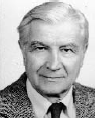
Dr Lajos Garay, FIP-Medallist 1992, died in early February. He started his studies at the Bolyai Military Technical Academy, worked on reconstruction of railway stations and bridges, and then attended the Palatine József University of Technology where he graduated as Civil Engineer in 1947.
Very early on he became Head of the structural department of the largest design bureau for industrial buildings in Budapest, designing major precast concrete halls and other structures, also abroad, e.g. in India. From 1960, he continued his work at the Hungarian Institute for Building Science as Head of Structural Division with his favourite field being the design and technology of PC elements.
In 1961, he started to work in FIP and was later elected as Head of the Hungarian FIP Group (Vice President of FIP) participating in many congresses, symposia, council meetings and commission meetings and often organising such events. Already holding numerous Hungarian awards, Dr Garay received the FIP Medal in 1992 and was later awarded the distinction of Honourary President for lifetime of the Hungarian fib Group. Our sincere sympathy is expressed to his family and friends.
Géza Tassi
Organized by the University of Leipzig, Institute of Structural Concrete and Building Material Supported by the fib, ACI, DAfStb, DBV
As a result of international developments in North America, Japan and Europe, high performance concrete (HPC) is now being investigated and tested intensively. On the one hand, the national and international standards meet the requirements for the use of HPC in building constructions, bridges and environmental engineering and, as a result, allow for the possibility of far-reaching designs for sophisticated building structures. On the other hand, the experience and understanding of using HPC is not yet widespread. In many projects, personnel are coming into contact with HPC for the very first time. The basic understanding of the peculiarities of HPC as a five component system is necessary for its successful application.
The designer has to take into account that, nowadays, HPC is not yet a generally available construction material. Therefore, the designer must take precautionary measures over the design and execution. Compared to ordinary concrete, HPC is more sensitive to a scatter of base materials and irregularities in its production. The excellent properties of HPC are achievable only with the appropriate quality control in production, handling and curing. The necessary care and sensitivity, with regard to the differences with ordinary concrete, must be observed by every person involved in a project. For this reason, an international exchange of experiences about HPC is a valuable contribution to standardising its application.
Programme
The symposium will take place from Sunday evening, 16 June 2002, to Thursday, 20 June 2002. On Sunday evening we would like to welcome the participants in the Neues Rathaus of the City of Leipzig. From Monday to Wednesday there will be oral presentations at the Congress Center, which is part of the New Trade Fair in Leipzig (Neue Messe). The symposium ends with a post-conference tour to Berlin for delegates and accompanying persons. The tour will visit the building sites of the Olympic Stadium as well as the main station ‘Lehrter Bahnhof’. The excursion combines both technical and tourist interests.
On Monday evening we will have a banquet at Da Capo, a restored factory hall at Leipzig-Plagwitz, and on Wednesday evening we will go to Castle Gnandstein, which is one of the oldest and best preserved castles of Saxony (this is for both delegates and accompanying persons).
During the stay in Leipzig a programme for accompanying persons will be arranged. We will offer two tours. The first tour is a visit to Dresden and Meissen, and the second tour is to Wörlitz and Dessau. Dresden is the capital of Saxony and is well known in connection with the reconstruction of the ‘Frauenkirche’ (Our Lady's Church), the Semper Opera House and the ‘Zwinger’. Meissen has become world-famous for the manufacture of royal porcelain. The historic and cultural significance of the Wörlitz Park was acknowledged by UNESCO and it is protected as part of the biosphere reserve ‘Central Elbe’. Close to Wörlitz is Dessau where Professor H. Junkers developed the first all-metal aeroplane in 1919 and where the Bauhaus provided an important influence in design and architecture. There is also a two hour walk through the City of Leipzig and we will visit some of the numerous architectural monuments, such as the ‘Nikolaikirche’ and the Mädler Passage.
Technical programme/sessions
The technical programme includes three full days, starting (Monday morning) and ending (Wednesday afternoon) with a plenary session, where the invited speakers, Professor Aitcin, Professor Fagerlund, Dr Hoff, Professor König, Mr Larrard and Professor Walraven, will present their lectures. In-between, papers from 35 countries will be presented in about 150 parallel sessions. The symposium will provide a comprehensive survey of HPC. The conference deals with the production, transportation and placing, application, properties and design of HPC, and the latest research results will be presented.
Symposium secretariat
Mrs Martina Hoepfner
University of Leipzig
Marschnerstrasse 31
D - 04109 Leipzig
Germany
Tel.: ++49-(0)69-630008-42
Fax: ++49-(0)69-630008-66
Email: hoepfner@wifa.uni-leipzig.de
More details, including a PDF file of the final programme, are available on the website at www.HPC2002.de
Congress and symposia
The calendar lists fib congresses and symposia (also co-sponsored events and, if space permits, events supported by the fib or organized by one of its National Groups). It reflects the state of information available to the Secretariat at the time of printing and the information given may be subject to change.
| Name and location | Event | Main organizer | Contact |
|---|---|---|---|
| 16–20 June 2002 Leipzig, Germany | 6th International Symposium on Utilization of High Strength/High Performance Concrete | Institut für Massivbau and Bau-stofftechnologie Co-sponsored by fib | Professor Dr-Ing Gert König, Universität Leipzig, |
| Institüt für Massivbau and Baustofftechnologie, | |||
| Marschnerstrasse 31, D-04109 Leipzig, Germany | |||
| Tel.: (+49.341) 973 3800; Fax: 973 3809 | |||
| Email: koenig@wifa.uni-leipzig.de | |||
| Web: http://www.hpc2002.de | |||
| 19–21 September 2002 Munich, Germany | 4th International PhD Symposium in Civil Engineering | Institute for Materials and Structures, TU Munich Supported by fib | Institute for Materials and Structures, TU Munich, |
| Germany | |||
| Tel.: (+49.89) 2892 7061; Fax: 2892 7064 | |||
| Email: info@phd.bv.tum.de | |||
| Web: http://www.phd.bv.tum.de | |||
| 6–9 October 2002, Nashville, Tennessee, USA | Annual Convention | PCI | PCI—Precast/Prestressed Concrete Institute, 209 W. |
| Jackson Boulevard, Chicago, IL 60606, USA | |||
| Tel.: (+1.312) 786 0300; Fax: 786 0353 | |||
| Email: info@pci.org | |||
| Web: http://www.pci.org | |||
| 13–19 October 2002Osaka, Japan | 1st fib Congress: ConcreteStructures in the 21 st century | fib Group Japan (JPCEA, JCI) | Japan Prestressed Concrete Engineering |
| Association, 4–6 Tsukudo-cho, Shinjuku-ku, | |||
| Tokyo 162-0821, Japan | |||
| Tel.: (+81.3) 3260 2521; Fax: 3235 3370 | |||
| Email: fib2002@jpcea.or.jp | |||
| Web: http://www.fib2002.com | |||
| 18–19 November 2002 San Francisco, California, USA | Annual Convention | ASBI | American Segmental Bridge Institute, 9201 N. 25th |
| Ave., Suite 150 B, Phoenix, AZ 85021-2721, USA | |||
| Tel.: (+1.602) 997 9964; Fax: 997 9965 | |||
| Email: asbi@earthlink.net | |||
| Web: http://www.asbi-assoc.org | |||
| 20–22 November 2002 Budapest, Hungary | International Symposium on Bond in Concrete—From Research to Standards | Department of Construction, Materials and Engineering Geology Supported by fib | Budapest University of Technology and Economics, |
| Department of Construction, Materials and Engineering | |||
| Geology, Müegyetem rkp. 3, H-111 Budapest, Hungary | |||
| Tel.: (+36.1) 463 4068; Fax: 4654 3450 | |||
| Email: adorjan@vasbeton.vbt.bme.hu | |||
| Web: http://www.eat.bme.hu/bond.html | |||
| 6–9 May 2003Athens, Greece | fib Symposium:Concrete Structures inSeismic Regions | Technical Chamber of GreeceSupported by IABSE | Office for Internal Relations, Technical Chamber of |
| Greece, 4 Karagiori Servias Street, GR-105 62 | |||
| Athens, Greece | |||
| Tel.: (+30.10) 323 5779; Fax: 322 2832 | |||
| Email: fib2003@strulab.civil.upatras.gr; | |||
| intrel@central.tee.gr | |||
| Web: http://www.fib2003.gr | |||
fib-news is compiled, drafted by and produced under the sole responsibility of the Secretary General as an integral part of the fib Journal Structural Concrete. Members of fib or participants in its work (for ex. members of one of its Commissions, Task Groups or Working Parties) are invited to submit to the secretariat any information they would want to disseminate through fib-news. Although the secretariat does its best to ensure that the published information is accurate, no liability or responsibility of any kind (including liability for negligence) is accepted in this respect by fib or its Secretary General. Contributions signed by an author were invited by the secretariat or proposed by the authors. They are published under the sole responsibility of the authors and, contrary to papers in the Journal itself, they are not submitted to a peer review process. Recent issues of fib-news are available free of charge as pdf files on fib website, http://fib.epfl.ch.
fib membership benefits
fib has 39 National Member Groups as statutory members, and about 900 individual or corporate members in about 60 countries. The objectives of fib are to develop at an international level the study of scientific and practical matters capable of advancing the technical, economic, aesthetic and environmental performance of concrete construction. These objectives shall be achieved by the stimulation of research, the synthesis of findings from research and practice, and the dissemination of the results by way of publications, guidance documents and the organisation of international congresses and symposia. The production of recommendations for the design and construction of concrete structures, and the information of members on the latest developments also belong to these objectives.
Individual membership is offered in two categories with the following benefits: Ordinary members receive the quarterly journal Structural Concrete and once a year a technical publication of their choice (‘Bulletin’) at a discount rate. Subscribing members receive a copy of all technical publications (on an average six Bulletins/year and the journal) and may order any quantity of publications at a discount rate (including former CEB or FIP publications).
Corporate membership is available in three categories with the following benefits: Associate members (libraries, companies, engineering offices etc.) may nominate one representative to be registered as individual member of fib, and, in addition to the benefits described above for subscribing members, may request two copies of all technical publications to be sent without extra charge. In addition to this, supporting members are entitled to nominate two representatives to be registered as individual members. They are also entitled to a special mention in the directory and receive discount rates when advertising in the journal Structural Concrete. In addition to this, sponsoring members will enjoy a special mention on the fib website, including a link to their own homepage. They may use fib’s logo by stating ‘Sponsoring member of the fib’ in their letterhead, and may nominate three representatives to be registered as individual members. They are entitled to nominate a member of a task group in one particular field or interest and may send a representative to the General Assembly.
In addition, all members in all categories receive free of charge the latest Directory and enjoy special access to certain information presented on fib’s website. Having attended official fib congresses or symposia, they will also enjoy reduced subscription fees for the year after.