


fib 2012 Symposium, Stockholm: Concrete Structures for a Sustainable Community
Since 2006 when the former U.S. vice-president Al Gore (Nobel Prize Winner 2007) presented his film “An Inconvenient Truth,” the word sustainability has been given high priority in many countries. Concrete is a material that has great potential for sustainability. It is made of natural materials that are almost infinite and accessible in most parts of the world, it can reach a very high durability, and it can be reused and recycled. It also has several advantages in the serviceability state. In buildings, use of concrete can lead to energy savings for heating and cooling. On roads and bridges, concrete surfaces can lead to savings in fuel consumption. In tunnels, the bright surface can lead to savings in energy needed for lighting compared to darker pavement materials.
These are just some examples; the Swedish Concrete Association invites everyone who wants to share his or her findings concerning concrete and sustainability to come to Stockholm in June 2012.
Despite the advantages of concrete, the concrete sector needs to make improvements in order to minimize its environmental footprint and further develop its sustainability. All cement producing countries are striving to minimize CO2 emissions from cement production. The fib 2012 Symposium in Stockhom will provide an excellent forum for both researchers and the material producers who work with these important issues to meet and to discuss.
The theme of the Stockholm Symposium is Concrete Structures for Sustainable Community. We welcome papers on sustainable concrete materials, sustainable concrete production, and sustainable concrete structures, i.e., sustainability has to be regarded in a broad sense. Alternative binders, improved productions methods to minimize construction errors, and design of hybrid concrete structures constitute examples in each category. This categorization shows that the sustainability is important for all parties involved in the concrete sector, i.e. material suppliers, contractors, consultants, architects, owners, users, researchers, and teachers.
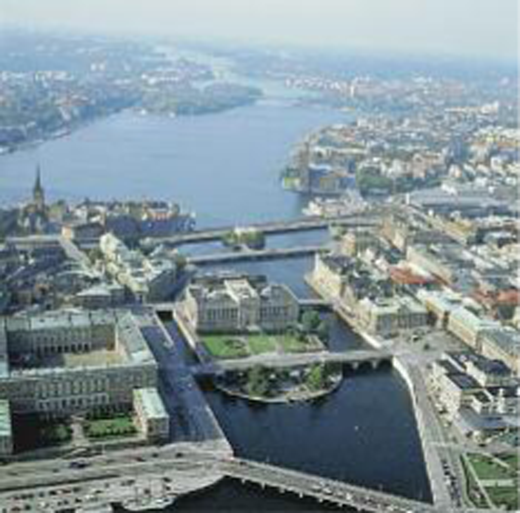
The Swedish Concrete Association has selected Stockholm and the Royal Institute of Technology (KTH) as the host city and venue for the Symposium. Stockholm is the capital of Sweden and has a population of more than one million. It is beautifully situated on the border between the lake Mälaren and the Baltic Sea. The city is never as beautiful as in June when there the sun is up during 18 hours each day and the trees are light green.
Many people know that Stockholm is the city where the Nobel Prize ceremony is held in December every year. KTH accounts for one-third of Sweden's technical research and engineering education capacity at university level. Education and research cover a broad spectrum – from natural sciences to all the branches of engineering as well as architecture, industrial engineering and management, urban planning, work science and environmental engineering. KTH was founded in 1827 and the main campus has been located in attractive, and now listed, buildings in central Stockholm since 1917.
The deadline for the submission of abstracts is 1st July 2011. For further information about the symposium, visit the website www.fibstockholm2012.se; or contact the secretary of the Organizing Committee, Ms. Ann-Thérèse Söderqvist, e-mail: annsod@cbi.se.
fib Presidium: membership changes for 2011
Following the 2010 General Assembly and the recent meeting of the Technical Council (October 2010), the following changes in the fib Presidium will be in place as from 1st January 2011:
President 2011–2012: György L. Balázs. The CV of György L. Balázs is summarised in the June 2008 issue of fib-news.
Deputy President 2011–2012: Gordon Clark. The CV of Gordon Clark is summarised in the March 2007 issue of fib-news.
Immediate Past President 2011–2012: Michael N. Fardis. The CV of Michael Fardis is summarised in the June 2008 issue of fib-news.
Two new elected representatives of the Technical Council for 1st January 2011 to 31 December 2014: Aurelio Muttoni and Koji Sakai.
As announced in the September 2010 issue of fib-news, the elected Presidium members for 1st January 2011 to 31 December 2014 are: Hugo Corres (Spain), Harald Müller (Germany), Tor Ole Olsen (Norway), Jun Yamazaki (Japan). Summaries of their CVs can be found in the December 2006 and March 2007 issues of fib-news.
In addition, incoming President György L. Balázs may co-opt two further members.
New Secretary General of fib

A German citizen, Dr. Schumacher has resided in the Netherlands for several years, earning her doctorate under Prof. Joost Walraven at Delft University of Technology in 2006, and later working for Shell as a civil engineer.
She has been a member of fib since 2006, and presented a paper on her PhD research (thesis entitled “Rotation Capacity of Self-Compacting Steel Fiber Reinforced Concrete”) at the 6th fib International PhD Symposium in Civil Engineering in 2006.
An overlap period of about 6 months with interim Director Rüdiger Tewes is planned to ensure a smooth transition of responsibilities.
fib Commission 1, “Structures”: recent and current activities
An important feature of fib-news is the regular reporting on the work of the Commissions and Task Groups: new groups formed, new publications, and any issues or questions connected with the Commission's and Task Group's terms of reference. Contributions from Commission Chairmen or Task Group Convenors are therefore particularly appreciated, and all involved are invited to contact the secretariat whenever they wish to use fib-news to disseminate information.
fib Commission 1 has a very general title of “Structures” and has an interest in Bridges, Marine structures, Buildings, Tunnels and Containment structures, and especially in Design aspects. It has several current active Task Groups and Working Parties which are progressing the gathering and sharing of knowledge on topics of design of concrete structures where the state-of-the-art is advanced ahead of published design guidance.
This is particularly true in the field of Bridges, and Task Group 1.2 covers this topic, headed by Jean-Francois Klein of Switzerland. Corrugated steel web bridges have been designed and constructed in many countries, and have particularly attractive advantages of economy, especially where they are externally prestressed, and this form of construction is not widely described. A working party headed by Akio Kasuga of Japan is preparing a report on this subject. Also in TG1.2 some design guidance on the important aspects of high speed railway bridges is in preparation, as there are unusual dynamic loads to be considered.
Development of the design of footbridges has progressed rapidly in the past years with more daring and extreme structural forms and shapes appearing, particularly as a result of design competitions. fib Bulletin 32 on Pedestrian Bridges was well received when it was published in 2005 and an update and review of this is underway. This update is focussing on the sections on Dynamics and Illumination, where the state-of-the-art has moved forward significantly.
The world is exploiting its oil and gas reserves and exploration interest is now moving into the arctic regions. TG1.5 is convened by Tor Ole Olsen of Norway, and was especially formed in 2006 to look at reviewing world-wide experience on the performance of offshore concrete platforms and addressing the challenges to be faced in extreme arctic conditions.
Bulletin 50 was published in late 2009 and has subsequently been translated into Russian. Tor Ole Olsen has been lecturing internationally giving audiences the benefit of his experience in this field and promoting the expertise of fib.
Whilst the global recession has caused a dramatic slow down of the number of tall buildings under construction, especially in the Middle East, design guidance for these is quite limited and Task Group 1.6 led by Andy Truby of the UK was established in 2008 and has brought together some of the world's experts to review the state-of-the-art and look at the important aspects for design and construction of tall concrete buildings. This is a very important topic for the future as more and more of the cities of the world expand and seek to build upwards rather than outwards.
The fib Model Code 2010 was published in draft earlier this year and one important aspect of that is the subject for Task Group 1.1 headed by Stein Atle Haugerud of Norway, on Design Applications, which has a working party on the topic of strut and tie models.
Commission 1 oversees all this work and tends to act as a Steering Group for the work of the Task Groups. Meetings are mostly annual and held in conjunction with an fib Symposium or Congress.
Gordon Clark
Chair of fib Commission 1
Status report: fib MC2010
The first complete draft of the 2010 fib Model Code was published in the spring of this year (Bulletins 55 and 56, announced in the June issue of fib-news). The draft has been under review in the interim months by the Commissions and National Delegations of fib, and the first comments resulting from the review were discussed at the recent Technical Council meeting in Corfu, Greece. The final deadline for comments is 1st December 2010, after which a revised draft will be elaborated within Special Activity Group 5 before the next General Assembly (Prague, June 2011) The GA will then thoroughly discuss and hopefull approve this final draft, so that the publication of the definitive MC2010 can be undertaken before the end of 2011.
Workshop on shear and punching shear in RC and FRC elements
A workshop on recent developments on shear and punching shear in RC and FRC elements was held in Salò, Lake Garda, on October 15 and 16, 2010.
The idea of organizing this workshop raised up in Dubrovnik, during the Joint fib-IABSE Conference “Codes in Structural Engineering. Developments and Needs for International Practice”, 3–5 May 2010, after a session on shear strength. Some researchers proposed to have a meeting for presenting the different points of view on shear and punching shear and discussing them altogether with the aim of finding a common point of view to include in the coming building codes, starting from the new fib Model Code, of which the first draft version was presented during the fib Congress in Washington last June.
In fact, a significant change in the shear and punching shear provisions, included in the first draft of Model Code 2010, can be outlined. Four different approximation levels are proposed for designing shear members, incorporating statements and models well recognized such as modified compression field theory (MCFT) and the variable truss angle theory.
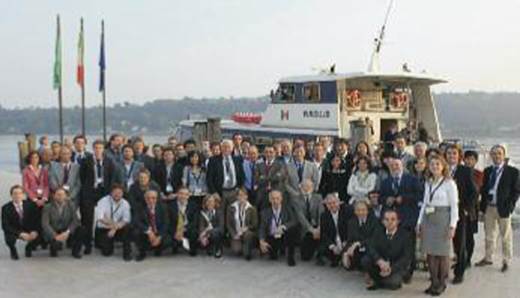
The group of researchers who came up with the idea for the workshop were Profs. Mancini, Minelli, Muttoni, Vandewalle and Walraven. The University of Brescia offered its availability for organizing the event on Lake Garda in middle October, with a strong support from all colleagues.
This group of researchers agreed on the urgent need to discuss the new approaches for shear design and how they meet or diverge one to each other. Moreover, it was found that it is of paramount importance to establish and foresee the implications that the new models may determine in the field and in structural design and applications. These were the main challenges of the workshop!
The workshop, organized by the University of Brescia, Department of Civil, Architectural, Environmental and Land Planning Engineering, was characterized by 18 invited presentations of 30 minutes. With Prof. Stephen Foster, chairman of fib Commission 4, Modelling of structural behaviour and design, and Prof. Viktor Sigrist, chairman of TG 4.2, Ultimate limit state models, it was decided to invite as speakers mainly members of the Task Group and worldwide specialists on punching and punching shear.
The idea of having a limited number of comprehensive and general presentations helped the discussion and an in-depth understanding of the new document and on recent advancements in the field. We had rather interesting discussions of more than 45 minutes: one that will be remembered by many participants is the heated discussion between Profs. Walraven and Collins on how to best model the size effect in shear.
The upcoming New Model Code, an important document for the community of structural engineers, also includes new structural materials such as Fibre Reinforced Concrete, which is quite promising for shear and punching shear. For this reason, one session on FRC was also included in the program.
A total of 72 attendants participated in the workshop, from three different continents and 12 countries, as in the following:
Australia 1; Belgium 2; Canada 3; Czech Republic 1; Germany 7; Hungary 1; Italy 41; Portugal 1; Spain 3; Switzerland 5; The Netherlands 4; UK 1; USA 2.
The workshop was organized, after a welcome and an introduction presentation from fib Deputy president, Prof. Balázs, in three different sessions as follows:
SESSION I: Overview of the MC 2010 for shear and punching shear. Chairmen: Prof. M. Collins and Prof. S. Foster
SESSION II: MC 2010 and recent advancements in shear and punching shear of FRC structural members. Chairmen: Prof. G. Balázs and Prof. di Prisco
SESSION III: Recent Advancements in Shear and Punching Shear of R/C structures.
Chairmen: Prof. G. Mancini and Prof. J. Walraven.
The University of Brescia was honoured to host this significant international event and to welcome top level invited speakers from other continents.
The event was organized in a very limited amount of time. However, the strength of the topic made possible a broad participation of the major worldwide experts. We also had the honour of having two past presidents and the current Deputy President of fib.
Many participants enjoyed the pleasant atmosphere, the venue on the lake shore, the two sunny days and the longest lake promenade in Italy.
Besides the greeting from mayor, City of Salò, to whom the organizing committee would like to express great appreciation for offering the beautiful wooden-roof conference room with original Italian paintings, there was a cultural presentation, given by Prof. Giuriani, on the 2004 earthquake in Salò, concerning strategies for preserving, assess and restore the cultural Italian heritage.
The social program included, on Friday night, a gala dinner at a historic 4-star hotel on the lake front of Gardone Riviera, a charming village next to Salò.
The presented papers will be published in a forthcoming fib bulletin (“Shear and punching shear in RC and FRC elements”) that will most likely become a reference document for shear and punching shear.
Finally, the workshop was an excellent opportunity for meeting and having fruitful discussions. Hopefully this will lead to further research on the field, to the aim of refining and harmonizing the available design analytical models and tools for shear.
The success of the workshop demonstrates the need to take time to constructively discuss open issues instead of a series of simple presentations of research projects, given in a few minutes, within a conference with several parallels (and often confusing) sessions, where in-depth discussion practically does not exist.
Fausto Minelli and Giovanni Plizzari
Dept. of Civil, Architectural, Environmental and Land Planning Engineering
University of Brescia
Workshop: Design of Concrete Structures using EN 1992-1-1
The First International Workshop: Design of Concrete Structures using EN 1992-1-1 was held in Prague on September 16th and 17th, 2010, supported by fib, CEN/TC250 and JRC. It was organised by the Faculty of Civil Engineering, Department of Concrete and Masonry Structures of the Czech Technical University in Prague, in cooperation with Slovak University of Technology in Bratislava and the Technical University in Vienna.
The opening ceremony was followed by the main program, which was divided into five sessions. In the first session, brief information was given about the background of EN 1992-1-1 and acquired new knowledge (Model Code 2010) and the possibilities of future work on EN 1992-1-1 were mentioned. Key presentations in this session were prepared by Prof. Walraven, Profs. Zilch and Lenz, Profs. Corres and Péres, and Prof. Mancini.
The second session was devoted to the presentation of the main features of National Annexes with comparison of the various results obtained by using National Annexes (Austria, the Czech Republic, Belgium, Germany, the Netherlands, United Kingdom, Italy).
Exchange of experience with practical design using EN 1992-1-1 in some European countries, presentation of charts and aids for design for simplification of concrete structures design and proposals for possible improvements of EN 1992-1-1 in future work on this code were the subjects of the third and fourth sessions.
With regard to using some code provisions of EN 1992-1-1 for design of bridges and other civil engineering structures, the last session dealt with the experience of using EN 1992-1-1 in design of these structures and proposal for its improvement. Each session was followed by discussion. At the end of the workshop its outcomes were reviewed: exchange of the experience of European countries with using EN 1992-1 for concrete structures design and presentation of possible improvements of EN 1992-1-1 in future work on this code.
To encourage contact among the participants and to continue discussion the workshop dinner was organised on the boat Admiral on the River Vltava.
The participants appreciated the workshop as very successful and a fruitful contribution to the next work on EN 1992-1-1. It was attended by 89 participants from 16 countries. The organising committee wishes to thank all who contributed to the success of this workshop, especially the supporting organizations and also the sponsors.
V. Vytlacilova, Organising Committee
Workshop on performance based specifications for concrete
Recent advances in cementitious material and chemical admixture technology, as well as the growing use of recycled materials have supported the increasing use of modern types of concrete that are not covered in existing codes and specifications and which are tailor made for specific applications or projects. Traditional prescriptive requirements for constituent materials, limiting water/binder ratios and cement contents are often not applicable for modern construction, while performance based specifications relate to certain performance criteria that can be defined for a particular application.
fib Task Group 8.10 is therefore holding a workshop on performance-based specifications for concrete, which will take place in Leipzig, Germany, on 14–16 June 2011.
The workshop will aim to obtain an overview of the state-of-the-art, to exchange results and to stimulate discussion between researchers and industry. Participation will be limited to 100 persons in order to encourage deeper interactions and discussions.
Important dates:
| Abstract submission | 30 Nov. 2010 |
| Abstract acceptance | 07 Dec. 2010 |
| Paper submission | 31 Jan. 2011 |
| Paper review completed | 28 Feb. 2011 |
| Final paper submission | 31 Mar. 2011 |
| Registration | 31 May 2011 |
| Workshop | 14–16 June 2011 |
For further information visit the workshop website: www.mfpa-leipzig.de
fib Switzerland Group: Concrete Day 2010
On September 1st, 2010, the Swiss group of fib (fib-CH) organized the second “Concrete Day” at the Ecole Polytechnique Fédérale de Lausanne (EPFL). A total of 180 participants from all over the country gathered to hear presentations about recent Swiss contributions to the field of concrete structures. These contributions are collected in the Swiss National Report, “Structural concrete in Switzerland”, published for the 3rd fib Congress in Washington, D.C.. They can be freely downloaded from the website of the fib-CH group: fib-ch.epfl.ch/Pubs/2010.
The conference, chaired by Prof. Aurelio Muttoni from EPFL, was opened by the immediate fib past President Hans-Rudolf Ganz and followed by 11 presentations ranging from architecturally and environmentally challenging buildings to innovative bridges and floating structures. It was concluded by a presentation of recent French bridges by fib Honorary President Michel Virlogeux.
The meeting was followed by a reception at the new EPFL Rolex Learning Center, the design of which was presented by Prof. René Walther (Honorary President of FIP).
Obituary
Gerd Thielen, 1942-2010
As this issue of fib-news was about to go to print, the secretariat received the sad news that Gerd Thielen passed away on 31 October 2010. Born in 1942, he received his PhD in Civil Engineering from the Technical University of Munich and was Technical Director at the CEB Headquarters in Paris from 1979 to 1982. After returning to Germany, he remained strongly involved in CEB work, serving as convener of a General Task Group, member of the Committee for the Model Code 1990 and above all as elected member of the Administrative Council (now: Presidium) from 1983 to 1993. Later he remained involved in fib as a Delegate of the German National Member Group. The current Technical Council members will remember his guest lecture as chairman of CEN TC 104, presented at the London TC meeting in June 2009.
Short notes
A new version of the fib website has been under development and is expected to be online by the end of 2010. In addition to a more modern look and user-friendly interface, a major feature will be a webstore for the purchase of Bulletins and Reports. The URL of the website remains unchanged: www.fib-international.org.
The fib Directory 2011 is in preparation and will be dispatched to fib members in late 2010 or early 2011. As previous editions, it will provide a detailled overview of the association, including the results of recent elections and updates to the Commission Working Programmes and membership lists. The Directory is sent to all fib members in all categories as part of their annual subscription.
Congresses and symposia
The calendar lists fib congresses and symposia, co-sponsored events and, if space permits, events supported by fib or organised by one of its National Groups. It reflects the state of information available to the Secretariat at the time of printing; the information given may be subject to change.
| Date and location | Event | Main organiser | Contact |
| 8-10 February 2011 | 55th BetonTage | FBF Betondienst GmbH | info@betontage.de |
| Neu-Ulm, Germany | www.betontage.de | ||
| 8-10 June 2011 | fib Symposium | fib Group Czech Republic | fib@cbsservis.eu |
| Prague, Czech Republic | “Concrete engineering for Excellence and Efficiency” | www.fib2011prague.com | |
| 14–16 June 2011 | Workshop on performance-based specifications for concrete | Fib TG 8.10 | karsten@mfpaleipzig.de |
| Leipzig, Germany | www.mfpa-leipzig.de | ||
| 13–15 June 2011 | AMCM : 7th International e | Polish Academy of Science fib Group Poland | amcm2011@pk.edu.pl |
| Cracow, Poland | Conference onAnalytical Models and New Concepts in Concrete and Masonry Structur | Cracow Univ. of Techonology | www.amcm2011.pk.ed u.pl |
| Deadline for abstracts: 15 November 2010 | |||
| 1–4 August 2011 | ICASP 11 | ETH Zürich | walzer@ibk.baug.ethz.ch |
| Zurich, Switzerland | International Conference on Applications of Statistics and Probability in Civil Engineering | Institut für Baustatik und Konstruktion | www.icasp11.ethz.ch |
| 9–11 August 2011 | 9th Symposium on High | New Zealand Concrete Society | www.hpc-2011.com/nz |
| Christchurch, New Zealand | Performance Concrete: Design, Verification & Utilization | ||
| 11–14 June 2012 | fib Symposium | fib group Sweden | annsod@cbi.se |
| Stockholm, Sweden | www.fibstockholm2012.se | ||
| 20–24 April 2013 | fib Symposium | fib group Israel | provisional email: Engltd2@netvision.net.il |
| Tel-Aviv, Israel | |||
| 10–14 February 2014 | The Fourth International fib Congress and Exhibition | fib group India | Website and call for papers to be announced |
| Mumbai, India |
fib-news is compiled, drafted by and produced under the sole responsibility of the Secretary General as an integral part of the fib journal Structural Concrete. Members of fib or participants in its work (for ex. members of one of its Commissions, Task Groups or Working Parties) are invited to submit to the secretariat any information they would want to disseminate through fib-news. Although the secretariat does its best to ensure that the published information is accurate, no liability or responsibility of any kind (including liability for negligence) is accepted in this respect by fib or its Secretary General. Contributions signed by an author were invited by the secretariat or proposed by the authors. They are published under the sole responsibility of the authors and, contrary to papers in the Journal itself, they are not submitted to a peer review process. Recent issues of fib-news are available free of charge as pdf files on the fib website, www.fib-international.org.
©fib 2010. fib, Case Postale 88, CH-1015 Lausanne, Switzerland. Tel: +41 21 693 2747; Fax: +41 21 693 6245; Email: fib@epfl.ch
fib - fédération internationale du béton - the International Federation for Structural Concrete - is grateful for the invaluable support of the following National Member Groups and Sponsoring Members, which contributes to the publication of fib technical bulletins, the Structural Concrete Journal, and fib-news.
National Member Groups
AAHES - Asociación Argentina delHormigón Estructural, Argentina
CIA - Concrete Institute of Australia
ÖVBB - Österr. Vereinigung Für Beton und Bautechnik, Austria
GBB - Groupement Belge du Béton, Belgium
ABCIC - Associação Brasileira da Construção Industrializada de Concreto, Brazil
ABECE - Associação Brasileira de Engenharia e Consultoria Estrutural, Brazil
fib Group of Canada
CCES - China Civil Engineering Society
Hrvatska Ogranak fib-a (HOFIB) - Croatian Group of fib
Cyprus University of Technology
Ceska betonarska spolecnost, Czech Republic
Dansk Betonforening DBF - Danish Concrete Society
Suomen Betoniyhdistys r.y. - Concrete Association of Finland
AFGC - Association Française de Génie Civil, France
Deutscher Ausschuss für Stahlbeton, Germany
Deutscher Beton- und Bautechnik-Verein e.V. – dbv, Germany
Technical Chamber of Greece
Hungarian Group of fib, Budapest Univ. of Tech. & Economics
The Institution of Engineers (India)
Management and Planning Organization, Iran
IACIE - Israeli Association of Construction and Infrastructure Engineers
Consiglio Nazionale delle Ricerche, Italy
JCI - Japan Concrete Institute
PCEA - Prestressed Concrete Engineering Association, Japan
Administration des Ponts et Chaussées, Luxembourg
Betonvereniging - fib Netherlands
New Zealand Concrete Society
Norsk Betongforening - Norwegian Concrete Association
Chancellery of the Polish Academy of Sciences
Committee of Civil Engineering, Concrete Structures Section, Poland
GPBE - Grupo Portugês de Betão Estrutural, Portugal
Society For Concrete and Prefab Units of Romania
Technical University of Civil Engineering, Romania
Association for Structural Concrete (ASC), Russia
Association of Structural Engineers, Serbia
Slovak Union of Civil Engineers
Slovenian Society of Structural Engineers
ACHE - Asociacion Cientifico-Técnica del Hormigon Estructural, Spain
Svenska Betongföreningen, Sweden
Délégation nationale suisse de la fib, IS-BETON, EPFL, Switzerland
ITU - Istanbul Technical University, Turkey
Research Inst. of Build. Constructions, Ukraine
fib UK Group
ASBI - American Segmental Bridge Institute, USA
PCI - Precast/Prestress. Concrete Institute, USA
PTI - Post Tensioning Institute, USA
Sponsoring Members
Preconco Limited, Barbados
Liuzhou OVM Machinery Co., Ltd., China
Consolis Technology Oy Ab, Finland
Fachverband Beton- u. F. B.-W. e. V., Germany
FIREP Rebar Technology GmbH, Germany
MKT Metall-Kunststoff-Technik GmbH, Germany
Larsen & Toubro Ltd., ECC Division, India
Sireg S.P.A., Italy
Fuji P. S. Corporation Ltd., Japan
Kajima Corporation, Japan
Obayashi Corporation, Japan
Oriental Construction Co.Ltd., Japan
P. S. Mitsubishi Construction Co., Ltd., Japan
PC Bridge Company Ltd., Japan
SE Corporation, Japan
Sumitomo Mitsui Construct. Co. Ltd., Japan
BBR VT International Ltd., Switzerland
SIKA Services AG, Switzerland
VSL International Ltd, Switzerland
PBL Group Ltd., Thailand
CCL Stressing Systems Ltd., United Kingdom
Strongforce Engineering PLC, United Kingdom

