

fib-news is produced as an integral part of the fib Journal Structural Concrete. Larger quantities of offprints are made available to National Members Groups on request.
fib Award for Outstanding Structures 2006: call for entries
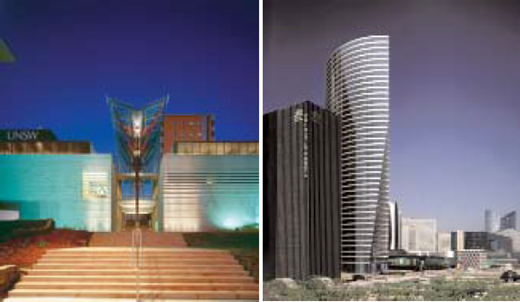
Winners of the 2002 edition of the fib Award for Outstanding Structures included The Scientia, Sydney, and the PB6 Tower, La Défense, Paris
Winners of the 2002 edition of the fib Award for Outstanding Structures included The Scientia, Sydney, and the PB6 Tower, La Défense, Paris
Applications are now being accepted for the 2006 edition of the fib Award for Outstanding Structures. This award is given every four years at fib Congresses to improve the international recognition of concrete structures, which demonstrate the versatility of concrete as a structural medium. It consists of a bronze plaque to be displayed on the structure, and of certificates given to the principal parties responsible for the work. Nominations for candidates are made by the fib National Groups. A jury designated by the Presidium selects the winners, which will be unveiled during a special ceremony at the next fib Congress in Naples, Italy, in June 2006.
The deadline for applications is 22 October 2005.
The structures submitted must have been completed during the last four years before the Congress at which the award is to be attributed, not counting the year of the Congress (this means that nominations for awards are now sought covering the period 1st January 2002 to 31st December 2005.) The jury may accept an older structure, completed one or two years before, provided that it has not been already submitted for the previous award attribution (Osaka 2002).
Entry forms, available on the fib website, are to be filled in by the candidates. For their submission, they must have the support of a Head of Delegation or the National Member Group Secretary in order to confirm the authenticity of the indicated authors.
Applications will consist of a completed entry form and a CD-ROM containing all necessary information for use by the jury. Short texts of about one page (or 500 words) each, should explain the history of the project, description of the structure, particularities of its realisation (difficulties encountered, special solutions found, etc.)
Moreover, three to five representative photos of the whole structure and/or any important details or plans, should also be submitted in the CD. (Note that by applying for an award, the copyright to publish one or more of these photos, or part thereof, will be granted to fib.)
The jury will attribute one or two ‘Awards’ and two or three ‘Special Mentions’ in each category, but is free to change these numbers according to the entries received. It will take into account criteria such as:
design aspects, including aesthetics and design detailing,
construction practice and quality of work,
environmental aspects of the design and its construction,
durability and weathering potential,
significance of the contribution made by the entry to the development and improvement of concrete construction.
Further information on the application procedure and requirements is available on the fib website: www.fib-international.org/about/awards.
Collaboration between engineers and architects: the example of the Millau viaduct
We are pleased to present the following interviews to our readers, reproduced with permisssion from NCE magazine. Highlighting an important aspect of bridge construction, the cooperation between civil engineers and architects, which has always been highly valued by fib‘s Honorary President Michel Virlogeux, they will certainly be of interest to many fib members.
“The Millau's tale”: an interview with Lord Foster, first published in December 2004
This week's opening of the stunning Millau Viaduct in the south of France was performed with great ceremony by head of state Jacques Chirac. But without doubt, the brighter media star was a figure standing alongside the president, UK architect Norman Foster.
Foster, whose winning design has been transformed into eight soaring spans of concrete and steel, is world famous, with a string of high profile, international projects to his name.
His structural engineering counterpart on the project, Michel Virlogeux, is also well known – although his fame is pretty much limited to France. He was acclaimed as lead designer of the Pont de Normandie and Millau has reinforced his excellent credentials.
Virlogeux's high level of public recognition is in part cultural. Engineers have historically enjoyed far higher prestige in France than in the UK. Had Millau been built in the UK, though, Foster would almost certainly have generated more column inches than the scheme's civil engineers.
Engineers have to put up with such overshadowing, and by and large they shut up. But it does not sit well with them. Foster felt the profession's simmering resentment during the infamous Bankside Millennium Bridge debacle. Tempers briefly boiled up after Foster distanced himself from the problem, landing blame squarely on the engineer.
So in talking to NCE about what the architect can bring to big civil engineering projects Foster treads carefully, emphasising that bridges are primarily engineering projects. “That is the dominant aspect,” he says. “We do not bend the engineering to suit our ideas but work with it, and perhaps even draw out the possibilities.”
But as soon as he begins to explain how the Millau design developed you can understand how well architecture interacted with engineering, and how important it is. Certainly the structural engineers on his team thought so; among half a dozen entries competing for France's most prestigious job in 1993, his was the only one which had the architect as the spokesman. “The others were persuasive and insisted that I presented – although I only did it on the basis that any engineering aspects should be queried as a direct conversation between the jury and the engineers.”
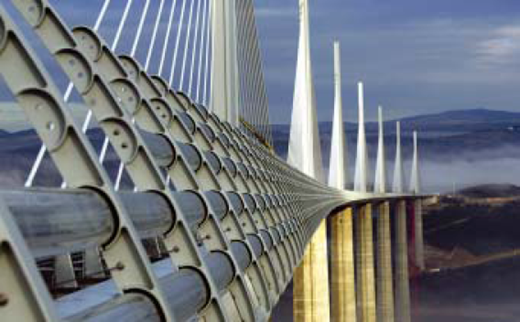
What he did was to jump straight in at the highest point, confronting the selectors with a philosophical challenge, he says. “I began by asking them a question – was this to be a bridge over the Tarn which celebrated the river crossing in a heroic manner? ‘If so,’ I said, ‘then we are not your team, because that is not what we have done. We believe this should instead be a link from one plateau to another – the river is just an incident, albeit important, along the way.”
That decision meant knowing the terrain, Foster says, the feel of the landscape, the shape of the huge valley, and careful study of the many upward or distant horizontal sight-lines. It it also meant a creative dialogue with the engineers from the outset about what was possible.
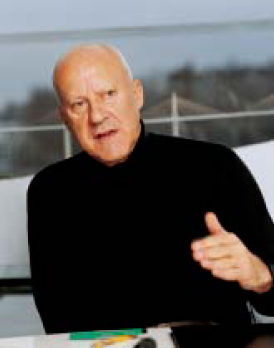
That could be done, he says, because the right individuals were able to interact – especially he and Virlogeux, who was with consultant Setra during formulation of the scheme, and then moved to become an adviser to the client once the project began detail design and construction.
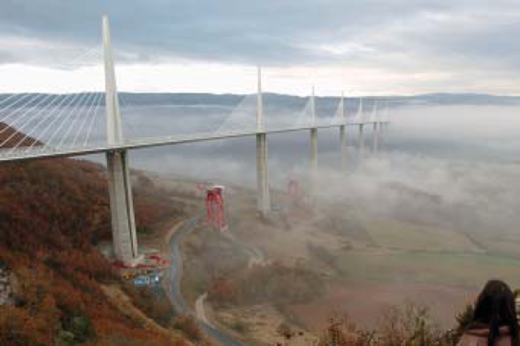
Collaboration is always “a question of individuals and the chemistry between them”, Foster says, “even though they are, of course, the focus for a whole team effort”. With the right individuals the whole team can be enabled to work together, dissolving the boundaries between engineer and architect, he claims. At Millau the fusion produced a bridge consisting of seven slender piers “marching across this 3km wide landscape”.
Getting the piers right aesthetically involved striking a delicate balance. They would be equidistantly spaced. They had to be economical – structurally efficient and buildable. And their number had to be optimised. Each pier represented massive cost, so there could not be too many of them. Yet, excessively long spans would create their own deck construction difficulties and cost increases. The selected compromise was a span of 342m.
As they grow up from the valley floor the sculpted, tapering piers are designed almost to disappear, says Foster. The large “needle eyes” at their tops begin the process of lightening the structure. Trompe dˇoeil contributes further.
“A sculptor will tell you that if you want a piece to disappear in the landscape it should be dark. I remember a conversation with Henry Moore that a bronze would do this; to make it appear again it should be light.”
Most viewers will see the Millau crossing against a blue or white cloud sky, so the cables are white to minimise their impact. “You can only see them looking from above – but that is for the birds, literally.” He quickly sketches in with dark pen on a recent photograph to show the difference – with cables fully visible the structure is much heavier, “another animal altogether. “And that is completely cost neutral for the engineering,” he adds. The effect is helped by a lightweight deck in steel, proposed by winning concessionaire and contractor Eiffage, which will operate and maintain the link for the next 75 years.
“We suggested both concrete and steel options,” says Alistair Lenczer. “The steel allowed for a slimmer diamond cross section deck. And it also reduced the number of cables needed in each fan by two.” A civil engineer by training, including time at Arup, he now plays an important role in speaking engineer's language within the Foster partnership.
Foster was involved in the selection of the design and build contractor and says he was pleased with a design that “went in the right direction”. His overall concept for the bridge, especially for the hollow curved sides to the piers and the concrete finishes, was firmly pinned down as soon as detail design got under way.
As Eiffage developed detail drawings they were examined and commented on by Foster's six strong project team. Final decisions were made by the client after round-table discussions with engineers and contractors. Eiffage's contract specified that the architect's form should be followed closely. But that did not mean conflicting with engineering needs, Foster emphasises.
For example, a curve in the line of the road, on a large 20km radius, is a key part of appreciation of the bridge by drivers, says Foster. These are after all the “inhabitants” of the structure, he says. “It makes all the difference.” However, it fitted well with the curving approaches of the motorway at either end of the viaduct. These were used as deck fabrication and launch yards; construction of curved deck sections meant no additional land take was required.
Foster maintains that it is critical to follow a project through from start to completion. “You have an interest in every stage – not simply ‘we are the designers’ but looking at the detail all the way through.” Close monitoring and particularly the use of full scale mock-ups of elements such as the deck wind shield are important, he says.
For Foster, work on the viaduct is a part of a philosophy which concentrates on infrastructure and urban spaces as much as buildings. Cities in the modern world make their impact not by individual buildings but as a totality of links and connections, he says. To work on those connections means an integration of the work of the architect and the engineer. Just who is leading depends on the kind of project and those creating the work, he claims. But he is adamant: If a project is to be engineering led, the designer must be able to convince with engineering arguments.
Adrian Greeman, NCE
“Le concepteur”: an interview with Michel Virlogeux, first published in February 2005
Michel Virlogeux's business card says a lot about how he sees engineering - or at least his role as a designer. It declares him as an “engineering consultant and ‘concepteur’ for works of art”.
Immodest the proclamation may seem, but with design of the dazzling Millau Viaduct and Pont de Normandie among the 100 or more bridges on his curriculum vitae, it would be hard to dispute. In the flesh, though, this dapper 58 year old is anything but assuming.
Ensconced in a shabby room loaned out to him by cable stay specialist Freyssinet in the industrial southern suburbs of Paris, Virlogeux explains in rapid-fire English and with a good deal of gesticulation that he sees himself in an 18th century tradition of French engineering.
“In the traditional education of the Ecole des Ponts et Chaussees [where he studied], art was a part of an engineer's training. In the 18th and 19th centuries engineers studied drawing, and on bridge projects they had to develop decoration [as well as make their structures work].” Virlogeux maintains that aesthetics should still be central to the process of engineering design. “This is not a one person view. But,” he laments, “it's a tradition that's in decline.”
Design offices are having aesthetic creativity squeezed out of them by increasingly slender fees, he believes. “They don't have enough time to work, not enough money to develop ideas - and in the long term it means we're losing the best engineering students.”
He also lays much blame for the loss of art in engineering on the use of computers. They dehumanise the design process, he argues. And their ability to crunch the numbers involved in any problem, however bizarre or inelegant, actually stops engineers from asking fundamental questions about form and force.
“The engineer's role is to design a structure with a very clear flow of forces. If you have a very clear idea of how to organise your structure you are able, at least for the main things, to do very simple calculations to check the dimensions and forces. Too many people now are using computers to see how forces pass through a structure. The relationship is upside down. “Personally, I don't have a computer.”
Virlogeux offers the maxim used by the western world's first known engineer, Vitruvius, as a guiding principle. “Utilitas, fermitas and venustas - utility and functionality, stability and durability, and beauty. In that order. It all begins with utilitas. The greatest art comes from making things very simple, but very elegant and perfectly adapted.” In seeing the Millau Viaduct through from conception to completion, Virlogeux has set out to exemplify the synthesis of engineering with art.
He claims to have been unruffled by the widespread misapprehension, even in France, that UK architect Sir Norman Foster designed the leggy, multi-span cable stay wonder. And lately the balance of attention has swung heavily towards Virlogeux, to the extent that the half to full day a week he is giving up to radio, TV and magazine interviews is becoming a cause for concern. “I'm self employed, so when I'm talking to the press I'm not earning.”
Even so, he admits he has been overshadowed by a man who played second fiddle throughout the whole design and construction process. “It probably wouldn't have happened 50 or 60 years ago. I am as much at fault as anyone -engineers have become very bad at communication.”
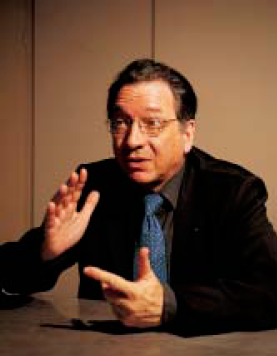
Yet Virlogeux is emphatic: He could not have made the Millau Viaduct the triumph it is without Foster. “I am able to see what kind of structure is fitting to the landscape, and what is technically suited to the conditions and constraints of the location. I'm able to develop the global proportions. But I'm not able to do the detailed shaping, and that's not a minor role. From the global idea you can form the detailed shape so that it expresses the flow of forces and can enhance the structural concept. This is something that, personally, I cannot do.”
He backtracks to the inception of the Millau project in 1988, when as head of state transport agency SETRA's bridges department he started looking for an alignment for this section of the Paris-Barcelona auto-route. Virlogeux decided to cross the valley by descending to the River Tarn from the north. He would leap it with a bridge with a fairly impressive 700m span - the length was important “to limit the height of the piers”. The road would then continue up the steeper southern side of the valley on viaduct before entering a tunnel through the valley wall to reach the plateau above.
“Though it was not beautiful it seemed to me the only practical way. But as soon as the idea was fixed, a road engineer asked: ‘Why do we have to go down [into the valley]? Why don't we go straight across on a viaduct?’ It was absolutely clear, that was the solution.”
Thrilled by his colleague's radical alternative, Virlogeux sketched various multi-span cable stay options and within a few months selected a seven pier design as his favourite. His department worked up 20 or so alternative designs, “some of which were absolutely ugly, absolutely stupid”, to make sure there were no better ideas “and to prove that the multi-span cable stay viaduct was the best”. The list was winnowed down to seven.
But Virlogeux's plans were to be hijacked. Design of the Millau Viaduct coincided with construction of his first really big bridge, the Pont de Normandie, and with a change at the head of SETRA: The director through the 1980s, an engineer “who was interested in everything technical”, was replaced by a politician.
“Nobody cared about the Normandy Bridge when we designed it - really, nobody. I made one design, straight. But when people saw it growing there was huge public excitement. Suddenly, everybody had something to say about it.
“The new head of SETRA saw this and realised that, as soon as Millau became known, it would also attract intense interest. His opinion was that a project coming from within the administration would never be accepted.”
Those fears were realised with Virlogeux's unwitting help. “I made a big psychological mistake in 1992 by making a drawing, showing at the same scale the Millau Viaduct, [Gustave Eiffel's seminal 1884 truss arch] Garabit Viaduct and the Eiffel Tower. The Eiffel Tower was smaller than the tallest pier. This drawing was published in the newspapers, so everybody saw it, and everybody wanted to be involved in the project. There were lobbies organised by contractors, design engineers and architects - mainly architects - and the director decided he wanted to make sure there were no other, better ideas.
“So he organised, not exactly a competition, more a definitive study. There was an absolutely huge response. Seven architects, including Foster, and eight engineers were selected and asked: ‘What do you think about the seven project proposals by SETRA. How would you improve on or treat them? Have you other solutions?’
“Of the responses, only one was similar to mine. It's fair to say they were all more classical. Some of the solutions from architects were absolutely terrible - heavy structures with decoration, with balconies…” Virlogeux momentarily looks as if he has been sucking lemons.
Seven designs, including Virlogeux's multi-span cable stay brainwave and two other SETRA options, were shortlisted. But the upbeat public announcement was accompanied by a blow. SETRA's director declared that the internal design office, Virlogeux's team, would be taking the project no further. The project would be let to external engineer-architect teams.
With 20 years at SETRA, Virlogeux was torn. However, “I had not developed such a beautiful solution to hand it over to somebody else. I believed it to be the best design, and I wanted to get it built.” He prepared to jump from SETRA and set up on his own to take his design forward.
After that, the partnership with Foster came naturally, Virlogeux says. “Foster had been selected [as one of the seven shortlisted designers] because he liked this [Virlogeux's] SETRA solution the best - he was convinced of the solution. He made some drawings which we could not build -the columns and deck were too slender -but were expressing something very simple, straight, light, transparent. This was exactly what I wanted.” They joined forces.
Their working relationship followed a pattern tried and tested on most of the projects he has undertaken. “First the architect has to give his opinion on the solution - how it's introduced into the landscape. Clearly, Foster liked the design.”
The tables then turn. Virlogeux asks his architects to sculpt his structures so they best express the forces at play. “Personally, I can't do the sculpting, but I'm able to see when it's OK. Sometimes I tell architects: “No”. Virlogeux is adamant, he is always in charge.
“The bridge hasn't been designed by Foster, that's very clear. I'm the designer, he is the architect.” Illustrating the difference between design and architecture, Virlogeux carries 100% risk for performance not related to construction. Responsibility for design was written out of Foster's contract.
At no time, however, did Foster's input infringe on structural good sense, though. “Foster understands structures. There's big fashion for architects to do crazy things, and engineers feel obliged to make them work, or to do big and striking things themselves to compete with architects. Some are taking risks. One of the great things about Foster was he did not try to push us in a dangerous direction technically.
“The engineer must not be reduced to the man who does only computations. But nor must you reduce the architect to someone who just does the finishing touches. It's something that must be more integrated.”
Foster's contribution to Millau is measured by its invisibility rather than by any obvious stamp of authorship, Virlogeux says. The bridge's efficiency is laid bare through looking very simple. “You have the impression that there is no work. This is absolutely the contrary.”
The architect's touch can be seen in the way the columns rise apparently straight from the ground. Foster insisted that the viaduct's colossal pile caps be invisible. Finding the ideal form for the columns themselves involved an evolution through 40 scale models.
Millau's box girder deck flows seamlessly into the hillside at either end. “We have designed very unconventional abutments -very narrow, with exactly the shape of the deck - where normally we'd make the abutment wider than the deck to make the transition easier. It was incredibly difficult, but it means that you don't see the end of the bridge.”
Foster also eliminated intermediate piers from the first spans of the viaduct. “An engineer is always a bit handicapped by what he's done before,” Virlogeux explains.
On the Pont de Normandie Virlogeux applied a principle successfully tried on a small cable stay bridge he designed in the 1980s. Intermediate back-span piers were used to provide rigidity, acting as additional anchor points and so stiffening the main span. “All the stays are working as backstays.
“I had that so much in my mind that I put them into the design of Millau. But in fact it's a bit stupid. As the bridge is designed to be stable over its intermediate spans without backstays, of course it could also be stable over its back spans.
“Foster cancelled these intermediate supports in the backspans and I immediately saw why. It makes the structure the simplest possible concept.”
If any doubt lingers about the engineer's feelings for the architect, Virlogeux dispels it. “We're trying to find new competitions to go for together.”
Andrew Mylius, NCE
New bulletins
The series of fib Bulletins for the subscription year 2005 began with number 30, Acceptance of stay cable systems using prestressing steels, and number 31, Post-tensioning in buildings, both mailed to members in April 2005. Brief descriptions are given below. Non-members may order this or any other publication by simply following the instructions given at www.fib-international.org/publications/.
Acceptance of stay cable systems using prestressing steels (fib recommendation)
• fib Bulletin 30, Format approx. DIN A4 (210 × 297 mm), 80 pages, in colour, ISBN 2-88394-070-3
• Non-member price 90 CHF, surface mail included; for airmail add 20% extra charge
• fib Bulletin 30, Format approx. DIN A4 (210 × 297 mm), 80 pages, in colour, ISBN 2-88394-070-3
• Non-member price 90 CHF, surface mail included; for airmail add 20% extra charge
This fib Recommendation gives technical guidelines regarding design, testing, acceptance, installation, qualification, inspection and maintenance of stay cable systems using prestressing steels (strands, wires or bars) as tensile elements, which can be applied internationally. This Recommendation is applicable for cable-stayed bridges and other suspended structures such as roofs. It may also be used for hangers in arch structures and as suspension cables, as appropriate.
This Recommendations has been formulated by an international working group comprising more than 20 experts from administrative authorities, universities, laboratories, owners, structural designers, suppliers of prestressing steels and stay cable suppliers. The text has been written to cover best construction practices around the world, and to provide material specifications that are considered to be the most advanced available at the time of preparing this text. For ease of use, the content has been arranged thematically according to the system components into chapters focusing on performance characteristics, requirements and acceptance criteria.
This Recommendation does not cover the technology of stay cables whose tensile elements are ropes, locked-coil cables, etc. or which consist of composite materials. Nevertheless, in many cases the specified performance criteria may also be applicable to these systems, although numerical values given for the acceptance criteria may need to be adjusted. For these systems it has been difficult to provide multiple protective layers similar to those specified for stay cables made from prestressing steel and therefore, the quality of corrosion protection may not be equivalent.
Post-tensioning in buildings (fib technical report)
• fib Bulletin 31, Format approx. DIN A4 (210 × 297 mm), 116 pages, in colour, ISBN 2-88394-071-1
• Non-member price 100 CHF, surface mail included; for airmail add 20% extra charge
• fib Bulletin 31, Format approx. DIN A4 (210 × 297 mm), 116 pages, in colour, ISBN 2-88394-071-1
• Non-member price 100 CHF, surface mail included; for airmail add 20% extra charge
The development of prestressing technology has constituted one of the more important improvements in the fields of structural engineering and construction. Referring particularly to post-tensioning applications, it is generally recognized how it opens the possibility to improve economy, structural behaviour and aesthetic aspects in concrete solutions.
In spite of the simplicity of its basic concepts and well-known advantages, the application extent of post-tensioning solutions cannot be considered harmonized in the different areas and structural applications. In fact, for various reasons, it appears that the potential offered by prestressing is far from fully exploited, especially in building structures field. In many cases where post-tensioning would provide a visibly superior solution, it often happens that a more conventional non-prestressed solution is selected.
The main objective of this Bulletin is therefore to show the benefits of using post-tensioning for the more common practical applications in concrete buildings. The document is mainly addressed to architects, contractors and owners. It is also drafted with the goal of motivating building designers to use post-tensioning: basic design aspects related to prestressing effects and design criteria are summarized and conceptual design aspects are emphasized.
A set of practical examples is presented, showing the adopted solutions and their advantages when meeting the requirements of specific problems. The selected examples were precisely not chosen because they are outstanding structures. As a matter of fact, post-tensioning principles and technology can be used in any structure, independently of its importance, covering a wide range of building structural applications, improving the structure quality and promoting concrete as a structural material.
The advantages of using post-tensioning, concerning structural behaviour, economy, detailing and constructive aspects, are illustrated by the presentation of several existing structures, most of them designed by Working Party members. General design calculations are not presented, but design results showing the improvement in structural behaviour are illustrated.
Obituary
Jean Muller
1925-2005
Jean Muller passed away on March 17, 2005, at the age of 80. A pioneer in the field of prestressed concrete, he is credited with the development of the match-cast precast segmental construction method for concrete bridges and the first concrete box-girder supported by a single plane of cable stays.
His achievements were widely recognized by awards throughout his career, including the FIP medal in 1978 and the Freyssinet medal in 1998, as well as by IABSE's International Award of Merit in Structural Engineering in 1993 and the Prix Caquot (AFGC - Association Française de Génie Civil) in 1996. In 2002 fib's Outstanding Structures Awards went to the Bras de la Plaine Bridge on “La Réunion” Island, of which Jean Muller was one of the main authors.
Short notes
Congratulations go to some prominent long-standing fib (CEB) members, who celebrate their birthdays at this time of year.
75 years: Hubert Hilsdorf (20 May), Manfred Stiller (3 June) and Yoshio Ozaka (29 July).
70 years: Petro Kryvosheyev (2 July).
65 years: Manfred Miehlbradt (10 May), retiring from the EPF-Lausanne at the end of May.
Congresses and symposia
The calendar lists fib congresses and symposia, co-sponsored events and, if space permits, events supported by fib or organised by one of its National Groups. It reflects the state of information available to the Secretariat at the time of printing; the information given may be subject to change.
| Date and location | Event | Main organiser | Contact |
|---|---|---|---|
| 20-24 June 2005, | 7th International Symposium on | American Concrete Institute | Mr. Thomas H. Adams, Symposium Secretary |
| Washington, D.C., | Utilization of High Strength/High | ACI International | |
| USA | Performance Concrete | thomas.adams@concrete.org | |
| www.concrete.org/events/conferences/ | |||
| 7th_International_Symposium.htm | |||
| 6-9 September 2005 | 2nd All Russian Conference on | fib Group Russia, NIIZhB | Dr. Jury Volkov, Conference Secretary |
| Moscow, Russia | Concrete and Concrete Structures | R&D Institute for Concrete and Reinforced | |
| Concrete | |||
| ysv@niizhb.ru | |||
| www.conf.niizhb.ru/eng | |||
| 8-9 September 2005 | Fibre Reinforced Concrete in | Austrian Society for Concrete | Osterreichische Vereinigung für Beton- |
| Graz, Austria | Practice: 1st Central European | and Construction Technology; | und Bautechnik |
| Congress on Concrete Engineering | fib Groups: Austria, Czech | Graz 2005 | |
| Republic, Hungary | office@ovbb.at | ||
| www.concrete-austria.com | |||
| 28-30 September | fib Symposium: | fib Group Argentina | Symposium Secretariat: |
| 2005, La Plata, | Structural Concrete | Cerrito 1250 (C1010AAZ) | |
| Argentina | and Time | Tel./Fax: +54 11 4815 8154 | |
| www.fib2005argentina.org.ar | |||
| 17-19 October 2005, | 22nd Biennial Conference, | Concrete Institute of Australia | Concrete 2005 |
| Melbourne, Australia | ‘Concrete 05’ | c/o The Meeting Planners | |
| concrete2005@meetingplanners.com.au | |||
| www.coninst.com.au | |||
| 5-8 June 2006, | Second fib Congress | fib Italia | The Secretariat, 2006 fib Naples Congress |
| Naples, Italy | Dip. di Analisi e Projettazione Strutturale | ||
| Università di Napoli Federico II | |||
| fib2006@unina.it | |||
| www.naples2006.com | |||
| 23-26 August 2006 | 6th fib International Ph.D. | ETH-Zürich | Institute of Structural Engineering |
| Zürich, Switzerland | Symposium in Civil Engineering | ETH Hoenggerberg | |
| www.phdce6.ethz.ch | |||
| Fax: +41 44 633 1064 | |||
fib-news is compiled, drafted by and produced under the sole responsibility of the Secretary General as an integral part of the fib journal Structural Concrete. Members of fib or participants in its work (for ex. members of one of its Commissions, Task Groups or Working Parties) are invited to submit to the secretariat any information they would want to disseminate through fib-news. Although the secretariat does its best to ensure that the published information is accurate, no liability or responsibility of any kind (including liability for negligence) is accepted in this respect by fib or its Secretary General. Contributions signed by an author were invited by the secretariat or proposed by the authors. They are published under the sole responsibility of the authors and, contrary to papers in the Journal itself, they are not submitted to a peer review process. Recent issues of fib-news are available free of charge as pdf files on the fib website, www.fib-international.org.
©fib 2005. fib, Case Postale 88, CH-1015 Lausanne, Switzerland. Tel: +41 21 693 2747; Fax: +41 21 693 6245; Email: fib@epfl.ch

