

fib-news is produced as an integral part of the fib Journal Structural Concrete. Larger quantities of offprints are made available to National Members Groups on request.
Numerical Analysis of Bridge Aerodynamics
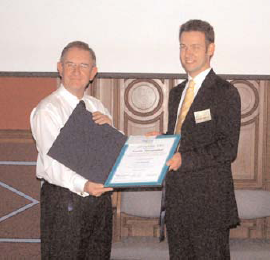
Born in 1975, Guido Morgenthal received his Ph.D. in 2002 from the University of Cambridge. This paper summarises the oral presentation he gave during the Technical Activities Workshop in Budapest in May 2005.
1 Introduction
Phenomena involving the interaction between wind and structures have become important problems in the design of structures. This is due to more slender and light-weight structures, enabled by modern materials, construction methods and design methodologies. The interaction between structural oscillations and the complicated physics of fluid flow around the structure leads to complex feedback problems. Wind-induced vibrations must be predicted and checked against in the design process. Often the aerodynamic problems are a governing factor in the design and early knowledge about the aerodynamic behaviour of a structure is required.
The desire of the engineer to understand the aerodynamic behaviour of a structure at an early stage of its design thus calls for an office-based solution. Here, numerical methods known as Computational Fluid Dynamics (CFD) are a viable alternative to wind tunnel testing. To date these have, despite of a number of successful applications, by far not reached the significance that their equivalents in structural mechanics and structural dynamics have.
2 The Vortex Particle Method
The Vortex Particle Method is a numerical approach to solving the underlying physics of the fluid flow. Being quite distinct from the other established methods such as Finite Volume and Finite Element grid-based Methods it has a number of advantages which make it a favourable tool for flow analysis around bluff body such as bridge towers or decks.
Particularly in its two-dimensional formulation, which is utilised herein, the Vortex Particle Method is considerably more efficient than grid-based methods, thus requiring less computing power and providing results more rapidly.
The scheme models the fluid flow by means of particles which discretise the vorticity field, that is the rotation of the flow. Being a grid-less Boundary Element scheme the method only requires the discretisation of the surface of solid bodies immersed in the fluid. Therefore, preprocessing is much facilitated compared to mesh-based tools which require the discretisation of the fluid on a grid which needs adjusting to the solid interface. During the simulation, the vortex particles are constantly introduced on the body surface, where they evolve to model the viscous rotational boundary layer. They are subsequently convected and diffused through the domain with the unsteady flow patterns evolving naturally.
In the purely grid-less scheme the solution of the Poisson equation to compute the velocity field from the vorticity field is usually done with a Green's function approach. However, this leads to a computation of the order of , where Np is the number of particles. Thus it becomes computationally very expensive for large particle numbers, prohibiting high-resolution simulations. To address this issue, a novel immersed boundary algorithm in the framework of the Vortex-In-Cell Method was developed. This allows for a vortex particle code retaining all the advantages of the classical method whilst improving the efficiency of the velocity computation and the handling of the particle resolution. A hybrid Particle-Particle-Particle-Mesh algorithm was developed. This efficiently solves the Poisson equation on a regular mesh using a fast FFT solver with exact prescription of free-space boundary conditions. The resulting velocity estimate is corrected through direct particle-particle interactions in the near-field thus providing an automatic resolution of sub-grid scales, i.e. contributions that cannot be resolved on the mesh and are usually largest in the vicinity of immersed solid bodies. Due to the trivial regular mesh utilised, no specific input by the user is required.
A redistribution of the particle elements to a regular lattice can be performed to achieve a favourable resolution and ensure the overlap of the vortex cores, which is crucial in achieving converged solutions. A new such particle remeshing strategy was developed which exploits the robustness of the random walk method used for diffusion modelling. The new scheme refrains from remeshing particles close to the solid boundaries, which would otherwise assign vorticity inside the solid region.
Detailed information on the numerical method and its implementation in the VXflow software can be found in (Morgenthal 2002 and Walther & Morgenthal 2002). The convergence of the implementation has been shown. Extensive validation of the code has been done on classical fluid dynamics problems such as stationary and rotating circular cylinders, flat plate boundary layer studies and the oscillating flat plate. Furthermore, comparative studies using wind tunnel data have been performed for various structures, mainly in the field of long-span bridge design. Some results are documented in (Morgenthal 2000, 2002, 2005 and Morgenthal & McRobie 2002).
The pressures on the solid surface are readily available at every timestep, which allows a detailed analysis of aerodynamic forces on structures of arbitrarily complex shape. Furthermore, the code can accommodate movements of the solid interface, such that flow-induced vibrations can be modelled. To this end, the aerodynamic forces can be fed into a structural dynamics solver representing the dynamic behaviour of the structure and the motion of the structure be accounted for in the fluid flow analysis. Thus, fully coupled simulations can be performed.
3 Vortex shedding
A bluff structure embedded in a fluid flow causes a shedding of vortices, which form a distinguished wake behind the body. If the structure is elastically suspended it can undergo oscillations caused by the periodic forces. Such vortex-induced vibrations occur at resonance between the dominant shedding frequency and the natural structural frequency. The body displacements will in turn influence the flow pattern and a complex interaction takes place. Close to resonance a synchronisation between both unsteady processes occurs. This ‘lock-in’ of the flow to the structural vibration thus widens the range of resonance flow speeds. On the other hand, however, the amplitude will always remain limited due to the aerodynamic damping involved.
As an example, analysis results of the vortex shedding from rectangular cylinders are shown here because of their relevance to long-span bridge design, where bridge pylons often exhibit similar cross sections.
Figure 1 shows the predicted non-dimensional vortex shedding frequency (Strouhal number) for cylinders of different aspect ratios. Different vortex shedding patterns are very well represented. In particular the distinct characteristics depending on the vortex formation region is well captured.
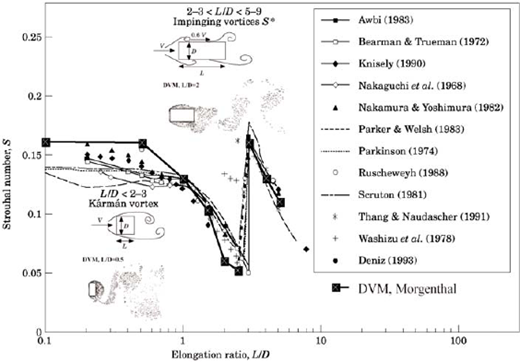
Vortex shedding from rectangular cylinders. Strouhal number St = fshedU∞/D dependence on aspect ratio after (Deniz and Staubli 1998) with added results of VXflow
Vortex shedding from rectangular cylinders. Strouhal number St = fshedU∞/D dependence on aspect ratio after (Deniz and Staubli 1998) with added results of VXflow
The aforementioned influence of structural oscillations on the vortex shedding process was investigated by analyses on a square cylinder. The results are outlined in Figure 2. The vortex shedding from a static, i.e. stationary, cylinder in simulated first. The vortex shedding is manifested in fluctuating lift forces and the frequency spectrum of the lift force time history exhibits a clear peak associated with the dominating frequency of vortex shedding fshed. If in the next step the cylinder is forced to move transversally in the flow according to d(t) = d0sin(2πft) at exactly the frequency f = fshed, the peak in the spectrum becomes even clearer. If the frequency of forcing is, however, increased away from fshed, the shedding is disturbed and a second peak can be seen at the frequency of the forcing motion. When at the same frequency the oscillation amplitude d0 is increased further, the shedding can be “locked-in” to that oscillation frequency entirely.
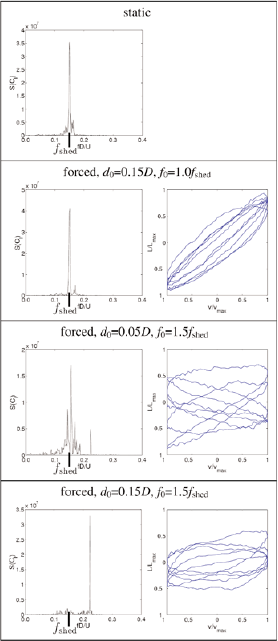
Vortex shedding from a square cylinder for different forcing scenarios. Left: spectrum of lift force time history; right; instantaneous lift force plotted against the instantaneous structural velocity.
Vortex shedding from a square cylinder for different forcing scenarios. Left: spectrum of lift force time history; right; instantaneous lift force plotted against the instantaneous structural velocity.
It becomes obvious, that the interaction between vortex shedding and structural oscillation exhibits rather complex physics. Consequently, in a free oscillation strongly nonlinear coupling exists, leading to the ‘lock-in’ phenomenon. This makes analytical predictions of the amplitudes of vortex-induced vibrations very difficult. Numerical flow modelling can be a useful analysis tool.
4 Bridge deck aerodynamics
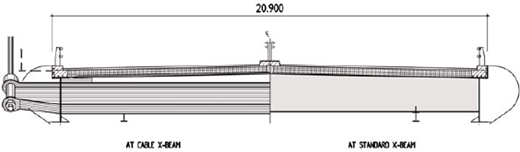
A typical deck configuration of a modern cable-stayed bridge is shown in Figure 3. Steel plate girders with a concrete roadway slab in composite construction are a very economic design. However, such girders are prone to torsional galloping, a one-degree-of-freedom wind induced instability similar to flutter. The bridge deck is thus only stable up to a critical wind speed, which must be shown to lie above the design wind speed
The main factors influencing the critical wind speed are the lowest torsional natural frequency of the deck and the aerodynamic properties of the bridge's cross sectional shape. A number of different sections were tested, shown in Fig. 4 with the surface panel discretisation used for numerical analysis. The original section ORG was extended by a wind nose (two geometries were tested, ALT1 and ALT2). The design ALT3 is derived from ALT1 but features a bottom flange extended further into the girder cavity.
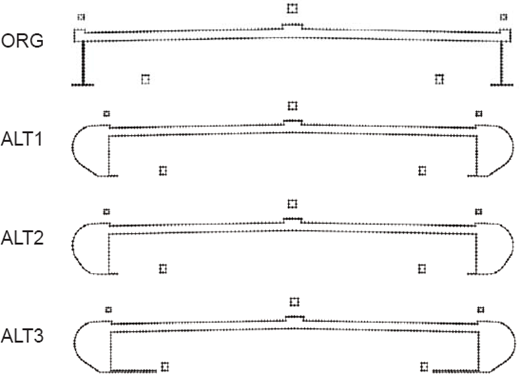
Generic bridge section. Cross section designs studied: original section (ORG), alternative sections with added wind noses (ALT1 - ALT3).
Generic bridge section. Cross section designs studied: original section (ORG), alternative sections with added wind noses (ALT1 - ALT3).
Firstly, the aerodynamic properties were determined for the static bridge deck, yielding mean and fluctuating force coefficients, pressure distributions and vortex shedding frequency content as shown in Figures 5 and 6.
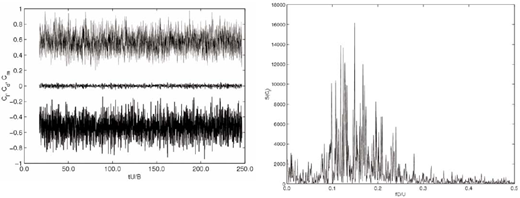
Generic bridge deck ALT1 at 0°. Left: time history of aerodynamic forces: (—) Cl, (—) Cd, (—) Cm; right: FFT of lift coefficient time history.
Generic bridge deck ALT1 at 0°. Left: time history of aerodynamic forces: (—) Cl, (—) Cd, (—) Cm; right: FFT of lift coefficient time history.
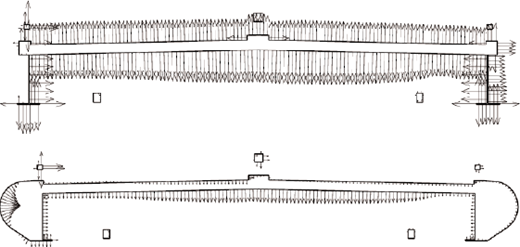
Generic bridge deck at 0°. Mean pressure distributions of the static decks. Top: ORG, bottom: ALT1.
Generic bridge deck at 0°. Mean pressure distributions of the static decks. Top: ORG, bottom: ALT1.
Sample flow visualisation snapshots for the static case are shown in Figure 7, revealing the flow alteration due to the wind nose. The wind nose leads to a more streamlined flow, which is also manifested in the computed drag force. Furthermore, the vortex shedding is less pronounced with a slimmer wake.
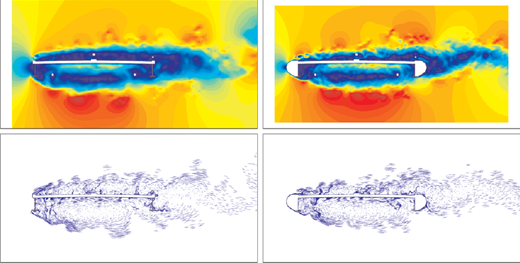
Generic bridge section flow visualisation. Instantaneous flow patterns. Left: ORG, right: ALT1; top: contour plot of the flow velocity, bottom: vortex particle map with streaklines.
Generic bridge section flow visualisation. Instantaneous flow patterns. Left: ORG, right: ALT1; top: contour plot of the flow velocity, bottom: vortex particle map with streaklines.
The motion-induced forces responsible for self-excitation phenomena such as torsional galloping are commonly treated in the framework of aerodynamic derivatives as proposed by (Scanlan & Tomko 1971). Of particular interest in the presented case is the derivative which corresponds to the torsional moment induced due to a pitching motion. In the simplified case without structural damping torsional galloping occurs when turns positive. Identical to common wind tunnel testing practice the derivatives are determined by applying a forced oscillatory motion to the cross section, measuring the induced forces and least-squares fitting these to the derivative definition. To show the favourable effect of the wind nose designs, Fig. 8 plots the value for a non-dimensional wind speed of νr = U∞/fpitch B = 6.0. It is obvious from the reduced derivative that the design evolution successively improved the bridge section stability, by pushing the critical νr to beyond 6.0.
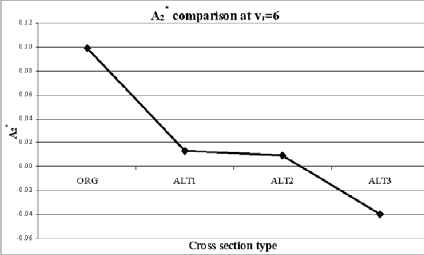
Generic bridge section. Aerodynamic derivative at νr = 6.0 for the different section designs.
Generic bridge section. Aerodynamic derivative at νr = 6.0 for the different section designs.
5 Bridge wind shielding
A study was undertaken to investigate the wind flow around the M4 River Neath Bridge in South Wales. The bridge is situated approximately 1.5km inland from Baglan Bay and crosses the River Neath just south of the A48 road bridge. The bridge, opened in 1994, is 2 kilometres long and split into three separate sections: a five span composite plate girder structure crossing the River Neath, and the approach sections constructed from pretensioned concrete beams with a cast-in-situ deck slab. These approach sections are discussed herein.
Wind loads endangering the passage of large vehicles have been found to occur several times a year, thus necessitating the closure of the bridge. Such traffic interruptions are a severe problem for the local economy. The task was to study the efficiency of different wind screen configurations proposed for a remedy action. The shielding was required to raise the threshold wind speed for overturning of vehicles.
The VXflow code was used to compute the complex air flow around the assembly of structure and wind shield. The particle remeshing scheme described in section 2 was used to ensure a sufficient discretisation of the flow. The simulations provided local velocity profiles on the traffic lanes, design forces on the shielding and the global section wind forces. All results were time-histories which subsequently underwent a statistical analysis.
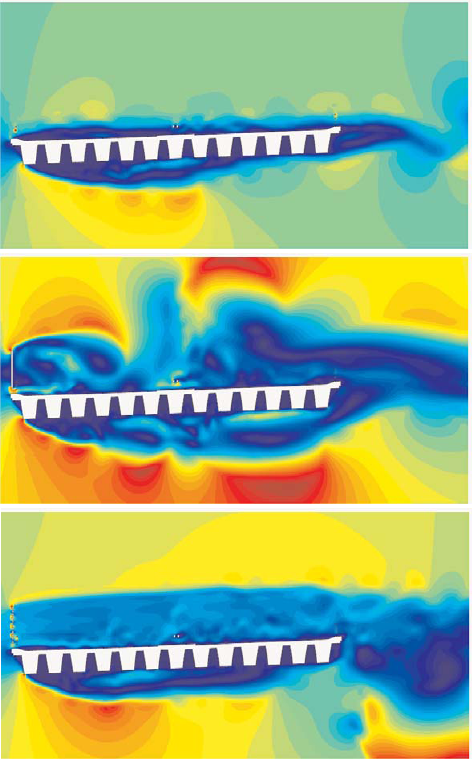
Figure 9 shows flow visualisation results firstly of the bare bridge configuration and secondly of the bridge with two different shield designs: a solid barrier and thin horizontal slats. The velocity distributions show that the traffic on the windward side experiences hardly any shielding from the bare bridge. A solid wind shield was found to block the wind, thus strongly reducing the mean wind speed behind the screen. However, it also creates a large rotating separation zone where strong velocity fluctuations are present, thus challenging the drivers. Hence, this solution was abandoned. A configuration with thin slats evolved as the optimum solution from a parametric study of a number of further designs. The slats not only constitute an obstacle to the oncoming wind but also lead to a stirring of the flow, which reduces velocity fluctuations behind the barrier. A strong reduction of wind loads on vehicles is found with a very steady wind field across the deck. This is evidenced in the statistical analysis depicted in Figure 10.
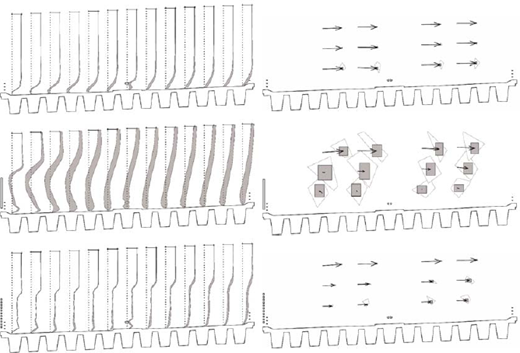
River Neath Bridge. Statistical analysis of velocity fluctuations on the bridge. Left: mean plus/minus one standard deviation velocity profiles; right: arrows indicate the mean velocity, white polygons are defined by the minimum and maximum velocities. Light grey boxes enclose the 5% and 95% fractile velocities; dark grey boxes enclose the standard deviation of the velocity around the mean.
River Neath Bridge. Statistical analysis of velocity fluctuations on the bridge. Left: mean plus/minus one standard deviation velocity profiles; right: arrows indicate the mean velocity, white polygons are defined by the minimum and maximum velocities. Light grey boxes enclose the 5% and 95% fractile velocities; dark grey boxes enclose the standard deviation of the velocity around the mean.
The study also included simulations with vehicles present on the bridge, for which the overturning moment could thus be determined.
Wind tunnel studies performed by another client showed good agreement between the flow patterns visualised by smoke introduction and the numerically computed velocity fields.
6 Summary
A computer code for the aerodynamic analysis of structures has been presented. The underlying Vortex Particle Method allows highly efficient numerical simulations of the fluid dynamics, such that a high resolution can be achieved at relatively low computational cost. Furthermore the visualisation aspect can provide valuable insight into flow properties. Due to its flexibility the method is particularly suited for parametric studies during the early design stages, where wind tunnel test results are not yet available. Hence such simulations can favourably supplement the design process.
References
fib Congress and Exhibition, Naples: 5-8 June 2006
Further the details about the programme for the upcoming fib Congress, taking place in Naples, Italy, from 5 to 8 June 2006, have been made available by the organisers. The programme reveals a full and varied event, which will include keynote lectures by renowned international experts, reports from fib national member groups and commissions, technical and poster sessions covering a wide range of topics, and a commercial exhibition. A rich social programme is also under preparation, including evening events and post-congress tours.
For an overview of the Congress’ preliminary programme, see the table on the following page.
The opening session on June 5th will include the presentation of two prestigious fib awards, the 2006 Awards for Outstanding Structures, and the Freyssinet Medals.
Plenary sessions will take place following the opening ceremony and before the closing ceremony on June 8th. Primary sessions will be held at the beginning of each day's sessions on June 6th and 7th, in parallel with the technical sessions. Leading experts from around the world are invited to talk during these sessions on issues concerning concrete structures in their fields of expertise.
National reports will be given on June 6th, after the Primary session and in parallel with the Technical sessions. Several countries with special topics to report will give oral presentations. Printed materials from fib member countries will be welcome for free distribution. On June 7th, most of the fib commissions and Special Activity Groups will report on their recent activities and upcoming publications.
Technical sessions featuring about 600 papers on the topics listed below will be held on every day of the Congress, except the last. Printed proceedings containing two-page abstracts and a DVD with the full-length articles are currently under preparation and will be distributed to all congress participants.
Technical session topics:
Large projects and innovative structures
Design and construction
Modelling and design
Underground and foundation structures
Composite and hybrid structures
Prefabrication
Plasticity in design of concrete structures
Seismic design of new concrete structures
Seismic evaluation of concrete structures
FRP reinforcement for new and existing structures
Blast protection of concrete structures
Response of concrete structures to high temperatures and fire
Concrete
Reinforcing and prestressing materials and systems
Durability of concrete structures
Safety of concrete structures (new construction, assessment)
Monitoring, maintenance, repair, residual life and failure
Sustainability (recycling, life cycle assessment, dismantling and demolition)
Architectural and environmental design
Preservation of structural concrete heritage
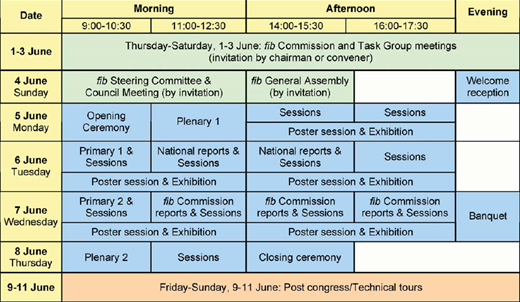
The commercial exhibition will take place in parallel to the sessions, freely accessible to all congress participants.
The symposium venue, the “Mostra dˇOltremare” International Congress Centre, was inaugurated in 1940 and is a prominent example among concrete structures from that period. Comprising several exhibition pavillions within a sheltered park, it will provide ample space and facilities for congress participants to exchange experience, knowledge and innovations on all aspects of structural concrete.
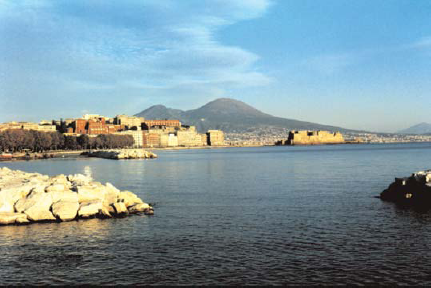
In addition, Naples’ magnificent location on the Bay of Naples, mild climate, and historical and cultural richness will make it an ideal setting for this highly anticipated event.
For further information, visit the congress website: www.naples2006.com.
Symposia in 2007: Calls for papers
fib symposium, Dubrovnik, May 2007
Abstracts are now being accepted for next year's fib symposium, on the theme: “Concrete Structures - Stimulators of Development”. The symposium will take place from 20-23 May 2007, in Dubrovnik, Croatia. It will address the following topics, which were identified as playing important roles in fostering regional and national development and prosperity:
Concrete structures connecting mainland and islands
Concrete structures in energy production
New materials
Analysis
Durability
The deadline to submit an abstract of 200-300 words relevant to one of the above topics is 30 June 2006. Notification of acceptance will be made by 30 September 2006; accepted authors will then have until 31 January 2007 to provide their full papers for publication in the symposium proceedings.
A commercial exhibition will be held in parallel with the symposium at the same venue, offering an ideal opportunity for companies to display their products and services.
Dubrovnik is situated in southern Croatia, on the coast of the Adriatic Sea, an area known for its great natural beauty, warm Mediterranean climate and historic charm. Tours and excursions in and around Dubrovnik will be organised for accompanying persons during the symposium.
Contact information:
fib Croatian Member Group
Janka Rakuse 1, 10000 Zagreb, Croatia
Tel.: +385 1 46 39 329
Fax: +385 1 61 25 100
Email: fib-dubrovnik-2007@igh.hr.
Second symposium on connections between steel and concrete, Stuttgart, 4-7 September 2007
Following the success of the first symposium in 2001, the second symposium on connections between steel and concrete will focus on the local behaviour of connections between steel and concrete without neglecting their influence on the global behaviour of the structure. It will bring together practicians and researchers from both fields to exchange knowledge on the latest technologies and developments for the design of safe, economical composite structures and fastenings to concrete.
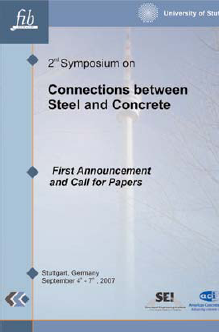
Technical categories: Test methods, behaviour and design, dynamic loading (shock, earthquake, fatigue), durability, response to fire, exceptional structures (airports; power-plants), related topics (post-installed rebars, anchorage to masonry)
Deadlines:
- Submission of abstracts: 15 October 2006; see guidelines given below.
- Notification of acceptance: 15 December 2006.
- Complete manuscripts must be received before 15 April 2007.
Guidelines for authors:
- Abstract title, author(s), full name, title, affiliation, mailing address, telephone, fax, email
- Abstract text in English, Times New Roman 12pt font, classification list, applicable category
- Submit the abstract attached to an Email addressed to abstract@iwb.unistuttgart.de or by fax/mail.
Contact:Secretariat for the Symposium c/o IWB University of Stuttgart Pfaffenwaldring 4, 70569 Stuttgart Germany Tel.: +49 (0) 711-685-3320 Fax: +49 (0) 711-685-2285 symposium@iwb.uni-stuttgart.dehttp://iwb.uni-stuttgart.de
New bulletins
The series of fib Bulletins for subscription year 2005 ended with number 33, Durability of post-tensioning tendons, mailed to members in February 2006. A brief description is given below. Non-members may order this or any other publication by following the instructions given at www.fib-international.org/publications/.
Durability of post-tensioning tendons
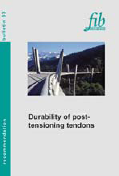
• fib Bulletin 33, Format approx. A4 (210 × 297 mm), 76 pages, in colour, ISBN 2-88394-073-8
• Non-member price 100 CHF, surface mail included; for airmail add 20% extra charge
• fib Bulletin 33, Format approx. A4 (210 × 297 mm), 76 pages, in colour, ISBN 2-88394-073-8
• Non-member price 100 CHF, surface mail included; for airmail add 20% extra charge
The durability of post-tensioning tendons depends undoubtedly on the durability of the materials used, but there are design concept specifics which are also of major importance: the post-tensioning layout and layers of protection such as concrete cover and selected materials in view of the aggressivity of the environment for instance.
It is well known that sustainability principles guide the Engineer from the very beginning, at the project conception, during construction and the service life of a structure. Decisions made during conceptual and design stage have the largest influence on the durability and sustainability of post-tensioning tendons.
fib Bulletin 33 addresses the specifics for prestressed concrete structures: the durability of post-tensioning tendons. It should be noted that it does not repeat topics that have been addressed in other fib bulletins and which is common for both reinforced concrete and prestressed concrete structures. Pre-tensioning, which is used extensively in the precast industry, is not considered, although conclusions and recommendations herein may, in many cases, also be applicable.
This Recommendation was prepared by Working Party 5.4.2, Durability specifics for prestressed concrete structures, in cooperation with fib Commission 9, Reinforcing and prestressing materials and systems. A preliminary version of this recommendation served as the basic document for the second workshop on “Durability of post-tensioning tendons”, held on 11-12 October 2004 in Zurich. This workshop was a follow-up to the first workshop held in Ghent in 2001. Bulletin 33 includes revisions corresponding to the agreed results of the Zurich workshop.
Contents
Design concepts for durable post-tensioning tendons
Materials and construction
Maintenance, assessment and rehabilitation
References
Appendix: Maintenance, assessment and rehabilitation of post-tensioning tendons in existing structures
fib Bulletins can be ordered via the interet (www.fib-international.org) or by mail, email or fax. They are sent regularly to all individual subscribing and corporate members of fib as part of their annual subscription. Ordinary members receive the Journal only, however they are entitled to order a Bulletin once a year at a discount rate.
Short notes
Congratulations to Zdenek P. Bazant, fib member, McCormick Institute Professor and W.P. Murphy Professor of Civil Engineering and Materials Science at Northwestern University, Evanston, Illinois, who received an honorary doctorate (Dr.h.c.) from the Vienna University of Technology. This is his sixth honorary doctorate, after those from the Czech Technical University in Prague; University of Colorado, Boulder; Karlsruhe University, Germany; Milan Polytechnic, Italy; and INSA Lyon, France.
Congratulations also go to Konrad Zilch, recipient of an honorary doctorate in October 2005 from the Darmstadt Technical University in recognition of his special merits in research, teaching and post graduate education and his outstanding work in structural engineering. Konrad Zilch is a longstanding member of former CEB, and now fib and is the chair of concrete structure at the Technical University in Munich. At present he is an active member of fib Commission 2, Safety and performance concepts, Task Group 9.3, Fibre reinforced polymer (FRP) reinforcement for concrete structures and the Working Group Textbook structural concrete in SAG 2, Dissemination of knowledge.
In November 2005 Horst Falkner, chair emeritus of the Institute for Building Materials, Concrete Structures and Fire Protection of the Technical University Braunschweig, received an honorary doctorate from the University Leipzig for his outstanding achievements in research and application of jointless concrete construction, fibre reinforced concrete and high strength materials. He participates in fib in Task Group 8.3, Fibre reinforced concrete and in Special Activity Group 5, New Model Code.
Many of our European members will have known Günter Breitschaft, who passed away on 25 December 2005 at the age of 76. As former President of the Deutsches Institut für Bautechnik, he was much engaged in the development of the CEB/FIP Model codes and their impact on Eurocodes and European Approval Systems. His work was widely acknowledged and for decades he supported the CEB secretariat and encouraged the participation of younger researchers in many ways. Those who knew him will remember him as an exceptional, open-minded personality.
The fib secretariat has recently made short news items available via an “RSS feed”. This web-based service allows users to subscribe to continuous information updates, reducing the time and effort needed to regularly check websites of interest for the latest news items. To subscribe to fib‘s RSS feed, go to the fib website, www.fib-international.org, and click on the orange icon that appears in the address bar of your browser. For further information on RSS feeds, see for example http://en.wikipedia.org/wiki/ RSS_(file_ format).
Reader's letter
CEB Honorary Member Henri Mathieu, former Ingénieur Général des Ponts et Chaussées with the French Highway Administration SETRA, was for many years the chairman of CEB Commissions related to Safety and Loads. He writes:
I found certain of the articles in the recent issues of Structural Concrete of great interest, in particular:
- in Volume 5 (2004), Number 3, the study by Mssrs Vrouwenvelder, Walraven et al, on the spatial (and temporal) variability of the deterioration of concrete structures. We have long known that the representation of each material in a structure by a unique random scalar quantity is a large source of uncertainty which has almost never been quantified. This article shows the possibility and interest of conducting research on this subject, and I hope that the authors’ wishes in this direction will be followed by the fib Commissions.
- in Volume 6 (2005), Number 2, the study by Mr. Wakasa, et al, on the differences of shear resistance of box girder bridge decks depending on the way in which the segments were manufactured and the type of prestressing. There is material to amend the code regulations on this subject.
These studies, and others published by fib (for example the one concerning the Cogan Viaduct in Volume 6 (2005), Number 3), demonstrate once again that international associations such as fib remain indispensable, as only they are able to bring together, even give direction to, certain research studies and to come to synthetic and operational conclusions.
I also noticed in particular in fib-news June 2005, published in Vol. 6, Number 2 the points of view expressed by Messrs Foster and Virlogeux on the general methodology problems encountered and resolved during the Millau Viaduct project. I have also encountered such problems, which were very often overlooked and quite poorly handled. It is exceptional to see them handled in depth as is shown in this issue, and it is important that those who have responsibilities in carrying out studies (technicians or non technicians) recognize the basic conditions which are indispensable in realizing successful projects.
Henri Mathieu
Congresses and symposia
The calendar lists fib congresses and symposia, co-sponsored events and, if space permits, events supported by fib or organised by one of its National Groups. It reflects the state of information available to the Secretariat at the time of printing; the information given may be subject to change.
| Date and location | Event | Main organiser | Contact |
|---|---|---|---|
| 5-8 June 2006, | Second fib Congress | fib Italia | The Secretariat, 2006 fib Naples Congress |
| Naples, Italy | Dip. di Analisi e Projettazione Strutturale | ||
| Università di Napoli Federico II | |||
| fib2006@unina.it | |||
| www.naples2006.com | |||
| 23-26 August 2006 | 6th fib International Ph.D. | ETH-Zürich | Institute of Structural Engineering |
| Zürich, Switzerland | Symposium in Civil Engineering | ETH Hoenggerberg | |
| phdce6@ibk.baug.ethz.ch | |||
| www.phdce6.ethz.ch | |||
| 20-23 May 2007 | fib Symposium: | fib group Croatia | Symposium secretariat |
| Dubrovnik, Croatia | Concrete Structures: Stimulators | Tel.: +385 1 4639 329 | |
| of Development | fib-dubrovnik-2007@igh.hr | ||
| www.igh.hr/fib-dubrovnik-2007 | |||
| 16-18 July 2007 | 8th International Symposium | University of Patras | Symposium secretariat |
| Patras, Greece | on Fiber Reinforced Polymer | Prof. Thanasis Triantafillou | |
| Reinforcement for Concrete | Dept. of Civil Engineering | ||
| Structures | University of Patras | ||
| frprcs8@upatras.gr | |||
| www.frprcs8.upatras.gr | |||
| 4-7 September 2007 | Second Symposium | University of Stuttgart | Symposium secretariat |
| Stuttgart, Germany | on Connections between | c/o IWB University of Stuttgart | |
| Steel and Concrete | symposium@iwb.uni-stuttgart.de | ||

