

fib-news is produced as an integral part of the fib Journal Structural Concrete. Larger quantities of offprints are made available to National Members Groups on request.
fib symposium 2008: Springtime and structures in Amsterdam
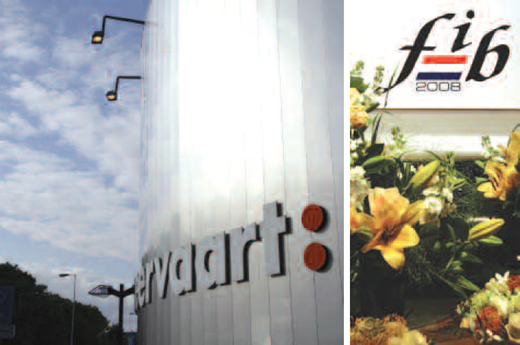
The official 2008 fib symposium took place from 19 to 21 May at the Meervaart conference centre in Amsterdam, The Netherlands.
The official 2008 fib symposium took place from 19 to 21 May at the Meervaart conference centre in Amsterdam, The Netherlands.
Opening session
The symposium opened with a warm welcome from Dick Stoelhorst, Secretary of the Organising Committee, who wished the participants a successful symposium, and commented on the aptness of Amsterdam as venue for this symposium, given its long history of construction and engineering on difficult terrain, its international diversity, and the fact that ten years ago, in 1998, Amsterdam was the venue of the last FIP congress, where the merger of CEB and FIP into fib was celebrated during the closing ceremony.
fib President Hans Rudolf Ganz then provided some information on fib and its activities, in particular introducing the recently elected President and Deputy President for 2009-2010, Prof. Michael N. Fardis and Prof. György L. Balazs, and the incoming fib Secretary General Dr. Anna Bösche (see page 120). He provided a brief overview of the different types of fib awards and honours, announced the attribution (in absentia) of an honorary membership to Prof. Alvaro Garcia Meseguer, and presented Prof. Peter Schiessl with the 2008 fib Medal of Merit (see page 119).
After a rousing jazz interlude by a Delft University Quintet, Joost Walraven, chair of the Dutch organising committee, continued the session with his reflections on the importance of this kind of meeting for scientists and engineering professional to exchange views, brainstorm and make contacts. Indeed such an event could never be replaced by a virtual conference.
The first day's programme then continued with keynote speakers Jacques Combault, Sybe Schaap and Luyanda Mpahlwa, who each elaborated on the theme of concrete solutions to meet specific challenges around the world.
Technical sessions, posters and exhibition
The technical sessions held over the three days of the symposium were made up of three parallel sessions of condensed presentations, so as to maximise as much as possible the number of exchanges among the participants. Topics covered during these session included, among others, Life cycle design, Underground structures, Innovative materials, Monitoring and inspection, Codes for the future, Developing a modern infrastructure, Increasing the speed of construction, and Design strategies for the future. The event's proceedings are published as one volume of brief abstracts and a CD containing the full papers, including poster presentations. To obtain a copy of these proceedings, see www.fib2008amsterdam.nl.
The open layout of the symposium venue, the Meervaart conference centre, was particularly conducive to meetings and exchanges between participants, presenters and exhibitors. On the upper level, the poster presentations were particularly successful, with 55 posters presented throughout the three days of the symposium. The large number of high quality posters received inspired the organisers not only to run the (well-attended) parallel poster sessions, but also to establish a jury to select a “Best Poster” award, attributed by incoming fib President Michael Fardis at the end of the symposium.
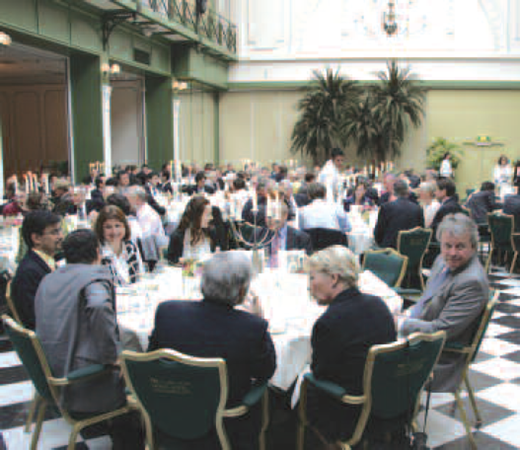
The closing banquet at the Grand Hotel Krasnapolsky was a well-attended, highly enjoyed event.
The closing banquet at the Grand Hotel Krasnapolsky was a well-attended, highly enjoyed event.
The closing session in the afternoon of Wednesday 21 May featured previews of upcoming fib events presented by representatives of the national organizers: this fall's HS/HPC symposium in Tokyo, presented by Dr. Shoji Ikeda, next year's 2009 fib symposium in London, presented by Martin Powell, CEO of the British Concrete Society, and the third fib Congress, to be held in May 2010 in Washington D.C., presented by Jim Toscas, President of PCI.
Following three days of presentations, discussions and deliberations, the Best Poster award went to Thierry Thibaux and his colleagues of Eiffage TP, France, for the poster “UHPFRC prestressed beams as an alternative to composite steel-concrete decks: the example of Pinel Bridge”. According to jury chairman Michael Fardis, the decision was a difficult one due to the overall high quality of the posters.
The symposium concluded with thanks from Hans Rudolf Ganz and Dick Stoelhorst to the participants, organisers, presenters and sponsors who made the 2008 fib symposium a very successful event.
Social programme and excursions
Amsterdam, with its canals, bridges, modern and historic buildings, and particular infrastructure that is continually maintained and renewed, was an ideal location for both technical and social excursion. Symposium participants enjoyed receptions at both the Meervaart conference facilities and in historic buildings in the heart of the city.
Social events provided excellent opportunities for participants to renew and create contacts in a relaxed atmosphere. A well-attended “get-together” party at the Meervaart venue on the eve of the symposium opening set a convivial tone, and was followed the next day by an enjoyable reception in the historic Koepelkerk, a magnificent 17th-century domed church now used for receptions. The highlight of the social programme was certainly the closing banquet at the elegant Grand Hotel Krasnapolsky in the city centre, during which participants had a final opportunity to socialize, relax and renew acquaintances and friendships while enjoying a superb multi-course meal.
The technical excursions following the symposium demonstrated to participants how the Netherlands continually works to keep its cities accessible, protect against floods, and use waterways for transportation. Participants in these excursions had the opportunity for a close-up look at the reconstruction of Rotterdam Central Station, and at the extension of a railway line via a cut and cover tunnel.
Technical Council, General Assembly, Commissions
fib's Technical Council and General Assembly met prior to the symposium. In addition to the usual business of commission updates, upcoming fib events and budgetary approval, the Technical Council discussed forthcoming publications and heard the presentation of guest speaker Prof. Michael Havbro Faber, ETH Zurich, on the Joint Committee on Structural Safety. The General Assembly elected Michael N. Fardis as President and György L. Balazs as Deputy President for the 2009-2010 term (see page 120) and bestowed Honorary membership on Alvaro Garcia Meseguer.
A series of Commission and Task Group meetings also took place in conjunction with the symposium, including SAG 5, which is developing the New Model Code and aiming for a published final draft in 2010; Commission 10, which is finalising its guide on “Formwork and falsework” for publication this year; and Commission 8, recently taken over by Frank Dehn.
Following the symposium, fib Commission 6 held a successful workshop and technical excursion on prefabrication in collaboration with PCI.
2008 fib Medal of Merit awarded to Prof. Peter Schiessl
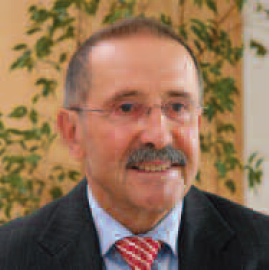
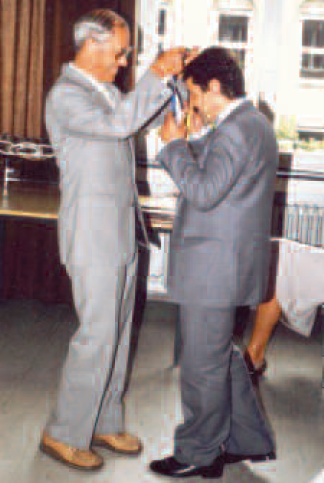
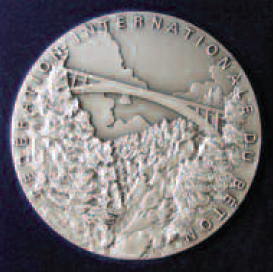
On 19 May 2008, the fib Medal of Merit was awarded to Professor Peter Schiessl, Germany, in recognition of his outstanding contributions to the field of structural concrete, and to fib. The medal was awarded to Professor Schiessl by fib president Hans-Rudolf Ganz during the opening session of the recent fib symposium in Amsterdam.
Born in 1943, Peter Schiessl began his career at the Technical Unversity of Munich, where he obtained his Civil Engineering degree in 1967. He then worked as an assistant at the Institute for Reinforced Concrete Structures, Technical University of Munich and completed his doctoral thesis entitled “Influence of Concrete Cover and Crack Widths on Corrosion of Steel in Concrete” In 1973 he became head of the “Practical Applications” Department of the Institute for Reinforcing Steel, research facility established by industry.
He remained in Munich for the next 12 years, until 1985, when he moved to the Technical University of Aachen to become the Chair for Building Materials and Director of the Institute for Building Materials, a position he held for 13 years.
Since 1998 he is back in Munich in his current position of Chair for Building Materials Testing and Director of the Institute of Building Materials. In parallel he established his own consulting office, Ingenieurbüro Schiessl, Gehlen, Sodeikat.
His main research areas include: carbonation of concrete, chloride ingress into concrete, corrosion of steel in concrete, durability of concrete structures, repair of concrete structures, service life design of concrete structure, bond of steel in concrete, detailing of reinforcement, crack width limitation in reinforced and prestressed concrete structures, material properties of reinforcement and prestressing steel, concrete technology, use of waste materials in building materials, environmental compatibility of concrete, and sustainability in concrete construction
Among his many achievements are over 250 scientific publications, of which more than half concern durability of concrete structures; construction rules for crack width limitation that have been incorporated in the German standard DIN 1045 since 1988 based on his work; fundamentals of durability design in international cooperation developed under his initiation and strong impulse.
Since the early years of his career Prof. Schiessl has been highly involved in the work of CEB and later fib, beginning with the CEB Commissions on Serviceability and Durability. In 1991 he became Vice-Chairman of CEB Commission 5, “Durability” and Convener of the Task Group on Service Life Design.

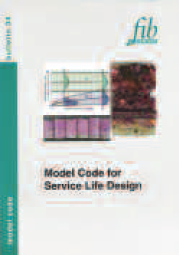
His involvement in the association continued following the CEB-FIP merger in 1998, as member of the fib Steering Committee and Chair of fib Commission 3 “Environmental aspects” from 1998-2002. He was a member of the Editorial Board of the Structural Concrete Journal from 1998 until 2006, and was Convener of fib Task Group 5.6 (2001-2006) which produced fib Bulletin 34, “Model Code for Service Life Design” (2006).
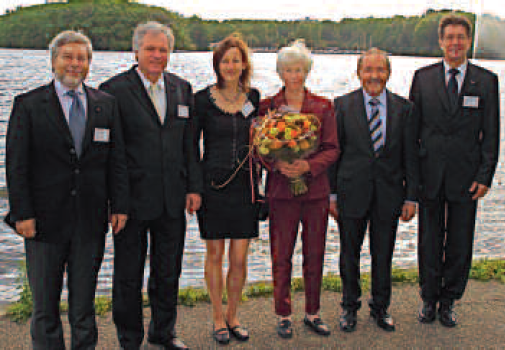
fib officers and the 2008 medallist in Amsterdam. From left to right: 2009-2010 President Michael N. Fardis, 2009-2010 Deputy President György L. Balazs, incoming Secretary General Anna Bösche, Bärbel Schiessl, Peter Schiessl, fib President Hans Rudolf Ganz.
fib officers and the 2008 medallist in Amsterdam. From left to right: 2009-2010 President Michael N. Fardis, 2009-2010 Deputy President György L. Balazs, incoming Secretary General Anna Bösche, Bärbel Schiessl, Peter Schiessl, fib President Hans Rudolf Ganz.
His work in fib continues with his membership in the Technical Council, Deputy in the German national member group, and corresponding membership in Commission 3, Environmental aspects of design and construction, and Special Activity Group 5, New Model Code.
Honorary member
Honorary memberships in fib are given by the General Assembly in recognition of significant personal contributions to the work of fib. At the General Assembly that preceded the symposium, honorary membership was given to Professor Alvaro Garcia Meseguer, Spain, in recognition of his significant personal contributions to both fib and its predecessor CEB (Comité Européen du Béton) for over 40 years, in particular as chairman of several commissions related to Notation and Terminology, as well as to Quality Control and Quality Assurance. Also recognised are his outstanding work for the 1964 and 1978 CEB-FIP Model Code, his support to the CEB secretariat as Technical Co-Director for some years, author of Bulletins, member of CEB's Administrative Council for several terms and his strong involvement the Spanish Member Group in various functions.
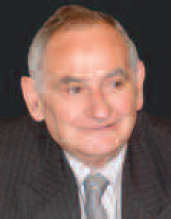
Professor Meseguer was unfortunately unable to attend the Amsterdam symposium to receive this honour in person; his honorary membership certificate will therefore be presented to him in Spain.
fib President and Deputy President, 2009-2010
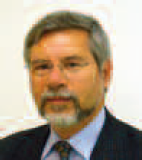
Michael N. Fardis was born in 1949, received his Diploma in civil engineering in 1971 at the National Technical University of Athens, Greece, obtained in 1977 an MSc in Civil Engineering, in 1978 an MSc in Nuclear Engineering, and in 1979 his PhD in Structural Engineering, all from the Massachusetts Institute of Technology, where he subsequently became Assistant and Associate Professor of Civil Engineering. In 1982 he was appointed Professor of Concrete Structures at the University of Patras, Greece, a position which he still holds today, as well as Director of the Structures Laboratory in the Department of Civil Engineering. In 1993 he received the Wason Medal for Materials Research of the American Concrete Institute (ACI). Prof. Fardis co-authored several books and authored about 55 papers in international refereed journals, about 150 papers in international conference proceedings, and numerous research reports. He has been active in CEB since 1985 in various bodies such as the Revision Group of the 1978 Model Code and the Committee for the CEB/FIP Model Code 1990, the Commission 3 ‘Design’ where he also became the convenor of the Task Group on ‘Behaviour and analysis of reinforced concrete structures under alternate actions inducing inelastic response’. He was a member of the CEB Administrative Council in 1997 and an active member of the CEB/FIP Strategy Group. From 1999 to 2005 Prof. Fardis was Chairman of CEN/TC250/SC8, responsible for Eurocode 8, “Design of Structures for Earthquake Resistance”, and for the conversion of its six parts from ENV to EN (European Norm). He was the lead author of the “Designers' guide to EN 1998-1 and EN 1998-5, Eurocode: Design of structures for earthquake resistance”. He is on the editorial boards of fib's “Structural Concrete” Journal, of the “Journal of Earthquake Engineering and Structural Dynamics” and of the “Bulletin of Earthquake Engineering”. Since 1998 he has been a member of the Technical Arbitration Panel in the concession contract for the construction of the 2.5 km deep-water Rion-Antirion bridge, Greece. He is presently a member of Commission 7 on Seismic Design and chaired Task Group 7.1, “Assessment and Retrofit of Existing Structures”, from 1998 to 2002. He is also a member of the Working Group on Short Courses of Special Activity Group 2 and has organised fib courses held in Greece and Turkey. He was chairman of the organising committee of the 2003 fib Symposium in Athens. He was elected member of the Steering Committee for the years 1998-2002, is Head of the Greek National Member Group in fib, and is currently Deputy President of fib.
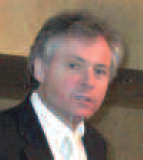
György L. Balazs was born in 1958 and graduated in 1982 at the Budapest University of Technology in Hungary. He worked for a year as bridge designer in the design office Uvaterv before returning to Budapest University for his PhD; part of this period was spent at the Politecnico di Milano. Having received his PhD degree in 1988 he became a lecturer and later a senior lecturer. After three and half years at the University of Stuttgart (from 1990 to 1994) he was appointed as a reader at the Budapest University of Technology, and in 1999 as a professor in structural engineering. His main fields of activities are: experimental and analytical investigations as well as modelling of reinforced and prestressed concrete, fibre reinforced concrete, fibre reinforced polymers, durability, bond, and cracking in concrete. In fib he served as chairman of the jury for the fib Awards for Young Engineers from 1999 to 2005, and currently serves as chairman of the fib Special Activity Group on Dissemination of knowledge and convener of the fib Task Groups on Serviceability models, fib Courses and Model Code Textbook. He also is a member of several other fib groups. He founded the fib International PhD Symposium in 1996, acts as Head of delegation for the Hungarian Group of fib and is a member of the Council since 1998. He was elected a member of the Steering Committee and as its Deputy-Chairman represented the Committee in the Presidium for the period 2002-2006, and has been an elected member of the Presidium since 2007.
fib welcomes incoming SG

Since April 1st of this year, Dr.-Ing. Anna Bösche has joined the fib secretariat staff, where she will take over as Secretary General of the association from Rüdiger Tewes when he retires in 2009.
Born in 1973, Dr. Bösche earned her undergraduate and doctorate degrees from the Technical Unversity of Dresden, under Prof. Manfred Curbach, and a Master's degree from California State University in Los Angeles.
Prior to her employment by fib, she worked as a Research Associate at the Institute of Concrete Construction at the University of Technology of Dresden, specialising in textile reinforcement concrete and reinforced concrete structures.
A transition period of about one year of on-the-job training is planned in order to ensure as smooth a transition as possible. We wish her a warm welcome and great success in her new role.
The third fib Congress and Exhibition
Washington D.C., 29 May – 2 June 2010
The International fib Congress and Exhibition, held once every four years, is always a major event on the concrete industry calendar. The 2010 event will be no exception. The theme for the 2010 Congress is “Think Globally, Build Locally,” celebrating international information sharing and collaboration to achieve superior results wherever people design and build with concrete.
Call for papers and posters
The Congress will offer a peer-reviewed technical programme and also general marketing and management sessions. Engineers and researchers from around the world will find the Congress to be a unique opportunity to share new ideas, experiences and knowledge within the field of concrete structures.
The deadline for receipt of abstracts is 15 April 2009. Abstracts should be submitted electronically via the congress website www.fib2010washington.com. Papers on a wide variety of themes are invited; please see the congress website for the complete list.
Authors of selected papers and posters will be notified of acceptance from the Scientific Committee by 15 July 2009. Final full length papers or posters are due 15 November 2009. Papers and posters will be reviewed by the Scientific Committee for final acceptance.

Parallel poster sessions will be organised for those presentations selected by the Scientific Committee. In these sessions, authors will be given the opportunity to present and discuss their work.
Throughout the congress there will be ample opportunities to network with colleagues and establish or renew contacts. Social events will include a Welcome Reception, daily luncheons, receptions and the closing banquet. Tours and activities will be available for accompanying guests.
Late May is an ideal time of year to visit Washington, with temperatures ranging between 15-25°C. With a wealth of sights, monuments and museums to be visited, the area has much to offer in addition to the congress itself.
For additional information and updates, visit www.fib2010washington.com
London 2009: Deadline for abstracts extended
The organisers of the 2009 fib symposium in London have announced the extension of the deadline for abstracts until 30 June 2008.
Note also that an early-bird registration rate of 975 Euros (instead of the full rate of 1100) is valid until the end of this year.
For more details: www.fiblondon09.com
New bulletins
The series of fib Bulletins for the subscription year 2008 continued with number 44, Concrete structure management: Guide to ownership and good practice. A brief description is given below. Non-members may order these or any other publication via the fib website, www.fib-international.org/publications/.
Concrete structure management: Guide to ownership and good practice
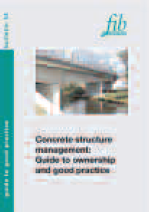
• fib Bulletin 44, Format approx. A4 (210 × 297 mm), 210 pages, ISBN 978-2-88394-084-0
• Non-member price 150 CHF, surface mail included; for airmail add 20% extra charge
• fib Bulletin 44, Format approx. A4 (210 × 297 mm), 210 pages, ISBN 978-2-88394-084-0
• Non-member price 150 CHF, surface mail included; for airmail add 20% extra charge
Construction projects are undertaken to meet a variety of business or service objectives, as well as aspirational needs. The success of a building or an element of infrastructure depends on how well it meets either the owner's needs and interests or those of the users.
Recent changes in owner attitudes to construction are reflected in an increasing interest in through-life costs, i.e. not only the capital costs of construction but also the operational costs associated with a structure's functional performance for a defined life span. The owner can greatly improve the likelihood of achieving the value they seek from the facility by being intimately and effectively involved in the definition of performance requirements at the start of the construction procurement process.
The objective of fib Bulletin 44 is to provide guidance to owners of concrete structures on:
the management of their concrete structures (buildings and infrastructure) as part of their business goals or the service objectives of their organization;
best practice in the management of concrete structures;
their responsibilities with respect to the management of their structures;
the wider context and issues of service life design;
information and direction needed by the supporting professional team of architects, engineers, specifiers, contractors and others.
This Guide also provides background information on topics such as deterioration processes and technical procedures used for the management of concrete structures, including reference to international standards for the protection and repair of concrete structures. These activities are illustrated by some application examples/case histories and by a section addressing frequently asked questions. A brief review is made of some potential future developments.
List of contents
Keywords
Vision behind preparation of document
Introduction and scope of issues
The owners' requirements and obligations
Implications of deterioration of concrete structures
Case histories – dealing with deterioration and extension of asset life
Engineering aspects of structure management
Process management
Application examples – works for the extension of asset life
Standards for the protection and repair of concrete structures
Some frequently asked questions (FAQ)
Future look and developments
References, websites & further reading
Appendices
Congratulations
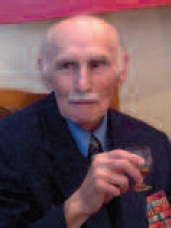
On April 18, 2008, Professor Konstantin V. Mikhailov celebrated the momentous event of his 95th birthday.
Prof. Mikhailov is well known for his invaluable involvement in fib's parent association, FIP. He was its Vice-President for 25 years (1963-1988), during which he consistently showed his concern for the best interests of the association as a whole. In 1984, he was awarded a FIP Medal for his outstanding work in the field of concrete and for the association. Upon his retirement as a Vice-President he was appointed honorary member of FIP.
Prof. Mikhailov has had a highly distinguished scientific career, which began at the Moscow Central Institute of Scientific Research for the Building Industry, later the Concrete Research & Development Institute (NIIZhB). He was appointed the Institute's Deputy Director for Scientific Activity in 1961, and then Director from 1965 to 1989, and for 20 years he was also Editor-in-Chief of the Russian Journal Beton i Zhelezobeton (“Concrete and Reinforced Concrete”. He made valuable contributions to the development of steel wires and cables for prestressing, and to their mass production through the former USSR. He has published over 300 papers and 12 monographs in Russia and other countries, and his extensive research work led to the preparation of many codes and standards dealing with reinforced and prestressed concrete. He also founded the Russian Technical Association on Reinforced Concrete and was its first president.
Prof. Mikhailov has received numerous awards and honours over the years, including the State Prize of Russia and the title “Distinguished Scientist of the Russian Federation”, and is an Honorary Member of the Russian Academy of Architecture and Structural Sciences.
Today Prof. Konstantin V. Mikhailov continues to participate in the scientific and public life of NIIZhB, sharing his vast knowledge with younger colleagues and associates.
Prof. Mikhailov is respected and admired for his exceptional contributions to FIP in particular and to structural concrete in general. We send him our warmest congratulations on this auspicious occasion.
Short notes
Short news items from the fib secretariat are available via an “RSS feed”. This web-based service allows users to subscribe to regular information updates, such as announcements of new bulletins and upcoming fib events. To subscribe to fib's RSS feed, go to the fib home page, www.fib-international.org, and click on the orange RSS icon that appears in the address bar of your browser.
For further information on RSS, see for example http://en.wikipedia.org/wiki/RSS_(file_format).
The fib secretariat continues its initiative to achieve a broader distribution of fib bulletins among students. University professors in civil engineering who are subscribing members in fib, or Individual Representatives of a corporate member, and wish to use an fib bulletin as part of their course materials can now apply for a PDF version of the bulletin. The bulletin will be provided at the normal member price (50 % off the non-member price), along with a special waiver allowing its free distribution, in electronic or printed form, to all students enrolled in the course, under the sole condition that the bulletin shall not be made available to third parties outside of the course.
For further information on obtaining PDF files of fib bulletins for teaching purposes, contact the secretariat at fib@epfl.ch.
fib is pleased to announce that several new National Delegations have recently joined the association: Israel, Brazil and Turkey.
Israel is represented by Delegate Avraham N. Dancygier, Technion - Israel Institute of Technology.
Brazil is represented by Delegates Fernando Rebouças Stucchi, EGT Engenharia S/C Ltda, and Marcelo de Araujo Ferreira, Federal University of Sao Carlos.
Turkey is representated by Delegate Alper Ilki, Istanbul Technical University.
Congratulations and best wishes to Prof. Peter Lenkei, Hungary, and Prof. Manfred Wicke, Austria, who are both celebrating their 75th birthdays; Prof. Lenkei on 25 May, and Prof. Wicke on 16 June.
Congresses and symposia
The calendar lists fib congresses and symposia, co-sponsored events and, if space permits, events supported by fib or organised by one of its National Groups. It reflects the state of information available to the Secretariat at the time of printing; the information given may be subject to change.
| Date and location | Event | Main organiser | Contact |
|---|---|---|---|
| 10-13 Sept. 2008 Stuttgart, Germany | 7th fib International PhD Symposium in Civil Eng. | Institut für Werkstoffe im Bauwesen Universität Stuttgart | Mrs. Simone Stumpp, Symposium secretary sekretariat@iwb.fib08.uni-stuttgart.de www.iwb.fib08.uni-stuttgart.de |
| 27–29 October 2008 Tokyo, Japan | 8th International Symposium on Utilization of High-Strength | Japan Concrete Institute, Japan Prestressed Concrete and High-Performance Concrete | www.jci-web.jp/8HSC-HPC 8hsc-hpc@jci-web.jp Engineering Association |
| 17–19 November 2008 San Francisco, USA | First ASBI Internation Symposium Future Technology for Concrete Segmental Bridges | ASBI | American Segmental Bridge Institute www.asbi-assoc.org |
| 29 June – 1st July 2009 London, UK | fib Symposium: Concrete: 21st Century Superhero | fib group UK | The Concrete Society www.concrete.org.uk |
| Deadline for abstracts: 30 June 2008 | |||
| 3–5 May 2010 Cavtat, Croatia | COPRA - Codes of Practice in Structural Engineering | Croatian group in IABSE and fib | Under preparation. |
| 29 May – 1 June 2010 Washington D.C., USA | Third fib Congress and Exhibition | fib group USA PCI | Precast/Prestressed Concrete Institute info@fib2010washington.com www.fib2010washington.com |
| Deadline for abstracts: 15 April 2009 | |||
| 20–23 June 2010 Copenhagen, Denmark | 8th fib International PhD Symposium in Civil Engineering | Technical University of Denmark - DTU Byg | Judith Selk Albsertsen, Symposium secretary fib_symposium_2010@byg.dtu.dk |

