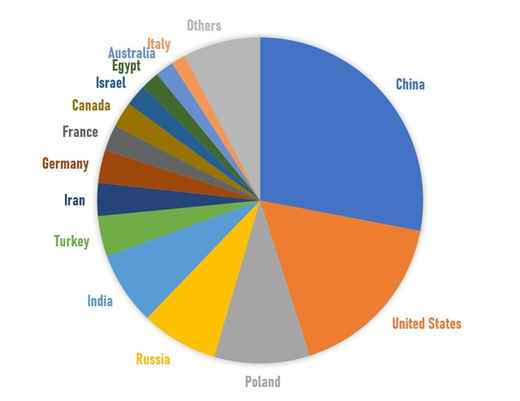
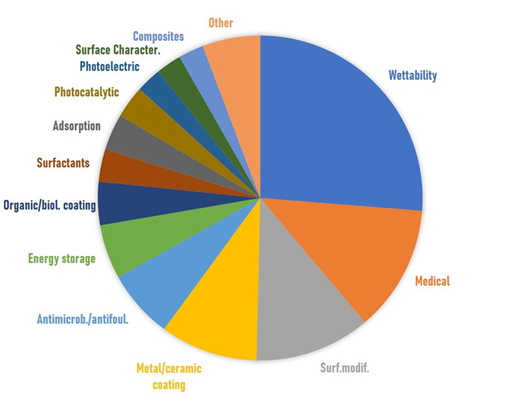
With this first (triple) issue of 2023, we mark the opening of our second decade of journal operation. To summarize the first 10 years, Surface Innovations published 278 technical papers including 37 reviews and 6 opinion articles prepared by scientists and researchers representing institutions from 30 different countries (Figure 1), and covering more than 20 surface/interface-related topics (Figure 2). The top twenty highest-citations papers are listed in the Supplementary Material.
As shown in Figure 1, the majority of published papers were submitted from China, USA, Poland, Russia and India, followed by Turkey, Iran, Germany, France, Canada, Israel, Egypt, Australia and Italy. Under other countries in Figure 1, we grouped double or single contributions from Saudi Arabia, Japan, Brazil, Hong Kong, Slovenia, Finland, New Zealand, Croatia, Tunisia, Mexico, UK, Malaysia, Sweden, Colombia, Slovakia and the Netherlands. Scientific and engineering areas in published papers are broad (Figure 2), with the leading topics being wettability (contact angles, liquid adhesion, superhydrophobicity, superhydrophilicity), medical materials (implant materials, surgical tools, and their surfaces), solid surface modification and functionalization, and coating of solids with metals or ceramics. However, especially in recent years, a larger pool of submissions addressed topics related to antimicrobial/antibacterial surfaces and coatings, antifouling surfaces and coatings, energy storage materials, polymeric, organic and biological coatings, surfactants and micelles, adsorption process, photocatalytic materials, photoelectric materials, surface characterization methods, composites and numerous other topics.
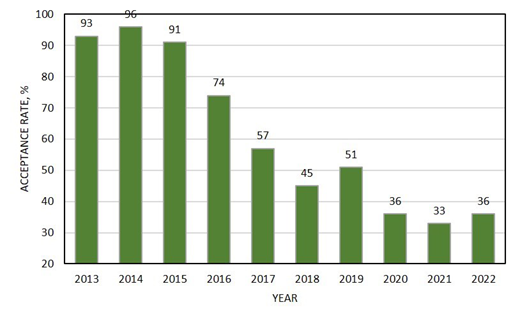
The increasing interest in publishing in Surface Innovations allowed us to screen the papers more proficiently (Figure 3). The acceptance rate for the journal dropped from above 90% in the first three years of operation to 33–36% in 2020–2022. We intend to keep the acceptance rate below 40–50% in the coming years, despite the fact that the journal recently increased the number of issues to six in 2022 and to seven in 2023. The screening of submissions and more rigorous peer review process allow us to diversify the papers in the journal and regulate the quality of content of each volume.
The first issue of 2023 offers 18 papers and opens up with an Invited Feature Article prepared by an international research team from Iran, Italy, Japan and Canada.1 In this review, the authors discuss the recent advances in the corrosion behavior of graphene incorporated into titanium dioxide (TiO2) coatings on titanium and titanium alloys. The graphene additives are used in the plasma electrolytic oxidation (PEO) process for formulation of new composite coatings, leading to an innovative and environmentally-friendly solution in the effort to enhance the corrosion resistance of light metals. The authors guide the readers through different aspects of corrosion science, making attempt to explain the different effects of graphene diversities on the corrosion behavior of composite PEO coatings. This brief review is a much-needed introduction to the effects of graphene additions on the morphology and corrosion resistance of PEO-coated titanium that provides strategies for improving the final performance of engineering materials.
In the first Original Research Article of this issue, Liu et al.2 demonstrate a conversion of expired waste ferrous gluconate to CoFe2O4/C composites through aqueous dissolution with cobalt chloride, precipitation and calcination process. The effect of the calcination temperature on the morphology, micro-structure and super-capacitive performances of CoFe2O4/C composites was studied in detail. The novel CoFe2O4/C composite, calcinated at 400°C in this study, showed a satisfactory electrochemical performance due to its low crystallinity, high electrical conductivity and high surface area. This innovative study demonstrates a successful recovery strategy for the circular economy of expired ferrous gluconate and should inspire other researchers to investigate novel technologies that could benefit the management and recycling of expired waste drugs.
In a new contribution from Professor Petr Rusinov and his collaborators,3 the authors reveal new surface composite layered materials composed of high-entropy material NiCoTiZrHf and high-temperature ceramic ZrO2-Y2O3-CeO2-Al2O3, and describe their structure and mechanical properties. The tests with steels coated with the surface composite layered materials NiCoTiZrHf–ZrO2-Y2O3-CeO2-Al2O3 showed their improved wear resistance. High-cycle fatigue testing also demonstrated improved cyclic durability of the coating. The technology of formulation of functionally oriented surface composite materials required the use of novel and patented equipment; it should inspire others to explore high-entropy materials and high-temperature ceramics for coating applications.
In the second contribution from Kuban State Technological University,4 the authors describe the structure and properties of NiCoTiZrHf–cBNCoMo, ZrCuNiCoTi–cBNNi3AlSiCCoY, TiNiZrHfCoCu–cBNCoNiAlY composites deposited on stainless steel using their proprietary technology for the formation of composites through high-energy mechanical processing of deposited powders, high-velocity oxygen fuel spraying in a protective environment, and subsequent thermomechanical and thermal processing. The article is of considerable scientific and engineering interest to many researchers and inventors from both academia and industry because it expands the field of knowledge for manufacturing heat-resistant composites, especially ceramic and high-entropy structures.
Next, Chen et al.5 describe the use of a micro-arc oxidation process in engineering of oxide surface films with additions of hexagonal boron nitride (h-BN). The oxide films produced were mainly composed of rutile and anatase. Doping the ceramic coatings with small quantities of h-BN reduced their porosity and improved both corrosion and wear resistance. As a result, this study demonstrates that the addition of h-BN to micro-arc oxide coatings on titanium alloys could improve the alloys’ life service.
In a new contribution, Dai et al.6 experimentally and theoretically investigate the dynamic behavior of water droplets on aluminum-based ratchet surfaces, studying the effects of tilt angle, tooth size and drop volume. It is shown that the velocity of the droplets on the tilted ratchet structures can accelerate but is non-linear and exhibits fluctuation. The results also show that the force acting on a liquid droplet fluctuates with drop size, rachet tilt angle and dimension of the tooth. This interesting contribution should attract attention of researchers working on manipulation and control over liquid droplets, particularly in applications to microfluidic and micromechanical systems.
The next contribution addresses development of composite material anodes with remarkable electrochemistry performance that could benefit next-generation energy-storage devices. Gou et al.7 demonstrate fabrication of a novel three-dimensional (3D) continuous C/CuVO3@Cu composite for the anode material of lithium (Li)-ion batteries. To fabricate this 3D continuous C/CuVO3@Cu composite, the authors used a combination of high-energy ball milling, non-solvent-induced separation and heat treatment. The composite anode formulated features a large specific surface area and microporous structure that accelerate transport of ions and electrons. It also demonstrates a high CuVO3 mass loading, outstanding cyclic stability and rate capacities. All researchers working on next generation lithium-ion batteries and energy storage devices should review this invention.
The researchers from Xi’an University of Science and Technology in China,8 report results of electrodeposition of diamond-like carbon (DLC) films containing single copper (Cu), nickel (Ni) and double Ni/Cu interlayers on an aluminum alloy, and examine the microstructure, micro-hardness, tribological and electrochemical behavior of these films. Overall, it is shown that films with double Ni/Cu interlayers exhibit higher microhardness and excellent wear resistance. Additionally, double Ni/Cu interlayers increased density of DLC films thus preventing the invasion of corrosion ions and enhancing corrosion resistance of the aluminum (Al) substrate. The DLC film containing double Ni/Cu interlayers could inspire other researchers working on lightweight materials for automotive and other applications.
In the next Original Research Article, Althubiti et al.9 describe dispersion of highly conductive silver (Ag) nanoparticles (AgNPs) in a conductive blend matrix made of methylcellulose (MC) and polyaniline (PAN) using the casting solution fabrication method. The casted MC/PANI/AgNPs films were then irradiated with oxygen-ion beams and the electrical conductivity, complex impedance behavior, electric modulus and energy density were analyzed throughout the frequency range of 100 Hz to 5 MHz. The results showed that the oxygen-ion beam irradiation enhances the dielectric properties of nanocomposite MC/PANI/AgNPs films. This invention opens a prospect of application of nanocomposite MC/PANI/AgNPs films in microelectronic devices, batteries and supercapacitors.
Methanol can spoil ethanol-containing beverages, especially if alcoholic products are produced by a poorly controlled fermentation process. If consumed, methanol may cause a wide range of adverse neurological and other health effects including coma and seizures. In a new report, Tian et al.10 propose detection of methanol in alcoholic beverages by using surface-enhanced Raman spectroscopy (SERS). To obtain the detectable SERS signal with gold (Au) nanoparticles, the authors selected a catalytic conversion of methanol into formaldehyde using a copper oxide catalyst. To avoid interferences with acetaldehyde produced during catalytic conversion of ethanol, the authors added 3-methyl-2-benzothiazolinonehydrazone hydrochloride hydrate, which interacts with acetylacetone. The studies showed that the SERS method detects methanol in wine and sake over an impressive wide linear range of methanol concentrations from 0.1–60 and 0.1–80 ppm, respectively.
Wei et al.11 used a direct current electrodeposition process to prepare copper wires cladded with graphene/copper coating having an enhanced electrical conductivity. The study includes the analysis of number of graphene layers, graphene defect density, surface morphology and surface roughness. The authors show relationships between surface roughness, electrical conductivity of wires and graphene concentration. This report benefits research on interconnecting wires in integrated circuits that are used in cloud computing and fifth-generation mobile communication devices.
In the next contribution, the research team from China demonstrates fabrication of flexible and stretchable polydimethylsiloxane substrates having superhydrophobic and superoleophobic surface characteristics.12 The authors used copper/copper oxide/copper chloride powder modified with perfluorooctanoic acid, which they deposited on polydimethylsiloxane and cured. The fine powder provided flexibility of superhydrophobic and superoleophobic coating, even with a stretching strain of up to 60%. This simple and reproducible technology could inspire other researchers in fabrication and application of water- and oil-repellent coatings.
With ever-growing applications and use of electronic devices and telecommunication systems, lightweight electromagnetic-interference (EMI) shielding materials with a high shielding efficiency are urgently needed to shield the electromagnetic interferences and reduce a potential harm to human health. In a new manuscript, Zhu et al.13 introduce carbon nanofiber aerogel/silicon oxycarbide composites for EMI shielding. The high specific shielding effectiveness of the novel formulated composite is the result of continuous conductive network of carbon nanofibers and a highly porous structure in the silicon oxycarbide, and it is preserved even in a harsh, high temperature environment.
The research team from Saudi Arabia demonstrates fabrication of polymer/ceramic nanocomposites made of polyaniline with incorporated lead sulfide nanoparticles on its surface.14 The fabrication process included oxidation polymerization of polyaniline, polymer saturation with lead ions, and then, their reduction to lead sulfide nanoparticles by thiourea at elevated temperature. The authors studied optical properties of the new nanocomposites of varying lead sulfide nanoparticle content, which could be used in photoelectric devices for energy applications. This work could inspire others to formulate polymers with nanoparticles of improved optical and mechanical properties.
In a new original report, Gao et al.15 introduce a thermal-insulation coating by using silk fibroin and hollow silica nanoparticles for the surface functionalization of endovascular devices. The authors systematically investigated the effects of different spray parameters and coating suspension compositions on the micro-structures of the resulting coatings. They show an easy-processing method to enhance the thermal insulation performance of a traditional catheter for cerebral hypothermia therapy. Although the biocompatibility of the coatings was not evaluated, this pioneering research introduces the concept of thermal insulating coatings to surface modifications of catheters for biomedical applications.
The research team from Arbuzov Institute of Organic and Physical Chemistry in Kazan (Russia)16 describe their studies on aggregation of morpholinium surfactant and its hydroxylated analog with ethanolamines, an additive that is commonly used in the cosmetic industry. The authors found no significant effects of ethanolamines on aggregate formation. However, ethanolamines affect pH of surfactant solutions and lead to deprotonation of phenolic dyes. As a result, the surfactant–ethanolamine mixtures can solubilize large quantities of hydrophobic dyes. The report should benefit research on formulation of cosmetic products, concluding that cationic morpholinium surfactants enhance solubility of hydrophobic organic weak acids.
In the next contribution, Mahmoud et al.17 describe electroplating of nanocrystalline nickel–cobalt–titanium dioxide coating on copper using a gluconate-cysteine bath and ultrasonic waves to improve its anti-corrosion resistance of copper in a simulated marine solution. Morphology, elemental composition and crystal structures are well characterized to understand the effect of cobalt on anti-corrosion resistance of the coating. The authors also support their experimental findings with density functional theory and Monte Carlo simulation techniques. This report could motivate other researchers to pursue similar coatings for copper-based alloys used for seawater pipes, heat exchangers, fuel lines and nails, to name a few.
By reading the paper by Zhou et al.,18 the readers can learn about a new fabrication of highly corrosive resistant superhydrophobic PDMS/titanium dioxide composite coatings that were deposited onto a brass substrate by using a combination of hydrothermal and sol–gel methods. The authors recap their research on thermal stability, acid–alkali resistance, self-cleaning behavior and corrosion resistance of coatings. In this innovation, a hydrophobic group is constructed on the surface of titanium dioxide nanoparticles by a suitable chemical modification, a sol is then formed by arrangement with PDMS, and finally the sol is coated on the brass substrate. A major advantage of the proposed technology is enhanced adhesion of the superhydrophobic coating to the substrate. It should be of interest to many research teams working on durable superhydrophobic coatings and their applications.
We would appreciate any feedback and valuable suggestions from contributing authors and readers on any developments to the Surface Innovations journal that could make it more appealing to them in the years to come.