From Black Box to Bright Future: AI’s Transformative Role in Tourism - Reflections from ENTER25
Date: 17 - 21 February 2025
The aim of the ENTER25 conference, organized by the International Federation for IT and Travel & Tourism (IFITT) from 17 till 21 February 2025 in Wrocław (Poland), was to collectively envision the long-term future of technology in travel, tourism, and hospitality. Here, different perspectives like Artificial Intelligence (AI), Big Data, Cocreation, Robots, Smart Destinations, Sustainability, and Technology Innovations were used to discuss the specific outlook towards 2060.
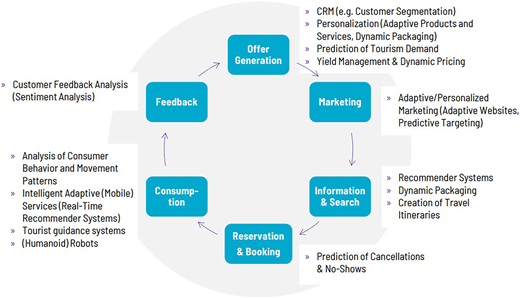
Höpken (2025) presented an overview of AI Applications in Tourism displaying the customer journey and connecting the possible AI applications to each stage.
This review follows the sequence outlined in Figure 1, aligning AI-related discussions from the conference accordingly. It is supported by an industry perspective from Filippe (2025), Senior Vice President at Amadeus, who pointed out that generative AI now plays a role in nearly all aspects of the customer journey.
AI has become more widely known since the launch of OpenAI’s ChatGPT in late 2022, which is built on the generative pre-trained transformer (GPT) 3.5 large language model (LLM). Industry and researchers acknowledge the enormous potential of including AI in travel and tourism sector by chatbots enhancing customer satisfaction, engagement, and cost effectiveness. Hesitance to integrate AI has also been seen due to customer’s perceived value for money, data privacy, economic- and ethical concerns (Hsu, 2025).
Following the customer journey, AI’s involvement begins with offer generation. Ideally, this is preceded by the creation of an ontology, as shared by multiple researchers like Moosmann and Brözel (Arnold et al., 2025) who called for participation in this. Ontology (with a capital “O”) refers to a particular philosophical discipline. Here, ontology (with a lower case “o”) is meant, being used in philosophical and computer science communities. In computer science “an ontology refers to an engineering artifact, constituted by a specific vocabulary used to describe a certain reality, plus a set of explicit assumptions regarding the intended meaning of the vocabulary” (Maedche, 2002, p. 11). Tourism ontology is needed to enable interoperability of data as well as fostering structured data integration. D'Angella and Inversini (2025) indicated that for the event industry, the main risks like data security and human touch outweighing the perceived value of AI. Filippe (2025) shared how Deep Learning is used to generate offers and pricing.
In the marketing stage, Amadeus uses generative AI to construct the automated generated airlines.com landing page, the Cytric Easy AI assistant (Seymour-Taylor, 2023), and the option to build personas based on the customer data shared (Filippe, 2025).
In information and search, AI can help as well to construct a decoy effect in the recommender system as indicated by Chvirova et al. (2025), assisting in steering the preferences away in peak times. Berdowski (2025) from Merlinx demonstrated the usefulness of modern data stack (MDS) helping with dynamic packaging and also indicated the limitations experienced of using solely a central processing unit (CPU) (sequential tasks). Including graphics processing unit (GPU), moving from only sequential tasks to diverse types of computational workloads, the company is able the manage real-time price calculations. Filippe (2025) shared how Machine Learning is used by Amadeus to optimize shopping and search.
Serifis (2025) from Nelios predicted a significant impact of AI on the tools used for operations like Property Management Systems (PMS) and Customer Relationship Management (CRM) systems in the reservation and booking phase. This requires staff to be trained, as he shared during the Smart and Connected Hospitality conversation led by Peter O’Connor. Manikis (2025), representing Wyndham Hotels, stated in the same conversation, technology cannot replace the love for the guest, and he pointed out we need to remain focused on the things which will not change when all things are changing like Jeff Bezos (Amazon) once said. What is subject to change, according to Manikis, are the labels used for the roles in hospitality, like receptionist: a label like Experience Officer, attracted over 500% more applicants then when labelled as a vacancy for a Receptionist (Manikis, 2025). Amadeus uses AI with the fixed airport resource management system (F-RMS), the flight operations control, and for forecasting (Filippe, 2025).
Intelligent adaptive services can monitor the actual consumption of a booked item. According to Neubig et al. (2025) this becomes more accurate when ontology is applied to allow real-time data used for visitor management. Amadeus has included AI by including air controller to minimize the delays in flights (Filippe, 2025).
In the end, feedback is often shared in the form of reviews, human or AI written, simultaneously being the starting point of the offer generation. Tuomi et al. (2025) stated that only 45% of the reviews were correctly labelled by participants as AI/Human where there was no difference between the level of familiarity with online reviews. Sentiment analysis has been discussed multiple times where Ivanov et al. (2025) concluded that ChatGPT in this case does not outperform NVIVO nor the manual analysis of sentiment. A fluently working system, as shared in Figure 1, requires one tourism language leading to standardized data, resulting in personalized recommendations, improving semantic search, and developing intelligent systems. Filippe (2025) supports the impact seen from the combination AI with big data at Amadeus and is one of the few discussing the relevance and importance of ethics. In addition, stating that guiding principles in using AI like fairness, privacy and security, accountability, reliability and safety, transparency, and sustainability need to be established. Talukder (2025) from Geotourist stated that ontology is not the only problem, but it encompasses as well that data is hard to collect, interpret, understand, combine, share, and is often outdated and inapplicable. Andruszklewicz (2025) representing Google Poland, emphasized the importance of the quality of data used: rubbish in, is rubbish out. Bulchand-Gidumal (Cabello-Pestano et al., 2025) continued with the impact of aggregated data on complex questions left unanswered.
Remaining, after having attended most of the AI related sessions, is the question of what the long-term vision for 2060 is. The organisation shared the following at the beginning of the conference: “This year's ENTER conference, eTourism Towards 2060, challenges our community to collectively envision the long-term future of technology in travel, tourism, and hospitality. While ICTs continue to enhance efficiency, personalization, and engagement, they also raise fundamental questions, for instance about ethical responsibility, labour displacement, and the societal impact of automation” (Nixon et al., 2025, p. iv). However, only two presentations during this conference had 2060 in their title had a focus point 2060, the theme of the conference. Sharma (2025) connected this to Data Science and Yeoman (2025) looked at inventions that had not been invented yet supposedly through the lens of patents. Hence, this is why in my opinion the envisioning of how the future in 2060 will look like, could have played a more significant role than it currently had been given. Questions have to be raised about why is this?
Based on the knowledge gained throughout the conference, the following research agenda towards 2060 in AI is suggested. First, AI-driven personalization and ethical data management focusing on privacy, transparency, and frameworks, all related to hyper-personalization, should be discussed. Secondly, the AI-enabled operational efficiency and Human-AI collaboration specifically in real-time decision making and the human role here, as well as which training programs need to be offered to hospitality professionals. Thirdly, transform the black box into a transparent and explainable AI system by using AI governance models balancing automation, sustainability, and ethical matters.
However, the starting point needs to be the creation of an ontology. As stated by Filippe (2025) and as well by Kirilenko (2025), AI is a black box and the main question now is, how to create a transparent box out if allowing it to be a game changer? Ensuring the developments in AI are not only technologically advanced but also sustainable, ethical, and aligned with human-centric values.