Spacecraft launch rates, including for tourist flights, have increased rapidly in recent years. Despite these advances, historically and culturally significant sites in space – such as the first human footprints on another celestial body – currently have no binding, international legal protection.
This article discusses the emerging concept of “space heritage” and presents a thematic content analysis of the 17-year history of the most prominent space-related Reddit group to gauge awareness and perceptions regarding this topic.
The analysis finds that discussions of space heritage tend to focus on the Moon, particularly the Apollo 11 site, and that there is notable disagreement regarding what constitutes space heritage, whether or not bestowing official heritage status is necessary, the viability of actually enforcing any protections and the potential tourism value of these sites. The findings underscore the importance of extending the study of heritage tourism beyond Earth, as human influence and impact likewise extend into the cosmos.
Space heritage is an underexplored topic in tourism studies, and the increasing involvement of the private sector in spaceflight indicates a need to begin delineating what constitutes space heritage and how to best protect such sites.
Introduction
NASA is basically saying: we know that it’s a public beach, but please don’t stomp on our sand castle.
The United Nations Educational, Scientific and Cultural Organisation (UNESCO) has protected over 1,200 World Heritage Sites in 168 countries. To be eligible for selection, a site must meet at least one of 10 criteria published by UNESCO. These criteria require the site to be of exceptional cultural or natural value. Numerous places in outer space are arguably of highly significant cultural importance, such as the footprints, flag and other artifacts left on the Moon by the Apollo 11 mission in 1969 (Capper, 2022; Fewer, 2007; Froehlich, 2020; Rogers, 2004; Spennemann, 2004; Siebrits, 2020). However, the World Heritage Convention does not apply to outer space, as the selection process requires countries to nominate proposed sites within their own borders.
Meanwhile, launch rates are increasing rapidly, and the private sector is more heavily involved in space activities than ever before, with SpaceX accounting for 80% of all launches from US soil in recent years (OECD, 2023). While much of that growth is due to satellite launches, there is ample evidence of renewed interest in missions to the Moon and, eventually, Mars. SpaceX has sold tickets to tourists for future fly-by missions to the Moon (Foust, 2022; Yamaguchi, 2024), spacecraft built by the private company Intuitive Machines have landed on the Lunar surface (Intuitive Machines, n.d.), and the Chinese Lunar Exploration Program has multiple missions planned to the Moon (NASA, n.d.). Numerous companies and governments have even expressed interest in mining the Lunar surface (Newcomb, 2012), and Elon Musk once suggested dropping thermonuclear bombs on the Martian poles to generate a greenhouse gas effect and make the climate more conducive to human life (Herron, 2016).
Several recent events indicate growing awareness of the importance of protecting cultural heritage in space. The 2020 Artemis Accords, “Principles for a Safe, Peaceful, and Prosperous Future in Space”, specifically mention space heritage. The Accords state the following two principles:
“The Signatories intend to preserve outer space heritage, which they consider to comprise historically significant human or robotic landing sites, artifacts, spacecraft and other evidence of activity on celestial bodies in accordance with mutually developed standards and practices”.
The Signatories intend to use their experience under the Accords to contribute to multilateral efforts to further develop international practices and rules applicable to preserving outer space heritage” (NASA, 2020, n.p.).
While currently signed by 54 countries, these Accords are non-binding. Also in 2020, the United States Congress passed the “One Small Step to Protect Human Heritage in Space Act”, which requires NASA contractors to protect heritage on the Moon, but this law only applies to contractors with NASA (Congress.gov, 2020). Finally, in 2025, the World Monument Fund listed the Moon, with specific focus on the Apollo landing sites, as endangered cultural heritage (World Monument Watch, 2025). Thus, while political and regulatory steps are being taken to protect space heritage, there is still no binding, international law or treaty, and no space site has been given an official heritage designation.
Academic literature about sustainability issues in the spaceflight sector largely focuses on topics such as climate change (Miraux et al., 2022; Ross and Jones, 2022; Ross et al., 2010; Ryan et al., 2022; Spector and Higham, 2019; Spector et al., 2017), space debris (Kessler et al., 2010; NASA, n.d.-b), unequal access to space resources (Spector, 2019; Spector et al., 2020) and the militarisation of outer space (Aylward et al., 2025; Dickens and Ormrod, 2007; Ormrod and Dickens, 2016). Compared to those topics, space heritage has received far less attention (Gorman, 2005, 2019, 2023; Gorman and May, 2020; Perez-Alvaro, 2024; Walsh, 2012). The renewed interest in outer space in recent years, particularly by the private sector, emphasises the importance of evaluating which sites are worth safeguarding and how to achieve protected status.
Designating particularly valuable locations in space as World Heritage Sites – or bestowing some similar designation upon them – offers the opportunity to pre-empt the future activities of governments, space tourists and private companies by establishing legal precedent for setting aside some areas of outer space for the benefit of all humankind. Protecting a selection of sites on the Moon, Mars or even in Earth's orbit also offers an opportunity to enhance sustainability education. Using the heritage tourism literature (Loulanski and Loulanski, 2011; Wright and Eppink, 2016), space law literature (Pham, 2020; Rotola, 2020) and prior research on space heritage (Gorman, 2005, 2019, 2023; Gorman and May, 2020; Perez-Alvaro, 2024; Walsh, 2012), the present manuscript investigates the emerging concept of heritage sites in outer space. A thematic content analysis of comments about space heritage from the largest space-related Reddit groups was conducted to analyse perceptions and awareness. This manuscript contributes to the heritage tourism literature by encouraging further research on space heritage while also demonstrating the usefulness of Reddit as a data source for gauging public interest and knowledge.
Literature review: world heritage and space heritage
The need to protect significant cultural and natural sites became particularly clear during World Wars I and II (Di Giovine, 2008; Leask and Fyall, 2006), eventually resulting in the passing of the first international treaty focused on protecting cultural heritage, the “Hague Convention for the Protection of Cultural Property in the Event of Armed Conflict” (UNESCO, 1954). The “World Heritage Convention” (UNESCO, 1972) subsequently delineated the official process for designating sites, expanded the concept to include both cultural and natural heritage, and detailed how the World Heritage Fund is to be allocated. Bestowing World Heritage Site designation on a location is seen as an important means of protecting valuable destinations (Santa-Cruz and López-Guzmán, 2017; Seyfi et al., 2020; Timothy and Boyd, 2006), though the influence on tourism arrivals is more complicated (Gao and Su, 2019; Yang et al., 2019).
UNESCO's (1972) convention states that cultural heritage is defined as follows:
“Monuments: architectural works, works of monumental sculpture and painting, elements or structures of an archaeological nature, inscriptions, cave dwellings and combinations of features, which are of outstanding universal value from the point of view of history, art or science”.
“Groups of buildings: groups of separate or connected buildings which, because of their architecture, their homogeneity or their place in the landscape, are of outstanding universal value from the point of view of history, art or science”.
“Sites: works of man [sic] or the combined works of nature and man, and areas including archaeological sites which are of outstanding universal value from the historical, aesthetic, ethnological or anthropological point of view” (n.p.).
That final category – “works of man” – is most relevant for the context of space heritage.
While the process for selecting and protecting sites on Earth has been developed and refined over the past half-century and benefits from extensive academic and industry research, the idea of protecting sites in outer space is still in an inchoate stage. The Artemis Accords define space heritage as “historically significant human or robotic landing sites, artifacts, spacecraft, and other evidence of activity on celestial bodies” (NASA, 2020, p. 4). For All Moonkind, the foremost advocacy group in this context, estimates that there are over 110 potential heritage sites on the Moon (For All Moonkind, n.d.). Crewed landing sites are seen as particularly valuable, with Apollo 11's landing location at the Sea of Tranquillity in 1969 constituting the most obvious candidate for a heritage site, as it represents the first time humans set foot on another celestial body. In addition to the iconic first footprints on the Moon, the site has other items left by the astronauts, including a golden olive branch and statements of goodwill and peace from 74 countries (For all Moonkind, n.d.). Apollo missions 12, 14, 15, 16 and 17 also left human artifacts at various locations on the Moon.
Artifacts from uncrewed Lunar missions, such as NASA's Surveyor and China's Chang'e Project, may also be considered valuable heritage. If Lunar artifacts from uncrewed missions are considered as potentially worth protecting, then various Martian sites may also be deemed eligible for consideration. Eighteen objects from fourteen different missions have been left on Mars, totalling almost 10,000 kilograms of material if including still operational craft (United Nations Office for Outer Space Affairs, n.d.). These Martian missions have been conducted by NASA, the China National Space Agency, the European Space Agency and the Soviet Space Program. As with Lunar sites, missions that were either the first or that experienced a particularly dramatic or noteworthy event would likely be considered most worthy for protection. Sites might include not only spacecraft but also drilling locations, rover tyre tracks and other related artifacts.
Under the UNESCO framework, locations on Earth can receive protected status for natural rather than cultural reasons, and there may be geological sites – particularly on Mars – that might warrant protection for their unique natural heritage (Matthews and McMahon, 2018; Profitiliotis and Haqq-Misra, 2023). These could include Olympus Mons (a volcano roughly the size of the state of Arizona), the Valles Marineris canyon (which is four times longer than the Grand Canyon), the icy regions at the Martian poles and various significant craters from asteroid impacts. Some have even suggested that such destinations could become planetary parks for future space tourists (Cockell, 2024; Ellis, 2015). The process of deciding which sites to protect might include conducting “extraterrestrial environmental assessments” to determine how susceptible various locations are to degradation (Kramer, 2020).
Finally, some have suggested possible space heritage candidates that are not on the Moon or Mars. These might include particularly relevant historical artifacts in Earth's orbit, such as the International Space Station (ISS) (Cannelli et al., 2023; Gorman, 2005b). Spacecraft and probes sent further afield – like Voyager 1, which at nearly 25 billion kilometres away at the time of writing, is the furthest human object from Earth – may be deemed to have historical, cultural and scientific significance, but the need to formally protect such distant objects is unclear (Gorman and May, 2020). Space-related heritage sites on Earth, such as historic launch locations, have been deemed worth protecting (Gorman, 2009; Spector, 2020; Tiberghien, 2024; Tiberghien et al., 2023). However, unlike sites in outer space, terrestrial space heritage can be protected using the existing UNESCO framework.
The term “exoarchaeology” has been coined to refer to the study of space archaeology, but a significant hurdle is that it is not always clear what constitutes space junk versus space heritage, particularly when considering artifacts from uncrewed launches (O'Leary, 2014; Rathje, 1999; Walsh, 2012). Whereas many would likely see the first human footprints on the Moon as culturally significant, the case is less clear for decommissioned rovers, spacecraft that crash landed and the like (Walsh, 2012). Given the nature of many possible space sites (which often essentially constitute decommissioned rovers and other launch craft), clearly delineating space heritage from space junk is likely to be an important hurdle in achieving protection.
A process similar to how UNESCO sites are chosen on Earth might be developed to identify which celestial sites have sufficient natural or cultural value to warrant protection. However, any such process may inevitably lead to controversy, as some might see a space heritage site as culturally and historically significant while others instead view it as a sign of Western imperialism and dominance (Gorman and May, 2020; O'Kill and Onciul, 2024). Attempting to achieve international protection for the United States flags left on the Moon, for instance, could lead to such disagreements. Further, there are debates regarding whether to protect certain space heritage sites in situ or to instead try to bring the artifact back to Earth (Bille et al., 2025).
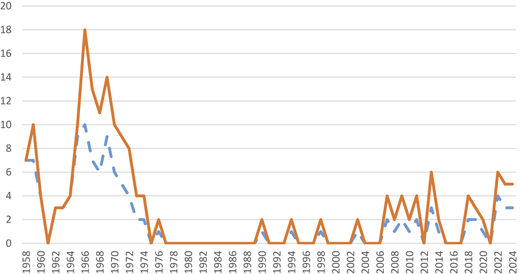
Regardless of these potential hurdles, it is increasingly apparent that space heritage sites might be threatened in the near future. As shown in Figure 1, the Space Race was followed by multiple decades of minimal Lunar launch activity. However, since the early 2000s, there has been renewed interest in spaceflight, largely due to the increasing involvement of the private sector (OECD, 2023). The “Outer Space Treaty” (1967), which many space-faring nations are signatories to, does not offer any specific protection for heritage sites. The subsequent “Moon Agreement” (1984) took a more restrictive stance, but, to date, no prominent space-faring nations have signed the agreement. Perhaps due to the growing realisation that Lunar sites will become increasingly threatened in the new era of privatised spaceflight, in 2020 the United States Congress passed the “One Small Step to Protect Human Heritage in Space Act” (Congress.gov, 2020). As noted above, this bipartisan legislation only applies to companies contracted by NASA. The United States also initiated the Artemis Accords (2020), which have been ratified by 54 countries, but the Accords are non-binding. Still, these non-binding regulatory efforts indicate a degree of political support for protecting Lunar heritage.
Given the historical presence of fraught geopolitics and the role of space as a means of nation-building (Klinger, 2021; Pace, 2023), it is important to consider how to achieve binding, international and cooperative protection for space heritage sites. The fact that the ISS has had a continuous human presence for over 25 years, has hosted individuals from 26 countries and is managed via international cooperation by numerous space agencies (including NASA, Roscosmos and the European Space Agency) indicates collaborative efforts in outer space are possible.
Studies of public attitudes towards space science and exploration often find broad support for such initiatives and perceptions are influenced by media consumption, including social media. Survey evidence indicates generally positive public interest in space research and exploration, though the level of detail in understanding varies significantly across populations (Smith, 2003). More recent work finds that that media framing influences support for space policy and investment (Bingaman et al., 2022). Social media analyses further reveal that platforms shape how the public engages with and values space activities (Zhang et al., 2025). Research is lacking regarding public perceptions of what constitutes space heritage and how to best protect such sites. The present study utilises a thematic content analysis of social media comments to elucidate perspectives on this topic.
Methods
Reddit was created in 2005 and now has approximately 1.1 billion monthly active users (Backlinko, 2025). In 2024, there were approximately 500 million posts and 2.72 billion comments published on Reddit (Backlinko, 2025). This publicly available “big data” can be instrumental in answering a range of research questions across the social sciences.
Nearly half of daily active Reddit users are located in the United States (Backlinko, 2025), which introduces an American-centric bias. While both the launch rate and the percent of GDP spent on the space sector are higher in the United States than in other countries (OECD, 2023), it is still important to be aware of this limitation, which will be discussed in more depth at the end of the article. Reddit is also male-dominated, with men accounting for two-thirds of users, and has a generally young demographic, with 44% of users being 18–29 years old (Duarte, 2025). As discussed at the end of the article, these limitations are salient and should be addressed in future studies.
The r/space group, which is the focus of the present study, had nearly 28 million members at the time of writing, making it the 15th largest group on Reddit overall and by far the largest space-related group. Therefore, r/space is a particularly germane context for understanding how concepts related to space heritage are perceived and understood by members of the public who likely have some pre-existing interest in outer space (as evidenced by their posting or commenting in a space-themed group). Additionally, prior studies show that social media can significantly influence public perceptions of outer space (Shoushan and Yavetz, 2025). Interactions on Reddit, which tend to be brief and spontaneous, provide an insightful alternative lens compared to other methods, such as survey research, by allowing perspectives to be analysed in situ.
Code was written in Python to scrape the entire history of r/space (26 January 2008 to 10 March 2025) for the following terms: heritage, artifact, artefact, preservation, landmark, legacy or footprint. These search terms were all made case-insensitive, and the “regular expression” function in Python was used to search for both plural and non-plural versions (e.g. footprint and footprints) and those without or without hyphens and spaces (e.g. footprint, foot-print and foot print). If one of the search terms appeared in either a submission or any of the resulting comments, the entire submission and all comments were scraped. The date of the submissions and the score (upvotes minus downvotes) of each submission and comment were also extracted. Additional search terms (such as “history,” “historic,” and “protect”) were tested, but r/space is sufficiently large that it is impractical to conduct overly broad searches, and Reddit's API limits (which dictate how the code interacts with the website) are quickly exceeded.
The initial data mining resulted in 504 submissions and 11,173 comments from r/space. Extensive data cleaning was required to cull results that contained one of the keywords but did not pertain to space heritage sites. In particular, the keyword “heritage” resulted in numerous non-relevant results due to the “Hubble Heritage Project,” which produced many iconic images of the Universe. The word “artifact” is also commonly used in this group when referring to apparitions that appear in astronomy photographs, caused by cosmic rays, the stitching together of multiple images or a technician adjusting the image colouring. After eliminating non-relevant results, a final data set of 49 submissions and 2,132 comments pertained to heritage sites in outer space, for a total of 68,597 words. This indicates that, while space heritage is not a frequent topic, it does generate a substantial level of discussion and interaction, with an average of nearly twice as many comments per submission compared to the initial data set (43.5 comments per submission versus 22.2 comments per submission).
Due to the typically brief nature of Reddit comments, the final data set was deemed small enough to allow for qualitative analysis. A thematic content analysis (Guest et al., 2011; Kuckartz, 2014; Miles and Huberman, 1994) was used to understand how individuals in this group perceive topics and issues related to space heritage. This entailed a multi-step procedure of coding, sorting, merging and then developing overarching themes (Miles and Huberman, 1994). The qualitative analysis was supplemented by limited quantitative data, such as reporting word counts where relevant (Patton, 2002).
The ethical implications of the study's use of data warrant discussion. As of the time of writing, using Reddit data in academic studies is not against the platform's policies. The main ethical and legal issues related to this study's methods instead stem from the European Union's General Data Protection Regulation (GDPR). GDPR applies not only if the researching organisation is located in EU (which is not the case for the present study) but also if the data subject is located in the EU. Some of the data used in this study could, of course, come from EU citizens. However, GDPR only applies to “personal data”, which Article 4(1) defines as “any information relating to an identified or identifiable natural person (‘data subject’); an identifiable natural person is one who can be identified, directly or indirectly, in particular by reference to an identifier such as a name, an identification number, location data, an online identifier or to one or more factors specific to the physical, physiological, genetic, mental, economic, cultural or social identity of that natural person” (Official Journal of the European Union, 2016, n.p.). Whether or not Reddit comments constitute “personal data” likely hinges on factors such as whether the individual's actual name is used as their username (which is uncommon on Reddit) and whether there is any personal identifying information in a user's post, such as their address or career details (which is also uncommon on Reddit).
To prevent possible conflicts with GDPR, two steps were taken. First, no usernames were collected in the original data scraping. This increases anonymity. However, if verbatim quotes from comments or submissions are published, a simple search on Reddit will often locate the original post, which then exposes the individual's username and account. In this study, a second step was taken to counteract this issue, and all quotes used below were edited to make them less identifiable while retaining the original meaning. While it appears to be a legal grey area, it is the author's opinion that it is irresponsible for academic studies to publish data – such as verbatim quotes – that can be linked back to specific user profiles. Even if the information is not generally deemed “personal data” due to the highly public nature of these platforms, it is possible that a subset of the data could include personal information.
Findings and discussion
Thematic analysis of the final data set resulted in the following themes regarding heritage sites in outer space:
Theme 1. A focus on the Moon, particularly the Apollo 11 site.
Theme 2: Disagreement regarding what constitutes space heritage.
Theme 3: Tension regarding the need to bestow official heritage status.
Theme 4: Scepticism regarding enforceability.
Theme 5. Potential tourism value of space heritage sites.
These themes will be discussed below, with extensive use of quotes to illustrate key points. As noted in the methods section, all quotations have been slightly altered to make it more difficult to find the original post via online searches. This was done to enhance anonymity. Every effort has been made to retain the original, in situ meaning.
Theme 1: A focus on the Moon, particularly the Apollo 11 site
The Apollo 11 landing site definitely has heritage value for all of humanity [1] [1].
The Moon was the most frequently discussed potential heritage site, with a total of 757 mentions of the keywords “Moon” and “Lunar.” Unsurprisingly, the 1969 Apollo 11 landing at the Sea of Tranquillity was the most commonly suggested candidate. This site, representing the first time humans set foot on another celestial body, is also frequently suggested in academic and industry circles (Ellis, 2015; For all Moonkind, n.d.; World Monument Watch, 2025). The following quotes illustrate typical sentiments in the r/space group regarding protecting the Apollo 11 landing location:
“It seems like this should be one of the first things on the International Moon Heritage List” [1].
“This is a perfect place to put on UNESCO's world heritage list” [15].
“I personally wish it could be left untouched and labelled a world heritage site” [35].
Based on the perspectives in the data set, the preceding literature review, the fact that the “One Small Step to Protect Human Heritage in Space Act” begins with discussion of Apollo 11 (Congress.gov, 2020), and the fact that Apollo 11 was singled out when the World Monument Fund listed the Moon as endangered heritage (World Monument Watch, 2025), it is clear that if only one space site were to be given heritage status it would very likely be the Apollo 11 landing location.
Other possibilities were, with much less frequency, also discussed in this group. For instance, one commenter argued that both Apollo 11 and 17 are valuable [35]. They did not expound on their reasons for suggesting Apollo 17, but some possible explanations include that it was the final Apollo mission and it broke several records, such as the longest stay on the Lunar surface. Another argued that even the “less historic” sites, such as Apollo 12 and 14, could be valuable as well [35], and one individual stated, “I think that all of the Apollo sites should be protected” [10].
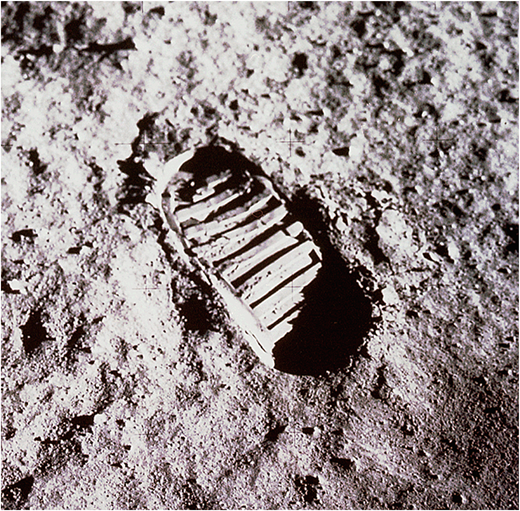
A sub-theme related to the focus on Lunar sites is the importance of footprints, as emphasised in quotes such as, “The footprints make these truly human sites; the objects could have been landed there robotically” [33]. As noted by NASA (2019), footprints on the Moon's surface can, theoretically, last millions of years due to the lack of an atmosphere and no wind. This topic is interesting because many likely envision protecting something akin to what is shown in Figure 2, which they might also mistakenly believe is the first footprint on the Moon. This iconic image is, in fact, not Neil Armstrong's famous “one small step”. Instead, it is a photo Buzz Aldrin took of his own footprint during a routine soil disturbance experiment (NASA, 2015). Furthermore, a return to the Apollo 11 site would likely reveal numerous scattered footprints, with no single one any more iconic than the others and with a lack of ability to even discern which was the first.
Neil Armstrong and Buzz Aldrin walking around in one another's footprints, the Lunar Module disturbing dust when taking off, and even possible meteorite impacts might mean that the Apollo 11 site, while still arguably historically important and iconic, does not match the public perception captured in the “lone footprint” image that is familiar to so many. Some commenters reflected this reality, saying, for instance, “Aldrin would have stepped in Armstrong's footprints when he stepped off the ladder, and they both would have stepped all over them when getting back in the module” [1]. However, other comments betrayed a mistaken perception of how identifiable the first footprint is likely to be, as seen in quotes such as, “Imagine seeing an Instagram influencer trying to fit their foot into Armstrong's first footprint and destroying it” [8]. Even in a space-focused group, there seems to be some confusion regarding what future visitors are likely to find when they travel back to the Apollo 11 site. This finding demonstrates the power of photographs such as the one shown in Figure 2 to shape public perceptions of cultural heritage, even if the subject of the image is not what many people think it is and even if the image does not accurately depict the current state of the site.
Some non-Lunar sites were also highlighted, with the ISS being the second most cited candidate for a heritage site after the Moon. The ISS will be discussed alongside the following theme, as it constituted a common area of discord regarding the line between space heritage and space junk. Two posts suggested creating “national parks” on Mars [13; 18]. However, unlike the Moon, Mars has not had any human visitors, has an atmosphere, and is subject to frequent and violent dust storms. As one response noted, “Mars is different, because dust storms will erase footprints and bury equipment and noticeably change the landscape” [18]. In summary, based on the findings under this theme, initial efforts to protect space heritage should focus on the Moon, particularly the Apollo 11 site, as that effort is most likely to garner public support.
Theme 2: Disagreement regarding what constitutes space heritage
What is there to preserve? Footprints, rubbish, and a whitewashed flag? [7].
Numerous discussions in r/space indicated tension regarding what, if anything, should qualify as space heritage. Such disagreements were present in multiple discussion threads and pertained to Lunar sites, the ISS, and the Mars rovers. As noted in the previous theme, some perceive astronauts' footprints as particularly valuable cultural heritage. Others see little reason to protect those footprints. Comments in this latter vein included the following:
“Who cares? Just because they are on the Moon? They are just footprints, and the only reason they are significant now is because there are not any others yet” [1].
“It is absurd to place the footprints on a cultural alter. It happened; it's over now” [1].
“Protecting architecture, art, or literature has more value than protecting something that holds only symbolic meaning like a footprint” [1].
“Neil Armstrong was, technically speaking, the first one to defile the site” [1].
“Every single step taken on Moon would take millions of years to fade. So, quite frankly, that makes none of them special” [5].
“How can you trash a sterile rock? No atmosphere to pollute, no waterways to poison, no biodiversity. It's a rock, and who cares about a footprint? Not everything needs to be preserved. It is not an ancient artifact or an irreplaceable work of art” [5].
This divergence in the perceived value of cultural heritage extended beyond footprints, with opposing views also present in terms of the flags and other items left by the astronauts. The Lunar Reconnaissance Orbiter, launched in 2009, took high-resolution images of the Moon, including the Apollo landing sites. Based on analysis of shadows in the images, NASA believes the Apollo 11 flag is no longer standing, which is unsurprising as Buzz Aldrin previously said he saw the flag fall over as the Lunar module took off (NASA, 2019b). NASA states that the flags left by Apollo 12, 16, 17 appear to be standing, but it is unknown whether the Apollo 14 and 15 flags still stand (NASA, 2019b).
Regardless of whether the flags in question remain standing, the heritage value may be reduced due to the bleaching effect that has likely occurred after extended exposure to solar radiation. Comments in this vein included, “Ultra-violet radiation with zero atmosphere? Those flags are whiter than a new sheet” [12], and “I do not even think they will be recognizable as flags any more. They were made of nylon, so solar radiation has probably destroyed them” [12]. Relatedly, some commenters saw all Lunar heritage as lacking heritage value, due to the lifelessness and harshness of the Lunar landscape. This included statements such as, “What is so special about Lunar heritage? There is no ecology on the Moon, and history is recorded digitally now. Are we going to start hanging velvet ropes around every planet we visit now? What the fuck people. Its regolith. Dirt. It does not need special legislation to continue being dirt” [1], and “What is there to preserve? Footprints, rubbish, and a whitewashed flag?” [7].
The data set thus indicates that some attach significant cultural and historical value to landing sites, particularly Apollo 11, whereas others view those sites as consisting of nothing more than space junk and scattered, non-descript footprints on a lifeless celestial body. This is an important topic for further research, and the disagreements seen in the present data indicate probable future conflicts regarding how humans should treat the environments of other celestial bodies.
Likely because r/space often takes a pro-development stance, some argued that Lunar heritage and artifacts only hold value in the first place due to the lack of a thriving space exploration programme. Comments illustrating this sentiment include the following:
“We should think about industrialisation of the Moon to go to the next place. Flags and footprints missions were a thing of the past” [11].
“It makes me a little sad that these artifacts are so priceless. They shouldn't be” [16].
“I look forward to the time when a Moon rock is not worth taking back with you” [19].
These individuals would prefer to see space travel become sufficiently routine that great importance is no longer attached to the destinations humankind has reached.
The ISS was a particularly prominent point of disagreement regarding the delineation between space heritage and space junk. Comments arguing for its cultural and heritage value included, “Hundreds of years from now the ISS would have enormous historical value as the start of a continuous long-term human presence in space” [14], and “It is a major historic artifact, the effort of dozens of countries at great effort and expense. Arguably, it was also part of keeping the peace at the end of the Cold War. It should never be deorbited, or scavenged for parts” [40]. Others saw value in preserving the ISS but advocated for a more pragmatic approach, expressing views such as, “I sympathize with your sentiment [to preserve it], but the ISS is a laboratory with a limited lifetime and it would be a waste of money and launch capacity to entomb it” [40]. Finally, some seemed to see no value at all in preserving the ISS, stating, “We should leave it in space to use for scrap parts” [46], or even “The ISS is a decaying pile of malfunctioning, outdated machinery” [40].
The ISS, which has had a continuous human presence since 1998, is an interesting topic for investigation in future studies, as some view it as an iconic symbol of human advancement and global collaboration that warrants preservation, whereas for others it constitutes little more than space junk. The present study did not reveal a clear consensus regarding the heritage value of the ISS. NASA's current plan is to deorbit the space station at some point after 2030, with most of it expected to burn up in the atmosphere upon re-entry and the remainder to safely crash into a pre-selected location in the ocean (NASA, 2024). Findings in this second theme indicate a lack of consensus regarding what constitutes space heritage and what is worth protecting, particularly when considering sites other than the Apollo 11 landing location.
Theme 3: Tension about the need to officially designate sites as space heritage
I hope we can all just have a gentlemen’s agreement to not mess with historical sites [10].
Considering both superpowers viewed nuking the Moon as a worthwhile alternative to a human landing, can you really be so naive? [44].
The third theme captures discussions about whether or not bestowing official heritage status on space sites is necessary, even if we want some heritage to be preserved. The “One Small Step to Protect Human Heritage in Space Act” (Congress.gov, 2020), the World Monument Fund listing the Moon as endangered cultural heritage on their biennial list (World Monument Watch, 2025) and general discussion of space law were the three main instigators of disagreement regarding the need to officially protect space heritage. One contingent pointed out the fact that space sites are, currently, not accessible to the broader public and, therefore, unlikely to be tampered with. This was reflected in comments such as the following:
“Space law will only become a thing when, as a species, we become truly space faring” [1].
“Rocket launches are licensed by the government, you cannot launch without it, and all space-faring governments have an interest in not tampering with the landing sites. This is a whole lot of ado over literally nothing” [5].
“I hope we can all just have a gentlemen's agreement to not mess with historical sites” [10]
“This law is a feel-good exercise since no one can get people to the Moon anyway” [12].
“I would think anyone stepping foot on the Moon or landing a rover or something like that will already have the utmost respect for all landing sites and artifacts” [19].
“This whole issue is a non-issue. No one is on the Moon, and the limited number of people who will go there in the foreseeable future is so small that it is not worth worrying about” [30].
An opposing point of view argued for a more forward-looking approach, as expressed in the following:
“This is very interesting, and I have to say I do firmly agree that these sites should be protected by international law as heritage sites. It is only a matter of time before this becomes a tangible issue” [1].
“I love the idea! Extend World Heritage sites to outer space. We need to set the precedent early, so then it will (hopefully) be easier to enforce later on” [1].
“We have already seen a private space company attempt to land human remains and preserved tardigrades on the Moon. Seems like we are overdue for some protections … though I would definitely concede that it still seems far away from needing to truly worry about someone accidently crashing a probe into the Apollo lander” [5].
“It does not hurt to start raising the issue now before it is an issue. All it takes is one careless company not giving a damn and an artifact from a pivotal moment in human history is destroyed forever” [5].
“We need to learn from past mistakes of exploration of new lands and territories. Humanity has destroyed countless parts of Earth. Ensuring we protect places before they are destroyed is, literally, the easiest thing we can do. We have plenty of time to figure it out and set up regulations and laws. There is genuinely no reason to just say ‘fuck it, nothing lives there anyway’ and charge forward completely recklessly like humanity has done for our entire history” [5].
“All it takes is one billionaire with too much money, not enough regard for preservation, and a business that builds rockets, who then decides they want to go to the Moon for fun. Wait … most of that already exists. Within 20 or 30 years, the ultra-wealthy will be visiting the Moon for tourism” [5].
“People have removed artifacts from the Titanic. Fifty years ago, that would have been just as unthinkable” [35].
Cumulatively, findings under this theme indicate substantial disagreement about whether to pre-empt possible future space development by taking a proactive stance or, instead, to adopt a more pragmatic approach and not waste resources attempting to achieve legal protection for destinations that are infrequently or never reached.
A sub-theme here included discussion regarding whether to protect sites in situ or to bring back valuable heritage. Some argued for bringing back the Apollo flags, retrieving other valuable Lunar artifacts, and (again, betraying a lack of understanding that the first footprint is likely unidentifiable) even making a cast of the first footprint on the Moon and bringing it back [1]. Finally, a semantic debate occurred regarding whether “world” heritage is the correct nomenclature, with some arguing that the term should not be used for non-terrestrial locations, such as the Moon [15]. Others, however, noted that sites like Apollo 11 are heritage “of” our world and the terminology still makes sense. In summary, the third theme indicates a hurdle to achieving full protection for space heritage will be convincing the public that it is a worthwhile endeavour despite the fact that launch activity to the Moon is currently very limited.
Theme 4: Scepticism regarding enforceability
I think the Moon might be out of their jurisdiction [23].
Regardless of whether individuals viewed protecting space heritage as a worthy cause or not, many expressed concerns regarding the lack of enforceability of any such measures. Comments in this vein were most frequent in relation to the United States of America's “One Small Step to Protect Human Heritage in Space Act” (Congress.gov, 2020). Typical sentiments included the following:
“Imagine thinking that you can dictate laws in space. How very American” [9].
“Pretty sure Russia and China do not care about U.S. law” [9].
“This type of thing should be addressed by international treaty, not by U.S. law” [9].
“They may be protected by US law, but that is something that the rest of the world doesn't care about, and there are a lot more space-faring nations than just the USA. Until there is international agreement and acceptance (which is not likely to happen), this is just political posturing by American politicians” [12].
“I am not sure how the USA can forbid anyone from doing anything on the Moon, considering we that cannot even get there” [43].
Some also voiced the opinion that the law is largely symbolic and lacks weight, even within the United States. For instance, one individual said, “In fact, all the law does is mandate that any companies working with NASA consider the sites protected. It does not even provide for any type of penalty for failure to comply” [9]. Discussion in r/space indicates a perception that the current regulatory regime is weak and does not prevent the destruction of space heritage, particularly if the launch is conducted outside the United States. However, as noted in the previous theme, some individuals take a more pragmatic stance and do not see an issue with the lack of official protection, either due to the current dearth of Lunar launch activity or due to not seeing heritage on the Moon as particularly valuable. As will be discussed in the conclusions, establishing the level of interest in protecting a selection of space heritage sites is an important area for future research. The present study indicates a degree of support for the concept, but, particularly in terms of sites other than Apollo 11, also finds a lack of agreement regarding what constitutes space heritage, the need to protect it until launch rates increase, and the enforceability of any laws passed by individual countries.
Theme 5. Potential tourism value of space heritage sites
Ninety-nine percent chance that the Apollo landing sites will become the first extraterrestrial National Parks [1].
The final theme pertains to the potential value of space heritage sites as future tourist destinations. This was a surprisingly common discussion point, with the words “tourism”, “tourist” and “tourists” being mentioned a total of 191 times. Most of these comments were in a single thread about protecting the Apollo sites. This thread received the most upvotes of any in the sample (56,097 upvotes) and had a total of 1,258 responses. Illustrative quotes regarding protecting Lunar tourism destinations included the following:
“It would be a shame if these sites are damaged and people are no longer able to visit and appreciate them” [1].
“Same idea the first time someone sets foot on Mars. That is a big deal. Protect that shit, and one day visitors can visit it” [1].
“I would think the best way to preserve this would be to leave things the way they are. Like, build a giant dome over the entire Apollo 11 site and restrict tourists on glass suspended walkways. Cordon off the site until there is enough Lunar tourism to warrant building such a structure” [1].
“Interesting hazard to think about regarding protecting historic sites. Even the footprints are historic and valuable artifacts, so something as simple as kicking up dust while trying to get pictures of the landing site could impact preservation efforts” [1].
“In terms of protecting the Apollo sites, even flying over them could potentially disturb them significantly (we don't want to lose the foot prints), and letting tourists muck up the place is just not wise. We could probably trust the first few to be conscious enough to not do this, but even the most revered places on Earth are not immune from dumbass tourists trashing the place” [1].
Despite the significant level of concern regarding how space tourism might impact space heritage sites, others saw a lack of need – at present – to be concerned with this issue. One individual said, “But how soon do you think Apollo 11 will become a tourist attraction, if ever?” [1]. Others, however, countered by responding, “It does not need to be a full-on tourist attraction to need to be protected. Look at the Titanic. Rich people on private expeditions to a practically unreachable place have messed up that priceless historic site” [1], and “Unfortunately the laws for protecting something are often very far behind the tourism industry. A good parallel might be Antarctica” [1]. This relates to Theme 3, with a lack of agreement regarding whether regulations should pre-empt possible future problems or if lawmakers should instead adopt a more reactionary approach. As this group is generally in favour of space development, some made arguments such as, “Getting space tourism to actually happen is a higher priority than preserving those sites” [1]. While it was not a prominent sentiment, this does indicate a possible area of tension if efforts to protect space heritage are deemed overly restrictive by those who advocate for a more pro-developments stance to space tourism.
Related to Theme 4, some expressed scepticism regarding the enforceability of any attempts to protect space sites from tourists, saying, for instance, “This [the One Small Step Act] protects the landing sites from US space tourists, but the Chinese and Russians will not care” [12]. As with prior themes, the Moon was the focus of these discussions. However, side discussions emerged about the tourism value of Martian sites and the ISS. In summary, findings under this theme indicate a significant degree of awareness in r/space regarding the potential tourism value of space heritage sites, particularly the Apollo landings. However, related to the prior themes, there was a concomitant lack of agreement regarding what constitutes space heritage and how best to protect it from space tourism.
Conclusions, future research and limitations
The five themes developed via analysis of r/space highlight important topics related to achieving protected status for space heritage. First, an effort to protect the Apollo 11 landing location is most likely to garner public support. However, it appears likely that the general public may be confused about what is actually being protected, particularly when it comes to the lack of ability to identify the iconic “first” human footprint on the Moon and the fact that the US flag is likely partially or fully faded due to solar radiation. It is unclear if the perceived heritage value of the Apollo 11 landing location will be reduced if the public has a more accurate view of the current status of the site.
Second, the present study finds a notable lack of agreement about what constitutes space heritage. This lack of consensus pertained to footprints on the Moon, the various flags left by Apollo astronauts, the ISS and rovers and other artifacts left on the Moon and Mars (see also, Gorman, 2019). Disagreement regarding the delineation of space heritage needs to be resolved in order to achieve international, enforceable protected status for space sites. As was the case with World Heritage Sites on Earth (UNESCO, 1972), having specific criteria developed with international input and a well-defined process for nominating and selecting sites may alleviate this tension. The inherent difficulty in delineating space junk from space heritage is likely one of the foremost hurdles in achieving protection for space heritage (O'Leary, 2014; Rathje, 1999; Walsh, 2012).
Third, the lack of launch activity beyond Earth's orbit since the end of the Space Race causes some individuals to view protecting sites that are rarely or never reached as a waste of resources. Others, however, use examples of previously difficult-to-reach places on Earth, such as the Titanic and Antarctica, to illustrate the need for a proactive rather than reactive approach to regulation. Disagreements regarding the timeline for protecting space sites are difficult to resolve due to uncertainty regarding future launch rates and destinations. Some argue the Moon will likely only be visited by professional astronauts and only very rarely by space tourists, thus invalidating the need to protect such difficult-to-reach sites. Others think the space industry is on the cusp of a new era that will include frequent launches and even mining celestial bodies, thus increasing the urgency of achieving official protection for a selection of space heritage sites (see also Figure 1 and OECD, 2023).
Fourth, even if efforts are made to protect space heritage, many are sceptical about the enforceability of such measures. This results from the legal grey area regarding what is permitted on the Moon. The ‘Outer Space Treaty’ (1967) precludes individuals or countries from claiming territory in space but does not specifically stipulate any further protections for space heritage. The subsequent “Moon Agreement” (1984) took a more restrictive stance and declared the Moon to be the common heritage of humankind, but none of the prominent space-faring nations ratified that later treaty. NASA (2011) recommendations regarding “How to Protect and Preserve the Historic and Scientific Value of U.S. Government Lunar Artifacts” offered voluntary guidelines for protecting space heritage, and the subsequent US.s “One Small Step to Protect Human Heritage in Space Act” (Congress.gov, 2020) then codified some of those guidelines into law. However, that Act only applies to contractors working with NASA and lacks global enforceability. The Artemis Accords (NASA, 2020) also specifically discuss protecting space heritage, but the Accords are non-binding. Governments and space agencies seem to be increasingly aware of the value of protecting space heritage, with an increase in regulatory efforts in recent years, but there is still no binding, international agreement, nor has any site been granted official heritage status.
Fifth, the potential touristic value of space heritage was a surprisingly common discussion point in the r/space group, and there seems to be strong awareness about the impacts that space tourism might have on cultural heritage in space. The increasingly laissez-faire approach to space indicates that a stronger regulatory regime may be necessary, compared to the days when only a handful of government space agencies were active in outer space (Cohen and Spector, 2019). Together, these five themes indicate the need to extend the study of heritage tourism into space, as the extension of human impact and influence likewise extends into the cosmos.
In addition to informing future academic research, the study has significant implications for public policy. In particular, the third, fourth and fifth themes – disagreement regarding what constitutes space heritage, tension regarding the need to bestow official heritage status and scepticism regarding enforceability – represent hurdles that need to be overcome if an effective, enforceable policy is to be created. Organisations such as For All Moonkind have begun doing important work in this vein by not only working with policymakers but also educating the public about the importance of protecting space heritage. The present study indicates that further educational initiatives are necessary to raise awareness and resolve the many debates regarding what constitutes space heritage and how to protect it.
This study has three main limitations. First, the lack of contextual information is a significant limitation, as is the case in most studies that use web scraping (Boegershausen et al., 2022). No data is available regarding demographic, geographic, psychographic, or behavioural traits. Second, collecting data from Reddit introduces biases in that many members of this group are likely predisposed to caring about space-related issues. The results should not be taken as indicative of the general population, but rather seen as indicating how those who have some pre-existing interest in outer space view the topic of space heritage. A third limitation stems from Reddit's user base tending to be Americans, male and young (Backlinko, 2025). While the United States has a high launch rate and spends more than other countries on the space sector (OECD, 2023), the American-centric bias in this study should be considered. Other cultures may not view space heritage in the same way, either due to cultural differences or due to the fact that Lunar heritage is often US-made. The rising launch rate in countries like China (Jones, 2025) demonstrates the need for cross-cultural comparisons in future studies. Additional sampling limitations include men accounting for approximately two-thirds of Reddit, and 44% of users being 18–29 years old (Duarte, 2025).
Future research on the concept of space heritage could address these limitations. In-depth interviews, extensive, surveys and other such research methods could illuminate perceptions of space heritage across a wider range of demographics. Future studies could control for pre-existing interest in space and intentionally include participants with varying levels of knowledge about and interest in outer space. Studies could also include additional social media sites and online data from other sources to elucidate public perception across platforms and channels, including ones with user bases predominantly outside the United States. Finally, as some scholars have encouraged focusing on stories rather than only places to fully understand the tourist experience (Moscardo, 2020), future work could analyse tourists' experiences of narratives about space heritage sites rather than the places themselves.
Space heritage appears likely to become an increasingly important topic if launch rates increase and cultural heritage on the Moon becomes more imminently threatened. This study has argued that heritage tourism researchers should begin analysing how significant cultural, historical and scientific sites in outer space might be protected and managed, in addition to highlighting the impediments that must be resolved to achieve that aim.
Note
The bracketed number after each quote indicates which submission it came from, not the specific user. For instance, all quotes labelled [15] came from the same thread, with each quote representing a different user. The 49 discussion threads were ordered in terms of upvotes, with lower numbers corresponding to more upvotes.