


The COVID-19 pandemic, which appeared in China in late 2019, has affected the world psychologically, socially and economically in 2020. Tourism is one of the areas where the effects of COVID-19 have been felt most clearly. The study aims to determine the effect of negative problem orientation (NPO) and perceived risk related to the COVID-19 pandemic on travel and destination visit intention.
This study employed a convenience and probabilistic sampling method for collecting data from 531 respondents using an online questionnaire. Partial least square structural equation modeling (PLS-SEM) was used for testing research model.
According to the findings, NPO and perceived risk related to the pandemic were found to have direct and indirect effects on the travel behavior of tourists. The results of this research provide theoretical and practical implications for hospitality and travel businesses on topics such as the psychological effects of the pandemic and the travel behaviors of tourists.
It is estimated that the pandemic will also affect tourist behavior due to its effects on human psychology. For this reason, a study conducted in the context of tourist behavior theories is expected to contribute to the literature, managers and future of the tourism.
Introduction
The virus COVID-19 first appeared in Wuhan, China, in December 2019 and has since spread globally (Li et al., 2020a; Shim et al., 2020; Lancaster et al., 2020; Zhang et al., 2020; He et al., 2020). On March 11, 2020, the World Health Organization declared COVID-19 as a pandemic (Shi et al., 2020; Lau et al., 2020) which has affected many (Roncon et al., 2020; Perini et al., 2020; Ahmadi et al., 2020) and a cure for the virus remains elusive at the time of publication (Singh et al., 2020).
The tourism industry has been gaining value all over the world (Sio-Chong and So, 2020). Many countries invest in tourism due to its economic contribution (Chen, 2011). Tourism has a considerable impact on countries; however, tourism is also vulnerable to crises (Inchausti-Sintes, 2015). The tourism industry has a dynamic structure. Due to high levels of tourism and human movement globally, tourism has been called hypermobile (Hall, 2010). Yet crisis events or disasters can shake the tourism industry (Kuo et al., 2008). Due to the phenomenon of globalization, tourism movements at a destination can be adversely affected by a crisis or events occurring in a different destination (Mao et al., 2010). Events such as the 1997 Asian Financial Crisis, the 1999 Taiwan and Turkey earthquakes, the September 11 attacks of 2001 in the USA (Wang, 2009; Chen, 2011), tsunamis in Japan date and Indonesia date are just a few examples of these crises (Kuo et al., 2008). However, health related crises (Novelli et al., 2018) have impacted on global tourism deeply, for example the Avian Influenza 2005 and the 2003 SARS outbreak (Sio-Chong and So, 2020). SARS was first identified in Guandong province, China in March 2003 (Wallis and Nerlich, 2005) and it was reported that the SARS epidemic affected Taiwan hotel stock price Chen et al. (2007).
The health sector has been adversely affected by the increasing number of COVID-19 cases (Kavoor et al., 2020). The pandemic has also adversely affected tourism as it has reduced or prevented human mobility. For example, the hotel industry in China reported a 71% decline between 23–26 January (Yang et al., 2020) and as the pandemic has spread these effects have been replicated across the globe as of 2020. UNWTO (2020a) states that as of January 2020, there has been a shrinkage of between 3% and 4% in global tourism movements as a result of COVID-19. It is thought that this contraction will be around 20–30% in the future. It is estimated that there will be a decrease of $ 30–50 billion in tourist spending globally. However, continued uncertainty in relation to the pandemic is predicted to have even greater impact. It is also recognized that these negative effects will significantly affect small businesses in the hospitality industry. To understand the potential outcomes, it may be helpful to consider experiences from previous outbreaks in an attempt to reduce these negative effects. Thus, this understanding may contribute to the re-development of tourism involving the coordination of planning and management and other stakeholders and organizations related to tourism (Page et al., 2006).
Tourism or travel demand is generally flexible in terms of safety and health (Rittichainuwat and Chakraborty, 2009; Mao et al., 2010). It has been found in many studies that tourists prefer safe places rather than risky destinations (Anderson, 2006; Liu et al., 2016). After the wake of the pandemic, tourists have canceled travel reservations as countries have imposed entry and exit bans. It is thought that the pandemic will affect national economies negatively for the medium to long term (Hoque et al., 2020).
The effects of COVID-19 on the tourism and travel industry have also been encountered in previous epidemic periods. When the 2003 SARS epidemic (UNWTOa), similar to COVID-19, was experienced, global tourism revenues fell by 1.2% to $ 694 billion, according to data from the World Tourism Organization (Wilder-Smith, 2006). The epidemic negatively affected all sectors of the tourism industry such as accommodation, food and beverage, events and travel (Chen et al., 2007). In particular, tourism within Asian countries such as China, Hong Kong, Singapore and Vietnam was significantly affected (McAleer et al., 2010). As COVID-19 has become a global pandemic, these effects are expected to be more severe and experienced at a global level.
It is estimated that the pandemic will also affect tourist behavior due to its effects on human psychology. For this reason, a study conducted in the context of tourist behavior theories is expected to contribute to the literature. This study aims to determine the mediating role of perceived risk and travel intention on negative problem orientation (NPO) and destination visit intention in the context of COVID-19. Because, it has been recognized that the pandemic has caused people to develop NPOs and has increased their risk perceptions, especially due to its psychological effects (Zheng et al., 2020; Odriozola-González et al., 2020). The subject of perceived risk is one of the crucial factors in shaping behavior in tourism (Mitchell and Vassos, 1997; Lepp and Gibson, 2003). Risk perception can therefore be expressed as an important factor influencing travelers when making travel decisions (Moutinho, 1987; Sönmez and Graefe, 1998a, b; Law, 2006). In addition, the fact that the NPO tested in the research has not been used in prior tourist psychology and tourist behavior studies, making this research important in the context of the literature.
Theoretical background, hypotheses and model
Negative problem orientation
NPO is defined as a series of beliefs that express suspicion about the ability to solve problems and a tendency to be pessimistic about results (Robichaud and Dugas, 2005). As a concept, it developed within the worry literature (Borkovec, 1985; Matthews, 1990) and one of the first important studies in the field claimed that an individual's trust in problem-solving abilities creates anxiety (Davey et al., 1992). Later, in the problem orientation literature, some researchers suggested that problem solving trust is a part of individuals that is prone to developing positive or negative behaviors toward problems (D'Zurilla and Nezu, 1990). In other words, it includes the cognitive, affective and behavioral responses of the person toward problematic situations. NPO has often been used in psychological research, although no studies have been found in which tourist psychology is associated with NPO. It is likely that potential tourists may feel anxious about negative problems and this will result in negative attitudes. Therefore, it is necessary to examine the effects of negative attitudes on tourist behavior. NPO is evaluated together with basic problems such as worry, uncertainty, anxiety, depression and problem solving (Dugas et al., 1997). Here, especially the concept of anxiety is the subject of studies that affect the NPO (Koerner and Dugas, 2006; Williams, 2015). Since COVID-19 carries some anxiety and uncertainty about traveling, it affects the NPO.
According to the theory of planned behavior (Ajzen, 1991), behavioral intent is influenced by attitudes or subjective norms. Tourist attitudes are explained as psychological tendencies expressed by positive or negative evaluations toward certain behaviors (Kraus, 1995). Potential tourist attitudes are very important in predicting future holiday plans. Limbu et al. (2012) stated that the consumer's attitudes toward a product will affect their intention to purchase that product and it is acknowledged that there is a positive relationship between attitude and intention (Liu and Yu, 2012). Jalilvand et al. (2012) also concluded that tourist attitude has a significant effect on travel intention, and it is an effective determinant of tourists' decision to travel to a destination (Jalilvand and Samiei, 2012). Therefore, attitudes are expected to have an impact on the potential intentions of tourists. Therefore, negative attitudes are likely to lead to negative intentions.
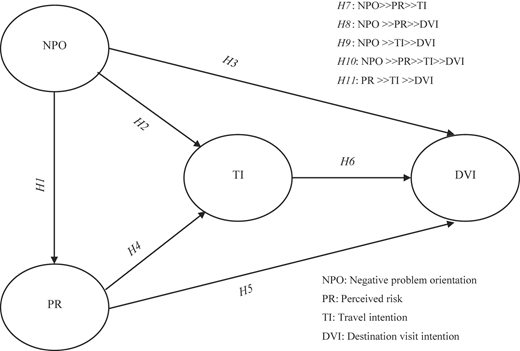
Negative problem orientation has a statistically significant relationship with perceived risk toward COVID-19.
Negative problem orientation toward COVID-19 has a statistically significant relationship with travel intention after the pandemic.
Negative problem orientation toward COVID-19 has a statistically significant relationship with destination visit intention after the pandemic.
Perceived risk
Safety and security are an important component in travelers' intentions to visit a destination (Beirman, 2003). This is the risk phenomenon that creates the need for safety and security. Risk is defined as the probability of an undesirable event that leads to possible negative consequences of the consumer's behavior (Glaesser, 2003; Laws and Prideaux, 2005; Li et al., 2020b; Kyrylov et al., 2020). Risk can arise in the context of multiple dimensions within the consumers' mind. These take place in the literature as financial, performance, physical, psychological, social and general risks (Sweeney et al., 1999; Pires et al., 2004; Fuchs and Reichel, 2004; Koç et al., 2019; Smith and Merritt, 2020; Fraser et al., 2020).
Consumers often tend to gravitate toward the least harm rather than the highest benefit in their purchasing decisions, so the issue of perceived risk is an important issue in understanding consumer behavior during the purchase decision process (Mitchell, 1999). Travel research emphasizes that the lack of security and safety is a major concern for tourists (Poon and Adams, 2000). These risks are examined in the literature within four main areas, war and political instability (Gartner and Shen, 1992; Clements and Georgiou, 1998; Ioannides and Apostolopoulos, 1999; Seddighi et al., 2001; Ivanov et al., 2017), health concerns (Cossens and Gin, 1994; Lawton and Page, 1997; Clift, 2000; Bushell, 2001; Richter, 2003; UNWTO, 2020b), crime and disorder (Sönmez, 1998; Pizam, 1999; Brunt et al., 2000; George, 2010; Mawby, 2014) and terrorism (Lutz and Lutz, 2020; Seabra et al., 2020).
The fact that tourists do not know what these risks will cause poses the real risk (Wilks and Page, 2006). Safety and security are also factors that can lead to risk and negative attitudes for potential tourists. Among these, one of the most important factors perceived as risk and can cause negative attitudes is health concerns. When potential tourists think that the risk is high, they prefer not to make a reservation, cancel, or go to place risk-free places (Sasso, 2005; Mansfeld, 2006). For example, many travelers avoided visiting Africa due to a negative attitude and perception of risk due to potential health-related risks (e.g. HIV) (Lepp and Gibson, 2003). Law (2006) researched three risk factors (terror attacks, infectious diseases and natural disasters) that affected the decision-making of international travelers. Maser and Weiermair (1998) revealed that hygiene and disease are important risk factors in travel-related risks. It has also been recommended that tourists do not visit developing countries with a high disease risk (Kozak et al., 2007). These recommendations highlight the risk perceptions of potential tourists. These risk perceptions affect tourism as was seen as the SARS virus had a negative impact on tourism and hospitality with many reservations being canceled (Rittichainuwat and Chakraborty, 2009).
Studies also indicate that when faced with tourist destinations that are equally attractive, tourists tend to visit the destination, where there is the least negative attitude or the least perceived risk (McLellan and Foushee, 1983; Erdem, 1998). This shows how important negative attitudes and risk perception are in the behavior of tourists. The negative attitude and perceived risk caused by COVID-19 is thereby thought to have an impact on tourist behavior. Although the attitudes of tourists toward a destination and travel have traditionally been resistant to change (Morrison, 2013), it is likely that their attitudes will change after the pandemic due to strong sociological and psychological changes. The main starting point and question of the research are also possible changes. In light of the literature, it is understood that the perception of risk can have a negative effect on travel intention. For example, Han (2005) found that the perceived risk and the intention to travel had a negative relationship.
Perceived risk toward COVID-19 has a statistically significant relationship with travel intention after the pandemic.
Perceived risk toward COVID-19 has a statistically significant relationship with destination visit intention after the pandemic.
Travel intention has a statistically significant relationship with destination visit intention.
Perceived risk toward COVID-19 is likely to mediate the effect of negative problem orientation toward COVID-19 on travel intention after the pandemic.
Travel intention
Intention is one of the most important descriptors of behavior (Hsu and Crotts, 2006) and can cause real behavior (Jang et al., 2009). Behavioral intent can be defined as behavior that existed before an action depending on social and situational factors (Moutinho, 1987). In addition, many researchers think that attitude is an important factor for behavioral intentions (Cheng et al., 2006; Hsu et al., 2010). In the context of tourism, travel intention has been defined as the possibility of traveling to any destination within any time (Baker and Crompton, 2000).
Unlike many other services, it is not possible for tourism and travel services to be experienced before they are purchased. Therefore, expenses are paid prior to travel. Thus, travel decisions are sensitive to risk and uncertainty (Promsivapallop and Kannaovakun, 2017). Apart from financial, social and terrorism risks, health risks have also been examined and found to significantly affect travel decisions (Rittichainuwat and Chakraborty, 2009; Schiffman et al., 2010; Lee et al., 2012; Haque and Haque, 2018). Additionally, travel restrictions imposed as a result of the pandemic will also have a negative impact on travel intentions and experiences (Hung and Petrick, 2010) and was supported by Lai et al. (2013). Based on this knowledge, it can be said that the barriers and risks to travel have a very significant impact on attitudes and travel intentions. In addition, these risk factors are among the most important descriptors of tourist behavior.
Perceived risk toward COVID-19 is likely to mediate the effect of negative problem orientation toward COVID-19 on destination visit intention after the pandemic.
Travel intention mediates the effect of negative problem orientation toward COVID-19 on destination visit intention after the pandemic.
Destination visit intention
The intention to visit is defined as the willingness to visit a destination (Chen et al., 2014) and safety and security are extremely important concerns when choosing a destination (Poon and Adams, 2000; Roodurmun and Juwaheer, 2010). Tourists who perceive fear towards the any destination image may negatively affect their intention to visit this destination (Hem et al., 2002). Yoon and Uysal (2005) referred to these as push factors. Many studies have found that perceived risk can impact on destination visit intention (Khan et al., 2017; Artuger, 2015). While risk perception is multidimensional, overall risk factors perceived by tourists have an impact on their intention to visit destinations (Şengel et al., 2022).
Perceived risk and travel intention mediate the effect of negative problem orientation toward COVID-19 on destination visit intention.
Travel intention mediates the effect of perceived risk toward COVID-19 on destination visit intention after the pandemic.
Questionnaire, sampling and data collection
The questionnaire used in the research consists of four sections and 35 statements, excluding demographic questions. Each of the scales will allow the testing of hypotheses developed as a result of the literature review. The NPO Scale of Clarke et al. (2017) was used to test NPO. To test the perceived risk, the Perceived Risk Scale used by Küpeli and Özer (2020), with dimensions of psychological, social, financial and general risk was applied. The scales used by Chin et al. (2015) and Chung et al. (2015) were used to test the travel intention and destination visit intention, respectively. The NPOs and perceived risks associated with post pandemic travel intention and destination visit intention were sought from people living in Turkey. Turkey is the destination of an important field of research for the solution of research question. Because with the first COVID-19 case, curfews and travel restrictions were imposed (Republic of Turkey Health Ministry, 2021). Research on the effects of COVID-19 in the country has begun to be published. It has been revealed that the hospitality industry in the country has been adversely affected with the onset of the pandemic (Şengel et al., 2020a; Eryılmaz, 2020). The perceptions of the people of the country regarding the epidemic were also tested (Doğan and Düzel, 2020; Ekiz et al., 2020). It has been revealed that different concerns about COVID-19 in the country negatively affect people's traveling behavior (Şengel et al., 2020c; Baykal, 2020). In addition, due to less human mobility, there is a significant increase in the demand for nature-based tourism types in the country in 2020 (Aydın and Doğan, 2020; Şengel et al., 2020b).
The research population consisted of people over the age of 20 and lived in Turkey. In this context, the 2019 census suggested a total population of 57,342,061 people over the age of 20 (Total Population-Under-20 population/82,886,000–25,543,939) which constitutes the universe of this study (TUIK-Turkish Statistical Institute, 2020). Within the scope of the research, no sample calculations have been made. In addition, within the context of the minimum number of samples required for statistical program, it has been targeted to reach 10 times the total number of expressions (35 × 10 = 350). The data were collected by convenience sampling method and were collected online due to social distancing rules associated with COVID-19.
Data were collected after COVID-19 was declared a pandemic. Because, over time, the NPO and perceived risks of people may decrease. The data collection process was completed in four months between October 12, 2020–February 12, 2021. This date range was preferred because the first case was identified on 11 March 2020 and the pandemic peaked toward the end of 2020. The prepared questionnaire was shared on authors' e-mail and social media platforms and participants were asked to fill in the questionnaire. The survey link was shared with groups of tourists and travelers. From this process, a total of 531 questionnaires were obtained and all of the questionnaires were used in the analysis. In social sciences, a sample size of 384 and above is considered sufficient for an unlimited number of research universes (Kotrlik and Higgins, 2001). For this reason, the data collection process was completed, considering that 531 participants would represent the research universe. Being a voluntary survey prevented the collection of incomplete and erroneous surveys. Details of the method of the study are presented in Table 1.
Details of the field research
| General population/study population | People who live in turkey and have destination visit intention |
| The geographical scope of the research | National |
| Data collection method | Online survey |
| Sampling frame | Anyone who volunteers to complete the questionnaire prepared in the online form (people over the age of 20 who intend to visit a tourist destination) |
| Population size | According to the 2019 census, people aged 20 and over (57.342.061) |
| Sampling technique | Probabilistic sampling-convenience sampling method |
| Data collection period | October 12, 2020–February 12, 2021 |
| Collected questionnaires | 531 |
| Valid questionnaires | 531 |
Data analysis
Two different statistical programs were used in the analysis of the data. The first program was used to determine the distribution of the demographic characteristics of the research sample given its capacity to present descriptive statistics and frequencies systematically. The second program was used to test the measurement and structure models as it provides flexibility for the analysis of reflective prediction models, facilitates the determination of predictions, needs no normality requirement and makes appropriate predictions within small samples (Loureiro and González, 2008; Henseler et al., 2009; Hair et al., 2012; Di-Clemente et al., 2019).
Descriptive statistics
Table 2 shows the descriptive statistics of the participants who participated in the study. There was a balanced distribution in terms of gender, marital status and income. In the age groups, those below the age of 46 were more common (about 82%). In addition, approximately 60% of the participants are people who travel with their families or prefer to do so.
Descriptive statistics of the participants
| Variables | Number | % | Variables | Number | % |
|---|---|---|---|---|---|
| Gender? | – | – | Marital status? | – | – |
| Female | 285 | 53.7 | Married | 281 | 52.9 |
| Male | 246 | 46.3 | Single | 250 | 47.1 |
| Age groups? | – | – | Income? | – | – |
| 30 and below | 220 | 41.4 | 500 $a and below | 186 | 35.0 |
| 31–45 | 215 | 40.5 | 501–1,000 $ | 148 | 27.9 |
| 46 and above | 96 | 18.1 | 1,001 $ and above | 197 | 37.1 |
| Have you traveled abroad for touristic purposes? | – | – | Who do you travel with? | – | – |
| Yes | 286 | 53.9 | Alone | 92 | 17.3 |
| No | 245 | 46.1 | Family | 316 | 59.5 |
| After the pandemic, do you intend to go abroad for touristic purposes? | – | – | Fiends | 123 | 23.2 |
| Yes | 385 | 72.5 | |||
| No | 146 | 27.5 |
Note(s): aUSD dollars
The most important information about the participants in this study is the information about their travel abroad, with 46.1% of the participants never having traveled abroad. However, 72.5% state that they were willing to participate in touristic activities abroad. This finding is opposite to what was expected given there is an expectation that international travel movements will decrease due to the pandemic.
Measurement model
Confirmatory factor analysis was performed to test the measurement model. While conducting analysis on the measurement model, a total of five statements were disabled, one from the NPO scale, three from the perceived risk scale and one from the destination visit intent. This process was carried out by considering statistical rules. Expressions with a factor load below 0.50 and t-value below 1.96 were disabled in the model (Doğan, 2019). Table 3 presents the confirmatory factor analysis (Kim and Hall, 2019). For factor loads, a value of 0.50 was taken as reference and expressions above 0.50 were included in the analysis (Chen and Tsai, 2007). t-values with ranging from 8.463 to 64.201 and were seen to be greater than the reference value of 1.96 (Doğan, 2019). The value of VIF (variance inflation factors) for each expression was less than 10. Although statistical program accepts VIF values lesser than 3 as reference, it is suggested that values less than 5 and 10 are acceptable (Sevinç, 2013). The fact that VIF values for each expression were less than 10 also has an effect on the scope of the research. Table 3 presents the arithmetic mean and standard deviation findings for each dimension (structure) that constitutes the quadruple structure in the study.
Confirmatory factor analysis and measurement model
| Dimension (structure) | Mean | Std. Dev | VIF | t-Value | Factor load |
|---|---|---|---|---|---|
| Negative problem orientation (related to COVID-19) | |||||
| I often doubt whether I can solve problems | 2.154 | 1.172 | 2.326 | 14.065 | 0.739 |
| It often seems like I cannot beat my problems | 2.109 | 1.130 | 3.269 | 17.068 | 0.804 |
| I think my problems will not go away, even if I can think of ways to solve them | 2.546 | 1.194 | 1.756 | 8.463 | 0.640 |
| I often feel that my problems cannot be solved | 1.985 | 1.146 | 2.562 | 14.274 | 0.754 |
| When I think about all the ways to solve a problem, I still wonder if my answer will work | 2.444 | 1.192 | 2.257 | 12.812 | 0.750 |
| I see problems as a danger | 2.605 | 1.295 | 2.218 | 14.920 | 0.787 |
| I think my problems as bigger than they really are | 2.435 | 1.240 | 1.768 | 12.255 | 0.700 |
| When I have a problem, the first think I do is think that I do not have the ability to solve it | 3.006 | 1.180 | 1.708 | 10.402 | 0.657 |
| I think that problems will get in the way of things I need to do | 3.032 | 1.282 | 2.119 | 14.458 | 0.758 |
| I see problems as a threat to my well-being | 3.718 | 1.346 | 1.508 | 10.018 | 0.570 |
| Before I try to solve a problem, I think that it is hard to solve problems | 2.780 | 1.241 | 1.631 | 13.950 | 0.670 |
| Perceived risk (related to COVID-19) | |||||
| The thought of purchasing a touristic product made me feel psychologically uncomfortable | 3.203 | 1.276 | 5.584 | 17.320 | 0.818 |
| The thought of purchasing a touristic product gave me a feeling of unwanted anxiety | 3.119 | 1.238 | 7.088 | 16.875 | 0.816 |
| The thought of purchasing a touristic product caused me to experience unnecessary tension | 3.023 | 1.268 | 4.501 | 16.946 | 0.813 |
| Overall, caused me to be concerned with experiencing some kind of losses | 3.119 | 1.222 | 2.164 | 14.089 | 0.729 |
| All things considered I think I made a mistake by buying touristic product | 2.825 | 1.269 | 2.566 | 16.061 | 0.801 |
| When all is said and done I really felt that it posed problems for me that I just did not need | 2.959 | 1.227 | 1.814 | 13.165 | 0.716 |
| Buying touristic product caused me to be thought of as being foolish by some people whose opinion I value | 2.186 | 1.170 | 1.697 | 8.591 | 0.591 |
| I wasted my money by purchasing touristic products | 2.267 | 1.226 | 2.886 | 11.238 | 0.685 |
| Financial investment I made for touristic product was not wise | 2.527 | 1.289 | 3.310 | 11.713 | 0.692 |
| I did not get my money's worth from products provided by the tourism enterprises | 2.497 | 1.195 | 2.919 | 9.541 | 0.649 |
| I worried that buying touristic products would involve unexpected extra expenses | 2.814 | 1.248 | 2.206 | 12.676 | 0.661 |
| Travel intention (after COVID-19) | |||||
| I am willing to travel and tour after the pandemic | 2.699 | 1.494 | 4.558 | 23.309 | 0.868 |
| I am committed to travel and tour after the pandemic | 2.614 | 1.472 | 5.768 | 30.613 | 0.904 |
| I am keen with the vacation after the pandemic | 3.358 | 1.507 | 1.966 | 19.249 | 0.779 |
| There is high possibility that I would travel and tour after the pandemic | 2.795 | 1.502 | 3.660 | 29.904 | 0.908 |
| Travel motivations are higher when people are young | 3.053 | 1.491 | 2.269 | 20.978 | 0.825 |
| Destination visit intention (after COVID-19) | |||||
| I will visit a destination again after the pandemic | 2.765 | 1.483 | 6.871 | 50.861 | 0.956 |
| I will continue to visit the any destination in the future after the pandemic | 2.814 | 1.507 | 8.841 | 64.201 | 0.973 |
| I intend to visit any destination frequently after the pandemic | 2.733 | 1.445 | 3.504 | 42.010 | 0.922 |
Table 4 presents the reliability, validity and correlation values. The Cronbach's (α) composite reliability and Rho-A are above 0.70, which is the minimum value required within social science research for each structure (size) (Campbell and Fiske, 1959; Carmines and Zeller, 1979; Nunnally and Bernstein, 1994). When these values are taken into account, it can be said that the analysis achieved the reliability requirement.
Reliability, validity and correlation
| Variables | Fornell–Larcker criterion | Heterotrait-Monotrait ratio | ||||||
|---|---|---|---|---|---|---|---|---|
| 1 | 2 | 3 | 4 | 1 | 2 | 3 | 4 | |
| Negative problem orientation (1) | 0.729 | |||||||
| Perceived risk (2) | 0.011 | 0.950 | 0.051 | |||||
| Travel intention (3) | 0.552 | 0.059 | 0.715 | 0.596 | 0.066 | |||
| Destination visit intention (4) | −0.113 | 0.622 | 0.013 | 0.858 | 0.122 | 0.667 | 0.053 | |
| Cronbach's alpha | 0.911 | 0.918 | 0.925 | 0.531 | ||||
| Reliability coefficient (Rho_A) | 0.946 | 0.949 | 0.966 | 0.903 | ||||
| Composite reliability | 0.903 | 0.906 | 0.919 | 0.511 | ||||
| AVE | 0.910 | 0.914 | 0.933 | 0.737 | ||||
The AVE coefficient was above 0.50, which is accepted as a reference in the social sciences for each structure (dimension) (Hair et al., 2010). In addition, the square roots of the AVE values were larger than the correlation value for each dimension. These assessments demonstrate convergent validity was achieved (Fornell and Larcker, 1981). In the Fornell and Larcker criterion evaluation, all of the values in the rows and columns are lower than the values written in italic and in the Heterotrait-Monotrait ratio (HTMT) evaluation, the values between 0 and 1 indicate that separation validity was achieved. In statistical terms, this value is expected to be less than 0.90 (Hair et al., 2017).
Structural model
The suitability of the structural model and the acceptance status of the hypothesis tests are presented in Table 5. Considering the model fit values, it can be said that the standardized root mean square residual (SRMR) value and Normed Fit Index (NFI) are at an acceptable level as the SRMR (RMSEA) value is expected to be less than 0.08 and NFI value will be greater than 0.80 (Karagöz, 2017). Especially for statistical program, a SRMR value can be accepted under 0.10 (Domínguez-Quintero et al., 2020).
Path coefficients and impact dimensions
| Hypothesis | Path coefficients | t-stat | p-value | Supported/Significant | SRMR | NFI |
|---|---|---|---|---|---|---|
| Direct effects | 0.072 | 0.747 | ||||
| H1: NPO → PR | 0.552 | 15.612 | 0.000** | Yes | ||
| H2: NPO → TI | 0.108 | 1.925 | 0.054 | No | ||
| H3: NPO → DVI | 0.007 | 0.166 | 0.868 | No | ||
| H4: PR → TI | −0.173 | 3.036 | 0.002** | Yes | ||
| H5: PR → DVI | 0.079 | 2.017 | 0.044* | Yes | ||
| H6: TI → DVI | 0.630 | 19.630 | 0.000** | Yes | ||
| Mediator effects | ||||||
| H7: NPO → PR → TI | −0.095 | 3.009 | 0.003** | Yes | ||
| H8: NPO → PR → DVI | 0.044 | 1.991 | 0.048* | Yes | ||
| H9: NPO → TI → DVI | −0.109 | 1.911 | 0.056 | No | ||
| H10: NPO → PR → TI → DVI | −0.060 | 2.991 | 0.003** | Yes | ||
| H11: PR → TI → DVI | 0.068 | 3.014 | 0.003** | Yes | ||
Note(s): Significant at *p < 0.05 level,
Significant at **p < 0.01 level,
t > 1.96,
NPO: Negative problem orientation, PR: Perceived risk, TI: Travel intention and DVI: Destination visit intention
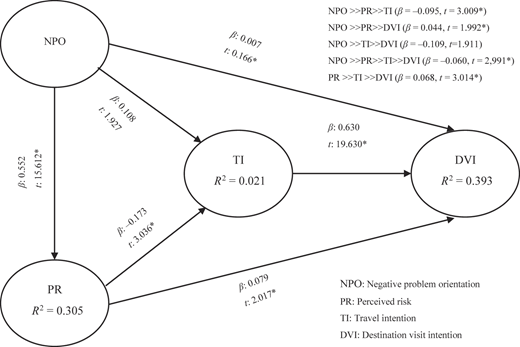
When Table 5 is examined, five of the six hypotheses where direct effects were tested were supported, while one was not. NPO affects perceived risk related to COVID-19 in the 99% confidence interval, while it does not affect travel intention and destination visit intention after COVID-19. Therefore, while H1 was supported, H2 and H3 were not supported. The perceived risk associated with COVID-19 affects the travel intention after COVID-19 in the 99% confidence interval and the intention to visit the destination in the 95% confidence interval. Similarly, post-COVID-19 travel intention affects destination visit intention in the range of 99%. In the light of this information, H4, H5 and H6 hypotheses are supported.
In the research, five hypotheses about intermediary variables measuring indirect effects were developed. Through these hypotheses, the effects of intermediary variables in the model were tested as a product of the coefficients of each of the causal relationships in the model (Hayes et al., 2011). Indirect effects of independent variables on dependent variables were tested using 5,000 bootstrap samples (Chin et al., 2013). According to Table 5, NPO toward COVID-19 affects post-COVID-19 travel intention and post-COVID-19 destination visit intention with a perceived risk mediator variable at 99% and 95% confidence intervals. Therefore, H7 and H8 were supported. H9 was not supported as the NPO toward COVID-19 does not affect the destinations visit intention through the travel intention mediator. According to the results, a NPO toward COVID-19 affects destination visit intention at 99% confidence level through perceived risk and travel intention mediators. Finally, the perceived risk to COVID-19 affects destination visit intention at 99% confidence level through the travel intention mediator. Therefore, H10 and H11 were also supported (see Table 6).
PLS predict analysis
| Dependent variables | Independent variables | R2 | Q2 | VIF |
|---|---|---|---|---|
| Negative problem orientation | Perceived risk | 0.305 | 0.148 | 1.000 |
| Travel intention | 0.021 | 0.014 | 1.438 | |
| Destination visit intention | 0.393 | 0.333 | 1.450 |
Note(s): 5,000 bootstrapping procedure used
In Figure 2, there are relations between the variables of the research according to the Partial least square (PLS) result. In the model, the levels explaining the variance of dependent variables by independent variables were included. The R2 value for destination visit intention after COVID-19 was 0.393. There was also 39.3% of destination visit intention variance after COVID-19, the dependent variable in this model and is explained by the independent variables (López-Bonilla and López-Bonilla, 2014; Nikbin and Hyun, 2017). Chin (1998) states that this explanatoriness is moderate.
Discussion and conclusions
A risk associated with each of the crises arising from economic, health, terrorism, political and natural disasters affects the intention to travel and general trips or tourist trips are often canceled. Specific to this research, the perceived risk toward the pandemic affects the travel intention negatively, while the destination visit intention remains positive. This bears some resemblance to a study by Floyd et al.'s (2004) after the September 11 terrorist attack and Qi et al. (2009).
The NPO toward the pandemic affects the travel intention and the destination visit intention after the pandemic with mediating variables. The NPO about the epidemic negatively affects the travel intention after the epidemic through the perceived risk mediator. The mediating effect of perceived risk on the travel intention was also identified in studies by Tavitiyaman and Qu (2013) and Maritz et al. (2013). Likewise, the NPO toward the pandemic negatively affects the destination visit intention with the variable travel intention mediator. This result is similar to the results of the study of Lehto et al. (2008) on the tsunami crises. In parallel, the NPO toward the pandemic affects the destination visit intention negatively through the perceived risk and travel intention mediators.
According to the other striking result of the study, the NPO positively affects destination visit intention with the perceived risk mediator. In addition, perceived risk positively affects the destination visit intention with the travel intention mediator. Chew and Jahari (2014) determined the effect of perceived risk on destination visit intent through the mediation effect of different variables in the context of intention to revisit. In this study, it was found that the negative effect turned into a positive effect through the mediator. This result is similar to the results of this study and Choi et al. (2013) also achieved similar results.
Theoretical implications
In the research, the NPO toward the COVID-19 pandemic does not have a direct effect on travel intention or destination visit intention. Strong relationships were identified between the attitude developed against any negative situation (Anable, 2005; Staats et al., 2006; Zhang et al., 2017; Ru et al., 2018) and participation in travel and tourism activities (Lam and Hsu, 2004; Hsu et al., 2010; Sharifpour et al., 2014). These relationships have also been supported by current study. There is a positive and linear relationship between the NPO of the COVID-19 pandemic and its perceived risk (Weber and Hsee, 1998; Eiser et al., 2002) and travel and destination visit intention. As the NPO of the epidemic increases, the perceived risk increases. Likewise, as the travel intention after the pandemic increases, destination visit intention increases. Studies on travel destinations visit intention are generally examined in the context of behavioral theories such as theory tourist behavior (Lam and Hsu, 2004; Zarrad and Debabi, 2015) and theory of planned behavior (Hsu et al., 2010; Damayanti et al., 2017). In this study, travel intention and destination visit intention were taken separately. Because every travel intention of people who cannot travel due to the epidemic may not be for a touristic purpose. In this context, it is stated in the literature that the factors affecting the destination visit intention are factors such as safety, image, quality and brand (Horng et al., 2012; Chi et al., 2013; Abubakar, 2016; Tan and Wu, 2016). Contrary to this, Ferns and Walls (2012) also examined the effect of travel on the destination visit intention with the help of mediating variables.
Crises that may threaten the safety of people can affect their intention and behavior to travel and participate in tourist activities. These crises set off a NPO and affect an individuals' perception of risk and therefore their opinions about travel and visit. There are many studies in the literature that reveal the fiction of these relationships (Sönmez and Graefe, 1998a, b; Reisinger and Mavondo, 2005; Huang and Hsu, 2009; Quintal et al., 2010; Alvarez and Campo, 2014; Park et al., 2017). The results of this study reveal the interaction between the concepts expressed here in the context of the COVID-19 pandemic. According to the results of the research, an increase in NPOs related to the pandemic increases the perceived risk related to the pandemic. Similarly, an increase in travel intention after the pandemic increases the destination visit intention. The NPO toward the pandemic negatively affects the travel intention through the perceived risk mediator. In addition, it negatively affects the destination visit intention through the travel intention mediator.
As people's general NPOs and risk perceptions about COVID-19 increase, their travel intention and destination visit intention decreases (Larsson and Gustavsson, 2020). When touristic travels and destination visits are reduced, the supply elements in the destination are adversely affected. The hospitality industry is a critical supply element. With the restrictions on incoming travel, accommodation businesses in most countries have ceased operation (Youssef et al., 2020; Kumar, 2020) or started to provide services to health workers.
Managerial implications
This study has revealed the effects of pandemic diseases, a type of crisis that seriously affects the tourism industry, on tourists' capacity to travel and on travel profits. The COVID-19 pandemic examined within the scope of this research is one of the most globally virulent pandemics in terms of its rate of contagion. Another characteristic of this outbreak is that the increased travel movements of our modern society has increased the rate of the pandemic’s transmission. The information technologies available during this outbreak means information about the pandemic is collected and presented globally on a daily basis. In light of this increased exposure through news and precaution measures, it is expected that people are likely to develop a NPO toward the outbreak and have a high-risk perception. It is also expected that the pandemic will affect people's intent to travel and their destination visit intentions.
As the effects of the pandemic have decreased in some countries, efforts to revitalize tourism movements have increased. In this context, the companies in the hospitality industry should take precautions in relation to hygiene, social distancing, mask use and information messages. These are important and can be used as a marketing strategy to help businesses survive the crisis caused by COVID-19 (Pappas, 2015; Karlsson and Tavassoli, 2016). The fact that businesses inform tourists quickly through the Internet may allow them to obtain a competitive advantage in this crisis environment (Scaglione et al., 2009; Hjalager, 2010; Nicolau and Santa-María, 2013; Campo et al., 2014; Consiglio et al., 2018). The hospitality industry acted similarly after the SARS outbreak (Jayawardena et al., 2008; Larsson and Gustavsson, 2020). The measures to be implemented by the hospitality industry can increase the travel intention and destination visit intention after the pandemic by positively affecting the perceived risk and NPO related to COVID-19.
The pandemic affected tourists' travel intention and their destination visit intention, while changing tourists' priorities on the other hand. Much of the discussion between business owners, senior executives and professionals in the hospitality industry focuses on the shift toward short-term strategic adaptation relative to the impact of COVID-19 on touristic activities. However, it can be said that the pandemic contributed to the sustainable renewal of the tourism and hospitality industry (Martin, 2020). Li et al. (2021) stated that rural-based tourism activities could come to the fore within this scope. The current crisis environment seems to have changed industry and tourist behavior respectively (Şengel et al., 2020c). These mutual behaviors may increase travel for touristic purposes, too.
Limitations and direction for future studies
There are two major limitations of the study. The first is that surveys could not be collected face to face due to the social distancing rules in the outbreak. Another important limitation of the study is that the data collection was limited to Turkey. Since COVID-19 is a global pandemic, further contributions from additional international studies would enhance our understanding of the subject. However, the social, cultural, geographical, economic and demographic characteristics of countries can create differing reactions to the outbreak. Therefore, the study was limited to Turkey.
Suggestions for future research have been made in two categories, in terms of the subject and the method. In the future, researchers may focus on topics such as tourist psychology, conditions for the revival of international travel movements, solutions for restructuring the tourism industry, cash flow and borrowing levels for tourism businesses, and anxiety and expectations of tourism workers. Doing studies with appropriate research methods according to the research topic may result in more beneficial results. In particular, quantitative research methods (surveys) can be carried out on subjects such as tourist psychology and employee anxiety and expectations from the collection of data from international samples, and qualitative research methods such as participatory observation, interview or focus group interview can also be carried out in smaller samples. In matters such as revitalization of international travel movements, restructuring the tourism industry, and cash flow and borrowing levels of tourism enterprises, studies can be conducted using analysis methods based on secondary data and computer aided simulation methods.

