

Traditional quality plans are being replaced by more user-friendly systems. This briefing details an innovative integrated approach to quality management being adopted on the Highways Agency's Area 3 motorway and trunk road network.
1. INTRODUCTION
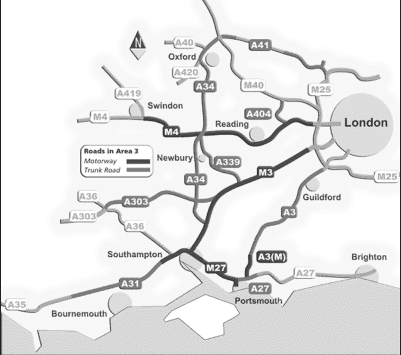
Raynesway Construction Southern Limited (RCS) and Mott MacDonald (MM) in conjunction with Hampshire County Council (HCC) have been maintaining the Highways Agency's Area 3 (Fig. 1) motorway and trunk road network since April 1997. In 2001, contracts for the term maintenance contractor and managing agent were re-won by the same team for a further period of five years. The opportunity of working together for a further term led to a new approach to quality management built around integrating processes across organisational boundaries.
The Highways Agency (HA), as the client, has itself been instrumental in working together with RCS and MM to develop and implement this integrated approach. Producing a management system that recognises that the client has an important role to play in achieving service delivery is believed to be a first for the industry.
2. CHANGING ROLES
Traditionally, civil engineering consultants and contractors have set up quality systems using written procedures that provide compliance against a recognised ISO quality standard. These systems have been backed up by quality plans written for specific projects. While this approach has worked well for standalone engineering projects, it is not suited to managing agent and term maintenance work where consultants and contractors are taking on increasing levels of non-technical work.
The 2001 Area 3 contracts for term maintenance contractor and managing agent required the production of detailed company-specific quality management plans covering all aspects of work undertaken on the network. Initial meetings between MM, RCS and the HA led to early recognition of
the need for all three partners to work closely together
the diverse range of activities undertaken by the three partners
the need to standardise practices across a large workforce.
In view of these points, producing separate, lengthy quality plans for each organisation's input was not considered to be the best way forward.
3. INITIAL STEPS
A Business Improvement Team was therefore established with representatives from RCS, MM, the HA Area Team and HA's PRIDe Team (an audit and performance measurement group set up to monitor and improve agency area performance). The main focus of the team has been the development of a Joint Management Plan (JMP). The following set of principles for development of the JMP were established
integration of the three Area 3 partner organisations
use of process mapping to define how individuals and organisations interact
to work towards predictability of time and cost
to focus on development of people.
The underpinning theme was to align people to deliver their defined objectives through making them aware of their responsibilities and providing them with the necessary tools and training to continually improve.
The Business Improvement Team report through the senior managers from the HA, MM and RCS to the Network Board—a virtual board established within Area 3 to direct strategy.
4. TAKING SHAPE
The move away from producing company-specific quality plans was not strictly in accordance with contractual requirements, but gained the support of the HA because they could see the potential benefits of adopting an integrated approach to network management.
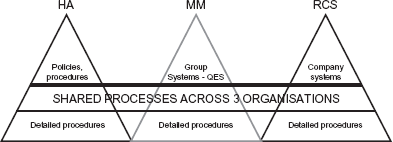
Figure 2 shows how corporate systems and organisation-specific detailed procedures are tied together by shared processes within the JMP which span all three organisations.
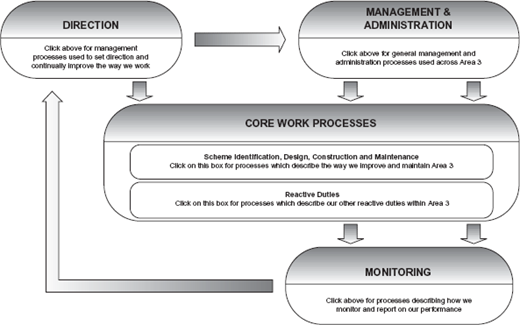
The core of the JMP is a series of process maps, defining roles and responsibilities of individuals drawn from all three partners. Fig. 3. shows how process maps fell neatly into four main groups.
Direction—a set of management-level processes used to set direction and continually improve methods of work.
Management and administration—processes which apply controls across the network, such as communications and roadspace management.
Core work processes—split into two subsets of
planned work involving scheme identification, design, construction and maintenance
unplanned reactive duties such as emergency responses to incidents and winter maintenance.
Monitoring—processes which describe how performance is monitored and reported.
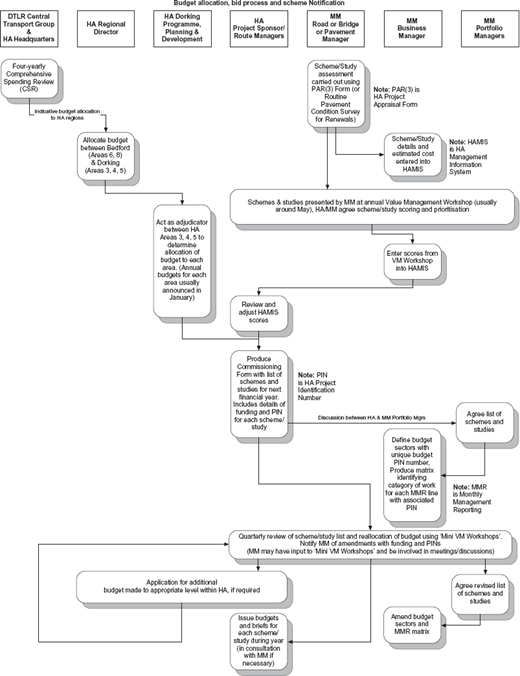
The design of the process map (Fig. 4. shows a typical process map) was given careful consideration and includes the following features
a named process owner responsible for overseeing the process and ensuring objectives are achieved
defined process objectives giving staff clear targets to work towards
a method of regularly measuring the performance of each process
cross-references to more detailed procedures, method statements, checklists, standard forms, etc.
The JMP relies heavily upon a commitment to investing in staff and their training requirements, and provides all staff with
a clear understanding of roles and responsibilities
necessary tools to undertake work effectively (databases, systems, forms, etc.)
motivation through clear process-specific and area-wide objectives
ownership by being able to contribute to system improvements.
5. ACHIEVEMENTS SO FAR
The JMP has been issued in hard copy to all Area 3 staff and includes a process map covering almost every aspect of work undertaken by the three partners across the network. Feedback on the integrated process map format has been very positive, with general agreement among staff that the system is easy to read, reduces ambiguity and provides an easy guide to staff responsibilities and objectives. The move away from wordy procedures has been welcomed. Staff have also benefited from understanding how their work fits in with other processes both downstream and upstream, thus underlining the importance of what they do.
6. THIS IS JUST THE BEGINNING
The JMP is in its early stages of development, but with its inbuilt structured commitment to continuous improvement, it will become more effective in delivering service-level improvements and efficiencies. Monitoring of process performance takes three forms
traditional audit undertaken by a full-time Area 3 internal auditor
quarterly ‘excellence surveys’ measuring staff perception of how well the team is performing
process performance measurements monitored by process owners.
There is also a popular feedback mechanism allowing staff to provide suggestions for improvement of the JMP to their Business Improvement Team representative. Regular review of processes based upon results of monitoring and staff feedback is now starting to take place, with the first process re-engineering workshops scheduled to take place shortly.
Other areas for improvement of the JMP which will be effected over coming months are
development of a fully hyper-linked on-line version allowing easy access to latest process maps together with links to all supporting risk assessments, forms, method statements, etc. used throughout the network
uploading of on-line process performance measurements allowing all staff to see improvements
the development of a joint audit team comprising individuals from all three partners sharing audit duties and lessons learnt.
The concept of using one management plan shared by different contractual parties has taken Area 3 partnering to a new level. The JMP has encouraged staff to forget organisational boundaries and work together as a team towards an agreed joint vision and set of objectives. It is hoped to publish a formal paper during 2003 giving examples demonstrating how the JMP has contributed to performance improvement across the network.
7. ACKNOWLEDGEMENTS
The authors wish to thank other members of the Area 3 Business Improvement Team who have contributed significantly to the development of the JMP. Particular thanks go to John Rylett (HA), Alex Tam (PRIDe), Guy Berresford (HA), David Richards (MM), Graham Drew (RCS) and Tim Fowler (RCS).

