Urban water-supply systems play a fundamental role in modern society. These infrastructures are exposed not only to natural hazards, but also to technical failure and terrorist attack. The effects of such events extend beyond direct users as they upset the performance of other systems. During a crisis, other infrastructures, like hospitals and other emergency systems, may be unable to respond. Economic losses may ensue in industrial facilities or power generation and distribution. Decision-makers therefore have to decide how infrastructures can be strengthened and operated to cope with hazardous situations. This paper discusses the technical and scientific challenges faced in building and applying decision models that include risk/uncertainty issues for the planning, design and management of urban water infrastructures.
1. INTRODUCTION
Urban water-supply systems are very vulnerable to different kinds of natural risks such as storms, earthquakes, floods, winds, drought, landslides and volcanic activity, as well as accidents due to the unexpected technological failure of a key element or provoked by acts of terrorism. The economic impacts and the disorder to human life provoked by such events are sometimes very significant.
These infrastructures are vital lifelines whose integrity is crucial to urban life and they should therefore be considered critical infrastructures. Climate change could pose further challenges to the creation of less vulnerable urban water-supply systems. An efficient response should result from the joint efforts of governments, water utility companies and operators, public health entities, emergency response and follow-up teams, academia and the private sectors involved.1
The risk associated with infrastructures depends on the probability that a hazardous event will occur and its consequences. It is important to emphasise that there are unexpected events whose probability cannot be known. Since the 2001 terrorist attacks on the US World Trade Center, this idea is becoming widespread today, but it is interesting to note that this concept was already understood in ancient times. Classic phrases such as ‘it is probable that the improbable will happen’ made by Aristotle2 and ‘Solum certum, Nihil esse certi’ (the only certainty is that nothing is certain) by Pliny the Elder3 imply this. A variety of scenarios should therefore be constructed to help define strategies at all levels for handling different threats and hazards. This should be a major goal for engineers, that is designs should be planned in such a way that a system performs well under a wide variety of possible conditions.
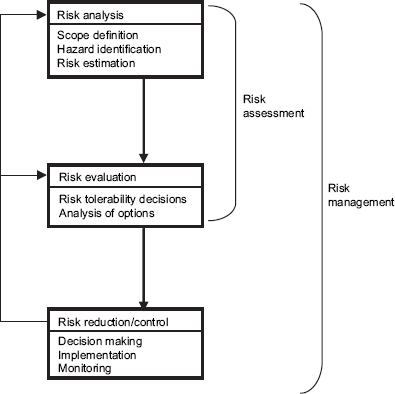
According to the International Electrochemical Commission (IEC)4 ‘the overall process called risk management is to control, prevent or reduce loss of life, illness, injury, damage to property and consequential loss, and environment impact’ (Figure 1). Even if risk management cannot eliminate uncertainty it may help to improve our ability to deal with uncertain events and their detrimental consequences.
Considerable research has been published on urban water infrastructures, taking a proactive attitude towards risk by developing actions in the so-called preparedness phase.5,6 Besides careful urban planning to avoid building in areas liable to landslide, flooding and so on, the literature focuses on four other aspects that contribute to strengthening infrastructures. According to Haimes et al.7 these factors are security, redundancy, robustness and resilience. Actions taken that bear these factors in mind will contribute to a better response and recovery of systems, and so minimise the effects of disasters.
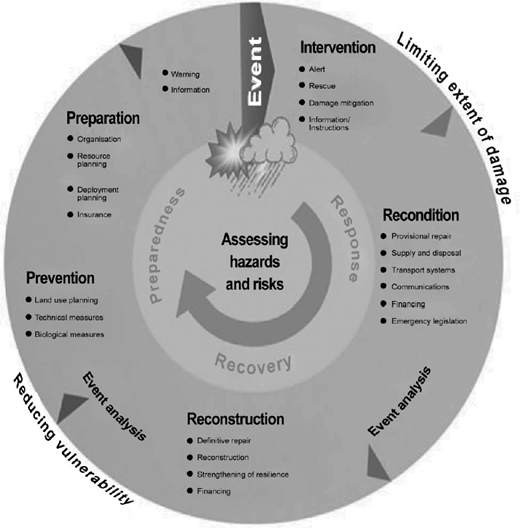
Over the past few years, especially after the International Decade for Natural Disasters (IDNDR) sponsored by the United Nations in the 1990s, many different views and institutional arrangements have been used to help to guide the actions to be taken. As an example, Figure 2 displays the risk cycle prepared by the National Platform on Natural Hazards (Planat) in Switzerland for a global approach to risk.8 This wheel highlights three phases
response (intervention, recondition)
recovery (reconstruction)
preparedness (prevention, preparation).
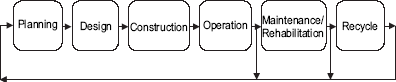
The lifecycle of a water supply system displayed in Figure 3 shows the different stages where actions can be taken to avoid the impacts of catastrophic events.9 Decision-makers have to decide how structures should be strengthened and operated to deal with risk situations. These infrastructure systems are very expensive and they can never be made to withstand all potential hazards. The costs would be unreasonable and, if a proactive attitude to risk management is adopted, decision-makers should analyse the trade-off between expenditure and improved reliability. People's willingness to pay for investment to cut risks to urban infrastructures has still not been clarified by economists.
2. DECISION MODELS
Decisions concerning public infrastructure involve environments characterised by a high risk/uncertainty. The literature includes deterministic approaches used for many decades, ignoring the risk/uncertainty features inherent to these decisions. To overcome these drawbacks, sensitivity analysis was then used in a trial-and-error manner to evaluate the consequences of the implementation of such decisions. Sensitivity analysis is reactive, so an effective proactive decision-making procedure, guided by appropriate techniques including risk/uncertainty considerations, is essential. Decision models can play an important role by considering all the relevant aspects of a situation simultaneously, in a structured fashion.
These models include one or more objective functions and a set of constraints: the objective function translates the criteria to be fulfilled and the constraints represent the limitations (physical, economic, legal, social, environmental and technological) on the achievement of the objectives.
2.1. Optimisation techniques
Intervention to solve planning and management problems is often very costly and sometimes difficult to reverse; therefore all available knowledge and techniques should be mobilised to arrive at the best decisions.
The planning and operation of urban water-supply systems in a proactive integrated risk management context lead to the formulation of highly complex decision models.10–15 Such tools can be very helpful in guiding decisions. They do not replace the decision procedure but they can be very useful for structuring an analysis of all the issues involved and identifying ‘good’ decisions once the objectives and assumptions are defined. They can represent the various interdependencies and interactions involving technical, economic and social issues, end users and different interest groups. At a strategic level, where a limited number of alternatives is to be analysed, multi-criteria decision analysis is of crucial importance (see Vincke16 for detailed information about evaluating and ranking methods in this field).
At an operational level, mathematical programming, including multi-objective programming, should be considered. In this case, the objective(s) function(s) and some constraints are non-linear and some variables are discrete. To keep close to reality, the corresponding models are therefore stochastic non-linear mixed-integer models. The establishment of the objective function and the constraints can be an intricate task. In fact, the different situations encountered in real-world problems require the consideration of a multitude of aspects (costs, benefits, environmental standards, budgetary prescriptions, legal and technical protocols, etc.). In a multi-objective context, trade-off analysis is needed to enlighten decision-makers about the possible combination of objectives, giving them information about the pros and cons of assigning higher priorities to some objectives.
It is only relatively recently that advances in operations research and computing technologies have made it possible efficiently to resolve models applicable to planning and management problems of urban water-supply systems. The role played by modern heuristic techniques (e.g. genetic algorithms, simulated annealing, tabu search, ant colony algorithms) is particularly important.17–19 Such methods allow the resolution of real-world engineering problems to be viewed with prospects of success. A thorough evaluation of these methods is, however, needed if good-quality mathematical solutions are to be obtained. Caution must also be used when bridging the gap between theory and engineering practice. The development of optimisation models for realistic case studies, including all the issues that characterise urban water-supply systems, is therefore essential.
2.2. Risk/uncertainty approaches
Risk can be incorporated into decision models by considering implicit stochastic optimisation models (models where all the available information is directly included in the model) or explicit stochastic optimisation models (where the concept of probability is explicitly included in the model).
Implicit stochastic optimisation methods, also known as Monte Carlo simulations, use historical or synthetically generated time series for data representation. Deterministic approaches can therefore be used to solve decision models, while the stochastic characteristics of problems are accounted for in the decision process. As such, the meaning of the results is clearly related to the number of historical or synthetically generated time series and the solutions obtained are suitable in situations analogous to those used as reference. This may be a disadvantage when large-scale optimisation problems are to be solved and a huge number of series is used. This is particularly complex in dealing with non-linear optimisation problems or non-linear mixed-integer problems.
Explicit stochastic approaches use a probabilistic description of random parameters directly in the decision model's formulation. Many models set out to optimise expected outcomes of a system (minimising expected costs or maximising expected profits for example). This procedure does not consider the variability of the outcomes and does not include risk-averse behaviour. Trade-off evaluations of the risks of suboptimal decisions and infeasible decisions are also dismissed.
Uncertainty can be incorporated into decision models by using models in the field of so-called robust optimisation.20 The complexity of situations that create vulnerabilities, the September 11 events and the challenges posed by global changes can render historical time series and normal statistical techniques illusory. Highly sophisticated mathematical formulations clearly do not remove the unknown: lack of information will always be lack of information. This is why it is necessary to bring together experts from different fields to try to build scenarios. These scenarios are the basis for defining the best solutions that are likely to work ‘well’, even under adverse conditions, within the scope of application of robust optimisation techniques. Trade-off analyses can be used to evaluate the gain in a solution's robustness and rising expenditure.
3. CONCLUSIONS
Proactive attitudes to risk are essential for minimising the effects of disasters, particularly in relation to vital infrastructures such as urban water-supply systems. More robust and resilient infrastructures should be developed that can work ‘well’ even during a critical event. The complexity of the economic, social and environmental consequences of hazardous events and the costs involved in all phases of risk management indicate that appropriate tools have to be used for optimal allocation of security resources.
Decision models capable of handling the various facets of the planning and management of urban water-supply systems are a very valuable aid to decision-makers. They can facilitate trade-off analyses among different objectives and give insights into decision priorities. The literature contains many recent developments in the area of decision methods directed to the consideration of risk/uncertainty in decision procedures. More work is needed, however, to bridge the gap between research and engineering practice through the use of realistic case studies.