

Modelling Pedestrian Movement
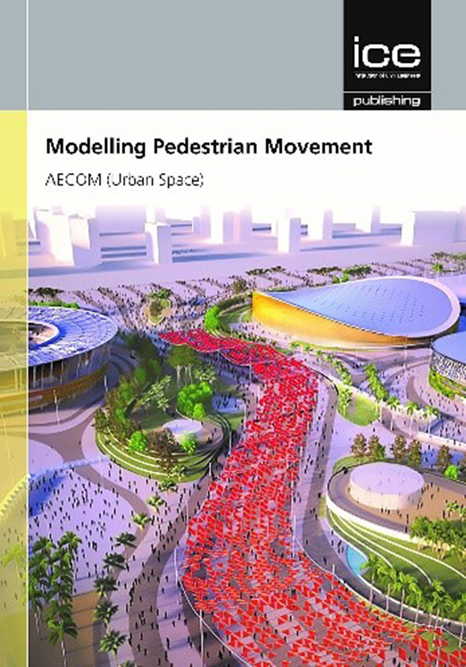
Modelling Pedestrian Movement provides a thorough introduction to the principles and practices involved in simulating pedestrian and crowd-flow patterns. It presents the theories, techniques and tools for pedestrian modelling, and presents a range of 12 original case studies from practice, varying from interchanges and station environments to events, public spaces, buildings and airports. The authors, Samya Ghosh, Emmet Ruxton and Martynas Didzys, all work at AECOM, one of the world's best-known infrastructure firms. The book is aimed at an audience of transport planners, modelling professionals, urban designers, architects, fire engineers and students of these subject areas.
The book is divided into two parts: one on Data and techniques, the other with Case studies. Each chapter is well structured and has well-written introductions, summary points and literature lists. Part I has a number of theoretical chapters, but also discusses very nicely the ‘model development process’ as well as the ‘future of pedestrian modelling’. The theory chapters are illustrated with ‘simple’ schemes, drawings and charts which make the theory come alive. The authors are also very open and honest about the challenges, uncertainties and limitations which come with modelling pedestrians and crowds, in particular when modelling is used to support urban design, planning and engineering decisions. Part II systematically presents 12 cases from all over the world.
It is my personal view that we cannot underestimate the importance and relevance of a better understanding of pedestrian(s), the pedestrian networks and the behaviour of pedestrians. Urban network theory tells us that the vitality of urban networks depends first and foremost on a proper functioning of the small-scale networks: the local nodes, local links and local flows. From a social point of view, we know that walking has many advantages – for example, for health issues. From a mobility point of view, we see that cities are looking for ways to fight congestion, space consumption, parking issues, traffic accidents, pollution caused by traffic et cetera. More and more, cities prioritise those modes of transport which best fit the specific urban conditions at hand – for example, collective transport in areas of high density, and slow-mode transport at local levels. However, the pedestrian also makes the connection between the different modes of transport at the intermodal transfer points. The design of the pedestrian network is the tool to make the intermodal transport system more efficient, more pleasant and more seamless.
So, for me, it was a joy to read the Modelling Pedestrian Movement book. And, after reading it, a suggestion for a next edition came to mind. In Delft University of Technology, we stimulate our students’ abilities to identify social and ethical issues in design, engineering and technology. We can also see these kinds of issues in pedestrian modelling, and the book could (perhaps should) address these. Why would a socially responsible engineer model the pedestrian flows in airports, which are so polluting? When modelling the Rio Barra Olympic Park, should a socially responsible engineer not only model the flow of pedestrians during the Games, but also after the Games in order to present the urban disaster of vacancy, degradation and emptiness that might happen – that actually did happen after three weeks of sports? The front cover of the book now presents the crowd-modelling visualisation of the 2016 Barra Olympic Park. The back cover could perhaps show the lack-of-crowd-modelling visualisation of post-Olympic times in its second edition.


