Issues around informal, non-formal and formal learning, intended and unintended learning and competencies and capabilities have been considered in work-based learning (WBL). However, demarcated modes of learning, or what can be called strategies or pedagogies of learning, associated with experience of work environments have yet to be examined. One mode of learning which has been highlighted in relation to work is reflective practice, and its centrality to learning at work has been established. But reflective practice as a core skill, and its relation to other approaches to learning and research in WBL, remains uncovered. The purpose of the present study therefore is to identify different modes of learning as they appear in the literature and to present a proto-theoretical “learning by …” model for WBL and research founded on learning by reflection.
Proto-theoretical modelling and qualitative descriptions of each mode of learning.
Work environments, and the higher degree WBL programmes which support them, should provide learning via every available mode of learning, thereby allowing students to find their own best orientation to learning and encourage it by any means.
The proto-theoretical model and 12 modes of learning applied to WBL are unique to this study. WBL provides participants of work with multiple opportunities and approaches to learn and similarly provides multiple modes through which learning can occur on the basis of knowledge and skills in reflective practice.
Introduction
This paper considers the notion of different modes of learning and how they apply to work-based learning (WBL) and research. It has been established that human beings learn via a significant number of separate, but often overlapping and interconnected, channels of exchange. These channels have been variously called learning strategies, learning methodologies, learning conditions, pedagogical practices and approaches to learning. In this research, we apply to WBL (as differentiated from workplace learning and work-integrated learning, for example) the meaning ascribed to it by Fergusson and van der Laan (2021a).
The principle of different modes of learning in WBL is aimed at helping in the articulation of bidirectional or iterative learning cycles, particularly in practice-based approaches to knowledge and skills acquisition which shift
the teaching-learning process from a model of knowledge transfer by teachers to a learning model based on student-centred competencies. Therefore, it has been necessary to include active learning methodologies that entail a greater degree of involvement on the part of the student, a greater dynamism in learning and a greater interaction with the contents. (Oliván Blázquez et al., 2019, p. 2)
Such a view has been wholeheartedly embraced by pedagogues of WBL, a transdisciplinary “field of study” (Garnett, 2016, p. 306) which incorporates a variety of learning approaches in work environments. WBL's impact has recently been investigated (Boud et al., 2020), and its relation to research is a topic of growing pedagogical interest (e.g. Fergusson et al., 2019a; Scott, 2020).
Modes of learning are not learning styles (Coffield et al., 2004). Modes of learning are value-free and can equally apply to all work-based learners, while learning styles have historically denoted dichotomous learner types and scales which have been rightly contested. Arguments against mechanistic and reductionistic classifications of learning styles have grown in the literature (Glazzard, 2015), and the so-called “false dichotomies” associated with stereotyping learners have been increasingly seen as problematic (MacNeill et al., 2018). Indeed, Dewey rejected the notion of the sharp binaries associated with learner pairs, and recent research matching learning style with teaching methods designed to accommodate different types of learner in higher education found no relation to academic achievement (Cimermanová, 2018).
According to Attenborough et al. (2019, p. 132), WBL appears “everywhere and nowhere”, meaning it is ubiquitous but often goes unrecognised by learners, teachers and organisations. Learning in this context apparently sits on an informal–formal scale: “at the informal end of the continuum WBL comprises implicit, unintended, opportunistic and unstructured learning, with the absence of a teacher. . . . Practice that is supervised by a mentor or supervisor represents WBL towards the formal end” (ibid.). WBL therefore incorporates both primary learning, where learning is the intended outcome of a work-related activity, and secondary learning, where it is an incidental and spontaneous by-product of work. In such environments, learning occurs when the working professional is both a student and a teacher, learning at and from work through a variety of modes, including what Wofford et al. (2013) called “learning-on-the-fly”.
Irrespective of whether learning at work is informal or formal, or is intended or incidental, at its heart is reflective practice (e.g. Fergusson et al., 2019b; Helyer, 2015). Therefore, according to Eden (2014, p. 267), “the experience of work and [its] subsequent analysis to properly comprehend that experience and to apply it to future work” sits at the core of the WBL mission. In this paper, I propose that reflective practice also permeates every mode of learning in WBL.
Reflective practice in work-based learning and research
Learning by reflection is well documented and involves creating a learning situation where the outcome is a combination of previous experience at work, specific work contexts and the theory that guided practice. Sometimes associated with higher-order thinking (Cañas et al., 2017), reflective practice is foundational to all modes of learning and has been adopted as a key feature of WBL (e.g. Costley and Abukari, 2015). Indeed, Helyer (2015, p. 16) called it a “critical skill” in WBL, claiming it develops “self-identity, self-awareness and personal agency” and thus leads to learning how to learn. Carrol (2010, p. 24) went further and said: “Reflection is the medium through which we learn. Not only is it the bridge between information and wisdom, it is the process that turns information and knowledge into wisdom”.
This is why Kim et al. (2018) discuss reflective practice in the context of work-based nursing, Gibbons (2018) does so in the context of work-based law education, and Gerhardt (2019) considers it in the context of human resource management. This is also why Lester and Costley (2010, p. 563) maintain that “one of the distinctive features [of WBL] is its emphasis on reflecting on and enquiring into work activity and on developing people as reflective, self-managing practitioners who are committed to their own development”. In education, it has been argued that “reflective practice aims to progress teachers' knowledge, understanding, and actions throughout various stages of their career, so that they positively impact student outcomes. . . . At the heart of reflective practice research is a teacher's ability to know, understand, and reflect upon professional practice. …” (Kern and Wehmeyer, 2021, p. 170).
However, the practice is not without its critics. For example, one of the most common criticisms of reflective practice is that “practitioners can become self-absorbed because they rely heavily on the knowledge that they already possess” (Bannigan and Moores, 2009, p. 346). This view has been expanded by Middleton (2017, p. 36) when she pointed out that the effectiveness of reflective practice:
can be questioned, particularly personal reflection which tends to focus on feelings. Introspection is the dominant approach to personal reflective practice, with prime focus being on individual and personal thoughts, feelings and behaviours. This often is seen by students as adequate and appropriate reflective practice, but a practice that is “fluffy” and irrelevant. Perhaps it is purely naval gazing and needs to be challenged in students so that critical reflection occurs that can lead to change, development and growth.
Nevertheless, Greenberger (2020) has attempted to create a “guide for reflective practice”. In so doing, he has approached the thorny issue of defining the practice in a coherent way while calling it a “skill (of reflecting on past experience) and method (to inquire about problems in professional practice) that is contextualized but also theory-guided” (p. 459).
Reflective practice has also been analysed from the perspective of work-based research. This author, for example, has considered micro- and macro-reflective cycles in work-based research associated with learning how to develop objectives and a research proposal and learning how to successfully conduct and report results from a work-based project (Fergusson et al., 2019b). The significance of that model was to show how reflective practice can be applied at all stages of work-based research: operationalising research; working with secondary data; gathering primary data; and analysing data. Activation of that reflective model in various real-world, international work-based settings has also been presented (Fergusson et al., 2020a).
Such an approach is said to result in a triple dividend; that is: a benefit to oneself, to one's organisation and to original knowledge creation about work (Fergusson et al., 2018). In a more recent conceptualisation of WBL's approach to transdisciplinarity, I have posited a fourth so-called “futures” dividend, that is, a dividend “which illuminates the way forward for a less harmful and more socially responsible, resilient approach to work and its contemporary problems. Increasingly, projects related to the ‘future’ embrace principles and practices which enhance awareness, require post-conventional responses, encourage a ‘vision to action’, and help navigate the Anthropocene” (Fergusson and van der Laan, 2021b, p. 19).
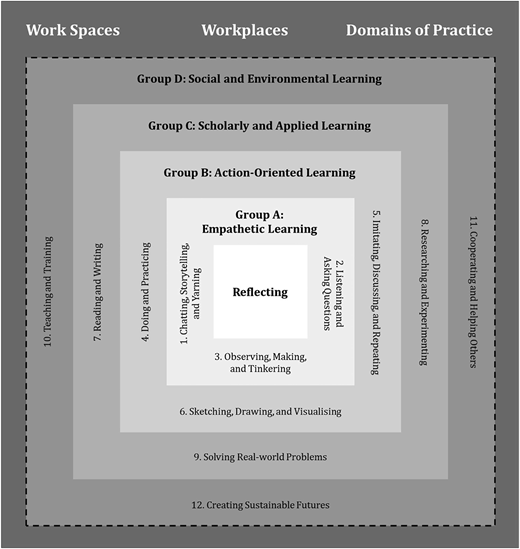
For these reasons, learning by reflecting has been centred at the heart of the work-based proto-theoretical model in Figure 1. In this model, reflective practice should be seen as foundational to, and implicitly involved in, every subsequent mode of learning associated with work. My aim here is not to propose an overarching synthesis of all possible modes of learning but to open a dialogue about which modes might be applied in WBL through reflecting.
Learning by …
On the basis of learning by reflecting, 12 modes of learning can be identified as they relate to WBL, and these have been grouped into four main types: Group A: Empathetic Learning, which includes learning by (1) chatting, storytelling and yarning, (2) listening and asking questions and (3) observing, making and tinkering; Group B: Action-Oriented Learning, which includes learning by (4) doing and practicing, (5) imitating, discussing and repeating and (6) sketching, drawing and visualising; Group C: Scholarly and Applied Learning, which includes learning by (7) reading and writing, (8) researching and experimenting and (9) solving real-world problems; and Group D: Social and Environmental Learning, which includes learning by (10) teaching and training, (11) cooperating and helping others and (12) creating sustainable futures.
The 12 modes of learning adopted in this paper resulted from an investigative survey of the literature on work and learning in the eight categories described by Fergusson and van der Laan (2021a), namely: (1) work-related learning (WRL); (2) work-based learning (WBL); (3) workplace learning (WPL); (4) work-applied learning (WAL); (5) work-based training (WBT); (6) work-integrated learning (WIL); (7) workplace-based learning (WPBL); and (8) work-based education (WBE).
The four main groups of learning have been developed as high-level constructs to help capture the essential nature of the modes identified within them and to thereby facilitate conceptual arrangement. How these four groups of learning organisationally relate to learning by reflecting and how the entire WBL endeavour is situated within a range of work environments, workplaces and domains of practice are shown in Figure 1. In this representation of learning, more organic, informal modes of learning have been identified closer to the centre and more concrete, formal approaches closer to the outer permeable region which lies between the individual learner and the three main environments in which work is carried out: work spaces, which include any setting in which work is performed, such as an atelier, workshop or “in the field”; workplaces, which include formalised places of employment, such an offices or factories; and domains of practice, which somewhat formalise work but are more commonly associated with a combination of direct and in-direct service, such as those provided by social workers and in-home carers.
However, this organisation of modes of learning could be misleading for several reasons. Firstly, it could be assumed that the modes of learning are definitive, when in fact they are representational; other modes exist and should be considered in WBL. Secondly, it could be assumed that the model is hierarchical, with those modes of learning closer to reflective practice more important than those further away; this is not the case: all modes are potentially of equal importance, and no special value has been placed on any one mode.
Thirdly, it could be assumed that each mode of learning is discrete and practised in isolation; this is not the case: in work environments, learning is an organic, holistic and continuous process, occurring informally (such as chatting and observing), non-formally (such as cooperating and helping others) and formally (such as researching and training).
And finally, it could be assumed that the proto-theoretical model in Figure 1 is a reductionist one and that each mode of learning is independent of all others; this is also not the case: learning is an interdependent phenomenon, and different modes of learning overlap and are congruent with all others, particularly when applied in messy work environments. Such a phenomenon can be seen in the example of “learning by observing”, which is severally embraced as a strategy in imitating, drawing, visualising and so on.
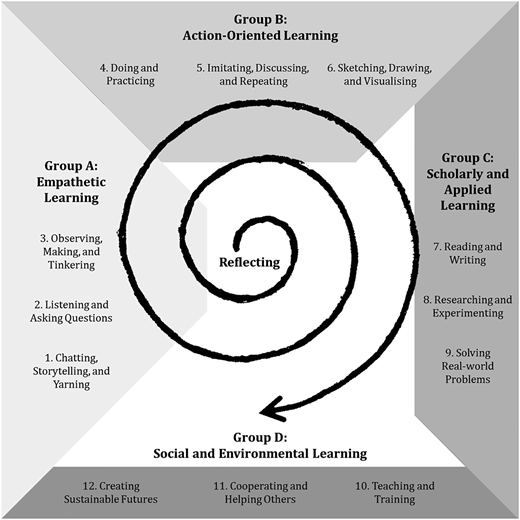
For these reasons, Figure 2 advances Figure 1 by representing the dynamic relationship between modes of learning and how reflecting in WBL is considered not only foundational to every mode but also informs, guides and inspires every aspect of lifelong learning. Thus, the “doing” of WBL can include listening, observing, chatting, storytelling, imitating, repeating, reading, writing, sketching, drawing and visualising, and each may occur for every learner in a continuous and dynamic interrelationship of work experience and reflection.
In the same way, “research”, particularly in higher education, can extend WBL to solving work-related problems, cooperating and helping others, teaching and training colleagues and improving organisations, government, society and the environment by creating sustainable futures, and may be the domain of multiple learner types. What is common to them all is the ability to reflect in a meaningful and critical way. The following four groupings seek to briefly explain the properties of the 12 modes of learning in the proto-theoretical model, along with representative citations from the work and learning literature.
Group A: empathetic learning
Learnings in Group A shown in Table 1 represent bidirectional channels of exchange within learners at work. Empathetic learning, as a generalised construct, relates in large part to the use of work environments as places of human exchange through what has become known as “appreciative inquiry”. This is why Wall et al. (2017, p. 131) contend “in terms of learning and emotion in workplaces, evidence indicates that when people are more emotionally (and positively) engaged, workplace learning is more effective”.
Learning by chatting, storytelling and yarning
Research has found that informal social interactions, such as chatting at work, can improve cognitive function (Ybarra et al., 2011). One of the ways this approach to learning is operationalised in organisations and work is storytelling; according to Gabriel (2000, p. 2), “stories open valuable windows into the emotional, political, and symbolic lives of organisations”. For many Indigenous people, informal and semi-formal oral communication is the most significant medium through which knowledge, culture and kinship are produced, practised and maintained. In Australia, for example, this diverse set of verbal practices associated with learning from elders is called yarning (Walker et al., 2014). These types of bidirectional verbal exchanges encourage empathy and learning about one's work environment and broader social and ecological context.
Learning by listening and asking questions
Listening is central to learning and “careful listening … can propel new cycles of expansive learning and agency” (Bang and Vossoughi, 2016, p. 182). Learning occurs when participants in work environments listen to each other and ask questions. For example, so-called “quality questioning” is viewed as essential for all learners (Walsh and Sattes, 2016).
Learning by observing, making and tinkering
Learning by observation is also central to learning, and research has found that learners learn more if they have a visual experience and then a verbal instruction rather than a verbal instruction alone (Bläsing et al., 2018). Such findings rely on what is called feedback-in-practice and consequential learning (DiGiacomo and Gutiérrez, 2016) where observation can lead to “trying out” or tinkering, both of which relate to fluid experimentation and open exploration. “In its ideal form, tinkering should be an ongoing process”, according to DiGiacomo and Gutiérrez (2016, p. 144), because “activities that promote a ‘live’ quality, such that they allow learners to see how the parts of an activity relate the its whole, are especially important for engaging learners over time”. Thus, individuals can glean a great deal from watching their colleagues work and by making and tinkering themselves.
Group B: action-oriented learning
Learnings in Group B are presented in Table 2. One of the primary features of WBL is its adherence to action learning, a mode of learning entwined with reflective practice (Costley and Lester, 2012). In my model, “action” embraces not only generic doing and practicing, but also imitating, discussing, repeating, sketching, drawing and visualising.
Learning by doing and practicing
Also called “experiential learning”, learning by doing occurs when the learner is directly in touch with the realities being studied, practiced or experienced. Such a view has a considerable history in education, encapsulating the work of Dewey, Piaget and others (e.g. Kolb and Kolb, 2005). The principle of learning by doing is predicated on the notion that doing is better than watching (Koedinger et al., 2015) and has been embraced, for example, by “do-it-yourself” civic actors who launch initiatives to green cities and combat climate change by initiating “a learning and adjustment process, both for the urban space in question and themselves” (Cloutier et al., 2018, p. 285).
Learning by imitating, discussing and repeating
Also referred to severally as mimetic learning, reinforcement learning and guided learning, imitation along with discussing and repeating, particularly when coupled with observation and other forms of doing, contribute to “holistic learning”. Imitating and repeating have become less fashionable in Western contemporary higher education, but in work contexts, they are suited to mechanical and systems learning, often drawing from expert demonstrations or working examples (Li et al., 2017).
Learning by sketching, drawing and visualising
While learning by observing and seeing can be linked to watching, they are also fundamental to perception and looking in the arts. Thus, observing is seen as a critical learning when associated with sketching, drawing and visualising, modes of learning which often accompany scientific inquiry (e.g. Gameira et al., 2018) and work practices and processes. These three modes mean, for example, in the context of design thinking that “ongoing experimentation and testing as concepts are made more concrete and users are involved in developing or assessing prototypes. Field experiments, prototypes, and visualization techniques such as drawings and pictures can be used to enable continuous learning and concept sharing and [can] clarify the characteristics of the idea and make it more amenable to critical consideration and feedback” (Micheli et al., 2019, p. 136). The same conclusion apparently applies to learning by story-telling, which Micheli et al. describe as a form of visualisation, and the work of Pink (2015) on methodologies in visual ethnographic research also bear directly on learning by observing and seeing.
Group C: scholarly and applied learning
Learnings in Group C are presented in Table 3. The last 25 years have seen an increased focus in higher education, industry and government on WBL. As a result, the issue of harnessing research and scholarship to address work-related problems has been highlighted, resulting in the implementation of government-supported WBL higher degree research programmes, such as the Professional Studies programme at University of Southern Queensland in Australia with which the author is affiliated. The three main elements of scholarship in WBL are learning by reading and writing, learning by researching and experimenting and learning by solving real-world problems.
Learning by reading and writing
Reading and writing, the so-called “academic literacies”, are fundamental to all forms of learning, not just learning which occurs in the workplace. Researchers therefore concur that reading and writing are foundational to WBL and are crucial to the development of metacognitive skills and work-related success. Benefits from reading and writing include a range of affective and cognitive outcomes. Such initiatives as writing workshops, which seek to inculcate scholarly habits associated with learning by reading and writing, may act as a “force for deeper change” (Boose and Hutchings, 2016, p. 42).
Learning by researching and experimenting
Work-based research has emerged in recent years as a powerful tool for changing the future of work (McCormack and Kiss, 2015), and its linkages to reflection and experimentation have been identified (Grosemans et al., 2015). However, evidencing the full range and extent of the impact of research on work environments is beyond the scope of this study.
Learning by solving real-world problems
In work-based research, the individual learner explores a topic related to her professional role within an organisation or community of practice. Her inquiry typically involves pragmatic, insider research as a way of investigating real-world problems and thereby improves practice in a broad professional context, utilising reflective practice, creating positionality and contributing to constructive impact. Miller and Maelloro (2016) suggest that collective reflection and reflective observation directly contribute to such an outcome.
Group D: social and environmental learning
Learnings which involve organisations, communities, societies and the global community are summarised in Table 4 and include learning by teaching and training, by cooperating and helping others and by creating sustainable futures. These modes of learning relate to the most applied, socially driven learning types in WBL, often identified with altruism and social activism and justice.
Learning by teaching and training
Learning by reflecting lies at the heart of learning through teaching and training (Margolinas et al., 2005). Work environments can provide opportunities for didactic interaction, but in such circumstances, the teacher or trainer can (and should) be a learner as much as a leader. Teaching, training and learning in the workplace always provide for bidirectionality of knowledge and skills, and everyone thereby becomes an epistemic agent. Criteria associated with this mode include: learning how to unlearn what we think we know to make room for new knowledge; remembering what it is like to be a student; when at work, everyone learns; we learn empathy when we teach others; only practice teaches theory; teachers teach, but great teachers learn; and great teachers find ways to inspire themselves through learning new things. Moreover, teachers learn through reflection (Grosemans et al., 2015).
Learning by cooperating and helping others
An individual can learn by giving, cooperating and helping others in the work environment. This is sometimes called “service learning” or “citizen science”. Benefits of learning to provide include insights into one's own learning and thus go beyond simple reciprocated assistance (Shah et al., 2018); learning by cooperating in citizen science has been described as a way to “develop positive action on behalf of the environment” (Phillips et al., 2018, p. 1).
Learning by creating sustainable futures
Aboytes and Barth (2020, p. 993) call learning by creating sustainable futures “transformational learning” and consider it “critical to enhancing and catalysing social transformations towards sustainability” through “learning that leads to the transformation of unsustainable mindsets” (p. 994). Allen et al. (2019, p. 781) likewise maintain that such an approach to learning meets “the need for an ecocentric stance to sustainability that reflexively embeds humans in—rather than detached from—nature”. Perhaps the most urgent of all 12 modes, learning by creating sustainable futures means learning to live sustainably on this planet, drawing on resources that can be replenished and are in tune with a balanced ecosphere and describing and changing currently unsustainable patterns of human thinking and activity. Work-based learning and research have the capability to contribute to this endeavour, and examples emerging from WBL higher degree programmes are now doing so (Fergusson et al., 2020b).
Conclusion
The proto-theoretical model presented in Figures 1 and 2 locates learning by reflecting at the centre of WBL, a concept consistent with the published literature on work and learning. WBL also provides participants of work with multiple opportunities to learn (and become more experienced and qualified) and similarly provides multiple modes through which learning can occur on the basis of knowledge and skills in reflective practice. Moreover, WBL by necessity must accommodate many different types of learner and must be open, flexible and inclusive enough to expect and embrace diversity, change and fit-for-futures research.
Ideally, work environments, and the higher degree WBL programmes which support them, should provide learning via every available mode of learning, thereby allowing students to find their own best orientation to learning and encourage it by any means. Such a prospect has the potential for WBL to result in delivering a quadruple dividend, a significant benefit to: oneself; an organisation; original knowledge; and perhaps most importantly resulting in a benefit to a more sustainable human and social future.