Defying conventional wisdom, leaders' storytelling may have ambiguous and even negative effects on followers. Built upon transformational leadership and leader -member exchange theory, the intention-perception model of storytelling in leadership provides a framework to systematically explain when and why unintended effects of storytelling happen. Despite its theoretical and practical relevance, a quantitative evaluation of the model's main assumptions, and particularly of followers' perceptions of leader storytelling, is still pending.
The authors developed a scale to assess followers' story perceptions in study 1 (N = 79) and confirmed the scale's structure in study 2, an online cross-sectional field study (N = 60). In study 2, the authors also tested a main assumption of the intention-perception model of storytelling, that is, the relationship between followers' story perceptions and story effects, mediated via followers' affective arousal.
Data revealed that story effects indeed depend on followers' perception of the story. In particular, the better a leader's story met followers' needs (need-supply fit), the more adequate the input load transported by the story (story load), the more positive followers' appraisal of their leader's story (story appraisal) and the more positive affective reactions and positive effects of storytelling (transformation, leader -member exchange quality, and trust in the leader) followers perceived.
The authors provide practical insights into how leaders may improve their storytelling by tailoring their stories to the expectations and needs of their followers.
Taking a follower-centric perspective on a common leadership practice (i.e. storytelling), the present research provides first support for the intention-perception model of storytelling in leadership.
Storytelling, a form of leader -follower interaction in which past and future human experiences are shared (Boje, 1991), has received much attention in the popular management literature (e.g. Denning, 2011; Mead, 2014). Accordingly, a good story is said to always have positive effects on follower behavior and to be generally more effective than nonstory forms of communication. As a form of communication that is genuine, personal and emotionally engaging, leaders' storytelling may be fundamental to driving follower commitment (Gyensare et al., 2016) and innovative performance (Connelly and Gooty, 2015). Therefore, storytelling in leadership is considered particularly relevant in the present time, as companies increasingly compete for qualified employees and innovative ideas. Indeed, storytelling is referred to as an effective leadership practice by various leadership theories, such as leader -member exchange (LMX) (Graen and Uhl-Bien, 1995) and transformational leadership theory (TFL) (Bass and Avolio, 1993).
However, in practice, effects of leaders' storytelling on followers may vary, and can be even negative (e.g. Rossetti and Wall, 2017), for instance, if the story fails to “resonate positively with the audience” (Gill, 2011, p. 28), meaning that it disregards followers' needs or violates their expectations.
Integrating storytelling, LMX and TFL, the intention-perception model of storytelling in leadership (Stark et al., 2022) seeks to systematically explain when and why unintended effects of storytelling (referred to hereafter as intention-perception shifts) happen. Accordingly, leaders tell stories to build trusting relationships with their followers and evoke positive follower transformation, but frequently achieve the opposite, that is, a decline in trust and negative transformation. It has further been theorized, but remains untested, that storytelling effects are contingent on followers' perception of the story (Stark et al., 2022).
With the present study, we provide a first empirical test of the model's main assumptions by investigating followers' perceptions of work-applied cases of leader storytelling. Herein, we challenge the common premise that leaders' storytelling has mostly positive effects (e.g. Carriger, 2010; Cleverley-Thompson, 2018; Harris and Kim Barnes, 2006). Specifically, we question that a story is always helpful, the more intense and personal the story the better, and that storytelling is always perceived as genuine and authentic (Mládková, 2013). We thereby contribute to a growing body of managerial literature, revealing how followers' responses to leader behavior vary interpersonally and across situations, and thus refuting a one-fits-all approach to leadership (e.g. Tepper et al., 2018; Wang et al., 2019). Moreover, we answer a recent call for research on behavioral correlates of established broader concepts in leadership theory (i.e. LMX and TFL; Banks et al., 2021) by exploring positive and negative effects of storytelling as a simple leadership practice. We thus contribute to leadership theory, which has been criticized for its lack of behavioral proximity (e.g. TFL; van Knippenberg and Sitkin, 2013; and LMX; Gottfredson et al., 2020). Furthermore, we generate practical insights into improving leader-follower interactions in work-applied management.
The intention-perception model of storytelling in leadership
Storytelling has often been referred to as effective leader behavior by leadership scholars, most prominently in LMX and TFL literature. Following LMX theory, storytelling can be considered a particular form of person-oriented leader behavior intended to evoke positive emotions in followers and stimulate constructive behavior (Graen and Uhl-Bien, 1995). Storytelling might contribute to a high-quality LMX, as leaders can express vigor and enthusiasm through their stories (Gutermann et al., 2017). Moreover, according to TFL theory, leaders can stimulate sense-making and followers' identification with the organization by telling stories about the purpose of the work, shared values and the company's vision (Bass and Avolio, 1993; Hoffman et al., 2011). However, leadership theory has largely neglected followers' perceptions of leader storytelling and intention-perception shifts, and thus fails to explain varying and even negative effects of leader storytelling on followers.
Building on qualitative data and leadership theory, the intention-perception model of storytelling in leadership (Stark et al., 2022) addresses this gap. Specifically, the model differentiates between the following intended effects of leaders' stories: evoking a positive transformation in their followers, building or strengthening their relationship with followers and passing on information to their followers. The model further describes how leaders' storytelling evokes affective arousal in followers, which then translates into transformational, relationship-building and informational effects as perceived by followers. Notably, the model predicts that followers' affective arousal evoked by their leader's story may be positive or negative, explaining either positive effects of leaders' storytelling on followers (positive transformation, positive relationship-building and information), as intended by the leader, or negative effects on followers (negative transformation, devaluation of the leader, mistrust and confusion). The model further assumes that it depends on follower perception whether a leader's story translates into positive or negative arousal: how well the story fits followers' needs (need-supply fit), how adequate the (amount of) information transported by the story is (story load) and how the story is appraised and interpreted by followers (story appraisal; Stark et al., 2022). Stark et al. (2022) suggest that negative affective reactions and corresponding negative story effects occur if followers perceive a misfit with their needs, if the story is overloaded with (inappropriate) information or too many stories are told, and if followers misinterpret a leader's good intentions.
Whereas leaders' (positive) intentions towards trust-building and follower transformation are well documented in TFL and LMX literature (e.g. Barbuto, 2005; Dulebohn et al., 2012), and elaborated in the context of leader storytelling (Stark et al., 2022), an investigation of followers' perception of storytelling is still pending. In the present research, we take a follower-centric perspective on storytelling as a common leadership practice, considering followers' individual needs, preferences and interpretations regarding their leaders' storytelling. According to the intention-perception model of storytelling in leadership, intended (positive) effects of leader storytelling are more likely to be achieved, the more positive a story is perceived by followers. Testing this first assumption of the model, we suggest:
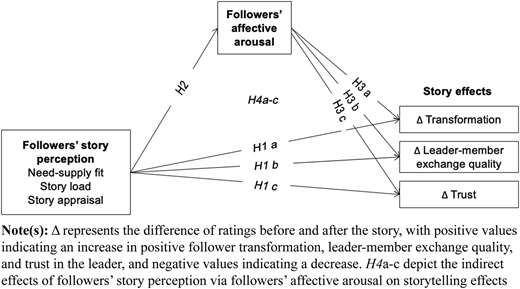
Followers' story perception is related to story effects in that a positive story perception (need-supply fit, adequate story load, positive story appraisal) has a positive effect on
Positive follower transformation,
LMX quality,
Trust in the leader.
The intention-perception model of storytelling further notes that the relationship between followers' perception of a story and story effects can be explained by followers' affective responses to a leader's story (see also Snyder et al., 2017). Testing this second assumption of the model, we suggest:
Followers' story perception is related to followers' affective arousal in that a positive story perception (need-supply fit, adequate story load, and positive appraisal) is positively related to positive affect among followers.
According to Fredrickson's (2001, 2004) broaden-and-build theory of positive emotions and Hobfoll's (2001) conservation of resources theory, positive emotions serve to build resources, which in turn foster the acquisition of further resources (gain spiral or upward spiral; see also Wall et al., 2017 for related work). Conversely, negativity and resource loss promote further resource loss (loss spiral or downward spiral). Based on these mechanisms of resource acquisition and resource depletion, the intention-perception model of storytelling posits that followers perceive either positive effects of their leaders' storytelling (positive transformation and positive relationship-building) or negative effects (negative transformation, devaluation of the leader and mistrust). Addressing this third assumption of the model, we suggest:
Followers' affective arousal is related to story effects in that positive follower affect is positively related to
Positive follower transformation,
LMX quality,
Trust in the leader.
Finally, we examined the process that is described by the intention-perception model of storytelling, namely, the indirect effect of followers' story perception via followers' affective arousal on storytelling effects. We thus tested the following mediation effects:
The relationship between followers' story perception and
Positive follower transformation,
LMX quality, and
Trust in the leader,
is mediated by followers' affective arousal.
Figure 1 visualizes how we translated the intention-perception model into our testable hypotheses.
Method
We conducted two studies. In study 1, we developed an instrument to measure followers' story perception and explored its factor structure. In study 2, we confirmed the instrument's factor structure and tested our hypotheses. Both studies were conducted in Germany and in German language. Data, code and all materials of our main study (study 2) are available on the Open Science Framework (OSF, https://osf.io/bnuk5/?view_only=f97e4f871c454d92b87f864fea4bc116). Both studies were conducted in accordance with the recommendations of the ethical principles of psychologists and code of conduct by the American Psychological Association (2017) and in accordance with the declaration of Helsinki (World Medical Association, 2013). Participants were given a comprehensive consent form, including detailed information about the project and the anonymization of the data.
Study 1
Procedure and measurement
Building on Stark et al.’s (2022) qualitative work, we developed an initial set of items covering followers' perception of story load, need-supply fit and story appraisal. We conducted an online survey which was distributed via social media channels and personal contacts. At the beginning of the survey, participants provided informed consent. Prerequisite for participation was that participants had (worked in) a job in which they had a direct supervisor. We then asked participants to remember a situation in which their supervisor had told them a story. We explained that stories also can contain anecdotes or jokes. Participants then had to indicate how they perceived this story and accordingly rated our items on story perception on a 5-point Likert scale (1 = completely disagree; 5 = completely agree).
Sample
A total of N = 79 persons (41.8% female, 54.4% male and 3.8% diverse) participated in study 1. The mean age was 29.1 years (with a range from 18 to 59 years). Of the participants, 91.1% were German, 5.1% were Austrian and 1.3% were Swiss (the rest indicated no or other nationalities). Regarding employment, 60.8% were employed, 2.5% were self-employed, 31.6% were students and 5.1% were in vocational education. On average, participants had worked with their supervisor for 5.12 years.
Data analysis and results
Data were analyzed with an exploratory factor analysis using a Promax rotation. The final set of 9 items, which were selected due to their psychometric characteristics and factor loadings, formed three factors, story load (3 items), need-supply (mis-)fit (3 items) and story appraisal (3 items) which explained a total of 74% of the variance. Together, the items form the Storytelling Perception Scale (SPS). The items and their factor loadings are displayed in Table 1. Please note that all analyses referred to the German version of the scale items.
Study 2
We conducted study 2 to confirm the factor structure of the SPS developed in study 1 and to test our hypotheses.
Procedure
We conducted an online cross-sectional field study. We recruited employees from different organizational contexts and industries via a broad range of social media channels (e.g. industry-related LinkedIn and Facebook groups). Like in study 1, prerequisite for participation was that participants had (worked in) a job in which they had a direct supervisor. At the beginning, participants provided informed consent. We then described that many leaders tell stories to their followers and that stories are often used as a leadership instrument by leaders in an organizational context. In accordance with Boje (1991), we further explained that stories are human experiences that are shared, that they can involve people's own experiences or the experiences of others, can be about the past and/or the future and can contain positive and/or negative emotions. To capture work-applied cases of leader storytelling, we then asked participants to recall a situation in the last few days or weeks in which their leader told them a story, and to imagine this situation as vividly as possible. They were further given the opportunity to describe this situation in a few sentences. These open-ended questions were intended to enable participants to remember the situation as exactly as possible, but were not analyzed in the context of this study. We asked for individual incidents of storytelling experiences as our research question focused on followers' individual story perceptions in real world settings and contexts.
Afterwards, participants answered questions regarding their perception of the story, the emotions evoked in them by the story, and story effects. Regarding story effects (i.e. positive transformation, LMX quality and trust), we asked participants to remember and rate how they perceived their leader and their relationship with their leader at the time before the story had been told and at the time directly after the leader had told the story. In this way, we sought to assess perceived positive or negative story effects over time, even though the overall survey design was cross-sectional. At the end of the questionnaire, demographic data was collected.
Sample
We initially conducted an a priori power analysis with G*Power 3.1 (Faul et al., 2009) for a linear multiple regression (fixed model, single regression coefficient). This analysis suggested a minimum of 59 participants for a one-tailed test with medium effect (f2 = 0.15), alpha at 0.05, power at 0.90.
72 participants completed all study items. 12 participants did not pass a control item (i.e. “In answering the questions, I had a specific situation in mind where my supervisor told a story”) and thus were excluded from further analysis. The remaining sample consisted of N = 60 participants, who were on average 35.38 years old (standard deviation (SD) = 12.03), had a job tenure of 5.13 years (SD = 6.00) and had worked 2.97 years (SD = 3.7) under their current leader's supervision. The majority of participants were female (72%; n = 43), employed full-time (77%; n = 46), had a higher education degree (63%; n = 38) and interacted with their leader at least once a week (85%; n = 51).
Measurement
Participants rated the following items on a 5-point Likert scale ranging from 1 = completely disagree to 5 = completely agree.
Followers' story perception
Followers' story perception () was measured with the 9-item SPS (Table 1), developed in study 1. The items covered story load, need-supply fit and story appraisal. In line with Stark et al. (2022), we assumed that all three dimensions together formed the factor “followers' story perception”.
Affective reactions
Affective reactions () were measured with ten items (e.g. “After listening to my supervisor's story, I felt inspired”) addressing positive affective reactions from the German version of the positive and negative affect schedule (PANAS, Krohne et al., 1996).
Story effects
Participants were asked to indicate their agreement with each statement before the story had been told as well as directly after the leader had told the story. We then calculated the difference between the two ratings (Δ), with positive values indicating positive story effects (increased positive follower transformation, increased LMX quality and increased trust in the leader), and negative values indicating negative story effects (decreased positive transformation, decreased LMX quality and decreased trust in the leader).
Positive follower transformation () was measured with six items (e.g. “I feel that my supervisor recognizes my individual needs, abilities and goals”) from the German version of the multifactor leadership questionnaire (MLQ, Felfe, 2006).
LMX quality () was measured with four items (e.g. “I feel that the working relationship with my manager is very good”) from the German version of the LMX Scale (Schyns and Von Collani, 2002).
Trust in the leader () was measured with four items (e.g. “I feel a strong loyalty to my supervisor”) translated from Podsakoff et al. (1990).
Results
Statistical analyses were conducted using R (Version 4.1.1). First, we tested the factor structure of the Storytelling Perception Scale (SPS) with a confirmatory factor analysis, using the lavaan package in R (Rosseel, 2012). The scale revealed adequate fit of the expected measurement model, that is, three factors loading on one general factor (Root Mean Square Error of Approximation (RMSEA) <0.001, Standardized Root Mean Square Residual (SRMR) = 0.028, Comparative Fit Index (CFI) = 1.00, χ2(24) = 23.55, p = 0.487).
Second, we tested our hypotheses. All results are reported excluding control variables (however, the results were similar when adding control variables, namely sex, age, job tenure and tenure under current supervisor). Means, standard deviations and Pearson correlation coefficients for followers' story perception, affective reactions and story effects are displayed in Table 2.
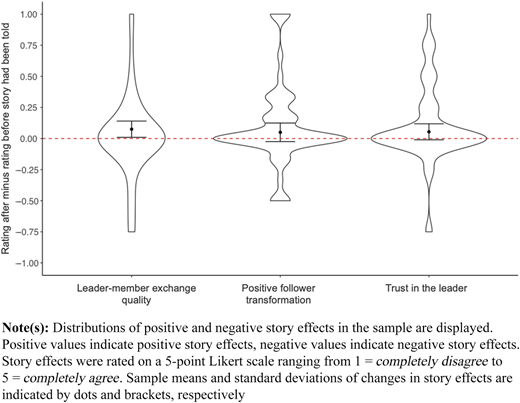
A descriptive analysis revealed positive, neutral and negative values for story effects. Specifically, we found an increase in positive follower transformation in 35% of cases (n = 21), an increase in LMX quality in 25% of cases (n = 15), and an increase in trust in 28% of cases (n = 17). Moreover, we found a decrease in positive follower transformation in 20% of cases (n = 12), a decrease in LMX quality in 17% of cases (n = 10), and a decrease in trust in 12% of cases (n = 7). No effect on transformation was observed in 45% of cases (n = 27), on LMX quality in 58% of cases (n = 35), and on trust in 60% of cases (n = 36). The distributions of story effects are displayed in Figure 2.
To test Hypotheses 1a-c, separate linear regression analyses were conducted including followers' story perception as predictor and one storytelling effect (i.e. Δ positive follower transformation, Δ LMX quality and Δ trust in the leader) as criterion. Assumptions of a linear regression analysis (i.e. linearity, normality and homoscedasticity) were met according to descriptive analyses. Supporting Hypotheses 1a-c, followers' story perception was positively related to Δ positive follower transformation (β = 0.38, standard error (SE) = 0.12, t(53) = 3.12, p = 0.003, 95% confidence interval (CI 95%) [0.14, 0.62]), Δ LMX quality (β = 0.46, SE = 0.12, t(53) = 3.99, p < 0.001, CI 95% [0.23, 0.70]), and Δ trust in the leader (β = 0.35, SE = 0.12, t(53) = 2.86, p = 0.006, CI 95% [0.11, 0.60]). That is, positive followers' story perceptions led to an increase in positive transformation, LMX quality, and trust in the leader, which supports Hypotheses 1a-c.
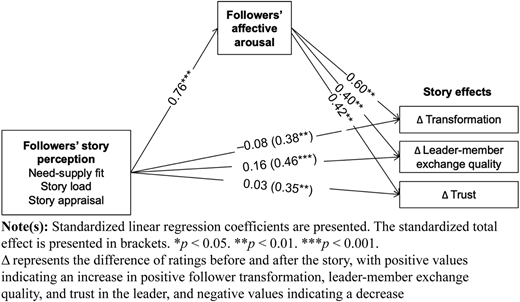
To test Hypotheses 2-4, a bootstrapped (k = 5,000) mediation analysis was conducted using the lavaan package in R to estimate direct and indirect effects (Hayes, 2009). Standardized path coefficients for the model are displayed in Figure 3.
Supporting Hypothesis 2, followers' story perception was positively related to positive follower affective arousal (β = 0.76, SE = 0.09, z = 8.89, p < 0.001, CI 95% [0.60, 0.93]). Specifically, the more positively followers perceived their leader's storytelling, the stronger the positive affective arousal they experienced.
Supporting Hypotheses 3a-c, positive follower affective arousal was significantly related to Δ positive follower transformation (β = 0.60, SE = 0.18, z = 3.43, p = 0.001, CI 95% [0.29, 0.99]), Δ LMX quality (β = 0.40, SE = 0.15, z = 2.70, p = 0.007, CI 95% [0.13, 0.71]), and Δ trust in the leader (β = 0.42, SE = 0.15, z = 2.74, p = 0.006, CI 95% [0.16, 0.77]). That is, followers' positive affective arousal in response to their leader's storytelling led to an increase in positive transformation, LMX quality and trust in their leader.
Supporting Hypotheses 4a-c, positive follower affective arousal mediated the relationship between followers' story perception and Δ positive follower transformation, Δ LMX quality and Δ trust in the leader, as indicated by significant indirect effects of followers' story perception through positive affective arousal on Δ positive transformation (β = 0.46, SE = 0.15, z = 3.11, p = 0.002, CI 95% [0.21, 0.79]), Δ LMX quality (β = 0.30, SE = 0.12, z = 2.61, p = 0.009, CI 95% [0.10, 0.55]) and Δ trust in the leader (β = 0.32, SE = 0.13, z = 2.51, p = 0.012, CI 95% [0.12, 0.62]).
Discussion
The present study supported the main assumptions of the intention-perception model of storytelling in leadership: The better a leader's story met followers' needs (need-supply fit), the more adequate the informational input transported by the story (story load) and the more positive followers' appraisal of their leaders' story (story appraisal), the more positive effects of storytelling followers perceived (positive transformation, LMX quality, trust in the leader). Positive follower affective arousal explained the relationship between followers' story perception and story effects.
Descriptive analyses revealed that across individual cases of leader storytelling, both positive and negative story effects occurred: Some followers reported an increase in positive transformation, LMX quality, and trust as a result of their leader's storytelling, whereas other followers actually reported a decrease. Arguably, negative story effects indicate intention-perception shifts, as leaders typically pursue positive intentions when engaging in storytelling (i.e. building trusting relationships with their followers and evoking positive follower transformation; Stark et al., 2022).
Theoretical implications
The present research makes three main contributions: First, our findings challenge the common premise that leaders' storytelling has mostly positive effects, but suggest that leaders' storytelling may have no effect at all, or even negative effects on followers. Capturing followers' story perception, we found that (1) stories did not always fit followers' needs, (2) the amount of storytelling was sometimes perceived as inappropriate and (3) followers did not always appraise their leaders' storytelling as being in their best interest. These findings directly contradict popular myths about storytelling in the management literature, namely that a story is always helpful, the more intense and personal the story the better and that storytelling is always perceived as honest and authentic (e.g. Carriger, 2010; Mládková, 2013). Moreover, these results quantitatively support the existence of intention-perception shifts, as qualitatively suggested by Stark et al. (2022).
Second, our findings provide empirical support for the main assumptions of the intention-perception model of storytelling in leadership (Stark et al., 2022). Thereby, we advance the integration of the storytelling construct into leadership theory, following current recommendations in leadership research (Banks et al., 2018). Specifically, scholars have argued that the introduction of new constructs that are disconnected from existing theory has led to a fragmentation of the leadership literature, when instead an integration of new and old constructs may better contribute to the overall relevance of organizational scholarship (Pillutla and Thau, 2013).
Third, we take a follower-centric perspective on popular leadership styles (i.e. TFL and LMX), contributing to the ongoing refinement of theoretical constructs in leadership research. Scholars have recently argued that followers' perception of leader behavior may vary as a result of individual differences (Wang et al., 2019). Notably, we provide evidence that leadership effects are contingent on how a leadership practice (e.g. storytelling) is perceived and interpreted by followers. Leadership styles thus not only manifest in specific leadership behaviors but also in followers' perception. To capture followers' perception of leaders' storytelling we developed and tested a new scale which future research can build on to further investigate intention-perception shifts in the context of storytelling.
Practical implications
Our findings imply that leaders should use storytelling in a well-reflected way. Storytelling is obviously not a one-fits-all approach to leader communication. In line with the intention-perception model of storytelling in leadership, we found support for the importance of three aspects of followers' story perception in determining whether stories have positive or negative effects. According to the first dimension of followers' story perception (i.e. story load) leaders should aim to provide an appropriate amount of information and degree of intimacy in their story. Like in other domains of leadership behavior, too much of a good thing in terms of storytelling may be harmful (Kaiser and Overfield, 2010). We thus advise leaders to closely observe their followers' behavioral responses (e.g. facial expressions, nodding and vocalization) while telling a story. Indeed, research has shown that narrators perform significantly better in storytelling, when observing their listeners' behavioral responses (Bavelas et al., 2000). Particularly for managers in higher levels, who tend to be less aware their followers' emotions (Lambert, 2020), paying attention to listeners' responses seems crucial.
Regarding the second dimension of followers' story perception (i.e. need-supply fit), leaders should be attentive to their followers' needs. Telling a story to a follower who instead requires factual information can apparently have negative effects, such as a decrease in trust and LMX quality. Therefore, we advise leaders to first explore their followers' needs by asking open questions about their perspective on a problem or a task and to carefully listen to the respective answers (Van Quaquebeke and Felps, 2018). Based on the information provided by their followers, leaders may then decide if storytelling meets their followers' needs in this situation.
Considering the third dimension of followers' story perception (i.e. story appraisal), leaders should be aware that their story may be appraised in a negative way by their followers. That is, even if conducted with good intentions, followers may interpret their leader's storytelling in a negative way. Specifically, followers' appraisal of a leader's story might be associated with their general perception of their leader (e.g. their leader's trustworthiness; Gilstrap and Collins, 2012). Considering the possibility of negative story appraisal is thus especially important in situations where followers' general perception is ambiguous or unstable, for instance, upon first acquaintance or in the face of an unresolved conflict.
Notably, when leaders suspect that their story may have had negative effects, we advise them to ask their followers for feedback. In fact, asking followers for feedback might even have positive effects on follower performance, complementary to storytelling (Ashford et al., 2018). Moreover, leaders are advised to engage in self-reflection and coaching (Wang et al., 2022), which might be particularly helpful if seeking follower feedback is not practical.
Limitations and future research
Whereas our findings imply causal links within our model, they are based on participants' recall of story effects and may thus be affected by hindsight bias and implicit theories about story effects. This calls for further investigation of causality, for example, by applying experimental manipulations of standardized scenarios of storytelling situations, or by conducting longitudinal field studies. Nevertheless, despite conducting a cross-sectional study, we came close to a “causal” design by including measures referring to two different time points: We asked participants to retrospectively assess their leaders before and after they had told a story. In this way, we captured numerous individual cases of leader storytelling in work-applied management. Therefore, despite its limited size, our sample is characterized by considerable external validity and practical value. Besides, an a priori power analysis deemed the sample size appropriate to detect the expected effects.
Building on recalls of individual storytelling experiences, we captured a multitude of idiosyncratic storytelling perceptions which might limit comparability and contradict a quantitative summary of the results. However, we decided for this procedure as we explicitly wanted to capture and examine real events of storytelling in a field setting to increase our results' external validity. Moreover, in our study, all individually recalled storytelling experiences referred to the same phenomenon (although with different content-related expressions), that is, having listened to a leader's story who told the story with specific intentions in mind and having perceived this story in a specific way. This is why we quantitatively summarized and analyzed this data.
Notably, the SPS was developed and validated in a German context and should be tested for measurement invariance when applied in other countries. Indeed, research consistently shows cross-cultural differences in communication (Hwa-Froelich and Vigil, 2004; Jang and Barnett, 1994). Therefore, future research should investigate the effects of storytelling in different cultures. Moreover, our findings should be replicated in different organizational contexts.
Future research could investigate further mediating mechanisms explaining the effect of affective arousal on perceptions of leadership outcomes via resource acquisition and resource depletion. This could help to establish a link between storytelling, leadership theories and resource theories (cf. Avolio et al., 2009). Moreover, future research could elaborate on intention-perception shifts by directly comparing leaders' intentions and followers' perceptions of storytelling in leadership using dyadic study designs.
Conclusion
The present research highlights the potential of storytelling in leadership for enhancing follower transformation, strengthening trust and improving leader-follower relationship quality. However, our results also show that leaders' stories can have negative effects, depending on how they are perceived by followers. Our findings are in line with the intention-perception model of storytelling in leadership, supporting its relevance for leadership theory and practice.
The authors thank Robert Schumann for his assistance in data collection and Keri Hartman for proofreading the manuscript. The authors thank the reviewers and the Editor for their helpful comments.