Skip to Main Content
Purpose

This research aims to identify and prioritize factors influencing the adoption of artificial intelligence (AI) in human resource management, providing a comprehensive understanding to assist organizations in successful implementation.

Design/methodology/approach

This applied research uses a qualitative meta-synthesis approach, systematically analyzing studies published between 2015 and 2023 to synthesize findings from both qualitative and quantitative studies.

Findings

AI adoption in human resource management is influenced by five main themes: (1) organizational and strategic factors, (2) technological and operational factors, (3) human-centric factors, (4) challenges and opportunities and (5) environmental and economic factors. These encompass aspects such as organizational strategies, technical infrastructure, improved decision-making, ethical issues and social impacts.

Originality/value

This study reveals AI adoption in human resource management as a complex, multidimensional process. Organizations must prepare technically, organizationally and in terms of human resources. The findings highlight the importance of ethical and legal considerations as well as psychological and attitudinal factors. These insights can guide organizations in adopting a comprehensive approach to AI integration in human resource management.

In today’s digital era, artificial intelligence (AI) is revolutionizing business processes, with human resource management (HRM) experiencing significant transformation through AI’s innovative solutions (Bhardwaj et al., 2020). AI’s evolution, from its industrial origins to contemporary applications, has progressed through the third industrial revolution’s computational advances to today’s sophisticated machine learning applications, fundamentally reshaping organizational practices (Yawalkar, 2019). Defined as an “ideal intelligent machine” capable of environmental adaptation and goal optimization (Sanyaolu and Atsaboghena, 2022), AI has emerged as a cornerstone of Industry 4.0 alongside IoT, big data and cloud technology (Jatobá et al., 2023; Barboza, 2019).

In HRM, AI applications span recruitment, performance management and talent development through machine learning algorithms, natural language processing, and predictive analytics (Rasheed et al., 2024). With 38% of organizations currently utilizing AI and 62% planning adoption (Bhardwaj et al., 2020), the technology has streamlined administrative processes and enhanced operational efficiency (Hossin et al., 2021). However, implementation challenges persist, particularly in developing countries, including financial constraints, employee resistance, job displacement concerns and training requirements (Arslan et al., 2022; Hossin et al., 2021) and data security issues (Jain, 2018).

The human–AI interaction presents additional complexities across various sectors (Arslan et al., 2022), encompassing technology anxiety, trust issues and performance evaluation challenges in hybrid teams (Kaur and Gandolfi, 2023). Successful implementation requires addressing data protection, algorithmic bias (Sabil et al., 2023) and regional-specific challenges such as infrastructure limitations and skill gaps (Chilunjika et al., 2022). While AI offers significant benefits in information processing and decision-making (Alsaif and Sabih Aksoy, 2023; Hossin et al., 2021), understanding adoption factors remains crucial. This study therefore addresses two key questions: (1) What factors influence AI adoption in HRM? (2) How are these factors prioritized in terms of their impact on AI adoption?

HRM has evolved from its industrial revolution origins into a critical driver of sustainable competitive advantage, with pioneering theorists establishing core concepts of selective recruitment and employee training, while the resource-based view emphasizes human capital’s strategic value (Kadam et al., 2022; Anwar and Abdullah, 2021). In response to technological advancement and globalization, modern HRM has embraced digital tools and data analytics to enhance employee engagement and continuous learning (del Val Núñez et al., 2024), while strategic alignment with organizational goals strengthens resilience in volatile environments (Groenewald et al., 2024). The integration of AI has further transformed practices through personalized experiences and predictive analytics, enabling innovation and productivity in multicultural environments while necessitating careful consideration of privacy and inclusivity (Holland et al., 2022; Groenewald et al., 2024; Anwar and Abdullah, 2021).

AI, defined as the simulation of human intelligence, represents a transformative interdisciplinary technology emerging from computer science, cybernetics and mathematical logic to solve complex problems traditionally requiring human cognition (Xu et al., 2021; Liu et al., 2018; Bankins et al., 2024). The field’s evolution since the 1950s, marked by Turing’s foundational question and McCarthy’s term coinage at the 1956 Dartmouth Conference (Zhang and Lu, 2021; Benbya et al., 2020), progressed through stages of cognitive perception, intelligence and decision-making capabilities (Xu et al., 2021). Key milestones include the 1943 artificial neuron model, 1980s neural networks and expert systems, and the 2006 breakthrough in deep neural networks (Zhang and Lu, 2021). In contemporary organizations, AI has evolved from passive tools to active agents, functioning as a disruptive technology that enhances processes through machine learning and data analysis, transforming workforce dynamics and organizational decision-making (Benbya et al., 2020; Xu et al., 2021; Makarius et al., 2020; Robert et al., 2020).

AI’s integration into HRM has revolutionized organizational practices by merging multidisciplinary elements of mathematics, management, computer science and linguistics to enable complex data analysis and pattern recognition in key processes, from applicant ranking to hiring efficiency (Kshetri, 2021; Vasantham, 2021; Qiu and Zhao, 2018). This technology empowers human resource (HR) professionals to focus on strategic initiatives while leveraging AI-driven analytics for decision-making and employee assessment, ultimately creating dynamic work environments guided by real-time data and personalized experiences (Singh et al., 2023; Kaushal et al., 2023; Chukwuka and Dibie, 2024). However, successful implementation necessitates addressing workforce displacement, upskilling needs and ethical considerations to maintain equilibrium between technological innovation and human-centric approaches (Singh et al., 2023).

AI has transformed HRM through the automation of routine tasks, including resume scanning and candidate evaluation, enhancing efficiency while minimizing human bias in decision-making (Vasantham, 2021; Qiu and Zhao, 2018; Vrontis et al., 2023). However, despite these transformative benefits, organizations face substantial implementation challenges. Most critically, job displacement emerges as a primary concern, with projections indicating automation could eliminate up to 50% of existing positions in the coming decades (Abdeldayem and Aldulaimi, 2020). Furthermore, employee resistance and technology anxiety create additional obstacles, necessitating organizations to develop collaborative environments where AI serves as an enabling tool rather than a threat (Suseno et al., 2021). In this context, the integration of AI systems and humanoid service robots requires strategic workforce role transitions (Vrontis et al., 2023). Consequently, successful implementation hinges on achieving equilibrium between technological advancement and workforce preparedness through targeted initiatives addressing skill gaps, cultural transformation and organizational alignment (Suseno et al., 2021; Vasantham, 2021).

This study employs a distinctive meta-synthesis approach to analyze AI adoption factors in HRM, systematically integrating both qualitative and quantitative findings to generate comprehensive insights (Nye et al., 2017). The methodology’s strength lies in its interpretive and dialectical approach, enabling “third-order” interpretations through three key mechanisms: first, reciprocal translation across diverse studies; second, thematic synthesis of emerging patterns and third, analytical refinement of theoretical constructs (Nye et al., 2016). This rigorous process reveals the underlying mechanisms while emphasizing analytical transferability over mere generalizability, effectively bridging the paradigmatic divide between research and practice. The research systematically implements Sandelowski and Barroso’s (2007) comprehensive six-step framework, progressing from systematic search and evaluation through synthesis and interpretation, ensuring methodological rigor while maintaining interpretive depth (Lachal et al., 2015).

The meta-synthesis implementation follows distinct stages as shown in Figure 1. The research question formulation, as the first step, considers key parameters including methodology, study population, time frame and subject matter. The foundational questions outlined in Table 1 guide the research direction and establish the study’s framework.

In the second step, a comprehensive systematic review was conducted using keywords related to AI and HRM. The search covered the Science, Google Scholar, Scopus, Emerald and Springer databases, selected for their extensive coverage, credibility, search capabilities and access to current research in management, technology and human sciences. Keywords included “Artificial Intelligence,” “Human Resources Management,” “Adoption” and “Acceptance.”

After completing the search for articles intended for meta-synthesis, as seen in Table 2, the following process was undertaken to select articles. Initially, all articles related to the topic, totaling 87, were downloaded from databases. Subsequently, a thorough and purposeful five-stage refinement process was conducted.

From the initial 87 articles extracted from reputable databases.

  1. Elimination of duplicates: In the first step, 15 duplicate articles (17%) were removed to ensure originality and uniqueness of the selected studies.

  2. Title screening: The titles of the remaining articles were carefully reviewed, leading to the exclusion of 22 articles (25%) that were deemed irrelevant to the topic of AI adoption in HRM.

  3. Abstract review: Abstracts of the remaining articles were examined to assess relevance and methodological rigor. This stage resulted in the removal of 19 additional articles (21%) that failed to meet the inclusion criteria.

  4. Full-text content analysis: A deeper evaluation of the full texts was conducted to identify studies with insufficient information or lacking direct relevance to the research topic. Consequently, 11 more articles (12%) were excluded.

  5. Quality assessment using Critical Appraisal Skills Programme (CASP) criteria: Quality assessment of the final 20 articles was conducted using the CASP checklist (Lachal et al., 2015). The evaluation covered 10 key criteria: (1) clarity of research aims, (2) appropriateness of methodology, (3) relevance of research design, (4) recruitment strategy suitability, (5) data collection adequacy, (6) researcher–participant relationships, (7) ethical considerations, (8) data analysis rigor, (9) findings clarity and (10) research value. Each criterion was scored from 0 to 5 points. All studies met quality standards, with most scoring highly across criteria, as detailed in Table 3.

In the fourth stage, the analysis focused on identifying and categorizing factors influencing AI adoption in HR processes across organizational, technological and human contexts. This systematic process enabled the extraction of key concepts and patterns, forming the basis for developing a conceptual framework.

The fifth stage revealed that no previous study had taken a comprehensive approach to AI adoption in HR processes. A systematic literature review demonstrated that earlier research had primarily focused on specific aspects of this topic. Table 4 displays the final extracted codes for each dimension, category and influencing factor, providing deeper insights into the studied phenomenon and establishing groundwork for an integrated model of AI adoption factors in HR.

To validate research reliability, Cohen’s Kappa coefficient (1960) was employed with two independent evaluators classifying articles into five main categories of AI adoption factors in HR (organizational-strategic, technological-operational, human-centric, challenges-considerations and environmental-economic). The Kappa coefficient of 0.81 demonstrated strong inter-rater agreement, confirming high validity in both categorization and factor extraction processes.

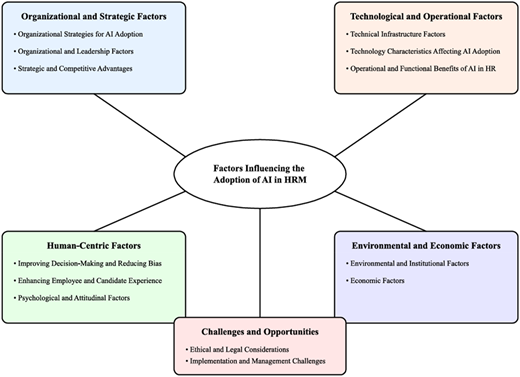
The final stage integrates the research outcomes into a cohesive process, systematically synthesizing findings from previous studies on AI adoption in HR processes. Through detailed analysis and classification, this culminated in a comprehensive model (Figure 2) that illustrates the factors influencing AI adoption in HR, providing both a research summary and a conceptual framework.

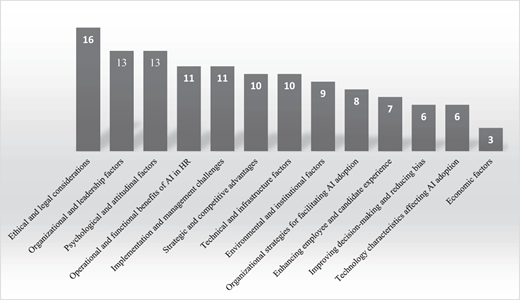
Figure 3 ranks the factors influencing the adoption of AI in HRM based on theme frequency. These data not only demonstrate the relative importance of each factor but also provide a comprehensive overview of the influential factors in this domain.

Through a meta-synthesis of 2015–2023 studies, this research examined AI adoption factors in HRM. The analysis identified five main themes: organizational and strategic factors, technological and operational factors, human-centric factors, challenges and opportunities and environmental and economic factors.

Analysis highlights ethical and legal considerations as the primary concern, with the highest frequency (16), emphasizing the critical importance of addressing risks and regulatory challenges in AI implementation. Notably, economic factors demonstrated the lowest frequency (3), suggesting that noneconomic considerations currently dominate organizational decision-making.

Organizational and strategic elements emerge as foundational, with leadership factors underlining the importance of vision. Psychological and attitudinal factors demonstrate that successful adoption depends heavily on employee perceptions and organizational culture. Operational benefits and technical infrastructure provide the technological groundwork for implementation, while management challenges highlight integration complexities.

This analysis reveals that AI adoption in HRM requires a holistic approach balancing technological capabilities with human readiness, ethical considerations and strategic opportunities. Success depends on creating an organizational ecosystem that effectively leverages technology while maintaining human-centric values and compliance standards.

The findings demonstrate that multiple interconnected factors shape AI adoption in HRM, with ethical and legal considerations emerging as the predominant factors (16 occurrences). Singh and Pandey (2024) recount a case in which a global company discontinued AI-based hiring in 2018 due to biases with significant legal and societal impacts. Parallel to these legal considerations, ethical frameworks play a crucial but separate role, as emphasized by Asif’s (2024) research on developing ethical guidelines for AI implementation in recruitment processes.

The multifaceted nature of AI adoption is particularly evident in the domain of user trust, as identified by Kelly et al. (2023) in their comprehensive analysis. While ethical and legal compliance forms one dimension of trust-building, the phenomenon is inherently more complex, encompassing multiple interconnected factors: technological reliability, algorithmic transparency, system performance metrics, user experience outcomes and demonstrated operational efficiency (Xu et al., 2024; Chatterjee et al., 2024). This multidimensional trust framework is further complicated by privacy considerations, which Choi (2021) identifies as a significant moderator of user adoption willingness. Tuffaha and Perello-Marin’s (2023) identification of research gaps in ethical implications suggests an emerging scholarly focus on these critical aspects.

Organizational and leadership factors, alongside psychological and attitudinal considerations (13 occurrences each), represent the second tier of influence in AI adoption dynamics. Alsheibani et al.’s (2020) empirical investigation demonstrates the crucial interplay between top management support, organizational readiness and regulatory compliance. This finding is reinforced by Pillai and Sivathanu’s (2020) analysis of leadership support’s role in successful AI integration within talent acquisition processes. Hamm and Klesel’s (2021) identification of 13 distinct organizational factors further validates the complexity of institutional dynamics in AI adoption. The psychological dimension, particularly evident in Ochmann and Laumer’s (2020) examination of candidate expectations in automated recruitment, reveals the intricate relationship between user attitudes and adoption outcomes, a finding substantiated by Kelly et al.’s (2023) predictive modeling of AI acceptance patterns.

Operational benefits and implementation challenges (11 occurrences each) constitute the next significant cluster of factors. Cost-effectiveness and comparative advantages emerge as primary drivers of adoption (Pillai and Sivathanu, 2020), while performance expectancy significantly influences implementation success (Kelly et al., 2023). However, organizations face substantial challenges, including resource allocation demands, organizational resistance, standardization complexities (Rane et al., 2024) and cybersecurity considerations (Pillai and Sivathanu, 2020).

Technical and infrastructure factors (ten occurrences) play a crucial role in adoption outcomes, with vendor support emerging as a critical success factor (Pillai and Sivathanu, 2020). The environmental and economic context (nine occurrences) shapes adoption through regulatory frameworks (Alsheibani et al., 2020) and market competition dynamics (Pillai and Sivathanu, 2020; Rane et al., 2024).

The findings largely align with existing literature while highlighting emerging trends, particularly the prominence of ethical and legal considerations in AI adoption for HRM. The high ranking of both organizational/leadership and psychological/attitudinal factors emphasizes that successful AI integration requires a holistic approach beyond technical implementation. This meta-synthesis demonstrates the multidimensional nature of AI adoption in HRM, suggesting organizations must address these interrelated factors comprehensively to optimize AI implementation while managing associated challenges.

This study’s findings align with and extend key technology adoption frameworks. The prominence of psychological and attitudinal factors corresponds with the Technology Acceptance Model’s core constructs (Davis et al., 1989), while the high frequency of ethical and legal considerations (16 occurrences) suggests the need to expand traditional frameworks. This aligns with recent developments in TAM2 [1] and UTAUT [2] (Mogaji et al., 2024), which recognize broader social and psychological determinants.

The findings also reflect the five characteristics of the diffusion of innovation theory (Muliadi and Usman, 2024). Organizational readiness and strategic alignment mirror the theory’s emphasis on compatibility, while ethical considerations highlight innovation complexity. This research uniquely bridges the technology acceptance model’s cognitive-psychological focus with the diffusion of innovation theory’s organizational–societal perspective, demonstrating how individual user experiences interact with broader organizational dynamics in AI adoption for HRM.

The prominent role of ethical and legal considerations introduces a critical dimension often understated in traditional frameworks. This suggests the need for an integrated adoption framework that synthesizes insights from existing theories while incorporating ethical responsibility, human-centric readiness and strategic alignment. Such theoretical advancement would better address the complexities of AI adoption in HRM and guide future research on the interplay between technological, psychological and organizational factors.

Successful AI adoption in HRM requires a comprehensive strategy addressing multiple dimensions, with ethical and legal considerations emerging as the highest priority factor. Organizations must establish robust frameworks for data privacy, algorithmic fairness and regulatory compliance to mitigate the risks of bias and discrimination.

Organizational leadership and psychological factors form the next critical layer, requiring strong strategic alignment and cultural adaptation. This involves implementing transparent communication strategies, developing targeted training programs and actively engaging employees to address technology resistance and build trust. These initiatives should leverage AI’s operational benefits while managing implementation challenges through systematic change management approaches.

Technical infrastructure and strategic advantages demand equal attention, requiring scalable systems and expert collaboration to optimize AI performance. Environmental and economic factors must be considered within the broader ecosystem, while organizational strategies should focus on enhancing employee experience and improving decision-making processes.

The successful integration of AI in HRM ultimately depends on balancing these interconnected dimensions while prioritizing factors based on their empirically determined significance. This evidence-based approach ensures organizations can effectively leverage AI’s transformative potential while maintaining ethical responsibility and operational excellence.

Future research should address the critical issue of AI bias, which remains a significant challenge to fairness and transparency in HRM. Bias in AI systems often stems from imbalances or prejudices in training data, algorithmic limitations or design flaws, potentially leading to discriminatory practices and undermining trust in AI-based decisions (Ahn et al., 2022; Leong and Sung, 2024). Exploring strategies for detecting, mitigating, and preventing such biases is crucial for ensuring ethical and equitable AI adoption in HR processes. Addressing these concerns will not only improve the ethical implementation of AI but also enhance its acceptance and effectiveness in diverse organizational contexts.

1.

Extended technology acceptance model.

2.

Unified theory of acceptance and use of technology.

Abdeldayem
,
M.M.
and
Aldulaimi
,
S.H.
(
2020
), “
Trends and opportunities of artificial intelligence in human resource management: aspirations for public sector in Bahrain
”,
International Journal of Scientific and Technology Research
, Vol. 
9
No. 
1
, pp. 
3867
-
3871
.
Ahn
,
J.
,
Kim
,
J.
and
Sung
,
Y.
(
2022
), “
The effect of gender stereotypes on artificial intelligence recommendations
”,
Journal of Business Research
, Vol. 
141
, pp. 
50
-
59
, doi: .
Alkudah
,
N.M.
,
Almomani
,
T.O.
and
Sarayrah
,
S.A.
(
2024
), “
Incorporating artificial intelligence in human resources management in small and medium companies: descriptive study
”,
International Journal of Academic Research in Business and Social Sciences
, Vol. 
14
No. 
3
, pp. 
146
-
169
, doi: .
Alsaif
,
A.
and
Sabih Aksoy
,
M.
(
2023
), “
AI-HRM: artificial intelligence in human resource management: a literature review
”,
Journal of Computing and Communication
, Vol. 
2
No. 
2
, pp. 
1
-
7
, doi: .
Alsheibani
,
S.
,
Messom
,
C.
,
Cheung
,
Y.
and
Alhosni
,
M.
(
2020
), “
Artificial intelligence beyond the hype: exploring the organisation adoption factors
”,
ACIS 2020 Proceedings
, Vol. 
33
,
available at:
 https://aisel.aisnet.org/acis2020/33
Anwar
,
G.
and
Abdullah
,
N.N.
(
2021
), “
The impact of Human resource management practice on Organizational performance
”,
International Journal of Engineering Business Management
, Vol. 
5
No. 
1
, pp. 
35
-
47
, doi: .
Arslan
,
A.
,
Cooper
,
C.
,
Khan
,
Z.
,
Golgeci
,
I.
and
Ali
,
I.
(
2022
), “
Artificial intelligence and human workers interaction at team level: a conceptual assessment of the challenges and potential HRM strategies
”,
International Journal of Manpower
, Vol. 
43
No. 
1
, pp. 
75
-
88
, doi: .
Asif
,
A.
(
2024
), “
Integrating AI in recruitment: a review of perceptions, acceptance, adoption and ethical considerations of AI usage
”,
Frontiers in Business, Economics and Management
, Vol. 
15
No. 
3
, pp. 
108
-
115
, doi: .
Bankins
,
S.
,
Ocampo
,
A.C.
,
Marrone
,
M.
,
Restubog
,
S.L.D.
and
Woo
,
S.E.
(
2024
), “
A multilevel review of artificial intelligence in organizations: implications for organizational behavior research and practice
”,
Journal of Organizational Behavior
, Vol. 
45
No. 
2
, pp. 
159
-
182
,‏ doi: . pp.
Barboza
,
C.
(
2019
), “
Artificial intelligence and HR: the new wave of technology
”,
Journal of Advances in Social Science and Humanities
, Vol. 
5
No. 
4
, pp.
715
-
720
, doi: .
Benbya
,
H.
,
Davenport
,
T.H.
and
Pachidi
,
S.
(
2020
), “
Artificial intelligence in organizations: current state and future opportunities
”,
MIS Quarterly Executive
, Vol. 
19
No. 
4
,
available at:
 https://aisel.aisnet.org/misqe/vol19/iss4/4
Bhardwaj
,
G.
,
Singh
,
S.V.
and
Kumar
,
V.
(
2020
), “
An empirical study of artificial intelligence and its impact on human resource functions
”,
2020 International Conference on Computation, Automation and Knowledge Management (ICCAKM)
,
IEEE
, pp. 
47
-
51
, doi: .
Chatterjee
,
S.
,
Jemima
,
A.G.
,
Ray
,
S.
,
Kumar
,
M.S.
and
Ahluwalia
,
G.
(
2024
), “
A systematic review of artificial intelligence (AI) and impact on human resource management (HRM): challenges, risks and opportunities
”,
Naturalista Campano
, Vol. 
28
No. 
1
, pp. 
558
-
591
,
available at:
 https://museonaturalistico.it/index.php/journal/article/download/118/104
Chilunjika
,
A.
,
Intauno
,
K.
and
Chilunjika
,
S.R.
(
2022
), “
Artificial intelligence and public sector human resource management in South Africa: opportunities, challenges and prospects
”,
SA Journal of Human Resource Management
, Vol. 
20
, 1972, doi: .
Choi
,
Y.
(
2021
), “
A study of employee acceptance of artificial intelligence technology
”,
European Journal of Management and Business Economics
, Vol. 
30
No. 
3
, pp. 
318
-
330
, doi: .
Chukwuka
,
E.J.
and
Dibie
,
K.E.
(
2024
), “
Strategic role of artificial intelligence (AI) on human resource management (HR) employee performance evaluation function
”,
International Journal of Entrepreneurship and Business Innovation
, Vol. 
7
No. 
2
, pp. 
269
-
282
, doi: .
Davis
,
F.D.
,
Bagozzi
,
R.P.
and
Warshaw
,
P.R.
(
1989
), “
Technology acceptance model
”,
Journal of Management Science
, Vol. 
35
No. 
8
, pp. 
982
-
1003
.
del Val Núñez
,
M.T.
,
de Lucas Ancillo
,
A.
,
Gavrila
,
S.G.
and
Gandía
,
J.A.G.
(
2024
),
Technological transformation in HRM through knowledge and training: innovative business decision making
,
Technological Forecasting and Social Change
, Vol. 
200
, 123168, doi: .
Dima
,
J.
,
Gilbert
,
M.H.
,
Dextras-Gauthier
,
J.
and
Giraud
,
L.
(
2024
), “
The effects of artificial intelligence on human resource activities and the roles of the human resource triad: opportunities and challenges
”,
Frontiers in Psychology
, Vol. 
15
, 1360401, doi: .
Geetha
,
R.
and
Bhanu
,
S.R.D.
(
2018
), “
Recruitment through artificial intelligence: a conceptual study
”,
International Journal of Mechanical Engineering and Technology
, Vol. 
9
No. 
7
, pp. 
63
-
70
,
available at:
 http://www.iaeme.com/IJMET/issues.asp?JType=IJMET&VType=9&IType=7
George
,
G.
and
Thomas
,
M.R.
(
2019
), “
Integration of artificial intelligence in human resource
”,
International Journal of Innovative Technology and Exploring Engineering
, Vol. 
9
No. 
2
, pp. 
5069
-
5073
, doi: .
Ghosh
,
R.
,
Nachmias
,
S.
,
Murdoch
,
D.
and
McGuire
,
D.
(
2024
), “
Prioritizing humans: HRD's vital role in AI adoption for workplace success
”,
Human Resource Development International
, Vol. 
27
No. 
3
, pp. 
319
-
323
, doi: .
Groenewald
,
C.A.
,
Groenewald
,
E.
,
Uy
,
F.
,
Kilag
,
O.K.
,
Abendan
,
C.F.
and
Pernites
,
M.J.
(
2024
), “
Adapting HRM practices to globalization: strategies for success in a borderless economy
”,
International Multidisciplinary Journal of Research for Innovation, Sustainability, and Excellence (IMJRISE)
, Vol. 
1
No. 
3
, pp. 
142
-
149
,
available at:
 https://risejournals.org/index.php/imjrise/article/view/195
Hamm
,
P.
and
Klesel
,
M.
(
2021
), “
Success factors for the adoption of artificial intelligence in organizations: a literature review
”,
AMCIS 2021 Proceedings
, Vol. 
10
,
available at:
 https://aisel.aisnet.org/amcis2021/art_intel_sem_tech_intelligent_systems/art_intel_sem_tech_intelligent_systems/10
Holland
,
P.
,
Dowling
,
P.
and
Brewster
,
C.
(
2022
),
HRM and the smart and dark side of technology
,
Asia Pacific Journal of Human Resources
, Vol. 
60
No. 
1
, pp. 
62
-
78
, doi: .
Hossin
,
M.S.
,
Ulfy
,
M.A.
,
Ali
,
I.
and
Karim
,
M.W.
(
2021
), “
Challenges in adopting artificial intelligence (AI) in HRM practices: a study on Bangladesh perspective
”,
International Fellowship Journal of Interdisciplinary Research
, Vol. 
1
No. 
1
, pp. 
66
-
73
, doi: .
Jain
,
D.S.
(
2018
), “
Human resource management and artificial intelligence
”,
International Journal of Management and Social Sciences Research
, Vol. 
7
No. 
3
, pp. 
56
-
59
, doi: .
Jatobá
,
M.N.
,
Ferreira
,
J.J.
,
Fernandes
,
P.O.
and
Teixeira
,
J.P.
(
2023
), “
Intelligent human resources for the adoption of artificial intelligence: a systematic literature review
”,
Journal of Organizational Change Management
, Vol. 
36
No. 
7
, pp. 
1099
-
1124
, doi: .
Jia
,
Q.
,
Guo
,
Y.
,
Li
,
R.
,
Li
,
Y.R.
and
Chen
,
Y.W.
(
2018
), “
A conceptual artificial intelligence application framework in human resource management
”,
Proceedings of The 18th International Conference on Electronic Business
,
ICEB
, pp. 
106
-
114
.
Joshi
,
A.
,
Singh
,
R.
and
Rani
,
S.
(
2024
), “
Strategic adoption of artificial intelligence for human resource management practices transforming healthcare sector
”,
The International Journal of Education Management and Sociology
, Vol. 
3
No. 
3
, pp. 
151
-
163
, doi: .
Kadam
,
S.
,
Luharia
,
A.
,
Tivaskar
,
S.
and
Khatib
,
M.W.
(
2022
), “
Evolution of human resource management–a review article
”,
Journal of Pharmaceutical Negative Results
, Vol. 
13
No. 
8
, pp.
212
-
218
, doi: .
Kaur
,
M.
and
Gandolfi
,
F.
(
2023
), “
Artificial intelligence in human resource management-challenges and future research recommendations
”,
Revista de Management Comparat International
, Vol. 
24
No. 
3
, pp. 
382
-
393
, doi: .
Kaushal
,
N.
,
Kaurav
,
R.P.S.
,
Sivathanu
,
B.
and
Kaushik
,
N.
(
2023
),
Artificial intelligence and HRM: identifying future research Agenda using systematic literature review and bibliometric analysis
,
Management Review Quarterly
, Vol. 
73
No. 
2
, pp. 
455
-
493
, doi: .
Kelly
,
S.
,
Kaye
,
S.A.
and
Oviedo-Trespalacios
,
O.
(
2023
), “
What factors contribute to the acceptance of artificial intelligence? A systematic review
”,
Telematics and Informatics
, Vol. 
77
, 101925, doi: .
Kshetri
,
N.
(
2021
), “
Evolving uses of artificial intelligence in human resource management in emerging economies in the global south: some preliminary evidence
”,
Management Research Review
, Vol. 
44
No. 
7
, pp. 
970
-
990
, doi: .
Lachal
,
J.
,
Orri
,
M.
,
Sibeoni
,
J.
,
Moro
,
M.R.
and
Revah-Levy
,
A.
(
2015
), “
Metasynthesis of youth suicidal behaviours: perspectives of youth, parents, and health care professionals
”,
PLoS One
, Vol. 
10
No. 
5
, e0127359, doi: .
Leong
,
K.
and
Sung
,
A.
(
2024
), “
Gender stereotypes in artificial intelligence within the accounting profession using large language models
”,
Humanities and Social Sciences Communications
, Vol. 
11
No. 
1
, 1141, doi: .
Lichtenthaler
,
U.
(
2020
), “
Extremes of acceptance: employee attitudes toward artificial intelligence
”,
Journal of Business Strategy
, Vol. 
41
No. 
5
, pp. 
39
-
45
, doi: .
Liu
,
J.
,
Kong
,
X.
,
Xia
,
F.
,
Bai
,
X.
,
Wang
,
L.
,
Qing
,
Q.
and
Lee
,
I.
(
2018
), “
Artificial intelligence in the 21st century
”,
IEEE Access
, Vol. 
6
, pp. 
34403
-
34421
, doi: .
Makarius
,
E.E.
,
Mukherjee
,
D.
,
Fox
,
J.D.
and
Fox
,
A.K.
(
2020
), “
Rising with the machines: a sociotechnical framework for bringing artificial intelligence into the organization
”,
Journal of Business Research
, Vol. 
120
, pp. 
262
-
273
, doi: .
Merhi
,
M.I.
and
Harfouche
,
A.
(
2024
),
Enablers of artificial intelligence adoption and implementation in production systems
,
International Journal of Production Research
, Vol. 
62
No. 
15
, pp. 
5457
-
5471
, doi: .
Mogaji
,
E.
,
Viglia
,
G.
,
Srivastava
,
P.
and
Dwivedi
,
Y.K.
(
2024
), “
Is it the end of the technology acceptance model in the era of generative artificial intelligence?
”,
International Journal of Contemporary Hospitality Management
, Vol. 
36
No. 
10
, pp. 
3324
-
3339
, doi: .
Muliadi
,
M.R.
and
Usman
,
B.
(
2024
), “
Analysis of e-wallet application adoption through the diffusion of innovation theory approach (study of e-wallet application users in Bengkulu city)
”,
Jurnal Mantik
, Vol. 
7
No. 
4
, pp. 
3001
-
3011
, doi: .
Nye
,
E.
,
Melendez‐Torres
,
G.J.
and
Bonell
,
C.
(
2016
),
Origins, methods and advances in qualitative meta‐synthesis
,
The Review of Education
, Vol. 
4
No. 
1
, pp. 
57
-
79
,‏ doi: .
Nye
,
C.D.
,
Su
,
R.
,
Rounds
,
J.
and
Drasgow
,
F.
(
2017
), “
Interest congruence and performance: revisiting recent meta-analytic findings
”,
Journal of Vocational Behavior
, Vol. 
98
, pp. 
138
-
151
, doi: .
Ochmann
,
J.
and
Laumer
,
S.
(
2020
), “AI recruitment: explaining job seekers' acceptance of automation in human resource management”, in
Wirtschaftsinformatik (Zentrale Tracks)
, pp. 
1633
-
1648
, doi: .
Palos-Sánchez
,
P.R.
,
Baena-Luna
,
P.
,
Badicu
,
A.
and
Infante-Moro
,
J.C.
(
2022
), “
Artificial intelligence and human resources management: a bibliometric analysis
”,
Applied Artificial Intelligence
, Vol. 
36
No. 
1
, 2145631, doi: .
Pan
,
Y.
,
Froese
,
F.
,
Liu
,
N.
,
Hu
,
Y.
and
Ye
,
M.
(
2022
), “
The adoption of artificial intelligence in employee recruitment: the influence of contextual factors
”,
International Journal of Human Resource Management
, Vol. 
33
No. 
6
, pp.
1125
-
1147
, doi: .
Panda
,
A.
,
Pasumarti
,
S.S.
and
Hiremath
,
S.
(
2023
), “Adoption of artificial intelligence in HR practices: an empirical analysis”, in
Tyagi
,
P.
,
Chilamkurti
,
N.
,
Grima
,
S.
,
Sood
,
K.
and
Balusamy
,
B.
(Eds),
The Adoption and Effect of Artificial Intelligence on Human Resources Management, Part B
,
Emerald Publishing Limited
,
Chapter 18
, pp.
65
-
80
, doi: .
Pillai
,
R.
and
Sivathanu
,
B.
(
2020
), “
Adoption of artificial intelligence (AI) for talent acquisition in IT/ITeS organizations
”,
Benchmarking: An International Journal
, Vol. 
27
No. 
9
, pp. 
2599
-
2629
, doi: .
Qiu
,
L.
and
Zhao
,
L.
(
2018
),
Opportunities and challenges of artificial intelligence to human resource management
,
Academic Journal of Humanities and Social Sciences
, Vol. 
2
No. 
1
, pp. 
144
-
153
, doi: .
Rane
,
N.
,
Choudhary
,
S.
and
Rane
,
J.
(
2024
), “
Artificial intelligence acceptance and implementation in construction industry: factors, current trends, and challenges
”,
SSRN
, doi: .
Rasheed
,
A.
,
Ahmad
,
S.
,
Kaleem
,
S.
and
Ibrahim
,
K.
(
2024
), “
Applications of artificial intelligence in human resource management in Asia
”,
Journal of Asian Development Studies
, Vol. 
13
No. 
2
, pp. 
1374
-
1381
, doi: .
Rathi
,
R.A.
(
2018
), “
Artificial intelligence and the future of HR practices
”,
International Journal of Applied Research
, Vol. 
4
No. 
6
, pp. 
113
-
116
.
Robert
,
L.P.
,
Pierce
,
C.
,
Marquis
,
L.
,
Kim
,
S.
and
Alahmad
,
R.
(
2020
), “
Designing fair AI for managing employees in organizations: a review, critique, and design agenda
”,
Human-Computer Interaction
, Vol. 
35
Nos
5-6
, pp. 
545
-
575
, doi: .
Sabil
,
S.
,
Bangkara
,
B.M.A.S.A.
,
Mogea
,
T.
,
Niswan
,
E.
and
Timotius
,
E.
(
2023
), “
Identification of HRM improvement strategy using artificial intelligence in modern economic development
”,
International Journal of Professional Business Review
, Vol. 
8
No. 
6
, e01835, doi: .
Sandelowski
,
M.
and
Barroso
,
J.
(
2007
),
Handbook for Synthesizing Qualitative Research
,
Springer Publishing Company
,
New York
.
Sanyaolu
,
E.
and
Atsaboghena
,
R.
(
2022
), “
Role of artificial intelligence in human resource management: overview of its benefits and challenges
”,
ResearchGate
. doi: .
Singh
,
A.
and
Pandey
,
J.
(
2024
), “
Artificial intelligence adoption in extended HR ecosystems: enablers and barriers. An abductive case research
”,
Frontiers in Psychology
, Vol. 
14
, 1339782, doi: .
Singh
,
S.
,
Thakur
,
P.
and
Singh
,
S.
(
2023
), “
How does the use of AI in HRM contribute to improved business performance?: a systematic review
”,
Managing Technology Integration for Human Resources in Industry
, Vol. 
5
, pp. 
131
-
139
,‏ doi: .
Suseno
,
Y.
,
Chang
,
C.
,
Hudik
,
M.
and
Fang
,
E.S.
(
2021
), “
Beliefs, anxiety and change readiness for artificial intelligence adoption among human resource managers: the moderating role of high-performance work systems
”,
International Journal of Human Resource Management
,
Advance online publication
, Vol. 
33
No. 
6
, pp. 
1209
-
1236
, doi: .
Tabor-Błażewicz
,
J.
(
2023
), “Artificial intelligence adoption in human resources management”, in
Game Changers in Management
,
Wroclaw University of Economics and Business
, pp. 
30
-
43
, doi: .
Tuffaha
,
M.
and
Perello-Marin
,
M.R.
(
2023
), “
Artificial intelligence definition, applications and adoption in human resource management: a systematic literature review
”,
International Journal of Business Innovation and Research
, Vol. 
32
No. 
3
, pp. 
293
-
322
, doi: .
Tuffaha
,
M.
and
Rosario Perello-Marin
,
M.
(
2022
), “
Adoption factors of artificial intelligence in human resources management
”,
Future of Business Administration
, Vol. 
1
No. 
1
, pp. 
1
-
12
, doi: .
Vasantham
,
S.T.
(
2021
), “
The role of artificial intelligence in human resource management
”,
Engineering and Scientific International Journal
, Vol. 
8
No. 
2
, pp. 
59
-
63
, doi: .
Vrontis
,
D.
,
Christofi
,
M.
,
Pereira
,
V.
,
Tarba
,
S.
,
Makrides
,
A.
and
Trichina
,
E.
(
2023
), “
Artificial intelligence, robotics, advanced technologies and human resource management: a systematic review
”,
Artificial intelligence and international
, No. 
6
, pp. 
172
-
201
. ‏doi: .
Xu
,
Y.
,
Huang
,
Y.
,
Wang
,
J.
and
Zhou
,
D.
(
2024
), “
How do employees form initial trust in artificial intelligence: hard to explain but leaders help
”,
Asia Pacific Journal of Human Resources
, Vol. 
62
No. 
3
, e12402, doi: .
Xu
,
Y.
,
Liu
,
X.
,
Cao
,
X.
,
Huang
,
C.
,
Liu
,
E.
,
Qian
,
S.
,
Liu
,
X.
,
Wu
,
Y.
,
Dong
,
F.
,
Qiu
,
C.-W.
,
Qiu
,
J.
,
Hua
,
K.
,
Su
,
W.
,
Wu
,
J.
,
Xu
,
H.
,
Han
,
Y.
,
Fu
,
C.
,
Yin
,
Z.
,
Liu
,
M.
,
Roepman
,
R.
,
Dietmann
,
S.
,
Virta
,
M.
,
Kengara
,
F.
,
Zhang
,
Z.
,
Zhang
,
L.
,
Zhao
,
T.
,
Dai
,
J.
,
Yang
,
J.
,
Lan
,
L.
,
Luo
,
M.
,
Liu
,
Z.
,
An
,
T.
,
Zhang
,
B.
,
He
,
X.
,
Cong
,
S.
,
Liu
,
X.
,
Zhang
,
W.
,
Lewis
,
J.P.
,
Tiedje
,
J.M.
,
Wang
,
Q.
,
An
,
Z.
,
Wang
,
F.
,
Zhang
,
L.
,
Huang
,
T.
,
Lu
,
C.
,
Cai
,
Z.
,
Wang
,
F.
and
Zhang
,
J.
(
2021
), “
Artificial intelligence: a powerful paradigm for scientific research
”,
Innovation
, Vol. 
2
No. 
4
, 100179, doi: .
Yawalkar
,
M.V.V.
(
2019
), “
A study of artificial intelligence and its role in human resource management
”,
International Journal of Research and Analytical Reviews (IJRAR)
, Vol. 
6
No. 
1
, pp. 
20
-
24
, doi: .
Zhang
,
C.
and
Lu
,
Y.
(
2021
), “
Study on artificial intelligence: the state of the art and future prospects
”,
Journal of Industrial Information Integration
, Vol. 
23
, 100224, doi: .
Published in Journal of Work-Applied Management. Published by Emerald Publishing Limited. This article is published under the Creative Commons Attribution (CC BY 4.0) licence. Anyone may reproduce, distribute, translate and create derivative works of this article (for both commercial and non-commercial purposes), subject to full attribution to the original publication and authors. The full terms of this licence may be seen at http://creativecommons.org/licences/by/4.0/legalcode

Data & Figures

Figure 1
A diagram shows steps from formulating research question to presenting findings.The diagram shows a horizontal sequence of six rectangular boxes connected by right-pointing arrows. The first box reads “Formulating Research Question”. The second box reads “Systematic Literature Review”. The third box reads “Selecting Appropriate Studies”. The fourth box reads “Extracting Information from Studies”. The fifth box reads “Quality Assessment”. The sixth box reads “Presenting Findings”.

The stages of implementing the meta-synthesis method. Source(s): Sandelowski and Barroso (2007) 

Figure 1
A diagram shows steps from formulating research question to presenting findings.The diagram shows a horizontal sequence of six rectangular boxes connected by right-pointing arrows. The first box reads “Formulating Research Question”. The second box reads “Systematic Literature Review”. The third box reads “Selecting Appropriate Studies”. The fourth box reads “Extracting Information from Studies”. The fifth box reads “Quality Assessment”. The sixth box reads “Presenting Findings”.

The stages of implementing the meta-synthesis method. Source(s): Sandelowski and Barroso (2007) 

Close modal
Figure 2
A diagram shows factors influencing the adoption of A I in H R M with five connected categories.The diagram shows a central oval labeled “Factors Influencing the Adoption of A I in H R M” connected to five surrounding boxes. The top left box is titled “Organizational and Strategic Factors” and contains three bullet points: “Organizational Strategies for A I Adoption”, “Organizational and Leadership Factors”, and “Strategic and Competitive Advantages”. The top right box is titled “Technological and Operational Factors” and contains three bullet points: “Technical Infrastructure Factors”, “Technology Characteristics Affecting A I Adoption”, and “Operational and Functional Benefits of A I in H R”. The bottom left box is titled “Human-Centric Factors” and contains three bullet points: “Improving Decision-Making and Reducing Bias”, “Enhancing Employee and Candidate Experience”, and “Psychological and Attitudinal Factors”. The bottom right box is titled “Environmental and Economic Factors” and contains two bullet points: “Environmental and Institutional Factors” and “Economic Factors”. The bottom center box is titled “Challenges and Opportunities” and contains two bullet points: “Ethical and Legal Considerations” and “Implementation and Management Challenges”.

The model of factors influencing the adoption of AI in HRM. Source(s): Authors’ own work

Figure 2
A diagram shows factors influencing the adoption of A I in H R M with five connected categories.The diagram shows a central oval labeled “Factors Influencing the Adoption of A I in H R M” connected to five surrounding boxes. The top left box is titled “Organizational and Strategic Factors” and contains three bullet points: “Organizational Strategies for A I Adoption”, “Organizational and Leadership Factors”, and “Strategic and Competitive Advantages”. The top right box is titled “Technological and Operational Factors” and contains three bullet points: “Technical Infrastructure Factors”, “Technology Characteristics Affecting A I Adoption”, and “Operational and Functional Benefits of A I in H R”. The bottom left box is titled “Human-Centric Factors” and contains three bullet points: “Improving Decision-Making and Reducing Bias”, “Enhancing Employee and Candidate Experience”, and “Psychological and Attitudinal Factors”. The bottom right box is titled “Environmental and Economic Factors” and contains two bullet points: “Environmental and Institutional Factors” and “Economic Factors”. The bottom center box is titled “Challenges and Opportunities” and contains two bullet points: “Ethical and Legal Considerations” and “Implementation and Management Challenges”.

The model of factors influencing the adoption of AI in HRM. Source(s): Authors’ own work

Close modal
Figure 3
A bar chart shows factors influencing A I adoption, with ethical factors highest and economic factors lowest.The horizontal axis lists categories labeled “Ethical and legal considerations”, “Organizational and leadership factors”, “Psychological and attitudinal factors”, “Operational and functional benefits of A I in H R”, “Implementation and management challenges”, “Strategic and competitive advantages”, “Technical and infrastructure factors”, “Environmental and institutional factors”, “Organizational strategies for facilitating A I adoption”, “Enhancing employee and candidate experience”, “Improving decision-making and reducing bias”, “Technology characteristics affecting A I adoption”, and “Economic factors”. The vertical axis represents frequency values. Each bar has its value labeled inside the bar. The values from the bars are as follows: For Ethical and legal considerations: 16. For Organizational and leadership factors: 13. For Psychological and attitudinal factors: 13. For Operational and functional benefits of A I in H R: 11. For Implementation and management challenges: 11. For Strategic and competitive advantages: 10. For Technical and infrastructure factors: 10. For Environmental and institutional factors: 9. For Organizational strategies for facilitating A I adoption: 8. For Enhancing employee and candidate experience: 7. For Improving decision-making and reducing bias: 6. For Technology characteristics affecting A I adoption: 6. For Economic factors: 3.

Ranking of factors influencing AI adoption in HRM. Source(s): Authors’ own work

Figure 3
A bar chart shows factors influencing A I adoption, with ethical factors highest and economic factors lowest.The horizontal axis lists categories labeled “Ethical and legal considerations”, “Organizational and leadership factors”, “Psychological and attitudinal factors”, “Operational and functional benefits of A I in H R”, “Implementation and management challenges”, “Strategic and competitive advantages”, “Technical and infrastructure factors”, “Environmental and institutional factors”, “Organizational strategies for facilitating A I adoption”, “Enhancing employee and candidate experience”, “Improving decision-making and reducing bias”, “Technology characteristics affecting A I adoption”, and “Economic factors”. The vertical axis represents frequency values. Each bar has its value labeled inside the bar. The values from the bars are as follows: For Ethical and legal considerations: 16. For Organizational and leadership factors: 13. For Psychological and attitudinal factors: 13. For Operational and functional benefits of A I in H R: 11. For Implementation and management challenges: 11. For Strategic and competitive advantages: 10. For Technical and infrastructure factors: 10. For Environmental and institutional factors: 9. For Organizational strategies for facilitating A I adoption: 8. For Enhancing employee and candidate experience: 7. For Improving decision-making and reducing bias: 6. For Technology characteristics affecting A I adoption: 6. For Economic factors: 3.

Ranking of factors influencing AI adoption in HRM. Source(s): Authors’ own work

Close modal
Table 1

Research parameters

Key questionsResponses in this research
WhatIdentifying the core research topic marks the initial step in the meta-synthesis approach. In this study, this phase was initiated through the following research questions: 1. What factors influence AI adoption in HRM? 2. How are these factors prioritized in terms of their impact on AI adoption?
WhoIn this research, reputable international scientific databases and various search engines have been examined
WhenThe timeframe during which documents and evidence were searched and reviewed was from 2015 to 2023 CE
HowThis research employs “thematic analysis” for collecting and analyzing studies, an advanced method for secondary data analysis. Through specific criteria, relevant and high-quality studies are identified and selected

Source(s): Authors’ own work

Table 2

Article selection criteria

FactorsAcceptance criteriaRejection criteria
Type of study
  1. Articles published in peer-reviewed journals with proven scientific credibility

  2. High-quality conference papers (subject to peer review and relevance)

  1. Personal opinions and non-scientific articles

  2. Content from personal websites and informal reports

  3. Articles lacking peer review or academic rigor

Subject
  1. Studies focusing specifically on factors influencing the adoption of AI

  2. Articles addressing AI adoption within organizations, especially in HRM

  1. Articles unrelated to AI adoption

  2. Studies that mention AI superficially or lack clear focus on adoption processes

General scope
  1. Articles addressing AI applications within HRM

  2. Both theoretical and applied studies on the impact of AI in HR processes

  1. Articles focused on other fields such as engineering, medicine or non-HRM topics

  2. Studies not aligning with the HRM domain

Research method
  1. Studies employing qualitative methods (e.g. case studies and interviews)

  2. Studies using quantitative methods (e.g. surveys and statistical analyses)

  3. Articles applying mixed-methods research approaches

  1. Non-methodical studies with no clear research methodology

  2. Descriptive or opinion-based articles lacking empirical or analytical data

Study period
  1. Articles published within the period 2015–2023 CE

  2. Studies reflecting contemporary insights and trends in AI adoption

  1. Articles published outside the specified timeframe

  2. Outdated studies with limited relevance to current AI research

Research language
  1. Articles published in English

  1. Articles published in languages other than English

  2. Studies without full-text availability

Source(s): Authors’ own work

Table 3

Scores assigned to selected articles

Article numberScoreArticle numberScore
1401147
2361243
3471344
4451443
5501545
6461637
7411750
8441849
9401945
10502041

Source(s): Authors’ own work

Table 4

Main and sub-themes

Main themesSub-themesConceptsReferencesRepetition of themes
Organizational and strategic factorsOrganizational strategies for facilitating AI adoptionTraining and skill development (1): increasing employee knowledge and reducing anxiety/Participation in decision-making (1): Creating opportunities for employee involvement/Reassurance about Job Security (1): reducing employee concerns/Improving employee selection criteria (1): focusing on adaptability to change/Developing AI-specific resources (1): encouraging managers to implement relevant resources/Developing AI literacy (1): enhancing knowledge of HR professionals/Strategic leadership (1): collaboration between leaders and HR development specialists/Stakeholder engagement (1): involving a wide range of stakeholders in the adoption processGhosh et al. (2024), Palos-Sánchez et al. (2022), Suseno et al. (2021) 8
Organizational and leadership factorsSenior management support (3): Supporting AI adoption/Organizational culture (2): Supporting change and innovation/Integrated competency development (2): continuous improvement to address integration/HR managers’ understanding (1): facilitating adoption through increased comprehension/Competitive pressure (1): impact of competition in talent acquisition/Vision and strategy (1): connection with AI implementation/High-performance work systems (1): Reducing anxiety and increasing readiness/Reward system (1): motivation for AI adoption/Continuous learning (1): adapting to AI-induced changesPillai and Sivathanu (2020), Joshi et al. (2024), Suseno et al. (2021), Merhi and Harfouche (2024), Tuffaha and Perello-Marin (2022), Dima et al. (2024), Alkudah et al. (2024), Ghosh et al. (2024) 13
Strategic and competitive advantagesCreating competitive advantage (2): assisting in talent attraction and retention/Improving recruitment and hiring processes (2): enhancing interview quality and employee matching/Improving performance management (2): automated analysis of performance data/Modernizing processes (1): digitalization of HR/Human-AI integration (1): creating effective interaction models/Focus on human development (1): maintaining focus on employee well-being/Increasing fairness in compensation management (1): creating a more equitable evaluation systemPillai and Sivathanu (2020), Alkudah et al. (2024), Joshi et al. (2024), Jia et al. (2018), Rathi (2018), Ghosh et al. (2024) 10
Technological and operational factorsTechnical and infrastructure factorsHR readiness (1): ensuring readiness of personnel and technological resources/Vendor support (1): assistance at each stage of adoption and use/Technology competence (1): positive relationship with AI adoption/Technology complexity (1): negative relationship with AI adoption/Computational power and capacity (1): impact on data processing and productivity/Real-time experience (1): positive impact on rapid decision-making/IT infrastructure (1): prerequisite for digital technologies/Perceived compatibility (1): impact on implementation success/Data quality and complexity (1): importance in output accuracy/Security and privacy (1): necessity of data protectionPillai and Sivathanu (2020), Pan et al. (2022), Panda et al. (2023), Merhi and Harfouche (2024) 10
Technology characteristics affecting AI adoptionPerceived usefulness (1): extent of user belief in performance improvement with AI use/Perceived ease of use (1): employees’ belief in the ease of interacting with AI/Compatibility (1): degree of AI alignment with organizational values and needs/Relative advantage (1): degree of perceiving AI as value-adding/Complexity (1): level of difficulty in understanding and using AI/Performance speed (1): high processing and performance speed of AILichtenthaler (2020), Tuffaha and Perello-Marin (2022), Tabor-Błażewicz (2023) 6
Operational and functional benefits of AI in HRAutomation of repetitive tasks (3): reducing fatigue and errors, improving variety/Optimization of HR data usage (1): aiding data-driven decision-making/Enhancement of human capabilities (1): increasing specialists’ abilities/Improvement of organizational efficiency (1): enhancing performance by combining procedures and tools/Increasing efficiency of recruitment processes (1): eliminating 75% of related tasks/Effective candidate screening (1): assisting in initial screening and engagement/Automated scheduling (1): automatic booking of meetings and interviews/Big data analysis (1): processing and analyzing large volumes of data/Predicting employee turnover (1): preventing productivity declineAlkudah et al. (2024), Dima et al. (2024), Geetha and Bhanu (2018), George and Thomas (2019), Palos-Sánchez et al., (2022), Tabor-Błażewicz (2023) 11
Human-centric factorsImproving decision-making and reducing biasEmployee performance and sentiment Analysis (1): identifying psycho-emotional characteristics/Reducing bias in HR Processes (1): creating equal opportunities/Quality and unbiased hiring (1): utilizing extensive data/Precise talent matching (1): identifying and matching skills with job requirements/Increasing accuracy in analysis and prediction (1): Improving workforce planning/Relative advantage (1): improving decision-making and candidate selectionGeetha and Bhanu (2018), George and Thomas (2019), Panda et al. (2023), Pillai and Sivathanu (2020) 6
Enhancing employee and candidate experiencePersonalization of training and development (2): creating customized training programs/Improving candidate interaction (1): using chatbots for responses/Facilitating access to information (1): providing easy access to company information/Improving request processes (1): using automated emails and messaging/Facilitating new employee onboarding (1): providing necessary information and resources/Offering career development programs (1): providing individualized training and coaching programsGeetha and Bhanu (2018), George and Thomas (2019), Jia et al. (2018) 7
Psychological and attitudinal factorsEmployee attitudes (3): key role in adoption/Concerns about job automation (2): fear of unemployment and resistance to adoption/Trust-building (1): reducing psychological barriers to adoption/Adherence to traditional methods (1): obstacle to full AI utilization/AI anxiety (1): negative impact on adoption readiness/Knowledge and awareness (1): lack of knowledge as an adoption barrier/Skills and competencies (1): lack of skills as an adoption barrier/Technology inclination (1): more positive attitude towards AI/Comfort orientation (1): more positive attitude towards AI/Social acceptance of AI (1): essential condition for successful implementationDima et al. (2024), Joshi et al. (2024), Lichtenthaler (2020), Palos-Sánchez et al. (2022), Pillai and Sivathanu (2020), Suseno et al. (2021), Tabor-Błażewicz (2023) 13
Challenges and opportunitiesEthical and legal considerationsEthics (4): integrating ethical aspects for greater transparency and privacy/Security and privacy concerns (3): concern about candidate confidential data/Transparency and accountability (2): increasing trust and acceptance/Legal environment (2): positive relationship between supportive legal environment and adoption/Reducing discrimination and increasing diversity (1): helping identify and eliminate bias patterns/Ethical approach (1): creating ethical frameworks for responsible use/Transparency (1): creating transparency in decision-making processes/Data security and privacy (1): prioritizing employee privacy protection/Ethical and legal issues (1): responsibility for ethical implementation and compliance with laws and regulationsAlkudah et al. (2024), Dima et al. (2024), Ghosh et al. (2024), Joshi et al. (2024), Merhi and Harfouche (2023), Pan et al. (2022), Pillai and Sivathanu (2020), Rathi (2018) 16
Implementation and management challengesTechnical and systemic challenges (1): technical barriers can delay AI adoption/Lack of expertise (1): organizations often lack necessary expertise for automation adoption/Governance (1): current AI governance efforts are still in early stages/Accountability (1): inability to explain the reason for a particular action can create accountability issues/Lack of empathy and “Human” Approach (1): this deficiency can be a barrier to AI adoption in HR processes/Lack of understanding of complex issues (1): virtual assistants’ inability to understand complex issues can be an adoption barrier/Lack of Creativity (1): lack of creativity in AI can be a negative factor in its adoption/Implementation challenges (1): difficulty in understanding and implementing software or algorithms can be an adoption barrier/Complexity of HR phenomena (1): complexities in HR phenomena can be a barrier to AI adoption and implementation in this field/Transformation of HR procedures (1): AI profoundly transforms HRM and impacts hiring, employee management, and decision-making/Workplace redesign (1): AI changes the form and content of work, necessitating preparation of employees for higher value-added jobsAlkudah et al. (2024), Dima et al. (2024), Joshi et al. (2024), Palos-Sánchez et al. (2022), Rathi (2018), Tabor-Błażewicz (2023) 11
Environmental and economic factorsEnvironmental and institutional factorsLegal regulations (2): necessity of complying with current and evolving laws as a challenge to AI adoption/Vendor support (2): technical and human resource support from vendors/External pressure (1): competitive pressure for faster AI adoption/Government involvement (1): impact of government policies and laws on encouraging AI dissemination/Vendor participation (1): reducing costs of managing and maintaining technical assets through vendor collaboration/Asset specificity (1): moderating effect on technology complexity and competence/Uncertainty (1): moderating effect on technology competenceTabor-Błażewicz (2023), Merhi and Harfouche (2024), Tuffaha and Perello-Marin (2023), Pan et al. (2022) 9
Economic factorsEconomic viability (2): reducing labor costs and time required for repetitive tasks/Reducing recruitment time and cost (1): reducing costs by up to 71% and increasing recruiter efficiencyJoshi et al. (2024), Pillai and Sivathanu (2020), George and Thomas (2019) 3

Source(s): Authors’ own work

Supplements

References

Abdeldayem
,
M.M.
and
Aldulaimi
,
S.H.
(
2020
), “
Trends and opportunities of artificial intelligence in human resource management: aspirations for public sector in Bahrain
”,
International Journal of Scientific and Technology Research
, Vol. 
9
No. 
1
, pp. 
3867
-
3871
.
Ahn
,
J.
,
Kim
,
J.
and
Sung
,
Y.
(
2022
), “
The effect of gender stereotypes on artificial intelligence recommendations
”,
Journal of Business Research
, Vol. 
141
, pp. 
50
-
59
, doi: .
Alkudah
,
N.M.
,
Almomani
,
T.O.
and
Sarayrah
,
S.A.
(
2024
), “
Incorporating artificial intelligence in human resources management in small and medium companies: descriptive study
”,
International Journal of Academic Research in Business and Social Sciences
, Vol. 
14
No. 
3
, pp. 
146
-
169
, doi: .
Alsaif
,
A.
and
Sabih Aksoy
,
M.
(
2023
), “
AI-HRM: artificial intelligence in human resource management: a literature review
”,
Journal of Computing and Communication
, Vol. 
2
No. 
2
, pp. 
1
-
7
, doi: .
Alsheibani
,
S.
,
Messom
,
C.
,
Cheung
,
Y.
and
Alhosni
,
M.
(
2020
), “
Artificial intelligence beyond the hype: exploring the organisation adoption factors
”,
ACIS 2020 Proceedings
, Vol. 
33
,
available at:
 https://aisel.aisnet.org/acis2020/33
Anwar
,
G.
and
Abdullah
,
N.N.
(
2021
), “
The impact of Human resource management practice on Organizational performance
”,
International Journal of Engineering Business Management
, Vol. 
5
No. 
1
, pp. 
35
-
47
, doi: .
Arslan
,
A.
,
Cooper
,
C.
,
Khan
,
Z.
,
Golgeci
,
I.
and
Ali
,
I.
(
2022
), “
Artificial intelligence and human workers interaction at team level: a conceptual assessment of the challenges and potential HRM strategies
”,
International Journal of Manpower
, Vol. 
43
No. 
1
, pp. 
75
-
88
, doi: .
Asif
,
A.
(
2024
), “
Integrating AI in recruitment: a review of perceptions, acceptance, adoption and ethical considerations of AI usage
”,
Frontiers in Business, Economics and Management
, Vol. 
15
No. 
3
, pp. 
108
-
115
, doi: .
Bankins
,
S.
,
Ocampo
,
A.C.
,
Marrone
,
M.
,
Restubog
,
S.L.D.
and
Woo
,
S.E.
(
2024
), “
A multilevel review of artificial intelligence in organizations: implications for organizational behavior research and practice
”,
Journal of Organizational Behavior
, Vol. 
45
No. 
2
, pp. 
159
-
182
,‏ doi: . pp.
Barboza
,
C.
(
2019
), “
Artificial intelligence and HR: the new wave of technology
”,
Journal of Advances in Social Science and Humanities
, Vol. 
5
No. 
4
, pp.
715
-
720
, doi: .
Benbya
,
H.
,
Davenport
,
T.H.
and
Pachidi
,
S.
(
2020
), “
Artificial intelligence in organizations: current state and future opportunities
”,
MIS Quarterly Executive
, Vol. 
19
No. 
4
,
available at:
 https://aisel.aisnet.org/misqe/vol19/iss4/4
Bhardwaj
,
G.
,
Singh
,
S.V.
and
Kumar
,
V.
(
2020
), “
An empirical study of artificial intelligence and its impact on human resource functions
”,
2020 International Conference on Computation, Automation and Knowledge Management (ICCAKM)
,
IEEE
, pp. 
47
-
51
, doi: .
Chatterjee
,
S.
,
Jemima
,
A.G.
,
Ray
,
S.
,
Kumar
,
M.S.
and
Ahluwalia
,
G.
(
2024
), “
A systematic review of artificial intelligence (AI) and impact on human resource management (HRM): challenges, risks and opportunities
”,
Naturalista Campano
, Vol. 
28
No. 
1
, pp. 
558
-
591
,
available at:
 https://museonaturalistico.it/index.php/journal/article/download/118/104
Chilunjika
,
A.
,
Intauno
,
K.
and
Chilunjika
,
S.R.
(
2022
), “
Artificial intelligence and public sector human resource management in South Africa: opportunities, challenges and prospects
”,
SA Journal of Human Resource Management
, Vol. 
20
, 1972, doi: .
Choi
,
Y.
(
2021
), “
A study of employee acceptance of artificial intelligence technology
”,
European Journal of Management and Business Economics
, Vol. 
30
No. 
3
, pp. 
318
-
330
, doi: .
Chukwuka
,
E.J.
and
Dibie
,
K.E.
(
2024
), “
Strategic role of artificial intelligence (AI) on human resource management (HR) employee performance evaluation function
”,
International Journal of Entrepreneurship and Business Innovation
, Vol. 
7
No. 
2
, pp. 
269
-
282
, doi: .
Davis
,
F.D.
,
Bagozzi
,
R.P.
and
Warshaw
,
P.R.
(
1989
), “
Technology acceptance model
”,
Journal of Management Science
, Vol. 
35
No. 
8
, pp. 
982
-
1003
.
del Val Núñez
,
M.T.
,
de Lucas Ancillo
,
A.
,
Gavrila
,
S.G.
and
Gandía
,
J.A.G.
(
2024
),
Technological transformation in HRM through knowledge and training: innovative business decision making
,
Technological Forecasting and Social Change
, Vol. 
200
, 123168, doi: .
Dima
,
J.
,
Gilbert
,
M.H.
,
Dextras-Gauthier
,
J.
and
Giraud
,
L.
(
2024
), “
The effects of artificial intelligence on human resource activities and the roles of the human resource triad: opportunities and challenges
”,
Frontiers in Psychology
, Vol. 
15
, 1360401, doi: .
Geetha
,
R.
and
Bhanu
,
S.R.D.
(
2018
), “
Recruitment through artificial intelligence: a conceptual study
”,
International Journal of Mechanical Engineering and Technology
, Vol. 
9
No. 
7
, pp. 
63
-
70
,
available at:
 http://www.iaeme.com/IJMET/issues.asp?JType=IJMET&VType=9&IType=7
George
,
G.
and
Thomas
,
M.R.
(
2019
), “
Integration of artificial intelligence in human resource
”,
International Journal of Innovative Technology and Exploring Engineering
, Vol. 
9
No. 
2
, pp. 
5069
-
5073
, doi: .
Ghosh
,
R.
,
Nachmias
,
S.
,
Murdoch
,
D.
and
McGuire
,
D.
(
2024
), “
Prioritizing humans: HRD's vital role in AI adoption for workplace success
”,
Human Resource Development International
, Vol. 
27
No. 
3
, pp. 
319
-
323
, doi: .
Groenewald
,
C.A.
,
Groenewald
,
E.
,
Uy
,
F.
,
Kilag
,
O.K.
,
Abendan
,
C.F.
and
Pernites
,
M.J.
(
2024
), “
Adapting HRM practices to globalization: strategies for success in a borderless economy
”,
International Multidisciplinary Journal of Research for Innovation, Sustainability, and Excellence (IMJRISE)
, Vol. 
1
No. 
3
, pp. 
142
-
149
,
available at:
 https://risejournals.org/index.php/imjrise/article/view/195
Hamm
,
P.
and
Klesel
,
M.
(
2021
), “
Success factors for the adoption of artificial intelligence in organizations: a literature review
”,
AMCIS 2021 Proceedings
, Vol. 
10
,
available at:
 https://aisel.aisnet.org/amcis2021/art_intel_sem_tech_intelligent_systems/art_intel_sem_tech_intelligent_systems/10
Holland
,
P.
,
Dowling
,
P.
and
Brewster
,
C.
(
2022
),
HRM and the smart and dark side of technology
,
Asia Pacific Journal of Human Resources
, Vol. 
60
No. 
1
, pp. 
62
-
78
, doi: .
Hossin
,
M.S.
,
Ulfy
,
M.A.
,
Ali
,
I.
and
Karim
,
M.W.
(
2021
), “
Challenges in adopting artificial intelligence (AI) in HRM practices: a study on Bangladesh perspective
”,
International Fellowship Journal of Interdisciplinary Research
, Vol. 
1
No. 
1
, pp. 
66
-
73
, doi: .
Jain
,
D.S.
(
2018
), “
Human resource management and artificial intelligence
”,
International Journal of Management and Social Sciences Research
, Vol. 
7
No. 
3
, pp. 
56
-
59
, doi: .
Jatobá
,
M.N.
,
Ferreira
,
J.J.
,
Fernandes
,
P.O.
and
Teixeira
,
J.P.
(
2023
), “
Intelligent human resources for the adoption of artificial intelligence: a systematic literature review
”,
Journal of Organizational Change Management
, Vol. 
36
No. 
7
, pp. 
1099
-
1124
, doi: .
Jia
,
Q.
,
Guo
,
Y.
,
Li
,
R.
,
Li
,
Y.R.
and
Chen
,
Y.W.
(
2018
), “
A conceptual artificial intelligence application framework in human resource management
”,
Proceedings of The 18th International Conference on Electronic Business
,
ICEB
, pp. 
106
-
114
.
Joshi
,
A.
,
Singh
,
R.
and
Rani
,
S.
(
2024
), “
Strategic adoption of artificial intelligence for human resource management practices transforming healthcare sector
”,
The International Journal of Education Management and Sociology
, Vol. 
3
No. 
3
, pp. 
151
-
163
, doi: .
Kadam
,
S.
,
Luharia
,
A.
,
Tivaskar
,
S.
and
Khatib
,
M.W.
(
2022
), “
Evolution of human resource management–a review article
”,
Journal of Pharmaceutical Negative Results
, Vol. 
13
No. 
8
, pp.
212
-
218
, doi: .
Kaur
,
M.
and
Gandolfi
,
F.
(
2023
), “
Artificial intelligence in human resource management-challenges and future research recommendations
”,
Revista de Management Comparat International
, Vol. 
24
No. 
3
, pp. 
382
-
393
, doi: .
Kaushal
,
N.
,
Kaurav
,
R.P.S.
,
Sivathanu
,
B.
and
Kaushik
,
N.
(
2023
),
Artificial intelligence and HRM: identifying future research Agenda using systematic literature review and bibliometric analysis
,
Management Review Quarterly
, Vol. 
73
No. 
2
, pp. 
455
-
493
, doi: .
Kelly
,
S.
,
Kaye
,
S.A.
and
Oviedo-Trespalacios
,
O.
(
2023
), “
What factors contribute to the acceptance of artificial intelligence? A systematic review
”,
Telematics and Informatics
, Vol. 
77
, 101925, doi: .
Kshetri
,
N.
(
2021
), “
Evolving uses of artificial intelligence in human resource management in emerging economies in the global south: some preliminary evidence
”,
Management Research Review
, Vol. 
44
No. 
7
, pp. 
970
-
990
, doi: .
Lachal
,
J.
,
Orri
,
M.
,
Sibeoni
,
J.
,
Moro
,
M.R.
and
Revah-Levy
,
A.
(
2015
), “
Metasynthesis of youth suicidal behaviours: perspectives of youth, parents, and health care professionals
”,
PLoS One
, Vol. 
10
No. 
5
, e0127359, doi: .
Leong
,
K.
and
Sung
,
A.
(
2024
), “
Gender stereotypes in artificial intelligence within the accounting profession using large language models
”,
Humanities and Social Sciences Communications
, Vol. 
11
No. 
1
, 1141, doi: .
Lichtenthaler
,
U.
(
2020
), “
Extremes of acceptance: employee attitudes toward artificial intelligence
”,
Journal of Business Strategy
, Vol. 
41
No. 
5
, pp. 
39
-
45
, doi: .
Liu
,
J.
,
Kong
,
X.
,
Xia
,
F.
,
Bai
,
X.
,
Wang
,
L.
,
Qing
,
Q.
and
Lee
,
I.
(
2018
), “
Artificial intelligence in the 21st century
”,
IEEE Access
, Vol. 
6
, pp. 
34403
-
34421
, doi: .
Makarius
,
E.E.
,
Mukherjee
,
D.
,
Fox
,
J.D.
and
Fox
,
A.K.
(
2020
), “
Rising with the machines: a sociotechnical framework for bringing artificial intelligence into the organization
”,
Journal of Business Research
, Vol. 
120
, pp. 
262
-
273
, doi: .
Merhi
,
M.I.
and
Harfouche
,
A.
(
2024
),
Enablers of artificial intelligence adoption and implementation in production systems
,
International Journal of Production Research
, Vol. 
62
No. 
15
, pp. 
5457
-
5471
, doi: .
Mogaji
,
E.
,
Viglia
,
G.
,
Srivastava
,
P.
and
Dwivedi
,
Y.K.
(
2024
), “
Is it the end of the technology acceptance model in the era of generative artificial intelligence?
”,
International Journal of Contemporary Hospitality Management
, Vol. 
36
No. 
10
, pp. 
3324
-
3339
, doi: .
Muliadi
,
M.R.
and
Usman
,
B.
(
2024
), “
Analysis of e-wallet application adoption through the diffusion of innovation theory approach (study of e-wallet application users in Bengkulu city)
”,
Jurnal Mantik
, Vol. 
7
No. 
4
, pp. 
3001
-
3011
, doi: .
Nye
,
E.
,
Melendez‐Torres
,
G.J.
and
Bonell
,
C.
(
2016
),
Origins, methods and advances in qualitative meta‐synthesis
,
The Review of Education
, Vol. 
4
No. 
1
, pp. 
57
-
79
,‏ doi: .
Nye
,
C.D.
,
Su
,
R.
,
Rounds
,
J.
and
Drasgow
,
F.
(
2017
), “
Interest congruence and performance: revisiting recent meta-analytic findings
”,
Journal of Vocational Behavior
, Vol. 
98
, pp. 
138
-
151
, doi: .
Ochmann
,
J.
and
Laumer
,
S.
(
2020
), “AI recruitment: explaining job seekers' acceptance of automation in human resource management”, in
Wirtschaftsinformatik (Zentrale Tracks)
, pp. 
1633
-
1648
, doi: .
Palos-Sánchez
,
P.R.
,
Baena-Luna
,
P.
,
Badicu
,
A.
and
Infante-Moro
,
J.C.
(
2022
), “
Artificial intelligence and human resources management: a bibliometric analysis
”,
Applied Artificial Intelligence
, Vol. 
36
No. 
1
, 2145631, doi: .
Pan
,
Y.
,
Froese
,
F.
,
Liu
,
N.
,
Hu
,
Y.
and
Ye
,
M.
(
2022
), “
The adoption of artificial intelligence in employee recruitment: the influence of contextual factors
”,
International Journal of Human Resource Management
, Vol. 
33
No. 
6
, pp.
1125
-
1147
, doi: .
Panda
,
A.
,
Pasumarti
,
S.S.
and
Hiremath
,
S.
(
2023
), “Adoption of artificial intelligence in HR practices: an empirical analysis”, in
Tyagi
,
P.
,
Chilamkurti
,
N.
,
Grima
,
S.
,
Sood
,
K.
and
Balusamy
,
B.
(Eds),
The Adoption and Effect of Artificial Intelligence on Human Resources Management, Part B
,
Emerald Publishing Limited
,
Chapter 18
, pp.
65
-
80
, doi: .
Pillai
,
R.
and
Sivathanu
,
B.
(
2020
), “
Adoption of artificial intelligence (AI) for talent acquisition in IT/ITeS organizations
”,
Benchmarking: An International Journal
, Vol. 
27
No. 
9
, pp. 
2599
-
2629
, doi: .
Qiu
,
L.
and
Zhao
,
L.
(
2018
),
Opportunities and challenges of artificial intelligence to human resource management
,
Academic Journal of Humanities and Social Sciences
, Vol. 
2
No. 
1
, pp. 
144
-
153
, doi: .
Rane
,
N.
,
Choudhary
,
S.
and
Rane
,
J.
(
2024
), “
Artificial intelligence acceptance and implementation in construction industry: factors, current trends, and challenges
”,
SSRN
, doi: .
Rasheed
,
A.
,
Ahmad
,
S.
,
Kaleem
,
S.
and
Ibrahim
,
K.
(
2024
), “
Applications of artificial intelligence in human resource management in Asia
”,
Journal of Asian Development Studies
, Vol. 
13
No. 
2
, pp. 
1374
-
1381
, doi: .
Rathi
,
R.A.
(
2018
), “
Artificial intelligence and the future of HR practices
”,
International Journal of Applied Research
, Vol. 
4
No. 
6
, pp. 
113
-
116
.
Robert
,
L.P.
,
Pierce
,
C.
,
Marquis
,
L.
,
Kim
,
S.
and
Alahmad
,
R.
(
2020
), “
Designing fair AI for managing employees in organizations: a review, critique, and design agenda
”,
Human-Computer Interaction
, Vol. 
35
Nos
5-6
, pp. 
545
-
575
, doi: .
Sabil
,
S.
,
Bangkara
,
B.M.A.S.A.
,
Mogea
,
T.
,
Niswan
,
E.
and
Timotius
,
E.
(
2023
), “
Identification of HRM improvement strategy using artificial intelligence in modern economic development
”,
International Journal of Professional Business Review
, Vol. 
8
No. 
6
, e01835, doi: .
Sandelowski
,
M.
and
Barroso
,
J.
(
2007
),
Handbook for Synthesizing Qualitative Research
,
Springer Publishing Company
,
New York
.
Sanyaolu
,
E.
and
Atsaboghena
,
R.
(
2022
), “
Role of artificial intelligence in human resource management: overview of its benefits and challenges
”,
ResearchGate
. doi: .
Singh
,
A.
and
Pandey
,
J.
(
2024
), “
Artificial intelligence adoption in extended HR ecosystems: enablers and barriers. An abductive case research
”,
Frontiers in Psychology
, Vol. 
14
, 1339782, doi: .
Singh
,
S.
,
Thakur
,
P.
and
Singh
,
S.
(
2023
), “
How does the use of AI in HRM contribute to improved business performance?: a systematic review
”,
Managing Technology Integration for Human Resources in Industry
, Vol. 
5
, pp. 
131
-
139
,‏ doi: .
Suseno
,
Y.
,
Chang
,
C.
,
Hudik
,
M.
and
Fang
,
E.S.
(
2021
), “
Beliefs, anxiety and change readiness for artificial intelligence adoption among human resource managers: the moderating role of high-performance work systems
”,
International Journal of Human Resource Management
,
Advance online publication
, Vol. 
33
No. 
6
, pp. 
1209
-
1236
, doi: .
Tabor-Błażewicz
,
J.
(
2023
), “Artificial intelligence adoption in human resources management”, in
Game Changers in Management
,
Wroclaw University of Economics and Business
, pp. 
30
-
43
, doi: .
Tuffaha
,
M.
and
Perello-Marin
,
M.R.
(
2023
), “
Artificial intelligence definition, applications and adoption in human resource management: a systematic literature review
”,
International Journal of Business Innovation and Research
, Vol. 
32
No. 
3
, pp. 
293
-
322
, doi: .
Tuffaha
,
M.
and
Rosario Perello-Marin
,
M.
(
2022
), “
Adoption factors of artificial intelligence in human resources management
”,
Future of Business Administration
, Vol. 
1
No. 
1
, pp. 
1
-
12
, doi: .
Vasantham
,
S.T.
(
2021
), “
The role of artificial intelligence in human resource management
”,
Engineering and Scientific International Journal
, Vol. 
8
No. 
2
, pp. 
59
-
63
, doi: .
Vrontis
,
D.
,
Christofi
,
M.
,
Pereira
,
V.
,
Tarba
,
S.
,
Makrides
,
A.
and
Trichina
,
E.
(
2023
), “
Artificial intelligence, robotics, advanced technologies and human resource management: a systematic review
”,
Artificial intelligence and international
, No. 
6
, pp. 
172
-
201
. ‏doi: .
Xu
,
Y.
,
Huang
,
Y.
,
Wang
,
J.
and
Zhou
,
D.
(
2024
), “
How do employees form initial trust in artificial intelligence: hard to explain but leaders help
”,
Asia Pacific Journal of Human Resources
, Vol. 
62
No. 
3
, e12402, doi: .
Xu
,
Y.
,
Liu
,
X.
,
Cao
,
X.
,
Huang
,
C.
,
Liu
,
E.
,
Qian
,
S.
,
Liu
,
X.
,
Wu
,
Y.
,
Dong
,
F.
,
Qiu
,
C.-W.
,
Qiu
,
J.
,
Hua
,
K.
,
Su
,
W.
,
Wu
,
J.
,
Xu
,
H.
,
Han
,
Y.
,
Fu
,
C.
,
Yin
,
Z.
,
Liu
,
M.
,
Roepman
,
R.
,
Dietmann
,
S.
,
Virta
,
M.
,
Kengara
,
F.
,
Zhang
,
Z.
,
Zhang
,
L.
,
Zhao
,
T.
,
Dai
,
J.
,
Yang
,
J.
,
Lan
,
L.
,
Luo
,
M.
,
Liu
,
Z.
,
An
,
T.
,
Zhang
,
B.
,
He
,
X.
,
Cong
,
S.
,
Liu
,
X.
,
Zhang
,
W.
,
Lewis
,
J.P.
,
Tiedje
,
J.M.
,
Wang
,
Q.
,
An
,
Z.
,
Wang
,
F.
,
Zhang
,
L.
,
Huang
,
T.
,
Lu
,
C.
,
Cai
,
Z.
,
Wang
,
F.
and
Zhang
,
J.
(
2021
), “
Artificial intelligence: a powerful paradigm for scientific research
”,
Innovation
, Vol. 
2
No. 
4
, 100179, doi: .
Yawalkar
,
M.V.V.
(
2019
), “
A study of artificial intelligence and its role in human resource management
”,
International Journal of Research and Analytical Reviews (IJRAR)
, Vol. 
6
No. 
1
, pp. 
20
-
24
, doi: .
Zhang
,
C.
and
Lu
,
Y.
(
2021
), “
Study on artificial intelligence: the state of the art and future prospects
”,
Journal of Industrial Information Integration
, Vol. 
23
, 100224, doi: .

Languages

or Create an Account

Close Modal
Close Modal