


This study investigates the influence of cyber entrepreneurial self-efficacy (CESE) and educational support (ES) on cyber entrepreneurial intentions (CEIs) among individuals in the United Arab Emirates (UAE). Additionally, in the context of cyber-entrepreneurship (CE), it examines the potential moderating effect of ES on the relationship between self-efficacy and intention.
Online surveys were administered via the SurveyMonkey platform to UAE-based individuals who graduated from top-ranking universities within the past five years. A total of 283 valid responses were obtained, and the hypotheses were evaluated using partial least squares structural equation modeling.
The findings reveal that CESE and ES both exhibit a significant positive relationship with CEIs. However, the study also indicates that ES does not moderate the relationship between CESE and CEIs.
This research contributes to the existing academic literature by applying the theory of planned behavior to CE for individuals in the UAE. Furthermore, in contrast with prior studies, this study demonstrates that ES significantly impacts CEIs. From a practical standpoint, this study offers valuable insights to policymakers and educational institutions regarding the importance of utilizing ES to increase the number of cyber entrepreneurs in the UAE.
Introduction
Cyber-entrepreneurship (CE), also known as digital entrepreneurship, is a promising approach to applying innovative and creative ideas within the business realm (Tseng et al., 2022). Due to numerous advantages over traditional entrepreneurship, such as reduced operating costs and lowered entry barriers for startups, CE has evolved into a widely accepted and attainable entrepreneurial model (Chang et al., 2019; Wang et al., 2016). Notably, the appropriate educational environment for CE encompasses the promotion of self-efficacy beliefs and profoundly impacts individuals' motivations and inclinations to pursue entrepreneurial careers (Tseng et al., 2022).
Entrepreneurship is a complex cognitive process involving substantial human and material resources and significant risks (Ozaralli and Rivenburgh, 2016). This prompts the question: What motivates an individual to initiate a business? The answer resides in entrepreneurial intention (EI), a critical component of the entrepreneurial process (Youssef et al., 2020). Cyber entrepreneurial intentions (CEIs), which are distinguished as businesses that are initiated and operated through information technology to facilitate digital access to existing businesses, can be executed via websites and social media platforms (Zaheer et al., 2019). Wang et al. (2016) contend that extrinsic and intrinsic factors directly or indirectly influence CEIs, with self-efficacy belief being one such factor. Self-efficacy belief is an individual's belief in their ability to achieve their goals. A higher self-efficacy belief leads to increased confidence (Yeh et al., 2021). Sidratulmunthah and Imran Malik (2018) and Youssef et al. (2020) highlight the significance of educational support (ES) for individuals with CEIs. In this context, ES refers to the provision of information and communication technologies (ICTs), entrepreneurship knowledge, requisite skills and tools that enable easy access to the Internet and new technologies, thereby fostering individuals' intentions to become cyber entrepreneurs (Rocha et al., 2021).
Cyber entrepreneurial self-efficacy (ESE) (CESE) denotes an individual's confidence in their cyber competence to launch an e-commerce or m-commerce venture or to utilize internet technology, multimedia and social media platforms for commercial purposes (Yeh et al., 2019). These competencies encompass the basic knowledge to implement the necessary hardware and software and the business acumen to develop a business plan and manage a digital enterprise (Youssef et al., 2020). In essence, cyber competency involves employing digital technology to obtain, process and manage information to address digitalized workplace challenges and establish a knowledge base for entrepreneurs (Maran et al., 2021). Prior studies demonstrate that ESE and ES can influence EIs (Sidratulmunthah and Imran Malik, 2018; Wang et al., 2016). However, examining this relationship within the cyber context is crucial (Tseng et al., 2022).
Within the United Arab Emirates (UAE), limited research has examined the relationship between CESE and CEIs, and few studies have investigated the impact of ES on this relationship (Youssef et al., 2020; Chang et al., 2019; Wang et al., 2019). Consequently, the primary objective of the present study is to explore the influence of CESE and ES on CEIs among individuals in the UAE. To this end, the following research questions are addressed: (1) how does CESE affect CEIs among individuals in the UAE? (2) what impact does ES have on CEIs among individuals in the UAE? and (3) how does ES moderate the relationship between CESE and CEIs among individuals in the UAE?
This research addresses several gaps identified in prior studies. Most entrepreneurship literature focuses on traditional entrepreneurship, which includes starting a business with a physical storefront to offer goods or services to the community (Gul, 2020). However, research should pivot toward CE (Zaheer et al., 2019) due to the technological disruption prompted by the Fourth Industrial Revolution. While some studies have examined CE, ES has not been investigated as a factor influencing CEIs (Youssef et al., 2020).
Moreover, earlier CE studies primarily focus on Internet entrepreneurship and exclusively cover the utilization of websites, despite the business world's transition to social media platforms such as Instagram, TikTok, YouTube and Twitter (Youssef et al., 2020; Wang et al., 2019). Additionally, most previous research on CEIs has been conducted in developed nations, resulting in a lack of studies within the context of the UAE (Wang et al., 2019; Yeh et al., 2021). Finally, certain prior studies on CEIs only focus on university students. This renders the findings nongeneralizable as this segment of the population is not representative of society as a whole (Youssef et al., 2020; Chang et al., 2019; Yeh et al., 2021).
Hypothesis development and theoretical framework
Cyber entrepreneurial self-efficacy and cyber entrepreneurial intentions
Bandura (1991) posits that self-efficacy could be the mechanism through which people develop the determination to achieve their goals. Maran et al. (2021) assert that self-efficacy is a crucial determinant of an individual's approach to unfamiliar or challenging situations; it is associated with a broad array of positive outcomes, such as enhanced performance, adaptive coping strategies, the motivation to succeed, intrinsic motivation development and physiological stress responses. Individuals with high self-efficacy levels tend to have greater outcome expectations and are more inclined to identify and seize opportunities, despite any obstacles (Yeh et al., 2021).
The existing literature reveals a strong likelihood that individuals with high ESE will establish and operate new ventures (Chen et al., 1998; Gielnik et al., 2020; Wang et al., 2016); ESE is characterized as confidence in one's ability to initiate a business and perform other entrepreneurial tasks (Baum and Locke, 2004; Chen et al., 1998; Gielnik et al., 2020; McGee et al., 2009). Elnadi and Gheith (2021) emphasize that an individual's self-evaluation and assessment is the foundation for confidence in their entrepreneurial capacity, which fosters entrepreneurial behavior and skills (BarNir et al., 2011; Chang et al., 2019; Rachmawan et al., 2015). Consequently, ESE is considered to be the most critical and influential personal factor in EIs (Huang et al., 2022; Rodríguez Gutiérrez et al., 2021).
Yeh et al. (2019) define EIs as an individual's self-recognized conviction to initiate a new business venture in the future and position it as the immediate antecedent of entrepreneurship. However, other literature debates the precise definition of EIs (Tseng et al., 2022). Existing definitions prioritize, in sequence, an individual's evaluation of their likelihood to succeed, their commitment level to launching a business, their interest level in starting a business and the effort needed to pursue entrepreneurial behavior.
Within CE, CESE pertains to an individual's confidence in their CE abilities, which may forecast their CEIs (Chang et al., 2019). Wang et al. (2016), drawing on Crant (1995), define CEIs as an individual's assessment of the likelihood that they will establish and own a new e-commerce venture. Building upon Liñán and Chen (2009), Chang et al. (2018) characterize CE as the degree of effort involved with engaging in cyber entrepreneurial activities. Prior research has established a causal relationship between CESE and CEIs in which CESE positively influences CEIs (Chang et al., 2019; Tseng et al., 2022; Wang et al., 2019). The following hypothesis is proposed considering these insights:
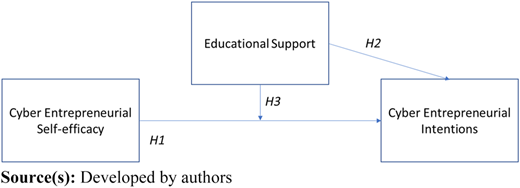
CESE is positively related to CEIs among individuals in the UAE.
Educational support and cyber entrepreneurial intentions
Higher education institutions are multifaceted establishments that are usually structured around three primary missions: education, research and initiatives that promote industrial competitiveness, innovation and social change (Alves et al., 2019). When combined, these missions may reflect higher education institutions' perspectives on entrepreneurship (Rocha et al., 2021). Appropriate institutional settings can foster entrepreneurial cultures that significantly influence students' perceptions of ES (Rocha et al., 2021). Institutions provide ES that includes equipping individuals with essential entrepreneurial skills, abilities, knowledge and other elements; heightening their awareness and enthusiasm for entrepreneurship and assisting with their ongoing business development beyond graduation (Khan and Krishnamurthy, 2016; Shi et al., 2019). In a supportive university environment, students can benefit from education, idea development and commercial assistance (Shi et al., 2019). In the modern era, universities aim to produce individuals capable of leading social and economic progress, a goal advanced by entrepreneurship education (Barba-Sánchez and Atienza-Sahuquillo, 2018). Choi et al. (2017) contend that educational institutions are now expected to encourage and support EIs among students by creating incubators and providing financial resources, consultation and access to technological tools.
Extensive research encompassing various socioeconomic perspectives demonstrates that ES, which includes creating an appropriate environment, providing essential tools and enhancing entrepreneurship knowledge, is crucial for fostering EIs (Youssef et al., 2020; Cazeri et al., 2021). However, Maheshwari and Kha (2021) maintain that ES does not directly impact EI; it might indirectly influence it through ESE (Maheshwari and Kha, 2021). Similarly, Yeh et al. (2019) find that ES raises individuals' awareness of entrepreneurship but does not increase EI. Based on these, the following hypothesis is proposed:
ES is related to CEIs among individuals in the UAE.
Cyber entrepreneurial self-efficacy, educational support and cyber entrepreneurial intentions
On the one hand, ES significantly affects ESE, as evidenced by Sidratulmunthah and Imran Malik (2018), who discovered that ES has a direct positive impact on EIs. On the other hand, Rocha et al. (2021) find that ES indirectly affects EIs through ESE. Regrettably, all previous studies examining the relationship between ES and EIs have focused on traditional entrepreneurship. Given technological advancements, it is crucial to direct new research toward understanding the relationship in a cyber context (Zaheer et al., 2019). Youssef et al. (2020) determined that CESE positively influences CEIs, although their study did not consider ES, focusing instead on positive thinking as a moderator between self-efficacy and CEIs. Tseng et al. (2022) reveal that ES moderates the relationship between CESE and CEIs. However, according to Wang et al. (2019) and Yeh et al. (2021), this moderating effect has been insufficiently examined. Consequently, the following hypothesis is proposed:
ES moderates the relationship between CESE and CEIs among individuals in the UAE.
Based on the aforementioned hypotheses, Figure 1 illustrates the theoretical framework of this study.
Research methodology
Context of the study
Understanding the factors that influence EIs, such as personal attitudes, social norms and perceived behavioral controls (Ajzen, 1991), is critical. Therefore, this research investigates the effect of CESE on CEIs and the moderating role of ES in their relationship among individuals in the UAE. The UAE was selected as the study's context for several reasons. First, the UAE government has made concerted efforts in recent years to bolster the country's entrepreneurial ecosystem by providing golden visas for entrepreneurs, reducing costs for small- and medium-sized enterprises, supporting innovative businesses and promoting digital transformation (Ministry of Economy UAE, 2021). The 2020 report of Digital Transformation in the UAE stated that the number of Internet users in the UAE was 9.84 million and that active social media users also accounted for 9.84 million (UAE Government Portal, 2023). Thus, the availability of the Internet and easy access to social media platforms could make the UAE an attractive and enabling environment for CE.
Second, the UAE's entrepreneurship ecosystem ranks fourth globally among 137 countries in the Global Entrepreneurship Index (Ministry of Economy UAE, 2022). This economic index examines how countries worldwide allocate resources to promote entrepreneurship based on three categories: attitude, abilities and aspirations (Global Entrepreneurship and Development Institute, 2023). The abilities category examines the depth of the country's technological capabilities (Global Entrepreneurship and Development Institute, 2023). This demonstrates the UAE's potential to attract cyber entrepreneurs, making it a relevant setting for this study.
Third, the UAE aims to become an entrepreneurial nation with 10 unicorn startups by 2031; these are businesses valued at over US$1bn (Mubarok, 2021). Tech startups are one example. The UAE intends to accomplish this by forging partnerships with big tech companies such as Microsoft to create programs for entrepreneurs to nurture and scale up their businesses (Startup Genome, 2023). This could increase cyber entrepreneurs' confidence in initiating digital businesses in the UAE, making it a relevant context for this study.
Sample
This research employed a quantitative research method and administered an online survey targeting individuals in the UAE. The population sample comprised individuals who graduated within the last five years from one of the top three universities in the UAE, as per the QS World University Ranking (2022) and the Center for World University Rankings 2022. Owing to the unavailability of accurate population figures, this research utilized the a priori sample size calculator for structural equation models to determine the minimum sample size (Soper, 2023). Upon setting the anticipated effect size at 0.3, the desired statistical power level at 0.8, the number of latent variables at 5, the number of observed variables at 27 and the probability level at 0.05, the minimum sample size to detect the effect was 150 (Kim, 2021; Sagan, 2019). Using snowball sampling, the sample size collected in this study was 304, with a total of 283 valid responses. As the sample size exceeded the recommended minimum of 150, it was deemed appropriate for this study.
Measures
This study utilized established and pre-tested measurement items employed in previously published research (see Appendix). The questionnaire's first section gathered demographic information, including gender, age range, education level, employment status (working or not working) and whether the respondent owned a business. The second section addressed CESE and comprised items from Yeh et al. (2021). The section included three main dimensions – leadership (LS), technology utilization (TU) and social media marketing and m-commerce (SMMC) and accounted for 15 items (Yeh et al., 2021). The third section followed Tseng et al. (2022), focused on CEIs and consisted of six items. The final section examined ES and featured seven items based on Youssef et al. (2020). All items in this study were scored using a five-point Likert scale, ranging from 1 (strongly disagree) to 5 (strongly agree).
Ethical statement
Through participant consent, withholding participant identities, reporting only aggregate conclusions and destroying the raw data when the data analysis process was complete, we were able to retain and guarantee the anonymity of the study's data. Ethical approval was obtained from the Institutional Review Board of Abu Dhabi University: File number: CB-0000023.
Results
The results indicated that 20.5% (N = 58) of the respondents were male and 79.5% (N = 225) were female; among these, 13.8% (N = 39) were business owners, while the remainder (N = 244) were not (see Table 1). The research measures and structural models were examined using variance-based techniques, employing a partial least squares (PLS) approach (Hair et al., 2017).
Respondent profile
| Demographics | Categories | Frequency | Percent |
|---|---|---|---|
| Gender | Male | 58 | 20.5 |
| Female | 225 | 79.5 | |
| Age group | 18–24 | 110 | 38.9 |
| 25–34 | 117 | 41.3 | |
| 35–44 | 44 | 15.5 | |
| 45–54 | 11 | 3.9 | |
| Above 55 | 1 | 0.4 | |
| Education level | Bachelor's degree | 214 | 75.6 |
| Master's degree | 62 | 21.9 | |
| Doctoral degree | 6 | 2.1 | |
| No answer | 1 | 0.4 | |
| Working status | Working | 162 | 57.2 |
| Not working | 121 | 42.8 | |
| Own a business | Yes | 39 | 13.8 |
| No | 244 | 86.2 |
Source(s): Developed by authors
Common method bias
Jordan and Troth (2019) assert that common method bias (CMB) can significantly influence research findings. Harman's single-factor test is the most widely employed method for detecting CMB (Jordan and Troth, 2019). Fuller et al. (2016) state that the single-factor test presumes bias when only one factor is extracted via the exploratory factor analysis of all available variables. Consequently, all items were loaded into a single factor, accounting for 43.337% of the total variance. Given that the total variance explained by the single factor amounted to less than 50%, the absence of any substantial CMB was verified.
Validity and reliability measurement model – first-order factors
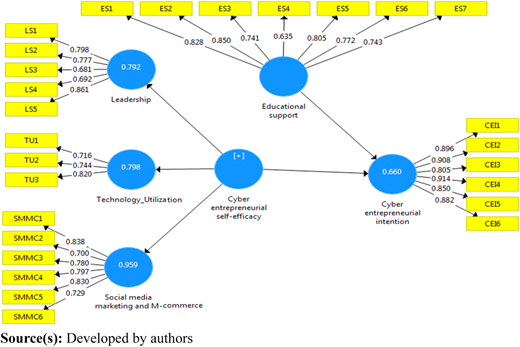
Initially, this study utilized SmartPLS v.3.3.9 to evaluate the measurement model's internal consistency, reliability, convergent validity and discriminant validity (Hair et al., 2017). All constructs were designed as reflective and encompassed the reflective model of higher-order constructs. Hancock et al. (2018) advise that factor loadings (outer loadings) for each item should exceed 0.7, but they also acknowledge that values of 0.5 or 0.6 are acceptable. In this study, the outer loading results for all constructs exceeded 0.6 at every measurement point except TU4. Consequently, TU4 was omitted due to its unsatisfactory loading factor.
The Cronbach's alpha (α) and composite reliability (CR) values were analyzed to examine measurement reliability. An item is deemed reliable if its Cronbach's alpha value is greater than 0.7 (Hair et al., 2017); Othman and Yusuff (2022) assert that CR values should be greater than 0.7 to be considered adequate. As illustrated in Table 2, Cronbach's alpha in this study ranged from 0.801 to 0.952, and the reliability of all measures, with CR values (above 0.7), ranged from 0.805 to 0.952. Additionally, the average variance extracted (AVE) should be greater than 0.5 to establish convergent validity (Hancock et al., 2018; Othman and Yusuff, 2022). This study confirmed convergent validity, with the AVE values ranging from 0.58 to 0.769, all greater than the suggested cutoff.
Reliability and validity of the constructs (first-order factors)
| Construct | Factor loadings | α | CR | AVE | CEI | ES | LS | SMMC | TU |
|---|---|---|---|---|---|---|---|---|---|
| 1. CEI | 0.805–0.914 | 0.952 | 0.952 | 0.769 | 1 | ||||
| 2. ES | 0.635–0.850 | 0.910 | 0.910 | 0.594 | 0.801 | 1 | |||
| 3. LS | 0.681–0.861 | 0.875 | 0.875 | 0.585 | 0.468 | 0.471 | 1 | ||
| 4. SMMC | 0.700–0.838 | 0.902 | 0.903 | 0.610 | 0.585 | 0.608 | 0.567 | 1 | |
| 5. TU | 0.716–0.820 | 0.801 | 0.805 | 0.580 | 0.492 | 0.541 | 0.584 | 0.673 | 1 |
Note(s): α = Cronbach's alpha; CR = composite reliability; AVE = average variance extracted
Source(s): Developed by authors
Henseler et al. (2015) attest that the heterotrait–monotrait (HTMT) ratio is a precise measure of discriminant validity when employing SmartPLS. Specifically, HTMT values should be less than or equal to 0.85 (Henseler et al., 2015). The HTMT values for the entire model were less than 0.85, thereby establishing discriminant validity (Henseler et al., 2015). Figure 2 displays the measurement model for the first-order factors.
The validity and reliability measurement model – second-order factors
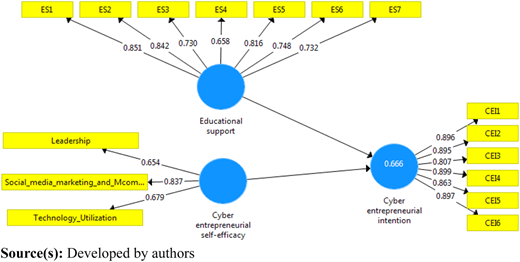
In this study, CESE was conceptualized as a second-order construct comprising three reflective dimensions. Evaluating the validity of second-order constructs is a critical component of the measurement model assessment; therefore, a two-stage approach was applied (see Figure 3) (Sarstedt et al., 2019). A two-stage approach offers the benefit of estimating a more parsimonious model through a higher-level analysis without including lower-order constructs (Sarstedt et al., 2019). Drawing on the recommendations provided by Hair et al. (2019) and Sarstedt et al. (2019) for evaluating reflective–reflective measurement models, CESE was assessed using convergent validity, indicator collinearity, statistical significance and the relevance of indicator weights as its key measures. As shown in Table 3, the analysis revealed that all item loadings exceeded 0.6, thereby supporting the indicator reliability. Cronbach's alpha values for all factors were deemed satisfactory. A minimum value of 0.7 is required for an item to produce reliable measurements (Hair et al., 2017). All CR values surpassed 0.7, further substantiating the reliability of the multi-item scales (Othman and Yusuff, 2022), and all AVE values exceeded the recommended cutoff of 0.5 (Othman and Yusuff, 2022). As shown in Table 3, each construct's HTMT ratio of correlation was below 0.85, establishing discriminant validity.
Reliability and validity of the constructs (second-order factors)
| Construct | Factor loadings | α | CR | AVE | CEI | CESE | ES |
|---|---|---|---|---|---|---|---|
| 1. CEI | 0.807–0.899 | 0.952 | 0.952 | 0.769 | 1 | ||
| 2. CESE | 0.654–0.837 | 0.767 | 0.770 | 0.530 | 0.661 | 1 | |
| 3. ES | 0.658–0.851 | 0.910 | 0.911 | 0.594 | 0.801 | 0.691 | 1 |
Note(s): α = Cronbach's alpha; CR = composite reliability; AVE = average variance extracted
Source(s): Developed by authors
Assessing the structural model and testing hypotheses
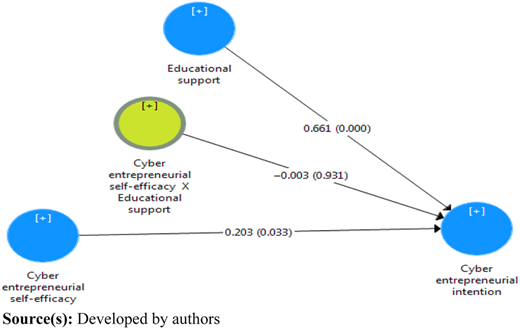
The evaluation of the structural model adhered to the assessment procedure outlined by Hair et al. (2017), which included an examination of multicollinearity, the coefficient of determination (R2), predictive relevance (Q2), effect size (f2 and q2) and the estimation of path coefficients. A consistent PLS bootstrapping resampling procedure with 10,000 subsamples and default settings (i.e. parallel processing and no sign changes) was employed to assess the path coefficients and their significance levels. The structural model utilized in this study is shown in Figure 4.
Multicollinearity was examined through the variance inflation factor (VIF) (Hancock et al., 2018). Table 4 shows that all exogenous constructs exhibited VIF values below 5, indicating an absence of multicollinearity issues within the structural model. R-squared (R2) and cross-validated redundancy (Q2) were utilized to ascertain the model's predictive relevance. R2 quantifies the extent to which exogenous constructs explain the variance of endogenous constructs. According to Cohen's (1998) guidelines, R2 values of 0.02, 0.13, and 0.26 represent weak, moderate, and substantial levels, respectively. Consequently, the R2 value for the CEI was deemed substantial. For an explicit reflective endogenous latent variable, Q2 values greater than zero signify the path model's predictive relevance concerning a specific dependent variable. The present study identified Q2 values exceeding zero (Latan and Noonan, 2017). Brydges (2019) recommends calculating each path's effect size (f2) within the inner model using Cohen's f2. Following Cohen's (1998) rule of thumb, values exceeding 0.02, 0.15, and 0.35 indicate small, medium, and large f2 effect sizes, respectively. This research determined that CESE exerted a small effect on CEIs (f2 = 0.066), while ES greatly impacted CEIs.
Results in direct effects
The analysis of direct effects revealed that CESE significantly positively impacted CEI (β = 0.203; t-value = 2.131; p < 0.05). Likewise, ES was found to have a significant positive effect on CEI (β = 0.661; t-value = 9.205; p < 0.001). Hypotheses 1 and 2 were fully supported by the results. Table 4 presents the results regarding these direct effects.
Moderating hypothesis
To assess the moderating effect of a construct within SmartPLS, interaction terms were generated between the moderator (ES) and the predictor (CESE) using the product indicator approach to examine the effect on CEIs. Table 5 shows that the interaction term, CESE × ES, exhibited a statistically nonsignificant influence on CEIs (β = −0.003; t-value = 0.086; p > 0.05). Therefore, Hypothesis 3 was rejected. A summary of the study's hypothesis testing outcomes is provided in Table 6.
Results of hypothesis on moderation
| Paths | Beta | SD | T | p |
|---|---|---|---|---|
| CESE × ES → CEI | −0.003 | 0.035 | 0.086 | 0.931 |
Source(s): Developed by authors
Hypothesis testing results
| Hypotheses | Description | Result |
|---|---|---|
| H1 | Cyber entrepreneurial self-efficacy is related to cyber entrepreneurial intention among individuals in the UAE | Supported |
| H2 | Educational support is related to cyber entrepreneurial intention among individuals in the UAE | Supported |
| H3 | Educational support moderates the relationship between cyber entrepreneurial self-efficacy and cyber entrepreneurial intention among individuals in the UAE | Rejected |
Source(s): Developed by authors
Discussion and implications
Discussion
The main motive of this study was to explore the potential moderating effect of ES on the relationship between CESE and CEIs. Many studies have examined ESE and intentions, but this study extended the concept to CE. As Wang et al. (2019) and Yeh et al. (2021) note, this relationship has been underexplored. Thus, the aim of this study was to fill this gap.
Notably, the present study found that ES does not moderate the relationship between CESE and CEIs. However, it does directly impact CEIs. This means that entrepreneurial education, knowledge, technical skills and competencies do not affect an individual's self-efficacy or their intentions to become cyber entrepreneurs. However, it is shown that if educational institutes foster cyber entrepreneurial creative ideas, cultivate the needed skills and abilities, provide the required knowledge and guarantee the availability of ICT tools, more individuals will start digital businesses. This finding contradicts previous literature stating that ES can enhance awareness of cyber and traditional entrepreneurship but is not a factor directly impacting individuals' EIs (Maheshwari and Kha, 2021; Rocha et al., 2021; Yeh et al., 2019).
Additionally, this study examined the relationship between CESE and CEIs from three dimensions: LS, TU and SMMC. The results revealed a positive association between CESE dimensions and CEIs. This means that individuals who make decisions, lead or persuade others with their ideas, who have computer skills and utilize social media for online businesses and who build marketing and pricing strategies for online businesses positively impact CEIs. This research has provided empirical evidence that self-efficacy is necessary when starting a digital business. Interestingly, it demonstrates that self-efficacy is an essential factor to EIs in both digital and traditional contexts (BarNir et al., 2011; Douglas, 2013).
Theoretical implications
This study contributes to the existing literature on the factors influencing EIs in several ways. First, this study extends the current literature on entrepreneurship to the context of CE by investigating the impact of CESE from three dimensions (LS, TU and SMMC) on CEIs as Tseng et al. (2022) have declared that this area is underexplored. Utilizing the theory of planned behavior, this study confirms that individuals with high CESE have broader intentions in CE. Second, this study focuses on the social media aspect of CE as studies investigating factors impacting CEIs are lacking in this perspective. This stretches the current literature to a new setting in alignment with the business world's transition toward social media platforms. Third, the model in previous literature indirectly examines the connection between ES and EIs (Rocha et al., 2021; Yeh et al., 2019). Accordingly, this research broadens the model by evaluating the direct impact of ES on intention, confirming that ES can impact intention directly in CE. This finding can serve as a foundation for future studies that investigate why ES directly impacts CEIs.
Practical implications
First, as ES directly impacts CEIs, it is advisable for educational institutions and career training centers to incorporate courses related to CE to sharpen entrepreneurial and cyber skills. These courses should aim to improve business management aspects (e.g. social media marketing and pricing strategies, social media business models, resource acquisition, cross-border m-commerce and LS) and technology and cyber components (e.g. file management, computer hardware, multimedia hardware and social media tools for online businesses). Therefore, it is recommended that courses that integrate technological and business skills be created by educational institutions and career training centers for individuals who are willing to, or who are planning to, start digital businesses. Second, governments could establish centers that provide centralized help and resources to benefit people with CEIs. This would encourage innovative ideas and refine skills. Additionally, governments should grant access to other resources required to conduct online businesses, including financial resources and the needed infrastructures (Internet, access to social media platforms, etc.) that would support and facilitate the establishment of CE. Third, business incubators can utilize the findings of this study to help startups in their cyber entrepreneurial journeys. This can be done by improving individuals' CESE by providing the proper training on LS skills, TU and business skills. Those incubators can work jointly with educational institutions to identify and upskill potential cyber entrepreneurs. This will boost CESE in those individuals and increase the number of cyber entrepreneurs. Finally, the findings have implications for experiential learning approaches, curriculum development and program evaluation in entrepreneurship education. To promote CEIs, entrepreneurship education programs should incorporate experiential learning approaches that focus on developing cyber self-efficacy and that provide adequate ES. Also, curricula should include modules that specifically target cyber self-efficacy, such as workshops on digital marketing or design thinking. Additionally, program evaluations should measure cyber self-efficacy and ES to identify areas for improvement. These insights can help prepare students for success in the CE landscape and contribute to the broader field of work-applied management.
Conclusion
This research examined the moderating effect of ES on the relationship between self-efficacy and intentions to engage in CE. The findings indicated that CESE and ES are positively associated with CEIs. In other words, individuals with ES or CESE demonstrate greater intentions to pursue CE than those without ES or CESE. However, in contrast with prior studies, this research discovered that ES does not moderate the relationship between CESE and CEIs (Maheshwari and Kha, 2021; Tseng et al., 2022; Yeh et al., 2019). By better understanding the impact of self-efficacy and ES on CEIs, both governmental and educational institutes can derive deeper insights into enhancing educational curriculums to promote CEIs among individuals in the UAE.
Entrepreneurship has emerged as a crucial element in the UAE's economic development. This research investigated the moderating effect of ES on the relationship between CESE and CEIs among individuals in the UAE. We hope this research contributes to enhancing the ES provided for individuals, ultimately increases the number of entrepreneurs in the UAE and fosters economic growth.
References
Appendix
Construct measurements
| Construct | Dimensions | Reference | Items |
|---|---|---|---|
| Cyber entrepreneurial self-efficacy (CESE) | Leadership (LS) | Yeh et al. (2021) | LS1- I have the ability to be a leader |
| LS2- I could persuade others to agree with my ideas and thoughts | |||
| LS3- I could find colleagues who complement my ability | |||
| LS4- I could have pleasant conversations with my colleagues | |||
| LS5- I have the ability to make decisions after negotiations | |||
| Technology utilization (TU) | TU1- I have at least a basic ability for computer file management | ||
| TU2- I could install and manipulate basic types of computer hardware to help my business | |||
| TU3- I could use multimedia hardware to help my business | |||
| TU4- I could install and use social media applications | |||
| Social media marketing and M-commerce (SMMC) | SMMC 1- I can formulate an innovative social media marketing strategy | ||
| SMMC 2- I could create a unique social media commercial account | |||
| SMMC 3- I would know how to formulate a pricing strategy for my social media commercial account | |||
| SMMC 4- I could analyze the cost structure of my social media commercial account | |||
| SMMC 5- I could propose a profitable business model for my social media commercial account | |||
| SMMC 6- I could easily gain access to the resources needed to operate my social media commercial account | |||
| Cyber entrepreneurial intention (CEI) | Tseng et al. (2022) | CEI1 - I am ready to do anything to become a cyber entrepreneur | |
| CEI2- I will make every effort to start and run my own online business | |||
| CEI3- I have seriously thought about starting an online business | |||
| CEI4- I am determined to create an online business in the future | |||
| CEI5- My professional goal is to become a cyber entrepreneur | |||
| CEI6- I have a firm intention to start an online business someday | |||
| Educational support (ES) | Youssef et al. (2020) | ES1- I have been encouraged to develop creative ideas to be a cyber entrepreneur | |
| ES2- My cyber entrepreneurial skills and abilities were developed and enhanced | |||
| ES3- I was provided with the necessary knowledge in cyber-entrepreneurship | |||
| ES4- The knowledge acquired from the Internet can help me to become a cyber entrepreneur | |||
| ES5- Information and communication technology (ICT) usage encourages me to develop creative ideas to be a cyber entrepreneur | |||
| ES6- The availability of ICT tools (e.g. desktop computer, laptop, tablet computer, printer, USB/memory stick, interactive whiteboard, and ebook reader) increases my chances of becoming a cyber entrepreneur | |||
| ES7- Access to the Internet increases my chances of becoming a cyber entrepreneur |
Source(s): Developed by authors

