


A unique aspect of the Finnish healthcare system is that medical students can assume formal doctoral positions under specific circumstances while still pursuing their medical studies. This study investigates the prevalence of such engagements and examines whether factors such as gender, age, or pre-medical school educational background influence work experience.
An electronic survey was distributed to final-year medical students in 2020. The survey explored their work experience in doctoral roles, including the duration and fields. A quantitative analysis assessed differences based on background variables.
The participation rate was 68% (110/162). Of the respondents, 70% (n = 77) had completed high school as their highest level of education before medical school, while 30% (n = 33) held prior higher education degrees. Regardless of the background variables, 98% (n = 108) of students reported working in formal doctoral positions during their studies, which is a novel finding. On average, students worked for 4.4 months in hospitals, 6 months in health centres and 3 months in other settings. Male students had significantly longer experiences in health centres than female students (8.0 vs. 4.2 months, p = 0.042).
This integration of learning and service, which offers equal opportunities in doctoral roles, benefits both the healthcare sector and students while promoting equality. Given the global similarities in medical education and healthcare staffing shortages, these findings have international relevance.
This study is the first to examine the influence of background variables on medical students' participation in formal doctoral roles during their studies.
Introduction
A shortage of physician workforce and disparities
The healthcare workforce is globally experiencing significant shifts and confronting numerous challenges. Despite a growing number of female students enrolling in medical education worldwide (Allen, 2005; Bickel, 2001; Finnish Medical Association, 2019; Heiligers and Hingstman, 2000; Kusurkar et al., 2010; Phillips and Austin, 2009; Van Der Velden et al., 2008), gender disparities in rank, retention, and leadership roles persist throughout the academic career trajectories of female physicians (Carr et al., 2018; Mousa et al., 2021; Ringdahl et al., 2014; Roth et al., 2016). Additionally, disparities persist among physicians with immigrant backgrounds (Salmonsson, 2014). Moreover, despite a growing number of doctors (Finnish Medical Association, 2019), the healthcare workforce continues to experience a shortage of physicians in public primary healthcare (Butt et al., 2024; Heilmann, 2010; Soini, 2023). Consequently, during the COVID-19 pandemic, various countries mobilised medical students as volunteers to support healthcare systems during emergency situations (Bazan et al., 2021; Byrne et al., 2023).
Medical students’ work-life orientation
Compared to their peers in other fields, medical students exhibit a strong orientation towards working life, especially those with educational backgrounds beyond high school, demonstrating a deep theoretical and practical commitment to their studies (Kronqvist et al., 2007). Furthermore, medical students with higher educational backgrounds before medical school tend to perform better in working life orientation (Mäkinen et al., 2004). Recent studies suggest that a health-related undergraduate degree results in the best performance throughout medical school, whereas a biomedical science background is associated with lower performance (Aston-Mourney et al., 2022). Additionally, there is a global trend towards higher educational backgrounds among medical students, as documented in North America, Canada, Australia, and parts of Europe (Baum and Axtell, 2005; Ten Cate, 2007; Nivala et al., 2016; Prideaux and McCrorie, 2004). Accordingly, medical students with prior university-level studies in the sciences generally demonstrate better performance in their first-year preclinical courses (Nivala et al., 2016).
Medical students’ working in formal doctor positions
To the best of our knowledge, there is no international comparison study of medical students’ experiences of paid employment as a doctor. However, a notable aspect of the Finnish healthcare system is the opportunity for medical students to temporarily work in formal doctor vacancies under specific circumstances, with a temporary licence, while pursuing their studies (Valvira, 2023). This practice, which is neither tied to crises nor pandemics, is a common aspect of Finnish medical training and is supervised by Valvira, a central agency operating in the administrative sector of the Ministry of Social Affairs and Health. Valvira supervises the appropriateness of social and health care services and issues licenses in the administrative sector of social and health care services (Valvira, 2023). These periods of employment are not mandatory components of the medical curriculum; however, students may choose to pursue them for experience, income (Valvira, 2023), and to strengthen the physician workforce. Salaries in public healthcare are governed by the Employment Contracts Act (“Employment Contracts Act”, 2001), and this practice is legitimised by Finnish law (Valvira, 2021).
As such, Finland presents a unique opportunity to investigate the integration of medical students into the physician workforce in public healthcare. Surveys of Finnish medical students’ experiences working as doctors during summer breaks have revealed that fourth-year students predominantly work in specialised medical care units (hospitals) or health centre wards, while fifth- and sixth (final) year students predominantly work in health centres (Finnish Medical Association, 2016, 2017, 2022a, b; Kerkkonen et al., 2020). However, these surveys have mainly focused on the working experiences themselves (Finnish Medical Association, 2016, 2017, 2022a, b; Kerkkonen et al., 2020), without exploring whether background variables influence medical students’ participation in doctoral roles alongside their studies or the duration of employment throughout medical school. Moreover, while advancing medical education and gaining insights into students’ skill gaps and readiness to enter the workforce is immensely valuable, this area currently lacks comprehensive information (Niemi-Murola and Merenmies, 2019). Just as understanding teachers’ competencies is vital (Mäkelä et al., 2018), understanding the individuals being educated to join the healthcare workforce is equally necessary.
The research topic
Given that the Finnish healthcare system permits medical students to assume formal doctoral roles under specific conditions while still pursuing their studies (Valvira, 2023), we hypothesise that participation rates are high. However, there is a lack of data on whether equal opportunities exist for all medical students. As prior research into the extent and locations of medical students’ employment is limited, the findings of this study can offer practical insights for both medical education and workforce diversity. Since perceptions shape actions, motivations, and behaviour (Koskiniemi et al., 2019), it is essential to identify any barriers that may prevent students from diverse backgrounds from accessing equal opportunities to work as doctors and join the physician workforce.
The shortage of doctors in public primary healthcare is a global challenge (Butt et al., 2024), and Finland is no exception, also experiencing a deficit in medical professionals (Soini, 2023). In response, the Finnish Government has initiated the Good Work Programme to address the sufficiency and availability of personnel in healthcare, social welfare, and rescue services (Ministry of Social Affairs and Health, 2023). Consequently, scientific research is needed to investigate potential factors—such as age, gender, pre-medical education, preparedness, and the timing of entry into the healthcare workforce—that may undermine the adequacy and availability of healthcare and social welfare personnel, including doctors.
Hence, our study provides a Finnish perspective on the global discourse concerning the physician workforce and its disparities. We aim to investigate the globally rare opportunity that allows Finnish medical students to engage in the physician workforce alongside their studies in public healthcare, and to explore whether equality is present by examining the influence of factors such as gender, age, or pre-medical school educational background. To our knowledge, no previous studies have explored these factors in the relevant academic literature. Given the issues highlighted above, this study is both timely and relevant.
The context of the study
Medical education in Finland
Unlike the graduate medical schools in the United States of America and Australia, where a bachelor’s degree is a prerequisite for admission, students in Finland and many other European countries can enter medical school directly after secondary education (Kusurkar et al., 2010; Mäkelä et al., 2018; Wijnen-Meijer et al., 2013). Until 2020, admission to Finnish medical schools was primarily based on entrance test results or a combined score of the matriculation examination certificate and the entrance test (Mäkelä et al., 2018). Undergraduate medical education in Finland spans six years and involves the completion of 360 ECTS credits (“Government regulation on university degrees and specialization training”, 2011). The initial two years in Finnish medical schools are typically dedicated to preclinical studies, during which students are exposed to internships within healthcare settings and have interactions with patients (Mäkelä et al., 2018). The third year marks the start of a four-year clinical phase, integrated into hospital and health centre environments, with exposure to various medical specialties (Mäkelä et al., 2018). Finnish medical education thus shares many similarities with systems in the UK, France, Germany, the Netherlands, and Italy (Kusurkar et al., 2010; Mäkelä et al., 2018; Wijnen-Meijer et al., 2013).
Opportunities for medical students to work as a doctor
A distinctive feature of the Finnish healthcare system is the traditional practice of allowing medical students to work in formal doctoral vacancies alongside their studies (Valvira, 2023). Medical students who have completed the initial four years of medical studies are temporarily permitted to work in formal doctor’s vacancies within specialised medical care units or health centre wards (Valvira, 2023). However, this allowance does not extend to other roles within health centres (Valvira, 2023). Students must have completed studies in the specific specialty in which they intend to work, yet they are not authorised to serve as emergency duty physicians in joint primary healthcare and specialised medical care emergency services (Valvira, 2023). Students who have completed at least the initial five years of study are granted temporary permission to practice as physicians in primary healthcare and specialised medical care units. When final (sixth) year students are on emergency duty, a designated backup emergency duty licensed physician must remain continuously present and oversee the emergency unit as per the relevant healthcare professionals’ legislation (Valvira, 2023).
Furthermore, every student must be assigned, in writing, a supervisor by the relevant healthcare or social care unit (Valvira, 2023). This supervisor should work within the same unit as the student, hold a valid license as a healthcare professional, and be qualified to practice the relevant profession independently (Valvira, 2023). The supervisor must possess substantial practical experience and supervise, guide, and monitor the student’s activities, intervening promptly in case of any deficiencies that may compromise patient safety (Valvira, 2023). If the student is delegated some responsibilities of an emergency duty physician, they are mandated to operate under the immediate direction and supervision of a licensed physician, often a senior colleague (Valvira, 2023).
In Finland, health services are divided into primary healthcare and specialised medical care (Ministry of Social Affairs and Health, 2020). Primary healthcare encompasses services related to monitoring the population’s health, promoting well-being, and preventing, diagnosing, and treating diseases, with a particular focus on public health issues (Ministry of Social Affairs and Health, 2020). Specialised medical care, predominantly provided within hospitals, also offers consultations for primary healthcare (Ministry of Social Affairs and Health, 2020). Both public and private sector contribute to healthcare provision, with most hospitals being publicly operated, including 20 central hospitals and five university hospitals (Ministry of Social Affairs and Health, 2020).
Materials and methods
Study design
The survey instrument was developed following a review of existing literature concerning the working experiences of medical students in their roles as doctors (Bazan et al., 2021; Byrne et al., 2023; Finnish Medical Association, 2022a, b; Kerkkonen et al., 2020), as well as relevant factors and challenges influencing these experiences (Mousa et al., 2021; Ringdahl et al., 2014; Roth et al., 2016; Salmonsson, 2014; Soini, 2023). The authors selected a survey methodology due to its efficiency in collecting data from a large sample within a limited timeframe (Artino et al., 2018). The research questions were designed by the authors to address the research objectives, ensuring reliability and content validity (Artino et al., 2018; Messick, 1995a, b).
Before its full implementation, the survey underwent a pretesting phase conducted by the authors to evaluate the clarity and comprehensibility of the survey items and to identify any potential ambiguities or challenges in interpretation. Feedback obtained during this phase ensured the questionnaire’s relevance to the study population and its overall clarity. No pilot study was conducted.
A cohort of final-year medical students at the university of Oulu was contacted via email with an invitation letter to participate in the survey prior to the “Leadership in Healthcare” course in November 2020. This compulsory final-year course (2 ECTS) was not tied to the survey, and participation in the survey did not affect the completion of the course. The survey was completely voluntary and independent of the course agenda.
Study questionnaire
The survey was administered electronically via a web-based platform (Webpropol) to facilitate convenient access and timely completion by participants. Background information, including gender, age, and educational background prior to entering medical school, was collected. The entire survey instrument also included questions about students’ perspectives on physician leadership, but these were not incorporated into the present study as they had been published previously. An English translation of the original Finnish survey is available in the appendix.
The survey questions used in this study were as follows:
“Have you worked as a doctor (in paid employment as a doctor) during your medical studies?”
“If you have worked as a doctor (in paid employment as a doctor) during your medical studies, for how long (in months)?” and
“If you have worked as a doctor (in paid employment as a doctor) during your medical studies, what kind of work (description)?”
The sample of final-year students represented the population of interest well, as the entire cohort of final-year medical students in 2020 (n = 162) was invited to participate in the survey, yielding a high response rate of 68% (n = 110). All responses were digitally recorded and coded to facilitate analysis. The total data from the study produced eleven A4-sized pages (Arial font, 12-point, single spacing).
Statistical analysis
The statistical analysis was conducted using SPSS 27.0 for Windows (IBM Corp. Released, 2020. Armonk, NY: IBM Corp.). Categorical variables were reported as frequencies and percentages and were analyzed using Pearson’s chi-square test. Continuous variables were expressed as means and standard deviations (SDs) and were further analyzed using the independent samples t-test. The relationship between variables was assessed using Pearson and Spearman correlation coefficients, where appropriate. All results were evaluated at a significance level of p < 0.05.
Ethical statement
The students were given clear instructions outlining the study’s purpose, the voluntary nature of their participation, assurances of confidentiality and anonymity, and their right to withdraw or refuse the use of their data at any time. Consent for data collection and usage in research was obtained from all participants, and no incentives were provided for participation. The study adheres to national and international research ethics criteria for non-medical research involving human participants, in accordance with the Finnish National Board on Research Integrity TENK’s ethical principles (2019) (Finnish National Board on Research Integrity TENK guidelines 2019, 2019) and the European Union’s data protection regulations. In compliance with Finnish law and ethical guidelines, the study did not require approval from an ethics committee. Permission to conduct the study was granted by the Faculty of Medicine in accordance with the prevailing policies.
Results
Of the 162 medical students, 68% (n = 110) participated in this survey. Among the respondents, 58 (53%) were female, 51 (46%) were male, and 1 student chose not to disclose the gender. Regarding age distribution, the majority (n = 71/65%) fell within the 25–30 age group, while 14% (n = 16) were aged 31–35, 4% (n = 4) were between 36 and 40, 8% (n = 9) were under 25, and 9% (n = 10) were over 41.
Seventy percent of the respondents (n = 77) indicated high school as their highest level of education before entering medical school, while 30% (n = 33) held prior higher education degrees. Among those with previous higher education, 8 held a Master of Science (Technology) degree, 8 had other types of master’s degrees, 8 had bachelor’s degrees (excluding Bachelor of Medicine), 2 held PhD degrees, 3 had degrees from Universities of Applied Sciences, and the remaining respondents did not provide specific details about their prior higher education (see Table 1). Due to the small proportion of respondents with prior higher education, further statistical analysis of this subgroup was not conducted.
Highest level of education attained by final-year medical students prior to medical school
| Previous highest education degree | n |
|---|---|
| High school | 77 |
| Master of Science (Technology) | 8 |
| Master of Laws | 2 |
| Master of Science (Economics and Business Administration) | 2 |
| Master of Arts | 2 |
| Doctor of Philosophy | 2 |
| Bachelor of Science | 3 |
| Pharmacist | 1 |
| Physiotherapist | 1 |
| Nurse | 1 |
| Bachelor of Science (Technology) | 1 |
| Bachelor of Science (Economics and Business Administration) | 1 |
| Bachelor of Arts (Education) | 1 |
| Bachelor of Science (Agricultural and Forestry) | 1 |
| Master of Food Sciences | 1 |
| Master of Health Sciences | 1 |
| A degree from University of Applied Science | 1 |
| Bachelor of Arts (Education) | 1 |
| No information | 3 |
Source(s): Authors’ own work
Nearly all participants (98%, n = 108), reported having worked in formal doctor’s vacancies during their medical studies. On average, respondents worked 4.4 months (standard deviation [SD] 5.2) in hospitals, 6.0 months (SD 8.6) in health centres, and 2.95 months (SD 3.7) in other healthcare settings. Neither the respondents’ age nor their previous education significantly influenced their work experience in hospitals, primary healthcare, or other medical work environments, with correlation coefficients ranging from −0.08 to 0.06 (p > 0.05). However, male’s reported significantly more work experience in health centres compared to female’s (8.0 vs. 4.2 months, p = 0.042). Gender did not influence work experience in hospitals or other settings. In terms of total work experience (8 months for females vs. 11 months for males), no statistically significant differences were observed (p = 0.25) (Figure 1).
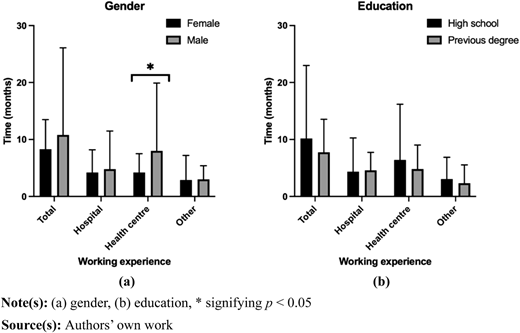
Working experience of final-year medical students as doctors during their medical studies
Working experience of final-year medical students as doctors during their medical studies
A total of 102 participants provided descriptions of their working roles. Their roles included general practitioners in health centres (outpatient care and wards), emergency departments, maternity and family planning clinics, school healthcare, infectious disease clinics, occupational healthcare, psychiatric emergency services, psychiatric outpatient clinics, nursing homes, and research positions. In hospitals, most respondents worked in wards (50 responses) or emergency rooms (29 responses), with 11 reporting work in outpatient clinics. In primary healthcare, 59 respondents worked in emergency rooms, 37 in wards, and 62 in outpatient clinics. Other roles included emergency and research work, with one respondent mentioning work in a service home and another in occupational health. Due to the small proportion of respondents in various roles, further statistical analysis of these working roles was not conducted.
Discussion
Health centres and hospitals predominating as workplaces
The purpose of this study was to investigate the extent to which Finnish medical students work as doctors during their studies, and whether factors such as gender, age, or prior educational background influence their involvement, considering Finland’s unique context (Valvira, 2023).
Most respondents utilised this opportunity, with 98% (n = 108) engaging in non-obligatory physician activities alongside their medical studies, primarily in public hospitals and health centres. This strong participation confirms our hypothesis. In terms of total work experience, on average, students worked 4.4 months in hospitals, 6 months in health centres, and 3 months in other settings. Prior research also argues that most medical students working in health centres or hospitals are generally satisfied with their roles (Finnish Medical Association, 2022a). Although health centre salaries are higher for medical students (Finnish Medical Association, 2022b), this study did not find financial reasons for males to prefer health centres. Given that salaries in public organisations are typically determined by the Employment Contracts Act (“Employment Contracts Act”, 2001), the observed gender difference may be co-incidental. Neither this study nor previous literature provides a definitive explanation for this gender disparity.
Educational background
The results of this study indicate that 70% of respondents (n = 77) reported high school as their highest level of education prior to entering medical school, whereas 30% (n = 3) had completed higher education degrees. This notable proportion of medical students with educational backgrounds beyond high school aligns with previous research, which has identified a trend toward higher education among medical school entrants (Baum and Axtell, 2005; Ten Cate, 2007; Nivala et al., 2016; Prideaux and McCrorie, 2004).
Interestingly, this study did not identify any specific background variables that significantly influenced selection for graduate entry into medicine. This finding contrasts with recent studies that have suggested that having a health-related undergraduate degree predicts better performance, while a biomedical science background is associated with lower performance (Aston-Mourney et al., 2022). These results may contribute to the ongoing refinement of selection criteria for medical school applicants (Kronqvist et al., 2007).
Additionally, the level of prior education did not significantly impact students’ engagement in physician-related activities during their medical studies. This outcome is notable because it diverges from earlier findings that suggested students with education beyond high school were more strongly oriented toward working life (Kronqvist et al., 2007; Mäkinen et al., 2004). However, it aligns with other research indicating that medical students, in general, exhibit a strong orientation toward professional practice compared to their peers in other university disciplines (Mäkinen et al., 2004).
Age and gender
Of the respondents, 30% had completed higher education degrees prior to entering medical school, making them older on average than those who entered directly from high school. However, the results indicate that age did not significantly influence students' engagement in physician-related activities during their medical studies.
Additionally, 53% of the participants were female, reflecting the global trend of increasing female enrolment in medical education (Finnish Medical Association, 2019). Male students, on average, reported more work experience in health centres compared to female students (8.0 vs. 4.2 months, p = 0.042), although health centres were the primary workplace for all participants. This finding aligns with prior research showing that medical students in advanced stages of their education predominantly work as doctors in health centres (Kerkkonen et al., 2020).
High working rates with equality
Given the long working periods reported in this study, and the fact that it was not specified whether this work was full-time or part-time, it is possible that some respondents may have taken gap years to work as a doctor, which could explain the length of their working periods. Nonetheless, regardless of educational background or possible gap years, credits are only valid for ten years (University of Tampere, 2022), and the duration of undergraduate medical education in Finland remains fixed at six years (360 ECTS credits) for all students (University of Oulu, 2023a). Thus, there is limited flexibility to delay graduation with concurrent work (University of Oulu, 2023b), which reduces the feasibility of gap years.
The physician shortage in Finland (Heilmann, 2010; Soini, 2023) and the approximately 2.5-month annual summer vacation available to medical students provide plentiful time for them to work (Finnish Medical Association, 2022a; Kerkkonen et al., 2020) and earn money (Finnish Medical Association, 2022b). Moreover, secure employment for physicians in Finland may also be based on the robust reputation of the medical education system. However, the high rate of medical students working during their studies, regardless of background variables, suggests equitable working opportunities. As global studies indicate gender disparities in postgraduate academic careers (Carr et al., 2018; Mousa et al., 2021; Ringdahl et al., 2014; Roth et al., 2016; Salmonsson, 2014), the equality observed in work opportunities during medical school could serve as a foundation for greater equality in the future.
Learning by working
In Finland, these medical students’ non-mandatory working periods as doctors can be counted towards mandatory internships, potentially allowing students to accelerate their medical studies (University of Oulu, 2023b). As the medical students’ working frequency in this study was the same regardless of their educational background before medical school, this study contradicts previous findings suggesting that students with higher educational backgrounds demonstrate greater theoretical and practical dedication to their studies (Kronqvist et al., 2007; Nivala et al., 2016) and that certain undergraduate degrees lead to better performance in medical school (Aston-Mourney et al., 2022).
Previous studies indicate that most medical students found clinical support roles beneficial and preferred their final-year clinical placements to be replaced with formal roles within a clinical team (Bazan et al., 2021; Byrne et al., 2023). These roles not only complement the curriculum but also provide opportunities for clinical skill development, reflective practice, and meaningful contributions to healthcare services (Bazan et al., 2021; Byrne et al., 2023). Furthermore, interactive patient case discussions, such as in multi-professional teams, help medical students progress in their learning (University of Oulu, 2023a). Experiencing different fields through real work-life situations provides students with a broader perspective on various specialties, aiding them in future career decisions.
The COVID-19 pandemic highlighted the importance of global health awareness among medical professionals, making the internationalisation of medical education essential for cultivating culturally competent and globally conscious healthcare providers (Wu et al., 2022). Work-based learning during medical school supports competence-based learning, enhancing specialisation education (“ELSA – monitoring and evaluation of specialization training”, 2024). Moreover, learning through work enhances future employment prospects by developing high-level skills, not only because of the trusted reputation of medical education.
Educational aspect
The high frequency of work engagement among medical students during their studies, regardless of background variables, suggests that medical education in Finland effectively equips students with the skills and confidence needed to enter the physician workforce. More broadly, extensive involvement in clinical work during medical school can enhance students' confidence in their professional abilities and contribute to the overall quality of medical education. In Finland, all medical students follow a standardised curriculum, irrespective of their educational background prior to admission (University of Oulu, 2023a). Therefore, the findings of this study indicate that there is no need to modify the current medical curriculum based on students' prior educational experiences.
This study contributes valuable insights into evaluating medical education in terms of students' preparedness to assume physician roles early in their careers. Such preparedness is significant for addressing potential physician shortages and maintaining a robust employment rate among physicians. The high working rates of medical students also play an important role in ensuring the availability and adequacy of doctors (Ministry of Social Affairs and Health, 2023), thereby alleviating shortages in public healthcare (Soini, 2023).
These findings should be considered in future planning to ensure the sufficiency and availability of physicians. They also have implications for calculating expected working years and accounting for factors such as pregnancy, parental, and childcare leave (Ministry of Social Affairs and Health, 2023, 2024; Statistics Finland, 2023). However, while the principles of medical education are generally consistent worldwide, it is essential to account for contextual differences and generational shifts when interpreting these results (Onyura et al., 2019). National variations in policies and changes in living costs may also influence the outcomes observed in this study.
Workplace reputation
Work experience allows medical students to explore various workplace possibilities, which can influence their postgraduate career choices. The Finnish Association of Junior Doctors conducts an annual workplace survey, allowing junior physicians to anonymously grade their workplaces. The results are made public and widely shared, providing workplaces with an opportunity for positive publicity and reputation-building. Thus, providing workplaces with a great opportunity to gain good publicity and reputation (Finnish Association of Junior Doctors, 2023). This phenomenon benefits both students and workplaces, offering the possibility of making a positive first impression and helping secure a future physician workforce.
Strengths, limitations and future research
It is essential to acknowledge the limitations of this study, which focused solely on one cohort of final-year (sixth year) medical students in Finland. Additionally, the study was conducted in November 2020, at the onset of the COVID-19 pandemic, which may have partially affected medical students’ work opportunities. Nevertheless, the sample of final-year students represented the population of interest well, as the entire cohort of final-year medical students in 2020 (n = 162) was invited to participate in the survey, resulting in a high response rate of 68% (n = 110).
Future studies, conducted annually and comparing results over time, could offer insights into potential trends, such as shifts in career paths due to the prolonged COVID-19 pandemic. Additionally, post-2024 studies will be valuable as medical schools' admission criteria have evolved, shifting from joint point selection to matriculation examination certificate selection (Mäkelä et al., 2018). This change might affect the composition of medical student’s backgrounds and their career impacts. Furthermore, a deeper exploration of the transitional experiences of medical students, including the challenges and opportunities they face as they enter the workforce, could provide valuable insights into how education and employment in healthcare can be better aligned. Research into possible female gender disparities in rank, retention, and leadership could also be worthwhile. Considering national variations is necessary, as while the fundamental principles of medical education are consistent worldwide, contextual differences may influence the findings’ applicability and generalisability (Onyura et al., 2019). Notably, in Finland, the privilege to practice as physicians is extended to medical students who have completed the initial four years of medical studies (Valvira, 2023).
Conclusion
The findings of this study highlight equality among medical students in Finland regarding entry into the physician workforce, with an overwhelming majority (98%, n = 108) working as doctors during their studies, irrespective of their background variables. This underscores the important role of medical students in maintaining the availability and adequacy of doctors (Ministry of Social Affairs and Health, 2023) and alleviating the shortage of physicians in healthcare (Soini, 2023). Consequently, these findings should inform future planning to ensure the sufficiency and availability of doctors.
The high working frequency among medical students, regardless of their background, reflects the comprehensive medical education provided in Finland, which prepares students to enter the physician workforce with confidence. Additionally, the absence of significant associations between background variables and selection for graduate entry into medicine supports the conclusion that there is no need to modify the current medical curriculum based on students' educational backgrounds prior to admission.
Notably, 30% of the students had completed higher education degrees before entering medical school, making them older than those who entered directly from high school. Furthermore, 53% of the participants were female, consistent with the global trend of increasing female enrollment in medical education (Finnish Medical Association, 2019).
Considerations such as expected working years, pregnancy, parental leave, and childcare leave (Ministry of Social Affairs and Health, 2023, 2024; Statistics Finland, 2023) should be factored into future workforce planning. In light of these findings, age and gender variables should also be taken into account to address the sufficiency and availability of physicians effectively.
Given that many countries share structural similarities in their medical education systems (Kusurkar et al., 2010; Mäkelä et al., 2018; Wijnen-Meijer et al., 2013) and face a global healthcare staffing shortage (Butt et al., 2024; Heilmann, 2010), the findings of this study hold international relevance. To leverage this knowledge for educational improvement, medical schools worldwide could consider integrating varied work opportunities for medical students into their curricula and support structures, benefiting both healthcare services and students’ workplace learning (Byrne et al., 2023). A broader unification of medical curricula globally could also facilitate international exchanges for medical students and ease the transition of the physician workforce between countries. Furthermore, as previous studies have highlighted gender disparities as well as disparities among immigrants in postgraduate academic careers globally (Carr et al., 2018; Salmonsson, 2014), promoting equality during the medical school phase could provide a valuable opportunity to address these disparities and establish a solid foundation for improved equality in the future.
The COVID-19 pandemic underscored the importance of medical professionals' understanding of diverse healthcare perspectives (Wu et al., 2022). During the pandemic, medical students played a critical role on clinical teams, representing an essential workforce for healthcare services (Bazan et al., 2021; Byrne et al., 2023). Our study adds a Finnish perspective to this discussion by exploring medical students' integration into the physician workforce during ordinary circumstances, beyond crisis situations. In Finland, this integration offers a win-win advantage for both healthcare systems and medical students by combining service and learning opportunities, thus enabling medical students to join the physician workforce seamlessly with equality (Valvira, 2023). Moreover, this exploration of various workplace possibilities not only provides medical students with insights into postgraduate employment but also allows workplaces to assess potential future physicians (Finnish Association of Junior Doctors, 2023). This encourages workplaces to maintain high standards and quality, ultimately benefiting patients.
The authors wish to thank the medical students at the University of Oulu for their participation in this study.
Ethics approval and consent to participate: The research was carried out in accordance with the instructions of the Finnish Advisory Board on Research Integrity, in compliance with EU data protection regulations and the research practices of the University of Oulu and the Faculty of Medicine. The permission for the study was granted by the Faculty of Medicine in accordance with current policies.
Availability of data and materials: The data that support the findings of this study are available from the corresponding author upon reasonable request.
Competing interests: The authors declare that they have no competing interests.
Authors’ contributions: All authors have made substantial contributions to the conception and design of the work, as well as to the acquisition, analysis, and interpretation of data. All authors have also significantly contributed to drafting the work and critically revising it for important intellectual content. Each author has given final approval for the version to be published and has agreed to be accountable for all aspects of the work, ensuring that questions related to the accuracy and integrity of any part of the work are appropriately investigated and resolved.
Details of individual contributions: Sari Huikko-Tarvainen: Study design, data analysis and interpretation, manuscript drafting and revision, final approval of the version to be published. Timo Tuovinen: Study design, data collection, analysis and interpretation, manuscript drafting and revision, final approval of the version to be published. Petri Kulmala: Study design, data analysis and interpretation, manuscript drafting and revision, final approval of the version to be published.
References
Appendix The survey questions
Age
Gender
Highest previous education (open answers)
Have you worked as a doctor (in paid employment as a doctor) during your medical studies?
If you have worked as a doctor (in paid employment as a doctor) during your medical studies, how long (in months)?
If you have worked as a doctor (in paid employment as a doctor) during your medical studies, what kind of work (description)?
Furthermore, additional inquiries encompassed students' perspectives on physician leadership, but these were not incorporated into the present study:
How should physicians be led?
How would you describe a good physician leader?
Would you be interested in working as a physician leader in the future?

