


The purpose of this paper is to analyze the various factors that inhibit tourism student’s inclination toward tourism-related entrepreneurial activities in Oman.
The study was conducted with 223 students of tourism studies who were selected on simple random sampling basis and were contacted through a well-defined questionnaire.
The study reveals that the factors like non-discrimination of gender, promotion opportunities and physical working conditions play a crucial role in motivating students to take up tourism-related career. The empirical results also reveal that the high risk of accidents, non-tourism spouse preferences and Omani traditional values discourage tourism. Thus, a natural growth toward setting up of such tourism-related entrepreneurial activities is thwarted.
The study was restricted to undergraduate students of tourism studies in and around Muscat, Oman. The study could be extended to know the insight of the personnel involved in the entire tourism sector in Oman.
The study demonstrates that there is a strong association between the motivating factors and the various reasons that encourage studying tourism. The main factors impeding entrepreneurship tourism are the insufficiency of capital, lack of awareness about the ongoing programmes as well as the lack of entrepreneurial skills.
There exists necessity for the government and the related sponsoring institutions to create an ecosystem that facilitates and encourages tourism entrepreneurs. This will in turn help in the process of diversifying Oman’s future economy toward tourism.
Very few studies have examined the entrepreneurship tourism in Oman for sustainable development, and it is a first-hand study of its kind.
Introduction
The Sultanate of Oman is one of the Gulf Cooperation Council (GCC) countries in the Middle East whose economic growth is steady and progressive. It is a predominantly oil-based economy. But the distant threat that Oman will run out of its oil resources in less than 20 years has stimulated the government to diversify its economy (Al Shanfari, 2012). Official statistics shows that the oil production, which was 960,000 barrels a day, reduced to 800,000 barrels a day in 2010 (Middle East Economic Review, 2010). In fact, all the GCC states are striving toward economic diversification through various projects and investments. As pointed out by Cook and Nielson (2011), Oman is building its service and tourism industry. His Majesty Sultan Qaboos during his 29th National Day address emphasized that the tourism industry is well capable of serving the aims of regional development, since its benefits will cover all regions. On the 38th National Day of Oman, His Majesty once again reaffirmed the necessity to give tourism priority. He stated that it is well qualified to offer career opportunities to Omanis (Al Balushi, 2014).
Globally, the tourism industry is estimated to have directly supported 100,894,000 jobs in 2013. It resulted to a direct contribution of USD2,155.4 billion (2.9 percent of total gross domestic product), while its total contribution to global GDP was estimated at USD6,990.3 billion in 2013 (World Travel and Tourism Council (WTTC), 2014). It is estimated that this figure will grow to 126,257,000 jobs or 3.5 percent of total employment by 2024. This is the reason why most of the countries have started to view tourism industry as a viable and sustainable alternative one to fuel their economies (WTTC, 2014). The Sultanate of Oman is no exception. It has started implementing policies to help divert its oil-based economy toward tourism as a part of its “Vision 2040.” Vision 2040 is essentially an updated version of Vision 2020 which was first drafted on the same lines. It aims at providing suitable conditions for economic diversification by increasing the non-oil production in the country (Ministry of National Economy, 1995). This includes a plan to make tourism the next main source of income for Oman after oil and gas. The mission statement clearly states that tourism will help to facilitate economic diversification, preservation of cultural integrity and environmental protection of the Sultanate of Oman (Ministry of Tourism, 2015). In Oman, though the government set aside RO298 million for the development of human resources for all the industries, including the tourism industry, the localization drive has met with limited success. This may be attributed to gaps such as lack of interest in joining the hospitality sector, lack of skills in general and specifically with regards to language and tour guiding (Times of Oman, 2014).
The government has recognized the gaps and is trying to train and educate more Omani nationals, thus, trying to prepare them for taking up employment in the tourism and hospitality sector (Bontenbal and Aziz, 2013). The Omanization criteria in the tourism sector has been set in the tourism and hospitality sector since 2003 vide ministerial decree No. 165/2003. This decree laid out the percentages of direct Omani employment to be achieved by the country’s tourism industry by 2007, namely, 83 percent in airlines, 100 percent in tourist restaurants, 80 percent in travel agents and 75 percent in 3/4/5 star hotels (Ministry of Manpower, 2003). Omanization means employing citizens of Oman. Despite strong government backing, the target is yet to be reached. Table I shows the prevailing status of workforce employed in tourism sector.
Workforce/labor in tourism sector 2013
| Omani | Expatriate | Total | Omanization % | |
|---|---|---|---|---|
| Airline agencies | 3,152 | 2,163 | 5,315 | 59.30 |
| Tourism agencies | 1,265 | 2,312 | 3,577 | 35.36 |
| Accommodation | 2,724 | 6,608 | 9,332 | 29.19 |
| Car rentals | 210 | 124 | 334 | 62.87 |
| Totals | 7,351 | 11,207 | 18,558 | 39.61 |
Source: Al Balushi (2014)
The government has also undertaken other reforms in order to improve and facilitate foreign investments in the tourism industry. With the induction of the country into the World Trade Organization in the year 2000, Oman’s strategy of promoting tourism industry to enhance private sector participation has been successful. With this, the country’s other objectives like including remote areas within this development as well as increasing employment opportunities for its citizens became easily achievable.
In the Eighth Year Plan (2011-2015), the government had allocated a huge amount for the development of tourism infrastructure. It spent RO2,084 million for airport and port construction and RO1,233 million for development and expansion. RO503 million was allocated for road improvement and development. In addition, sanctions were given for the construction of additional 3,000 hotel rooms by the end of 2014.
All these investments saw a positive effect on the tourist arrival leading to an increase in tourism revenue for the country. As per the WTTC (2014) statistics, Oman’s travel and tourism industry made a direct contribution of 3 percent to the GDP (RO982.8 million). This is expected to grow by 5.4 percent per annum, leading to an overall contribution of 3.9 percent (RO1,834.2 Million) by 2024. The employment generated by this industry was at 3.3 percent of the total employment in the country, which accounted for 37,000 jobs. This is expected to increase to 60,000 jobs by 2024. This means that the Omanization targets could easily be met.
Review of literature
It is argued that a country’s development and economic growth can be achieved by promotion of enterprise among students – a trait which requires knowledge of entrepreneurship, financial resources and favourable business environment (Milius and Sarkiene, 2008). With more tourism and hospitality projects being undertaken in both the cities and the rural areas, there is a lot of potential for starting up small and medium enterprises (SMEs) which cater to the burgeoning tourism sector. Given the fact that tourism has huge potential to create employment and entrepreneurial opportunities, development of tourism becomes vital for Oman’s economic development (Sokhalingam et al., 2013). According to Kirby (2004), entrepreneurial activity should not be seen only as a creation of new small firms but as something which operates much more broadly in all sectors of the economy. Entrepreneurship is the product of a belief of a potential entrepreneur and his/her ability to activate and undertake this belief (Global Entrepreneurship Monitor (GEM), 2009). Entrepreneurship toward tourism sector nowadays called entrepreneurship tourism is a welcome approach that caters to the needs of the growing tourism industry. Tourism is one of the economic sectors in which a great degree of involvement is needed by the entrepreneurial community (Chilembwe and Gondwe, 2013). There are many factors that lead to entrepreneurial development, but “viable” and “profitable” opportunity is seen as a prime factor for breeding prospective entrepreneurs (Burrow et al., 2008). Additionally, according to Ryan et al. (2012), entrepreneurs play an important role in tourism development due to shared culture for tourism. This in turn can lead to success in tourism development. They refer to the claim made by Koh and Hatten (2002) that a community’s quantity and quality of supply of entrepreneurs significantly determines the magnitude and form of its touristscape. The argument being that a tourism entrepreneur is the persona causa of tourism development. In fact, they even believe that a well-endowed tourism industry would never evolve successfully without tourism entrepreneurs. According to Hvidt (2013), Oman like its GCC counterparts is striving to steer its citizens (both men and women) by educating and preparing them to compete for jobs in the private and public sectors. The tourism sector has a wide of range of jobs, including travel agencies, tour operations, accommodation facilitations, catering services, transportation, etc. Yet it is observed that Omani students are not keen in taking up profession in the tourism and hospitality industry even though there is very good scope and enormous job opportunities in tourism sector. Even the parents of the students, especially those coming from a semi-traditional context believe that the jobs in this industry is “servitude” by nature and have little prospects of promotion from rank and life (Pang, 2010). The perception is driven by the fact that the tourism employees are often seen as being uneducated, unmotivated, untrained, unskilled and unproductive (Pizam, 1982). This is confirmed by O’Mahony and Sillitoe (2001) that many positions within the tourism industry need only little experience and low skills. Even according to Roney and Oztin (2007), though the tourism industry is credited with employment generation, the jobs themselves were low paid and mostly needed low skills. In order to understand this, Kusluvan (2003) deems it important to understand it from the perspective of tourism students who are currently undertaking their course or those who have recently graduated. Casado (1992) found that the basic expectations of these students to be “fairly realistic” before their graduation period. But as they progressed into their degree course, the students’ perceptions of the industry deteriorate (Jenkins, 2001). Thus, it is argued that commitment to tourism and hospitality industry will be affected by the fact that the future potential employees have a negative image of working in the industry (Aksu and Koksal, 2005). The same was confirmed by Richardson and Anthony (2009) when their study showed that Australian students studying tourism and hospitality studies believed that the industry does not offer them the attributes necessary to make it attractive as a future career. It seems students did not consider starting their own business in tourism as a career option.
For a country like Oman where 78.4 percent of the population falls under the age of 35 years and the unemployment rate is estimated to be 15 percent, the focus on employment creation becomes crucial (Ennis, 2015). This is a tough job considering the fact that there are nearly 50,000 graduates entering the mainstream every year. Thus, encouraging entrepreneurial activity is the only option to create employment opportunities. But no amount of planning will help if there is no willpower among the students to become self-employed (Ennis, 2015). Omani society has always claimed to have thrived on the spirit of entrepreneurship, but things have changed in the recent years. An academic survey by the Sultan Qaboos University confirmed the fact that the spirit of entrepreneurship has been replaced by a notion of entitlement. “Entitlement culture” means how people are constantly looking for government help. This mind set directly affects the entrepreneurship spirit. Many feel starting up an enterprise is a hard work, but to be fair, this is a trend that can be seen elsewhere too. It can be observed how America which was once famous for its innovative and creative entrepreneurs is also becoming a victim of entitlement culture (Tarkenton, 2012). On the above lines, though various government-sponsored schemes and supporting programmes are available to the budding Omani entrepreneurs, only a handful of attempts have been made in tourism entrepreneurship. This may also be blamed on factors like shortage of “role models,” lack of proper training, unrealistic goal setting, and lack of planning skills and experience (Parambi, 2014). Another factor for taking up jobs in place of setting up a business is “Mahar” (dowry) system in the Omani society (boys have to pay money to their bride). Starting a business means there may be a lack of regular flow of money making it difficult to save for their marriage.
Though various researches have been carried out to find out the reasons for turn away from the industry, the root cause of the problem remains unsolved. In the recent past, colleges from tourism and hospitality studies in Oman have been facing many dropouts in the courses offered by them which is trivial from the statistical bulletin of Oman. Therefore, this research focuses on the study of the students’ perception and the impediments toward setting up of entrepreneurial units in tourism.
Research methodology
The survey was conducted among the students from various colleges offering tourism and hospitality management studies in Oman (namely, Oman Tourism College, German University of Technology and Gulf College). The students studying in these colleges came from various regions of Oman. Only students who had registered for graduate studies were taken into consideration. The samples were selected on simple random sampling basis, and 223 questionnaires were distributed. To confirm accuracy, the questionnaires were personally handed over to the students, and unbiased responses were collected. The respondents were also aptly assisted by way of translation and supplementation wherever required.
Data analyses and findings
From Table II the demographic details of the respondents are observed.
Demographic information about the respondents
| Characteristics | F | % |
|---|---|---|
| Gender | ||
| Male | 95 | 42.6 |
| Female | 128 | 57.4 |
| Hometown | ||
| Ibri | 6 | 2.7 |
| Muscat | 127 | 57.0 |
| Musandam | 17 | 7.6 |
| Nizwa | 12 | 5.4 |
| Sohar | 23 | 10.3 |
| Salalah | 5 | 2.2 |
| Sur | 2 | 0.9 |
| Others | 31 | 13.9 |
| Work experience | ||
| No prior experience | 182 | 81.6 |
| Less than 2 years | 16 | 7.2 |
| 2-5 years | 10 | 4.5 |
| More than 5 years | 15 | 6.7 |
| Major course of study | ||
| Tourism management | 195 | 87.4 |
| Hotel management | 16 | 7.2 |
| Event management | 9 | 4.0 |
| Hospitality management | 1 | 0.4 |
| Club management | 1 | 0.4 |
| Others | 1 | 0.4 |
| Enrollment of study | ||
| Full time | 222 | 99.6 |
| Part time | 1 | 0.4 |
| Nationality | ||
| Omani | 221 | 99.1 |
| Non-Omanis | 2 | 0.9 |
| Studies discontinuity | ||
| No (first time of study) | 194 | 87.0 |
| One time discontinued | 28 | 12.6 |
| Discontinued for 2 times | 1 | 0.4 |
| Sponsorship | ||
| 100% by ministry | 155 | 69.5 |
| 50-50 ministry and self | 45 | 20.2 |
| 100% self-sponsored | 23 | 10.3 |
| GPA during study | ||
| 1-2 | 27 | 12.1 |
| >2-3 | 137 | 61.4 |
| >3-4 | 55 | 24.7 |
| >4 | 4 | 1.8 |
| Choice of study | ||
| Yes tourism | 189 | 84.8 |
| No tourism | 34 | 15.2 |
| Different career paths in tourism | ||
| Yes (awaits) | 74 | 33.2 |
| No | 149 | 66.8 |
| Plan to start own business | ||
| Yes | 83 | 37.2 |
| No | 140 | 62.8 |
| Recent developments | ||
| Yes | 53 | 23.8 |
| No | 170 | 76.2 |
| Aware of promotion by the government | ||
| Yes | 27 | 12.1 |
| No | 196 | 87.9 |
| Job vacancies in tourism | ||
| Yes | 60 | 26.9 |
| No | 163 | 73.1 |
| Applied for job based on any advertisement | ||
| Yes | 14 | 6.3 |
| No | 209 | 93.7 |
Source: Questionnaire
It is evident from Tables III-IV that the p value is less than 0.05, which means, the null hypothesis is rejected, i.e., there is a significant relationship between gender and the hometown. Therefore, the claim that the hometown from where the respondent hails influences the gender effectiveness on becoming tourism students is proved positively. In other words, it is found that the majority of the students joining tourism studies were female students hailing from city and urban areas. The students from rural areas are reluctant to join tourism studies.
Gender vs hometown
| Gender | |||
|---|---|---|---|
| Hometown | Male | Female | Total |
| Ibri | 2 | 4 | 6 |
| Muscat | 53 | 74 | 127 |
| Musandam | 14 | 3 | 17 |
| Nizwa | 3 | 9 | 12 |
| Sohar | 6 | 17 | 23 |
| Salalah | 1 | 4 | 5 |
| Sur | 0 | 2 | 2 |
| Others | 16 | 15 | 31 |
| Total | 95 | 128 | 223 |
It is evident from Table V that p value is less than 0.05. Therefore, the null hypothesis is rejected at 5 percent level of significance, i.e., it connotes that there is a significant relationship between the statements pertaining to the reason for selecting tourism and hospitality course and the choices of the respondents. Thus, the assertion that “the issues (statements) play a dominant role in affecting the selection of tourism and hospitality course” is proved positively. Furthermore, it is evident from the Kolmogorov-Smirnov (K-S) test values that “a future career in tourism” was ranked first among the factors followed by the factors “getting a scholarship” and “the only major I was offered.”
Reason for selecting tourism and hospitality course
| No. | Statements | SD | D | UD | A | SA | K-S value | χ2 | p value |
|---|---|---|---|---|---|---|---|---|---|
| 1 | A future career in tourism | 6 | 7 | 18 | 52 | 140 | 5.392 | 92.686 | 0.000 |
| % | 2.7 | 3.1 | 8.1 | 23.3 | 62.8 | ||||
| 2 | Parents compelled me | 83 | 51 | 22 | 33 | 34 | 3.395 | ||
| % | 37.2 | 22.9 | 9.9 | 14.8 | 15.2 | ||||
| 3 | Curriculum is reasonable | 29 | 27 | 24 | 58 | 85 | 3.596 | ||
| % | 13.0 | 12.1 | 10.8 | 26.0 | 38.1 | ||||
| 4 | Course fee is reasonable | 29 | 38 | 36 | 50 | 70 | 2.939 | ||
| % | 13.0 | 17.0 | 16.1 | 22.4 | 31.4 | ||||
| 5 | I got scholarship | 19 | 11 | 43 | 34 | 116 | 4.567 | ||
| % | 8.5 | 4.9 | 19.3 | 15.2 | 52.0 | ||||
| 6 | Easy to get a job | 1 | 2 | 39 | 80 | 101 | 4.160 | ||
| % | 0.4 | 0.9 | 17.5 | 35.9 | 45.3 | ||||
| 7 | Studying tourism is easier | 6 | 26 | 10 | 66 | 115 | 4.335 | ||
| % | 2.7 | 11.7 | 4.5 | 29.6 | 51.6 | ||||
| 8 | The only major I was offered | 8 | 39 | 7 | 53 | 116 | 4.475 | ||
| % | 3.6 | 17.5 | 3.1 | 23.8 | 52.0 |
It is evident from Table VI that p value is less than 0.05. Therefore, the null hypothesis is rejected at 5 percent level of significance, i.e., it connotes that there is a significant relationship between the statements pertaining to personality traits and the choices of the respondents. Thus, the assertion that “statements play a dominant role in affecting the personality traits” is proved positively. Furthermore, it can be seen from the K-S test ranking in the above table that the respondents believe the prime personality trait toward tourism is “like to meet people” followed by “like to work with people with different culture” followed by “like to travel” (Table VII).
Personality traits
| No. | Statements | SD | D | UD | A | SA | K-S value | χ2 | p value |
|---|---|---|---|---|---|---|---|---|---|
| 1 | Like to travel | 33 | 23 | 12 | 58 | 97 | 3.995 | 144.426 | 0.000 |
| % | 14.8 | 10.3 | 5.4 | 26.0 | 43.5 | ||||
| 2 | Like to meet people | 2 | 4 | 10 | 47 | 160 | 6.255 | ||
| % | 0.9 | 1.8 | 4.5 | 21.1 | 71.7 | ||||
| 3 | Do not mind working in shifts | 10 | 15 | 28 | 65 | 105 | 3.954 | ||
| % | 4.5 | 6.7 | 12.6 | 29.1 | 47.1 | ||||
| 4 | Like to work with people with different cultures | 4 | 32 | 16 | 44 | 127 | 4.999 | ||
| % | 1.8 | 14.3 | 7.2 | 19.7 | 57.0 | ||||
| 5 | Like to work abroad | 28 | 68 | 25 | 34 | 68 | 3.365 | ||
| % | 12.6 | 30.5 | 11.2 | 15.2 | 30.5 |
Factors during the selection of a job
| No. | Statements | Rank 1 | Rank 2 | Rank 3 | Rank 4 | Rank 5 | Rank 6 | Total | K-S value |
|---|---|---|---|---|---|---|---|---|---|
| 1 | Interesting, comfortable and enjoyable job | 4 | 3 | 23 | 30 | 2.529 | |||
| 2 | Pleasant working condition | 24 | 14 | 3 | 3 | 22 | 66 | 2.228 | |
| 3 | Promotion prospects and faster career growth | 2 | 27 | 41 | 12 | 46 | 6 | 134 | 2.710 |
| 4 | Job security | 17 | 52 | 34 | 30 | 3 | 3 | 139 | 2.708 |
| 5 | A job acceptable by my family | 2 | 28 | 4 | 47 | 28 | 109 | 3.196 | |
| 6 | To use the knowledge gained from my study | 4 | 28 | 32 | 2.942 | ||||
| 7 | A society-respected job | 4 | 48 | 11 | 17 | 80 | 3.297 | ||
| 8 | Opportunities to travel abroad | 4 | 13 | 6 | 32 | 22 | 77 | 2.591 | |
| 9 | Good starting salary | 135 | 40 | 9 | 17 | 3 | 204 | 5.404 | |
| 10 | Bonus and other prerequisites | 17 | 43 | 58 | 25 | 13 | 16 | 172 | 2.922 |
| 11 | Straight working timings – no heavy workload | 13 | 10 | 40 | 26 | 3 | 92 | 2.557 | |
| 12 | Adventurous job | 17 | 11 | 18 | 9 | 19 | 32 | 106 | 2.060 |
| 13 | International opportunities | 8 | 15 | 12 | 3 | 17 | 23 | 78 | 2.027 |
| 14 | Job contributing good to the society | 9 | 3 | 9 | 13 | 34 | 1.557 | ||
| Total | 226 | 241 | 223 | 226 | 220 | 217 | 1,353 |
K-S test value is 1.1067 which clearly shows that there is a significant relationship between rank factors and factors involved in selecting a job. It can be seen from the K-S test ranking in the above table that the respondents believe the prime reason for selecting a tourism job is “good starting salary” followed by “a society-respected job” followed by “a job acceptable by family.”
It is evident from Table VIII that p value is less than 0.05. Therefore, the null hypothesis is rejected at 5 percent level of significance, i.e., it connotes that there is a significant relationship between the statements pertaining to the motivating factors and the choices of the respondents. Thus, the assertion that “the motivating factors (statements) play a dominant role in affecting the selection of tourism and hospitality course” is proved positively. Furthermore, it is evident from the K-S test values that “no sex discrimination in the tourism industry” was ranked first among the factors followed by the factors “good physical working conditions” and “there is always something new to learn in this tourism job.”
Motivating factors toward tourism jobs
| No. | Statements | SD | D | UD | A | SA | K-S value | χ2 | p value |
|---|---|---|---|---|---|---|---|---|---|
| 1 | Get chances to meet famous people during tourism job | 59 | 54 | 12 | 60 | 38 | 3.298 | 154.220 | 0.000 |
| % | 26.5 | 24.2 | 5.4 | 26.9 | 17.0 | ||||
| 2 | There is always something new to learn in the tourism job | 22 | 52 | 13 | 70 | 66 | 3.850 | ||
| % | 9.9 | 23.3 | 5.8 | 31.4 | 29.6 | ||||
| 3 | Physical working conditions are good in tourism | 14 | 28 | 26 | 78 | 77 | 4.036 | ||
| % | 6.3 | 12.6 | 11.7 | 35.0 | 34.5 | ||||
| 4 | No vocational qualification required in tourism industry | 18 | 28 | 31 | 69 | 77 | 3.635 | ||
| % | 8.1 | 12.6 | 13.9 | 30.9 | 34.5 | ||||
| 5 | There is no sex discrimination in tourism industry | 58 | 88 | 18 | 40 | 19 | 4.294 | ||
| % | 26.0 | 39.5 | 8.1 | 17.9 | 8.5 | ||||
| 6 | Plenty of job openings available in tourism industry | 77 | 62 | 14 | 44 | 26 | 3.734 | ||
| % | 34.5 | 27.8 | 6.3 | 19.7 | 11.7 | ||||
| 7 | There are lots of promotion opportunities in tourism job | 69 | 75 | 10 | 42 | 27 | 3.151 | ||
| % | 30.9 | 33.6 | 4.5 | 18.8 | 12.1 |
In other words, “no discrimination of sex in the tourism sector” was the prime reason due to which more female students were joining/willing to join tourism studies.
It is evident from Table IX that p value is less than 0.05. Therefore, the null hypothesis is rejected at 5 percent level of significance, i.e., it connotes that there is a significant relationship between the statements pertaining to the reason for not joining the tourism and hospitality courses and the choices of the respondents. Thus, the assertion that “the issues (statements) play a dominant role in influencing the non-selection of tourism and hospitality course” is proved positively. Furthermore, it is evident from the K-S test values that “high risk of accidents in the tourism industry” was ranked first among the factors followed by the factors “Omanis do not prefer to marry a boy/girl from tourism industry” and “no job security.”
Reasons for not joining the tourism industry
| No. | Statements | SD | D | UD | A | SA | K-S value | χ2 | p value |
|---|---|---|---|---|---|---|---|---|---|
| 1 | No job security in this sector | 29 | 24 | 31 | 72 | 67 | 4.151 | 165.704 | 0.000 |
| % | 13.0 | 10.8 | 13.9 | 32.3 | 30.0 | ||||
| 2 | Tourism job is not respected in Omani society | 13 | 19 | 32 | 69 | 90 | 3.608 | ||
| % | 5.8 | 8.5 | 14.3 | 30.9 | 40.4 | ||||
| 3 | Omanis do not prefer to marry a boy/girl working in tourism industry | 10 | 29 | 19 | 90 | 75 | 4.322 | ||
| % | 4.5 | 13.0 | 8.5 | 40.4 | 33.6 | ||||
| 4 | There are high risk of accidents in the tourism industry | 62 | 95 | 27 | 24 | 15 | 4.358 | ||
| % | 27.8 | 42.6 | 12.1 | 10.8 | 6.7 | ||||
| 5 | Working hours are not suitable for regular life | 25 | 34 | 30 | 70 | 64 | 3.625 | ||
| % | 11.2 | 15.2 | 13.5 | 31.4 | 28.7 | ||||
| 6 | Promotion opportunities are less | 8 | 17 | 26 | 66 | 106 | 4.010 | ||
| % | 3.6 | 7.6 | 11.7 | 29.6 | 47.5 | ||||
| 7 | Most of the people working in the tourism industry are rude | 17 | 35 | 33 | 60 | 78 | 3.313 | ||
| % | 7.6 | 15.7 | 14.8 | 26.9 | 35.0 | ||||
| 8 | Pay is low and not sufficient | 8 | 20 | 30 | 67 | 98 | 3.712 | ||
| % | 3.6 | 9.0 | 13.5 | 30.0 | 43.9 | ||||
| 9 | Fringe benefits (bonus, holiday and meals) are insufficient | 3 | 11 | 49 | 70 | 90 | 3.596 | ||
| % | 1.3 | 4.9 | 22.0 | 31.4 | 40.4 | ||||
| 10 | Working in tourism is in contradiction to my family values/traditional values | 17 | 17 | 26 | 62 | 101 | 3.749 | ||
| % | 7.6 | 7.6 | 11.7 | 27.8 | 45.3 |
Even Omani parents are not interested to get their wards married to a person employed directly in the tourism sector.
It is evident from Table X that p value is less than 0.05. Therefore, the null hypothesis is rejected at 5 percent level of significance, i.e., it connotes that there is a significant relationship between the statements pertaining to the reason for discouraging tourism to start your own tourism business and the choices of the respondents. Thus, the claimed assertion that “the issues (statements) play a dominant role in discouraging to start your own businesses” is proved positively. Furthermore, it is evident from the K-S test values that “interested in government jobs” was ranked first among the factors followed by the factors “not sufficient entrepreneurial skills” and “insufficiency of capital.”
Discouraging factors toward tourism
| No. | Statements | SD | D | UD | A | SA | K-S value | χ2 | p value |
|---|---|---|---|---|---|---|---|---|---|
| 1 | No self-interest | 22 | 46 | 15 | 29 | 28 | 2.831 | 103.857 | 0.000 |
| % | 9.9 | 20.6 | 6.7 | 13.0 | 12.6 | ||||
| 2 | Risk | 2 | 2 | 25 | 52 | 59 | 2.960 | ||
| % | 0.9 | 0.9 | 11.2 | 23.3 | 26.5 | ||||
| 3 | Insufficiency of capital | 3 | 3 | 20 | 42 | 72 | 3.536 | ||
| % | 1.3 | 1.3 | 9.0 | 18.8 | 32.3 | ||||
| 4 | Not sufficient entrepreneurial skills | 5 | 5 | 22 | 35 | 73 | 3.561 | ||
| % | 2.2 | 2.2 | 9.9 | 15.7 | 32.7 | ||||
| 5 | Interested in government jobs | 2 | 4 | 14 | 33 | 87 | 4.302 | ||
| % | 12.6 | 30.5 | 11.2 | 15.2 | 30.5 |
From Table XI the obtained linear regression is V2=27.936+0.114 V1, where V1 is the motivating factors and V2 is the reason for selecting tourism studies. It can be seen from the above that variable V1 has an impact on the reasons for students’ selecting tourism studies.
Results of analysis of variance test after elimination
| Variables entered/removedb | |||||
| Model | Variables entered | Variables removed | Method | ||
| 1 | Motivating factors toward tourisma | – | Enter | ||
| Model summary | |||||
| Model | R | R2 | Adjusted R2 | SE of estimation | |
| 1 | 0.155c | 0.024 | 0.020 | 3.725 | |
| ANOVAc | |||||
| Model | Sum of squares | df | Mean square | F | Sig. |
| Regression | 75.214 | 1 | 75.214 | 5.422 | 0.021b |
| Residual | 3,065.800 | 221 | 13.872 | ||
| Total | 3,141.013 | 222 | |||
| Coefficientsb | |||||
| Model | Unstandardized coefficients | Standardized coefficients | |||
| B | SE | β | t | Sig. | |
| (Constant) | 27.936 | 1.068 | 26.160 | 0.000 | |
| Motivating factors toward tourism | 0.114 | 0.049 | 0.155 | 2.328 | 0.021 |
Notes: aAll requested variables entered; bdependent variable: reason for selecting tourism; cpredictors: (constant), motivating factors toward tourism
Results
Among the respondents, 84.8 percent of them have joined the tourism courses on their own interest. Females are the majority of the students (95 percent) motivated toward joining tourism studies. It can be observed that most of the tourism students are from Muscat followed by those from Sohar. According to the ranking by the respondents, among the reasons for selecting tourism studies, “a future career in tourism” ranked first followed by the factors “getting a scholarship” and “the only major I was offered.” The personality trait toward tourism is “like to meet people” followed by “like to work with people with different culture” and “like to travel.” The prime reason for selecting a tourism job is “good starting salary” followed by “a society-respected job” and “a job acceptable by family”. The main motivating factor affecting the students toward selecting tourism course is “no sex discrimination in the tourism industry” – this is the prime reason due to which more female students from the city and urban areas were joining/willing to join tourism studies.
The factors for the non-selection of tourism and hospitality course are “high risk of accidents in the tourism industry” followed by the factors “Omanis do not prefer to marry a boy/girl from tourism industry” and “no job security.” Among the various courses available, majority of the respondents (87.4 percent) preferred to study tourism management as their major course of study, and the majority of the students (69.5 percent) join tourism studies on the ministerial scholarship and only 23 percent of the respondents spend their own funds to join the tourism studies. It is clearly observed that 66.8 percent of the respondents are not aware of the different career paths available in tourism, and 76 percent of the respondents are unaware of the recent developments taking place in the tourism sector. Moreover, 87.9 percent of the respondents are unaware of the tourism promotions and campaigns by the government. Furthermore, 73.1 percent are unaware of the job vacancies in tourism, and 93.7 percent of the respondents have never even applied for jobs based on the advertisements. It can be observed that only 33.2 percent of the respondents have shown interest to venture into entrepreneurial tourism, i.e., to start their own tourism business, and the reasons for discouraging students to start your own business is “interest in government jobs” followed by the factors “not sufficient entrepreneurial skills” and “insufficiency of capital.”
Furthermore, ANOVA test results shows that there is a strong association between the motivating factors and the reasons for students choosing tourism as their studies, whereas the personality traits do not have any impact on the selection.
Conclusion, discussion and managerial implications
It is clear from the above that interest in tourism studies did not seem to sustain and motivate the students to take up tourism as a career. Similarly, starting a tourism business is also not an option for the students. The main impediments seem to be society and cultural pressures. Also, the spirit of tourism entrepreneurship is subdued by perceptions that they are not equipped with enough knowledge and capital. This lack of awareness of the career path within tourism and the government steps to promote it as the next big industry only adds to the above impediments. According to Rampton (2014) entrepreneur must have five striking personality traits, which include passion, resilience, a strong sense of “self,” flexibility and vision. But the passion declines gradually and risk aversion is developed. In spite of tremendous supporting programmes offered by Omani governmental organizations and other institutions, such as Sanad, Intilaaqah, Jusoor, etc., in the development and promotion of entrepreneurship and tourism, the number of SMEs emerging in this sector is very limited. Omani students prefer to work in time-specific, sophisticated white collar jobs. They are not prepared to take risk in venturing into tourism sector. In fact, the dropout rates in tourism studies are high in the initial years in Oman. Tourism students who join initially with full zest lose their initiative just because of their lack of awareness about the future of the industry. This may be because of gaps in the way and medium of communication of the promotional campaign and initiatives by the government. This calls for an urgent relook into the targeting and delivering strategy of the campaign. Majority of the tourism sector business in Oman is controlled by non-Omani-dominated multinational companies. Thereby, there is leakage of national income from the tourism industry as well. This makes it reason enough for the sponsoring organization and the government to pay immediate attention to entrepreneurial tourism to sustain competition. There seems to be an international awareness to this (Cooper, 2015). She further added that the “fear to fail” attitude, “lack of a mature venture capital market” as well as “lack of education.” She proposed more involvement from the government, banks and other financial institutions as well as mentoring to encourage a sustained growth of tourism entrepreneurship. Gellner and Moog (2008) argued that the overall planning by the relevant authorities should be balanced in such a way that the availability of financial capital is provided to make entrepreneurship in the tourism sector more attractive (Figure 1).
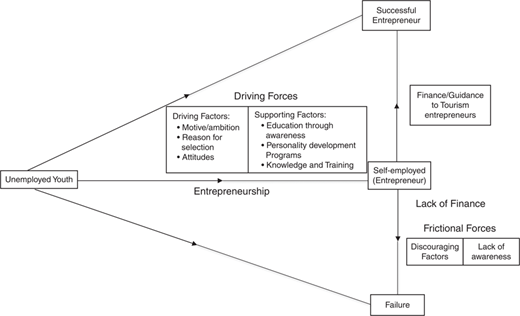
Effective force vector model (EF model) of a successful entrepreneur
Effective force vector model (EF model) of a successful entrepreneur
As suggested in the effective forces model (given above) by Khan (2009), the tourism entrepreneurship can only be activated with the governmental assistance and the sponsoring institutions. Cultural aspects notwithstanding, tourism students are still tempted to enter the entrepreneurship because of the perception of earning appreciable profit, but financial problems seem to create hurdles resulting in operational losses and closures of their business. Many blame that the governmental financial programmes were still not available to all, and the ground reality was far different than those on paper. Policy makers should remember that while young people are more creative and innovative, they are not averse to risks, are impatient and are easily put off. Hence, the governmental as well as private financial institutes that are willing to provide financial assistance to budding entrepreneurs should make themselves more approachable with easy advance procurement procedure. There should also be plans to encourage a better venture capital mechanism in Oman. Private stakeholders should be encouraged to support the government and provide supportive assistance. This assistance may be offered in the form of training as well as consultation. Sustainable support should also be provided from as early as the business planning stage until two to three years after a business is up and running. A system of mentoring is definitely needed for new entrants through support groups. A conducive climate should be provided so that failed ventures should not be frowned at but should be supported as a learning process. Pride in self-reliance as well as in the entrepreneurial spirit should be promoted at all levels. Tourism entrepreneurs’ meets should be held on a more frequent basis with media coverage to promote the successful entrepreneurs as role models. The success of every tourism entrepreneur should be celebrated in order to breed more of them. There should be synchronization between the tourism and hospitality professional associations and the SMEs so that there is more understanding and cooperation among them. This will help the small businesses survive competition. The educational institutes that harbor the youth need to design their “tourism and hospitality” curriculum inclusive of theoretical as well as practical entrepreneurship. They should work together with all stakeholders to develop and promote entrepreneur skills among the youth so as to kindle their entrepreneur spirit. There should be proper data available and recorded so as to have a record of entrepreneurial successes and failures. This will help policy makers in making policies to prevent eroding of the entrepreneurial spirit. Youth are the future of Oman. When all the stakeholders work together to support and create an ecosystem that helps to sustain the spirit of tourism entrepreneurship, the outcome can only be positive. Policies that are based on ground realities will help in future proofing the sustainable growth of tourism in Oman.

